 |
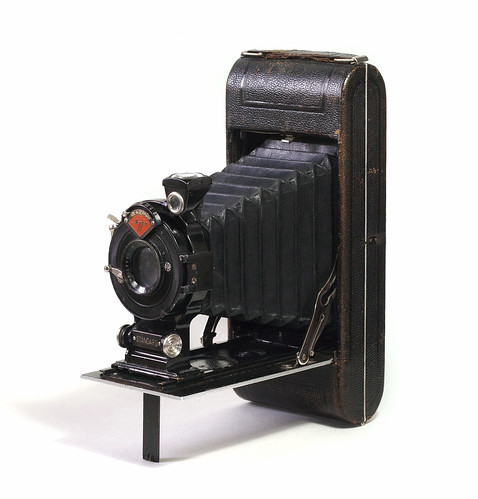
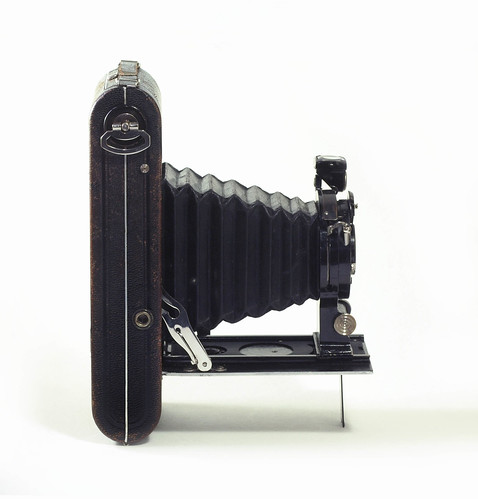
| Agfa Standard |
As a company,
Agfa had a fairly long history in chemicals, then in photography supplies (notably the developer Rodinal), before it became one of the larger camera manufacturers in twentieth-century Germany. The
Agfa Standard was the first new model of camera after Agfa had acquired the Munich-based lens and camera maker
Rietzschel (via Bayer), and their existing lines and manufacturing capacity. The Standard was made in two plate and two rollfilm formats, 6.5x9 and 9x12cm plates, and 120 and 116 formats respectively, and were made from 1926 to 1933. My camera is the Model 255 Standard for 116 format (Agfa's own designation of the rollfilm was D-6, as written inside the camera body) for 6.5x11cm negatives. This is the camera I used for
last month's 116 Day.
 |
| Agfa Standard |
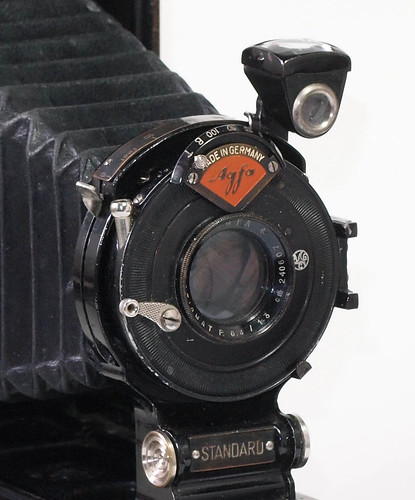
The Standard is a fairly typical non-self-erecting folding camera of its era, the body being solidly constructed from aluminium, well-finished in real leather, now rather scuffed. The lens is mounted on a fairly substantial cast metal block, although it has no rise, unlike many cameras of the period. The Standard was provided with different lenses, initially only Agfa Anastigmats, with faster lenses being naturally more expensive. My camera has the f6.3 13cm lens, the mid-priced option for the Model 255; a cheaper lens was the f7.7, while the f4.5 was most expensive. The lens stops down to f36, and has the old continental range of f-stops: 9, 12.5, 18, 25. The shutter is a Gauthier everset leaf shutter (some later models had Compur shutters). The shutter itself doesn't carry a name; the manual and other promotional material describe it as new, so it may have been designed expressly for the Standard. In the English manual it's named as the Agfa Automatic shutter; in a German brochure it's the Agfa Automat shutter. The orange Agfa rhombus becomes a wedge on the shutter speed selector dial. The shutter has five speeds (2, 5, 25, 50, 100) plus B and T and there is a cable release socket; the shutter on my camera only appear to fire at a single speed.
 |
| Agfa Standard lens |
As a non-self-erecting folder, when the camera is opened, the lens has to be manually drawn forward on its rails to an infinity stop. Focus itself is by a lever seen in the image above behind the cable release socket, with the lens and shutter moving forward as a unit, down to six feet. As seems common with old Agfa cameras, the focus on my Standard is stiff, a result of the particular lubricant that Agfa used. That the focus markings are in feet rather than metres indicates that the camera is an export model, as is the prominent 'Made in Germany' on the shutter selector (a number of examples of the Standard online do not have this). The focus scale and the aperture settings are designed to be seen from above the lens unlike many other folding cameras of this period, which frequently have these underneath the lens.
 |
| Agfa Standard in horizontal orientation |
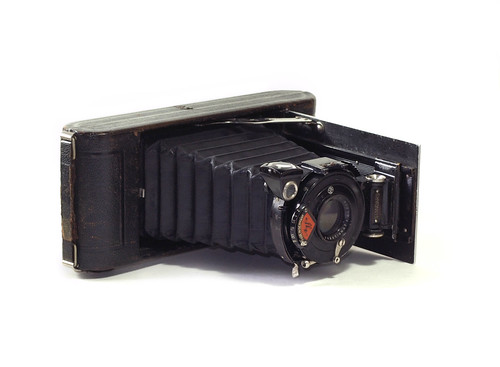
My camera originally had a wire frame finder. The remnant of the rear sight indicates that this was the older style: at some point during production, this rear sight was made larger. With cameras of this type, I typically use the wire frame finder for composing the image, so had to use the small rotating brilliant finder instead, which I find more difficult to use - and also does not have a spirit level. A number of my shots suffered, and had to be cropped level as a result. For ease of loading and unloading, the spool holders pivot, lifting out with hinged ends from the camera body. Frame advance is by a winding key on the side of the body in vertical orientation, or underneath when held horizontally (the camera also has standard tripod fittings for horizontal and vertical orientation). The red window is without a cover; this window is uniquely square, rather than round. When using medium format film with adaptors rather than 116 backing paper, some light does get from the red window around the edge of the narrower 120 backing paper, a problem I had with the
Kodak No.2A Brownie.
 |
| Agfa Standard with Agfapan APX100 |
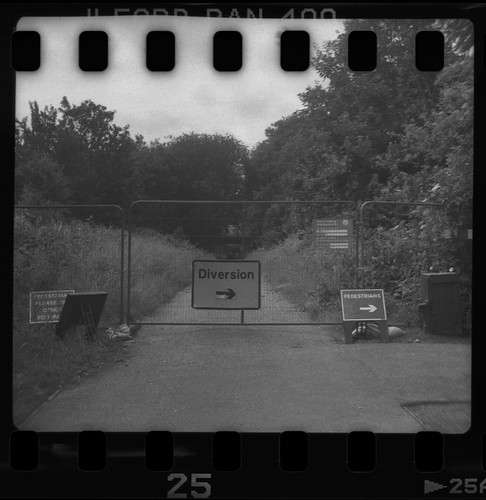
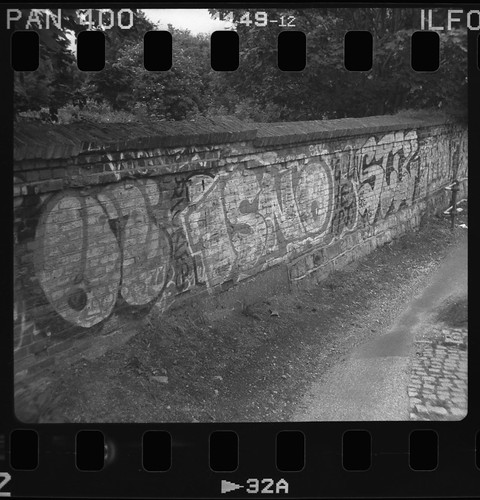
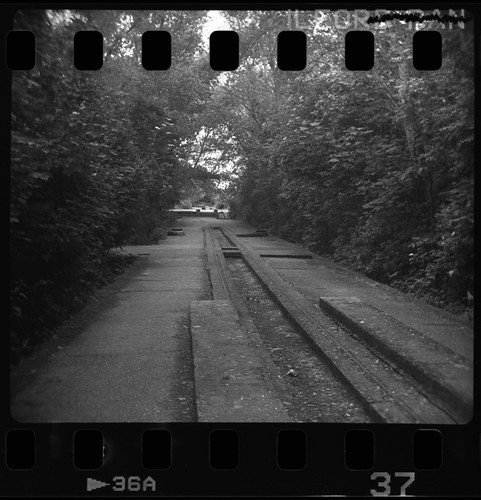
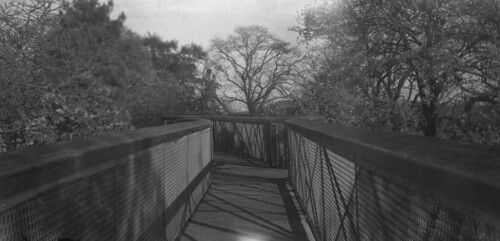
I have mostly used the Agfa Standard with 120 film taped to 116 backing paper, which is the easiest manner to shoot with the camera today, although not without problems. On some shots, the film appears not to have been held sufficiently flat, as demonstrated by out of focus areas in the image above, while the film not being wound tight enough has led to some light leaks (also seen above). This seems to have been solved in part at least by pushing the metal prongs inside the camera towards the take-up spool side to provide more pressure on the film when winding on. The lens mount also appears to protrude onto the film plane: in the image below, the brassing on this mount must surely be wear by film and backing paper being drawn over this (there's evidence that this has also been pressing on the inside of the rear door). Some of my negatives were marked from this, which seems like a design flaw. It may be advisable to only advance film with the camera open and lens erected.
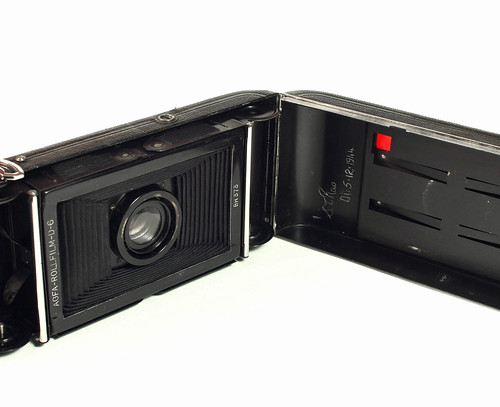 |
| Agfa Standard opening for loading |
Inside the camera, on the rear door there's a name and date scratched into the black paint, "S. D. Rao Dt(?) 5.12.1944"; inside the camera's original case there's the name Lieut. P. J. Cummins and what certainly looks like S. D. Rao crossed out, with the same date written underneath. The camera itself would have been well over ten years old at this date, during the war (that the second name has a rank also suggests wartime). It's curious that the name also has a date; as a result I wanted to post this today, 5th December, seventy-three years later; it was also a Tuesday then. Also in the case was an information leaflet for Kodak Super-XX film, discontinued some time in the 1960s (possibly with a 1948 date), and the camera still had a wooden 116 spool inside.
 |
| Inscription inside case |
The Agfa Standard Model 255 was quite simple to use with 120 film re-rolled with 116 backing paper (easier to load than the
Zeiss Ikon Cocarette), despite the problems with one film not rolling tightly enough. Using the brilliant finder alone made composing more difficult, and the problems with film flatness showed up in some exposures but not others; it might be possible to solve this by some form of additional pressure plate or framework to help centre the narrower 120 film. The lens is sharp enough if stopped down when lighting conditions allowed this hand-held and, like many other older rollfilm cameras, the large negative size can also be forgiving - the landscape shot with the electricity pylon below is probably the best example of what's possible with the camera, as indeed are a couple of the night shots from the 116 Day.
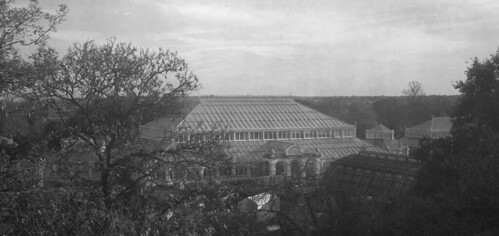 |
| Agfa Standard with Agfapan APX100 |
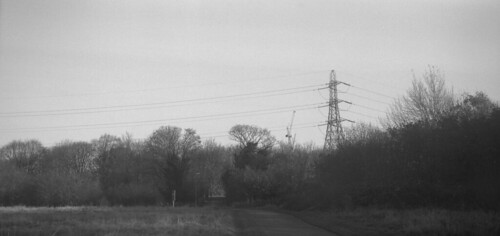 |
| Agfa Standard with Ilford FP4 Plus |
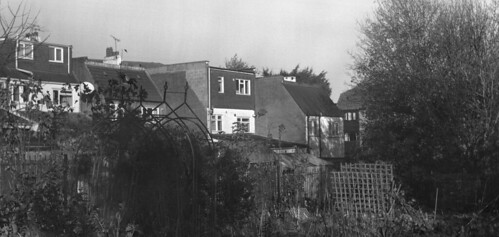 |
| Agfa Standard with Ilford HP5 Plus |
Sources/further reading:
Agfa Standard on Camera-Wiki
Agfa Standard Model 255 on Collection-Appareils (in French)
Agfa Standard cameras catalogue page in French
Agfa Standard brochure pages (in German)