 |
| Ensign Folding Klito de Luxe No.9 |
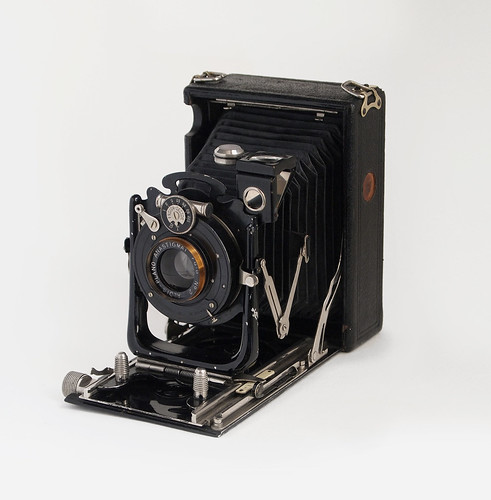
Over the past few months of looking out for unused vintage photographic plates, I have noticed that the most common size of plates to find in online auctions (in the UK at least) are in 'quarter-plate' format (3 1/4x4 1/4 inch/8.2x10.8cm). Smaller formats, like 6.5x9cm and their Imperial equivalent are also relatively common, while 4x5 inch plates are rare in comparison. I had been intending to make adaptors for my 4x5 format holders to fit the quarter-plate size, but it was as easy to buy a camera in the right format specifically to shoot the plates: the
Ensign Folding Klito de Luxe No.9. This would have been a fairly well-featured hand-and-stand camera of its time. My model has an Aldis-Plano Anastigmat f6.8 lens in an Ensign-Sector everset shutter. The camera features double extension bellows, held by the distinctive hinged metal arms at each side, significant front rise and fall, and front cross movements.
 |
| Ilford G.30 Chromatic plate, Ensign Folding Klito |
With the Ensign Folding Klito, I loaded a number of plate holders to test plates from some of the already open boxes in the quarter-plate size. Apart from the Ilford G.30 Chromatic plate, which I shot as a single exposure based on
my previous experience of the plates (the results were more fogged than the other boxes I used), I made graduated tests with successive exposures on each plate.
FP4 first appeared as a plate emulsion in 1955, and as Ilford's packaging changed around 1960, these plates could be dated to 1955-60 (Ilford didn't produce FP4 for roll film until 1968 - and according to
Photomemorablia this was not the same emulsion as the plate version: the plates were rated 160 ASA post-1960, unlike the rollfilm FP4, which remains 125 ISO to this day in its 'Plus' iteration). For this test I rated the plate at 40, half its pre-1960 speed rating, and took four successive exposures.
 |
| Ilford FP4 plate, Ensign Folding Klito |
I also had a box of Imperial Special Rapid plates, the test of which did not come out, and two boxes of Kodak plates,
Kodak Orthochromatic plates and P.1200 Super Panchro Press. The
Orthochromatic plate, below, was partially fogged from exposure to light: the dark diagonal line in the lower left of the picture is a shadow from the cardboard runner that usually holds the plates together in pairs (the rest of the box may be in better condition). The
P.1200 Super Panchro Press plates have a handwritten date on the box '11/04/61'; the plate test below is fairly unpromising.
 |
| Kodak Orthochromatic plate, Ensign Klito |
 |
| Kodak P.1200 Panchro-Press plate, Ensign Klito |
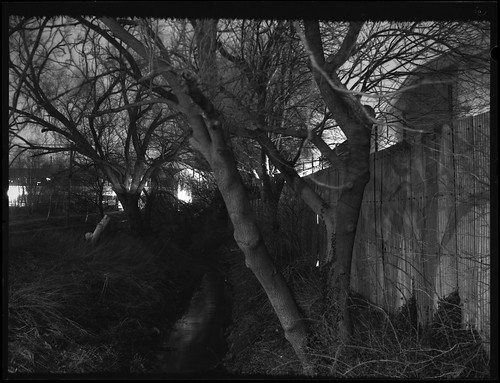
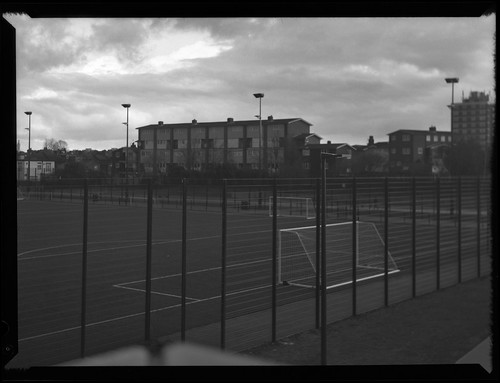
Having shot the tests, I swapped the original Aldis-Plano Anastigmat f6.8, for a faster lens (to aid focussing in low light), an f4.5 Dominar from an Ica Ideal III, which, unusually for a 6.5x9cm camera, has a 120mm lens rather than the standard 105mm focal length for the 6x9 format.
 |
| Ensign Folding Klito de Luxe No.9 with Ica Dominar lens |
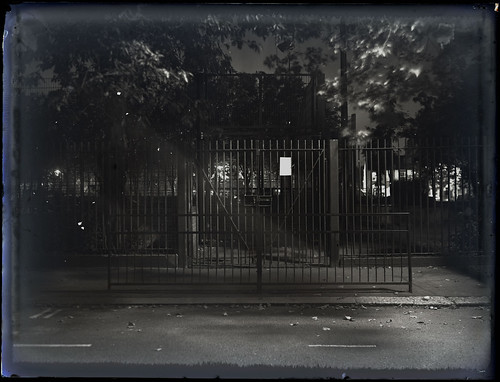 |
| Entrance to a Park, FP4 plate, Ensign Klito with Ica Dominar lens |
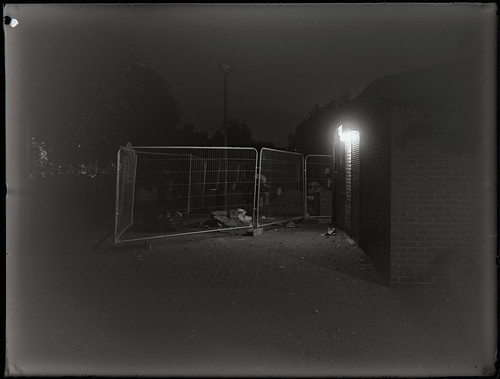 |
| Park at Night, Ilford G.30 Chromatic plate, Ensign Klito with Ica Dominar lens |
In same lot as the quarter-plate FP4 and G.30 plates that I've tested and used with the Ensign Klito above, there were three boxes of plates, which didn't have a size on them, but were in slightly larger boxes than the others. These were
9x12cm plates, which I shot with a Voigtländer Avus with a f4.5 Skopar lens; I've also got a
Kodak Recomar 33, but this has a slower lens, and less suited to night photography.
The three boxes (all previously opened) contained Barnet Line-Tone (Thin Film) plates, Ilford H.P.3 and Ilford Soft Gradation Panchromatic plates. The
Barnet Line-Tone plates were too heavily fogged to scan, although an image was discernable against a bright light, from three successive exposures at 10 EI.
H.P.3 - Hypersensitve Panchromatic plates were introduced in 1943. Before the 1960 change in meter settings these were rated at 200 ASA. The box style suggests these plates are from the late 1940s to the 1950s. According to
Silver By The Ton, HP4 was first produced in rollfilm as early as 1960 and sheet film in 1964: it may not have been produced as a glass plate, and it doesn't appear in the plates list in the Appendix of
Silver By The Ton. The Technical Information Sheet for HP3 plates from the
Ilford Technical Information Book is dated 1961, so HP3 plates were produced alongside HP4 in rollfilm for a period. For the test below, I metered for 100 EI, and took four successive exposures.
Soft Gradation Panchromatic plates were introduced by Ilford in 1928. This emulsion was later given the designation
R.10, and post-1960 were rated at 100 ASA. These were
the first plates I shot last year, in a smaller size, and gave good results. The box of the 9x12cm Soft Gradation Panchromatic plates has an earlier packaging style, possibly dating back to the 1940s. I metered for 50 EI, and gave the plate three successive exposures. The results were as good as the same plates from the 1960s, and suggest 25 to 12 as a usable exposure index.
 |
| H.P.3 plate test, Voigtländer Avus |
 |
| Soft Gradation Panchromatic plate test, Voigtländer Avus |
For the first 9x12cm glass plates I shot at night, I chose a fairly difficult subject. The lights inside the telephone exchange are very bright in comparison with the exterior of the building, which is lit from streelights partially obscured by trees. This gives the lighting of the scene a look reminiscent of being underwater. The plate might also be a little underexposed due to reciprocity law failure (for comparison I also shot the scene on
Fomapan 100 film). Despite the heavily fogged Barnet Line Tone plate, I'd loaded a couple more plateholders with them, so I shot two. I scanned the best result which shows the light from the doorway just visible.
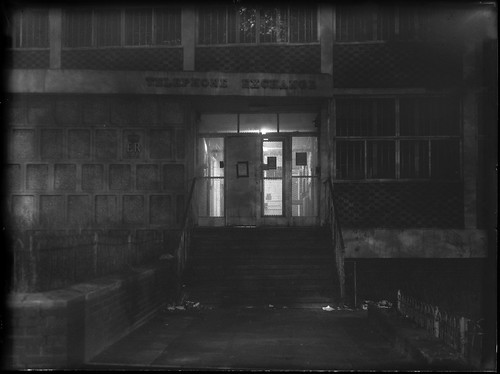 |
| Telephone Exchange, Ilford H.P.3 plate, Voigtländer Avus |
 |
| Telephone Exchange, Barnet Line-Tone plate, Voigtländer Avus |
Sources/Further reading
Silver by the Ton - A History of Ilford Limited 1879-1979, RJ Hercock and GA Jones
Ilford Technical Information Book Volume 2