 |
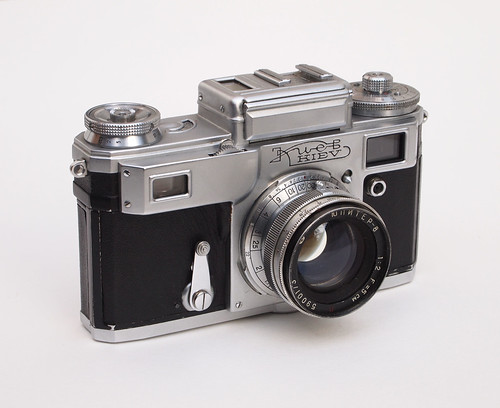
| Kiev-4 rangefinder with Jupiter-8M f2 5cm lens |
The Arsenal factory in Kiev produced a range of cameras almost all named after the city itself, in a variety of different film formats: 35mm, medium format, and subminiature; the model which began Arsenal's sixty-year history as a camera manufacturer was the
Kiev rangefinder. Unlike many other Soviet-era productions, the Kiev rangefinder was not reverse engineered from existing cameras - like the
FED and the later
Zorki Leica copies - but instead was created from the drawings, dies, tools, and (initially) parts of the pre-war
Zeiss Ikon Contax cameras. It's debatable as to whether the Kiev rangefinder should be strictly described as a Contax
copy, as it was rather a direct continuation of the pre-war Contax, with a long, drawn-out diminution of quality during its extensive production run. The Kiev Survival Site has probably the most
comprehensive history of the camera available online.
The first Kiev rangefinders are named
Kiev II and
Kiev III to correspond with the Contax II and III: both models designated
III have an uncoupled selenium lightmeter. The Kiev cameras were then slightly modified by the addition of a PC socket for flash: these became the IIa and IIIa. The next iterations were the Kiev-4 (with light meter) and 4A (without meter), followed by the last cameras in the series, the 4M and 4AM. (There was also a
Kiev-5, a comprehensive redesign from the Contax-based original, which had a relatively short production run). All the different models appear to have overlapping production dates, according to the details provided on
SovietCams.com; the 4M and 4AM variants of the Kiev rangefinder were produced until the mid-1980s, remarkable for the fact that, although there were many changes during production, it was still recognisably Zeiss Ikon's camera of fifty years earlier.
Zeiss Ikon produced the first Contax rangefinder in 1932 as a direct response to the Leica. Later known as the Contax I, it was very much a work in progress with numerous changes to the camera while in production; the Contax II from 1936 demonstrated Zeiss Ikon's determination to better Leica in almost all specifications (Cameraquest has a
detailed comparison between them), yet the Contax doesn't have the same legendary name or status that the Leica has achieved. Perhaps this is in part due to the post-war legacies of both companies: Leica concentrated on their famous rangefinder, aimed at a small section of the luxury camera market, while Zeiss Ikon AG had a large product range, attempting to cover all aspects of consumer photography, and were essentially put out of business by Japanese competition. Although Zeiss Ikon AG were relatively quick to produce the post-war Contax in 1950, as a camera system it wasn't subsequently supported and developed, while Leica produced the M3 in 1954 - which incorporated a number of features that the pre-war Contax had, with improvements in other areas.
In part due to cost, I'd never bought into the cult of the Leica. However, the Contax, and probably even more, the Kiev rangefinders have a following of their own - for example, there's a wealth of websites dedicated to the Kiev (see bottom of this post): the Kiev gives one a taste of the Contax at a fraction of the price (similarly, with Leica, there are also the
FED and
Zorki copies; and both the Contax and Leica have numerous cameras inspired by their designed, sometimes combined into one - like the
Nikon). Late last year, a box arrived from Ukraine containing a Kiev rangefinder: I'd researched the model I wanted, and spent some time looking online before buying. Unsurprisingly, the Kiev is still largely to be found in its country of origin, and, although not expensive, the postage was half the price of the camera.
I'd found a relatively early version of the Kiev-4 model. The first two letters of the serial number designate the year of production: my camera dates from 1960, with a the standard Jupiter-8M 5cm f2 lens from a year earlier. According to
Fotoua, this Kiev-4 is a Type 2b, defined by
not having a stop bolt on the accessory shoe, and the "lines of rigidity" on the meter (the raised 'T' shape between the accessory shoe and the meter window). My initial impressions were that I had been expecting the camera to be bigger - it's smaller than an SLR such as the
Canon A-1 for example - but also, externally at least, the quality and finish of the body are of a high standard; the aluminium lens barrel less so. Many of the comments in this post relating to the functions of the Kiev-4 are probably equally applicable to the design of the original Contax II/III, including some of its quirks, with a few caveats.
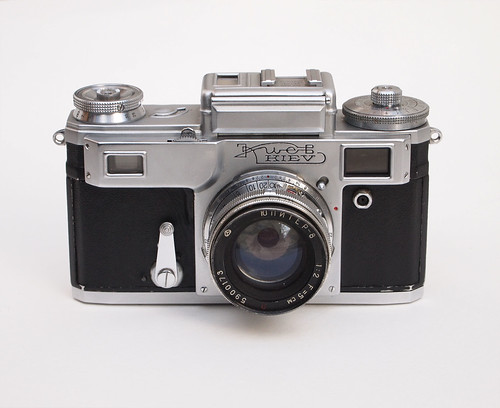 |
| Kiev-4 with Jupiter-8M f2 5cm lens |
I'd chosen the Kiev-4 partly thanks to the built-in light meter; early models appear to be fairly common, while it has some refinements over the IIIa. There may be reasons for preferring the meter-less versions, but I decided it might prove a useful feature. Presumably without any direct contact, the post war Contax IIIa prompted the Kiev-4 redesign, with a smaller, lower and simplified meter, and a smaller rewind knob and calculator dial alongside it (the Contax IIIa also had a smaller body with a shorter rangefinder base, neither of which influenced the Kiev-4 design).
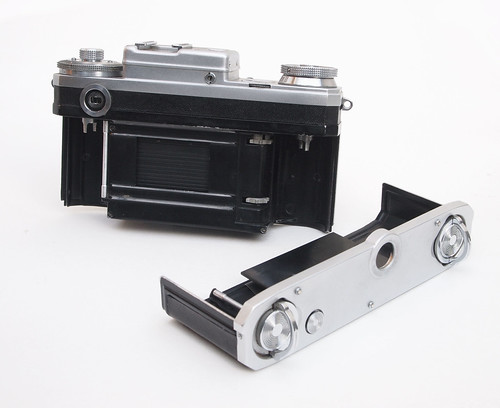 |
| Kiev-4 with back removed for loading |
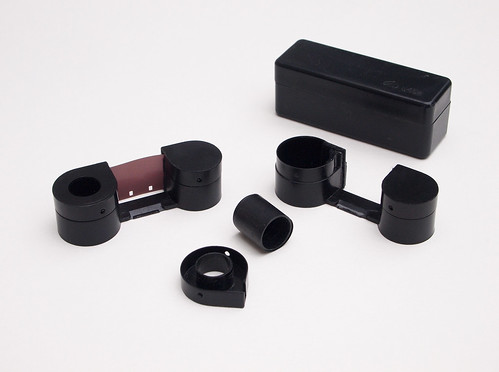
The back removes entirely to load the camera; two flip-up, rotating handles on the camera base unlock the back. The original Contax camera was designed without a fixed take-up spool to provide flexibility: as well as Contax reloadable cassettes, which could be loaded in each chamber, removing the need to rewind the film, there were also 'Contax spools', with the film not in a cassette or cartridge, but with a paper leader and a trailer (rather like the 220 version of medium format rollfilm), this also did not need rewinding but required a removable take up spool; the camera could of course be also used with the (then new) Kodak daylight loading 35mm cassette. The Contax film spool does not appear in the post-war Contax IIIa manual, presumably having been discontinued. The Kiev rangefinders replicated this arrangement, including the metal reloadable cassettes, until the 4M and 4AM versions, which had fixed spools.
My camera came with a metal removable spool with a
central slot for the film leader, and to use this would mean either cutting the film leader to a point, or taping it to the spool. Neither approach is entirely impractical but perhaps undesirable when out in the field. Initially, I attempted to use two 35mm cassettes, with the take-up cassette made up in mirror image, much like with the
Belomo Agat18k, but this first roll of film tore as the sprocket holes in the film did not quite match up with the sprocket teeth.
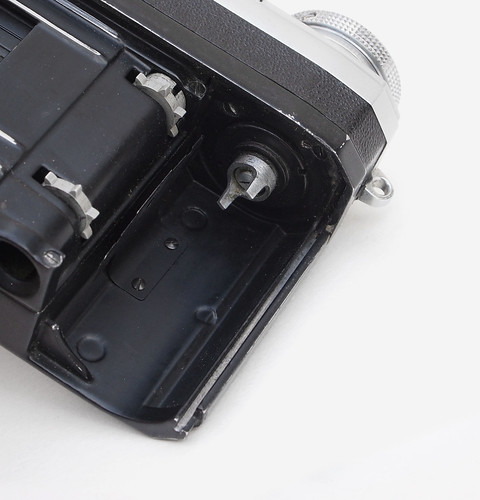 |
| Take up chamber with film advance claw |
On close inspection of both the metal spool and the camera itself, I could see why the film wasn't properly aligned: there is a raised rim around the base of the film advance 'claw' (as the Contax III manual describes it), shown above. This raised rim prevents a spool from a standard 35mm cassette aligning perfectly with the film path. I adapted the solid plastic internal spool from a 35mm cassette to use in the take up chamber, in a slightly different fashion than the advice on
making a replacement Contax spool from Mike Elek's site, which appears on a number of Kiev/Contax rangefinder sites. In addition to cutting a slot in the plastic with a hacksaw to locate the film leader, I also removed the protruding rim around the base, to make this flush, as with the metal Kiev spool, illustrated below. This was a detail I'd not found while researching online; perhaps the Kiev is different from the Contax in this respect, perhaps not, but sometimes the internet isn't quite so good for minutiae such as this.
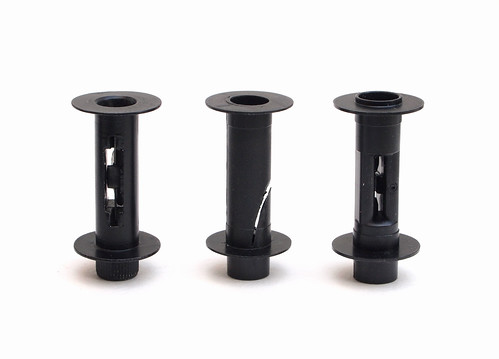 |
| Left to right: original Kiev spool; modified solid spool; unmodified spool |
Once loaded, the film counter has to be set manually, and counts up (I have read elsewhere that it counts down, so perhaps this isn't consistent). Shutter speeds are set on the film advance knob, in the centre of which is the shutter release; turning the knob to advance the film also cocks the shutter. To set the shutter speed, the knob is pulled up and rotated to locate an internal pin, which has to be done
after the shutter has been cocked. If this is done once the shutter has been released, this internal pin might not be correctly located. As on the Contax II/III, the highest speed is 1/1250th, down to 1/2th, and 'B' (the later 4/4A models and the 4M/4AM versions had the top speed reduced to 1/1000th). On the Contax, using the 'B' setting with the self-timer achieved a shutter speed of 1 second; on the Kiev, this is a rather-less-than-precise range of 1-3 seconds: the
Kiev manual recommends to "check its value before using". On my camera, it is around the three-second mark. The focal plane shutter comprises two curtains that are constructed from a series of interlocking vertical metal slats. These are remarkably quiet above 1/50th; at 1/50th and below, the shutter has a muted 'zip' sound.
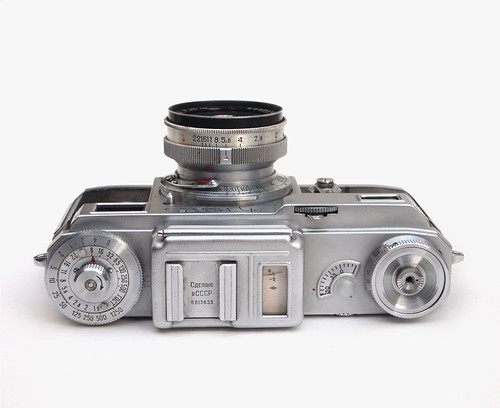 |
| Kiev-4 rangefinder, view of top plate |
The Kiev/Contax rangefinder has a very long base - 90mm - and this distance between the two windows makes for very accurate focussing. There are compromises with this: ergonomically, it's easy to cover up the rangefinder window while holding the camera (thus making the 'Contax grip' necessary and the Contax manuals describe how to place the user's right hand to take advantage of this); also, with the standard 5cm lens, the rangefinder's accuracy provides a high degree of rotation to change the focus from infinity to 0.9m. In comparison, the focus lever on the
Kodak Retina IIa rotates 90º from infinity down to 3.5 feet, while on the Kiev-4 the 5cm lens rotates
270º from infinity to 0.9m. This makes switching from infinity to close focus not as rapid as it might otherwise be, notably when using the focus wheel on the body.
The Contax/Kiev lens mount has an internal
and external bayonet: the internal bayonet is used by the 50mm lenses and has a built-in helical; other lenses use the external mount and this means that the entire 5cm Jupiter-8M lens rotates as it focus. The lens aperture ring thus rotates away from the user until it can no longer be seen from the top of the camera. Some 50mm lenses had the aperture scale engraved twice around the lens to ensure it's always visible, but my lens has only one scale. As the 50mm lenses do not focus themselves, the internal bayonet mount also has focus and depth of field scales engraved around it. There is an infinity lock on the focus, which has two release levers: the tab above the focus wheel on the body, and the sliding pin by the lens itself. To change lenses with the internal bayonet, the lens must be locked at infinity.
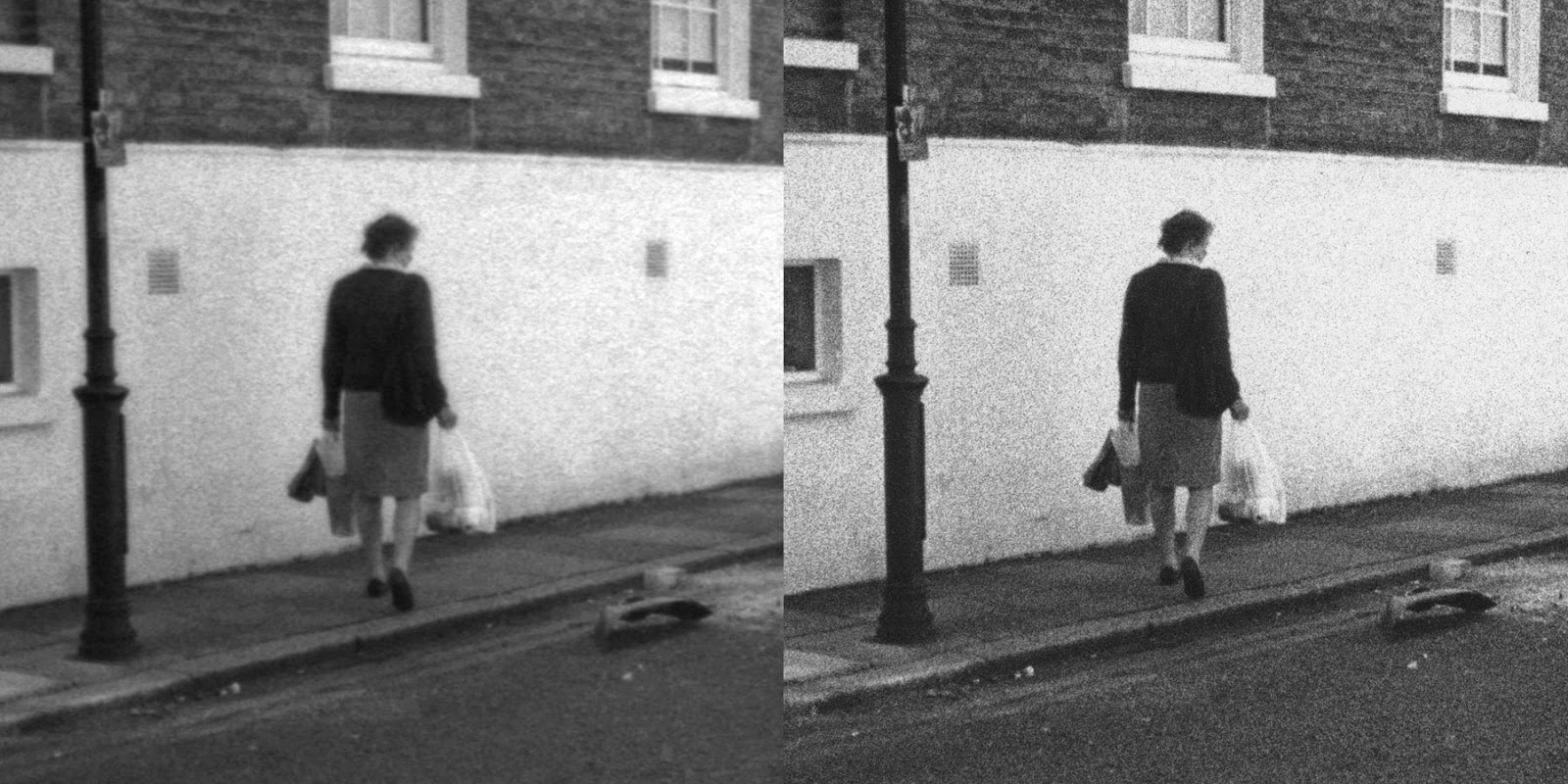
For writing this blog post, I've only been using the standard Jupiter-8M f2 5cm lens that came with my camera, but Arsenal duplicated the Contax range of Zeiss lenses, with the f1.5 50mm lenses - both the Zeiss Sonnar and the Jupiter-3 version - being most sought after and commanding the highest prices. With the 50mm lenses, both the wheel on the body or rotating the lens barrel can be used to focus the lens once the infinity lock has been released. It's not recommended to use the focus wheel on the body for other lenses due to their inertial weight. The rangefinder is clear and easy to use (the viewfinder has no frame lines or parallax indication, merely the square superimposed rangefinder patch), and I did find that I was deliberately choosing subjects to make use of its accuracy, isolating near objects and using wide apertures to throw backgrounds out of focus. The Jupiter-8M lens has a nine-bladed aperture diaphragm that no doubt helps in the smooth rendering of out-of-focus areas, such as in the shot below.
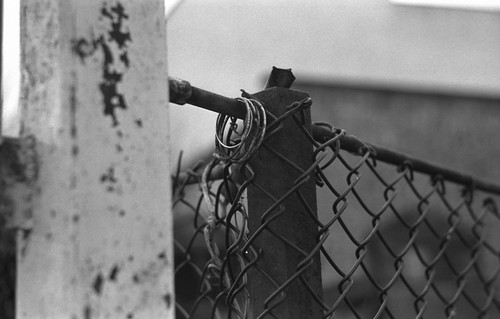 |
| Kiev-4 with Adox Silvermax |
For most of the shots taken to illustrate this blog post, I've trusted the built in light meter: cross-referencing with the 'Sunny-16' rule, the meter appeared to be functioning with sufficient accuracy for black and white negative film. As mentioned above, the Kiev-4's meter was based on that of the post-war Contax IIIa, although it differs from it in having 2x and 4x exposure marks, while the Contax IIIa only had one mark for correct exposure. The original Contax III had a light meter scale with markings for multiplying factors of 2, 5, 10, 20, and 40: I imagine that at the highest end of the scale, there's a potential for greatly magnifying a margin of error when using with insufficient light.
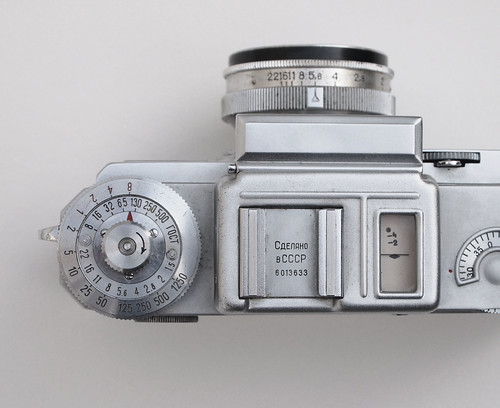 |
| Kiev-4 lightmeter and exposure calculator |
To use the Kiev-4's light meter, a pin by the cover's hinge releases the cover, which operates as a shade against the sky skewing meter readings. On the exposure calculator, film sensitivity is marked in the USSR's GOST scale, which is about one tenth
less than the comparative ISO. The meter needle can be moved by rotating the outer ring of the calculator until it aligns with the rhombus in the meter window, or, in lower light, to the 2x or 4x exposure compensation marks, and then aperture and shutter speed combinations can be read off the lower side of the calculator dial. There's also a small circle to zero the meter, with a tiny screw on the back of the meter housing for adjustment. Although not very useful for low light situations, I haven't found selenium light meters to deserve the negative reputation that appears to be quite common online; perhaps I've been exceptionally lucky to get camera after camera with working meters.
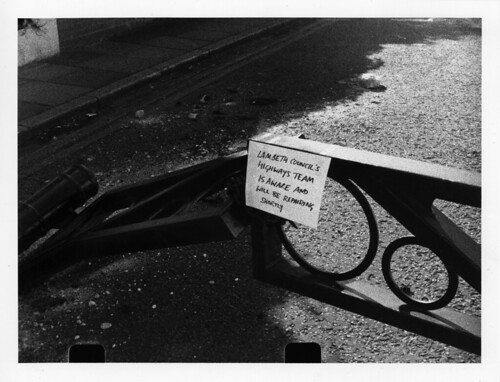
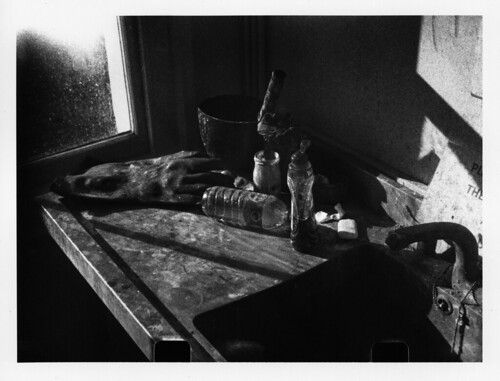
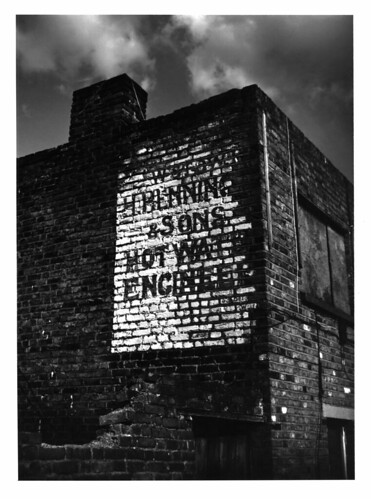
Having used the Kiev-4 for just a couple of months, and with the standard Jupiter-8M lens only, this is by no means a comprehensive review of the camera. However, the results I've had so far have largely shown the camera to perform very well (the best perhaps are those shot on
Adox Silvermax). Once I'd worked out exactly how to adapt a spool for the take-up side, using the camera was largely trouble free, although on a couple of occasions the frame spacing has been erratic, once with larger gaps than normal at the start of a roll, once with overlapping frames on a short roll of film. Operation of the camera isn't as intuitive as it might be, and takes a little getting used to, especially holding it without obscuring the rangefinder window. I've often found it more convenient to use the lens barrel to focus once the infinity lock has been released, although the wheel on the body is good for fine tuning the focus. I've missed having a yellow filter for some of the shots below, and although I generally use standard focal lengths for most of the photographs I like to take, there is the potential to acquire a range of lenses (and accessories) to take advantage of Zeiss Ikon's eighty-year old conception of this rangefinder as a complete professional system camera.
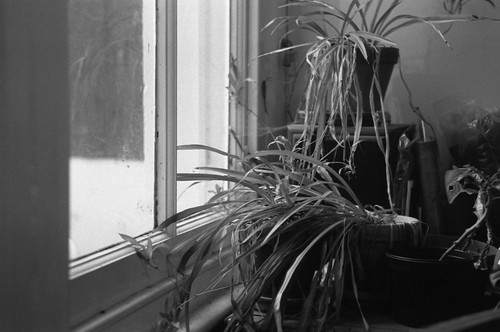 |
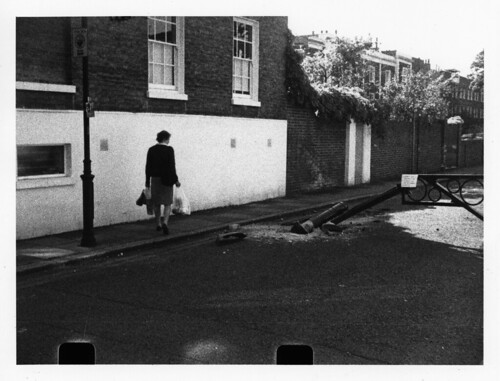
| Kiev-4 sample image on Ilford HP5 Plus |
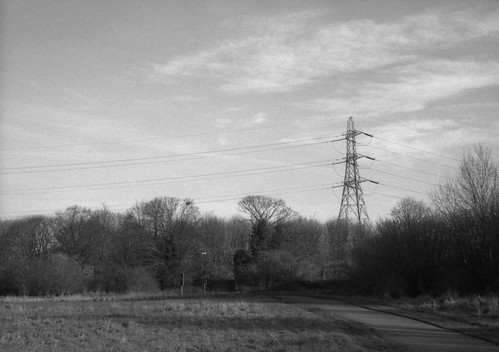 |
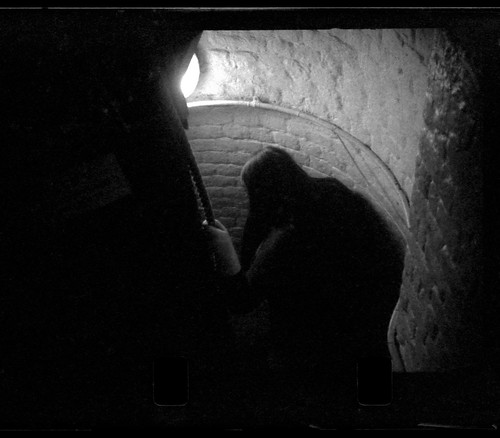
| Kiev-4 sample image on Ilford FP4 |
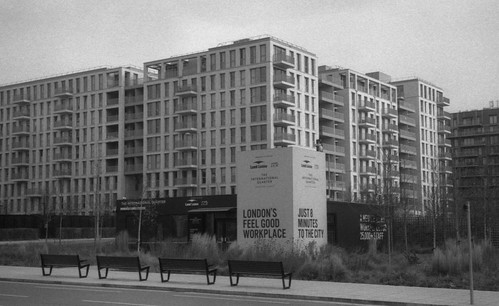 |
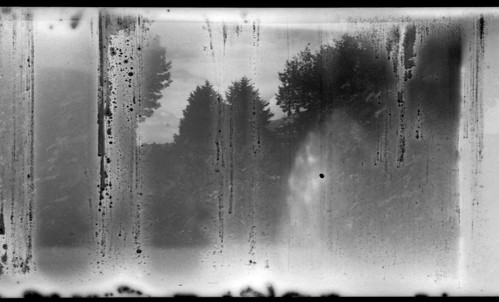
| Kiev-4 sample image on Ilford Mark V Motion Picture Film |
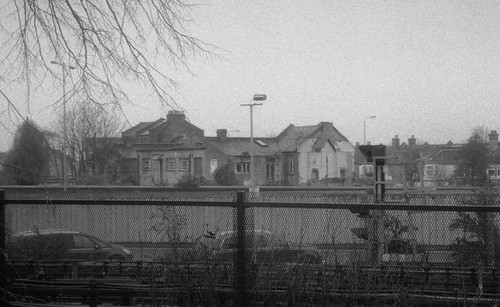 |
| Kiev-4 sample image on Foma Retropan 320 |
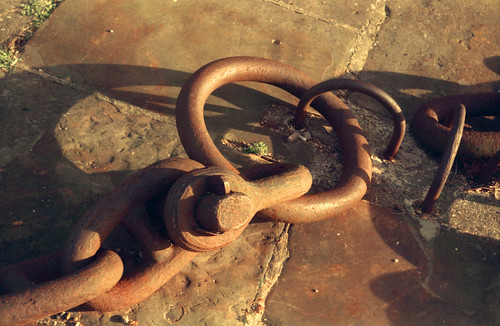 |
| Kiev-4 sample image on expired colour print film |
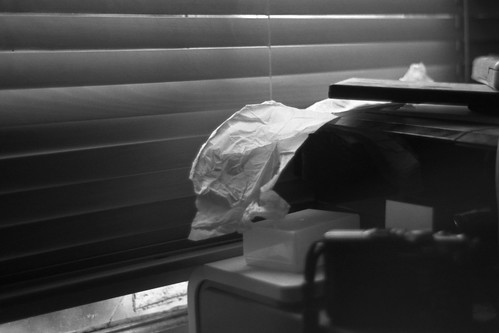 |
| Kiev-4 sample image on Adox Silvermax |
Sources/further reading:
SovietCams.com overview of the Kiev/Contax
Kiev-4 manual translated into English
Kiev Survival Site
Kiev-4 schematics on USSRPhoto
Kiev-4 on Photoethnography
Kiev-4 on Matt's Classic Cameras
Kiev-4 on Camerajunky
Kiev-4 on Early Photography
Kiev-4 on Classic Cameras
Contax manuals from Butkus.org