Showing posts with label Orca. Show all posts

Monday, 7 March 2022

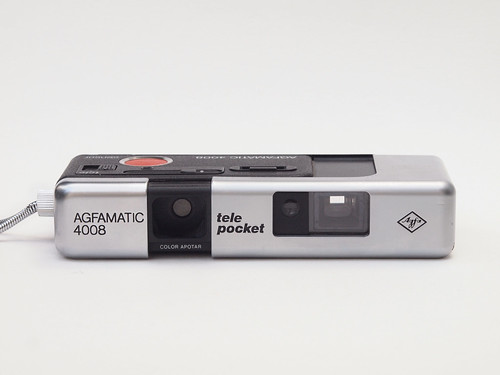
Agfa Agfamatic 4008 tele pocket sensor

Agfa Agfamatic 4008 tele pocket sensor
Thanks to Lomography's reintroduction and support of 110 film, this subminiature drop-in, cartridge load format–despite all its drawbacks–is not obsolete as it once was, and looked to remain, at some point in the 2000s when Kodak and Fuji stopped making 110 film. Early last year, during a period of pandemic restrictions, I found myself looking at Agfa's range of 110 cameras from the 1970s again. I had used the Agfa Optima 6000 Pocket Sensor camera for a while, but had ultimately sold it on; looking back to that post, I realise that I'd only used reloaded 110 cartridges with the camera, and no new 110 film. This was partly, I think, due to having never been quite satisfied with Lomography's black and white Orca film when I'd used it before–as well as not using colour film, leaving unexplored other film options with the camera. 

In my post on the Optima 6000 pocket sensor I'd written a bit about Agfa's enthusiastic embrace of the 110 format, but neglected to mention Agfa's approach to design in the 1970s: this, I suspect, is part of the reason for the appeal of their cameras, and mention should be made of Agfa's employment of the Schlagheck & Schultes Design studio. Alfred Klomp, writing about the Optima Sensor cameras, sums it up thus:

"...the Agfa Optima marks the end of the engineer's era and the onset of the industrial designer's. Around the time of the Optima series, industrial design became a serious factor in consumer products. Flatly technical solutions didn't cut it anymore, because with increasing competition on price, manufacturers couldn't afford to disregard their users's experience. Had camera manufacturing always been the realm of the small mechanical industry, now the factories discovered that it was profitable to listen to consumers. Hence the industrial design approach. [...]

I think Agfa's idea was to design a line of cameras without reference to any mechanical heritage or past. They emancipated the camera as something technical/mechanical and gave it to the users as a friendly household instrument."
Regardless of precisely whatever it was that drew me back to Agfa's 110 cameras, online, I found a fairly inexpensive Agfamatic 4008 tele pocket sensor. The 4000 models are towards the upper end of Agfa's range, with features that put them fairly above the usual 110 box-camera equivalents (usually a fixed focus lens, one or two aperture settings, and/or one or two shutter speeds), but below the 5000 and 6000 cameras. This also makes the 4000 cameras shorter than the 5000 and 6000s, with the Agfamatic 4008 tele pocket sensor 12cm long when closed, compared to the 6000 at 13.2cm. 
Front view, opened for use
The first iteration, the 4000 model, takes flash cubes; this was updated to take a flip-flash, and named 4008 (presumably the eight in the name stands for the eight bulbs in the flip-flash unit). The final version of the camera from 1975 has 'tele pocket' appended to its name, and, as this suggests, it features an additional telephoto lens, and is also a little longer in the body than the other 4000 models (there was also a later 4000 flash pocket model). Having been unable to find a manual for the tele pocket version of the Agfamatic 4008, there is conflicting information online about its precise technical specifications. Many sites describe it as being 'the same' as the Agfamatic 4008 pocket sensor with the addition of the telephoto lens: the 4008 pocket version manual states a shutter speed range of 1/500th to 30 seconds; the lens is not described, but online, this is given as a 26mm f6.3 Color Apotar name. For the 4008 tele pocket model, Camera-Wiki gives an aperture of f5.6 with a focal length of 27mm (the additional lens being 47mm and f5.6) and a shutter speed range of 1/1000th to 15 seconds - but having timed the longest exposure (with the shutter closing again–see comments about night photography below), this is 30 seconds. Apart from the telephoto lens however, it is a different camera from the non-tele 4008: notably, the focus scale itself is different (which might suggest the possibility of a different lens) close focus being 1.2 metres; the sliding focus scale has markings at distances from 1.5, 2, 3, 5, and infinity. The non-tele model has just three settings with pictograms for 5m-infinity (a mountain), 2-5m (two people) and 1-2m (one person): on the other side of this scale, it's marked 4, 2, 1 metres for flash. Intriguingly, the Apphotnum website describes the Agfamatic 4008 tele pocket as a 

"special model based on 4008 but with some elements borrowed to 5008 and 6008"–without stating what those elements are. Given the slightly more detailed focus scale on the 4008 tele pocket model

, one might speculate that this might be helpful for more accurately focussing a slightly faster lens, especially as the aperture is fixed 

(the sliding scale is also longer–allowing for more accurate intermediate positions)

; in addition, having a slightly faster lens might also call for a higher top speed of 1/1000th (as well as a shorter long exposure limit) - however, without knowing the true specifications this is just speculation. 

Although neither f6.3 nor f5.6 is especially fast, either would be a large improvement on simpler 110 cameras which commonly feature f9, f11 or smaller aperture fixed focus lenses. 

Top view showing focus slider, cable release thread, telephoto lens selector,
flipflash socket and sensor shutter release
As can be seen from the image above, most of the user controls are located on the top right of the camera, easily accessible by fingers on the user's right hand: the big orange sensor shutter release, the focus slider and selector for the telephoto lens. This switches between the normal lens, behind the shutter, to the telephoto lens, which swings in front of the shutter. The viewfinder also changes, with an additional hinged component for the wider-angle view that the normal lens requires. There is a cable release socket between the focus scale and shutter release, useful given the camera's impressive shutter speed range–whether this runs from 1/500th to 30 seconds, or from 1/1000th to 15 seconds. Partially depressing the shutter button, a red light inside the viewfinder shows as a long exposure warning if exposure is below 1/30th. The manual for the non-tele version of the 4008 also describes holding a finger over the small CDS meter and partially depressing the button for a battery check. The viewfinder itself has a simple frame outline with a single mark for parallax. On the bottom of the camera is a sliding catch to unlock the camera for opening; typically, frame advance is by opening and closing the camera. The catch on the bottom can be put in the 'close' position while the camera is open, which means that when the camera is pushed into the closed position, it locks closed, rather than (for example) having to hold the camera closed and then sliding the catch back to lock it. To load the camera, a small sliding catch releases the back of the camera. 

Battery cover opened, showing LR44 instead of V625U batteries
The camera takes two V625U batteries, hidden behind the name and model number panel on the front of the camera, with a subtle finger grip to slide this open. I tried two LR44 button cell batteries when I first received the camera, and these seem to work perfectly well, and, despite being a slightly different shape from the V625U, the nature of the battery compartment design with two angled, sprung contacts, secures these without any need to adapt them (such as with a washer or other spacer that would need to be conductive). Incidentally, the shutter will not open to expose film without batteries inserted, although there's clearly both a mechanical element as well as an electronic one to the shutter: pressing the shutter release without batteries inserted does trip the shutter–which appears to be a guillotine-type–and one blade can be seen replacing another, which makes a noise, deceptive perhaps, and the film can be advanced to cock the shutter again–but the lens remains covered.

Detail of accessory shoe, wrist strap and tripod socket
One final feature on the camera is its accessory shoe, which can be used to mount the dedicated Agfalux 400T electronic flash unit, with a cable that plugs into the flipflash socket; the accessory shoe is also used to attach the wrist strap, which fixes into a plastic tab via a screw fitting inserted into the accessory shoe: this doubles as a tripod socket.

Agfamatic 4008 with Lomography Orca film
I first used the Agfamatic 4008 during the period of restrictions early in 2021 while still working from home, but leaving the house for exercise, walking and cycling. I tested the camera with some reloaded 16mm film to make sure everything worked, and then shot cartridges of both Lomography Orca film and expired Fukkatsu black and white film. The Fukkatsu film had a "PROCCESS [sic] BEFORE" date of 2018, and is marked 100 ISO–but is packaged in a cartridge with a high film speed tab. This isn't an important concern for many simple 110 format cameras which do not sense the film speed but, for those which do–like the Agfamatic 4008–the film would therefore be underexposed. When Kodak designed the 110 cartridge, they included the possibility of indicating film speed by the length of the tab at one end of the cartridge, without specifying what ISO these referred to, leaving it to camera manufacturers to designate: essentially there is a low ISO cartridge tab (long) and a high ISO tab (short). There's very little information online about Fukkatsu films (it's not listed on the Massive Dev Chart; the box does state "PROCCESS [sic] D-76/ID-11" but without any times), and certainly no times for a two-stop push, and, as a result, this was left on a shelf undeveloped for months.

Fukkatsu 110 Black & White Film
In late December, looking for a camera and some film to put in a pocket for a cycle ride, I went back to the Agfamatic 4008; I had a cartridge of Lomography Orca film, but, as the light levels were low, with  short days of overcast weather, I cut the film speed tab on the Orca cartridge to expose it as a high speed film. When it came to developing the Orca film, like the Fukkatsu film, the Massive Dev Chart wasn't much help in terms of times, with only entries for Orca at box speed in Rodinal, my preferred developer. I used Adox Adonal (a Rodinal clone) at a dilution of 1+25 for 14 minutes at 20ÂșC, an educated guess for a two-stop push. I also loaded the tank with the roll of Fukkatsu film shot earlier in the year just to see what the results were with the same development time as the Orca film. Incidentally, the Fukkatsu cartridge came apart very easily after scoring with a knife, to remove the film in the dark. I've used Lomography Orca before, but have generally been underwhelmed by the film in the past; when scanning the negatives after pushing the film, I was pleasantly surprised by the results.

Lomography Orca film, pushed two stops
The estimated development time worked well enough, and the film scanned quite easily; any increase in contrast was not especially discernible given the low-level, low-contrast lighting conditions. Ultimately, the Lomography Orca film when pushed gave the best results with the camera, and I'd certainly expose and develop the film in this way in future.  The extended development time also worked for the Fukkatsu film exposed months earlier.

Fukkatsu B&W film, pushed two stops
For a second roll of the Fukkatsu film, I wanted to expose it at the right exposure index, so needed a way for the camera to recognise the cassette as being a low ISO film. As a simple expedient, I cut a short length from a wooden skewer and taped it at the bottom of the tab, which would connect to the button inside the camera. 

Fukkatsu 110 cartridges, front cartridge (left) modified for low film speed
When I developed this roll, I found that the focus seemed a little off on many of the frames. This could have been user error, but there were a few shots that would have been set to infinity focus (such as in the image below), and these were very soft. I suspect that the piece of wood taped to the cassette end upset the lens-to-film plane distance a small amount, being a little thicker than the cassette on its own (as a consequence of the format's design, the tolerances of using paper-backed film inside the plastic cassette is in itself not ideal in this regard). A better approach may have been to simply reload the film into a properly-tabbed 110 cartridge.

Fukkatsu B&W film at box speed
I also used some Kodak Plus-X, reloaded into a slow-film speed tabbed cassette. Like many 110 cameras, the Agfamatic 4008 does need the format's single perforation for each frame: reloading the cassette with double perforated 16mm film means that the internal pin locates each perforation, preventing the film from advancing any further, so, to avoid overlapping exposures, a second 'blank' shot needs to be taken to advance the film sufficiently. With unperforated film, the camera's lens does not cock, and the film will wind all the way through without stopping.

Kodak Plus-X in reloaded 110 cartridge
Using double perforated film, the perforations do show prominently at the top and bottom of the frame. I did get some overlapping exposures, and some in which I did not cover the lens enough when making the second exposure. Reloading 110 cartridges with 16mm film does make use of the whole negative area, without the pre-exposed frames of the 110 format; with single perforated film, and with cropping these out, very little of the image area would be lost in relation to a pre-exposed 110 frame.

Long exposure with Lomography Orca film (pushed two stops)
Given the Agfamatic 4008's shutter speed range, I wanted to test long exposures with the camera. With relatively low light, this seemed to work pretty well: I made some test exposures at night, under moderately low interior lighting, placing the camera on a table for stability rather than a tripod, and could hear the lens open and close with exposures measured in seconds, as in the image above; taking photographs outside at night with the camera, I found that the shutter stayed open. This may possibly be intentional, an effective 'B' setting if the exposure is longer than 30 seconds, but the shutter only closes when advancing the film–which is very hard, if not impossible to do without moving the camera and this showing up in the resulting image, as seen below with the light trails (there is also a small amount of camera shake). However, with care, it is possible to get sufficiently good night shots with the Agfamatic 4008 as seen in the second image below.
Long exposure with Lomography Orca film at box speed
Long exposure with Fukkatsu B&W film at box speed
The one feature of the Agfamatic 4008 tele pocket sensor I've left to last is the telephoto lens: on my camera, selecting this simply resulted in out of focus images, as in the comparison of the two frames below. Initially I did wonder whether, when engaging this lens, the camera's focus lever had to be set at different distances from the normal lens, but there are no markings for this, which one would expect if this was intentional. Despite the possibility of an effective 'B' setting as described above, it's impossible to keep the shutter open to check how the focus works with the telephoto lens: ideally, one could use tape in the back of the open camera and a loupe, but, having tried covering the light sensor to get the shutter to stick open, it still closes again shortly afterwards if it's in an environment bright enough to be able to examine the camera.

Lomography Orca film (box speed) with normal lens

Lomography Orca film (box speed) with telephoto lens

The out of focus telephoto lens is a bit of a puzzle: sliding the focus scale, the telephoto lens clearly moves with the scale, but there does not appear to be any means to adjust the lens itself. It's possible that the telephoto lens in my camera may have always been out of registration, but, short of taking it apart to investigate, this is unknowable (the camera doesn't have any damage to suggest a significant knock or drop which might have caused such a problem). Putting aside the unusable telephoto lens, the camera itself is one of the better 110 cameras around (even without the telephoto lens, the more accurate focussing scale might make it preferable to the standard 4008 model), and Agfamatics of all kinds seem to be very plentiful on the secondhand market. It's clearly not in the same league as the Pentax 110 Auto, but still a good camera for a once all-but-obsolete film format which, unlikely as it seems, is still catered for in 2022. 

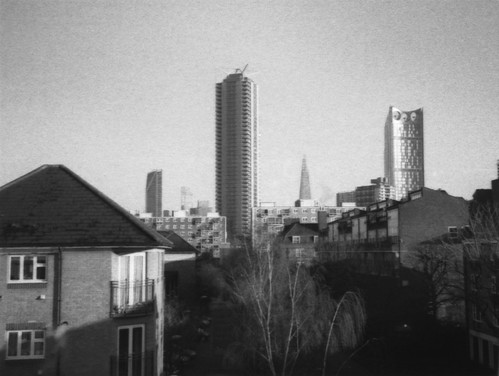
Agfa Agfamatic 4008 tele pocket sensor with Fukkatsu B&W film at box speed

Agfa Agfamatic 4008 tele pocket sensor with Fukkatsu B&W film at box speed

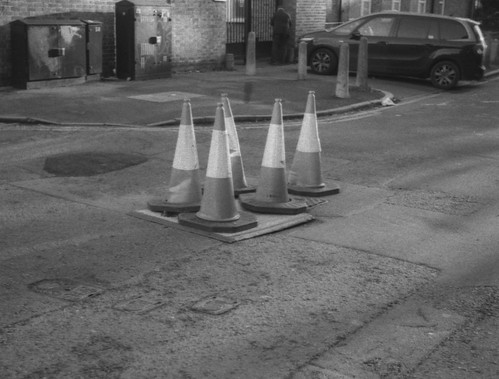
Agfa Agfamatic 4008 tele pocket sensor with Lomography Orca at box speed

Agfa Agfamatic 4008 tele pocket sensor with Lomography Orca at box speed

Agfa Agfamatic 4008 tele pocket sensor with Plus-X

Agfa Agfamatic 4008 tele pocket sensor with Plus-X

Agfa Agfamatic 4008 tele pocket sensor with push-processed Fukkatsu B&W film

Agfa Agfamatic 4008 tele pocket sensor with push-processed Fukkatsu B&W film

Agfa Agfamatic 4008 tele pocket sensor with push-processed Lomography Orca film

Agfa Agfamatic 4008 tele pocket sensor with push-processed Lomography Orca film

Agfa Agfamatic 4008 tele pocket sensor with push-processed Lomography Orca film

Sources/further reading:


Wednesday, 14 February 2018

Minolta Weathermatic-A

Minolta Weathermatic-A
Some cameras I've bought purely on a whim. The Minolta Weathermatic-A was one such camera: a waterproof, underwater 110 format camera, listed on a well-known auction site for a mere £5 plus postage - which gained no other bids. When the camera arrived, my initial impression was that it's surprisingly large, large for 110 format: the camera body is 190mm long, around 50mm at its thickest where the knobs and levers are, and 70mm deep. The Weathermatic-A dates from 1980 and Minolta's decision to bring out a waterproof camera for the 110 format probably reflects the growing popularity of scuba diving and other such sports. The camera is waterproof to 5 meters, and as well as its large controls, designed to be easy to use with gloves, there is also an intergral padded wriststrap which can be attached to either right or left side of the camera. The yellow and black colour scheme also denotes its design relationship to diving gear, and a few other companies made waterproof cameras with yellow and black colour schemes around the same time period in the late 1970s and through the 1980s, notably the Motormarine and the Aquamatic. The Weathermatic-A wasn't followed by a Weathermatic-B, but the concept of an amateur underwater camera seems to have been sound enough for Minolta to follow it with the 35mm Minolta Weathermatic 35 DL (there was also a Minolta Weathermatic Vectis Zoom for the APS format in the 1990s). Other accessories for the Weathermatic-A included a sports finder, plastic case and belt strap.

Minolta Weathermatic-A, top view with aperture and focus controls
The controls are large and simple to use. On the top of the camera are two knobs, one for focus, with a series of symbols to indicate distance, the other, which changes the aperture, has two weather symbols, for sun and cloud and flash. Next to this is the shutter button, a large rubberised pad - not dissimilar to Agfa's orange buttons in their Sensor range. On the underside of the camera is the frame advance lever. The lens is a f3.5 26mm Rokkor, with a close focus distance of 0.9m or 3ft; the shutter is set at 1/200th only.

Minolta Weathermatic-A rear view
The viewfinder indicates the focus setting with a red transparent tab that moves over the same series of distance symbols. There is also a simple parallax indication, and a red underexposure warning. This is powered by a single AA battery, used for both metering and the built-in flash. However the shutter itself is entirely mechanical: I first used the camera without a battery, shooting in daylight with the aperture selector set to 'cloudy'. The Weathermatic-A is sometimes described online as having three aperture settings, but this is more nuanced: the aperture knob can be set to intermediate positions between the two aperture settings, for full sun or cloud, while the flash setting changes the aperture with the focus setting - as the focus is set closer, the aperture reduces.

Minolta Weathermatic-A with strap information for focus settings
Embossed on the underside of the camera body is a numerical key for the distance symbols in both feet and metres, and "actual flash-range on land"; these are also printed on both sides of the strap toggle. The flash distances are given for 100 and 400 ASA film: the camera has the film speed pin to sense either low or high cartridges. On top of the camera, behind the focus and aperture knobs, there's a raised triangle. This might just be a design quirk, but it seems to indicate the film plane: it's in the right place, directly behind the lens, and above the window which shows the cartridge and the frame number on the backing paper of the film.

Minolta Weathermatic-A opened for loading
The camera back has two locks for its rear seal, these have clips that need to be lifted before each lock can be rotated in opposite directions. Inside this, both film and battery can be loaded separately.
For my first tests with the Weathermatic-A, I used 110 cartridges reloaded with double-perforated 16mm Kodak Photo Instrumentation film. The Weathermatic-A is a typical 110 camera in that it needs perforations to function: the shutter release does not work unless the internal pin connects to a perforation. However, unlike some other 110 cameras I've used, the Weathermatic-A's single-stroke lever will advance the film a whole frame - or four standard 16mm perforations - without snagging, with just an odd, occasional overlap.

Minolta Weathermatic-A with reloaded Kodak Photo Instrumentation film
Although I hardly ever use flash, I did test the camera's built in flash unit, seen in the image below, which worked perfectly adequately. There's a small 'flash-ready' LED that shows up on the rear of the camera body to show when the flash is fully charged.

Minolta Weathermatic-A with reloaded Kodak Photo Instrumentation film
When I made my first tests, I didn't use it underwater, but I did take the camera out on a very rainy day with impunity; to test it was still waterproof, I did submerge the camera in a sink full of water, checking for any air bubbles coming from the body to indicate a leak before using it underwater.

Minolta Weathermatic-A with reloaded Kodak Photo Instrumentation film
After the first tests made with reloaded 110 cartridges, I later shot a roll of Lomography Orca film while swimming in the sea, testing the camera's waterproof qualities. I also used the Lomography Tiger colour negative film on the same occasion, but only after getting out of the water. I did try a couple of shots underwater, but these were very uninteresting shots of feet in the mud (located at the end of the Thames estuary as the coastline turns, Southend and Shoeburyness, where I shot these films, are very well known for their mud, from the silt carried down the river); in one shot further down this post, I attempted to shoot camera with its lens half submerged.

Minolta Weathermatic-A with Lomography Orca film
As with other 110 cameras, the negative size is significantly larger than the 110 film's pre-exposed mask, as can be seen in both colour and black and white images: one benefit of using reloaded cartridges is to take advantage of the whole negative area, which is admittedly compromised by the perforations themselves. However, it would be possible to crop the frame to its full width for a slightly elongated rectangular image inside the perforations.

Minolta Weathermatic-A with Lomography Tiger film
In the photographs using the reloaded cartridges, the frame has a distinct shape with three notches along the top of the frame. At the top left of many frames, there's a mark which appears to be some form of light leak (outside of the 110 printed frames), but its regularity makes it seem like a deliberate marking, although its hard to see what the purpose might be.

Minolta Weathermatic-A with reloaded Kodak Photo Instrumentation film
I subsequently used the Weathermatic-A while kayaking, taking a number of films, both cartridges of reloaded Photo Instrumentation film and Lomography Orca, with spare films in a resealable plastic bag to keep them dry. Paddling with the camera strapped to one wrist was not practical, but it could be attached to the life jacket I was wearing in such a way that I could lift it to my eye to shoot while on the river (as I avoided capsizing on this excursion, I didn't actually use the camera in the water here).

Minolta Weathermatic-A with Lomography Orca film
In a number of frames, some curious light spots appear in the image area. My first thoughts was that these were caused by water on the lens housing, with the possibility that small droplets might have created this effect by reflecting sunlight into he camera. However, this didn't seem a satisfactory explanation, as some were in shots taken on dry land. When I got the colour negative film developed, there were spots again, but of an orange-red colour. Some research online showed that these marks are caused by minute holes in the backing paper - and the positioning of these spots does seem to match up with the hole in the back of the cartridge in which the frame numbers appear, rather than across the whole film. Looking back at 110 shots from other cameras did show up these marks on occasion, but rarely - which I think must be determined by the brightness of the light when shooting: it's much less likely to happen when photographing inside and on overcast days as I had done with the Agfa Optima Pocket Sensor for example. Reusing the cartridges no doubt also causes wear on the backing paper which possibly increases the likelihood of this occurring, but this effect also shows in the new Orca films. Taping over the cartridge window would be one solution, although this means not being able to see how many frame have been shot.

Minolta Weathermatic-A with Lomography Tiger film
Other than light leaks from the backing paper, the most common problem I found when shooting the Weathermatic-A was down to user error: the focus knob has a click stop at the 'whole person' icon. This is set to 3.5m or 11ft; as this is the only click stop on the focus knob and is its 'centered' position. I made the mistake of assuming that this might be a hyperfocal distance setting for the 'full sun' aperture at least, which it isn't - resulting in quite a few slightly-out-of-focus frames. Although I've only shot a very limited range of emulsions with the camera, I think the Photo Instrumentation film provides the best results so far; although I don't see it being used regularly, as a camera to take anywhere wet, the Minolta Weathermatic-A works very well within its intended remit.

Minolta Weathermatic-A with Lomography Orca film
Minolta Weathermatic-A with Lomography Tiger film
Minolta Weathermatic-A with reloaded Kodak Photo Instrumentation film
Sources/further reading
Minolta Weathermatic-A on Camera-Wiki
Weathermatic-A on Submin.com
Collection-Appareils page on the Weathermatic-A
Weathermatic-A on Forgotten Charm
Minolta Weathermatic-A manual on Butkus

Monday, 25 August 2014

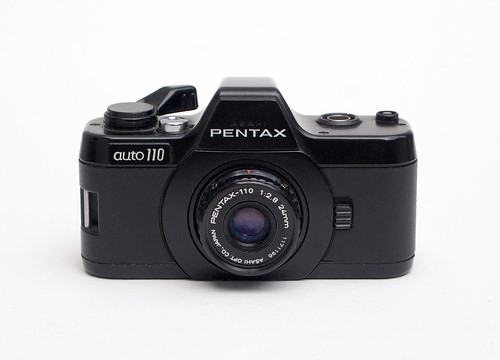
Pentax Auto 110

Pentax Auto 110 with 24mm lens
The Pentax Auto 110 is a remarkable single lens reflex camera on a miniature scale for the 110 format. Although the subminiature format was popular with many other Japanese manufacturers from the adoption of 16mm film for still picture cameras in the 1950s, through to the introduction of the 110 cartridge in the 1970s, Asahi/Pentax only entered the subminiature market with the Auto 110 in 1978. However, the Pentax Auto 110 was not the first SLR for the format: two years earlier, Minolta had produced their initial model of the Minolta 110 Zoom SLR. The Minolta cameras had a fixed zoom lens with aperture priority exposure and a range of ISO settings; by contrast, the Pentax was far more compact, measuring just 98x56x43mm with the 24mm lens, yet it has interchangeable lenses, fully automatic exposure, and a range of accessories.

As an SLR system camera, designated by Asahi simply as 'System 10', the Pentax Auto 110 was provided with a full range of lenses: as standard, the 24mm lens represents the 'normal' angle of view, and was complemented with the 18mm wide angle, 50mm 'portrait' lens, 70mm telephoto and 20-40mm zoom. Focus on all lenses except the fixed 'pan-focus' version of the 18mm is manual: the viewfinder has a split image central spot. As the unique two-bladed diaphragm combines both shutter and aperture and is an integral part of the camera body (shown in the image below), all lenses had to work with the same maximum aperture of f2.8, which stops down to the smallest aperture of f13.5 in the right conditions. There was also a third-party 1.7x teleconverter from Soligor, and a number of filters for the different lenses, including UV and skylight, but also close-up fliters. Other accessories include two different flash units, a power winder, and a belt clip.
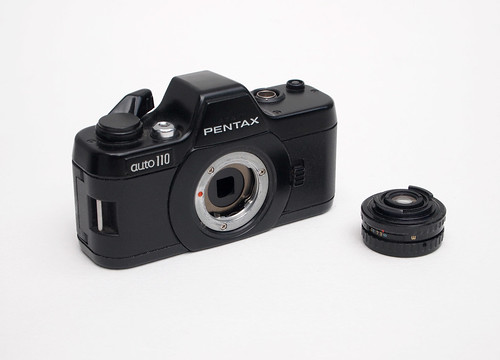
Pentax Auto 110 with lens removed
As the name suggests, the TTL exposure is entirely automatic: lightly pressing on the shutter button, an LED shows in the bottom right corner of the viewfinder, green for shutter speeds above 1/30th, yellow (for low-light) speeds below 1/30th. Exposures ranged from 1 second at f2.8 to 1/750th at f13.5. The Pentax Auto 110 does use the 110 cartridge's film speed tab to set exposure at either 80 or 400 ISO (some websites list the high speed setting as 320 ISO). As exposure is automatic, it's important to note that the camera does not work without batteries: the SLR mirror does flip up mechanically, but the shutter itself will not fire. Fortunately, the camera utilises two SR44/LR44 type batteries which are commonly available. The removable battery holder has a unique design with rotational symmetry which means it works inserted into the camera either way up.
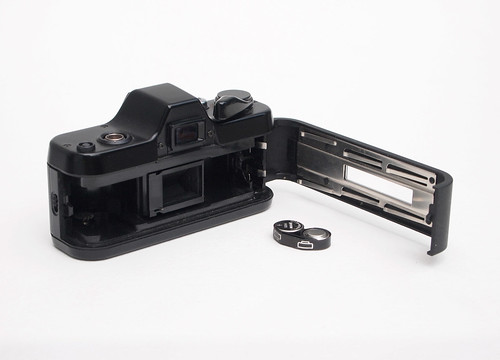
Pentax Auto 110 with open back & battery holder removed
The Pentax Auto 110 in the images illustrating this post was left behind when a family member emigrated, and had evidently not been used for some time when I chanced upon it. Opening up the camera revealed two heavily furred batteries, but after cleaning the battery compartment and the contacts, I inserted two new batteries, and the light inside the viewfinder came on when lightly depressing the shutter button. The battery compartment also had some damage, where the plastic edge seperating the film chamber from the batteries had broken away, which may have been due to leaking battery acid. This does not appear to affect performance directly, but, as I later found, it may have meant that the batteries fit less securely. I very quickly found a 50mm lens online to supplement the 24mm, for just £7, so ordered this and a couple of film cartridges.
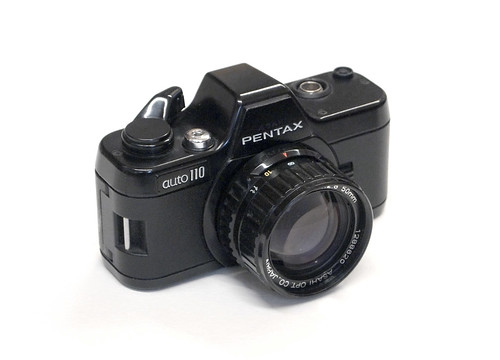
Pentax Auto 110 with 50mm lens
In a number of my posts about 16mm subminiature cameras, I have referenced the 110 format as a point of comparison. Kodak introduced the 'pocket instamatic' drop-in cartridge in 1972, essentially a smaller version of the earlier 126 cartridge, which succesfully competed with the various 16mm subminiature systems, and the format was very popular through the 1970s and into the 1980s. As a format commonly used for cheap snapshot cameras, like 126 and the short lived APS film, the 110 film cartridge was a casaulty of digital photography, and most companies had discontinued production by the mid-2000s, the last being in 2007, but since 2011 the format has been ressurrected with Lomography marketing both colour and black and white 110 films. The first production run of Lomography's black and white 'Orca' film cartridge didn't use backing paper, but subsequent batches do, which is useful to have when reloading the cartridge.

I bought a cartridge of the Lomography Orca film to test the Pentax Auto 110. After loading, I shot a few frames before realising that the exposure LED was not lit. This turned out to be poor battery contact, perhaps caused by the damage to the battery compartment. I removed the film cartridge (although later realised this could be done with it in place), and wedged a small piece of folded card to force the metal contacts tighter to the batteries. I also shot an old Kodak Verichrome Pan cartridge (with a develop before date of Sept 1978), this being the only black and white film originally made for the 110 format - until Lomography's reintroduction in 2011. This cartridge contained 12 frames, and due to the camera's fully automatic exposure, I was unable to compensate for the age of the film when shooting. I attempted to do so when developing, but with little success. Lomography's website has times for a number of film developers, but using the unlisted Ilfotec LC29, I choose to utilise stand development at a dilution of 1:100, for one hour with the Orca film, and two hours for the Verichrome Pan.

Lomography Orca 110 format film
One of the first things I noticed after developing and scanning the films was the clear presence of an overlap around the printed frames. This can be seen in the scan below, particularly in the lights around the top and sides of the frame. Kodak's original specifications for 110 film included this pre-exposed frame for the convenience of photo-lab printing. It was interesting to discover that the printed frames were not insignificantly smaller than the actual frame size that the camera uses. I attempted to measure the size of the pre-exposed frames from the scanned negatives, and got the following approximate measurements: Kodak's Verichrome Pan frames were 12.6x16.9mm; the Lomography Orca frames were practically the same at 12.7x17mm. However, without the pre-exposed frame, the Pentax Auto 110 has a negative size of 13.4x19.6mm. At the small scale of the 110 format negative, the extra 2mm width is not inconsiderate. In terms of area, the Orca negative is 215.9mm2, compared to 262.6mm2 without the frame, a difference of 21.6 per cent.
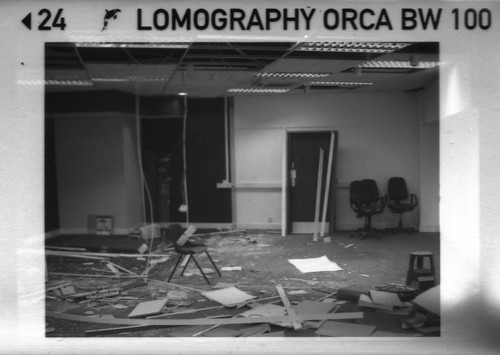
Orca 110 film, showing overlap with printed frame
Unlike the cassettes of the 16mm subminiature cameras I've used recently, the 110 cartridge is not designed to be reloaded with film and re-used. This I think represents something of a split between the formats, as, although the various different 16mm cassettes could be bought ready loaded with film, these cassettes were designed to be reloaded by the user - for example, my Kiev-30M box set came with two empty cassettes. The 110 cartridge is made to be used once, and handed in to be professionally processed. Although it may be fanciful to characterise this split as that between a consumer and an amateur, implying more the original sense of the word, reloading and reusing 16mm subminiature cassettes requires a certain level of commitment from the user, different from the spirit of the single-use drop-in cartridge. Additionally, the pre-exposed frames of the 110 format also impose limitations on camera manufacturers: by comparison, although there is a standard 35mm frame size, there are cameras which use different format frames, such as half frame, or the few odd cameras which take square format images. Likewise, 120 rollfilm cameras use 6x9, 6x7, 6x6, 6x4.5 framings, among others. 16mm subminiature cameras also had different frame sizes: generally, as the cameras were developed, frame sizes expanded, from cameras designed with frame sizes to fit between the holes of double-perforation film, to larger areas using nearly the full width of unperforated film. There was even a 16mm panoramic camera: the Viscawide-16.
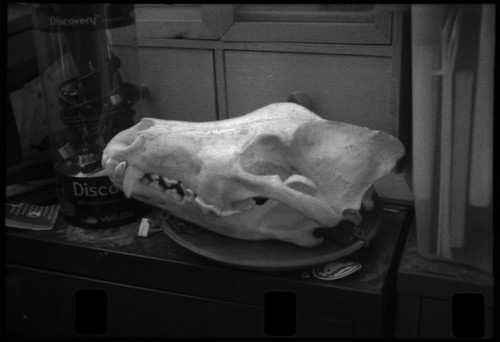
Pentax Auto 110 with 24mm lens, cartridge reloaded with Kodak WL Surveillance film 2210
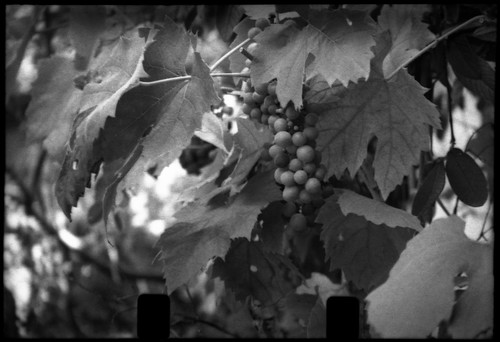
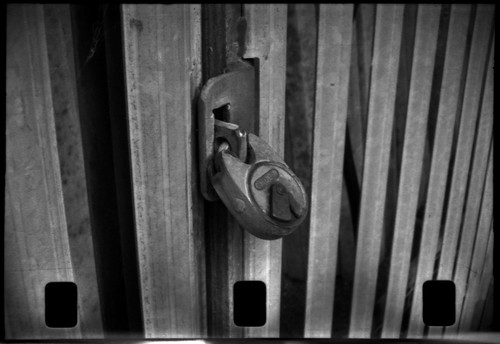
Having used two 110 cartridges and developed the films, the next step was to reload them. The website Instructables has a good guide to taking apart and reloading a 110 cartridge, which I looked at before my own attempts. The Orca cartridge came apart relatively easy after scoring the seams at each end and around the two chambers. The Kodak cartridge seemed more securely put together, and broke, although with each chamber intact, it could still be reloaded, and held together with more tape. There are some issues with reloading 110 cartridge with 16mm film. Ideally, unperforated film should be used, but the only unperforated film I currently have, Agfa Copex HDP 13, is too slow to be used in the Pentax Auto 110. I used Kodak WL Surveillance film, single perforated, with the perforations at the top of the cartridge, meaning that these would be at the lower edge of the frame. This also ensured that the pin to register 110's single perforation for each frame is not confused by the perforations along the edge of the 16mm film. This pin is used by the camera to stop film advance for each new frame, released when the shutter button is pressed. In some cameras, this pin is also used to cock the shutter, but this is not the case with the Pentax, where the shutter is cocked on the second stroke of its two stroke film advance. Without a perforation to register each frame, it is possible to shoot frames against the leader and trailer of the film's backing paper, providing that there is enough overlap of film, and it is also possible to wind the film through the camera without shooting a frame, as film advance doesn't stop on each unxposed frame. Additionally, some of the frames once developed show surge marks around the perforation holes, visible in the shot of the padlock further below.
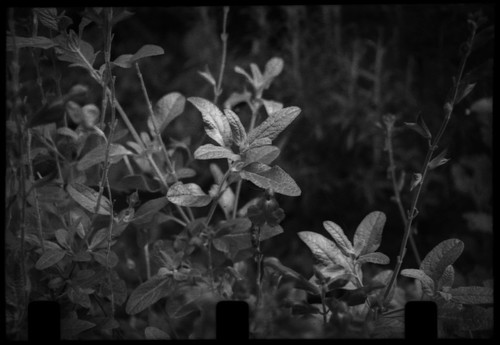
Pentax Auto 110 with 50mm lens, Kodak WL Surveillance film 2210
I modified the Orca cassette to use it for high speed film by cutting down the tab, as I had been shooting the Kodak WL Surveillance film at EI400. For this first reloaded roll, I used stand development with Ilfotec LC29, diluted 1:100 for one hour. The test roll negatives looked dense, which suggested overexposure, but this may have been mitigated by the effects of stand development and the WL Surveillance's good latitude. Subsequent scans from the film above show a good tonal range, without blocking in the highlights. To check for a difference in exposure though, I shot another two rolls of reloaded Kodak WL Surveillance film, one in the unmodified Verichrome Pan cartridge, the other in the Orca cartridge, which should have meant that the camera would rate the VP cartridge at 80, the Orca at 400. Both films were stand developed (together) in Ilfotec LC29, with dilution increased to 1:150, and a slightly shorter time of 50 minutes. Both sets of negatives (shown immediately below) looked as though they had recieved the same exposure. As the Pentax Auto 110 does have the high speed/low speed switch, I concluded that this wasn't working, and both films were rated at 100. I may not have cut the film speed tab correctly, or perhaps, as the film speed switch is next to the battery compartment, its connections may have been damaged by leaking battery acid. Regardless, the WL Surveillance film worked well enough automatically exposed by the camera, and when I shot more reloaded cartridges, I used stand development at 1:100 again, for one hour.
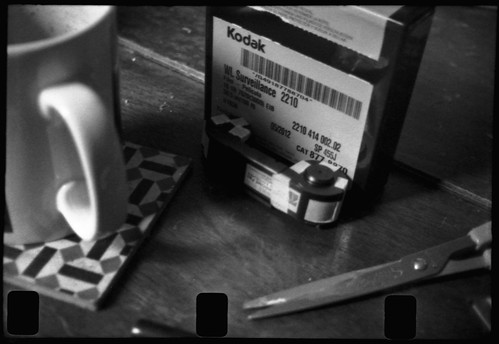
Kodak WL Surveillance film, stand developed in Ilfotec LC29, 1:150
The limitations of the Pentax Auto 110 are essentially the limitations of the original 110 format specifications. With fully automatic exposure, it can only be used with films close to the two ISO settings, but as Lomography's currently available films are 100 and 200 ISO, this is only an issue when reloading cartridges For films of slower (or faster) speeds, development could be tailored to compensate for over or under exposure, but the use of much slower films with finer grain may not be advisable due to the effective push increasing contrast. There was a second version of the camera, introduced in 1983, the Pentax Auto 110 Super, which had a number of improvements, such as a single stroke advance lever, backlight compensation, self-timer, a shutter lock and a smaller minimum aperture. However, the Super was produced in much smaller numbers, as the popularity of the 110 format was already waning in the mid-1980s. Now 110 films are available once again, the Pentax Auto 110 SLR must be one of the best secondhand cameras around for the format.
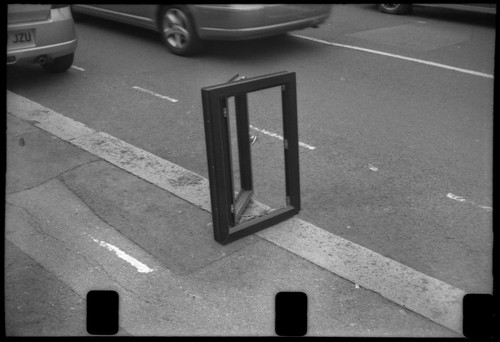
Pentax Auto 110 with 24mm lens, Kodak WL Surveillance film 2210
Pentax Auto 110 with 50mm lens, Kodak WL Surveillance film 2210
Sources/further reading:
http://www.pentax110.co.uk/
http://www.photoethnography.com/ClassicCameras/AsahiPentaxAuto110.html
http://www.cameraquest.com/pentx110.htm

110 Format:
http://en.wikipedia.org/wiki/110_film
http://www.lomography.com/magazine/lifestyle/2012/06/18/the-demise-and-comeback-of-110-film
http://www.frugalphotographer.com/info-110.htm