Showing posts with label animation. Show all posts

Friday, 29 October 2021

'Thumb Cinema'


The subject of this post is, perhaps, just outside the self-declared remit of this blog. It is however, about a hybrid constructed with analogue means. While studying fine art in the mid-nineties, I was interested in film, interested in the moving image as a medium, but struggled to find ideas which would be best conveyed in the form, something in essence which I felt with the work I was making in general for most of my degree, but easier perhaps to disguise beneath technique and process in the prints that made up the bulk of my work then. I did however make a number of short video pieces, which I described at the time as animations, which isn't the best description for what they really were. These were all made with Adobe Photoshop 2.5 and Apple MoviePlayer, the forerunner to QuickTime Player, and originated with 8mm or Hi8 video footage, videoed projections of Super 8 film, or scanned photographs and drawings–such as the work I made using Muybridge's chronophotography, referenced in The Hand Inside the Frame.

One piece I made with this method was simply titled after when it was filmed: April 1996. This combined footage taken from a train on the main line railway into London Liverpool Street, some shots around Stratford, both on and off trains, then the actual approach to Liverpool Street itself, the Tate Gallery as it was then known, a street in Barking and a view on Wanstead Flats. A number of the static locations were also videoed in a plastic mirror to distort them. If there was any ostensible subject to the piece, it was a record of my journeys around London over Easter 1996, and, by implication, the transport network: the shots from Barking and Wanstead Flats both show distant trains (around the same time I made a set of screenprints collaging photographs taken on the London Underground, overlaid with typography and graphic design with elements of trompe l'oeil in the form of torn posters). If there was to be a soundtrack to this silent piece, it would be St Etienne's 'Railway Jam'.

Adobe Photoshop 2.5 was the release before Layers, and using it to make frame-by-frame animations was a challenge. Without Layers one could copy and paste from one image onto another, and, in the process of pasting, the floating selection could be blended with the image below, using blending options very much like those in the Layers panel, but once deselected, the floating selection and the image below were then became a single image. In addition, one could only Undo/Redo to the previous state; together, these forced both a definite and linear way of working. I mostly used this method to create transitions between different shots, and in other video pieces, combined these with text, copying and pasting frame by frame from short MoviePlayer files, low resolution (320x240 pixels), low frame rate (around 6 fps). The resulting MoviePlayer files were transferred to VHS, and the originals saved in sections over numerous floppy disks initially, before I invested in a 100mb Zip disk. In 1996 these methods were primitive and perverse at the time–much of the effects could have been achieved rather more easily in the college's conventional video editing suite, but I think I enjoyed working on my own, often on Saturday mornings in the college's small Mac suite (a couple of LC IIs and a Performa with the all-important video card; the college's digital studio was all PC), hidden in a room at the bottom of the old library, figuring out how to make this method work.


A strand that runs through a number of the works I've made in recent years is that of the particularity of location. In The Work of Art in the Age of Mechanical Reproduction, Walter Benjamin describes the revolution that stems from the reproducibility of photography and film: no longer dependent on an original artefact being located in a particular time and place, every photographic print or print of a film being theoretically indistinguishable from the last, everyone can experience the work of art on a flat, democratic level. The loss of what Benjamin terms the original work of art's 'aura' is not to be something to be mourned: from a political perspective, it is a liberation. The footage from my journeys around London over Easter 1996, made into a low resolution, low frame rate video, was only ever shown to fellow students and staff at college, its ability to transport the viewers then to these locations was incredibly limited, about as far from an immersive experience as it's possible to be, even when experienced as a video projected onto a wall in a seminar room. Twenty-five years after I made April 1996, as a small performative gesture, I decided to return it to the specific location that it had originated from. There are a number of reasons for wanting to do this (the general principle of not leaving old work alone–even primitive juvenilia–being one), but the main reason was the simple fact of finding myself living not far from one of the locations used in the film. 


The shot from Wanstead Flats shows a train passing on the Barking to Gospel Oak line, then part of the North London Line, now combined into the Overground, seen from the Harrow Road playing fields, looking in the direction of Acacia Road, E11. At the time, this particular branch line felt like one of the most unloved parts of the whole London transport system: old two-carriage, slam-door diesel trains in the old livery of Network SouthEast, which ran at a frequency of twice an hour, if I remember correctly. If one wants to get a feel for London in the mid-1990s, Patrick Keiller's London represents it best; much of the infrastructure felt underfunded, broken, uncared for. The GLC had been abolished a decade earlier, British Rail had been privatised, and London had to wait until New Labour to regain a distinct political authority–with oversight for public transport–once more.


Rather than through editing, a juxtaposition with contemporary footage that brought both together in a digital space, to return this shot of the film to its location, I wanted a physical artefact that I could take there and document it replaying. This could have been on some form of monitor, a projection perhaps, but in finding an appropriate form to do this, a flip book seemed to be ideal. Its simplicity mirrored that of the original video, as well as its poor resolution and low frame rate, but also its place in the prehistory of film. The flip book's origins are located in the period in the mid-nineteenth century to which numerous devices (the phenakisticope and zoetrope, notably) designed to produce the illusion of movement date: it was patented as the Kineograph by John Barnes Linnett in 1868. Unlike those other devices, the flip book is linear, not circular, in its sequencing of motion, and, in that particular fact, foreshadowed the form that cinema would take–and indeed was a form that some of its pioneers–such as Max Skladanowsky–utilised, and, through the Mutoscope, also evaded Edison's patents. Although predating cinema, the German term for flip book is Daumenkino, literally and descriptively 'thumb cinema'. That the motion in this particular sequence in my video features a train is a fortuitous association, unintended at the time, with the birth of cinema, and the Lumières' famous train; the close-up, too, emerges with the invention of cinema (the single, short static shot that I used for this documentation is also similar to the duration of the Lumières' first films; there is also, intriguingly, a wisp of smoke alongside the bridge, no doubt from from the kind of business that inhabits a railway arch, smoke, along with water, was the kind of evanescent and ephemeral incidental subject that fascinated the Lumières). Even at its very low frame rate, it was impractical to turn the whole of April 1996 into a flip book. I took the original .mov file, imported this into a rather more recent version of Photoshop, and exported the frames from layers into individual files to print. From the start of the film, through the transition into the section shot on Wanstead Flats, then its transition into its distorting mirror image, made eighty-something pages.


It might have been more exact to have made this over Easter this year, a neat twenty-five years on, but as my life is still shaped by the academic calendar, October half-term would do. The two tower blocks in the original footage were demolished many years ago gone. These stood on Cathall Road, once overlooking over St Patrick's Catholic cemetery and the Central Line in Leyton. There is now a small park on their footprint. In the original footage, the angle of view–and also the image's aspect ratio–crop out the nearby John Walsh tower, seen on the right above, although its edge intrudes into the distorted mirror image footage in the original video. The sports pavilion on the left has also been rebuilt in the intervening years. The trees, still in leaf, obscure the railway line more than they once did. 

I recorded the short sequence with my Olympus Pen EPL1, using a manual focus Canon 28mm FD lens and a close up filter to achieve the close focus on the flip book. This meant some compromises: the angle of view is different from the original, taken from much further back, but along roughly the same axis; more importantly, I wanted to make this in one single shot, observing some notion of dramatic unity or fidelity to the event: operating the camera myself, and 'operating' the flip book too, I couldn't easily refocus the lens before and after holding the flip book in front of the lens. However, the 'real' shot of the scene is not sufficiently out of focus so as to be unintelligible–and one can discern both the moving figures in the distance and the train crossing the bridge. I did multiple takes: getting the the flip book right in the frame, in focus, then flipping through it sufficiently well wasn't always easy to achieve. The flip book itself really required tighter binding as well as a deeper spine to make the pages flip with greater regularity. As it exists, some of the pages bunch together, and the animation as a result is insufficiently smooth to achieve the illusion of motion, but in the take I used as 'Thumb Cinema', the middle section with the train passing is legible–and is followed shortly after by the contemporary train, travelling in the opposite direction, now electrified, four carriages long, four trains an hour during the day.


Sources/further reading
Rudolf Arnheim, ‘The Thoughts that Made the Picture Move’, in Film as Art, Faber, London 1958

Friday, 31 May 2019

'Uboot' Action Sampler

Uboot Action Sampler
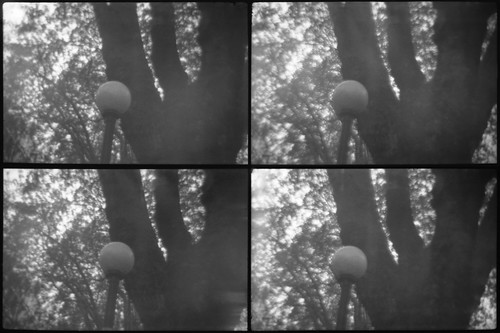
With another #ShittyCameraChallenge announced for this May, having recently been given an Action Sampler, this seemed serendipitous, and it felt a good choice: the Action Sampler is a 35mm point and shoot camera, almost entirely plastic in construction, including lenses, bar the odd metal screw holding it together and the clip for the handstrap. Its unique design, however, features four lenses that take four shots in quick succession in the space of a standard 35mm frame, with a shutter that rotates behind the lenses to achieve this. Apart from this, in keeping with the #ShittyCameraChallenge aspirations, the Action Sampler's specifications are very basic: the 28mm plastic meniscus lenses are fixed focus, fixed aperture at f11, and the shutter fires at a single speed, 1/100th, with a delay of 0.22 seconds between each lens, with the result that the four images are separated by less than a second. There is a simple, flip-up frame as a viewfinder, with a manual advance that cocks the shutter: internally there are two toothed wheels, one for setting the shutter, the other simply to turn the frame counter on the base of the camera; without a film loaded inside the camera it is possible to check the shutter operation by turning the first of these wheels manually. There is a manual rewind knob on top of the camera with a button on the base of the camera to depress for rewinding; this does not pull-up like many a manual rewind: when loading the camera, there is a cut-out section of the base, completed by a corresponding section in the camera back, so that on loading the camera, the 35mm film cartridge simply slides onto the rewind spool.

My example of the camera has 'uboot' printed on the back (the downwards pointing arrow on the front appears to be the uboot logo and is also printed on the back); in smaller type it has 'powered by www.lomo.com'; as with a number of cheap plastic novelty cameras, including the similar Action Tracker, the Action Sampler is s typical example of Lomography's modus operandi: take a cheap plastic novelty camera, rebrand it, market it, and sell it for many times its value. This 'uboot edition' was apparently given away free in the early 2000s to promote a social networking website (see this discussion on Flickr); there were a number of variations of the camera, in different colours, some with different coloured filters over the lenses, a flash version, and so on: the Lomography website is currently selling a clear version for £29.

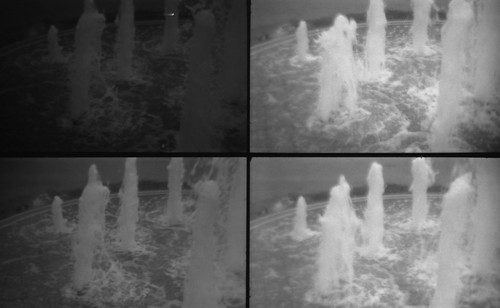
My initial thought was to use the four sequential frames to make short animated loops as GIF files, in part inspired by recent research into early moving images, by the work of Muybridge and Marey, and by reading Rudolf Arnheim (notably, 'The Thoughts that Made the Picture Move’, from Film as Art). Given the very limited parameters of what the camera was capable of, the limit of four frames, I began to think of simple, repetitious cycles of motion that the camera could represent, and might work as a short animated loop. The sequences would have to be circular, not linear, to work as loops, and I thought of some of the ideas behind my piece 'Paper Cinema' and the descriptions of how the movement of the inanimate had fascinated early viewers of cinema at its inception, epitomised in the motion of leaves in the wind. A further example of the movement of the inanimate which is present in many of the Lumiere's early films is water in its various forms: the water from a hose, waves on the surface of the sea, steam rising. In addition, I then thought of visible states which represented binaries, on/off states; all of these subjects would have to be comprehended in less than a second.

As I hadn't shot with the Action Sampler before the start of the #ShittyCameraChallenge, I looked for these subjects with the first roll through this camera, without knowing what to expect in terms of the results other than conceptually what the camera does (I had, of course, seen examples online).

Action Sampler with Ilford Pan 100
Developing the first roll through the camera suggested that I may have been too ambitious in regards of what I thought the Action Sampler capable of: to begin with, the quality of the images is rather poor, perhaps what one might expect with a plastic meniscus lens and one quarter of the resolution of a normal 35mm frame; in addition, one lens on the bottom right doesn't seem to be properly aligned and this frame in all the photographs has worse definition that the others, the upper right frame being little better. The lenses are prone to flare, and pronounced aberrations (coma, showing up in the highlights, seems to be particularly bad), and despite the stepped recesses behind each lens, the plastic interior frequently resulted in internal reflections. The shutter also is not very consistent: the exposure varies across all four frames, sometimes starting very dark, and getting brighter, suggesting that it slows as it completes its cycle.

Action Sampler with Ilford Pan 100
The shutter slowing as it rotates also overexposed the film: I used Ilford Pan 100, but this was too fast for many scenes with bright sunlight, suggesting that the shutter was slower than 1/100th (the density of the negatives did also make scanning difficult and did not improve the resolution of the images). However, when I began to create animated GIFs from some of the frames, something of my original intentions had survived despite all the technical compromises.


The best of these images were generally the simplest: it hadn't always been easy to find subjects which fitted with the limitations of the four frames in less than a second, and in addition, the parallax caused by the separate positioning of the four lenses I hadn't really taken into account. This meant that it was not a simple matter of literally stacking the four frames one after the other, but it made more sense to find a focal point to each sequence and align this in each four frames, then crop to a consistent whole, clearly seen in the image below.


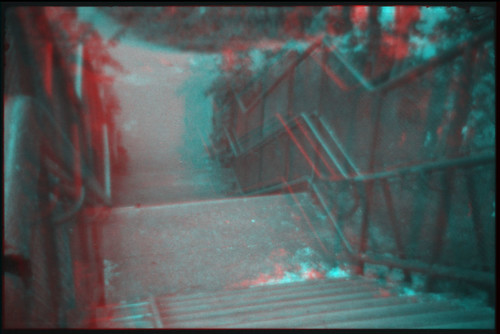
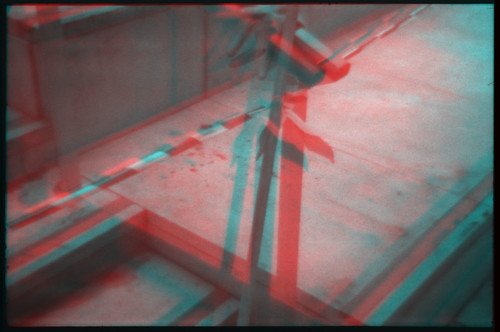
This parallax effect is essentially 'wiggle stereoscopy', and, even while I was still shooting the first roll, I thought that it would be possible to make stereo pairs from static scenes. Given the design of the four lenses, to shoot on a single standard 24x36mm frame of 35mm film, there isn't much lens separation, but the parallax is clear when put together as an animated GIF from the shifting position, both horizontal and vertical, as above. I chose some scenes with close subjects contrasting with some form of recession that could give relatively good separation despite the close stereo baseline, and the first image below is perhaps the best demonstration of this; the second image I had intended to make into an animated GIF, but the breeze which had been animating the tape did not sufficiently do so at the point at which I took the photographs, but the tape itself stands out well enough from the background as a stereo anaglyph.

Stereo anaglyph from two Action Sampler frames
Having shot and developed one roll of film during the first week of May, aware of the results, the camera's limitations and what to expect from it, I loaded a second roll of film into the Action Sampler, only to find that the camera stopped working. Initially, I did think that the shutter was simply jammed - I could advance the film, but pressing the shutter release did nothing; on closer inspection, the film advance was cocking and tripping the shutter all in one action - which I only realised once I'd taken the film out of the camera; evidently, the mechanism which is supposed to 'catch' the cocked shutter and prevent further film advance was somehow slipping: at some future point I may attempt to disassemble the camera and investigate, but, as far as May's #ShittyCameraChallenge, I decided to content myself with just the one roll of photographs, rather than pick another camera that could fulfil its conditions.


Sources/further reading:
Lomography Acton Sampler microsite
Action Sampler on Camera-Wiki
Alfred Klomp's review of the Action Sampler - includes scans of the (2-page) manual

Monday, 28 August 2017

The Hand Inside the Frame


Earlier this year when invited to participate in the exhibition Pinhole and the Art of Invention, I instinctively wanted to turn the premise on its head (“Pinhole and The Art of Invention celebrates the art of invention and the inventiveness of artists by including photographers who build homemade cameras and mechanisms to serve a specific purpose. These innovative apparatuses will take centre stage…”), and, instead of the camera being the inventive mechanism, I wanted to use that invention as a means of showing a sequence of animated pinhole images. For the exhibition, with the pinhole as a constraint, I wanted to use the most minimal means to create a moving image, which meant using pre-cinematic optical devices that produced a form of animated image, specifically the zoetrope, flip book, and phénakisticope. Although commonly thought of as optical toys, these began as instruments to demonstrate theories around the idea of the persistence of vision. Probably the least well-known, the phénakisticope was invented first, and simultaneously, by Joseph Plateau and Simon von Stampfer in 1832 (called the stroboscope by Stampfer), based on work by Peter Mark Roget and Michael Faraday; the zoetrope (in its definitive form), designed by William Ensign Lincoln, and the flip book, by John Barnes Linnett (under the name kineograph), were both invented in the 1860s.

It struck me as a remarkable coincidence that during the same decade that photography was being invented, a number of scientists were independently investigating visual phenomena that could produce the appearance of motion from a sequence of rapidly changing still images. A primitive form of photographic animation would have been theoretically possible from its very birth - although, with the long exposure times then necessary, this would have had to have been constructed through stop motion. The use of the pinhole rather than a lens was simply a consideration in order to fit the remit of the show, but this necessity, and the long exposures that resulted from the pinhole, did provoke the idea that, given the fact that these optical devices were as old as (and separate to) photography, the ‘instantaneous’ photograph (which would become the individual frames of cinema) was not necessary for animation, that the long exposure times of the mid—nineteenth century, replicated in part by the long exposures of the pinhole, could still have created moving images. Yet the desire to do so appears to have only developed after motion had been analytically broken down by the instantaneous photograph, and the subsequent realisation that it could be recombined into movement.

The subject for the animations needed to be simple and repetitive, easy to comprehend and limited to a very few frames. As a model for animated sequences shot with a pinhole camera, I turned to the very beginnings of the moving image, and, specifically, the work of Eadweard Muybridge. Of course, Muybridge didn’t use a pinhole for any of his work, but to animate his photographs, he made a modified version of the phénakisticope, combined with a magic lantern, to project moving images with what he called the zoöpraxiscope of 1879 (these were generally painted versions, rather than photographic, stretched in order to combat the distortion of the figures caused by the rotation of the disc against the counter-rotation of the viewing slits). I had previously used photographs from Muybridge’s Animal Locomotion when at college, re-animating some sequences, in my ignorance thinking that in this I was doing something unique, ignorant of those who had done same thing before me; I had also made some flip books using photocopies taken from illustrations in Aaron Scharf’s book, Art and Photography (where I also encountered the chronophotography of Marey, although Marey is best known for using multiple exposures on a single plate, and so most of his work does not have the ease of Muybridge’s for appropriation, at least for animation). My interest in Muybridge’s work had been rekindled by the Tate Britain exhibition in 2010, which put the Animal Locomotion in the wider context of his entire career as a photographer.

Drawings after Muybridge, 1996
For the exhibition, I shot sequences based on two plates from Animal Locomotion, ‘Movement of the hand; drawing a circle’, and ‘Movement of the hand; lifting a ball’, both of which were simple, repetitive motions; the first plate was one that I had used in one of the simple animations I had made while at art college twenty-one years ago. In the original plates, Muybridge constructed his sequences from twelve images, shot from in front of the figure, and a second set from the side; to replicate or emulate these twelve shots on a continuous strip of film, with the 6x6 negative size, a roll of medium format film would provide twelve square shots. I shot the images with an MPP large format camera with a 9x12cm rollfilm back, with a mask for 6x6 negatives. I made a 4x5 to 9x12cm plate back adaptor to use this back, which changed the camera’s film plane, but using a pinhole lensboard, focus was not a consideration. The photographs were shot at a focal length of around 50mm, a wide angle at 6x6, useful as it was difficult to calculate exactly what would be in the frame. For the exhibition itself, I displayed the work in the three forms previously mentioned: my initial idea was to make zoetropes to show the sequences, which were made contact prints from the uncut strip of negatives on Kodak High Resolution Aerial Duplicating film; to these I added phénakistocopes, printed from scans, and also flip books made from contact prints on paper. The latter were the most successful for showing the sequences moving; the luminance of the image does have some bearing on how well the effect of animation was perceived, and the pinhole images I had made were not bright or clear enough for both the zoetropes and phénakistocopes. However, the best representation of these image sequences is as animated GIF files - the perfect form for short, repetitive sequences of images: at one point almost a footnote, an anachronous remnant of the early internet, now social media has made the animated GIF the perfect visual form for the easily digestible meme of the social media age.


That my own hand appears in the frame is a coincidental echo of the Moebius film made earlier this year, while the theme of emulation or re-enactment also ties it to the photograph of my hand holding a photograph in Gelsenkirchen as part of my project around Wim Wenders' locations used in his road movies trilogy in the 1970s. With all of these pieces, projecting oneself into the work, as these were all made on film, taking the photographs entirely myself, there was a difficulty of knowing exactly how much of the image was in view or in focus; someone else could have operated the camera, but it was never practical in these cases. The hand inside the frame stands in for the hand of the viewer; in these two other pieces, the camera placed to suggest a subjective viewpoint, while the pinhole animations attempted the ostensible detachment of Muybridge’s work. The invisible surface of the photograph and its ability to render texture in a close-up image provokes a desire for a tactile confirmation - the viewer wanting to touch - and the hand in the frame provides an imaginative access into this depicted realm. This may be a sublimated response, and only really relates to a certain type of photograph, but perhaps the close-up of any near object has this potential, whether the subject is animate or inanimate, one can imagine the feel of the bark of a tree, the worn surface of steps, the side of a face, a wisp of hair, or in the animations, the textures and responsive pressures of the resistance of a graphite pencil against a sheet of paper. Once made, I had the odd realisation that they (my hands) looked like the hand (or more specifically the forearm) of my father, but reminiscent of the experiences of childhood intimacy, bound up with demonstrations of dexterity - the hands of my father as he demonstrated how to do things: drawing, painting, cutting lino or wood, coupled with the idea that my hands are older now than his were when this would have been the case.


Although Muybridge himself does appear in a number of the Animal Locomotion plates, the hands in these sequences are not his. They belong to J. Liberty Tadd, the director of the Industrial School of Art in Philadelphia. One wonders if he introduced the idea of the subject of the hand to Muybridge; certainly, the plate of the hand drawing a circle has overt art historical references, most clearly to the anecdote of Giotto drawing a perfect circle freehand, a feat that Albrecht Dürer repeated two centuries later to demonstrate his parity with the artists of the Italian Renaissance. Its circularity is also ideal for the limitations of the twelve-image sequences that Muybridge was working with. Once animated and looped, the circle is infinitely drawn and erased. In my own re-enactment, I marked out twelve positions around a lightly traced circle where my hand would rest for each minute-long exposure, and in doing so made explicit an analogy to the clock, both in the motion and duration of the twelve images. The 'Movement of the hand; lifting a ball' has less immediate associations, although perhaps the clock of the previous plate has now become a globe; these exposures were two minutes long each, and with my hand unsupported for most of the shots, this time duration is more evident in the final pinhole photographs.


The two plates that I drew on for the exhibition were part of a larger sequence of five of Tadd; these five plates all appear at the very end of Part Five of Animal Locomotion, being ‘Males and Females (Draped)’. All five plates are titled 'Movement of the hand', with the explanatory suffixes: plate 532 is 'Movement of the hand; drawing a circle', 533, 'clasping hands', 534, 'lifting a ball', 535, 'beating time', and 536, 'hands changing pencil' (Part Six which follows is 'Abnormal Movements’). Having re-enacted the first two plates, it seemed logically necessary to tackle the other three plates, to complete the project outside of the exhibition; two of these, clasping hands and hands changing pencil, lack the visual clarity of the other three, in that the representation of a simple gesture or movement does not naturally form a circular unit; one plate in particular, 'Movement of the Hand; beating time', had a richness to it that merited further consideration. Intriguingly, the plate of 'hands changing pencil', although in itself perhaps the least interesting (it appears almost as if it is a preparation for the drawing of the circle - although it is in fact a different tool), in  J. Liberty Tadd’s obituary from the American Art News, in its short paragraph, among other achievements, it mentions a demonstration of ‘ambidextral drawing’ to the Royal Arts Society of London in 1891, so this plate might acknowledge Tadd’s ambidextrousness. All five plates of the hand demonstrates dextrousness of course: the fine motor skills and opposable thumbs of the human hand. That Muybridge’s Animal Locomotion is in some senses a comparative anatomy, one could infer that evolution might be an implied, unconscious subject.


Plate 535, the 'hand beating time' plate clearly suggests music - and therefore sound. A few of the Animal Locomotion sequences explicitly do suggest the idea of music in mind of the viewer, namely those of figures dancing; less than a decade after Animal Locomotion, under the aegis of Thomas Edison, William Kennedy Laurie Dickson’s ‘Experimental Sound Film’ of late 1894 or early 1895 achieved the feat of recording sound and moving images simultaneously, showing Dickson himself playing the fiddle into a phonograph while two men dance. Sound was present from the very birth of cinema, and all through the silent era (the 'silent era' was of course never silent) there were numerous attempts to record sound simultaneously with the images; although the problems with synchronising playback were not conquered until the development of sound-on-film (the earliest successes with ‘talking pictures’ did in fact use sound-on-disc), amplification was as much an issue as synchronicity. I emulated the positions of Tadd’s hand through this sequence rather than beat time itself, given the long exposures. Was Tadd beating time to a tune in his head - or to music provided by one of Muybridge’s assistants? (It would be too fanciful to suggest that he was beating time to music being played on an Edison phonograph; a few short decades later, silent films would use music on set to create an emotional atmosphere for actors - ‘silent’ film sets were themselves notoriously noisy, and in larger, open studios several different scenes might all be being filmed at the same time). Although there is no possibility of reconstructing a tune, Tadd’s hand appears to be beating in triple-time - not itself surprising given the date of the sequence, but I was struck how strongly the visual rhythm suggests this.


Muybridge and Edison met in 1888. Muybridge’s account of the meeting suggests that they discussed using Edison’s phonograph to accompany his zoopraxiscope, although, with the very short duration of Muybridge’s sequences, logically, the phonograph would have needed to simply produce a short loop of sound if these were to be synchronised; the phonograph’s two minutes of recording time must have seemed vastly expansive to Muybridge. The form of the phonograph - a cylinder with a linear, spiral track - informed Edison and Dickson’s initial approach to moving pictures: a glass cylinder with microscopic frames arranged in a spiral. However, after Muybridge, Edison met Marey in 1889, by which time Marey was working with rolls of film rather than fixed plates. Thus Muybridge’s closed, circular motion in the zoopraxiscope led to an open, cylindrical motion, to the linear motion of a continuous strip of film of (theoretically) unlimited length. This was also a transition from the inflexible glass plate to flexible celluloid film (via some experiments with paper) and a host of other inventors (Janssen, Anschütz, Le Prince, Friese-Greene, Donisthorpe, to name a few), as detailed in Rudolf Arnheim’s ‘The Thoughts that Made the Picture Move’.

Muybridge's photographs were cropped significantly for publication in Animal Locomotion: the frame was imposed retrospectively, and what we see in the neat modernist grids of the published plates is not the whole photograph. The cyanotype contact prints of the photographs that make up the 'Movement of the hand' series show Tadd as a half-length figure, with a hat shading his face against the sun. As with almost all early cinema (and proto-cinema), Muybridge depended on natural light for his sequence images; although the dark, gridded background appears airless, the grid itself was an open screen of twine: in some of the oblique views it's possible to perceive this background as a shallow space beyond the grid that it is possible to enter, not merely the limit of the picture in depth. That the 'Movement of the hand' plates have a unique position in the Animal Locomotion as a whole is emphasised by the fact that these five plates (as “Class 9. Movements of a man's hand”) were available as one of the separate sections when Muybridge reissued Animal Locomotion at the time of the 1893 World's Columbian Exposition in Chicago, which had a ‘Zoopraxigraphical Hall’ where he lectured; there is some dispute over whether Edison demonstrated his Kinetoscope at the fair or not. The 'Movement of the hand' plates do not appear to have been translated into zoopraxiscope discs for projection, but one particular aspect of the sequences does foreshadow cinema: they are the only plates which could be said to constitute a close-up in the whole project. David Campany describes the close-up, along with montage, as part of the distinguishing grammar of cinema, and, that, “…as Beaumont Newhall noted in 1937, ‘photographs of portions of objects (close-ups) were most uncommon before the moving picture.’” This uncommoness is represented in Muybridge's distinct five plates of the 'Movement of the hand':
The close-up can show us a quality in a gesture of the hand we never noticed before when we saw that hand stroke or strike something, a quality which is often more expressive than any play of the features. The close-up shows your shadow on the wall with which you have lived all your life and which you scarcely knew; it shows the speechless face and fate of the dumb objects that live with you in your room and whose fate is bound up with your own.
Béla Balázs, Theory of the Film

Bibliography

Hans-Christian Adam, Eadweard Muybridge: the Human and Animal Locomotion photographs, Taschen, Köln 2014
Rudolf Arnheim, ‘The Thoughts that Made the Picture Move’, in Film as Art, Faber, London 1958
Béla Balázs, Theory of the film: character and growth of a new art, translated from the Hungarian by Edith Bone, Dover Publications, New York 1970
Philip Brockman, Eadweard Muybridge, Tate, London 2010
David Campany, Photography and Cinema, Reaktion Books, London 2008
Kevin MacDonnell, Eadweard Muybridge: The man who invented the moving picture, Weidenfeld and Nicolson, London 1972
E. J. Marey, Movement, translated by Eric Pritchard, D. Appleton and Co, New York 1895
Eadweard Muybridge, Descriptive Zoopraxography, Lakeside Press, Chicago 1893
Aaron Scharf, Art and Photography, Allen Lane, London 1968
Rebecca Solnit, River of Shadows: Eadweard Muybridge and the Technological Wild West, Bloomsbury, London 2003
Spencer Sundell, The Pre-History of Sound Cinema, Part 1: Thomas Edison and W.K.L. Dickson
J. Liberty Tadd obituary, American Art News