|
| Edixa 16-S |
Before Kodak introduced the 110 cartridge format in 1972, one of the great issues of subminiature film cameras was the proprietary cassette: with the popularity of subminiature cameras emerging in Japan in the 1950s, it seems every manufacturer made their own film cassettes which were all incompatible with other manufacturers' cameras. Evidently, Kodak were aware of the subminiature market, and after the success of the drop-in 126 cartridge, Kodak entered–or subsumed–that market with the consumer-friendly 110 cartridge; with Kodak's reach, the 110 format forced a standard and most other subminiature camera formats slowly disappeared.
There were some examples of cross-manufacturer compatibility, but this generally happened through the copying of cameras, most notably, the initial Kiev Vega cameras which were copies of the initial model of the Minolta 16 camera, although the Kiev camera soon diverged as it evolved. One rare example of what must have been active co-operation, the Rada 16 cassette was adopted by three different German manufacturers. Although some information online doesn't always agree, it appears that the Goldammer Goldeck 16 camera was first, in 1959, followed by the first Edixa 16 in 1960 and finally the Rollei 16 in 1963.
One reason for picking up an Edixa 16 camera is that I already had a number of cassettes thanks to sourcing them for my Rollei 16. There was also the sense of still looking for the 'perfect' subminiature camera that would take 16mm film (if such a thing could be found). The Rollei 16 has some limitations, such as its automatic exposure, but the biggest restriction of the camera is its use of perforated film. This means that cut-down film cannot be used in the camera, and one is restricted to whatever emulsions are available in 16mm–restricted further to single-perforated unless one wants to have the perforations appear along one edge of the image. The Rollei 16 is also quite large for a subminiature camera; the image below comapares the Edixa 16-S to the Rollei 16.
 |
| Edixa 16-S (front) and Rollei 16 (viewfinder extended for use) |
There are a number of different Edixa 16 models, as well as Franka and Alka-branded versions; I found an Edixa 16-S at a relatively low price online and it was one of the cameras I bought on something of a whim during the second year of the pandemic as a distraction, and one without much research, although the sources seem a little thin on detail. Comparisons to the Rollei 16 here feel apt–the cameras have a similar feel in some respects, not just from the use of the same cassette; with the optional lightmeter that attaches to the side of the camera, the Edixa 16 and Rollei 16 look more alike (my camera came without the meter). I had thought that Heinz Waaske might have been involved in both designs, as Waaske famously worked for Rollei on the Rollei 35, but he only joined Rollei two years after the Rollei 16 was introduced (Waaske also proposed a compact 35mm camera to Wirgin, no doubt thanks in part to his work on the Edixa 16; Wirgin passed on the concept, which Waaske then took to Rollei, who produced around 2 million Rollei 35 cameras).
Without the lightmeter, the Edixa 16 is just over 8cm wide, by 4cm deep and about 3cm high with the various buttons, dials and levers protruding from the top and botton. The Edixa 16-S appears to be the low-end of the range of Edixa 16 cameras, with some of the functionality of the other models absent. There is also an Edixa 16 S, a different model from the similarly named 16-S described here (the S on that camera is engraved below the name - S - like the other models, M, MB, U. The 16-S lacks the small wheel or lever located next to the exposure dial for use with flash. It has an unnamed 25mm f2.8 lens–most of the other models, although not all, have a circular lens surround which gives the name of the lens, supplied by Schneider-Kreuznach, Rodenstock or Schacht. According to Submin.com, the Edixa 16-S has a Rodenstock Trinar lens, although this is not marked.
 |
| Edixa 16-S top plate |
On the left is the exposure dial. On the Edixa 16-S, shutter speed and aperture are a coupled EV (exposure vaue) system with black numbers ranging 8-15; outside this, the apertures above are marked in red. This is not the first camera I've had with an EV system, but on the Edix 16-S there is no means to override the coupling. The exposure dial also lacks shutter speed information (the Edixa 16 M and MB do have markings for shutter speeds) but the coupling is simple: from EV 10-15, the shutter is set to 1/150th: this encompasses the whole range of apertures. EV 9 is 1/60th at f2.8, and EV 8 1/30th at f2.8. The dial on the 16-S does rotate to a position below EV; on other cameras, this is where there is a B setting, but on the 16-S this doesn't function as an unmarked B and is presumably the same setting as EV 8.
The exposure dial also has a ring to set ISO. Without the dedicated lightmeter that attaches to the Edixa, this ring simply functions as a reminder. Using my Edixa 16-S, I mostly relied on the 'sunny 16' rule, although the EV numbers work well with contemporary light meters that have LV/EV numbers that one can use without thinking about the precise aperture/shutter speed combinations. There is–to me at least–a faint echo of the top plate of the Edixa 16 cameras in Heinz Waaske's design of the front face of the the Rollei 35.
 |
| Edixa 16-S bottom plate |
The viewfinder is of the bright albada type, with parallax marks for close subjects. The viewfinder is not quite as good as that on the Rollei 16 but close–it is one of clearest subminiature viewfinders I've experienced (it's also worth mentioning that it's larger and clearer than a number of my 35mm and medium format viewfinders); the viewfinder does take up nearly one-third of the length of the camera body. On the end of the body by the viewfinder there's a large screw and two round hole to which the meter attache; on the other end is threaded socket which functions for a tripod or hand strap.
 |
| Edixa 16-S showing rear latch |
 |
| Edixa 16-S opened for loading |
A unique aspect to the Edixa 16 camera is the take-up spool, which is removable: to load the camera, the take-up spool is taken out. It has a spring clip under which the end of a fresh roll of film is secured, and then both are dropped into the camera, both with different dimensions, which means that they can't be inserted the wrong way around. If the take-up spool is missing, the camera is unusable as there's no way for the film to be wound on. The take-up spool has two small holes in the top through which two tabs on a spindle in the body connects this to the advance lever. Closing the camera body after loading, if the two parts of the camera don't fit closely, it can be that attention needs to be given to the positions of the tabs and the corresponding advance crank on the camera bottom to match these up properly (as well as the small slot in the release catch needing to be lined up correctly).
 |
| Edixa 16 advance or take-up spool |
The first roll of film that I put through the Edixa 16-S was a cut-down section of Ilford HP5 Plus, an offcut from making up 127 format rolls. I did use the sunny 16 rule when exposing this film. With the shutter speed at most exposure settings being 1/150th, it wasn't necessarily easy to make exposure calculations in my head as I shot, and I think the results rely on the fact that HP5 Plus has enough latitude to excuse a lack of precision in exposure.
 |
| Edixa 16-S with Ilford HP5 Plus |
The results were promising: the unnamed lens performs well on the subminiature level, and the shot I was most pleased about was the image above, shot in the Tate Modern Turbine Hall, not the easiest lighting conditions to contend with when exposing. The images from the camera in this post are scanned from the negatives; printing in the darkroom from the negatives would no doubt give better results. I also shot some Kodak Imagelink film, an unperforated document film. I rated this film at either 20 or 25 ISO: the film is very tight in grain but has narrow latitude.
 |
| Edixa 16-S with Kodak Imagelink |
With bright sunlight and deep shadows, the Imagelink film does not have the latitude to record information in both highlights and shadow areas, and so is better suited to overcast days when taking photographs outside. It is also particular in development, bearing in mind that using the film for pictorial purposes is not its intended use (I used a semi-stand development in Kodak HC-110 at dilution G, 1+119 from concentrate at 18 minutes at 20ºC, with agitation every 5 minutes).
There were two issues that emerged with my Edixa 16-S. I began to have overlapping frames on my negatives; I may have caused this by breaking the small pin which registers the film counter. I did this when trying to load the camera without a cassette inside a black bag–this was as I didn't have a cassette loaded, and I thought I could get a longer length of 16mm inside the camera without a cassette, but then caught the pin and bent it. When trying to bend this back into place it broke.
 |
| Edixa 16-S counter pin |
This proved impossible to fix: I taped the two pieces together and fixed it back into the camera, but its spring was gone, which meant that the frame counter now keeps slipping back to the start position. The overlapping negative frames might be related to this.
 |
| Edixa 16-S with Kentmere Pan 400 |
I did find a workaround for this: when advancing the film, I found I was able to watch the rewind crank turn–like a manual 35mm camera–and if it didn't appear to be turning, or turning enough, I would take a blank frame and advance it again. It is one additional concern when using the camera.
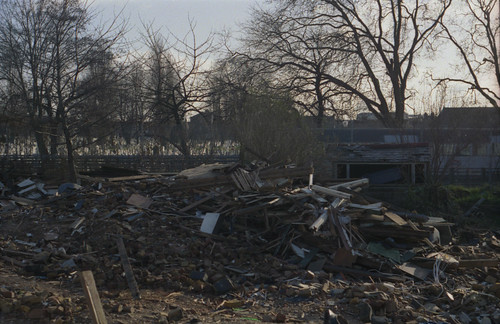
Other than these issues, the Edixa 16-S is one of the better subminiature cameras I've used, partly due to its small size and how it feels in the hand–or handled in a coat pocket like a netsuke. Having used it for a few rolls, any of the more fully-featured Edixa 16 cameras would be preferable of course–the Edixa 16 M or MB models being the top of the range, and, using the dedicated lightmeter, although this makes the camera bigger, it would make exposure easier, although I'm used to using manual cameras with or without metering, so this isn't necessarily a great consideration when shooting. I hadn't used any conventional low ISO films with the camera, which might provide images with finer grain but better latitude than the Kodak Imagelink, something else to try, and would also show off the quality of the lens–which printing from the negatives in the darkroom would ultimately demonstrate.
 |
| Edixa 16-S with Ilford HP5 Plus |
 |
| Edixa 16-S with Ilford HP5 Plus |
 |
| Edixa 16-S with Kodak Imagelink |
 |
| Edixa 16-S with Kodak Imagelink |
Sources/further reading:
Edixa 16 cameras on Camera-Wiki.org
Heinz Waaske on Camera-Wiki.org
Edixa 16 cameras on Submin.com