Showing posts with label Canon A-1. Show all posts

Friday, 16 January 2026

FAST

A12, Leytonstone, January 16th 2024

Two years ago I made a series of posts about my photographs of the M11 Link Road, posting on the dates on which I had taken the original pictures in 1993 and 1994, thirty years on, but with comparison photographs I had taken of the same locations twenty years later, already ten years old. I took new photographs then as well, but, apart from a set of pictures taken in August, I didn't post those at the time. I recently came across the scans of some of the negatives from 2024, mislaid through switching desktop computers. I had taken colour photographs in January 1994 (and in 2014; the post 'SQUIBB' compares these), so did the same in January 2024; the 16th of the month, the date I had taken the original pictures, was a Monday, a working day in 2024, which meant a detour to take the photographs before going to work, and, being January, the first photographs were taken just before sunrise. I got the handful of photographs I had wanted; the day before, I'd also taken a set as security, of the same locations as well as some in Wanstead which felt like too far in the wrong direction to shoot before work.

The image at the top of this post looks across the A12 (known as the M11 Link Road during its construction) towards the remaining sections of Dyers Hall Road, replicating one of the shots from 1994; in 2024, I also waited for a train to cross the railway bridge (the rebuilding of which–the green section–had been one of the first visible signs of the coming of the road), something I'd photographed in black and white a couple of weeks earlier in 1994 (the colour photograph from 1994 is first below).


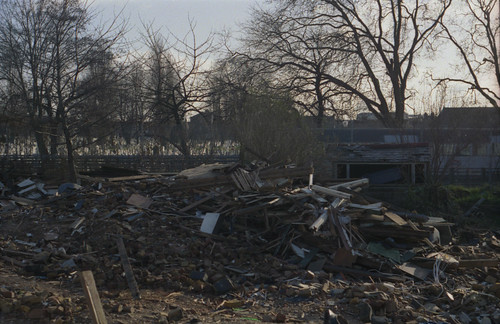
The most striking images from January 1994 were those taken on Claremont Road; Claremont Road was almost entirely swallowed up by the new road, and now exists as a very short dead-end stub. A few new houses have been squeezed into the space between the houses and gardens on Grove Green Road and the A12 itself, with its characteristic yellow and red brick wall. In the previous post, I had reckoned that my position in the picture of the new houses would overlap with that of the partially demolished house from 1994 at the top of that post; see the pairing below. I think the short driveway in the middle of the picture from 2024 should roughly match up with the two doorways to the left of the photograph from 1994. 


What I didn't notice in 2014, when I took the photographs after a twenty year gap, is that there was a small section of the original houses on Claremont Road still surviving, like a remnant of Roman Wall sandwiched between contemporary buildings such as one might find in the City of London; I photographed this on the Sunday; the shot below (with detail) is taken to the left of that immediately above.


The rest of the photgraphs from Claremont Road are impossible to replicate: this would require levitating above the A12 (in August 2024, I used the strategy of taking some photographs across the A12 from the cemetary on the far side with a long lens, something that I didn't consider in January). The other photographs were from Colville Road, which lost all its houses on its eastern side, and a few facing these at the northern end, but was a little easier to replicate: after thirty years, the plane trees on the other side of the Central Line are still recognisable. My main difficulty in January 2024 was photographing into the rising sun above the wall of the A12 as below.


The other shot from Colville Road can be approximated; the 2014 photograph didn't take into account the fact that the road changes its angle at the northern end. Even taking this into consideration, the picture from 2024 should still be much closer to the contemporary wall (the graffiti on the gantry above the A12 gives this post its title).
 

The final two images from 1994 were taken from the footbridge over Eastern Avenue in Wanstead; as previously explained, I shot these in 2024 on the 15th rather than the 16th. The pairing of the first two shots below suggests that the footbridge was rebuilt slightly further down the slope over Eastern Avenue from that of 1994.

Unlike the photographs taken in 2014, I didn't attempt to use the same lens design for the photographs in 2024: these were all shot with the Canon A-1. I did use the same film, Kodak Gold 100 (however similar it may be the Kodak Gold 100 of thirty years ago); the positions for the photographs in 2024 was, in the main, closer to the original photographs taken in 2014, as much as can be achieved within the built environment as it currently exists between Leyton, Leytonstone and Wanstead. Although not replicating a photograph from 1994 (I regret not taking more photographs then), I took a photograph from the footbridge in Wanstead looking up the A12 to where it enters the George Green tunnel, site of some of the early and visible resistance to the road scheme–with the occupation of a 400-year old tree–as this was to go thanks to the use of cut and cover, a less expensive construction technique than tunneling itself.


Saturday, 25 February 2023

Lomography Fantôme 8 - single roll review

Lomography Fantôme 8 35mm film

Approaching two years ago at the time of writing, I posted a short 'single roll' review on the Lomography Berlin Kino 400 film. This had been one of the rolls of film that I had won as part of the #ShittyCameraChallenge prize (sponsored by David Walster - @196photo on Twitter), four different rolls of 35mm black and white film, all of which were new to me. One of the other rolls was Lomography Fantôme 8; like the other Lomomgraphy film, the box has the description '35mm KINO film', but unlike the 'Berlin' film, Fantôme 8's origins are not those of a camera film, used to generate a negative–which its low ISO of 8 indicates. According to Alex Luyckx, Fantôme 8 is Orwo DP31. Orwo's data sheet describes it thus:

ORWO duplicating positive film DP 31 serves as a film for the production of intermediate positives (master positives). Due to is panchromatic sensitisation this film can be used for duplicating from black & white negatives as well as from colour negatives producing well-balanced grey values referring to original colours. Special features of this film are the excellent resolving power and the extraordinary fine grain

As a very low ISO film, I had been anticipating that I'd want to use the roll of Fantôme 8 for something specific which would take advantage of its particular characteristics, rather than 'everyday' film photography. Last week I wanted to make an interpositive to create a print in negative from a negative, and naturally thought of the Fantôme 8 for precisely the qualities the data sheet describes (this, incidentally, was for the Undertow exhibition). I shot half the roll and developed it as needed, then decided that I may well as well find the time to use the remainder of the film. For the purposes of making the interpositive, I used a tripod and my Canon A-1 SLR; at 8 ISO, there are few situations in which hand-holding a camera with Fantôme 8 is practical, but I did expose a couple of frames hand-held, both of which were with the lens wide open at f1.8 and a fairly slow shutter speed. The second image below was at 1/20th, which will have probably introduced a small amount of camera shake, leading it to be less sharp as a result; the first image, silhouetting bare branches against a bright sky at a medium distance was rather easier 

Canon A-1 with Lomography Fantôme 8

Canon A-1 with Lomography Fantôme 8

The first image above was shot on the end of the half of the roll I had used first, and the high contrast of the image was fairly evident. I used Kodak HC-110 at dilution H, 1+63 from concentrate, with a time of 14 minutes at 20ºC (the Orwo data sheet, unsurprisingly for a motion picture film, gives D96 as a developer). The film has probably the clearest base of any I've used–and was also extremely curly once developed. Having used half the film first, and assessing the results, this gave me an idea of how to approach using the remainder of the film. Thanks to its high contrast, in terms of subjects, for most frames I avoided including much or any sky in the composition, concerned it would render almost entirely bright and featureless (as a panchromatic film, it would have been possible to use a yellow filter); the image below was one of the few with a significant area of sky in the frame.

Canon A-1 with Lomography Fantôme 8
I may have been cautious in this, but the few frames with bright sky and bare branches silhouetted against it brought up a different problem in scanning: the clear base introduced a form of halation in the  scanning of the negatives, with the light of the scanner passing through these clear areas and reflecting back inside the scanner. This is an effect I've noticed with a few other films, but this was particularly intrusive here. In the image below it is a rather disruptive artefact of the scanning process; I imagine that darkroom printing would not have the same problem.

Canon A-1 with Lomography Fantôme 8

Close-up crop from scan

Given Fantôme 8's characteristics, I had hoped for overcast weather conditions for photographing, not uncommon here in February, but instead I found it was an afternoon of intermittent, if hazy sunshine. To lessen the high contrast of the film, using the Canon A-1, with its double exposure capability, on a number of frames, I was able to use the technique of pre-exposure to raise the shadow values. To do this, I first shot a frame of a grey card without focussing three and a half stops below the camera's indicated exposure, then pushed in the multiple exposure switch before engaging the film advance, which, with the multiple exposure switch engaged, simply cocks the shutter without moving the film. After development, the frames which had pre-exposure were easily distinguishable on the negatives, although in scanning, with many frames the differences were not as great as I might have expected.

Canon A-1 with Lomography Fantôme 8
Canon A-1 with Lomography Fantôme 8 and pre-exposure
The most successful use of this technique is demonstrated in a pair of frames in which the subject was the low winter sun reflecting of a puddle, with the surroundings otherwise in shadow, which wouldn't be a subject easy to expose for a film with greater latitude: the pre-exposure here opens up the shadow detail just enough to define the landscape which becomes a little lost in the first image, where more exposure would lose detail in the highlights.

Canon A-1 with Lomography Fantôme 8
Canon A-1 with Lomography Fantôme 8 and pre-exposure
A better test would be to print from these negatives in the darkroom, to be able to properly appreciate the difference the pre-exposure has made. However, for some of the images here, it does appear to have benefitted the negatives. As a general preference, longer tonal scales in negatives I find easier to work with (which was, in part, the frustration I felt with Ferrania P30); for many or most subjects it's a general look that I prefer, and, as a technique, using pre-exposure with Fantôme 8 here has softened some of the film's particular qualities. Many of the examples of the film that I've seen online play on these high-contrast qualities, and, had I been wanting that look, and found subjects appropriate for it, Fantôme 8 would have been ideal: I do feel that I found it a bit more flexible than I had anticipated. With the some of the compositions in which I was mindful in not including the sky, I found that there was something–a little–of the 'ungrounded' quality of some of Muybridge's photographs of Yosemite (on a much less grand scale of course) which I had been looking at again recently, in which the lack of a horizon or discernible foreground places the viewer in an uncertain relation to the scene depicted. Having used the film initially for a purpose not dissimilar to its original usage, then, finding the right subject matter and an appropriate technique for the film's limitations, I found myself liking Lomography Fantôme 8 rather more than I had expected to.


Sources/further reading

Sunday, 10 May 2020

Eastman Double-X - Part Two

In the three years since my post on Eastman Double-X film, observing interest online, the popularity of this motion picture film stock amongst still photographers has steadily increased. As a motion picture stock Eastman Kodak produce Double-X in 35mm and 16mm in bulk lengths, the minimum length being 100ft/33m in 16mm; since my previous post about Double-X, a number of companies now provide 35mm canisters ready loaded with the films for still photographers (I previously bought a 100ft roll of 35mm to load my own canisters); the film is marketed as CineStill BwXX, Film Photography Project's X2, as Double-X from Camera Film Photo, and Nik & Trick among others. My motivation for revisiting Double-X in this post came about through using the film with a different developer from those I'd used previously - D96. D96 is Kodak's recommended developer for black and white negative motion picture stock - which now comprises of just Double-X; comments on my original blog post recommended that I use D96 after my somewhat ambivalent conclusion to the film from using it in 35mm for the best part of a year. It didn't seem particularly fine-grained for its speed, and the speed itself didn't seem fast enough to make it a good all-round film in comparison with 400 ISO films on one side, or finer grained 100 speed films on the other.

Formulas for making D96 from its raw ingredients are readily available online, and it has also been available as a powder, but recently Bellini have produced a liquid version of D96. Evidently there are many advantages to the convenience of liquid developer, especially as a stock solution; my habitual developers are Rodinal/R09 and Ilfotec LC29, which I have used for a number of years: it makes sense, especially when starting out with developing black and white film, not to change too many variables at any point, one of these obviously being film developer. However, I recently shot two rolls of 2x8mm Double-X (reperforated for the format and repackaged by the Film Photography Project) in a Bolex ciné camera, and, wanting to develop the films myself, it seemed wise to try the manufacturer's recommended developer with the film, especially given the small size of the 8mm frame. The short film below was shot on 2x8mm Double-X and developed in D96; for reasons too complicated to detail here, I pushed the film three stops in development, which does account for the contrast, while the appearance of the grain is mostly down to the degree of enlargement necessary from the tiny 8mm frame.

Having used the D96 for a couple of rolls of 2x8mm Double-X, having a litre of D96, I wanted to test the film in 35mm with the developer and it seemed timely to revisit Double-X for a new blog post. For a first test with 35mm, I shot a roll with in a Canon A-1 SLR for a latitude test, rating the film at successive exposure indexes of 64, 125, 250, 500, 1000, 2000 for two sets of six exposures, as seen in the first and second rows below, and developed the film for 6 minutes in stock D96 at 21ºC.

Eastman Double-X latitude test, developed in D96
Eastman Double-X latitude test, developed in Ilfotec LC29
Comparison with the same film developed in Ilfotec LC29 (above) from my previous tests appears to show greater latitude when developed in D96, although the conditions with the Ilfotec LC29 were higher in contrast; the same film when developed in Ilfotec LC29 looks as though the shadow detail drops away faster. It's also possible that the test film developed in D96 is slightly underdeveloped: Kodak's published time for Double-X is 7 minutes at 21ºC (rather than the more usual 20ºC); my notes indicate I developed the film for just 6 minutes at 21ºC.

Double-X at EI 64 (two stops overexposed)
Double-X at EI 2000 (three stops underexposed)
I was a little surprised at the latitude range which this test demonstrated as evidenced in the two shots from either end of the scale above: scanning the film, I was able to pull out as much detail as possible from the negatives when underexposed. This was easier than the equivalent exposures with Ilfotec LC29. Overexposure did compress the tonal range from mid-tones to highlights, giving the images more of a flat look than the lighting alone. The latitude in this test is no doubt due in part to the diffused, low contrast lighting when I shot the the film to try D96, as well as the developer itself.

When I'd previously used the film, I did try pushing it one, two and three stops, with very uneven results at two and three stops. Published times for Double-X in D96 are very limited, but the Massive Dev Chart and Bellini's own data sheet give a time of 25 minutes at 20ºC when rated at 1600. I shot a roll at 1600 in (mostly) challenging lighting conditions. This test was possibly overdeveloped, using 21ºC for 25 minutes, rather than 20ºC.

Double-X at EI 1600
Most of these shots were taken under artificial light, in a low-lit museum setting, with spot-lit displays creating inherently high contrast subjects, the above image being a good example; the Double-X rated 1600 did give relatively good results in these difficult circumstances. There were only a couple of shots that I took under daylight conditions, and these on a fairly dark day in February, not enough to draw any meaningful conclusions, but the results look good enough, as below; generally, daylight would of course give enough light to rate the film at 250. Although the times for push-processing Double-X in D96 are limited, it would be possible to make reasonable guesses for one and two stops, perhaps around 12 minutes to rate the film at 400 and 18 minutes for 800, although I haven't tested for these times.

Double-X at EI 1600
As well as trying 35mm Double-X with D96, I also wanted to see how it would perform in 16mm for various subminiature cameras, notably the Rollei 16 camera (this has reputedly one of the sharpest lenses on any subminiature camera). The results on this post are scanned from the negatives; printing in the darkroom, it might be possibly to resolve more detail from the 12x17mm negative. The best of the shots from the Rollei 16, such as that below, showed D96 to give fairly fine-grained development: with the negative very nearly a quarter of the size of a standard 35mm frame, at a modest enlargement, the quality does hold up (albeit perhaps suggesting the grain of a faster film, but I think the general point holds true).

Rollei 16 with Eastman Double-X
As a motion-picture negative developer, fine grain is paramount. Grain is inherent to the film's emulsion, but obviously, the appearance of the grain is affected by a number of factors. D96 contains sodium sulfite, which acts as a solvent (as well as a preservative), softening the look of the grain; equally, some of the fineness of the grain in my results may be in part due to the developer's low contrast, particularly on a micro level, smoothing out the look of the grain. This also makes it a good choice of developer for using Double-X in half-frame cameras, as well as subminiature cameras. I did shoot some Double-X in a couple of half-frame cameras for this post, but, again, under fairly poor lighting conditions, which perhaps didn't provide the best conditions for testing the film.

Olympus Pen EE3 (half-frame) with Eastman Double-X
Belomo Agat 18K (half-frame) with Eastman Double-X
I had been fairly ambivalent about Eastman Double-X prior to using it with D96: it almost felt like a different film, testing it again with a more sympathetic developer. The grain appears finer, the film does seem to have better latitude, and, on my limited tests, it pushes better, with more consistent results. However, a few further reflections on using D96 might be apposite here. The developers I have mostly used for black and white films - Rodinal and Ilfotec LC29 - I have treated as 'one-shot' developers, Rodinal, which I've generally used as Compard's R09 One Shot clearly being so, but also Ilfotec LC29, which Ilford recommend using as a one-shot developer when diluted 1+29, or indeed for best results. At lower dilutions, 1+9 or 1+19, I've tended to use it for just one session, but have developed a number of rolls of film, one after the other. Using a stock solution such as D96 does provide some consideration, namely around temperature and exhaustion. With a highly concentrated one-shot solution, I get the water to dilute the film developer up to temperature simply by adding hot and cold together until these reach 20ºC, then add the concentrated developer. Even if this is cold, adding one 30th part at 15ºC for example, 12ml to 300ml, will not significantly alter the temperature. With D96, I found warming the bottle of stock solution took more care, especially when using this early in the year, when the stock solution might be at less than 10ºC off the shelf. Plunging this into a jug of water somewhat warmer than 20 or 21ºC to bring it up to a working temperature more quickly often meant it would get too warm, and then would need to cool before use. The other consideration, exhaustion, was more difficult to calculate. I bought my bottle of Bellini D96 from Nik & Trick; on their website, the suggestion is that a litre of D96 will process "about 100ft". Presumably this is 35mm film. I developed two lengths of 25ft 2x8mm film, 16mm wide, which probably equates to 25ft of 35mm; I also shot four rolls of 27-exposure 35mm film, and some 16mm film with both the Rollei 16 and Mamiya 16 subminiature cameras. In addition, I used the D96 for some Plus-X too, and the FP4 Plus that I'd shot in the Bolex. With the FP4 film, I developed half the film and the negatives were very thin. This might be partly due to user error of course - most of the roll of Double-X I shot with the Agat 18K produced thin negatives, but this was one of the first rolls of film I developed in D96. Returning to comments earlier in this post about not changing too many variables, obviously, using several different cameras, with different metering systems or none, and also developing different emulsions with the same stock solution of D96 made it more difficult to see when the developer was beginning to exhaust: the last films I was developing with the D96, I found myself having to double their published times in order to get good results - clearly, accurate record keeping would have helped here. Comments about developer exhaustion notwithstanding, using Eastman Double-X film with D96 has lead me to reappraise this film stock - and understand the enthusiasm that still photographers do have for it.

Rollei 16 (16mm subminiature) with Eastman Kodak Double-X rated 200
Belomo Agat 18K (half-frame) with Eastman Kodak Double-X rated 250
Olympus Pen EE3 (half-frame) with Eastman Kodak Double-X rated 250
Kodak Retina IIa with Eastman Kodak Double-X, rated 250
Canon A-1 with Eastman Kodak Double-X rated 250
Canon A-1 with Eastman Kodak Double-X rated 1600

Thursday, 3 October 2019

'Heatwave'

'Heatwave' installation in Undertow at Sluice HQ
Last Summer, I was shooting some digital video on the very outskirts of London. It was a location where I had once drawn the scenes in front of the camera in a sketchbook many years before. While recording the landscape, I noticed smoke rising from the near horizon.  It was close enough that I abandoned what I was doing, and, following the footpath I knew would take me towards the smoke, I emerged onto a large field of stubble beside the path to find the far edge of it and the field beyond on fire. Fire engines had arrived, and were arriving, the flames were being beaten out while leaping up elsewhere, creeping across the field to where I was standing. This encounter with the present made me think that the project I had been engaged on - looking back at the landscape through the drawings years ago - lacked the immediacy of the present: that present, last Summer, was the most sustained heatwave in the south of England for forty-two years, and had, at that point, continued for several weeks.

At the time, I had been looking at early cinema, and had come across accounts of observers, amongst the very earliest viewers of films, remarking at how the camera captured the movement of inanimate objects, and that this was a revelation. This led to the piece called Paper Cinema in which the idea of a film responding to these accounts was paired with the earliest observations of the formation of a projected image - that of the image of the sun during an eclipse projected through gaps in the leaves of a canopy of trees - and in my initial conception of this piece as a film, there would be a voiceover describing these two phenomena as they appeared on two screens. Having written the text for that voiceover, I realised that this was sufficiently conveyed without the necessity of the image to move: I made the piece as a two photographic prints, with the text as an integral part of the prints. The viewer could read these texts and their internal voice became the voiceover for the photographs they could imagine moving. In thinking back to that earlier piece, I visualised a static shot of uncut dried grass moving in a slight wind. This would be the content of a short film, a moving photograph, whose subject was the continuing heatwave.

I filmed this with the Canon Cine Zoom 512 on part of a roll of 8mm Orwo UP15 film with a ‘develop before’ date of March 1976 - the same year as the most prolonged heatwave before that of 2018, and which last Summer was inevitably compared. I had already used some of this film previously: despite its age, it only needed a small increase in exposure to counter the loss of sensitivity with the passage of time to record a visible image.

The process of filming had to take into account the technological constraints of using this film stock from 1976 to record the scene. I used a short length of film rather than all that was left on the reel, long enough to fill the universal developing tank's reel - and documented the process itself on the same film stock with the Mamiya-16 Automatic. One of the reasons for using this, beyond just being able to shoot the 16mm-wide 2x8mm film, was that the frame size with the Mamiya-16 Automatic is designed to take double-perforated film - as with the 2x8mm format. Other subminiature cameras use single- or unperforated film which would therefore show the perforations in the frame. For the 8mm ciné camera, I spooled around five feet onto a reel to use in the camera to shoot the scene, and a second, shorter length for the stills camera. As the 2x8mm film is passed through the 8mm camera twice, I framed two adjacent views for each pass of the film. In between, the film is removed from the camera and turned over to shoot on the other side; it is possible to do this in the dark so as to not expose the film to light, but the format was designed for this to be done out in the light, albeit subdued light; on a whole roll of film, the beginning and the end of the reel are treated as a leader and trailer and not intended to be used for filming, but with a much short length of film, I shot from the point of loading until the end, leading to the image being bleached out by the light at each end. The film could have been loaded, reloaded and unloaded in complete darkness, which would have meant taking a black bag with me while filming, but I wanted this bleaching-out to occur as it felt appropriate to the subject. I panned the camera between this two shots; with a small overlap, the two framings show adjacent views of the dry, uncut grass.
Documenting the process of the film’s making, I realised that this documentation perhaps revealed more than the film itself. When taking the still photographs, I had broken down the process into five components: the film stock; the lightmeter; the camera; the scene or location; and the film itself after development, hanging up to dry. Having documented the process on the same film, these images were printed in the darkroom. Each of these images required a caption. With the 2x8mm film from the Canon Cine Zoom camera developed as a negative rather than a reversal or transparency film for projection, I could also print images from this in the darkroom and made a sixth print of two frames from the two different shots of the film. This was scanned as a negative unsplit along the middle of the film, as would be the case if reversal development was used to produce a transparency for  projection. For the Undertow exhibition at Sluice HQ, the texts for each caption were shot on photographic film and were also printed in the darkroom to the same format, both images and texts being made from the same physical material and would, in format if not attention, have an equality when displayed. The text was first laser-printed to A3 size then photographed with a Canon A-1 with a 50mm lens and a close-up filter using 35mm Rollei ATO 2.1 Supergraphic film. I rated this at an exposure index of 6, and bracketed the shots to two stops over; this film I developed by inspection with RO9 One Shot at a dilution of 1+200.


Printing the frames from the 2x8mm film in the darkroom required a mask with a folding baffle to expose one frame first, then rotated 180º to expose the second frame before development; the scale of the 8mm frames - a tiny negative of 4.8x3.5mm - was entirely dependent on how high the enlarger head could be extended. I had first printed a section of the film without the mask to determine the size and format of the mask that I subsequently made (as with negatives of the still photographs, I used the subminiature film adaptor which had come with the Kiev-30M camera, designed to fit into a 35mm enlarger tray, and keep the negative flatter than would be the case using it unsupported within a 35mm tray).


Making the film was a gesture at the contemporary, but became about the process, about the near-obsolete technology used. This technology has a relationship to the physical world that the digital lacks, and the caption texts reflect this: light sensitive material, the measurement of light, clockwork motion, the grain of the film. In exhibiting the photographs at Sluice HQ without the film, the descriptions point to something viewer is not actually seeing - and this admits the inadequacy of the medium to convey the physiological aspect of the heatwave. A narrative account in some form might have been able to use metaphor, description, a montage of visible signs but would still be inadequate. Again, with reference to Paper Cinema, this would have to be created in the mind of the viewer.

A shorter version of this post was published on the Undertow Research blog earlier this year. The Undertow exhibition was held at Sluice HQ London March-April 2019.