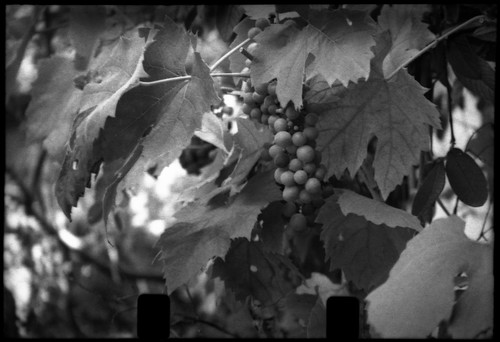
Showing posts with label Kodak WL Surveillance. Show all posts

Friday, 12 September 2014

Subminiature odds and ends

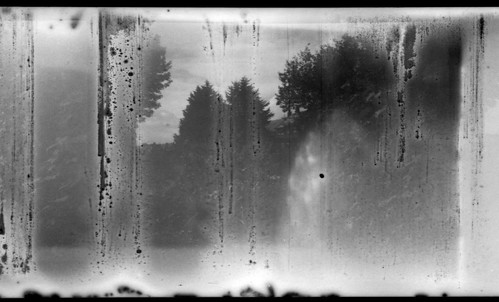
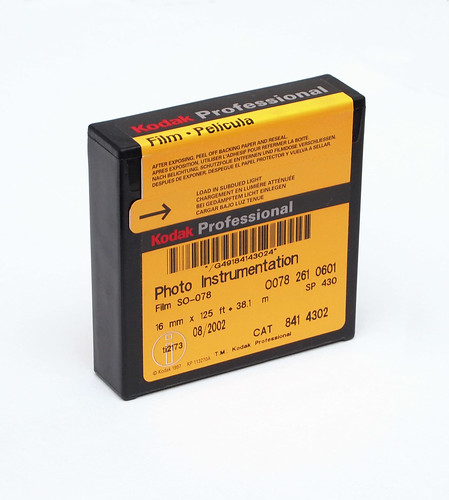
As I have shot a lot of film in my subminiature cameras over the past few months, it seemed timely to write a short summary of a few aspects of using them not covered in the posts about the individual cameras. Coming to the end of the 100ft-roll of Kodak WL Surveillance film, I bought a similar-looking box of Photo Instrumentation Film SO-078. This film was double-perforation, although I thought it was single when I bought it, the 'SP' on the box label clearly refers to something else. There was very little information online regarding the film (the seller had stated it to be 500 ISO); one obscure reference I did find was in a report from a NASA conference on atmospheric electricity where it was described as "a 400 ASA T-grain emulsion". As the film's SO number designates, this is a 'special order' film, which may mean that the emulsion itself could be the same as Kodak's TMAX 400 coated on a particular base and format. My first test showed that metering for 200 gave fuller negatives: exposed at 400 the negatives are thin, but the film is 12 years past its develop before date.

Kodak 16mm Photo Instrumentation Film SO-078
Having got 30 images from my first test roll using the Mamiya-16 Automatic, as against the 20 frames that the camera's cassettes are designed to be loaded with, I suspected that the Photo Instrumentation film was a little thinner that the surveillance film I've used previously. The box contains 125ft/38.1m of film on the same metal spool that usually contains 100ft. I shot the film at a range of exposure indexes, stand developing in Ilfotec LC29 at 1:100, and, as mentioned above, found rating it around 200 gave the best results.

Kodak Photo Instrumentation film SO-078 test roll
 Having perforations on both sides of the film, with the Mamiya-16 Automatic the lower holes were just on the edge of the bottom of the frame, if perfectly centred, although the scan of the film above shows the frames tilted on the film, which means the perforations occasionally intrude further into the image area. Scanning the negatives shows the Photo Instrumentation film as being fairly grainy, although as I have mentioned on other posts about the subminiature format, prints made in the darkroom would give a better representation of the film's qualities.

Kodak Photo Instrumentation Film SO-078 test shot, rated 400 EI
Kodak Photo Instrumentation Film SO-078 test shot, rated 200 EI
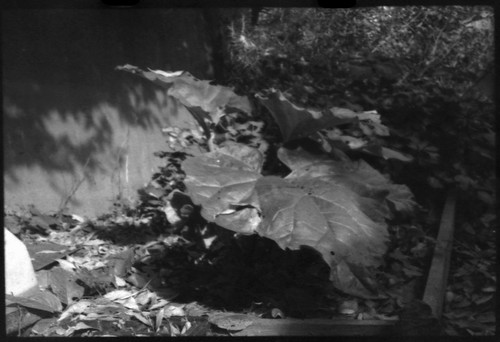
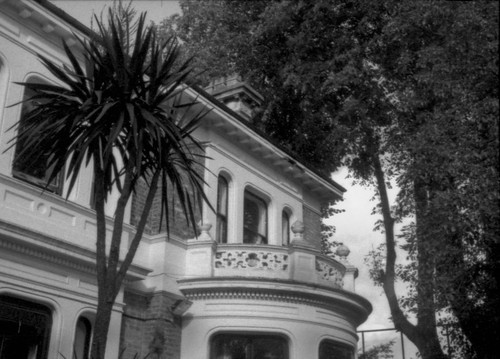
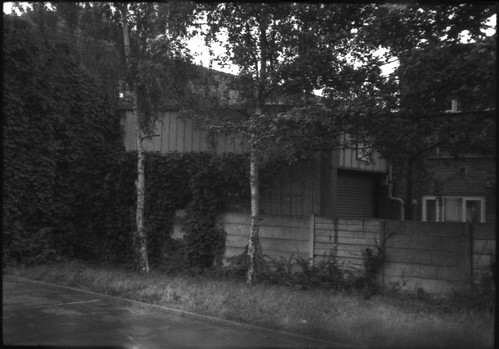
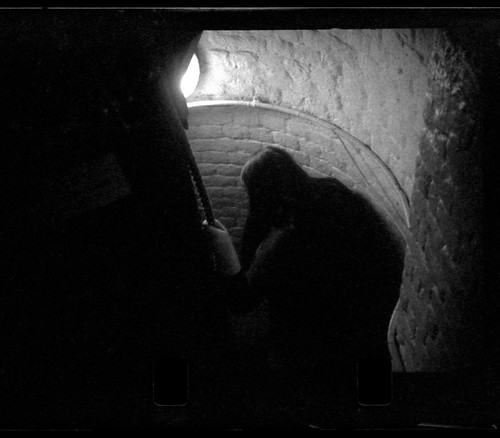
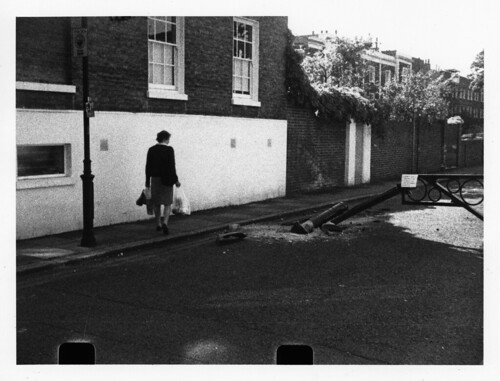
I also shot the film with the Kiev-30M, where the camera's larger frame size meant that the sprocket holes appeared at both top and bottom of the image. Depending on the subject matter, this can be more or less distracting, as in the examples shown below.

Kiev-30M with Kodak Photo Instrumentation Film SO-078
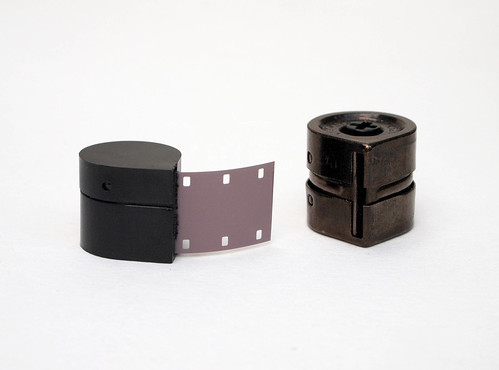
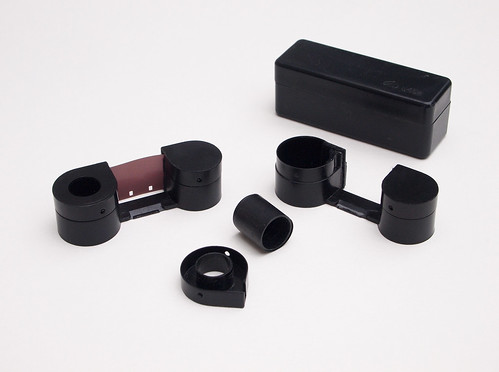
Although a number of different emulsions are still made in 16mm (and there is always the option of cutting film down to fit the format), one of the problems confronting the contemporary user of subminiature cameras is the scarcity of the propriety cassettes. Those made for the Kiev series of subminiature cameras appear to be most common, having been produced until around 1990. I found a cheap online seller of these, and, having bought ten cassettes, I decided to modify a couple to use with my Mamiya-16 Automatic. I already had two original metal cassettes, as well as a later plastic two-chambered one.  The metal cassettes are designed to fit both sides of the camera, and, being identical, each contain the spool used to advance or wind on the film. As the spool in the supply-side chamber is redundant, I cut the supply chamber from a couple of the plastic Kiev cassettes to feed the metal ones, as these were small enough to fit the Mamiya-16 Automatic. This now means that I can load three cassettes for the Mamiya camera, rather than just the two. I also cut an old yellow gelatin filter to fit the Mamiya-16 Automatic's filter holder as a substitute for the missing glass filter. As referred to im my post about the Minolta 16 QT, it's very handy having the filter built-in to the camera rather than an additional accessory to carry around.

Cut down Kiev cassette (left), with single Mamiya cassette
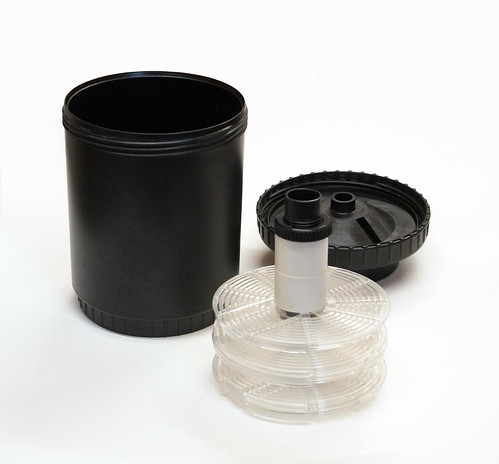
For about a year I had been developing 16mm film from the various subminiature cameras by taping it, emulsion side out, to 35mm film and loading it onto a normal Paterson reel. This hasn't been always consistent, and I have had problems with the 16mm film not being held taut enough against the 35mm for the developer to adeqautely reach the emulsion surface. Frequently, the tape would come off the film in its hour-long immersion when stand developed, with the usual result of having to fix the film loose. As my use of 16mm film has increased over the past few months, the solution to developing the films was a tank or reels that would actually fit 16mm, having only used Paterson tanks and reels for years. I found a very cheap 'universal' developing tank from the former Soviet Union, which uses reel ends separated by spacers which can be changed in their configuration to hold 35mm, medium format, or, as in the image below, 16mm, with an arrangement that can develop two films at the same time. The reels do not have ball bearings to drive the film around the spirals, so it requires a little more care when loading, but it's a useful addition to my darkroom equipment.

Universal Developing Tank, with reels in the 16mm configuration

Monday, 25 August 2014

Pentax Auto 110

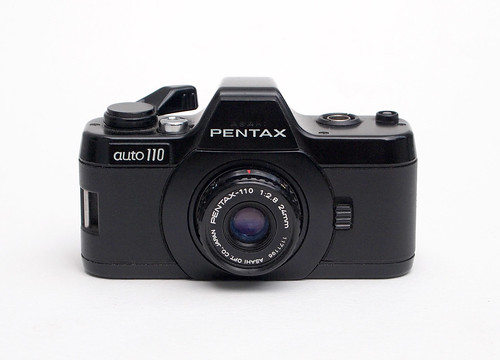
Pentax Auto 110 with 24mm lens
The Pentax Auto 110 is a remarkable single lens reflex camera on a miniature scale for the 110 format. Although the subminiature format was popular with many other Japanese manufacturers from the adoption of 16mm film for still picture cameras in the 1950s, through to the introduction of the 110 cartridge in the 1970s, Asahi/Pentax only entered the subminiature market with the Auto 110 in 1978. However, the Pentax Auto 110 was not the first SLR for the format: two years earlier, Minolta had produced their initial model of the Minolta 110 Zoom SLR. The Minolta cameras had a fixed zoom lens with aperture priority exposure and a range of ISO settings; by contrast, the Pentax was far more compact, measuring just 98x56x43mm with the 24mm lens, yet it has interchangeable lenses, fully automatic exposure, and a range of accessories.

As an SLR system camera, designated by Asahi simply as 'System 10', the Pentax Auto 110 was provided with a full range of lenses: as standard, the 24mm lens represents the 'normal' angle of view, and was complemented with the 18mm wide angle, 50mm 'portrait' lens, 70mm telephoto and 20-40mm zoom. Focus on all lenses except the fixed 'pan-focus' version of the 18mm is manual: the viewfinder has a split image central spot. As the unique two-bladed diaphragm combines both shutter and aperture and is an integral part of the camera body (shown in the image below), all lenses had to work with the same maximum aperture of f2.8, which stops down to the smallest aperture of f13.5 in the right conditions. There was also a third-party 1.7x teleconverter from Soligor, and a number of filters for the different lenses, including UV and skylight, but also close-up fliters. Other accessories include two different flash units, a power winder, and a belt clip.
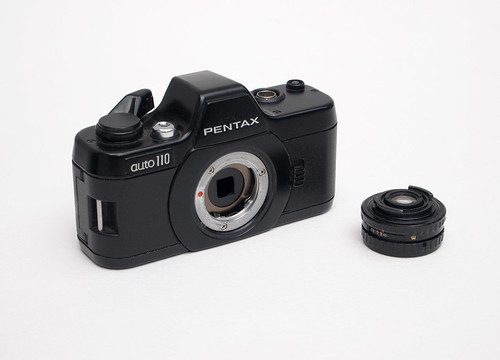
Pentax Auto 110 with lens removed
As the name suggests, the TTL exposure is entirely automatic: lightly pressing on the shutter button, an LED shows in the bottom right corner of the viewfinder, green for shutter speeds above 1/30th, yellow (for low-light) speeds below 1/30th. Exposures ranged from 1 second at f2.8 to 1/750th at f13.5. The Pentax Auto 110 does use the 110 cartridge's film speed tab to set exposure at either 80 or 400 ISO (some websites list the high speed setting as 320 ISO). As exposure is automatic, it's important to note that the camera does not work without batteries: the SLR mirror does flip up mechanically, but the shutter itself will not fire. Fortunately, the camera utilises two SR44/LR44 type batteries which are commonly available. The removable battery holder has a unique design with rotational symmetry which means it works inserted into the camera either way up.
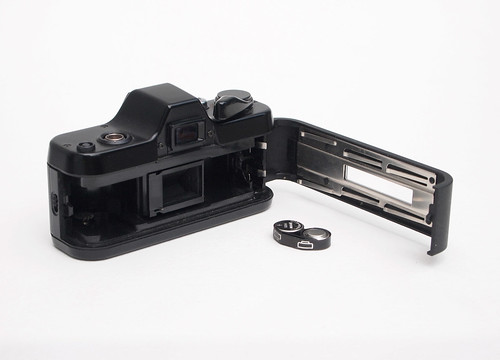
Pentax Auto 110 with open back & battery holder removed
The Pentax Auto 110 in the images illustrating this post was left behind when a family member emigrated, and had evidently not been used for some time when I chanced upon it. Opening up the camera revealed two heavily furred batteries, but after cleaning the battery compartment and the contacts, I inserted two new batteries, and the light inside the viewfinder came on when lightly depressing the shutter button. The battery compartment also had some damage, where the plastic edge seperating the film chamber from the batteries had broken away, which may have been due to leaking battery acid. This does not appear to affect performance directly, but, as I later found, it may have meant that the batteries fit less securely. I very quickly found a 50mm lens online to supplement the 24mm, for just £7, so ordered this and a couple of film cartridges.
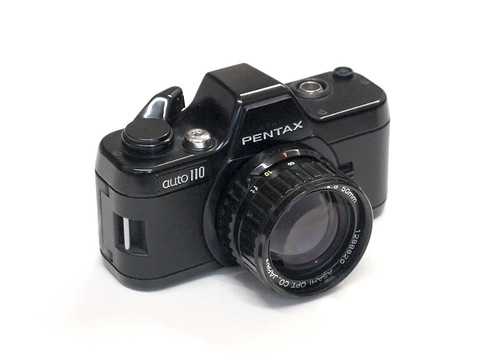
Pentax Auto 110 with 50mm lens
In a number of my posts about 16mm subminiature cameras, I have referenced the 110 format as a point of comparison. Kodak introduced the 'pocket instamatic' drop-in cartridge in 1972, essentially a smaller version of the earlier 126 cartridge, which succesfully competed with the various 16mm subminiature systems, and the format was very popular through the 1970s and into the 1980s. As a format commonly used for cheap snapshot cameras, like 126 and the short lived APS film, the 110 film cartridge was a casaulty of digital photography, and most companies had discontinued production by the mid-2000s, the last being in 2007, but since 2011 the format has been ressurrected with Lomography marketing both colour and black and white 110 films. The first production run of Lomography's black and white 'Orca' film cartridge didn't use backing paper, but subsequent batches do, which is useful to have when reloading the cartridge.

I bought a cartridge of the Lomography Orca film to test the Pentax Auto 110. After loading, I shot a few frames before realising that the exposure LED was not lit. This turned out to be poor battery contact, perhaps caused by the damage to the battery compartment. I removed the film cartridge (although later realised this could be done with it in place), and wedged a small piece of folded card to force the metal contacts tighter to the batteries. I also shot an old Kodak Verichrome Pan cartridge (with a develop before date of Sept 1978), this being the only black and white film originally made for the 110 format - until Lomography's reintroduction in 2011. This cartridge contained 12 frames, and due to the camera's fully automatic exposure, I was unable to compensate for the age of the film when shooting. I attempted to do so when developing, but with little success. Lomography's website has times for a number of film developers, but using the unlisted Ilfotec LC29, I choose to utilise stand development at a dilution of 1:100, for one hour with the Orca film, and two hours for the Verichrome Pan.

Lomography Orca 110 format film
One of the first things I noticed after developing and scanning the films was the clear presence of an overlap around the printed frames. This can be seen in the scan below, particularly in the lights around the top and sides of the frame. Kodak's original specifications for 110 film included this pre-exposed frame for the convenience of photo-lab printing. It was interesting to discover that the printed frames were not insignificantly smaller than the actual frame size that the camera uses. I attempted to measure the size of the pre-exposed frames from the scanned negatives, and got the following approximate measurements: Kodak's Verichrome Pan frames were 12.6x16.9mm; the Lomography Orca frames were practically the same at 12.7x17mm. However, without the pre-exposed frame, the Pentax Auto 110 has a negative size of 13.4x19.6mm. At the small scale of the 110 format negative, the extra 2mm width is not inconsiderate. In terms of area, the Orca negative is 215.9mm2, compared to 262.6mm2 without the frame, a difference of 21.6 per cent.
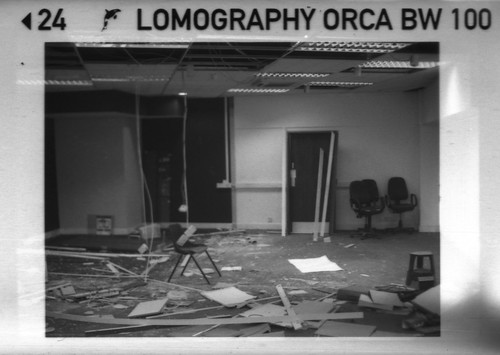
Orca 110 film, showing overlap with printed frame
Unlike the cassettes of the 16mm subminiature cameras I've used recently, the 110 cartridge is not designed to be reloaded with film and re-used. This I think represents something of a split between the formats, as, although the various different 16mm cassettes could be bought ready loaded with film, these cassettes were designed to be reloaded by the user - for example, my Kiev-30M box set came with two empty cassettes. The 110 cartridge is made to be used once, and handed in to be professionally processed. Although it may be fanciful to characterise this split as that between a consumer and an amateur, implying more the original sense of the word, reloading and reusing 16mm subminiature cassettes requires a certain level of commitment from the user, different from the spirit of the single-use drop-in cartridge. Additionally, the pre-exposed frames of the 110 format also impose limitations on camera manufacturers: by comparison, although there is a standard 35mm frame size, there are cameras which use different format frames, such as half frame, or the few odd cameras which take square format images. Likewise, 120 rollfilm cameras use 6x9, 6x7, 6x6, 6x4.5 framings, among others. 16mm subminiature cameras also had different frame sizes: generally, as the cameras were developed, frame sizes expanded, from cameras designed with frame sizes to fit between the holes of double-perforation film, to larger areas using nearly the full width of unperforated film. There was even a 16mm panoramic camera: the Viscawide-16.
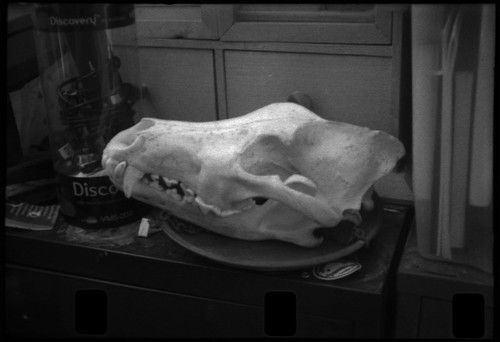
Pentax Auto 110 with 24mm lens, cartridge reloaded with Kodak WL Surveillance film 2210
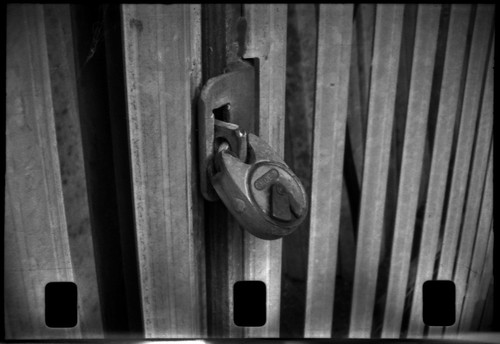
Having used two 110 cartridges and developed the films, the next step was to reload them. The website Instructables has a good guide to taking apart and reloading a 110 cartridge, which I looked at before my own attempts. The Orca cartridge came apart relatively easy after scoring the seams at each end and around the two chambers. The Kodak cartridge seemed more securely put together, and broke, although with each chamber intact, it could still be reloaded, and held together with more tape. There are some issues with reloading 110 cartridge with 16mm film. Ideally, unperforated film should be used, but the only unperforated film I currently have, Agfa Copex HDP 13, is too slow to be used in the Pentax Auto 110. I used Kodak WL Surveillance film, single perforated, with the perforations at the top of the cartridge, meaning that these would be at the lower edge of the frame. This also ensured that the pin to register 110's single perforation for each frame is not confused by the perforations along the edge of the 16mm film. This pin is used by the camera to stop film advance for each new frame, released when the shutter button is pressed. In some cameras, this pin is also used to cock the shutter, but this is not the case with the Pentax, where the shutter is cocked on the second stroke of its two stroke film advance. Without a perforation to register each frame, it is possible to shoot frames against the leader and trailer of the film's backing paper, providing that there is enough overlap of film, and it is also possible to wind the film through the camera without shooting a frame, as film advance doesn't stop on each unxposed frame. Additionally, some of the frames once developed show surge marks around the perforation holes, visible in the shot of the padlock further below.
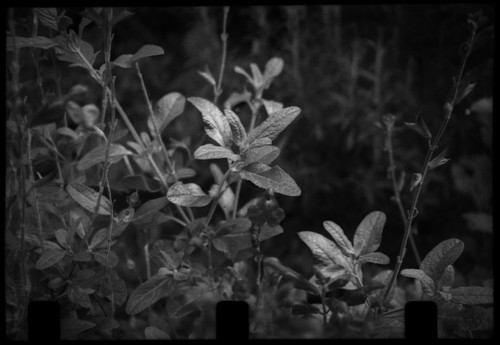
Pentax Auto 110 with 50mm lens, Kodak WL Surveillance film 2210
I modified the Orca cassette to use it for high speed film by cutting down the tab, as I had been shooting the Kodak WL Surveillance film at EI400. For this first reloaded roll, I used stand development with Ilfotec LC29, diluted 1:100 for one hour. The test roll negatives looked dense, which suggested overexposure, but this may have been mitigated by the effects of stand development and the WL Surveillance's good latitude. Subsequent scans from the film above show a good tonal range, without blocking in the highlights. To check for a difference in exposure though, I shot another two rolls of reloaded Kodak WL Surveillance film, one in the unmodified Verichrome Pan cartridge, the other in the Orca cartridge, which should have meant that the camera would rate the VP cartridge at 80, the Orca at 400. Both films were stand developed (together) in Ilfotec LC29, with dilution increased to 1:150, and a slightly shorter time of 50 minutes. Both sets of negatives (shown immediately below) looked as though they had recieved the same exposure. As the Pentax Auto 110 does have the high speed/low speed switch, I concluded that this wasn't working, and both films were rated at 100. I may not have cut the film speed tab correctly, or perhaps, as the film speed switch is next to the battery compartment, its connections may have been damaged by leaking battery acid. Regardless, the WL Surveillance film worked well enough automatically exposed by the camera, and when I shot more reloaded cartridges, I used stand development at 1:100 again, for one hour.
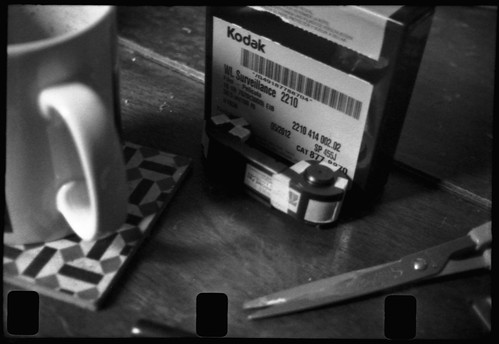
Kodak WL Surveillance film, stand developed in Ilfotec LC29, 1:150
The limitations of the Pentax Auto 110 are essentially the limitations of the original 110 format specifications. With fully automatic exposure, it can only be used with films close to the two ISO settings, but as Lomography's currently available films are 100 and 200 ISO, this is only an issue when reloading cartridges For films of slower (or faster) speeds, development could be tailored to compensate for over or under exposure, but the use of much slower films with finer grain may not be advisable due to the effective push increasing contrast. There was a second version of the camera, introduced in 1983, the Pentax Auto 110 Super, which had a number of improvements, such as a single stroke advance lever, backlight compensation, self-timer, a shutter lock and a smaller minimum aperture. However, the Super was produced in much smaller numbers, as the popularity of the 110 format was already waning in the mid-1980s. Now 110 films are available once again, the Pentax Auto 110 SLR must be one of the best secondhand cameras around for the format.
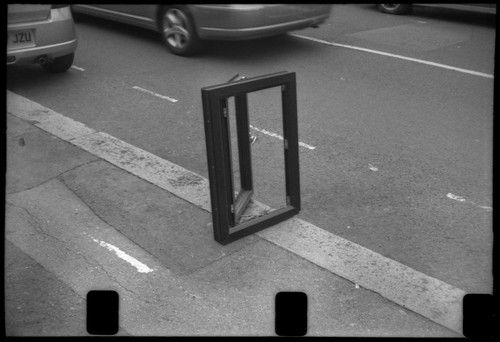
Pentax Auto 110 with 24mm lens, Kodak WL Surveillance film 2210
Pentax Auto 110 with 50mm lens, Kodak WL Surveillance film 2210
Sources/further reading:
http://www.pentax110.co.uk/
http://www.photoethnography.com/ClassicCameras/AsahiPentaxAuto110.html
http://www.cameraquest.com/pentx110.htm

110 Format:
http://en.wikipedia.org/wiki/110_film
http://www.lomography.com/magazine/lifestyle/2012/06/18/the-demise-and-comeback-of-110-film
http://www.frugalphotographer.com/info-110.htm
Sunday, 17 August 2014

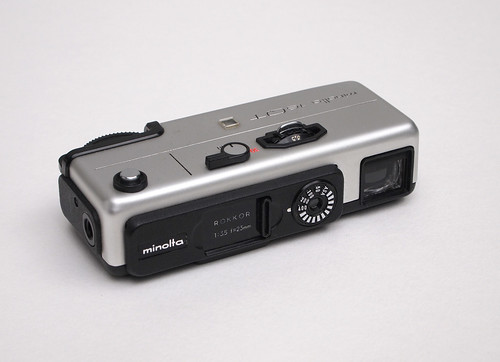
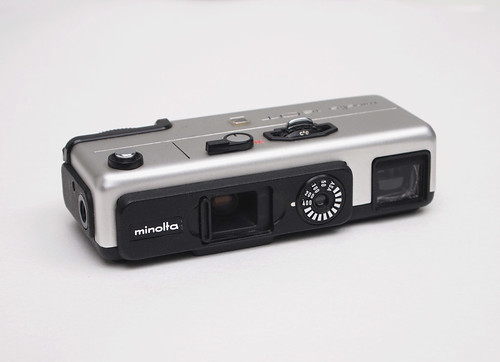
Minolta 16 QT

Minolta 16 QT
The Minolta 16 QT was the last of Minolta's 16mm subminiature cameras, a series that began with the Konan-16 Automat in 1947. Introduced in 1972, the QT coincided with the launch of Kodak's 110 format, which was the end for 16mm subminature cameras with proprietary cassettes (with a few exceptions). The following year, 1973, Minolta brought out the Pocket Autopak 50 for 110, while production of the Minolta 16 QT was discontinued a year later. The camera features more plastic in its construction than previous Minolta subminiature models, making for a lighter camera, and the design isn't dissimilar to that of contemporary 110 format cameras. The QT is notable for being the only Minolta 16mm camera that had a focussing lens: previous cameras had fixed focus lenses, and while some had built-in 'portrait' filters, clip-on filters were also provided for distance focus - some cameras would not provide sufficient depth of field at wide apertures to focus on infinity. Incidentally, the Minolta 16 QT can use close up filters initially designed for copy stand work with the Minolta-16 MG-S. The appeal of subminiature cameras is primarily their compact size: if the camera then needs accessories such as additional filters to focus on near and far objects, part of that appeal is diminished.

Minolta 16 QT with lens cover open
The lens is a Rokkor 23mm f3.5 with a sliding lens cover that also locks the shutter. Apertures are contiunously adjustable from f3.5 down to f22, this last aperture setting being smaller than most on subminiature cameras providing the QT with excellent depth of field - from 0.8m to infinity when set at the 2m or half-length figure mark. The aperture ring on top of the camera body accessed by pushing down the 'electric eye' button which activates the light meter. This shows 'O' when overexposed, 'K' for under, and both light at the correct exposure. The CDS light meter, with ASA settings from 50 to 400, is powered by a PX30 battery, accessed by opening the bottom plate for film loading. However, as battery only powers the meter, the shutter being mechanical, the camera itself will work without a battery and can be used manually. Operation of the camera is simplified by the use of just two shutter speeds: a switch on top of the camera selects either 1/250th or (picked out in red) 1/30th.

Minolta 16 QT bottom plate
The focus slider is located underneath the lens on the bottom plate with a series of pictograms: a mountain for infinity; full length figure (highlighted with a click stop for hyperfocal distance); half length figure; and head and shoulders. During the QT's production run this was changed to a distance scale in feet and metres (the settings are: 30ft/10m; 13ft/3.5m; 7ft/2m; 4ft/1.2m). The pictograms are also shown in the viewfinder with the selection highlighted. The viewfinder also has an outline for framing with crop marks for parallax and a red tab slides in at the top of the viewfinder to indicate when the shutter switch is set to 1/30th.

Minolta abandoned push-pull film advance after the Minolta 16 II. The QT's advance wheel is large enough to advance a frame without needing a large turn, being the subminiature equivalent of a single-stroke advance lever. The frame counter counts down 20 exposures after the 'S' mark for Start, to 'E' for empty, and although it is possible to shoot more than 20 frames, the counter remains at 'E' until the camera is opened, which resets the counter. The frame size was 12x17mm, just small enough to enable the use of single perforated 16mm film. The Minolta 16 QT also features a PC socket for flash with adjacent screw thread for its dedicated flash unit; and on the other side of the camera body is another screw thread for either hand strap or tripod. The camera case with belt loop has a rigid padded top to protect the electric eye button so as to prevent accidentally draining the battery.

Top: Kiev submminiature cassette
Bottom: Minolta 16 cassette
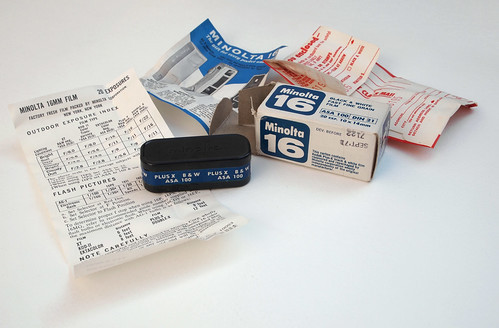
As described in my post about the Kiev-30M, the Kiev cameras were initially based on the Minolta 16 II, whereas Minolta continued to use the same cassette for all their cameras. Both cassettes have the same external dimensions, but the Kiev cassette was redesigned with a smaller take up spool to allow a greater length of film in the chamber. This means that Minolta cassettes will fit in Kiev subminature cameras, but not the other way around. With my recent interest in subminiature cameras, I picked up the QT at a low price in an online auction, but the camera did not come with a cassette.  Searching for one to use the camera, the cheapest I found was a box loaded with Kodak Plus-X with a 'develop before' date of September 1971. Incidentally, this film is older than the camera itself: in the box alongside the exposure instructions and process-paid envelope, there was also a sheet detailing the three models of Minolta 16 cameras then available: the Minolta 16 II, the MG and the PS (interestingly, the Minolta 16 II had a long producation run from 1957 to the early 1970s and was offered alongside the models that Minolta subsequently developed).

Kodak 16mm Plus-X repackaged in Minolta 16 cassette
As the film was well over forty years old, I assumed the Plus-X, originally 100 ISO, to have lost a fair amount of sensitivity. Without a battery, I used the 'sunny 16' to roughly calculate exposure, with  bracketing. Most of the shots were at 1/30th using wider apertures; when I developed the film I realised that some of the frames were out of focus because the hyperfocal click stop at 3.5m (or full length figure) only gives a depth of field at f8 and above, and many frames were shot at f5.6. I used stand development with Ilfotec LC29 for one hour diluted 1:100. With plenty of exposure to compensate for age, the Plus-X film performed well. The images below are scans from the negatives; doubtless prints from the negatives would provide better quality.

Minolta 16 QT with expired Kodak Plus-X
I subsequently reloaded the cassette with 16mm Kodak WL Surveillance 2210 film, which is also single perforated. Processed in the same manner, the images below are also scanned from the negatives. The old Plus-X film appears to show finer grain than the WL Surveillance, but again a better test would be printing from the negatives in the darkroom.

Minolta 16 QT with Kodak WL Surveillance Film 2210
Sources/further reading:
Minolta Subminiature Variations on Submin.com
Minolta 16 QT on Camerawiki.com
Minolta Subminiature cameras at SubClub.org

Saturday, 28 June 2014

Kiev-30M

Kiev-30M (open, the red dot, just visible, indicates the shutter is cocked)
The Kiev-30M is the penultimate model in a series of 16mm subminiature cameras produced by the Arsenal factory in Kiev, Ukraine. The original model of the Kiev subminiature series, the Vega, was based very closely on the Minolta-16. Like other Eastern Bloc post-war cameras copied from (mostly German) cameras, the Kiev Vega then evolved separately from the camera it was based on as the design was modified with each successive model. The second version of the Kiev Vega added the ability to focus the lens, something that the Minolta-16 cameras didn't have until much later models (though there were close-up filters available). The cassette was redesigned for the Vega 2 with a smaller spool than that of the Minolta-16, increasing the number of frames on a roll of film from 20 to 30. The Kiev Vega 2 was succeeded by the Kiev-30, which utilised a larger frame size (13x17mm) in a redesigned body. This larger frame size reduced the number of frames on a roll of film from 30 to 25 (although I wonder that the reason for the camera being called the Kiev-30 is due to this change to the preceding model). The Kiev-30M had a couple of minor changes from the Kiev-30, simplifying the camera by losing the PC flash sync socket and the manual exposure calculator on the back. The last 16mm model from Arsenal was the Kiev-303, which featured a redesigned plastic body in a variety of colours, and had four speeds rather than three, with 1/125th and 1/250th instead of the previous top speed of 1/200th.
Kiev-30M box contents
My Kiev-30M came in a box set from the Lubitel shop in St Petersburg (I wrote a post about the camera shortly afterwards, but, recently, having used it more, I felt it was worth substantially rewriting this). Although the box had seals that had been broken, everything inside appeared as new. As well as the camera, the contents are: a camera strap and case; a second film cartridge, in a plastic box; a reducing frame for using the 16mm negatives in a 35mm enlarger; a reel to fit in a developing tank; the camera manual; and a piece of paper with a list, possibly of suppliers. The manual is dated with a stamp of April 1989. The three rolls of Svema Foto 65 film (which came from a different camera box) have a 'develop before' date of 'IX/1986'.

Kiev-30M (closed)
The Kiev-30M is very compact 86x47x28mm when closed, extending to 108mm wide when open. Despite the camera's small size it is relatively heavy at 190 grams as the camera is constructed almost exclusively from metal and is entirely manual and mechanical. The controls visible on the side of the camera are two wheels, one to set the limited range of shutter speeds, 1/30th, 1/60th and 1/200th; the other controls the aperture, from f3.5 to f11. On the underside of the camera is a window showing the exposure number. To take photographs, the camera's outer body shell slides to the open position (as in the image at the top of this post), which uncovers the shutter release and focus control; the two glass windows align to the viewfinder and lens. The window that covers the lens can be removed by sliding it out sideways: the Minolta-16 had filters which could be inserted here, although the Kiev-30M box didn't come with any filters. The lens is a 23mm Industar-M, which on the 13x17mm frame size provides roughly a (horizontal) 40º angle of view. The lens focuses down to 0.5 metres, markings are also provided for 1 and 2 metres, in black, while picked out in red are the infinity mark and, close to this, a dot. The red dot is the focus setting for 5 metres, which serves as a hyperfocal position for all apertures. Also uncovered on the camera's top plate is a film plane indicator, while the serial number is engraved on the underneath.

Depth of focus table from the manual;
the '15' in the focus setting column must be a misprint for 0.5
Opening the camera cocks the shutter and advances the film: the shutter appears to be a guillotine-type, and when cocked, there is a red dot to indicate this visible in the lens window. The push-pull film advance does mean that opening and closing the camera without taking a shot results in a blank frame, but without opening the camera it isn't possible to look through the viewfinder.

Kiev-30M opened for loading
To load and unload the Kiev-30M, the outer shell has to be removed completely: there is a catch which can be released only when the camera is in the open position. This lays bare the exposure counter wheel: when loading a film, this needs to be manually reset by aligning a red line on the wheel with another line on the bottom plate. The film cassette is loaded by opening a cover on the top. The film cassettes have two chambers, one smaller, without a spool, for the supply side, with take-up side being slightly larger to accommodate the spool. As a legacy of the camera's origins as a copy, Minolta 16 cassettes are said to be compatible with the Kiev cameras. With a frame size of 13x17mm rather than 10x14mm, the Kiev-30M is designed for unperforated 16mm film (perforations will be visible in the image area). The cassette takes a 45cm length of film: the frame counter goes up 25, with every third number represented with two dots between (there is also a red dot between the numbers 16 and 19). When loading the cassette, a small pressure plate with a tiny tab needs to be pulled back to slide the section of film between the two chambers into position, not immediately obvious on a first attempt.

Kiev-30M cassettes
Kiev-30M with expired Svema Foto 65 film
I shot two of the Svema films while in St Petersburg, loading the cartridges inside the hotel room cupboard with all the lights in the room turned off. I finished the second roll of film once I had  returned home and stand developed it in Rodinal diluted 1:100 for one hour, using the technique I'd tried with film from the Mamiya-16 Automatic of taping the 16mm film, emulsion side out, to a length of 35mm film and loading this on a normal 35mm developing reel. The film is Foto 65, the 65 being the film's GOST value, the Russian speed scale, equivalent to 20 DIN/80 ASA. Translating the text on the box, the film was originally priced at 10 kopecks, surely very cheap even 30 years ago, and has a developing time of 5 minutes, although there's no indication of the developer required. The price of the film refills perhaps reveal why the 16mm subminiature format persisted in the Soviet bloc (the last Arsenal subminiature camera, the Kiev-303, was produced c.1990), while elsewhere Kodak's 110 format essentially used market dominance to push out all the previous competing 16mm systems twenty years earlier, where most cameras had proprietary cassette designs.

Kiev-30M with Kodak WL Surveillance 2210 film, scan from negative
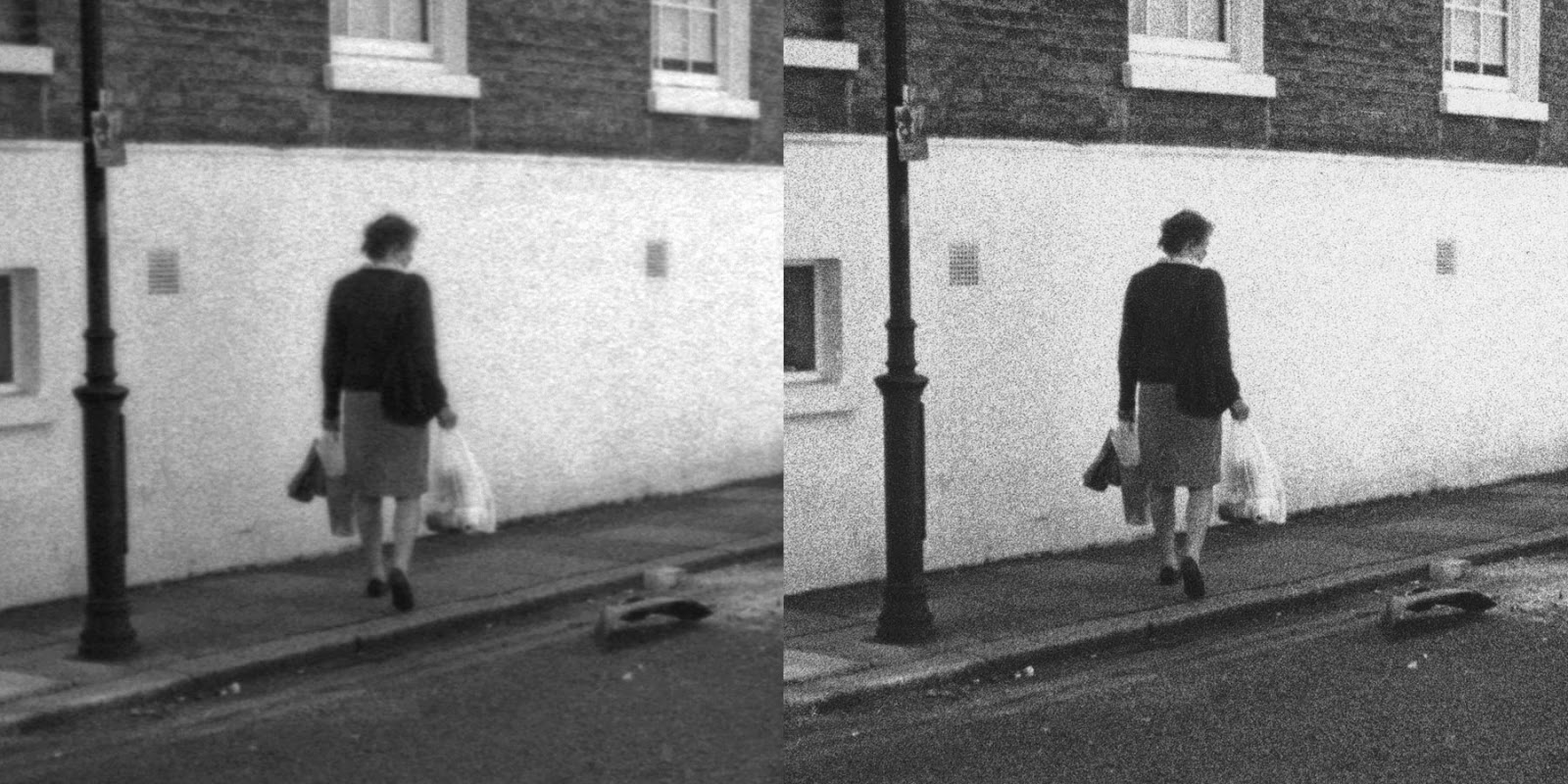
When loading the cartridges with 16mm film from 100ft rolls, it is possible to get more than 45cm of film into the supply side chamber, and it's relatively easy to get around 30 rather than 25 frames, although the frame counter doesn't turn around any further after the number 25. With single perforated film, if the film is loaded into the cassettes with the perforation side towards the plastic bridge between the chambers, the perforations appear at the bottom of the frame, to my mind less obtrusive to the resulting photographs. As I found when using the Mamiya-16 Automatic, subminiature negatives are too small when scanned with flat bed scanners to properly resolve detail. To really appreciate the results from the camera, I recently printed a number of shots from the Kiev-30M in the darkroom. The 16mm reducing frame which came in the box proved very useful when printing, and given the small size of the negatives, I had to wind the enlarger head almost to the top of its post to achieve a print size of 5x7 inches. The images below are all scanned from prints on Kentmere VC Select paper.

Kiev-30M with Kodak WL Surveillance 2210
Left: scan from negative at 3200dpi; right scan from 5x7 inch print for comparison
Kiev-30M with Kodak WL Surveillance 2210
The Kodak WL Surveillance 2210 film for the shots above is a 400 ISO film, and the grain is particularly pronounced as a result of the subminiature frame using approximately a quarter of the film area compared to a standard 35mm frame. I also shot some Agfa Copex HDP 13 microfilm with the Kiev-30M (although not stated, it's a reasonable assumption that HDP stands for High Definition Panchromatic). Typically for a microfilm, it's very slow and very high contrast, but extremely fine grained, which is a great benefit to the subminiature frame size. My first tests with stand development in R09 One Shot at 1+150 suggested an exposure index of 25, but I subsequently shot another roll rated 16 and using a developer dilution of 1+200, which provided better results. The images below were printed on Kentmere VC Select with a 00 Mulitgrade filter, the lowest contrast possible when printing (it is easier to reduce contrast further when scanning).

Kiev-30M with Agfa Copex HDP 13
Detail from the above image showing fine grain structure and high resolution
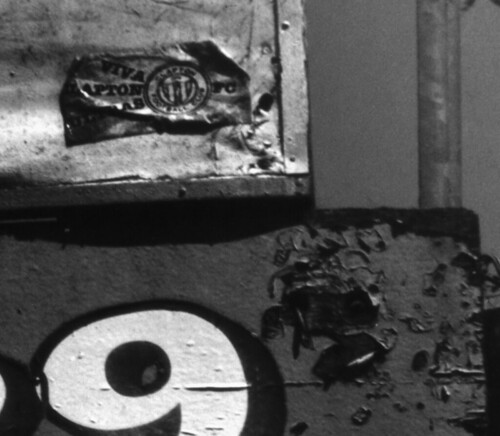
The enlarged detail above demonstrates both the high resolution of the Agfa Copex HDP film and the resolving power of the lens in relation to the negative size. The sticker in top left is approximately 0.6mm high on the negative: the small lettering in the roundel on the sticker itself which is just legible is considerably less than a tenth of the size of the sticker. Evidently the film resolution exceeds that of the lens, but the extremely fine grain makes it ideal for the subminiature format, although the inherently high contrast means that it has very little latitude and may be more suitable for low contrast scenes and subjects, although both images above were taken on a bright sunny day, and the slow speed of the film is more appropriate for bright conditions.

As with many cameras from the former Soviet Union, the Kiev-30M is not without problems. The push-pull frame advance is not always reliable: occasionally the shutter does not cock, and so a frame is wasted in opening and closing the camera again; the catch on the underside of the body can be forced under the outer casing itself, the remedy to this is to bend this catch upwards to engage the outer casing more securely (Minolta cameras abandoned the push-pull advance as new models were introduced after the Minolta-16 II). I have also had odd vignetting on a number of frames, such as in the last shot above, which may be due to the shutter not opening fully. The cassettes are prone to light leaks, this happens more with perforated film. The limited aperture and shutter settings can fall a little short when using a fast film in bright light: 1/200th at f11 with a 400 ISO film in bright sunlight means accepting some overexposure (a yellow or neutral density filter would help in such circumstances). Conversely, a faster lens and a B setting would be useful for low-light situations. Set against these issues, the Kiev-30M is enjoyable to use for a number of reasons: its small size, when closed, easily the smallest camera I own; 16mm film is very cheap by the frame, a standard 100ft/30.5m) roll will fill many cassettes at 45cm each; and the simplicity of the camera itself.

Sources/further reading:
Kiev 16mm cameras on SovietCams.com
Kiev 16mm variations on Submin.com
Soviet-era subminiature camera list on Commie Cameras
Kiev-30M variations on Fotoua.com
Kiev-30M on USSRPhoto.com