 |
| Voigtländer Vito B |
The
Voigtländer Vito B sits neatly between two camera models about which I have previously written posts:
Voigtländer's Vito IIa and the Vito C series, with the Voigtländer Vito CL. The Voigtländer Vito B was produced concurrently to the folding Vito II and its successor, the IIa, and it's representative of the direction 35mm camera design would take from the 1950s into the 60s, not only in simply being a rigid-bodied version of a previous folding model, but also the general form that fixed-lens 35mm cameras would take, with greater simplicity in construction once folding 35mm cameras were discontinued: the Agfa Silette cameras, Kodak's rigid-bodied Retinas and Zeiss-Ikon's Continas are all indicative of this design direction. The Vito B was produced from 1954 to 1960 with a number of different production models, as well as the variant cameras Vito BL and the rarer Vito BR, which added a lightmeter and a rangefinder respectively. The Vito C series which replaced the B featured a less complicated loading mechanism, more plastic in their construction, and cheaper lens variants; the Vito B body itself was used as a basis for the concurrent development of the Vitomatic camera.
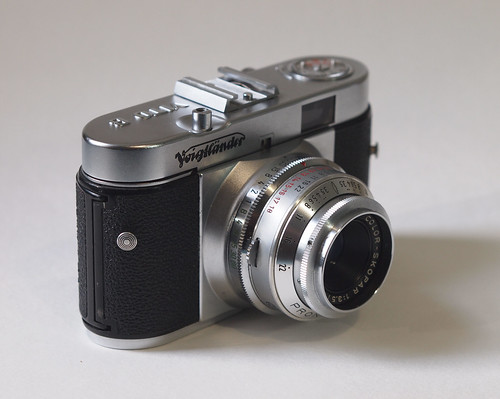
The Voigtländer Vito B is not a rare camera, and there are many resources and discussions on the camera available online: perhaps the most comprehensive page on the Vito B is on from the focal plane to infinity which draws together resources from many other sites and books as well. The most obvious difference in the production variants of the Vito B is in the viewfinder: the camera was given a larger viewfinder in 1957, but it seems the small viewfinder model was continued all the way through the production run. The larger viewfinder required a larger top section to the camera, which many commentators online consider to negatively affect the aesthetics of the camera, despite being no doubt easier to use, especially for wearers of spectacles. The small viewfinder version of the camera is pretty compact for a full-frame 1950s 35mm camera: less than 12cm side-to-side, 7.5cm deep, and 7cm high. The other main production difference between models is in the lens' maximum aperture, with the Vito B being offered with both f3.5 and f2.8 50mm Color-Skopar lenses. The f2.8 lens appears to be rarer than the f3.5. My particular camera is of the small viewfinder variant with the f3.5 Color-Skopar, which seems the most common version of the Vito B.
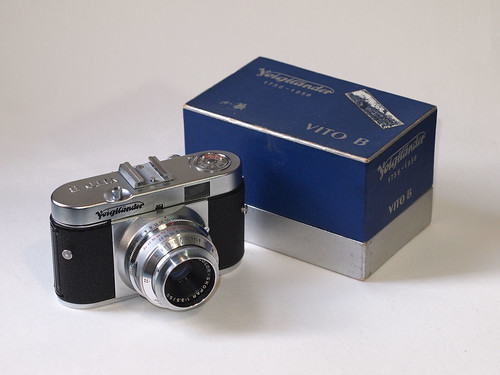 |
| Voigtländer Vito B with original box |
There were other differences: the Vito B was provided with either a Prontor SVS or Pronto shutter, with the shutter speeds on the Prontor SVS changed between the older-style intervals (1/2/5/10/25/50/100/300) to new (1/2/4/8/15/30/60/125/300); there's also a rare model with a top speed of 1/500th on the shutter. The last variant is that later cameras were provided with an
EV scale linking the shutter and aperture together. There were some small cosmetic changes too, such as the detailing around the eyepiece, though these are relatively minor. My Vito B is one with the new-style Prontor shutter speeds, and the EV scale; the serial number of the lens dates it to 1958. Its features identify it as a Type 126/96 in Voigtländer's own model code. Its focus scale is in feet, which marks it as an export model, and it came in an original Vito B box, celebrating the 200th anniversary of Voigtländer. The camera is in very good condition, possibly due to having been kept with its box for the past sixty-something years, with just a little wear on the printed numbers on the film reminder dial, and a small amount of tarnish on the camera's bottom plate.
 |
| Voigtländer Vito B top plate |
Having previously used the Voigtländer Vito IIa, and then the Vito CL, there was much about the Vito B that was immediately familiar. It bears greatest similarity to the Vito IIa, and it's possibly not inaccurate to describe it as the rigid-bodied version of the folding camera. Like the Vito IIa, it's relatively compact for a 1950s 35mm camera; the general body shape, with its rounded sides, inherited from the Vito II feel good in the hand, while it feels entirely and confidently solid in its construction. The camera's ergonomics are fairly standard for a 35mm camera of its date: the shutter release in a (with threaded cable mount) is in a small recess on the top plate, with a rapid advance lever, operated by the user's right forefinger and thumb, and focus, shutter speed and aperture adjustment are all concentrated around the lens, operable with the user's left hand. The viewfinder is on the left of the body from the user's perspective; this is extremely simple, as it doesn't provide any framing or parallax marks.
 |
| Voigtländer Vito B |
The lens focuses down to 3.5 feet (or possibly a little closer: the barrel turns beyond this mark a small amount, which might equate to 1 metre on a metric scale). There are marks of a circle between 60 and 12 feet, and a triangle between 12 and 9 feet intended for quick guess focus for distance and group shots respectively. Around the focus ring is a depth of field scale with an elongated diamond mark to indicate focus position on one side, and aperture selection on the other. Behind the aperture markings are a series of red numbers which are the EV scale, linking aperture to shutter speeds, which is the ring nearest to the camera body.
 |
| Voigtländer Vito B - bottom plate |
The camera's bottom plate has a 3/8th inch tripod socket (my camera came with a 1/4 inch insert already fitted, the frame counter setting ring, and the latch to open the camera back. This is a small curving lever which normally fits flush to the camera bottom; flipping this up, with a turn, this opens the camera, the panel below the film cassette opening a full 90º and freeing the hinged back to open. This opening means that loading a 35mm film cassette is easier than some cameras: it simply slides into place onto the rewind crank. The take-up spool on the other side of the camera is a smooth drum with a single slot, wider than most; this can be rotated by hand to locate the slot, or turned with the advance lever, which has a pleasing audible ratchet sound. Closing the camera is a reversal of the steps to open it, first closing the camera back, then second pushing in the hinged bottom panel, and thirdly and finally rotating the small latch lever and folding it flat. This hinged panel is the only part of the back with a foam light seal; in my camera, this is in very good condition for being over sixty years old, and presumably original. Notably, the Vito B needs a film running through it to cock the shutter, but to test the camera, it is possible to turn the sprocket wheel inside the camera to check whether the camera is fully working.
 |
| Voigtländer Vito B with back open for loading |
The frame counter has to be set manually and it counts down rather than up. There's a serrated wheel with the frame numbers on which runs around the lens-shutter unit on the body, which can be rotated by hand in either direction from a small cut out section on the camera's base plate. There is a curved sprung bar next to this, presumably to prevent it being accidentally turned, although in practice, this is very easy to do. The frame numbers are upside down if one looks at the camera straight on: when using the Vito B, these are designed to be read by simply tipping the camera up while held for shooting.
 |
| Voigtländer Vito B - detail of frame counter |
To rewind the film after shooting a small lever located on the left of the body below the rewind knob releases this when pulled backwards, and the knob springs up. The knob isn't as easy to use as a more modern flip-up rewind crank lever, but it's easier than many other rewind knobs that I've used. There is a film reminder disc set into the top of this, running from 6 to 200 ASA and the DIN equivalents, and some letters in red (presumably for colour film only) for daylight or tungsten negative or reversal films.
 |
| Voigtländer Vito B - detail of rewind knob |
The EV scale on the Vito B gives a (fairly) full range from 2 to 18, although in practical terms, the dial will not quite reach 3; at a shutter speed of 1 second, the f2.8 lens might just reach 2. The EV numbers could be read from a light meter and set on the camera. What the EV scale linkage allows the user to do is switch easily between a range of shutter speeds and apertures which will all give the same equivalent exposure. On the Vito IIa, the EV scale has an arm connected to the aperture ring with a small sprung pointer that connects to a set of teeth around the shutter speed ring, which needs to be disconnected from these teeth to change the EV setting. The EV setting on the Vito B is rather simpler: there are two small metal grips either side on the lens to help turn the scale, which rotates both aperture ring and shutter speeds together. Pushing in the grip on the user's left allows the aperture ring to turn independently of the shutter speeds. The EV ring gives a the lens more of a tapering look: in earlier versions, the shutter, aperture, and focus rings have a much clearer set of steps from wider to narrower around the lens.
 |
| Voigtländer Vito B - lens and shutter detail |
On the shutter speed setting ring, the 'B' setting is marked in green, with the whole numbers 4/8/15/30/60 following this also in green. This allows for calculating long exposures, with 'B' as 2 seconds: although the shutter speed ring does not turn beyond 'B', if one reads off the corresponding apertures, this gives the correct long exposure (not accounting for reciprocity law failure, of course, and the user then has to disengage the EV coupling to select the desired aperture for the long exposure). The shutter does also have a V/X/M selector, with V for self-timer (it's generally not recommended to attempt using the self timer on old Gauthier shutters) with X for electronic flash and M for flash bulbs. There is also a PC socket for flash almost hidden underneath the lens, and a small stud to support the lens and keep the camera level on a flat surface.
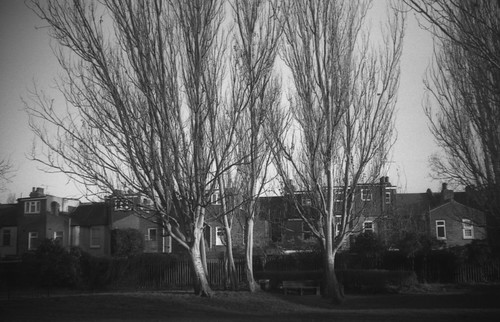
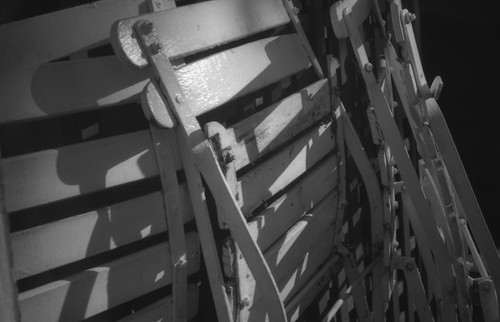
The real draw of the Vito B is the Color-Skopar lens. Voigtländer's original Skopar was an iteration of the Carl Zeiss Tessar; the Color-Skopar was a revision of the Skopar for colour photography after the war (I have, typically, only used the Vito B with black and white film). Describing the 'look' that a lens produces is, I think, frequently reliant on personal interpretation as much as identifying any form of specific characteristics. However, there is
something in the images the Color-Skopar produces: the definition in the busy scene below does feel subtly distinctive, without wishing to read to much into the photograph (obviously the use of black and white is in itself sufficiently allusive to
colour interpretations of how 'classic' the lens renders the scene).
 |
| Voigtländer Vito B with Ilford HP5 Plus |
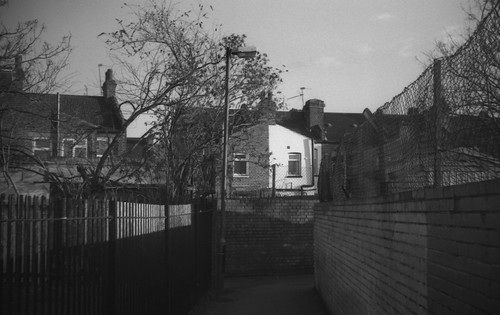
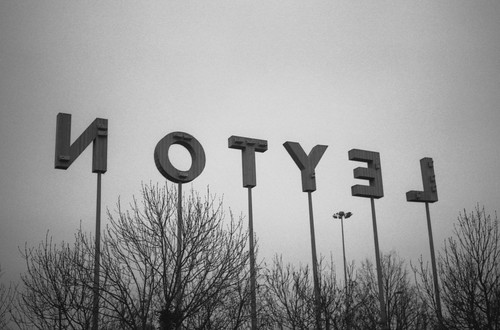
The Color-Skopar does suffer from some vignetting when shot wide open as can be seen in the image below (and in some of the other examples on this post: I mostly shot with the Vito B over December and January, which days of heavy overcast skies, frequently needing wide apertures for hand-held shots). However, the vignetting is not unpleasant, and the sharpness does not diminish appreciably into the corners as with less well-constructed lenses. The lens accepts 32mm push-on filters, a common size especially in the 1950s, and so I have filters and lens hoods which already fit the camera. Like the Vito CL, I've also found the top from a plastic 35mm film container fits as a lens cap.
 |
| Voigtländer Vito B with Ilford FP4 Plus |
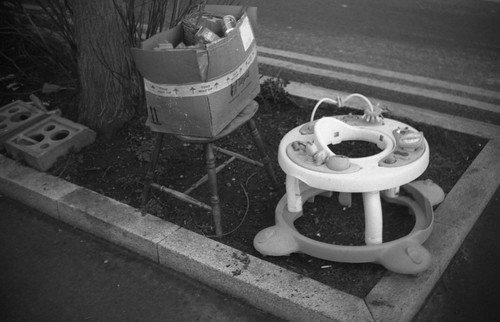
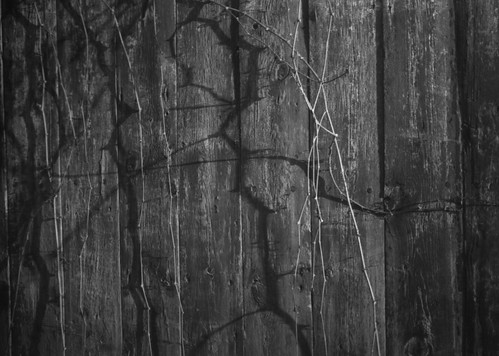
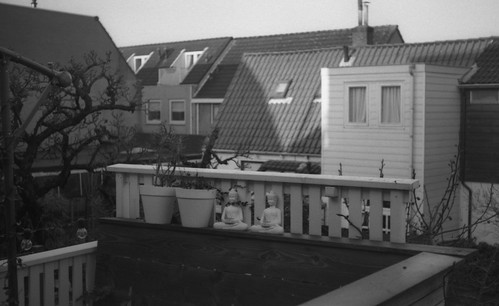
In use, I found the linked EV scale not as troublesome as that on the Vito IIa (unfortunately, I no longer have the Vito IIa to directly compare the cameras side by side), and it was fairly simple to ignore. I am also used to composing with small viewfinders (the smallest I regularly use being the Baldalux), which for contemporary users may be off-putting. I didn't always get the focussing right in all the photographs I've shot in the Vito B at closer focus, partly due to using mostly wide apertures hand-held with available light, so a rangefinder on the accessory shoe would help. The Vito B is one of the better post-war compact 35mm viewfinder cameras around, and, although I'd shot with the Vito IIa previously, and so have used a camera with a Color-Skopar lens and should have been prepared for the quality of the results, these were still better than I had anticipated: as indicated above, the Color-Skopar lens
is the reason for using the Vito B today.
 |
| Voigtländer Vito B with Agfapan APX100 |
 |
| Voigtländer Vito B with Agfapan APX100 |
 |
| Voigtländer Vito B with Ilford HP5 Plus |
 |
| Voigtländer Vito B with Ilfrod FP4 Plus |
 |
| Voigtländer Vito B with Ilford FP4 Plus |
Sources/further reading:
Vito B on from the focal plane to infinity
An overview of the Vito B series
Vito B on Camera-Wiki
Vito camera pages on Marriottworld.com
Matt's Classic Cameras on the Vito B
Vito B review on Austerityphoto
Vito B on 35mmc