 |
| Halina 35X |
According to the chronology on
Collections Appareils, the
Halina 35X was
Haking's first camera, while other sources place their medium format pseudo-TLR cameras earlier, it may well be that the 35X was simply the first
35mm camera that Haking produced. The Halina brand name was used for Haking's first cameras in the late 1950s, and later became synonymous with ubiquitous, cheap, mass-produced plastic cameras in the 1980s and 90s. Haking still exists, and their
website (although apparently not recently updated) lists both 35mm and digital cameras. My first new camera as a teenager was a red Halina (a
260 I think), after being given a secondhand
Kodak Instamatic 25.
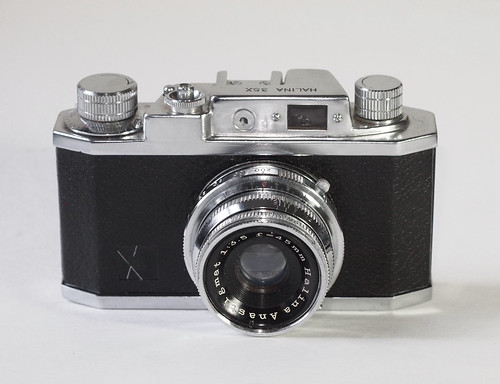
The Halina 35X camera that illustrates this post was acquired in the job lot which included the
Praktica nova I, the
No.2A Brownie, and the
Vest Pocket Autographic Kodak. The Halina 35X was the least interesting of the lot, but I decided to put a roll of film through it in order to check that the camera worked. My camera was missing its badges - the red, round badge above the lens might suggest a rather well-known expensive camera maker, which the camera's general design mimics (the styling makes the camera look more sophisticated than it is) - but the name and model designation are firmly inscribed on the camera's top plate. Haking was established in Hong Kong during the post-war period, while it was still a UK colony: my camera has the non-specific phrase "Empire Made" on the bottom. Presumably this meant that it was not subject to import restrictions to the UK at the time, enacted with the object of protecting the home market against the resurgent German manufacturers immediately after the war.
 |
| Halina 35X |
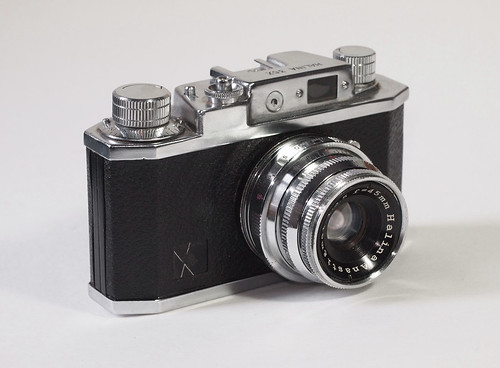
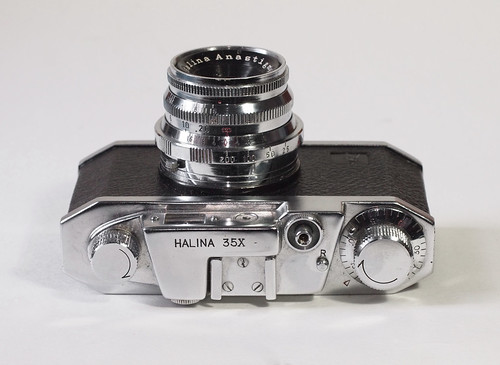
The Halina 35X is a manual 35mm viewfinder camera. It has a fixed 45mm f3.5 Halina Anastigmat lens in a four-speed leaf shutter with speeds 1/25th, 1/50th, 1/100th, 1/200th, as well as 'B'. The shutter needs cocking on the lens barrel (about which more below); the shutter release is on the top plate of the camera. Focus is manual, down to 3 feet. Aperture selection is on the outermost ring of the lens; it is marked down to f16, but it does turn further, possibly to f22. The aperture ring also rotates as the camera is focussed. The viewfinder has neither framelines and, naturally, no parallax correction. Frame advance is by knob, at time when the design of many other 35mm cameras had progressed to an easier-to-use lever.
 |
| Halina 35X top view |
The frame counter around the advance knob needs to be manually set. To rewind the film, there's a small button on the top near the shutter release marked 'R', and the rewind knob on the user's left is a little smaller than the advance knob. The camera does feature a PC socket for flash, and an accessory shoe. The back of the camera removes entirely for loading.
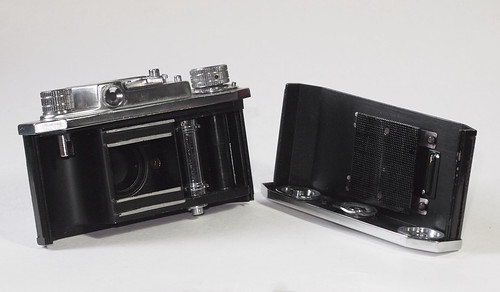 |
| Halina 35X opened for loading |
My camera came with its original case and push-on lens cap - this, oddly, is transparent. The case has a
plastic dome and top to protect the lens, but there's no plastic in the camera itself. What is remarkable about the Halina 35X is, for its small size, it is surprisingly heavy. The main body is cast from a fairly substantial block of metal with very, very shiny chroming to the top and bottom plate. Rather than being reassuring, this weight (and shininess) suggests a lack of care over its design.
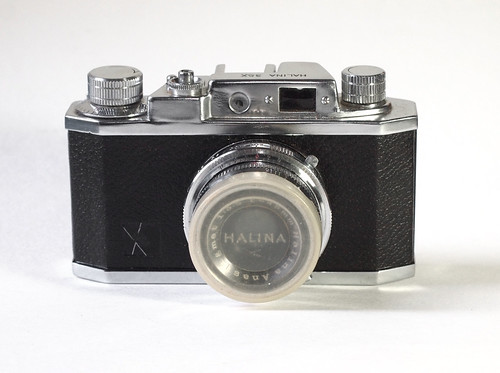 |
| Halina 35X with original lens cap |
As with some other vintage cameras, the Halina 35X seems to have been lubricated with grease that becomes very stiff with age: the focus ring was difficult to rotate, needing a firm grip on the body and lens in each hand to turn (there are some suggestions that this was always a problem with the camera). However, the most frustrating aspect of using the camera is its counter-intuitive double exposure prevention. After the shutter release has been pressed, the advance knob need to be turned to wind on the film before another shot can be taken
whether or not the shutter has been cocked. This means that if one presses the button without remembering to depress the cocking lever - or by accident (there is no shutter lock), a blank frame is the result. Even with being familiar with non-self cocking shutters, it is still easy to waste film with the 35X.
This post on Filmwasters states that if one
continues to hold down the shutter release after pressing it without cocking the shutter, before winding on, it is possible to then cock and fire the shutter.
 |
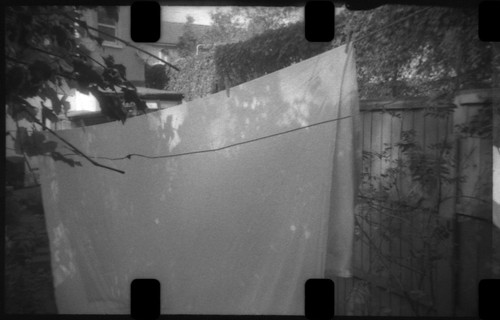
| Halina 35X with Ilford Pan 100 |
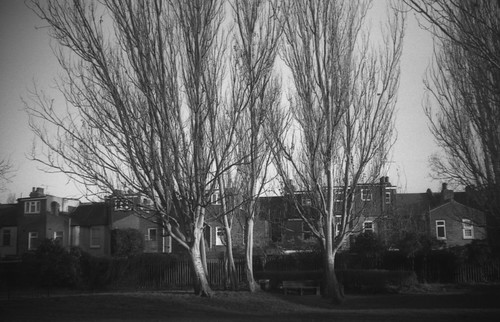
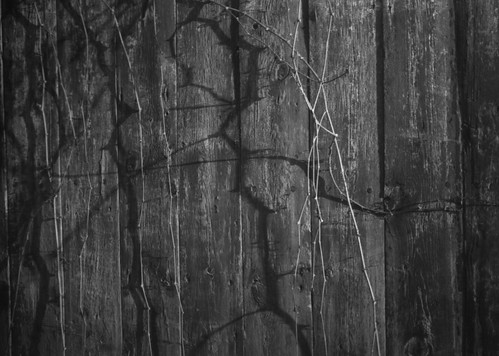
I shot half a roll of
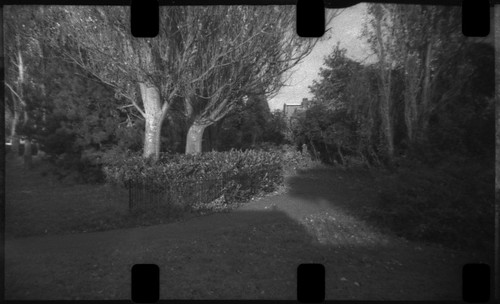
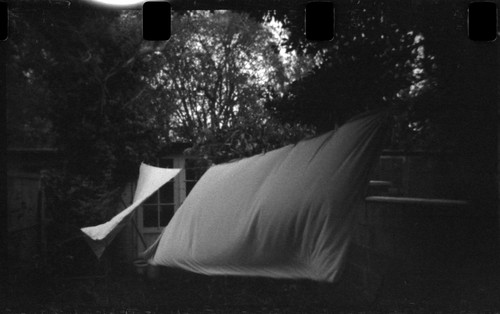
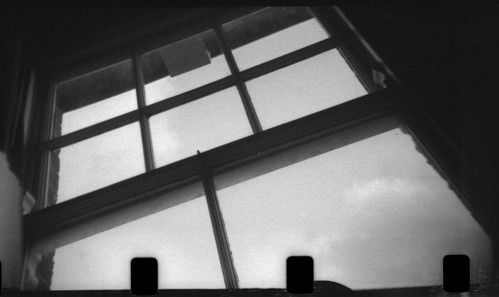
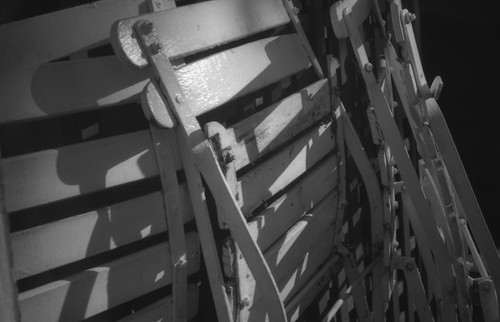
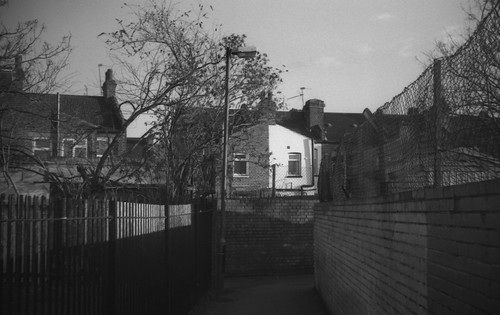
Ilford Pan 100 to test the camera. The lens provides fairly heavy vignetting, and, based on just the few photographs I took with the camera, uneven illumination across the frame too. For some subjects of course, such as the image below, the vignetting from the lens may add something in terms of atmosphere or character, but it's not necessarily something one might want on all frames.
 |
| Halina 35X with Ilford Pan 100 |
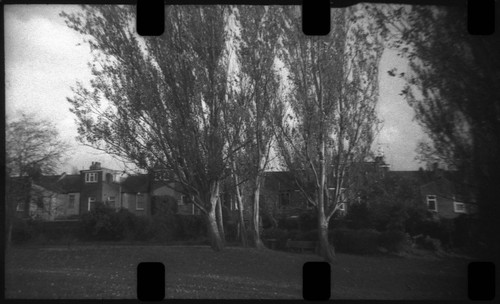
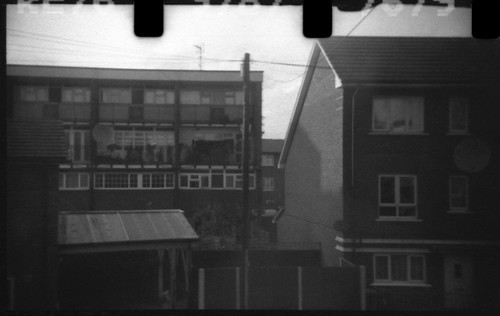
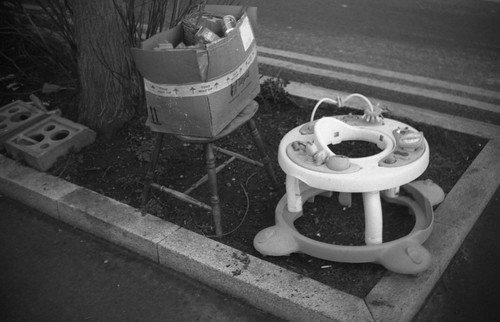
Combined with the vignetting, there is also a falling off of definition away from the centre of the image - and, although the lens is described as an
Anastigmat, the out-of-focus areas away from the centre of the image do seem to show some astigmatism. On the small sample of photographs that I shot with the camera, although a triplet, the lens behaves more like a meniscus or doublet - some of which can still perform well at small apertures. Oddly, just two of the three lens elements are coated.
 |
| Halina 35X with Ilford Pan 100 |
In a blog post on the Halina 35 X, Kosmophoto asks
"Is this the worst 35mm camera ever made?" No doubt it isn't, but the Halina 35X is badly designed, and frustrating to use. There's not much to recommend the camera - and there are many other entirely mechanical compact viewfinder cameras that one could chose for a better experience of shooting, and to provide better results. The post on Filmwasters already referenced states that the Halina 35X is "loose" and "un-camera-like": "it gives the feeling that it must be a facsimile of a camera, rather than an actual camera. This sounds weird, but when you have one in your hands you'll understand. It is both familiar and alien at the same time." It almost suggests that the designers of the camera had seen detailed drawings, photographs, and descriptions of contemporary 35mm cameras - without ever have actually used one. To sum up, on a page which is more a passing comment than a review, Rick Oleson describes the Halina 35X as a
35mm Hit camera.
 |
| Halina 35X with Ilford Pan 100 |
 |
| Halina 35X with Ilford Pan 100 |
Sources/further reading:
Halina_35X on Camera-Wiki
Collection-Appareils (French)
Kosmofoto's page on the Halina 35X
Halina-35X on John's Old Cameras
Filmwasters review of the Halina 35X