Showing posts with label Bolex B8VS. Show all posts

Thursday, 17 July 2025

The Paillard-Bolex B-8VS

Bolex B-8VS
The Canon Cine-Zoom 512 which I wrote about a number of years ago has all the features that one might want in a 2x8mm film camera except compactness. Considering the desire for a compact 8mm camera for travelling, but one quite fully-featured, led me to consider the series of Bolex cameras which began with the Bolex L8 in the early 1940s, through various models and iterations for the next two decades. I wanted a 2x8mm camera, ideally with as many manual features as possible, in particular variable frame rates, and small enough to fit in a camera bag alongside a 35mm folding camera, a medium format folding camera, numerous rolls of film and accessories. The model that I bought to fulfil as many of these stipulations as possible was a Bolex B-8VS. I wanted it for a trip to the Netherlands made just before the outbreak of the Covid-19 pandemic; I had the intention of making some work there on 8mm film and I wrote about this under 'Cameras Obscura' and 'A View of Delft'; I also used the Bolex for the first version of 'Workers Not Leaving The Factory'. I had intentions of writing a post about the camera itself around the time, in 2020, but for one main reason–which I will come back to–I didn't; looking through a number of draft posts, having neglected this blog recently, I thought it worth finishing my write up.
 
The Bolex L, B, C and D series cameras are all built around the same body casting and spring wound motor; the distinguishing feature of the B8 cameras, which followed the L8, was the presence of the dual lens turret. In the years before zoom lenses became common, beyond the more basic, lower-end cameras with fixed lenses, for the convenience of changing focal lengths without having to physically unscrew one lens and replace with another, turrets proliferated. Through the 1950s, dual turret cameras were superseded by triple-lens turrets (which would hold a wide, standard and long at once) until zoom lenses made these obsolete. However, both triple turrets and zoom lenses (which also necessitated reflex viewing) increased the bulk of cameras, which was why the B-8 series appealed; being familiar with fully manual still cameras also drove me to seek out manual ciné cameras. Without lenses the Bolex B body is 128mm high, 54mm wide and 88mm deep, compact but heavy. (The letter suffixes for Bolex cameras–after the single-lens L–run B: twin lens turret; C: single lens; D: triple lens; there was also the model P, still built around the same basic body but with a zoom lens; there was also the H8 camera, based around the 16mm Bolex, and as a result a much larger camera–for most of the information about dates and specifications, this post has relied heavily on the excellent Bolex Collector website).
 
 
The Bolex B-8 was introduced in 1953, and its various iterations were produced for the next decade; the B-8VS (variable shutter) model dates from 1957, with the serial number on mine dating it to the following year (serial numbers are engraved on the tripod mount on the bottom of the camera–on the B-8VS this sits a little proud meaning that the camera does not entirely sit happily on a flat surface); following the B-8VS there was a B-8L model with built-in light meter, a single speed B-8SL and the last model, the B-8LA, an improved B-8L. All feature the same rotating turret which allows for two standard D mount lenses; my camera came with a 13mm f1.9 Yvar lens, a 'standard' focal length for the 8mm format; I already had a 36mm f2.8 Yvar lens from another camera, a long lens to complement the standard. As the lenses are the common screw-in D-mount, it means that there are numerous interchangeable lenses available in a variety of focal lengths and apertures that can be used on the Bolex B-8. 
 
Bolex B-8VS with lower lens removed

The lens in the uppermost position on rotating turret is in taking position; the turret rotates clockwise, with a handy arrow to direct the user, with a sprung detent in the centre which clicks the lenses' positions satisfyingly in place. The lenses' screw thread is designed such that the focus and aperture settings are aligned with the indicating line on the lens body when looking down from the top of the camera (the built-in lightmeter on later models necessitated this positioning being changed so that the lens' settings on those cameras is seen from the side). The standard length Kern-Paillard lens which my camera came with is capable of focusing to 3/4 of a foot, or 23cm–a very close focus which of course produces parallax problems, but these are not insurmountable (the post 'Cameras Obscura' describes my attempts to film a close-up of a camera obscura screen roughly 8cm square). The Kern-Paillard lenses have a clever depth of field indicator built in, named by the manufacturers 'Visifocus': turning the aperture ring displays or hides a set of bright orange dots which can be read off against the distances on the lens. Focus and aperture settings are manual and the separate viewfinder is non-reflex.

Lens detail showing the Visifocus depth of field system
All B-8 cameras take 7.5m/25ft rolls of 2x8mm film, run twice through the camera to shoot each side of the film in succession, developed and spliced together for a 50ft length of film for projection. Loading the B-8 camera, although not as simple as inserting a Super-8 cartridge, is fairly straightforward. After opening the camera, turning the catch on the door from F to O, the film gate's pressure plate is released using a pivoting lever. The fresh roll of film is placed on the upper spindle in the film chamber, threaded through the gate while the pressure plate is open, and wound onto the take up spool on the lower spindle. The camera door cannot be closed and the catch turned to F while the pressure plate is disengaged. 

Bolex B-8VS opened for loading
One interesting feature to note is the fact that the two spindles inside the camera are undifferentiated in terms of which side of the spool they will accept: 2x8mm spools are designed with three tabs on one side and four on the other so as to make it impossible to insert them into a camera the wrong way around: some cameras have corresponding teeth at the bottom of each spindle, some only on the take up spindle; the Bolex B-8 has a sprung section on the take up spindle only which holds the take up spool by friction. The footage counter on the rear of the camera is reset on opening the camera; unlike some cameras which use a lever arm on the supply side spool to determine how much footage has been shot, the Bolex B-8's counter must simply be registering the rotations of the take up spool. The camera does require some winding of the motor to load; the winding key ratchets, meaning that the motor can be quickly wound by rocking the key backwards and forwards rather than making complete turns.

Bolex B-8VS with pressure plate opened for threading

Away from the lens, all the other user controls are on the right hand side of camera body. The shutter speed dial has seven speeds from 8 frames per second, through 12, 16 (picked out in red as the standard fps setting), 24, 32, 48, 64; the latter four generally used as slow-motion speeds, with 8 and 12fps intended more for use in low light with the availability of emulsions at the time rather than speeding up motion. The top dial is used to adjust the viewfinder's angle of view, with settings for 12,5mm, 25mm and 36m: for wide angle lenses there was an adapter which slipped over the front of the viewfinder. The shutter release is a lever that wraps around the corner of the body with a serrated grip; below this is a dial to lock the shutter, which will lock in both closed or open positions; above this is a cable release socket with a sliding cover: the first open position is for normal running of the shutter; the top position indicated by a second notch is for single-frame operation. The B-8VS also has a dial to set the variable shutter. This has three semi-circle icons at the front of the dial: one filled in silver, one half-filled, and one black, followed by an arrow and a letter S. On the other side of the dial, there are settings of 35 and 70 which align with the full silver dial and half-filled respectively: these refer to effective shutter speeds, the full open shutter (the silver semi-circle) giving an effective speed of 1/35th of a second, the half-filled circle a 70th. Possibly the 'S' stands for 'shut' with the shutter fully closed. 

User controls on the side of the Bolex B-8VS
When I bought the camera, the possibility of adjusting the shutter angle seemed to be a useful additional control, useful for creating in camera fades to black, or for using a wider aperture in brighter light for example, or a faster film in brighter conditions. However, I found the variable shutter dial on my camera very stiff to turn, and would not turn to the fully-open setting at all; turning it to the half open setting would somehow jam the shutter and the film would not run through the camera. As a result I shot the film with the dial half-way between this setting and the closed symbol, not really understanding at the time what these icons meant and what the numerals referred to. As a result, I found my films shot on the trip to the Netherlands around three stops underexposed; I developed one roll first to find it underexposed, then did numerous tests before getting an acceptable if high contrast image by greatly extending the development time on the second roll of Kodak Double-X that I had shot; with a roll of very old Orwo UP21 film from the early 1980s, I extended the development time, flashed the whole roll to pre-expose it in an attempt to raise shadow detail and then toned it with selenium toner as an exercise in intensifying the negative. This was only partially successful, as can be seen in the post 'A View of Delft' and in the short clip below. 
 
 
Once I had realised that this was a problem, I could adjust the camera when shooting to take into account the partially-closed shutter: the easiest way to do so would be open the aperture by three stops, or simply downrating the film when metering. This was the approach I made for 'Workers Not Leaving The Factory', although that had its own problems thanks to using unperforated film in the camera. I had previously used single-perforated 16mm Double-X film in the Bolex when testing exposure and development times: the Bolex B8 only engages the perforations on one side of the film, but having shot a short length of single perforation film, I thought I might as well try to flip the film and pass it through the camera a second time, and the pull-down claw obviously had enough friction to advance the film. The left hand side of the print below from the film shows fairly regularly spaced marks on the left, unperforated side of the film; the perforated side has the frames bunched up and overlapping.
 
Print from single-perforated 16mm Double-X film, shot with the Bolex B-8VS
I used the fact that I could put unperforated film through the camera when making 'Workers Not Leaving The Factory', using lengths of medium format Ilford FP4 Plus cut to 16mm wide in order to shoot the site of the Ilford factory in Ilford on Ilford film, which was partially successful. Shortly after shooting this film, the camera's spring-wound motor stopped working properly. Using it prior to this, when the motor was fully wound, part-way through its run, there would be an audible 'clunk' (which could also be felt); I suspect that there was a kink in the spring, possibly due to it being stored for years, maybe even decades, with the spring motor partially wound. It feels as though the spring no longer winds past this kink, with the result it only runs for eight or nine seconds–and the speed as it runs sounds irregular as well. Perhaps using unperforated film had some effect, although one feels that this shouldn't really affect the motor. As a result, the camera has stayed on a shelf (or indeed, inside a drawer) since. It may well be worth disassembling to investigate–for which I may have held off from writing this post that the time–but this hasn't been something I've been keen to do so far, having acquired other 8mm cameras since to take the place of the Bolex B-8VS.

Sources/References
Bolex B-8VS on Bolex Collector 
Bolex B-8VS in the Science Museum 
Bolex B-8 on Vintage Cameras (French) 
Bolex B-8VS with triple turret coversion on Deutsches Kamera Museum (German)

Sunday, 28 February 2021

'ADDITIONAL POURTRAYALS [sic]'

"One of the internet's most intriguing capabilities, for a topographical film-maker, was that it offered contemporaneous views of distant landscapes. During 1996, I had heard that there were websites where one could access the cameras that observe traffic on UK motorways, and immediately conceived a strong desire to explore, and perhaps to sample, what I imagined would be a large and increasing number of real-time moving images of landscapes throughout the world. I wondered, perhaps, one day, I might be able to make a film without leaving the house."
Patrick Keiller, 'The Robinson Institute'

"And then, again, a sudden light, and recurring darkness.”
O. Winter, ‘The Cinematograph’, May 1896

Just short of a year ago, I filmed two views in Ilford, with an 8mm camera facing the locations which had once been entrances to Britannia Works, a large factory site that was the main manufacturing base for the photographic company that became Ilford, Limited, and wrote about this as 'Workers Not Leaving The Factory'. Due to a sense of dissatisfaction with the results, I had a desire to revisit the location and film the site again. In the latter part of last year, I realised that the opportunity might coincide with either one of two significant anniversaries: in December, it would 125 years since August and Louis Lumière demonstrated projected moving photographic images to a paying audience, which, despite other prior claimants, is seen to mark 'the birth of cinema'. The other anniversary was 21st February, when the Lumières' films were first shown before a paying audience in London in 1896.

Original 2x8mm negative, digitally inverted

Last year, I shot the film on Ilford FP4 Plus, using a length of 16mm-wide film cut down from medium format. As a result, this did not have perforations, but I found that, imperfectly, this would be driven through a Bolex B8 camera by the friction of the pull-down claws alone. Using this film involved many compromises, particularly in duration, so I had been looking out for Ilford ciné film on a certain well-known auction site, and, eventually, a couple of rolls of 16mm Ilford Fast Pan film turned up, and were purchased. The labels on both read "date of test 6.1.69", meaning that the film would have been made at the Britannia Works site in Ilford before production there stopped in the mid-1970s. In addition, I also acquired a couple of Kodak 16mm movie cameras, one of which was made in England, so I was set to film a new version of 'Workers Not Leaving The Factory' at the site of the now-demolished factory, with vintage Ilford film made there, and possibly with an English-made 16mm camera. The ideas that I had touched upon in writing about the filming last year were still appropriate of course, but I hoped the material aspect of this action now had more resonance.

Ilford Fast Pan 16mm Film

The current coronavirus pandemic, and its particular severity in the UK, upset my plans. I had filmed last year on the 3rd of March. Less than two weeks later, my workplace moved to remote working, preceding the government's general 'stay at home' injunction by a little over a week itself. In December 2020, I was still recovering from Covid-19, having contracted the virus in mid-November, which precluded filming on the 28th, the date of the Lumières' first public showing at the Salon Indien du Grand Café, Paris, in 1895. With daily new infection rates in the tens of thousands, and infections in London running at an estimated rate of around 1 in 30 of the population by the beginning of January, new restrictions were put in force across the UK. Having largely recovered from the virus myself by the second anniversary date of 21st February when the Lumières' films were first shown in London, I could have returned to Ilford to shoot these two locations again. However, the 'stay at home' injunction still applied. Reasons to leave home included travelling to a workplace if that work could not reasonably be carried out at home; arguably, this filming could have come under this definition of 'work', but I felt it was hardly within the spirit of the rules. Another reason for leaving home would be for daily exercise, once a day, and I have used my daily exercise to take photographs while walking a route around my local area; in this rule, the 'local' is stressed: although Ilford is less than 5 miles from where I currently live, again, this feels outside the spirit of the rules, particularly so when one uses a tripod, which makes the act of taking photographs (or filming) seem less like an incidental aspect of daily exercise and something more intentional.

Given the 'stay at home' order, nevertheless I still wanted to mark this anniversary. The act of projection itself, appropriately, would take the place of location in importance. Last year's film physically existed as two negatives, 16mm-wide, without perforations, the frames running in both directions along their lengths. Having been given a dual-format 8mm/Super-8 projector for Christmas, if I could make a positive print from these negatives, I could project my film. With perforations it would have been possible to make a contact print by sandwiching the negative film on top of a roll of unexposed film and, running both through a camera, this would expose the fresh film through the negative, and, once developed, this would result in a positive print. However, in using cut down Ilford FP4 Plus film, my original negative didn't have perforations. Although the film had gone through the camera without perforations at the time I shot it, trying to run this back through the camera with perforated film underneath might have worked, but my Bolex B8 had developed a fault with its motor, and wasn't running properly (I also think that there would be a high likelihood of the unperforated negatives slipping against the fresh film; if the negative had perforations this would keep the two layers of film aligned while running through the camera).

The only practical solution within easy reach was to expose the two separate negative lengths as a contact print with fresh film underneath. As the original negative had erratic frame spacing, there was no way of ensuring that the frames would be correctly aligned with the perforations in the positive print, so, as a fait accompli, there was simply no point in worrying about accurate registration. The hardest part of the exercise was lining up the long strips of 16mm-wide film in complete darkness before exposing these, only partly successful, and this became another contingent fact in the print, whereby the successive frames wander in both horizontal and vertical directions as a result. Not having a single sheet of glass large enough to cover the whole film, I used two sheets in an attempt to keep the film as flat as possible during exposure, with some of the film not held flat at either end and the edges of the glass showing in the prints. 

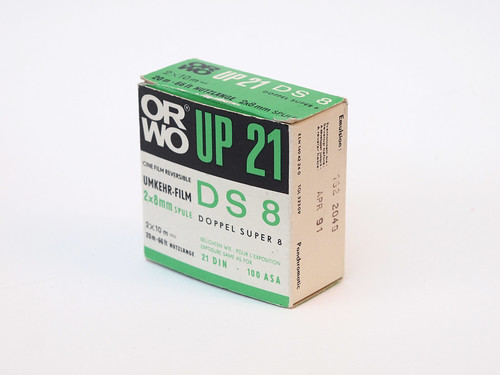
Orwo UP21 DS8 Film
I tried a test with 1970s Orwo UP15 2x8mm film stock, which, although I've had good results in the past from similar vintages, was too fogged to be of any use. For the final prints I used Orwo UP21 double Super-8 film with a develop before date of April 1991. Double Super-8 (or DS8) film and cameras use the principle of 2x8mm film in that the camera exposes frames on one half of the width of roll of 16mm-wide film, which is then flipped around at its end and run through the camera a second time, exposing the other half; once developed the film is split into two 8mm widths which are then spliced together–the crucial difference is that the DS8 format uses the much smaller Super-8 perforations, ensuring a larger frame size, while taking advantage of not using the plastic Super-8 cartridge with its built-in plastic film gate, supposedly allowing for better frame registration, as well as other aspects of 2x8mm, such as being able to run the film backwards through the camera for in-camera effects like dissolves made by the double-exposure of a fade-in over a fade-out.

I made one test with the UP21 DS8 film to get a rough idea of exposure, then contact printed the negatives onto the film, developing it in Ilfotec LC29 diluted 1+19 for 9 minutes at 20ºC. I cut these prints to 8mm width by hand, somewhat imperfectly (I had ordered a 2x8mm splitter the day before, realising this would be useful, but I went ahead with cutting the prints by hand, not thinking that the splitter would arrive a couple of hours later).

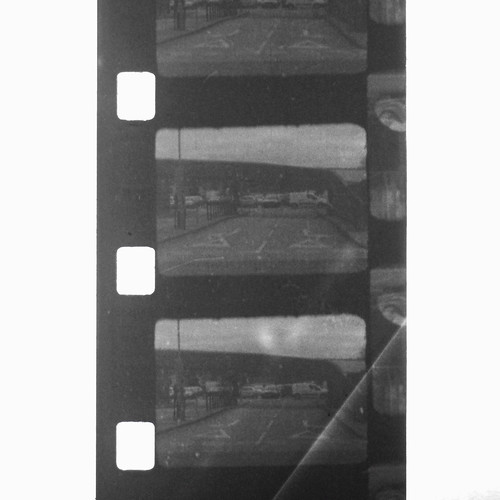
Contact print on Orwo UP21 DS8 film;
the diagonal white line lower right is the edge of one sheet of glass

Unable to film in Ilford on the 21st, I wanted to connect–visually–the projection of my film from last year to the site with some form of simultaneousness to Ilford on the 21st of February. I conceived that the manner of achieving this could be through streaming a live projection of a webcam from the town and recording both projections at the same time. I found just one such instance online with any kind of proximity to the site of Britannia Works: a traffic camera on the A118 Romford Road looking in the direction of Ilford Hill, across the river Roding underneath the A406 flyover. Britannia Works would have been off to the right of the field of view of this camera, but at some point Ilford Limited had expanded their operations to include properties between Roden Street and Ilford Hill, including the use of a skating rink, which would have been somewhere in the location of the building with the white double-height ground floor seen on the camera. Close by, there is another camera on Mill Lane, offline at the time of writing: in my research I found no connection between the paper mill which gives the road its name and the raw materials supplied to Ilford for the manufacture of photographic paper. There is also a webcam focused on a depth gauge in the Roding, although this only provided a still image; this could be 'animated' through refreshing a web browser window to update the image, but this had less of the 'liveness' of the traffic camera, although there was an association there to be had with the anecdote in Silver by the Ton of drying the glass used for photographic plates by the banks of the river while the area was still semi-rural at the end of the nineteenth century, as well as the risk of flooding on Riverdene Road that caused the houses that once backed onto Britannia Works there to be built with a slightly raised lower storey.

Contact print on Orwo UP21 DS8 film; 
the second location on Riverdene Road

The passage from Patrick Keiller's 'The Robinson Institute' that continues from the quote at the top of this post quickly punctures its utopian idea: Keiller goes on to write about how this promise of electronic flânerie was more imagined than realised at the time, in the late 1990s, there being relatively few websites providing actual live streams rather than, like the flood gauge in the Roding, still images that needed constant refreshment. At the time of writing twenty-five years later, the idea of scouring the internet for websites showing live images from anywhere around the world–for some experiential form of spatially-dislocated dérive–seems to me something of a relic of the idealistic promise of those early years. Other forms have supplanted the simple live webcam view: the experience of Google Street View, for example, while affording the opportunity to travel virtually through many towns and cities around the world does not allow the user to experience the simultaneousness of the live stream; this simultaneousness is now part of the everyday with various videoconferencing platforms, but using these has a tendency to subsume any kind of pleasure in the experience of dislocation into pragmatic and productive concerns.

The traffic camera I found looking in the direction of Ilford Hill only provides a short loop of a few seconds: this loop is updated every few minutes online. However, this suited my purposes as the short lengths of film that I projected are only seconds long (I didn't have the right equipment to splice the film together into one continuous length), and each section would have to be separately threaded into the projector; in the interim I could refresh the page to update the loop from the traffic camera to its most recent version. This webcam stream also had a date and timestamp, functioning as evidence to the specificity of the day I projected and recorded it as 'live', returning to the location remotely. There was a provisional quality to the composition of these two projections, utilising an otherwise neglected corner of a room, furnishing it with some of the ephemera that I'd collected in my research into the history of the Britannia Works site in Ilford, sufficient to give a texture to the white walls. I had envisaged the possibility of recording this set up with multiple camera angles, close ups of the various elements within the frame: the business of just projecting the film and documenting this action took precedence over anything more complex than a single angle, static camera.

I had problems in the actual projection of the film I had made. The short lengths had no leader: I had made the contract prints longer than the negative strips, with this extra length acting as a leader, but leader material tends, I think, to be a little thicker than the film itself. The projector I used has automatic threading, which frequently refused the prints I'd made; sometimes these would go through smoothly, but did not always come out the other end of the film path of the projector (also an issue to do with the material's thickness), which then had a tendency to fold itself up inside the projector, and, once creased, was even less likely to cleanly run through the projector, jamming in the gate, which sometimes could be shepherded through by toggling the frame. In addition, thanks to being hand cut, some parts of the film were a millimetre or so too wide, which was relatively easily solved by trimming a sliver from the edge; some parts of the film were not wide enough, and this caused it to jam, possibly by having too much side-to-side play when engaging the projector's pull down mechanism. Despite these issues I was able to film the four separate parts of the footage (each location's filming having been broken over the two lengths of the original cut-down negative); I also kept a section where one length of film jammed in the projector's gate, partly as this print shows a good deal of the lettering in the film rebate, notably 'ILFORD' itself. The duration is shorter than the original film: this was shot at 12 frames per second; although the projector does have adjustable frame rates, it seems to only run at 16fps. I tried slowing the playback to 75%, but found the distortion of the slower audio (even at its original pitch) more distracting than anything gained by seeing the film at the rate intended. With all these contingent factors, the film itself as projected has become fragmentary and somewhat abstract, the image sliding across the frame, hard to fix. Perhaps, in terms of "photographs in motion" (a phrase from David Campany in Photography and Cinema, on the Lumières' first film) the least obstructive section is the very brief few frames in which a pedestrian crosses the screen, but the focus here is off, partly due to the contact print, compounded by the projection itself, in which, thanks to the hand-made quality of the material, needed constant readjustment.

Contact print on Orwo UP21 DS8 film showing both
irregular vertical and horizontal framing

Writing about the beginnings of Ilford, Limited under Alfred Harman last year, I described it as "literally a cottage industry" in that, having outgrown his basement on Cranbrook Road, Harman rented a cottage on the Clyde Estate as his first expansion into the location which would become Britannia Works, rapidly incorporating many more cottage buildings, some of which remained on the site until demolition nearly a century later. This use of domestic space as a site of production was something I wrote about at the end of 'Workers Not Leaving The Factory', or rather, more specifically, the de-localising or re-localising of production outside of a strict spatial definition of 'the workplace'. The global pandemic has accelerated some of these trends, while delineating what kind of work could be moved online easily (although not always pursued) against work impossible to carry out remotely. Surrounding the filming in Ilford a year ago, the consumption the supermarket that has replaced Britannia Works allows relies on the productive work, necessarily tied to a number of spatially-located specificities, non-virtual, culminating in the supermarket itself; the construction work just off-frame is also solidly tied to the real, real bricks, real concrete, and the physical labour required to configure these materials into living spaces, such spaces now co-opted into being the site of production for many, unforeseen a year ago.

The title used here comes from a reproduction of the original programme of the Lumière films shown in London in 1896: their first film, of workers leaving the Lumière factory, is not among the titles listed, but the possibility that it may have been shown is tantalisingly suggested by the promise that the programme "will be selected from the following subjects, and will be liable to frequent changes, as well as ADDITIONAL POURTRAYALS [sic]".


Sources/Further reading:
David Campany, Photography and Cinema, Reaktion Books, London 2008 (2012 reprint)
RJ Hercock and GA Jones, Silver by the Ton - A History of Ilford Limited 1879-1979, McGraw-Hill, London, 1979
Patrick Keiller, 'The Robinson Institute', The View From the Train, Verso 2013
O. Winter, ‘The Cinematograph’, The New Review, May 1896 (https://picturegoing.com/?p=4166 retrieved 21/3/20)


See also the bibliography of 'Workers Not Leaving The Factory'.

Tuesday, 13 October 2020

A View of Delft

“For it is not a question of presenting works in correlation with their time, but rather, in the time in which they are born, of presenting the time that knows them.”
Walter Benjamin (italics mine)

When Vermeer was ‘rediscovered’ in the nineteenth century, his oeuvre scattered and attributed to others, there was no unified idea of what a Vermeer painting was, and therefore what could be looked at and considered a Vermeer. Now, Vermeer is generally thought of as a painter of quiet interiors, usually with a solitary figure, usually female, with just a few odd paintings lying outside these descriptors. However, in this period of rediscovery, many other artists’ works were attributed to Vermeer, driven by Théophile Thoré’s conception of what Vermeer’s oeuvre should look like. Thorè, writing under the pseudonym Willem Bürger, in his article ‘The Sphinx of Delft’ in the Gazette de Beaux Arts (1866), included twenty-two landscapes and street scenes, around a third of the paintings that he listed as being by Vermeer, seeing the artist as a painter of views (these paintings are now attributed to Vermeer’s contemporaries Jacob Vrel, his near-namesake Dirk Jan van der Meer, and the much later amateur painter Jan van der Laan). That Thorè-Bürger saw Vermeer as a painter of views was no doubt influenced by the impact of his encountering the View of Delft and the Little Street:

"In the museum at the Hague, a superb and most unusual landscape captures the attention of every visitor and powerfully impresses artists and connoisseurs. It is the view of a town, with a quay, old gatehouse, buildings in a great variety of styles of architecture, garden walls, trees and, in the foreground, a canal and a strip of land with several figures. The silver-gray sky and the tone of the water somewhat recalls Philip Koninck. The brilliance of the light, the intensity of the color, the solidity of the paint in certain parts, the effect that is both very real and nevertheless original, also have something of Rembrandt.

When I visited the Dutch museums for the first time, around 1842, this strange painting surprised me as much as The anatomy lesson and the other remarkable Rembrandts in the Hague museum. Not knowing to whom to attribute it, I consulted the catalogue: View of the Town of Delft, beside a canal, by Jan van der Meer of Delft. Amazing! Here is someone of whom we know nothing in France, and who deserves to be known!"

[…]

"Later, even before 1848, having returned to Holland several times, I also had the opportunity of visiting the principal private galleries, and in that of M. Six van Hillegom—the happy owner of the celebrated portrait of his ancestor, Burgomaster Jan Six, by Rembrandt—there I found two more extraordinary paintings: a Servant pouring milk and the Façade of a Dutch house,—by Jan van der Meer of Delft! The astounding painter! But, after Rembrandt and Frans Hals, is this van der Meer, then, one of the foremost masters of the entire Dutch School? How was it that one knew nothing of an artist who equals, if he does not surpass, Pieter de Hooch and Metsu?"

In my previous post, Cameras Obscura, I wrote about my own encounters with the work of Vermeer, and of seeing the Little Street while studying A-level art, and of Arthur J. Wheelock Jr.’s monograph on the artist; a section of this book details Delft’s brief artistic flourishing in the mid-seventeenth century - as well as containing photographs of the (then) contemporary Delft (the book was first published in 1981). As a result I had my own imaginary conception of the city long before I travelled there, and one built in a formative stage in my own life. Arriving in Delft by train, after dark, at the very end of last year, walking from the station to the apartment where we stayed, I suddenly found myself in the market square, confronted by the Nieuwe Kerk, familiar from Fabritius’s View, as well as its tower appearing in Vermeer’s View of Delft. Like finding Alice’s grandmother’s house from the film Alice in the Cities in Gelsenkirchen four years ago, written about on my other blog, this confirmation - in a physical reality - of a world as experienced through images, and, as such, this was an imaginative world, an idea, a conception of place invested with something equivalent to a mythical existence, accessed through its representations, although one much more particular than those larger, more widely-held mythologies of Paris or New York for example. My interest in Wim Wenders’ films of the 1970s was based, in part, through my prior experience of reading about the films as a student, without, at the time, being able to see them; reading about, and seeing Vermeer’s (and Fabritius’) paintings as a teenager, and, perhaps, with an intervening period of my life, many years in fact, in which I did not think about them very much, little did I suspect, then, that one day I would find myself in Delft, and, indeed, staying on Nieuwe Langendijk, a street which continues on from Oude Langendijk, which itself runs alongside the Nieuwe Kerk, and is the corner location of Fabritius’ A View of Delft; Vermeer himself was documented as living on on Oude Langendijk in 1660. 
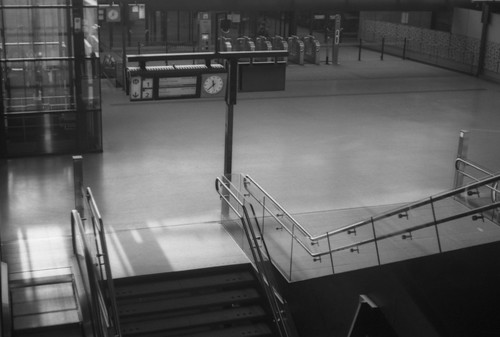
Delft central station, Kodak Retina IIa with Agfapan APX100

Much is made of the contemporary experience of the ‘non-place’, and the new railway station in Delft, the first impression of the city when arriving by train, conforms in some respects to this idea of the non-place, but then, moments later, standing in the market square, there was a feeling, a feeling of being definitely placed, by the Dutch vernacular architecture of course, and by the memory of those second-hand impressions of the city through the work of Fabritius, Vermeer, and de Hooch, and the material commentary of prints, drawings, and maps which often contextualises these artists and others. In writing about Alice’s Grandmother’s House I quoted, then, at length, a passage from Georges Perec’s 'Species of Spaces': “To cover the world, to cross it in every direction, will only ever be to know a few square metres of it, a few acres, tiny incursions into disembodied vestiges, small, incidental excitements, improbable quests congealed in a mawkish haze a few details of which will remain in our memory…” which summed up the particularity of how it felt to be there, then, at that moment; in the same passage, the phrase “out beyond the panoramas too long anticipated and discovered too late” could stand in for the title of this post.
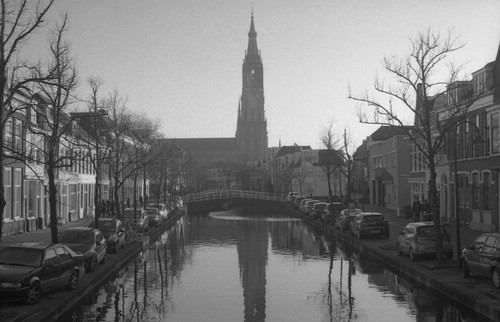
Nieuwe Kerk, Delft, Kodak Retina IIa with Ilford HP5 Plus

A day earlier, I had been in the Rijksmuseum. As well as the Maidservant Pouring Milk, I had seen again the Little Street, this time paired with Velazquez’s similar-sized landscape of the gardens of the Villa Medici as part of the temporary exhibition ‘Rembrandt-Velázquez: Dutch & Spanish Masters’. There’s something about these two small paintings by two artists not known for making views which makes them remarkable; one wonders exactly how they conceptualised what they were doing when they made these works. Of course, there are many paintings like Vermeer’s Little Street, alike enough that they were at one time attributed to him, and yet unalike, now, that they have become stripped from his oeuvre, given to Vrel and van der Laan, with something about these other paintings, suggesting a fidgety, sentimental or anecdotal quality (apparent, too, or too often, with Pieter de Hooch); however these are all part of a general trend in Dutch art of the seventeenth century that fundamentally re-thought what it was to make pictures, but in the particularity of Vermeer’s Little Street, and in the View of Delft, there is something more, a foreshadowing of a tendency which would begin to make itself known over a century later in artists’ sketches from nature. Peter Galassi, in Before photography: painting and the invention of photography traces the “ultimate origins of photography” to the invention of perspective, an ordered way of seeing the world with everything in its proper place and relation to the viewer; establishing this, Galassi elaborates that it is not the development of perspective construction itself (though necessary) which leads on to the invention of photography, but how, in the hands of artists, it is used:
“The Renaissance system of perspective harnessed vision as a rational basis of picture-making. Initially, however, perspective was conceived only as a tool for the construction of three dimensions out of two. Not until much later was this conception replaced—as the common, intuitive standard—by its opposite: the derivation of a frankly flat picture from a given three-dimensional world. Photography, which is capable of serving only the latter artistic sense, was born of this fundamental transformation in pictorial strategy.”
As an example of this, Galassi contrasts a Renaissance painting known as the Urbino Ideal Townscape or Ideal City (c. 1470), in which the space depicted is placed before the viewer; with Emanuel de Witte’s Protestant Gothic Church (1669), the viewer is placed in the space. Galassi describes the two different approaches as depending of two different mentalities: the former, using perspective, in constructing a world; the latter, again using perspective, but taking from the world as an already existing arena of potential paintings. (Galassi also describes a new particularity of time in de Witte’s painting: the Ideal City is suffused with an even light which gives equal clarity to the architecture; de Witte’s painting in contrast shows sunlight breaking up this clarity for a specific time of day - and something analogous is happening with Vermeer’s View of Delft). Galassi states that, for the historian of perspective, its development and uses do not follow a smooth progression, but, instead, this history is
“…denser in the fifteenth, seventeenth, and nineteenth centuries, when innovative conceptions of perspective were richer than during the sixteenth and eighteenth centuries. And its emphasis is not guided by absolute value, for Saenredam will claim attention equal to Vermeer, and the young Corot more than David. Similarly, for a given period, it will favor some branches of art over others. The problem of vision was often most directly posed, for example, in the painting of landscapes and views. This tradition thus receives disproportionate attention; around 1800 it is the entire domain of the most radical experiments in the role of vision in art.”
This “problem of vision” explored in Vermeer’s work may explain his relative obscurity in the century following his death - and his ‘rediscovery’ in the age of the invention of photography. Like Saenredam’s radical compositions (“Not until the late nineteenth century was such a willfully fragmentary and internally discontinuous view the common option of every painter.”), Vermeer’s views are also, in their own way, anachronistic in conception, rare “forward glances” in Galassi’s phrase, the logic of which would have to wait for the invention of photography to be properly understood: “perhaps one of the ironies of art history that with a Kodak any child might now produce by accident a composition that a great artist like Vermeer had to use all his ingenuity […] to achieve.” (R. H. Wilenski, An Introduction to Dutch Art, 1928 quoted in Chrales Seymour Jr., ‘Dark Chamber and Light-Filled Room: Vermeer and the Camera Obscura.’)

View across the Kolk, Delft, Zodel Baldalux with Ilford FP4

Vermeer’s View of Delft was painted from a viewpoint looking roughly north, across a harbour called the Kolk, outside the city’s walls, towards the prominent Schiedam and Rotterdam Gates, with the tower of the Nieuwe Kerk prominently lit, and the Oude Kerk tower largely obscured. After visiting the Vermeercentrum and the Nieuwe Kerk earlier in the day, finding the location from which Vermeer painted the View of Delft was straightforward: although almost all the buildings depicted by Vermeer have gone, the general topography is the same: the Kolk, the canals branching off into the city from behind where the city gates were, the general street plan, and the Nieuwe Kerk tower of course (visually, the twin spires of the 19th-century Maria van Jessekerk echo the absent spires of the Rotterdam Gate on the skyline to the right of the Nieuwe Kerk). Wanting to make something about the experience of being in this place, but not knowing how to react, I filmed the reflections of the skyline in the water - the reflections being one of the most remarkable aspects to the painting - with the outline of the Nieuwe Kerk tower clearly seen against the late afternoon sky, its silhouette dominating, in a manner essentially absent in the painting (as it is brightly lit, with the sky behind it, the reflections below only pick up the dark masses of the tree or trees and the Rotterdam Gate in shadow either side of the more distant tower). Perhaps this was appropriate - filming a reflection of the tower which is impossible to discern in the painting - as the current tower of the Nieuwe Kerk is not the same as that depicted in the View of Delft. The Nieuwe Kerk was struck by lightning in 1872 (having been struck and partially destroyed before in 1536; the rebuilt tower that appears in Vermeer’s painting survived the ‘Delt thunderclap’ of 1654) and the tower rebuilt a second time as a result; the rebuilding of the upper stage of the tower used Bentheim sandstone, blackened through a reaction to atmospheric pollution, in contrast to the colour of the stage below, which gives the erroneous impression of having been scarred by fire. As well as not being the same tower reflected in the film, it is of course not the same water making its reflection.

Bolex B8, Retina IIa with Adox Scala 160

Although I didn't know it at the time, the Double-X film I shot here with the Bolex B8 wasn’t exposed properly due, as I later surmised, to the variable shutter being stuck in a near-closed position: I didn’t see the results until developing this roll of film some time later; however, as this footage was on the first roll of 8mm film from the trip that I developed, it did mean that I (rather belatedly) made a number of tests before developing the other two rolls of film shot in Delft, which, particularly in the case of the 'Pouring Milk' film, meant I was able to adjust the developing times sufficiently to get as good a result as was possible from the latent images. I have excerpted a short sequence as an animated GIF below; the thinness of the negative shows any dust incredibly well, a result of a lack of cleaning before scanning and ad hoc processing conditions - essentially attempting to improvise a means of drying 25ft of 2x8mm film in a hurry.


One reason for shooting film, rather than digital, were the sense of having a physical artefact, an indexical link to the contingencies of the location itself, ideas which probably do not hold too much weight in the digital present, especially with the results digitised and disseminated through a digital medium; regardless, what is recorded onto the physical medium is something other than a provisional interpolation of data (and, if ever exhibited, a positive could be printed from the negative and projected). In Ways of Hearing, Damon Krukowski attempts to encapsulate how it felt as a musician to be recording to tape in the 1980s, not an entirely unsympathetic analogy:

“In that analog studio, there was a feeling when the tape started rolling that this was the moment we would capture-a feeling of time moving both more slowly, and more quickly than usual. Like when you’re in an accident. Each split second is suddenly so palpable, as if you’re living in slow motion. Yet what do we say when it’s over? It all happened in an instant.

Analog recording is like an accident in other ways. On tape, there was no “undo”. You could try again, if you had the time and money. But you couldn’t move backwards. What’s done is done, for better and worse.”

Two days after visiting its location, we took the tram from Delft to the Hague to visit the Mauritshuis and see Vermeer’s View of Delft. Any attempt to describe the experience of finally seeing a painting familiar from reproductions for many years would be entirely inadequate. In real life, the View of Delft is both familiar and surprising (or at least to me, in some aspects, especially the thickness of the paint in some areas, notably in the near foreground) and one can appreciate the impression it made on Thorè-Bürger around the time photography was being invented. As a result, while still in Delft, I decided to revisit the viewpoint again. Having initially been to the spot with a camera but no clear idea, I needed to give myself a logical structure this time; in the interim, I had shot Pouring Milk and had used a duration for that film from a measure of how long visitors in an art gallery look at a work of art: while trying to find a definitive average, a different answer which I had also turned up was 17 seconds. Determining that, if I used a whole side of my last roll of 2x8mm film that I’d taken with me to Delft, shooting at 12 frames per second rather than 16fps, its duration should be long enough to contain 17 separate shots of 17 seconds each. Any response to Vermeer’s painting would only ever be inadequate; any attempt to communicate the personal experience of how it felt to be standing there, in that same location, looking over Delft from that same viewpoint, with the painting fresh in my memory, would also be inadequate. Acknowledging the futility of trying to engage meaningfully with such a canonical work of art, my approach was to not film the view itself: the film is built up from details around the viewpoint as it currently exists in the historical moment that I was there, then.
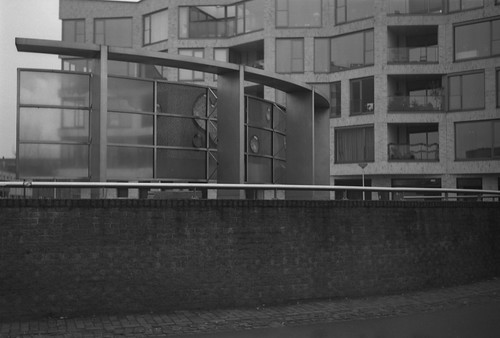
Thomas Elshuis, Panorama, Zodel Baldalux with Ilford FP4 

Facing the view, a raised platform above the quayside of the Kolk provides an approximate elevation to the correct viewpoint: Vermeer may have used the second floor of an inn which stood on that spot in the seventeenth century to make his painting. This platform is made from brick and paved, but when I was there some work to it was in progress or had just been finished: there were pallets of building materials collected there, paving bricks and kerbstones just at the right point of the platform overlooking the view. Behind the platform there was a patch of muddy, sandy ground which had evidently been re-landscaped recently, with a circular area of cobbles having been removed. In the middle of winter this was bare of grass, imprinted with footprints and tyre-tracks. Curving around the back of the raised platform, a steel structure supports a set of printed, translucent panels. This is a work of art called Panorama by Thomas Elshuis (although in the Dutch text, it seems to be called Gezicht op Delft - View of Delft), which brings together Newton’s discovery of the refraction of white light into the visible spectrum of colours with van Leeuwenhoek’s microscope, represented by drops of water, magnifying the sand from the bed of the Schie, the canalised river which meets the Kolk from Rotterdam and Delfshaven, and, perhaps, is also a reference to the sand incorporated into the paint in some passages of Vermeer’s painting. Photographs of this ‘folly’ (as Elshuis calls it) on the art in Delft website show sunlight streaming through it, highlighting the stained glass-like qualities of the translucent panels, making sense of the references to Newton and van Leeuweenhoek, an effect quite absent on a grey January morning. After I shot the film, behind the raised platform, partially covered with dirt, I discovered the two metal plaques set in the ground behind the structure which detail this piece of site specific artwork in Dutch and English. 

Metal plaques, Kodak Retina IIa with Agfapan APX100

Having shot the two rolls of (new) Double-X I’d taken with me, I had one roll of 2x8mm film left. This was Orwo UP21 with a process before date of November 1982. I had bought two rolls of this online with the same date, in the same lot, and had previously tested a short length cut from the other roll before travelling, and found the best exposure index for the film stock was around 12; I was also developing this as a negative: although nominally a reversal or transparency film, unlike some black and white reversal ciné film I’ve used, the Orwo film does not have a colloidal silver anti-halation layer, which means it can be developed as either a negative or a positive.

2x8mm Orwo UP21 film

I shot at 12fps for the increased duration this would provide, and this would incidentally mean a slower shutter speed, but the grey overcast morning light when I returned to the site was so low, I felt as though I needed an extra stop in filming, and rated the film at 24 rather than 12 (the light levels also meant that most shots were taken with the lens wide open, or close to wide open, and the accuracy of focus has suffered as a result). At the time I thought I might be able to extend the developing time a small amount to compensate. There was a general logic to the sequence of shots, although essentially improvised, moving from the very small, close-framed shots of the platform facing the view, to the final shots which show the artwork by Elshuis, but in fragmentary details. The editing of the film was done in camera, and the length of the film is shown in its entirety, with both leader and trailer. I loaded the film and unloaded to turn it over in a changing bag, meaning that the film wasn’t exposed to light in either operation, in order to use the whole length of the film. When developed, it was clear that the film had been exposed while wound on its spool, but I kept this bleached-out section, containing the identification code, the circular holes punched through the film at the start: light through these holes has imprinted itself through a couple of layers of the film; a wavy line, the shadow of the rubber band securing the roll can also be seen to the right hand side of the image.

When I came to develop the first roll of 2x8mm Double-X shot on this trip, as soon as I took the film out of the tank, I realised that something was wrong: it looked underdeveloped, or so I thought. I subsequently shot a number of short tests of both film stocks I had used in Delft, Double-X (and in doing so, discovered that single-perforated 16mm - having used all my 2x8mm perforated Double-X - would run through the Bolex B8, at least well enough to test the exposure), and the Orwo UP21 from the part-used roll I’d already tested in a still camera and not taken to Delft. I shot three test lengths of the UP21, decreasing the developer dilution and increasing development time as I went, in my attempts to get a usable result. Making these tests I realised - only gradually - that the camera was underexposing by around three stops, and my only explanation for this was that the variable shutter was stuck near closed, so in the shooting of this film, I had effectively exposed it around four stops faster than the exposure index I had tested for. As well as increasing time and decreasing the developer dilution, I also took two rather more extreme technical approaches: first, I flashed the entire roll of film in an attempt to raise the shadow values (as I would be pushing the film, the contrast would be increased, and I was expecting no or little shadow detail at this stage, although I had been filming in very flat, diffused light). To do this, I ran the whole roll of film through the Bolex again, double-exposing it by filming a featureless white wall - with the lens out of focus - and three stops below a meter reading taken from that wall. As before, I loaded, unloaded to flip the film spools, and finally unloaded the film using a changing bag after exposing both sides. I developed the film with Ilfotec LC29, diluted 1+9, for 20 minutes at 20ºC. The second approach was to tone the whole film with selenium toner after development, with the idea that this would act as an intensifier on the negative, providing a little more density. The end results are still far from what I had hoped. It’s possible that the toner may have simply increased the overall graininess of the negative, the fog of age; incidentally, the edge markings on the film look considerably blown out from the push processing. Due to the poor light levels, camera faults, and processing issues, the resulting images on the film are underexposed, hard to read, obscure. Titling it 'A View of Delft' is an assertion of what it shows, factually accurate, despite there being little of the location that is clearly recognisable in the film (although possibly I should call it 'Seventeen Views of Delft'). I have recently become interested in how the title of an artwork functions, how the title, as extrinsic content, is both integral to an artwork yet stands apart, separate from the object itself, a content which brings the viewer into a unique relationship to the art object, a relationship which, in some senses, ‘creates’ the artwork. In an essay called 'Entitling', John Fisher asserts that:
“Titles are names which have a sense; they call for responses. They determine, to a degree to which significant attention has never been given, interpretations and other acts.

[…]

Not all artworks are titled. Not all artworks need to be titled. But when an artwork is titled, for better or for worse, a process of interpretation has inexorably begun.”

Vermeer’s painting, the View of Delft has a declarative title which aids little in the process of interpretation, its need is small, especially if one is familiar with the city it represents; indeed, as with the title of Maidservant Pouring Milk, now more commonly known as the Milkmaid, as described in the previous post, the painting hasn’t always been simply the View of Delft: Thorè-Bürger knew it as View of the Town of Delft, which seems unnecessarily wordy, but a descriptive title suffices nonetheless. The changing function of works of art, through changing conditions of production and consumption, demand that, in many cases, the title has more work to do than might previously have been the case. As a title, A View of Delft alerts the viewer to the gaps in what it represents, perhaps appropriate to the contingent nature of working with a physical medium, film, the conditions of its making, and its unmet ambition in an attempt to meaningfully encounter Vermeer’s View of Delft.

Bibliography
Walter Benjamin, ‘The History of Literature and the Science of Literature’ from Poesie et revolution, Paris 1971, p14, quoted in Hubert Damisch, The Origin of Perspective, translated by John Goodman, Massachusetts Institute of Technology, 1994; originally published as L’Origine de la perspective, Flammarion, Paris 1987
Daniel A. Fink, ‘Vermeer’s Use of the Camera Obscura - A Comparative Study’, The Art Bulletin, Vol. 53, No. 4 (Dec., 1971) pp. 493-505
John Fisher, ‘Entitling’, Critical Inquiry, Vol. 11, No. 2 (Dec., 1984), pp. 286-298
Peter Galassi, Before Photography: painting and the invention of photography, Museum of Modern Art, New York, 1981 www.moma.org/calendar/exhibitions/2267
Jonathon Janson, 'Essential Vermeer' website: http://www.essentialvermeer.com/
Damon Krukowski, Ways of Hearing, MIT Press, Cambridge, Massachusetts, 2019
Georges Perec, ‘Species of Spaces’ in Species of Spaces and Other Pieces, translated by John Sturrock, Penguin 2008
Charles Seymour, Jr., 'Dark Chamber and Light-Filled Room: Vermeer and the Camera Obscura', The Art Bulletin, Vol. 46, No. 3 (September 1964), pp.323-331
Sandra Spijkerman, ‘Kunst in de Openbare Ruimte/Gezicht op Delft’, https://delft.kunstwacht.nl/kunstwerken/bekijk/330-gezicht-op-delft See also https://thomaselshuis.nl/
Arthur K. Wheelock Jr, Vermeer, Thames and Hudson, London 1988
Arthur K. Wheelock Jr., C. J. Kaldenbach, Vermeer’s View of Delft and his Vision of Reality, Artibus et Historiae, Vol. 3, No. 6 (1982), pp. 9-35