Showing posts with label FP4+. Show all posts

Saturday, 19 June 2021

126 Day June 2021

Kodak Instamatic 277X with Ilford FP4
By a quirk of Kodak's practice of re-using its obsolete format codes when designating the new easy-load drop-in plastic cartridge, calendrically, 126 Day follows on immediately from 116 Day in June. I'd picked up a 126 cartridge of Ilford FP4, with a develop before date of February 1974, which I shot on the day; I hadn't reloaded any cartridges with 35mm film as I had done on previous years, so had just 12 exposures in the FP4 cartridge. Having used quite a fair bit of FP4 film from the 1970s, I was fairly confident that I'd be able to get acceptable results from the film, and, as with the Verichrome Pan on the previous day, I didn't bracket any of the exposures.

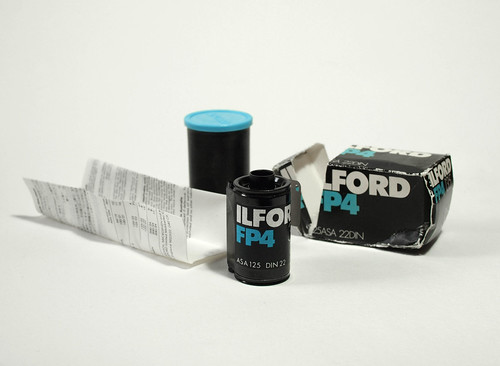
Ilford FP4 126 cartridge
For the camera, I used the Kodak Instamatic 277X that I've used previously, for the fact that it's got a wider range of adjustable apertures than most Instamatics. With only weather symbols to indicate the aperture settings, using the five-decades-old film, I compensated by generally choosing a setting two symbols wider (or darker) than the conditions indicated: for example, with a subject in bright sun, I set the aperture to the 'light cloud' pictogram, which worked well enough apart from a few frames in relatively deep shadow. In terms of subjects, with more time than the 116 Day before it, I simply followed a cycle route around my local area, one of the loops I'd found for my allowed exercise during the first lockdown last year, and indeed, this was some of the same route I'd taken on 116 Day in 2020.

Developing the film, I used the standard time and temperature for modern FP4 Plus, 15 minutes in Ars-Imago #9 diluted 1+50 at 20ÂșC with normal agitation. I had intended to re-use the plastic cartridge (in part due to the late 1960s/early 70s 'sunburst' Ilford symbol on the label), but even after repeated scoring with a knife, this proved too difficult to take apart cleanly, and it broke in the changing bag while attempting to do this. The spool and attached 126 backing paper were salvaged in the process however: when re-used with 35mm the backing paper can end up getting somewhat ragged after a few rolls. As an aside, on the leaflet which came in the box with the film, there are instructions for home processing, with a pair of illustrations on how to break open the cartridge (figures 1-3 on the first side of the leaflet show loading, advancing the film, and unloading).


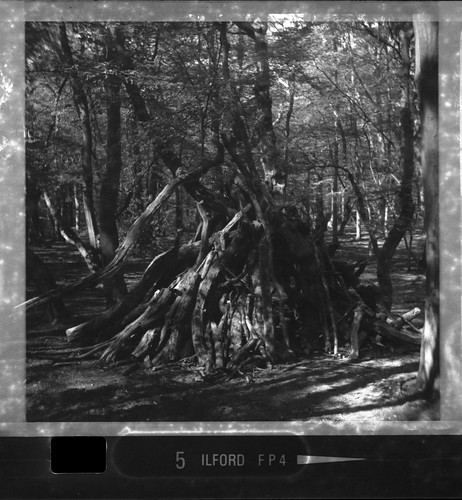
Scanning the negatives, it was clear that the emulsion had reacted to the backing paper–this showed up nicely in the rebate at the lower edge of the film where the shape of the long hole with its rounded ends is imprinted into the film (this doesn't match up with the single perforation for each frame as it's where the emulsion has been in contact with the back of the backing paper while rolled together). This reaction has caused a certain amount of mottling across the film, but, with enough exposure, in some frames it's hardly visible and only really shows in larger areas of smooth tones, such as the sky. The pre-exposed 126 frames also vary: on denser negatives, these begin to disappear; on thinner negatives, or with larger areas of shadow, these frames are much clearer. I chose not to crop the scans of the film, instead showing the whole width of the film, pre-exposed frames, perforations, rebate and frame numbers, and the overlapping edges of each exposure: the frame below shows all of these, the mottling and the backing paper hole too.
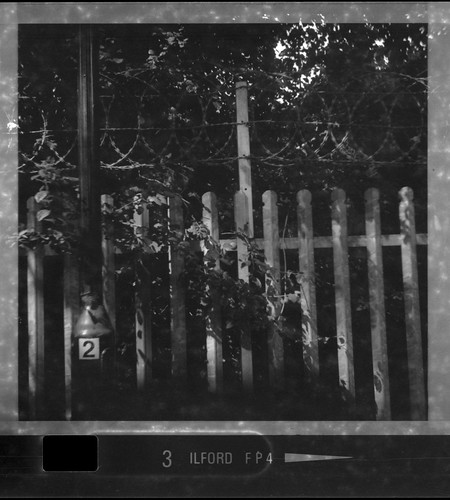

Last year, I'd shot a cartridge of 126 Verichrome Pan, and had used a yellow filter for the entire roll; many of the shots this year would have benefitted from the same, as the conditions were sunny and a number of frames had areas of sky with some light fair weather clouds; potentially a yellow filter might also have lightened the tones in some of the foliage, something I didn't consider until part of the way into the film, having left home without thinking I might need a filter. The other error I made was in not ensuring that the flap of the plastic every-ready case was always entirely clear of the lens, having it intrude into the bottom part of the image in a couple of frames.


Comparing these frames with those on Verichrome Pan from last year also brought up something which seems like a oddity in the manufacture of these 126 films: the pre-exposed frame lines do not appear to be a single exposure all around the nearly-square image, but an operation performed in (at least) two steps. The exposures for the horizontal and vertical frame lines clearly overlap; the horizontal lines at the top and bottom edges of the frames look continuous for the whole length of the film, while the vertical frame lines extend from the top edge of the film but do not entirely meet the lower edge of the bottom horizontal frame line, stopping a little short. I did reflect that possibly the exposure of the vertical frame lines could have been linked to a stepping motion at the same time as the exposure of the frame numbers, with an ascending counter linked to the position of the perforation hole. This is relatively easy to discern in the image below, one of the frames that has a lot of shadow areas around the edges. Last year's cartridge of Verichrome Pan shows the same overlapping pre-exposed horizontal and vertical lines. 


Overall, the FP4 came out reasonably well considering its age, some frames did need more exposure, and some carelessness on my part notwithstanding with the camera case, as well as overlooking using a filter. Thirty-odd years ago, had I dropped the cartridge into Boots for processing (as I did when first photographing with a handed-down Instamatic) I'd no doubt have received my twelve square prints with a sprinkling of advice stickers on them.

Sunday, 25 April 2021

#FP4Party April 2021

Two years ago, less a couple of months, for the #FP4Party in February 2019, I used my Ensign Folding Klito de Luxe No.9 with some old Ilford FP4 sheet film in quarterplate size; two boxes of this had come as part of a larger job lo: both were unopened boxes of 50 sheets each, both with the handwritten date of 16/11/78. I'd used film from this stock for the January and March #FP4Parties in 2019 too, in different cameras; for April 2021's #FP4Party, when considering what format to use, I saw that I had seven sheets of the last box of this film left, assuming I'd tallied my usage correctly. Thus, I decided to simply shoot one sheet a day for each day of shoot week, and the choice of camera had to be the Ensign Folding Klito de Luxe No.9 as it's the best of the three quarterplate-sized cameras I have. In 2019, in the three successive months, I'd shot two sheets a day, hopefully providing a 'good' and a 'spare'; with only seven sheets left this was not a luxury I could allow myself. In the event, I did accidentally use two sheets on one day, a result of unclear labelling of my plateholders. 

Although I was exposing just one sheet of FP4 each day, I also photographed each subject on other film stocks, some Ilford F.P.3 from the 1940s, and Ilford Fine Grain Ordinary N5.31 film (this box has a handwritten date of 11/3/70): without thinking, I picked up a second plateholder when photographing on the Friday, thinking it was the latter film when instead it was a second sheet of the FP4. In order to shoot FP4 film each day of the shoot week with two days to go and only one sheet of quarterplate-size FP4, I then cut down some larger FP4 Plus film to fit the format. Having made a jig that I taped to a cutting mat to cut the film to size inside a changing bag, I found this more difficult than expected. I tried to cut some 9x12cm film to quarterplate size–8.2x10.8cm–but found it was far too easy for the film to move around while changing from a cut in one orientation to the second cut in the other. After spoiling one sheet of 9x12cm FP4 Plus, and badly cutting another, I then cut down a sheet of 5x4-inch FP4 Plus. For this I only made one cut, going from 5 inches to 3¼ inches; quarterplate film measures 4¼ by 3¼ inches, but for ease of cutting down film to use in the Klito, 4 inches by 3¼ would have to do.

Part way through shoot week, I developed the first four sheets, partly as I didn't have enough spare film sheathes to load seven plateholders at the start of the week. This was also instructive: I had overestimated the bellows factor on the sheets already exposed, resulting in dense negatives, especially Thursday's; as a result, on Friday and Saturday I didn't compensate in exposure for bellows factor, and the negatives developed fine (Saturday's shot was taken on the cut-down 5x4, rated the same as the FP4 from the 1970s, although its process before date was only April 2010). As a consequence of simply being at home throughout the week, almost all the photographs were of close-focus subjects around the house and garden (such subjects needing to compensate for bellows factor–or not as the case seemed to be). The weather was almost uniformly sunny, with the brief exception of showers on the Saturday afternoon, which I tried to record somewhat obliquely.

The first shot of the week I'd hoped to have been better, but there was too much of a breeze to use an exposure time of 1/5th and expect the subject to be sharp; Sunday's subject, the last sheet of the 100, I chose the tree outside my window which I had been photographing for an entire year, and had indeed only recently finished that project, but wanted to record its new growth after being heavily pruned in the autumn. This shot suffered from a light leak which I think may have been due to mixing up darkslides and plateholders: some of the plateholders which fit the Klito camera are branded Klito; some are AP Paris; and others are unbranded, and, although very close in all respects, it's easy to mix up the darkslides and then find some are a better fit than others. 
 
Monday
Tuesday
Wednesday
Thursday
Friday
Saturday
Sunday

Sunday, 24 March 2019

#FP4Party March 2019

After using the Butcher's Cameo for January's #FP4Party, the Ensign Folding Klito for February, with March being the third and final #FP4Party of 2019, the logical choice had to be the Midg falling plate camera, the last of my three quarterplate-format (8.2x10.8cm) cameras, in order to use the same stock of Ilford FP4 film, of which I had two boxes of 50 sheets with a handwritten date of 16/11/78. I used the same rationale in shooting just two sheets of film each day for the shoot week. As with the previous two months, I rated the film at an exposure index of 50 to compensate for the loss of sensitivity with age, and, again like the last two months, a some of the shots were long exposures on a tripod (or, in one case, simply the floor), and some hand-held. The Midg has a relatively slow f8 Primus Rapid Symmetrical lens, and although its shutter should be adjustable, my camera only appears to fire at one speed on the instant setting, at possibly around 1/100th, making it only suitable to use hand-held in bright weather.


Of all the cameras I've used in the past three months, the Midg has been most troublesome. In my post about the camera itself, I quoted a letter from Miniature Camera Magazine referencing that falling plate cameras would 'jamb' at the critical moment, and I did experience this more than once during the week. On the first day of the shoot week, I did attempt to expose three sheets of film, but the second plateholder jammed, giving a double exposure. One of Tuesday's shots was out of focus due to forgetting to correctly select one of the close-up filters before exposure. Wednesday's two shots were affected by the first not falling cleanly into the bottom of the camera, hence the ghostly shape at the bottom of the frame, which is from the second exposure; the second shot had a shadow of the first plateholder partly obscuring it. Thursday was the only day of the week that I managed to take two shots without any problems, both sheets exposed hand-held with relatively bright sunlight. Friday's shot was made by placing the camera on its back, which meant a lot of dust falling onto the film inside the camera body; a second shot on Friday did not materialise as the sheet of film somehow slipped from its film sheath and I found it loose, unexposed, inside the camera when unloading. Saturday's second shot was very underexposed due to attempting an interior shot with a window handheld on the 'instant' setting. Sunday provided another double exposure, but ignoring my stricture to shoot just two photographs each day, I used up all four sheets of film still inside the Midg at the end of the week, and got the one good shot posted here.

Monday
Tuesday
Wednesday
Thursday
Friday
Saturday
Sunday

Sunday, 24 February 2019

#FP4Party February 2019

With February being announced as 2019's second #FP4Party, after shooting with the Cameo in January, it felt logical that I should use my other quarterplate-sized folding camera - the Ensign Folding Klito de Luxe No.9. Last month, I had set myself the task of simply photographing with two sheets of forty-year old Ilford FP4 each day during the 'shoot week', and so I did the same for February. The Ensign Folding Klito is a superior camera when compared to the Cameo; the most immediate difference in use is the rack and pinion focus on the Klito, rather easier to finely adjust against the Cameo's spring clamp. The Klito has its original ground glass focus screen with a hood; using the Klito with faster lenses than the Cameo also made accurate focus easier to achieve. Like the Cameo, it has front rise and cross movements, the rise controlled by beautiful circular gearing around the lens and shutter assembly.  Finally, the Ensign Folding Klito also has double extension bellows, allowing for close focus, without the need for a close-up lens attachment, as I used with the Cameo.

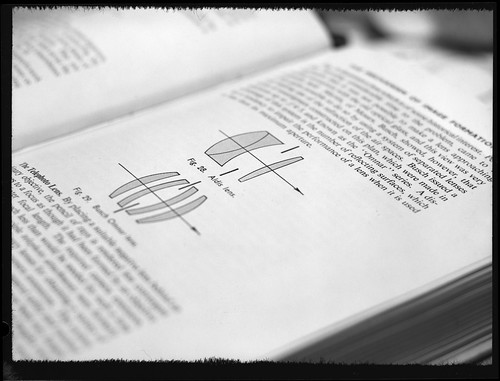
Over the first three days of the shoot week, I used the Klito with a 12cm Ica Dominar lens; the original lens is a No.2 Aldis Plano Anastigmat; I had replaced this with the Dominar lens while using the Klito to take night photographs on glass plates, being f4.5 against the f6.8 Plano: having a faster lens makes for a brighter image on the ground glass when composing and focussing, especially advantageous when working at night. However, wanting to use the Klito with this original lens, I reinstated the Aldis Plano, and shot with this for the remainder of the week. The Aldis Plano is a classic triplet design; while cleaning the thread on its retaining ring, I removed the rear element - and realised that it, a positive meniscus, formed an image on its own. The results (Thursday's image, with a diagram of the Plano shot for Friday) are very much as one would expect from a meniscus lens - it would appear that the front elements, a doublet, correct all the classic distortions present in the meniscus; the rear element on its own provides a wider angle - which I hadn't expected.

All the shots on this post were taken with a tripod. As in January, low light was a factor, but as much as the weather, being otherwise busy meant that a number of the shots were taken at home in the evening. Tuesday's photograph was taken on Fulbourne Road in Walthamstow, North London - the site of Houghton's factory - where the Ensign Folding Klito de Luxe No.9 was almost certainly made, a little over a century ago.

Monday
Tuesday
Wednesday
Thursday
Friday
Saturday
Sunday

Sunday, 27 January 2019

#FP4Party January 2019/Revisiting the Butcher's "Cameo"

Ilford FP4 shot on Ilford FP4 with Butcher's Cameo and close up lens attachment
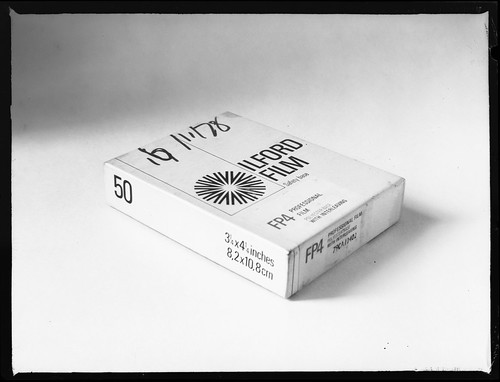
When choosing a camera for January's #FP4Party, a clear deciding factor for me was already having a fair stock of quarter-plate (8.2x10.8cm) FP4 sheet film. With one part or mostly used box of 50 and one unopened box, I decided not to buy any new rolls of FP4 and use this instead. Both boxes have a handwritten date of 16/11/78 (one box looks like it starts with 17/- which was then changed to 16); the film dates to well before the 'Plus' iteration was introduced in 1990 but I've previously used it with just one stop of extra exposure to compensate for age (I have also shot it at an exposure index of 100, and pushed the development by one stop instead). Possessing three cameras for the format: the Klito, Midg, and Cameo, all plate cameras, all of a similar age, over a hundred years old, I picked the Cameo, having used it for the first #FP4Party in September 2016, being the smallest and lightest of the three, and it seemed time to revisit it for this month's #FP4Party.
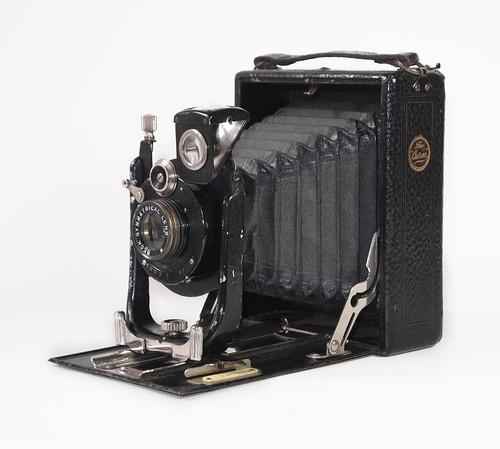
Butcher's and Sons "Cameo"
I restricted myself to expose just two sheets a day over the 'shoot week' (although on the first day I actually shot three sheets; I also didn't count the shot of the FP4 box in the total, but it made sense to photograph this on the film itself, using the lens attachment, during shoot week). Low light and short daylight hours in the northern hemisphere in January do not make for using a film rated at an exposure index of 50 necessarily sympathetic. In addition, using the Cameo handheld is not without a number of difficulties. Not entirely trusting the focus scale on the drop bed, to focus the camera using the ground glass screen requires one to use the spring clamps to position the front standard at the correct distance on the rails of the drop bed: it needs a certain amount of dexterity to put one's hand in such a way to move the front standard without obscuring the image on the ground glass with it: I miss rack-and-pinion focussing with the Cameo, particularly when using it hand-held.

Home-made ground glass screen; lens wide open
Even in relatively bright light, the Cameo's Beck Symmetrical lens produces a dim image: its widest aperture is nominally f8 (although it's most likely f7.7 when fully open beyond the f8 mark), slow by modern standards, and the screen is missing its hood to shade the ground glass, making this image difficult to assess. The ground glass was missing from my camera when I acquired it; I replaced this with some glass that I ground myself, but used too coarse a grade of grit, which adds to the difficulty in focussing. Once the image is in focus (as close as one can tell) on the ground glass, one then has to remove the focus screen and replace it with a plate holder, adjust both aperture and shutter speed to the desired settings, remove the darkslide from the plate holder, then frame the subject using the brilliant finder - and then gently press the shutter release lever. The Lukos II shutter has three 'instantaneous' speeds of 1/100th, 1/50th and 1/25th, and, while it would have been possible to get usable exposures at 1/25th, wide open on f8, for overcast, dull days, I only used the Cameo hand-held on a couple of days (Tuesday and Friday) when there was some winter sun, partly to use smaller apertures in the hope that a greater depth of field might compensate for any errors in focus.

Brilliant finder on the Cameo
For most of the shots during the week, I used a tripod or simply balanced the Cameo on a flat surface for long exposures, low-light shots, interiors and those at night. I also used the wide angle/close up lens attachment for some shots (Friday and Saturday) and the image of the box itself. I did my first batch of development during the shoot week rather than the 'development week' that followed. This acted as a check on my exposure and development regime: the first batch of film I developed with a one-top push - on top of the one and a third stop extra exposure - but developing the first few sheets appeared to show that extra development was unnecessary and the rest of the week's shots were developed in RO9 One Shot for the recommended time, 9 minutes, at a dilution of 1+25 at 20ÂșC.

Revisiting the Cameo, the quality of the results from the shoot week varied. Some of this was down to user error of course; other aspects were to do with the camera's limitations. When using the wide angle/close up lens attachment, there is clear vignetting, with a falling off of both illumination and definition towards the edges of the frame. This is less obvious when used as a close up attachment, as the lens' image circle would be wider the more the bellows are extended; when used as a wide angle attachment, the bellows are extended less than normal, making the image circle smaller. As well as the difficulties of focus set out above, there were also problems with film flatness (notably visible in the middle of the shot from Saturday); this might be due to the motley group of film sheathes I've been using, with some clearly home made, and others professional: some fit the sheet film better than others. The film itself stands up remarkably well: over four decades old, with only a little loss in sensitivity, the quarterplate-sized FP4 is still very usable.

Monday
Tuesday
Wednesday
Thursday
Friday
Saturday
Sunday

Sunday, 24 December 2017

FP4 Half-Frame Diary

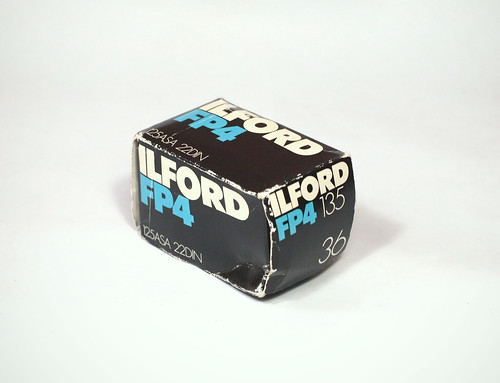
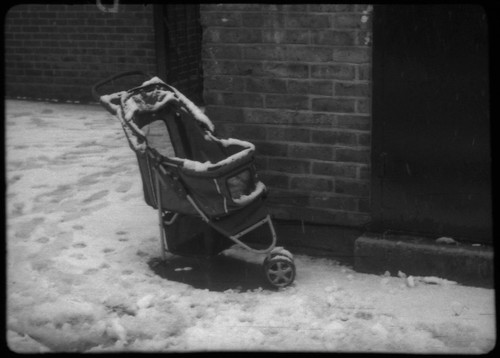
Ilford FP4, develop before date January 1991
A few months ago, I was given a roll of Ilford FP4 with a 'process before' date of Jan 91; this roll predates the introduction of the 'Plus' version of FP4 from 1990. The film itself was probably made in 1988-89, given 24 months or so between manufacture and 'expiry'. Looking for a reason to use the film, the announcement of the return of the #FP4Party for December provided the excuse if one was needed; last year, this was held three months in a row, although I only shot the old version of FP4 on one of the designated months in sheet film from the 1970s with the Butcher's Cameo.

Ilford FP4, develop before date January 1991
Inside the box, the plastic tub that the film was in has a blue top: Ilford films used to have colour co-ordinated tops (I mostly remember the red XP2 tops from the late 1990s to early 2000s, as this was the film I probably would have shot most). The metal film canister itself has easy-to-remove lid (making it easier to re-use), and the developing information is printed on a separate leaflet rather than inside the box.

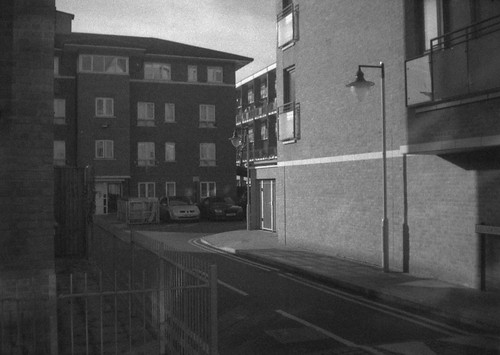
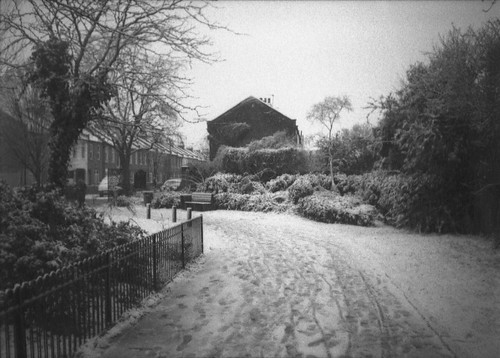
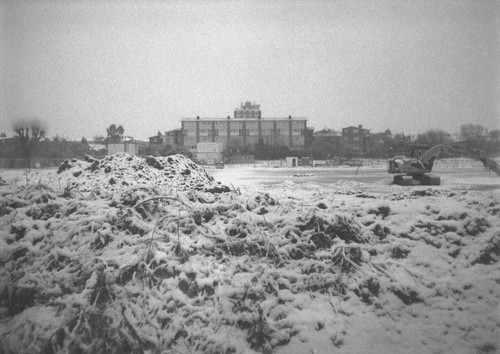
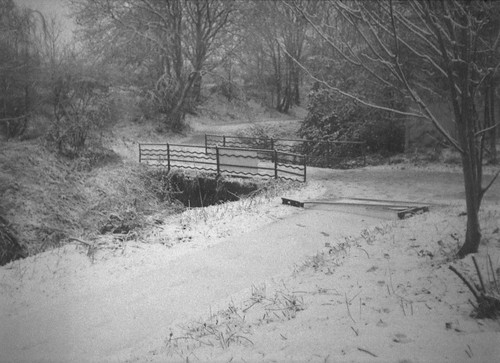
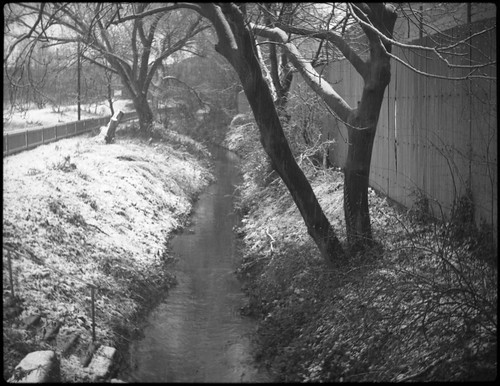
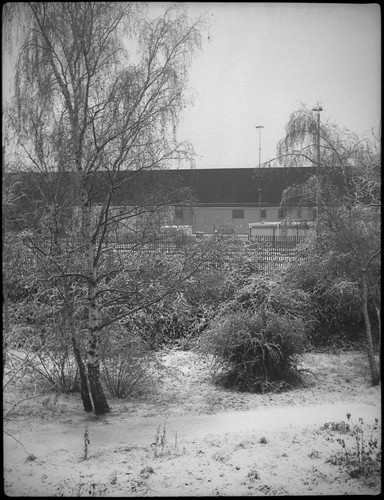
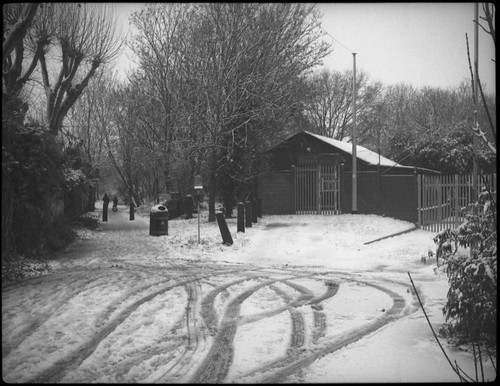
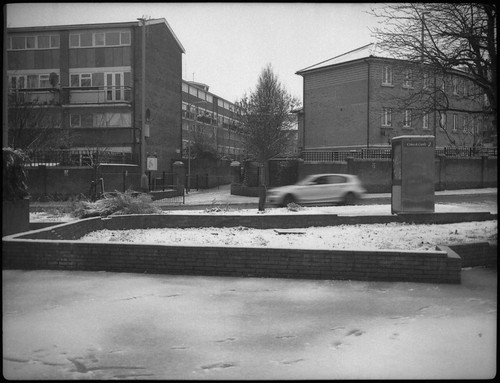
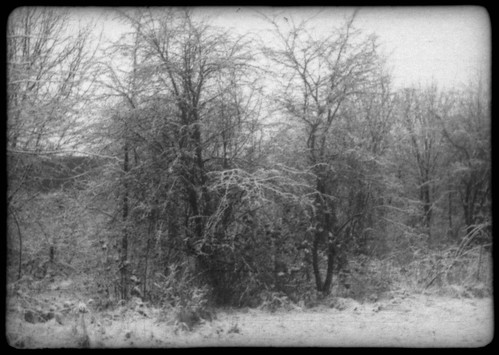
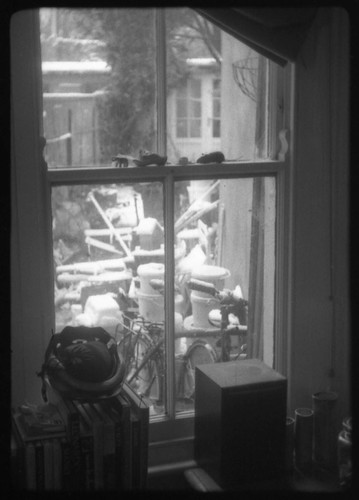
I chose the Belomo Agat 18K; as a half-frame camera, I could get twice the number of shots (72) with it. This gave me the idea to shoot the film throughout the week - ten shots a day - like a diary of sorts (the idea of a half-frame diary dates back to when I was a student, learning about the 35mm half-frame format from a photography tutor, Mick Williamson who used an Olympus Pen for his photo-diary; later, I found an Olympus Pen EE3 and used this for a number of years, with a similar idea, although without any strict rigour). To compensate for age, I exposed the roll at EI 64, and also developed it as if rated 200, giving it an effective 2/3-stop push. Development was with RO9 One Shot, diluted 1+50 for 20 minutes at 20ÂșC. The results appear to show I was a little optimistic about how well this particular roll had lasted - the negatives were mostly very thin and grainy - and would no doubt have been better exposed at 25 (there were also a number of horizontal marks, as seen in the second image below, where the emulsion seemed to have failed to react to the exposure, showing up every few frames, but fading away after the first dozen or so). During 'shoot week', a combination of short daylight hours and very overcast weather conditions proved challenging when shooting the film with available light when rated 64, and many of the photographs were taken with the lens wide open at f2.8, and show up my guess focussing to be not always as accurate as I might have liked. I did attempt to use flash for a few shots - such as the last frame on Tuesday below, but the camera did not consistently trip the flash, leading to a number of blank frames. Towards the end of the week, there was some sunnier weather, then, almost unexpectedly, the final day of shoot week coincided with the first decent snowfall in southern England for a few years, which providing a more interesting end to the project.

Monday


Tuesday


Wednesday


Thursday


Friday


Saturday


Sunday


In addition to the roll of 35mm FP4, the shoot week happened to with the December 127 Day on the 7th; having cut down some FP4 Plus to use with my Baby Ikonta, I had a number of 'short ends' of film cut down to 127 width - as the length of 120 film is longer than 127, cutting down a roll of medium format film, one ends up with a short length of film leftover. This was enough for up to six shots in 3x4 negative size. I used a few of these short rolls of FP4 Plus on the final day of the shoot week.

Baby Ikonta with Ilford FP4 Plus
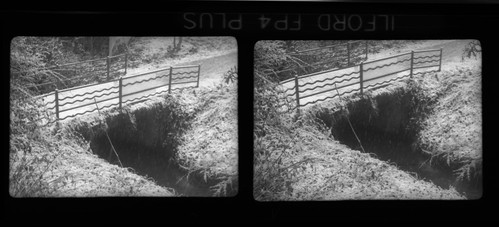
Finally, on the last day of shoot week, I also shot a roll of 16mm film with the Mamiya 16 Automatic, an off-cut from cutting down the width of FP4 from medium format - the first image below I scanned as a diptych to include the film name in the rebate.

Mamiya 16 Automatic with Ilford FP4 Plus