Showing posts with label ID11. Show all posts

Sunday, 31 December 2023

Retracings

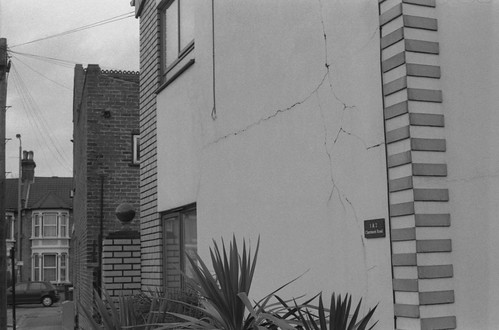
Dyers Hall Road, Leytonstone, 31st December 1993

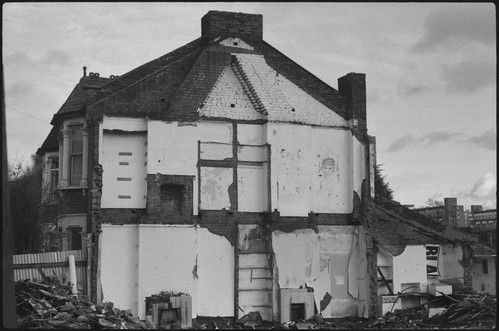
In a post that I wrote for this blog ten years ago, 'Twenty Years Since', I mentioned–almost in passing–photographs taken of houses being demolished to make way for what was then called the M11 Link Road, now the A12. The few words that described the experience of taking these photographs belies what was, in retrospect, an important formative experience or experiences. The taking of the these photographs was tied up with learning the craft of photography itself, following a basic introduction to photography as part of my Foundation Course in Art & Design a few weeks earlier, then receiving a secondhand Praktica BCA for Christmas in 1993.

I had been aware of the planning blight that accompanied the road scheme years earlier, although I hadn’t known that this was what it was. A journey into central London would involve taking the Central Line from Gants Hill or Redbridge stations; this branch of the Central Line is in a tunnel under Eastern Avenue, resurfacing just before Leytonstone station for a couple of stops, making this brief view from the windows of the tube train a diverting contrast to the darkness of the rest of the way. Houses backing on to the line where it runs above ground here had begun to be demolished or fall into disrepair years earlier: I distinctly remember the graffiti spelling out WHY BOTHER? on the back of a house from the late 1980s, later to provoke the rejoinder WHY NOT? (These were then joined by CRAWLING KING SNAKES KICK YO ASS.)

What had been an occasional journey while I was at school in nearby Wanstead became a daily one when I started college in 1993; I was all the more aware then that the demolitions were something that was actively happening, rather than what might have appeared to be a few streets fallen into desperate disrepair that I’d see whenever travelling into town. The protests around the tree on George Green in the autumn term was the moment that the active resistance to the road scheme made itself felt. (Rather pointlessly, one night after being kicked out of The George with a friend, we pulled down a fence post that had just been put up around the tree–there appeared to be no security at that stage–delaying the construction of the road by what must have been minutes at best, my only attempt at direct action).

The weather around Christmas in 1993 had been largely cold and wet, with some snow; the last day of the year, a Friday, turned fine and sunny, prompting me to decide that it was the perfect opportunity to use my new secondhand camera, with a roll of Ilford HP5 Plus bought for a holiday college project, which was to illustrate a number of words that we had been given. The photos are a record of that change in the weather. I took the tube to Leytonstone, and walked to Leyton, taking photographs along the way. I took some photographs in the British Museum afterwards on the same day; the last two photographs of the M11 Link Road sequence were taken from a moving train. These may have been from Leyton in the direction of Stratford, or I think I may have taken an eastbound train from Leyton back to Leytonstone, before then switching over (or under as the case is at Leytonstone) to take a Westbound train to Tottenham Court Road for the museum.

I returned on a number of occasions in the following months to take more photographs, neither systematic not comprehensive, but with the awareness that this felt like something of which it was worth making a visual record (the one time that I chanced upon evictions happening on Claremont Road in the summer of 1994, I had a part-used roll of film in my camera and no spare). The photographs were printed in the darkroom at college, rather inexpertly, and the images ended up used in artwork then, in collages and paintings, and I drew on these the following year when I’d left London and started a degree in Fine Art.

Dyers Hall Road, Leytonstone, 31st December 2013

I had occasion to revisit these photographs earlier this year, and needed to find the original negatives; in doing so I also found a set of negatives from 2013 in which I had attempted to match the locations from the photographs of what was then twenty ago as closely as possible. These negatives weren’t scanned at the time–I had intended a blog post then–and the moment passed. I had scanned the original negatives in 2007, and had posted these online in 2008, and rather over-promised the content of these images by calling this the ‘M11 Link Road Archive’ (an actual archive of material related to the M11 Link Road and the protests resides at the Museum of London). Returning to some of the original files, the quality of these original scans was relatively poor, with scanning artefacts and clipped highlights and shadows in many of the frames. (Scanning issues–software and hardware–partly explain the absence of posts on this blog this year, although the main excuse was the writing up of my PhD). Having found the negatives from both 1993 and 2013, I was able to scan these recently with better results for this post.

What I didn’t know at the time was that many of the houses along the route were or had been inhabited by artists. Acme Studios had been offered a number of the compulsorily-purchased houses by the Department of Transport in the 1980s; by the time I was taking these photographs, the houses along the route were occupied by the few original residents who had not moved away, some of the Acme artists who became involved in resisting the demolitions, and the first wave of anti-roads protestors, some of whom had come from Twyford Down, just outside Winchester–where I was going on to study–and many subsequently moved onto to protest the Newbury Bypass after the M11 campaign.

For a few years I probably didn’t think about this part of my life very much; I happened to cycle over the road on the Quartermile Lane bridge from Hackney just before it opened in 1999. I didn’t have a camera on me at the time, and thought I’d return to take photographs of the empty road, but I never did. Then in 2003, a site-specific sound piece by the artist Graeme Miller called LINKED was installed along the route. This required collecting a radio receiver and headphones, available from local amenities–we got ours from Wanstead Leisure Centre–and walking a route from Wanstead to Hackney Wick, along which one would encounter transmitters that broadcast audio loops consisting of extracts of oral history weaved with music into soundscapes.

Related to Miller’s LINKED, in 2008 I attended a number of seminars at LCC’s Photography and the Archive Research Centre (PARC), part of their research project Road: Artists and the Stop The M11 Link Road Campaign, 1984–1994; the ninth issue of PARC’s journal, Fieldstudy, was devoted to this research project, and featured a few of my photographs from 1993-94. Last year, Graeme Miller revisited LINKED: since its initial installation, with most of the receivers being placed on lamp posts along the road, a slow attrition had reduced these in number over time, some going as the Hackney Wick end of the route was swallowed up by the 2012 Olympic Park, others from the streetlights being knocked over, or the transmitters being unknowingly discarded by contractors. In anticipation of the project’s 20th anniversary, Miller revisited it for Re-LINK last year where the receivers were made available again for 48 hours and a roundtable discussion was hosted by Leytonstone Library; in conjunction with the exhibition Radical Landscapes at the William Morris Gallery, three open days for LINKED were planned, the first was in November, the next on 20th January and 17th February 2024. (In the intermediate years I had other opportunities to revisit Miller’s LINKED a few times, re-walking the route in different groups, thanks to the artwork being used as a PhD case study by Dr. Sarah Wishart.)

In 2013, attempting–as best I could–to find the same viewpoints as the photographs taken in 1993, it wasn’t always clear as to where exactly each picture had been taken then: I hadn’t taken any notes. However, the sequence on the contact sheet, and the linear nature of the route from station to station made this relatively easy in most cases, but for some photographs this would have meant hovering above the A12 itself, as with most of those taken along Claremont Road itself. Some of the photographs in my retracings from 2013 and 2014 were taken with a Zenit 11, some with Praktica MTL3, but for both cameras I used a Prakticar f1.8 50mm lens, the same design lens as I would have had on my Praktica BC1, and then the BCA which replaced it later in 1994 (Edit 25/01/24: Having rediscovered the contact prints from the photographs taken on the 31st December 2013, I had actually used an Olympus OM10 for this set of photographs).

The photographs from 1993 start at Dyers Hall Road. This road formed a shallow loop underneath the Gospel Oak to Barking branch of what was then the North London Line, joining Grove Green Road either end in a slightly more direct route along the Central Line. The A12 reduced Dyers Hall Road into two stubs, the shorter one now with the suffix 'South'.
For the pedestrian, or cyclist, the two ends of Dyers Hall Road are joined by a footpath and cycle lane which runs alongside the brick wall of the A12 here. At the end of Dyers Hall Road South, there is a footbridge that crosses the A12 to Norman Road on the eastern side; there had been a shorter footbridge here in 1993, which afforded a view across cleared ground to the railway bridge, a section of its brick arches already replaced by a long straight steel span.
A second photograph from the bridge looks over back gardens on Dyers Hall Road; the houses in the background face onto Grove Green Road. I took one photograph in 2013 looking across from the far end of the bridge towards the rear of those same houses on Grove Green Road, but a truer position would be on the footbridge itself, just past the line of the railway, where the previous footbridge would have ended–as in the third image below.
The next photographs are from Claremont Road, which became the focus of protest in 1994. The first of these are at the end of the right angle where it comes off Grove Green Road, two houses, one with a gibbet fixed to a chimney and a poster in a window: M11 LINK ROAD/DEVASTATING OUR COMMUNITIES. I’m reasonably sure that these houses were at the northern end of the road: the fence that runs alongside borders the Central Line. Behind would have been the Cathall Road bridge over the railway. In 2013 I took two photographs looking in the same general direction, one from that bridge, which would be somewhat behind the location of these houses, the other from the wide pavement before the bridge, which would be to the west.
A photograph of a house with a front door, curtains and a cat painted on breeze blocks is one of the pictures that would now be entirely where the A12 is now, or above, as the road sits in a cutting here.
There are two photographs at the southern end of Claremont Road where it turns back to Grove Green Road. After the A12 was built a small section of the southern end of Claremont Road remained; there was a little space here to build some houses, facing onto the road, thus ensuring that Claremont Road as a residential address still exists. A photograph looking back from here to Grove Green Road roughly replicates the same view of that from 1993.
The next photographs are from Colville Road. This was set a little further back from the Central Line than Claremont Road: houses which backed onto the railway were all demolished, along with some houses facing those at its northern end, where the angle of Colville Road was changed to accommodate the A12, running behind its brick wall but a stretch of terraced housing on the road’s western side survived.
This change in the course of the road can be clearly seen in the photograph from 2013 which looks along the wall, replicating a picture from 1993 looking over the corrugated iron fence to the end of terrace, side-on to the first photograph of Colville Road.
From here another photograph looks across to the Central Line, showing a 1962 stock Central Line train passing St. Patrick’s Roman Catholic cemetery in the far background (these trains, which I had grown up with, were phased out during that year I spent commuting on the Central Line, going to college, replaced by the current 1992 stock). A photograph of this view would be straight on to the brick wall; I took a picture in 2013 which I think must be looking up and more to the right.
There are two photographs from 1993 that mark the end of the walk from the entrance to the rail yard that lay to the southwest of Leyton Station; this would seem to extend down to Temple Mills, although I haven’t been ably to find whether Leyton Rail Yard was separate from that of Temple Mills, which is now the Eurostar depot. The view from here shows the horizon opening up to take in a skyline in which one can see One Canada Square in Canary Wharf, new in 1993 and the tallest building in the country at that point, past three tower blocks by Bow Church station, the Bryant and May match factory, across what is now the 2012 Olympic Park, marked by the two squat UEL residential towers, to the tower blocks clustered around Wick Lane and Victoria Park. The view now is almost entirely different: trying to locate the exact viewpoint would take one to the edge of the Leyton Mills retail park; slightly to the left, on the bridge over the A12 itself, shows a broadly similar view to that of 1993, with most of the horizon filled with development on the 2012 Olympic site. One Canada Square can still just be seen, as can the tower blocks by Wick Lane.
A second photograph in 1993 was taken at right angles to the first, looking back towards Leyton station, dominated by railway buildings facing the rise in the high road as it passes over the railway line; the current station building’s roof can just be see to their left, mostly obscured. A similar view today looks across the ramp and stairs into the retail park, with the station’s pitched roof in roughly the same position. I didn’t try to replicate the two photographs shot from the moving train in 1993, as I couldn’t be at all sure exactly where they were taken.
Although never directly involved in the campaigns and protests, not knowing about the community of artists there, feeling like an outsider despite it being relatively local, seeing and recording the progress of these demolitions in 1993 and 1994 affected me in part I think as the houses were very much like that I had grown up in, and was something that I could see happening as I took the tube to college every day. There was also an aspect of being confronted by the arbitrary use of the power of the state at this formative age, bound up as it felt at the time with the Criminal Justice Bill, much in the news at the time, passed into law in November 1994, with many of its measures seemingly targeted at the young and politically active, and how this galvanised, pre-internet, before social media, a grassroots opposition (Labour, under Tony Blair–first as shadow home secretary as the bill made its way through parliament, then as leader of the opposition following John Smith’s death–abstained when the bill received its third reading). My awareness of this came through a very different media ecology from today: posters on the streets, what alternative press I happened to come across, like SchNEWS, but mostly how it filtered through into the music of the time and the wider conversations around it in part through the ‘polytextuality’ (as Dean L. Biron describes it) of the music’s physical artefacts–the artwork and liner notes–and how this was reflected in the music press and the conversations that were part of meeting new people, new ideas, starting a college course, anticipating leaving home. When I took the photographs on the last day of 1993, photography was physical (it would be many years before I even saw a digital camera, though I did have my first experiences with Adobe Photoshop then, with a faint intuition that this would be a transformative technology), enabling me to return to the negatives thirty years later and create images anew from their matrices.

Fieldstudy issue 9 (PDF file)
Graeme Miller LINKED
Sarah Wishart, 'A Provenance of Performance'
SchNEWS Issue 3 December 1994
Dean L. Biron, 'Writing and Music: Album Liner Notes'

Tuesday, 17 February 2015

Twenty Years Since (2)

In my post, Twenty Years Since, I wrote about my first experiences developing black and white film while on a foundation course in art and design in 1993. Subsequently, as part of my degree course, I had another introduction to black and white photography in February 1995. This time we were given one roll of film per student, rather than having to share. I shot my film with the Praktica BCA which I had bought to replace the BC1 which had been my first SLR camera. The day before the photography introduction I'd bought a 28mm lens (originally £40, and, although secondhand, I asked for a student discount and was given 10% off the price - as a point of comparison I was paying £39 a week rent on my room in the student hostel at the time); and I had also found a book in the local library in which had a page on push-processing. This was a technique that I had not previously used, but wanted to try because I had heard that the film we were to be given for the introduction was 100 ISO, which I thought would be too limiting to use in February: the film we were given was Jessops 200 (which may have actually been Efke R100, according to this thread here) and in the event I shot most of the film using a tripod and with the camera's self timer. I rated the film at 800, which I recall produced a bit of a sharp intake of breath from the photography tutor, who suggested a time twice as long as indicated for box speed, and in neat ID11 (rather than 1:1). I developed the film for 18 minutes at 22ºC, having heated the developer above 20ºC, and was too impatient to either wait for it to cool, or stand it in cold water to speed its cooling.

Original contact sheet
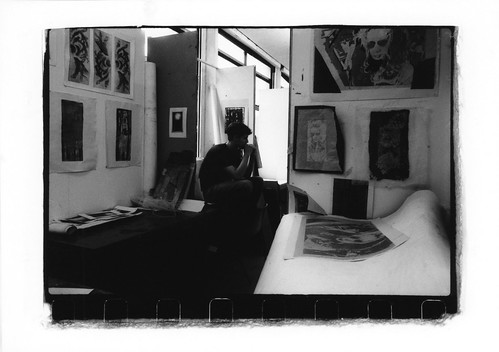
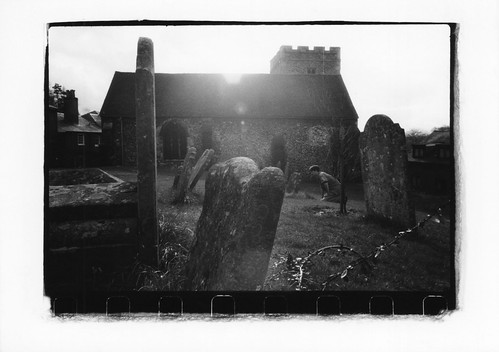
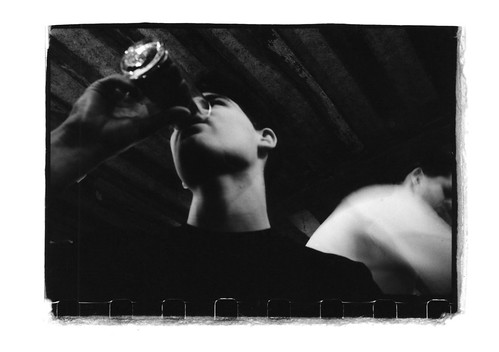
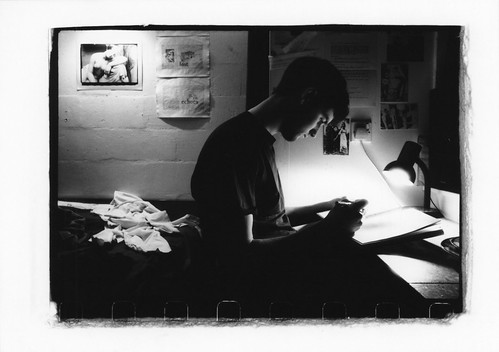
The prints that I produced were a series of self portraits in a semi-fictional day-in-the-life. At the start of the introduction, we had been given a slide show, which was mostly about artists using photography rather than photographers, if such a distinction is still meaningful. One of those was Cindy Sherman, which may have influenced my choice of subject matter. I had also made my own negative carrier specifically to allow the film rebate to be shown. This comes across as something of an affectation now, looking back at the prints from the distance of twenty years. At the time I was interested in artists' books as a form, and I made a cover to contain six prints of the images from the introduction. This also had a cover page to which I had given the title 'How Is The Author?' This came from an abbreviation of a Richard Pettibone piece which had appeared on one of our history of art slide lists as 'How Is The Author'.


Retrospectively, the images featured in the first post Twenty Years Since have aged better: as the first photographs that I was developing myself, with my first SLR camera, not uncommonly, I was concerned with formal qualities in most of the photographs, or, with the photographs of the route of the M11 Link Road, the documentary concerns have increased in interest with time. By comparison, the photographs from my second black and white photography introduction do have the feel of juvenilia to them.


Monday, 17 February 2014

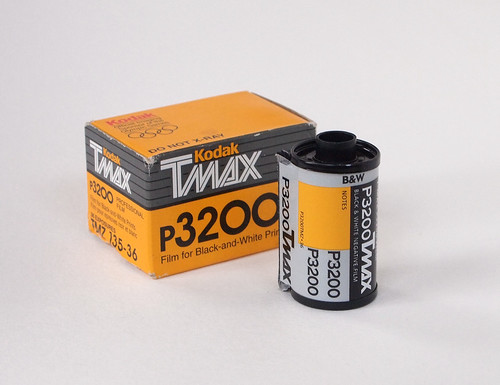
Kodak T-Max P3200

Kodak T-Max P3200
Nearly three years ago I wrote a post about Ilford Delta 3200, and at the time cited Kodak T-Max P3200 as being the other ultra-high speed film available, which was true at the time of writing. However in October 2012 Kodak announced, due to low demand, T-Max P3200 was being discontinued. [Edit 23/2/18: Kodak have announced that T-Max P3200 is being re-introduced.] It would be interesting to see the relative volume of sales for Delta 3200 against T-Max P3200, but one advantage that Ilford's film always had over T-Max P3200 was its availability in medium format as well as 35mm. The two emulsions are similar: these are both tabular grain films with a true speed around 1000 ISO. As fast films tend to have a lower contrast range, and both have the latitude to be rated 3200 and provide acceptable results with this push. Incidentally, this would appear to be the reason for the 'P' in P3200, acknowledging the 'push' when used at the box speed of 3200. The reason for writing a blog post about Kodak T-Max P3200 now, rather than when it was announced that it was to be discontinued, was that I recently decided to shoot a couple of rolls I'd been storing in my fridge for some time; one roll had a develop before date of 2011, the other 2001. In my experience faster films lose more sensitivity with age: I usually buy a Ilford Delta 3200 as and when I need the film, rather than keeping rolls in storage.

Kodak T-Max P3200 (sometimes referred to as TMZ from its emulsion code) appeared on the market in 1988, and it took Ilford another ten years to respond with Delta 3200 (Fuji similarly released a Neopan 1600, also now discontinued). For some, the benefits of such a fast film are marginal: with the right development both Kodak and Ilford 400 speed films can be pushed 3 stops to 3200, and indeed Kodak's discontinuation notice recommends using T-Max 400, pushed to 1600 as a replacement. However, for handheld night photography (for which I've often used Delta 3200), the increased contrast with push processing a slower film can be an issue as night scenes often tend to be high contrast in nature. The Kodak discontinuation notice admits this, stating that "The exception [to replacing P3200 with T-Max 400] would be extremely low light situations where P3200 might be able to pull out some shadow detail that would otherwise be lost".

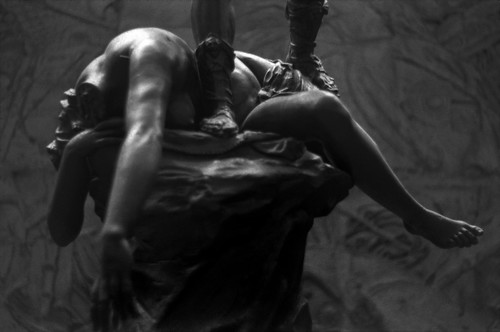
Kodak T-Max P3200, developed in ID11 stock solution, 12 minutes at 20º C.
I first used T-Max P3200 in the mid-1990s, and in my post on Delta 3200 I wrote about the kind of subject that I often desired to photograph at the time, frequently the low light situations such a fast film was produced for. As Kodak T-Max P3200 was more expensive, I tended to use HP5 Plus, push processed to 800, 1600 or 3200 in these situations instead. Developed in ID11, P3200 yielded relatively smooth grain when exposed properly. For the two rolls of P3200 shot recently, I used Ilfotec LC29 developer; Rodinal (and latterly the R09 One Shot version) has been my film developer of choice for about seven years, but, as any developer, it's not ideal for all situations, especially with the fastest and most grainy films. The grain appears more prominent in the negatives developed with Ilfotec LC29 compared to ID11.

Kodak T-Max P3200 (develop before date of October 2011),
developed in Ilfotec LC29, 1:19, 11 minutes at 20ºC.
Kodak T-Max P3200 (develop before date of September 2001),
developed in Ilfotec LC29, 1:19, 12m30s at 19ºC.
Of the two rolls I've shot in the last couple of months, that with a "develop before" date of September 2001 had noticeable fogging when developed, leading to quite evident grain in the shadow areas; the film with a 2011 date provided better results, less fog, and appeared to give sharper negatives with a better tonal range. Although I hardly ever used Kodak T-Max P3200, it's always unfortunate when an emulsion disappears from the market, shrinking the range of available films, and many photographers will miss it (see the elegies below); Ilford Delta 3200 now remains as the only ultra-fast film.

Further reading: 
Goodbye T-Max P3200 on the Online Photographer
The Demise Of Kodak TMAX P3200 John Vlahakis
Kodak P3200 T-MAX R.I.P. on Wallace Koopmans Artlog
Time To Start Hoarding: Kodak discontinues T-MAX P3200 film on Imaging Resource

Thursday, 7 April 2011

Ilford Delta 3200

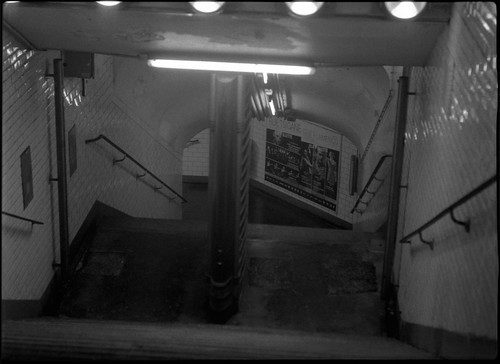
Metro Entrance, Ilford Delta 3200, handheld at 1/50th, f4.5

Along with Kodak T-Max P3200, Ilford Delta 3200 is the fastest black & white film currently on the market. Despite the prominent '3200' in the name, its true emulsion speed is 1000 ISO: essentially this means the film is recommended by Ilford to be exposed at a range of speeds, including 3200 ISO, and developed accordingly (incidentally, T-Max P3200 has similar characteristics: Kodak state it to be 1000 ISO in their proprietory T-Max developers, or 800 ISO otherwise). Delta 3200's main advantage over T-Max P3200 is that it is available in medium format as well as 35mm. When in Paris recently I shot a roll at night, as an experiment, to use the film in medium format; I had previously shot Delta 3200 in 35mm but found the results unsatisfactory. This may have been partly due to using Rodinal as a developer. Being a high-acutance developer, Rodinal tends to be recommended for slower films with more traditional emulsions, as the acutance effect can emphasise film grain considerably; with larger negatives in medium format, this is less noticeable.

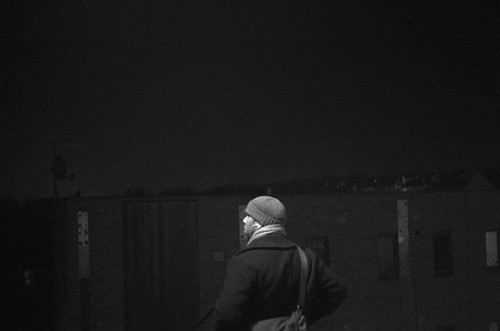
Kodak T-Max P3200, developed in ID11 stock solution, 12 minutes at 20 degrees C.
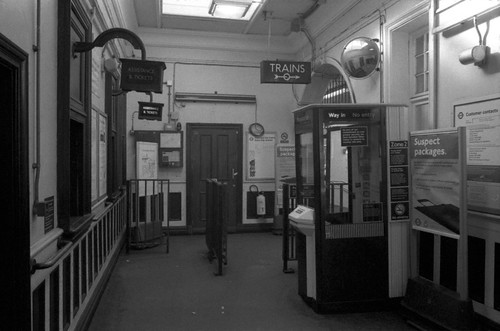
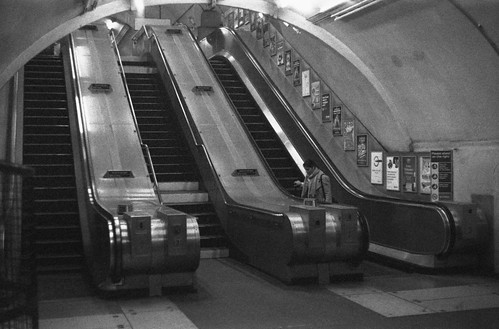
When I first began to take and develop photographs as a student, I frequently found myself wanting to shoot hand-held pictures in low-light situations, often in museums, or on the Underground. I carefully annotated my contact sheets with the ISO ratings and the developing times and dilutions I used at the time, so now, looking back, they provide a useful reference for comparison. I did use T-Max P3200 a couple of times, which was the fastest film on the market (Delta 3200 was introduced in 1998), although more often I pushed Ilford HP5+, frequently to 800 ISO, and occasionally to 1600 and to 3200, with variable results. I can't recall the prices, but I imagine T-Max P3200 was more expensive than HP5. I suspect the reason that I did not use T-Max P3200 more was that the I perceived the difference in quality insufficient for the price. Another factor was using ID11 to develop the film,  which is reputedly better than Rodinal for push-processing.

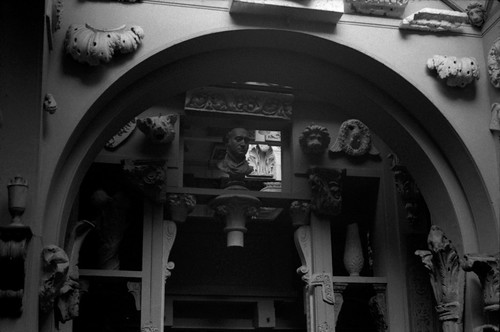
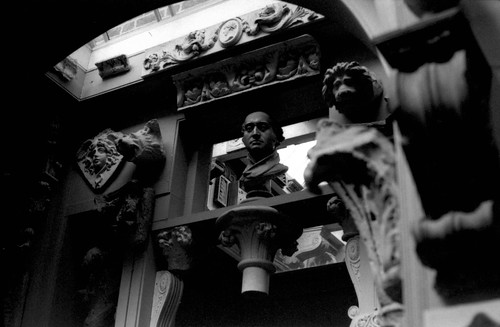
Ilford HP5, rated at 3200 ISO, developed in ID11, 18 minutes at 20 degrees C. A comparison to the previous shot of Sir John Soane's museum does show a lack of shadow detail, though not a considerable difference.

One consideration against push-processing film for night and low-light photography is that an effect of pushing a film is an increase in contrast. Often night scenes are themselves inherently high contrast: bright light sources and reflections, and dense shadow areas, therefore pushing a film can result in a negative with blocked highlights and very little- if any- detail in shadow areas. In this regard it would be more appropriate to pull-process the film, and so reduce contrast, which however negates the use of a higher ISO rating, a real consideration for hand-held photography.

Rue Lacepede, Ilford Delta 3200, handheld at 1/50th, f4.5
The current photographs were shot using a Baldalux medium format folding camera, with a 6x4.5 mask, a compromise between larger negatives, and getting more shots from a roll of film. One drawback with the camera is the lack of a built in light meter; for daylight shots I use a Weston light meter, but being a selenium cell meter, there isn't enough light for it to work at night, so the photographs I took in Paris are not metered. The hand-held shots were all taken wide open, at the maximum aperture of f4.5, at a 50th of a second; for the Jardin De Plantes photograph I held the camera flat against a hole in the iron gate. I developed the film in Rodinal 1:25 at 19 degrees C, 15m 45s (3 and a half minutes longer than Ilford's recommended time), with the last four minutes 'stand', meaning without agitation, preferring to potentially over-develop the film as an insurance against under-exposure.

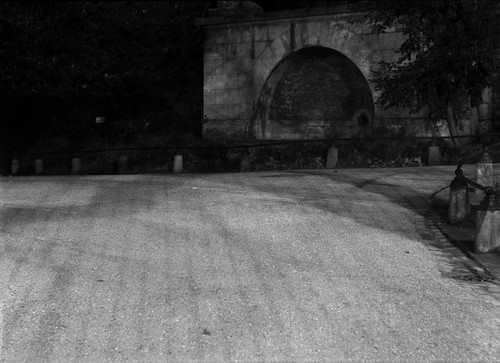
Jardin des Plantes, Delta 3200, roughly 60 seconds at f11.