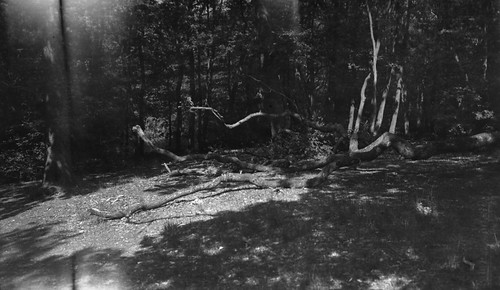
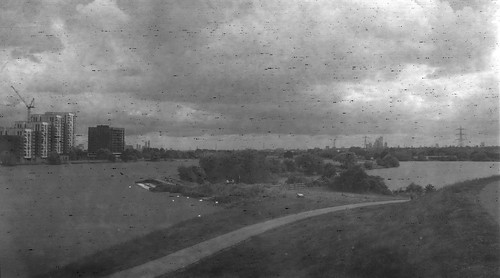
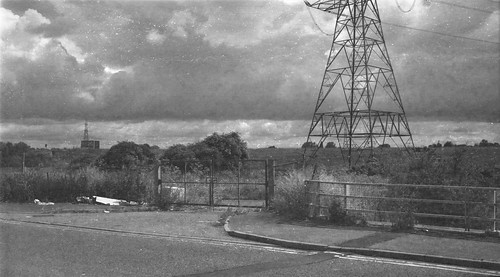
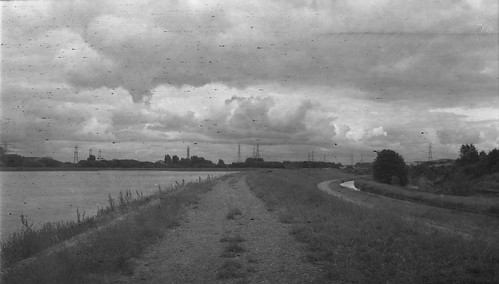
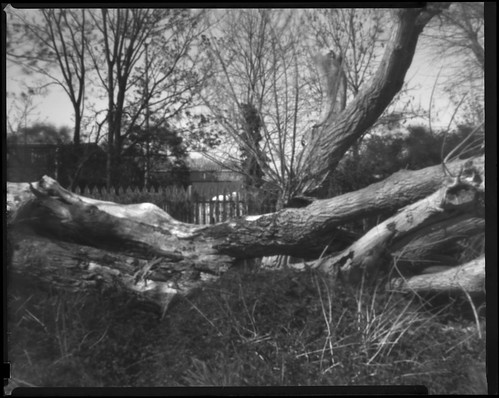
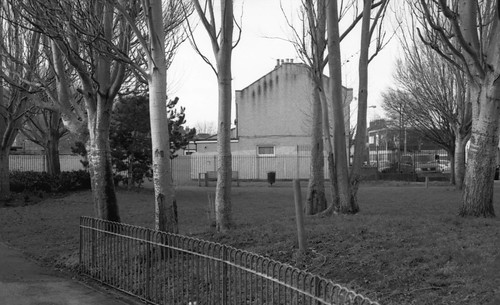
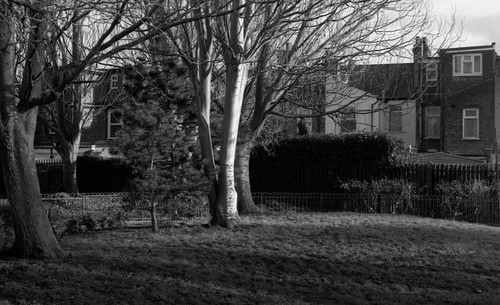
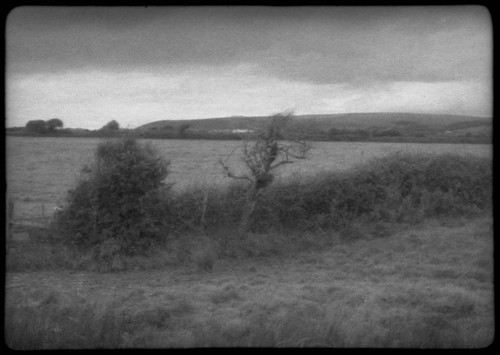
Showing posts with label Kodak Plus-X. Show all posts

Friday, 29 April 2022

'Homage'

What is an artistic medium? Encountering a work of art in a museum or gallery, or when this encounter takes place secondhand, through a book, magazine, or online, adjacent to the work there’s almost always a line of text, after the name of the artist (if known), after the title, and possibly the date, which will inform the reader of specific material substance or substances that constitute the object or artefact. On the website for the Marian Goodman gallery New York, Tacita Dean’s film Sound Mirrors is listed as follows: 
Sound Mirrors, 1999
16 mm b/w film; optical sound; 7 minutes
Edition of 4 plus 1 artist's proof
An artistic medium is not just the material basis for an artwork. It can be defined by its use, its practice, and the user’s intentions, as well as its constituent material. I am currently typing these words on a keyboard derived from a mechanical typewriter where once the pressure of my fingers would move metal keys, each with a raised–and reversed–letter, compressing an inked ribbon onto the surface of paper, a matrix with which to create legible, repeatable and standardised text. Now the words appear on a screen by an opaque process, the digital interface being one in which inputs become outputs by an inscrutable process. However, the medium is still writing. In the last two or three decades, with the rapid assimilation (and emulation) of what had once been long-established physical processes, there can be a tendency to see this shift creating a flat, surfaceless, frictionless digital world–a digital ’monomedium’–especially when so many tools to create anything can all be accessed through one device. Yet an artistic medium is both “‘at one and the same time’” the physical material used and the “emergent work” being created (Joseph Margolis, quoted by Nannicelli and Turvey in ‘Against Post-Cinema).  This ‘emergent work’ is situated within a set of distinct social practices - production, distribution, exhibition, and, mirroring these, audience expectation.

Tacita Dean’s films are made to be seen as projections in a contiguous space with their material matrix or substrate and the apparatus for doing so. Access to Dean’s film work outside of an exhibition context is all but impossible. Digital versions do not exist. UbuWeb does have a page for Tacita Dean, but the visitor is welcomed by the note: “These films have been temporarily removed by request of the Marian Goodman Gallery. For all inquiries please contact The Marian Goodman Gallery.” There is an insistence on the physicality of the medium, and its uniqueness in the encounter with the viewer, which can only occur when both are brought together in the same space and time, an odd inversion of Walter Benjamin’s sense of the aura: as artwork originating on film, these become that unique instance that needs direct experience, not encountered in reproduction.

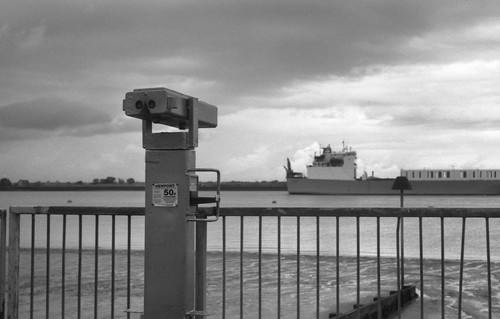
Voigtländer Bessa RF with Fomapan 400
I must have seen Sound Mirrors in 2001 as part of the exhibition 'Tacita Dean: Recent films and other works' at the relatively newly renamed Tate Britain–and I have not seen it since. (In my unreliable memory, before referencing exhibition dates, I had thought that I might have seen Sound Mirrors in the Turner Prize exhibition in 1999–I used to go every year–but Dean was nominated for the Turner Prize in 1998, one year before Sound Mirrors was made [Edit 10/04/23: Having recently found the exhibition guide to the 2001 exhibition, this was indeed where I saw the film–there is one small image in the booklet which could be a frame from the film itself, and a much larger reproduction of a 'location photograph']). Like Dean’s films, access to the sound mirrors on Denge Marsh is strictly limited, sited on a managed nature reserve. With an institutional trip arranged to Dungeness and to the sound mirrors, the possibility arose–especially since I had begun using 16mm film recently–of making something in response to the site, and to my own memories of seeing a film, once, long ago.

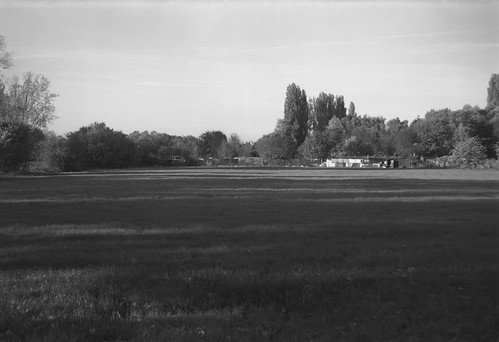
Dungeness, Canon A-1 with Silberra Pan 160
The edge of England where the sound mirrors are located has has a sense of having been rather mythologised in recent years, partly through the restricted access to the sound mirrors themselves, partly due to the particularity of the flat landscape, the coast road, the nuclear power station, and the presence of Derek Jarman’s Prospect Cottage and his garden, and Tacita Dean was not the first to commit the sound mirrors to film. Hal Foster, in ‘An Archival Impulse’, describes the sound mirrors, among other subjects of Dean’s films, as being "archival objects", and, pointedly, as “found arks of lost moments in which the here-and-now of the work functions as a possible portal between an unfinished past and a reopened future.” In 1999, encountering moving image works in a gallery or exhibition setting, the difference in image quality between film and video was still (just) marked: the ‘poor image’ of video in the hands of artists was used for its distinct qualities as a medium, oversaturated, bleeding colours, light trails, noise, all contributing to video’s immediacy. Now, film as a medium has a doubly-archival sense to it, becoming its own ‘archival object’, embodying a broad range of historical practices, once more prevalent and present, but now vanished (or still-vanishing) from a common everyday experience, like the sound mirrors, being overtaken by new technology. New technologies continue to be haunted by older forms, however, through their adoption of existing language, through emulation of processes, and through the very conception of what the medium is.

Voigtländer Bessa RF with Fomapan 400
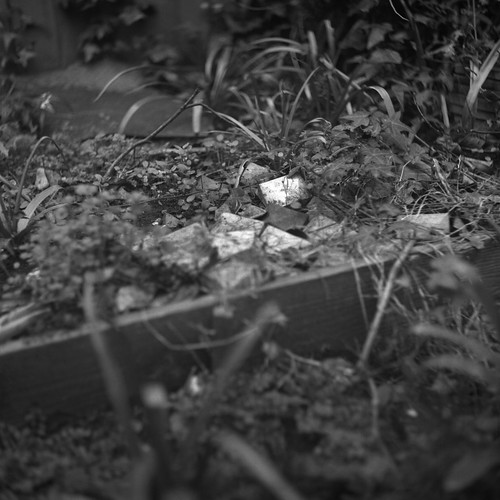
In Tacita Dean (Tate, 2001) there are images of the sound mirrors, but these are described as ‘location photographs’, not actual frames from the film itself. Here it may be worth making a distinction between still frames–the individual frames which comprise the moving image–and production stills, often called film stills: it was common practice in film productions to have a still photographer on set to produce images for publicity purposes and Dean’s location photographs fit this mould. I also took a handful of photographs on medium format film with a Voigtländer Bessa rangefinder camera, my own ‘location photographs’ (I took additional 35mm photographs, not of the sound mirrors themselves, with a Canon A-1 SLR), but ones which do not need to stand in for the film itself: for this, I used a single magazine loaded with 16mm Eastman Kodak Plus-X film manufactured in 1999, the same date as Dean's Sound Mirrors. The film was exposed using a Magazine Ciné-Kodak camera from 1936, around the time that the research on the methods embodied by the sound mirrors was becoming obsolete. The length of film in the magazine determined the duration of the film: nominally 50 feet (15 metres), this provides 2 minutes when shot at 16 frames per second, the camera's standard frame rate, that of silent non-sound synchronised film. I used the lens with which the camera was provided on purchase: a 25mm f1.9 Kodak Anastigmat. On regular 16mm film (not Super-16), this gives a slightly narrow angle of view. No sound was recorded: the Magazine Ciné-Kodak does not record sound; few 16mm cameras do.
“No one who went unprejudiced to watch a silent film missed the noises which could have been heard if the same events had been taking place in real life [...] People took the silence of the movies for granted because they never quite lost the feeling that what they saw was after all only pictures.”
Rudolf Arnheim, Film as Art (my emphasis)
Although naturalised, the sound film is a hybrid medium: the nature of a recorded image–a representation–and the nature of recorded sound–a reproduction–are different: when sound is reproduced–however it is recorded–it becomes sound again. Three-dimensional reality becomes a two dimensional image in the process of filming, a representation. With cameras which do (or did historically) record sound on film, most commonly through a magnetic stripe, a problem arises in that the recording of sound requires the substrate to be moving continuously, while the images require intermittent motion. Rudolf Arnheim, along with other writers on film who experienced the shift from silent to sound, and from black and white to colour, as a formalist, was wary of what he called the ‘complete film’, subjected to sound, colour, the widescreen, and stereoscopy, becoming inartistic, his conception of film as a medium depending on its limitations informing its possibilities: “…what might be called the ‘drawbacks’ of film technique (and which engineers are doing their best to ‘overcome’) actually form the tools of the creative artist.” The history of moving images is more complicated of course: films were hand coloured, tinted and toned, with the earliest ‘indexical’ colour experiments dating to around 1900. Sound was also present from film’s beginnings, harnessed to Edison’s phonograph in the ‘Dickson Experimental Sound Film’ from 1894 or 1895, synchronised with varying degrees of fidelity in the first decade of the 20th century, only for the form of film to outstrip its duration: with reproduction from a disc, sound had the same limitation as when Edison first experimented with images on a cylinder: sound needed to catch up with images and find its medium whereby the physical carrier, a spatially circular and cyclical recording, as Muybridge had achieved with projected images before Edison, became linear, allowing for expansion.

Voigtländer Bessa RF with Fomapan 400
My memory of seeing Dean’s Sound Mirrors twenty-one years ago is indistinct: there was no question of trying to emulate any aspects of shot length, composition, sequencing. There was also no real way of planning the film, only having access to the site on the day, with a limited time, with the result that the filming itself had to be simply improvised. The only consideration to structure was an attempt to begin with details, before building up to wider, more comprehensive angles of view, the opposite of using an establishing shot or shots to describe the space in which any action takes place. The result is ‘edited in camera’, or otherwise unedited, the continuous sequence of fifty feet unspooling through the camera. The only physical edit was removing a couple of fragmentary frames to create a clean splice at the end of the film. The nature of ‘editing in camera’ creates a coherent sequence in time, like a contact sheet of a single roll of film. The act of editing is another form of mediation of course, whether in camera or at the editing table. 

16mm fragment of Plus-X film
That Tacita Dean’s film Sound Mirrors exists in an edition of 4 plus 1 artist’s proof suggests that this was originated on negative stock and subsequently printed, whether with internegatives or interpositives, or any other stages in between, unlike being filmed on reversal film to produce a single, unique positive. The introduction of 16mm film as an amateur format relied on reversal processing, not negative-positive printing. However, even reversal film begins as a negative, the first stage of processing develops the latent image into a negative, which is subsequently bleached and the remaining undeveloped photographic emulsion re-exposed and developed. Theoretical or philosophical approaches to the the nature of photographic mediums, whether moving or still, have drawn the photograph’s beguiling power from its semiotic status as an indexical sign, that is, the necessary direct relationship between the photographic image and its referent: light reflecting off a surface passes through a lens (or other aperture) and leaves its trace as an imprint on a light sensitive matrix. In some respects, the photographic negative functions like any other matrix to print from, like a woodblock or etching plate, and this, and its initial monochrome nature, was conceptualised as printing, and borrowed the older mediums’ language. Unlike a woodblock, a tool for making a print, the negative is different, it cannot but embody this indexicality: in some senses it is more direct than the positive which it generates: it is like a daguerreotype or Polaroid. Semiotically, the index doesn’t have to look like its referent, only to possess a direct relationship. This is, in a sense, incidental: that photographs look like their referents extends their nature as signs from indexical to icons. The most famous (and most reproduced) photographic negative is William Henry Fox Talbot’s window at Lacock Abbey, with his note in which he described being able to count every individual pane of glass. Although not an established practice, especially at its very beginnings, negatives were sometimes shown as negatives–and have been shown again as such, as with Benjamin Brecknell Turner’s calotype negatives at the Victoria & Albert Museum. In an essay by Sarah Lea, ‘Tacita Dean: Mediums’, in the catalogue to accompany the co-ordinated 2018 LANDSCAPE/PORTRAIT/STILL LIFE exhibitions of Dean’s work, Lea emphasises the importance of contact, direct and unmediated, with the real physical material that comprises the many aspects of the work, the found photographs, the blackboard drawings, and film: film “embodies that contact with the actual: to some extent photochemical film retains an aspect of a document, or perhaps a chronicle, for we are only ever a step away from fabrication.” A negative may be the slightest of steps here.


In the book to accompany the 2001 Tate Britain exhibition, the credits to Sound Mirrors list Tacita Dean as ‘camera’, with four assistants, a sound editor, and various editing and post production facilities. Given the complicated nature of film as a medium, it is often a collaborative one, with specialised division of labour: often, in gallery and exhibition contexts, such aspects of production are often hidden. My camera, film, and film magazines were all bought secondhand; the coach trip to the location was provided by the institution (as improvised, each shot was framed in an attempt to avoid other members of this party appearing on-screen; a figure can be seen just walking into the edge of the frame in one shot). Photographic chemicals (in small quantities) were bought new. I developed my film by hand, using Adox Rodinal, in two halves, followed by a water bath, fixed, then washed, dried, and then the two separate sections spliced together with presstapes (the join is at the 42-second mark in the film). It was then physically posted to Gaugefilm to be scanned (the single most expensive aspect of the whole production process), creating a (positive) digital file which was then turned back into a negative using Adobe Premiere Pro, and vertically flipped. In the camera, when exposed, the image that the lens projects is upside down, and back to front on the surface of the photographic emulsion. When I first developed black and white film, I did not fully realise that this was what was happening inside the camera, obscured by the nature of the transparent substrate, reinforced by the orientation of edge printings, but obvious when working with opaque processes, direct positives or paper negatives–and a feature of the daguerreotype, its mirror image no doubt benefitting its use for portraiture, the subjects used to seeing themselves in the same orientation. 

The Eastman Plus-X negative film stock used for 'Homage', manufactured in the year that Tacita Dean made Sound Mirrors, was discontinued by Kodak over a decade ago. Dean has been active in preserving film as viable medium–the material basis–for the moving image. Perhaps, ideally, I would only show ‘Homage’ as a projection, from the unique 50ft length of original camera negative, an edition of one, physically degrading as it moves through the projector’s sprockets, pull-down claw, intermittently moving through the gate, loop after loop; but, thinking of the distinct practices of production, distribution, exhibition, and access to these channels of distribution and exhibition, the digital hybrid medium created by scanning the film allows for a flat, online distribution on such platforms as currently exist, possibly lost in a sea of content clamouring for attention, but there nonetheless.


Bibliography

Richard Abel and Rick Altman (editors), The Sounds of Early Cinema, Indiana University Press 2001
Rudolf Arnheim, Film as Art, Faber and Faber, London 1958. First published as Film als Kunst, 1933
Walter Benjamin, ‘The Work of Art in the Age of Mechanical Reproduction’ (originally published 1936) in One Way Street and Other Writings, translated by J. A. Underwood, Penguin Books, London 2009.
Tacita Dean, Tate 2001. Published on the occasion of the exhibition 'Tacita Dean: Recent films and other works', Tate Britain 15 February - 6 May 2001
Brian Dillon, 'Listening for the Enemy', Cabinet Magazine, Fall/Winter 2003 https://www.cabinetmagazine.org/issues/12/dillon.php
Hal Foster, ‘An Archival Impulse’, October, Autumn 2004
Jonathon Griffin, 'Tacita Dean: “I don’t care about the long run. I care about now.”', Royal Academy Magazine, 21/03/18 https://www.royalacademy.org.uk/article/magazine-tacita-dean
Sarah Lea, ‘Tacita Dean: Mediums’, in LANDSCAPE/PORTRAIT/STILL LIFE 
Patrick Loughney, ‘Domitor Witnesses the First Complete Public Presentation of the 'Dickson Experimental Sound Film' in the 20th Century’, Film History, 1999, Vol. 11, No. 4, Special Domitor Issue: Global Experiments in Early Synchronous Sounds (1999), pp. 400-403
Ted Nannicelli and Malcolm Turvey, 'Against Post-Cinema', Cinema & Cie, vol. XVI, no.26-27, Spring/Summer 2016, pp31-43.


Sunday, 12 July 2020

116 Day June 2020

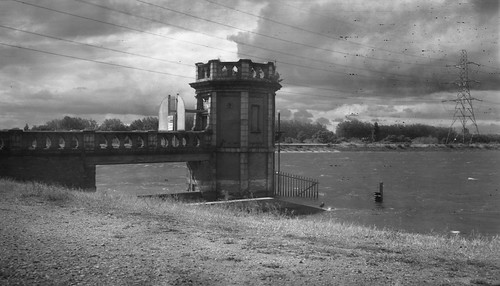
Zeiss Ikon Cocarette with Kodak Verichrome Pan
Last month, as well as shooting 126 film on the twelfth for 126 Day, I also shot several rolls of 116 format film the day before for a '116 Day'. I used a Zeiss Ikon Cocarette camera: in my post on the camera I wrote about how I had made some minor (and reversible) modifications to enable the camera to take 120 medium format rollfilm. On 116 Day in June, I undid these modifications in order to shoot 116 film, rather than 120. 116 film hasn't been made for over thirty years, and all the rolls of film I shot were much older than that. My expectations for the results were that I'd get something, but even if the film's emulsions had suffered from significant deterioration, I would at least have more 116 format backing paper for rolling with 120 film.
Ilford Selochrome Fast Ortho Film, September 1952
The first roll of film that I shot on the day was Ilford Selochrome 'Fast Ortho Film', was the oldest, with a date on the box of September 1952. Rating it at an exposure index of around 10, I also bracketed the shots, which I did with most of the shots on the day. I also used a tripod for most of the shots in this post, allowing for smaller apertures as a result of using longer exposure times than I would be comfortable hand-holding, although the weather was bright on 11th June in the UK when I took the photographs. As this Selochrome film was orthochromatic (there were also panchromatic versions of Selochrome), I tray developed it by inspection (using the 'see-saw' method) in Ilford Multigrade paper developer diluted 1+30. The negatives did need more exposure despite the bracketing; while developing the film, I could see that more development was just fogging the film however. After development, to get as much as I could from the film, I used a bath of selenium toner at a dilution of 1+9 to intensify the negatives.

Zeiss Ikon Cocarette with Ilford Selochrome Fast Ortho Film
The emulsion had reacted with the backing paper, unsurprising perhaps with a 68-year old roll of film. The number markings show up in a regular pattern of dots, visible at bottom right in the image above, and across the top. Incidentally, the roll of Selochrome had a full range of 116 format numbers on the backing paper, something I've not encountered before - the usual numbers for 8 exposures at 6.5x11cm, but also 12 exposures for 6.5x6.5cm square, and 16 exposures for 5.5x6.5cm 'half-frame format'. This did of course mean that there was more printing for the emulsion to react to than other 116 backing papers (this - the film reacting to the printing on backing paper - is an issue which still plagues the odd batch of new 120 film from time to time).

616 format Kodak Plus-X, develop before October 1955
The next roll of film that I shot on the day was 616 format, not 116: 616 is to 116 what 620 was to 120. Kodak used the same film size and backing paper arrangement but on a slimmer spool, with narrower flanges at the ends. Although the winding key for the film is also smaller, the central hole in the spool itself is the same size as with 116, which means that a roll of 616 film should fit into the supply-side chamber of a 116 camera without any problems. The 616 film I shot was a roll of Kodak Plus-X with a develop before date of October 1955. However, although the box was in good condition, this film had obviously been exposed to damp: the roll was wrapped in foil, and on unwrapping, one end of the metal spool had some visible corrosion. Advancing it through the camera, the film was very stiff, and needed a fair amount of force to get this onto the second frame; it also made a worrying noise when I advanced it. When it came to developing the film, I found that, for most of its length, it had stuck to the backing paper - although fortunately to the reverse of the film, not the emulsion side. Tearing it from the backing paper in a changing bag, once the tank was loaded, I found that the inside layer of the backing paper had mostly adhered to the film: a thin layer of backing paper remained surprisingly intact - the whole length of the roll, with the frame numberings (this film had two frame sizes on its backing paper - 8 exposures for 6.5x11cm, and 16 exposures for 5.5x6.5cm).

Although the second roll shot, this was the last that I developed, and seeing the results from the two rolls of Verichrome Pan,  I stand developed the Plus-X for three hours in Ilfotec LC29 diluted 1+100, agitating at the beginning and at the half-way mark. After development, and after thorough washing, but before fixing, I took the film of the developing reel and was able to remove the backing paper with some gentle rubbing.

Zeiss Ikon Cocarette with Kodak Plus-X
Having had very low expectations of this film, there were images on it. In just a few areas, the emulsion had lifted, possibly from sticking to the backing paper (as above), and this did also have frame markings imprinted on the negatives, more clearly on some frames than others. In addition, there are what looks like some kind of water marks - I'm not sure what caused these - possibly, this might be due to developing the film while stuck to the backing paper, and the chemicals being unevenly absorbed - or, despite a thorough washing, the backing paper still had film developer absorbed into it when I removed it to clean off the paper (I did this in order that the fix wouldn't end up full of black paper fibres as a result).

Zeiss Ikon Cocarette with Kodak Plus-X
The second frame also had creases across it - this was the point beyond which the backing paper had stuck to the film, and in forcing the film to advance, I had somehow gotten a fold running across the film - this is the frame above. One crease is clearly visible on the left of the frame: there is another just right of the centre, which is less visible. With all its problems, the 616 film also did not wind very tightly when advanced, resulting in some light leaks at the end of the film.

116 format Kodak Verichrome Pan, develop before August/September 1965
The last two rolls of 116 film that I shot on the day were both Kodak Verichrome Pan: one had a develop before date of August 1965, the other September 1965. These I'd bought as a single lot online, so possibly these two rolls of film had been bought at the same time in the early sixties, and had not been separated since. I have had some good results with Verichrome Pan of different ages, although not consistently so, and as these were a decade more recent than the other films, I had hopes that the emulsion might not have deteriorated as much. Incidentally, these have just one set of frame numberings on the backing paper, as I've found with other 116 film I've used - perhaps manufacturers abandoned printing numbers for the the less common formats as time when on. When I shot the films, I didn't note which was which, and the results were different - one roll had lots of tiny pinholes in the emulsion (showing as black specks); the other much less, but this one appears to have lots of small fibres (showing as irregular white flecks) stuck to the surface of the emulsion, although this patterning may be a reaction to the backing paper again. The first roll I stand developed for one hour in Ilfotec LC29 at a dilution of 1+100; the second I increased the time to 2 hours and 30 minutes. As the first roll had rather thin negatives, I again used selenium toner to intensify the negatives - the first image below is from this roll, as well as the image at the top of this post.

Zeiss Ikon Cocarette with Kodak Verichrome Pan, showing pinholing
Zeiss Ikon Cocarette with Kodak Verichrome Pan, showing white flecks
For landscape work, I find the proportions of the 6.5x11cm frame attractive: this might be the primary reason for continuing to use 116 format cameras. Short of investing in some 70mm-wide film to respool with the backing paper, using 120 film does work well enough, as I have done previously, although this crops some of the image from the top and bottom of the frame. When the 116 format was introduced at the very end of the 19th century, negatives would usually have been contact-printed, as with the other rollfilm formats of the time, driving the demand for the relatively large negative size; I frequently use 'expired' film, and, taking into account all the inherent problems of doing so, the results of the films shot on 116 Day go some way to demonstrating the possibilities of the large 6.5x11cm frame.

Zeiss Ikon Cocarette with Ilford Selochrome Fast Ortho Film
Zeiss Ikon Cocarette with Kodak Plus-X
Zeiss Ikon Cocarette with Kodak Verichrome Pan

Friday, 27 March 2020

Expired Film Day 2020

Rollei 16 with Eastman Plus-X negative film
This year's Expired Film Day was scheduled for 13th-15th March. Initially I hadn't intended to take part in any way, but on the 13th itself, which was a Friday, I thought to check the date of the roll of  Plus-X which was currently in my Rollei 16 - the camera I'd been using for the previous week's #FP4Party - and, after I'd finished the rolls of 1970s FP4, I'd reloaded the cassettes with Eastman Plus-X negative film. Plus-X itself was discontinued ten years ago in 2010; the box for the 100ft roll of 16mm does not have a date - but the film does. As a motion picture film stock, the 16mm Plus-X has a 'Keykode' - a series of numbers and letters printed at regular intervals along the very edge of the film, too small to be read by the naked eye (edit 29/3/20: Eastman Kodak edge code dating for motion picture stocks can be found on this document). I could however read this with a loupe, from a length of the film I'd tested previously (this particular box of Plus-X I'd only recently acquired). The Keykode ended with AS, meaning the film was manufactured in 1992, twenty-eight years ago.

Eastman Plus-X negative film Keykode edge printing
The use of double perforated film is not ideal with the Rollei 16 as one side of the perforations do appear along the bottom of the frame. In the past, although Expired Film Day is no longer a single day, I've previously chosen to shoot on one day only. The 13th found me both working at home with a deadline to meet, and waiting for a delivery as well. With the realisation that the film already in the Rollei 16 counted for Expired Film Day, I took a few photographs around the home, but also, with the weather just changing (with February having been notably wet), I took a number of photographs of clouds as daylight was fading.


I had rated the film at a number of exposure indexes, mostly at 40 and 80, bracketing shots, then developed the film in Ilfotec LC29 1+19 for 5m30s at 20ºC with the last of the FP4 film. The following day, loading another three cassettes with the same Plus-X film, I had time for a walk, again just as the end of the afternoon, as the light was beginning to fail with the clear skies began to cloud over. This was the weekend before restrictions due to the coronavirus pandemic in the UK began to genuinely make a difference to daily life, beyond the injunctions to wash hands for longer and more often. That weekend my workplace announced that it would be closing the following week and all work would be moving online, which was a few days ahead of many. The photographs taken during a day at home would become emblematic of the two weeks since, and for the foreseeable future.


Saturday, 17 December 2016

Kodak Plus-X

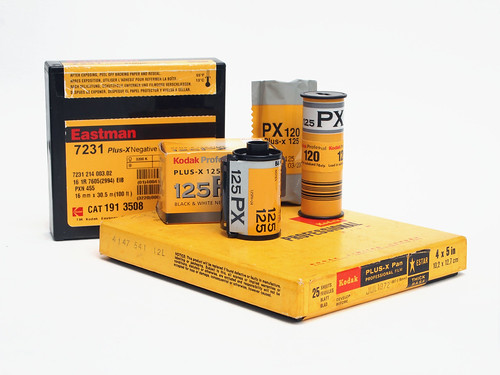
Kodak/Eastman Plus-X in 16mm, 35mm, medium format and large format sheet film
Eastman Plus-X was first introduced as a motion picture film in 1938, and shortly afterwards produced for still cameras in a number of different formats as Kodak Plus-X. The emulsion number for Plus-X as a motion picture film was -231, with Kodak's standard prefix codes of 7 for 16mm, and 5 for 35mm. As a motion picture film, Plus-X was available in both negative and 16mm reversal stock. For still camera film, Kodak Plus-X had the code PX for many years (with PXP for medium format 'professional' films; PXE for Estar-based 70mm film; and PXT for thick-based sheet film), but it was reformulated around a decade ago, and was then designated 125PX. A comparison of development times shows these to be broadly similar, but changed in many cases by 15-30 seconds in many developers. Kodak's technial data sheet for the new version states:
"To reflect our enduring commitment to black-and-white photography, black-and-white film production will take place in an even more advanced film-coating facility. New technology applied to these superior, time-tested emulsions will result in slightly different processing times for the film family. But the same great films—those you've known and trusted for years—will still deliver the same breathtaking results."
One notable difference between the two versions was the new Plus-X was provided with development times for a three-stop push to EI 1000, while the earlier film was only recommended to be pushed no more than two stops; both films' data sheets stated that a one-stop push to 250 could be achieved without a change to development times. In my own tests below, I did not attempt more than one-stop push, given that I was working with discontinued film, although the 35mm motion picture film was manufactured in 2010, not old enough to really be concerned with increasing exposure to compensate for a loss of sensitivity with age; in some other formats, the Plus-X film I shot was much older.

In the Kodak Reference Handbook from 1946 it is described under 'General Properties' for Roll Film and Film packs as being:
"High speed, fine grain, excellent gradation, wide exposure latitude. The speed and balanced color sensitivity make this film particularly suited to a wide range of outdoor conditions. It also has ample speed for well-lighted indoor subjects. The low graininess and high resolving power permit high quality enlargements many times the size of the original negative."
While for 35-mm and Bantam (828) films:
"High speed and fine grain. For general miniature camera work this film should be used unless light conditions are very adverse or unless a very high degree of enlargement is intended."
Plus-X was originally rated 50 ASA, but at some point in the 1950s this was increased to 80 ASA (this thread gives some information on Plus-X ratings). When speed ratings were changed for black and white films in 1960, Plus-X was rated at 160 ASA for a time, before gaining its 125 ISO rating, which it retained for nearly fifty years (Kodak's reference hand book implies the presence of the one-stop safety factor in the statement about Plus-X that, "When it is desired to reduce the exposure to a minimum, these values can be doubled with little danger of serious underexposure..." ). Additionally, the motion picture stock was recommended to be shot at a slower speed, 80 ISO in daylight and 50 under tungsten, which may just reflect the process of striking a positive from motion picture negative film, rather than a slower emulsion.

Eastman Plus-X was discontinued in 2010, with the notice for the still camera version announced the following year - although the production runs may have both stopped at the same time if the emulsion itself was the same. Incidentally, the Massive Dev Chart still has Plus-X on its main chart, not on its discontinued/unlisted page. Kodak's rationalising of the film stocks it produces in recent years has meant the discontinuation of many of its classic films. This does leave Kodak without a medium-speed traditional emulsion film (Ilford's FP4 Plus being the closest equivalent still available). Kodak suggests TMax 100 as a replacement for Plus-X; this film uses a modern T-grain emulsion. For most of the period that Kodak was manufacturing Plus-X, it also produced Verichrome Pan, another still picture film with a traditional cubic emulsion at the same speed as Plus-X, only discontinued in 2002; Verichrome Pan does appear to have been available in some formats (126, 127) that Plus-X was not, but both were available in the most common formats - 35mm, medium format and sheet film.

Minolta 16QT with 16mm Kodak Plus-X, develop before date Sept 1971
MPP pinhole with 4x5 Kodak Plus-X, develop before date July 1972
I had first used Plus-X in a ready-loaded Minolta-16 cartridge with a "develop before" date of September 1971. Around the same time, I also acquired a box of large format Plus-X from 1972 in a job lot, which I used for both this year's 'Expired Film Day' and on Worldwide Pinhole Photography Day, which I rated at 25 to compensate for the loss of the film's sensitivity over the more than four decades since it was made. Apart from this loss of sensitivity, the quality of neither film appears to have been much compromised with age. Unintentionally, I had begun to use Plus-X after it had been discontinued almost by accident; I subsequently bought a 100-foot roll of 16mm film for 110 cartridge reloads and other subminiature formats, after using up two rolls of Kodak WL Surveillance film, and finding the Photo Instrumentation film rather grainy. As Plus-X had been a motion picture stock, I wanted to use it for a separate project that I have been pursuing, looking at film locations; given how recently it has been discontinued, I found it relatively easy to find across Plus-X in 35mm and 120 online.

35mm Kodak Plus-X motion picture film latitude test
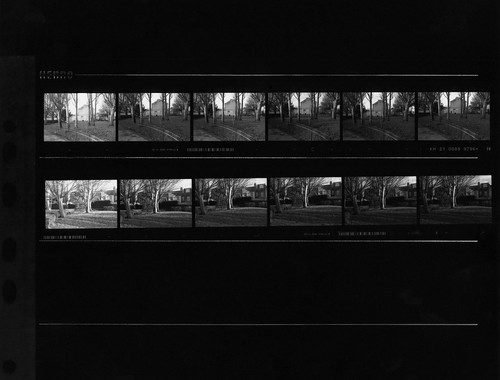
To test the film in 35mm, I bought some bulk motion picture Eastman Plus-X 5231. According to Kodak's guide, the date of manufacture for the 35mm Plus-X that I bought is 2010, which would mean that it was in the very last batches made before discontinuation that year, based on the edge code once developed. I tested the latitude of the film, as shown in the contact sheet above. For the first row, the film was exposed at indexes of 40, 80, 100, 125, 160, and 200. However, with the light changing due to quick-moving thin clouds, shooting manually, I couldn't be sure that I had a perfect set of exposures, so I repeated the latitude test a couple of days later. For the second row I used the same set of exposure indices, but the lighting on the day was more consistent. The film was shot with a Canon A-1 SLR and developed in Ilfotec LC29 at a dilution of 1+19 for 6 minutes at 20ºC. Both tests showed good latitude with a moderate amount of contrast over the fairly short range of exposures, and a relatively clear base, presumably being good for motion picture use, as well as possibly useful when scanning. Part of the reason for choosing these speeds was an attempt to be precise over whether any adjustments for age needed to be made, given that the motion picture stock is recommended to be shot at a slower speed (80 ISO in daylight) than the still camera version (125 ISO), which may just reflect the process of striking a positive from motion picture negative film.

Canon A-1 with Plus-X rated 40
Canon A-1 with Plus-X rated 200
Although I used a narrower range for the test than for other films I've tested, the results appeared to show the Plus-X has fairly good latitude; the two examples above from either end of the scale of exposures I used are both quite acceptable, in the lower image it might have been possible to pull more detail from the shadow areas. Other than the Plus-X from the 1970s, the last batches of 35mm motion picture stock and the medium format from the past decade were either shot at box speed, or generally rated at 100 rather than 125. I haven't tested Plus-X for push processing apart from one roll at 200, pushing one stop (or 2/3 of a stop) in Ilfotec DD-X. With the lighting conditions when the film was shot, the results were fairly high in contrast, I also shot the film with a yellow filter, which helped provide detail in the sky. As Plus-X has only been discontinued within the last decade, there's still a lot of the film around in different formats, although since I bought my last bulk roll, I have seen that prices have increased online. Perhaps Kodak Plus-X isn't significantly different from Ilford's FP4 Plus to make shooting it today anything other than a historical curiosity - I had never used the film before it was discontinued - although as a motion picture stock, it's a fortunate curiosity, appropriate enough to the ongoing project shooting film locations.

Mamiya-16 Automatic with 16mm Eastman Plus-X
Pentax Auto 110 with 16mm Eastman Plus-X
Agat 18K (35mm half frame) with Kodak Plus-X motion picture film, developed in Ilfotec LC29
Kodak Retina IIa (35mm) with Kodak Plus-X motion picture film, developed in Ilfotec LC29
Kodak Retina IIa (35mm) with Kodak Plus-X, rated 200, push processed in Ilfotec DD-X
Kiev-4 rangefinder (35mm) with Kodak Plus-X motion picture film, developed in Ilfotec LC29
Ikoflex Ic (medium format 6x6) with Plus-X, develop before date of 03/2006, developed in R09 One Shot
Zodel Baldalux (medium format 6x9) with Plus-X, develop before date 02/2007, developed in Ilfotec DD-X

Sources/further reading:
Kodak's history of motion picture film stocks
Plus-X Pan (PXP) tech sheet on 125px.com
Plus X (PX125) tech sheet on 125px.com
Kodak Reference Handbook 1946
http://silverbased.org/plus-x-kodak-woes/
https://blog.jimgrey.net/2014/06/25/shooting-kodak-plus-x-pan/
http://adambhalalough.com/post/572281627/thoughts-on-kodak-discontinuing-plus-x-bw-film