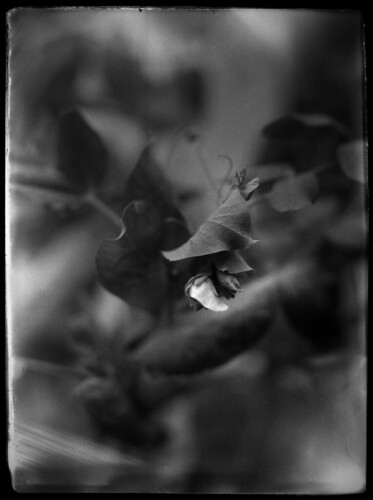
Showing posts with label large format. Show all posts

Monday, 26 October 2020

Isolation Projects Revisited

'Quarantine' 9x12cm paper negative on Ilfospeed grade 2 RC paper

In my post Isolation Projects, written five months ago, I described in detail an ongoing series of photographs, simply titled 'Quarantine'. These were paper negatives, shot each day, of the tree outside my window. At the time, I wrote that the project had a definite start, and that some UK-wide restrictions were being eased then, at the start of June. Since then, more restrictions were eased in July, then there was the 'eat out to help out' scheme; in September and October schools and colleges reopened for in-person teaching (schools had been open all through the height of the restrictions for vulnerable children and those of key workers of course); since then the number of coronavirus infections have begun to increase rapidly and new restrictions are in force. Currently, London, where I live, is in 'tier 2' the second highest or strictest measures. I continued taking photographs for the 'Quarantine' series each day all through the summer, unsure when there would be a logical point with which to end the series.

'Quarantine' 9x12cm paper negative on Ilfospeed grade 2 RC paper

In the previous post, I described the considerations of using different papers, mostly in terms of graded against variable contrast papers, finding that a light green filter effectively gave Ilford Multigrade paper sufficiently lower contrast to record both highlight and shadow details in most lighting conditions, as grade 2 paper unfiltered generally achieves (the difference between bright sun and overcast days is still quite marked). I have persisted since then in the routine of taking two photographs each day, one on old Ilfospeed grade 2 paper, one on Multigrade IV (it seemed prudent to shoot two photographs, rather than just one each day, for insurance). Currently, I have every intention of continuing the series for the time being; although the 'isolation' of the title of my previous post became more theoretical than actual during the later part of the summer, it still feels appropriate to the act of taking photographs of a small slice of the world outside through a window each day, and 'Quarantine' is appropriate enough as a title (I did consider that the project should initially last the 40 days that the word quarantine is derived from, but at the end of that time, restrictions were still strict-relatively speaking, in comparison, other countries were far stricter-so I continued the photographs; since then I have personally had two periods of self-isolating as a precaution in the last two months). Reflecting on the experience of having passed six months of this particular project, I've written a post for the Undertow Research blog here

Sunday, 31 May 2020

Isolation Projects

'Quarantine', 9x12cm paper negatives, first 28 days
In my post two months ago for 'Expired Film Day 2020', I referenced the current coronavirus pandemic, the full restrictions of which had come into force between taking the photographs, and then developing, scanning, and posting two weeks later. UK-wide restrictions were much less stringent than in other countries: even at the height of the pandemic, I could have left the house every day to take photographs, on my daily exercise or on essential shopping trips; in my post on Worldwide Pinhole Photography Day, I did reference that I couldn't go out to take photographs. The inference in this statement was that with a large format camera and long exposures, going out specifically to take photographs, with stopping for long periods with a camera on a tripod, would appear to be against the spirit of the rules then, if not the letter.

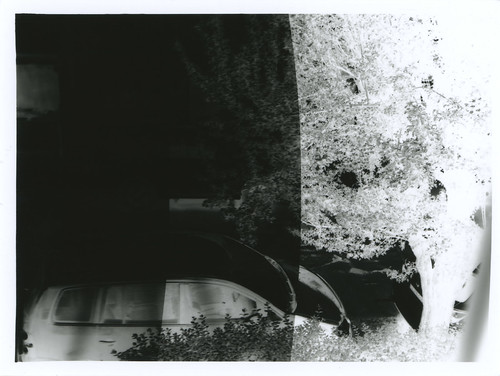
Unfixed paper negative, digitally inverted, Kodak Recomar 33
Instead, as with a number of photographers, I have been taking photographs at home for the duration. One participatory project initiated online by the artist William Arnold Goldstrom, 'Lockdown Living Spaces' uses the tag #covidobscura on Instagram. He invited artists to make long-exposures on photographic paper of their domestic spaces during lockdown - essentially, lumen prints, as the image below - which would then be scanned unfixed, digitally inverted into positives.

Unfixed paper negative lumen print, Kodak Recomar 33
I took part with a variety of cameras and formats - large format, quarterplate, 116 - with exposures ranging from one to three weeks, and for the two months from the 24th March, had at least one camera exposing at any one time. I also used three different types of photographic paper - Ilford Multigrade IV, Adox MCP 310, and grade 2 Ilfospeed paper from the 1970s. Photographing domestic spaces, for most of the cameras I used wide angle lenses or supplementary lenses: the image above, shot on Ilfospeed paper with a Kodak Recomar 33, used a Proxar supplementary lens; the image below, on Adox MCP paper, used a 75mm Dehel Manar lens on my MPP Micro-Technical Mk VIII.

Unfixed paper negative, digitally inverted, MPP Micro-Technical Mk VIII
Being fortunate enough to be able to work from home, documenting this time through long exposures of the domestic space as a work environment show traces of activity and the passing of time, while the human figure moves too quickly to register (although there is a faint indication of a blur in front of the monitor in the first image above). I found with slower lenses, as with the Kodak No.2A Brownie and the Cameo, two or three weeks were needed to give an image good enough for scanning; I also found that the scanning process darkened all of the paper considerably, as well as time outside the camera of course. I did fix some of the paper after scanning, but the images became much lighter after fixing. The best results were those using the Adox MCP paper; those using Ilford Multigrade produced a wider range of colours (on black and white paper) - not having much experience with lumen prints, this was a little surprising to me at least: the first two images below are on Multigrade; the Kodak Recomar shot is on Ilfospeed grade 2, while the other photographs use Adox MCP paper.

Unfixed paper negative, digitally inverted, Kodak No.2A Brownie
Unfixed paper negative, digitally inverted, Butcher's Cameo
Unfixed paper negative, digitally inverted, MPP Micro-Technical Mk VI
The day after setting up a couple of cameras for the #covidobscura project, I embarked on another series of photographs under the provisional title of 'Quaratine'. Looking for a subject in that fourth week of March, I noticed that the tree outside my window was just coming into leaf: I have been photographing it every day since as spring gives way to summer, the clocks went forward, the evenings get lighter, the full leaves on the tree being followed by blossom, which has now come and gone.

'Quarantine', 9x12cm paper negatives, weeks 5-8
These photographs were shot on photographic paper, with the intention of developing the paper, unlike the #covidobscura images. I used a Rietzschel Heli-Clack 9x12cm large format folding plate camera for these photographs. Prior to the lockdown, I had shot some paper negatives with this camera using the same Ilfospeed paper stock that I'd used for the #covidobscura lumen images. One reason for using this paper was simply that it was 3 1/2 x 5 inches, 8.9x12.7cm, which meant I only needed to cut 7mm from one side of the paper to fit the 9x12cm plateholders (although in the event cutting the paper to 11.9cm fits the film sheathes better).

'Quarantine', 9x12cm paper negative on Ilfospeed grade 2 RC paper
Being grade 2, I shot the Ilfospeed paper rated 6, which gave fairly consistent results without flashing or filtering. The box dates back to the late 1970s, but the only sign of age with the paper appears to be a slight yellowing to the base, which is not unattractive. I decided to take two shots each day, to guard against any mistakes, and providing the opportunity to choose the best of the two; I quickly used up the remaining sheets in the Ilfospeed box. The next photographs were shot on Adox MCP 310 paper. As a variable contrast paper, the results were generally higher in contrast than the grade 2 paper, but the Adox MCP paper does seem to be good at retaining highlight detail, and I shot this at an exposure index of either 10 or 12.

'Quarantine', 9x12cm paper negative on Adox MCP 310 RC paper
However, the Adox paper was cut down from much larger sheets; this paper has been discontinued from the start of this year and there seemed to be little available online when looking for a replacement as this started to run low. I switched to using Ilford Multigrade IV paper, having bought a box of 8.9x14cm specifically for the project, which, again, needs just one cut to fit the film sheathes. Unlike both the Ilfospeed and Adox papers, I found Multigrade IV to be too high in contrast to use 'straight' in the camera. I made a couple of tests before using this paper for the project, having researched online the different approaches taken to shooting paper negatives. In the lower of the two tests below, the difference a green filter makes is quite marked; the green filter was used as a 'minus-magenta' filter. It would have been possible to use Multigrade filters with the paper to control contrast, but as the high contrast layers in the paper are sensitive to magenta light, using a light green filter worked perfectly well.

Ilford Multigrade IV RC paper test rated 12/6/3 right to left
Ilford Multigrade IV paper test with light green filter rated 12/6/3 (adjusted for filter) right to left
I developed the paper negatives in Ilford Multigrade paper developer, with dilutions from 1+9 to around 1+30 or even 1+50; I had thought that high dilutions of the developer might also have an affect on the contrast, but this mainly seems to affect developing time. What this does mean is that it was easier to pull paper negatives from the developer early if these appeared to be developing too dark due to overexposure. However, as a general rule, this often showed as uneven development, and in most cases, I achieved more consistent results from allowing development to complete, and attempt to get the best exposure, within practical terms, when shooting the paper.

'Quarantine', 9x12cm paper negative on Ilford Multigrade IV RC (green filter)
Initially, I hadn't made any conscious decisions about how these photographs were to be displayed when I began taking them, but after developing the first batch, the quality of the negatives themselves seemed promising: I liked the distance as photograph it provides, and it also meant that I could use a direct product of the camera, due to the relatively large negative size and the fact that it was shot on paper. If exhibited, these paper negatives would be presented as grids of images, their number marking the days of confinement and the passing of time evidenced in the changes of the natural world.

'Quarantine', 9x12cm paper negative on Ilford Multigrade IV RC (green filter)
Having decided to show the Quarantine photographs as paper negatives, rather than either make positives by contact printing these, or digital positives, this also affected the way I continued to shoot the paper. Having experimented with 'flashing' some of the paper, I preferred the look of this - although the image above would no doubt work well as a negative to obtain a positive, aesthetically, I find the shadow areas rather 'bright', and so used flashing to bring up the shadow areas, which also helps reduce contrast. I had been keeping a log of all the exposure details of this set of paper negatives, but, frustratingly, the text file I had been adding to every day got corrupted 8 weeks in and I was only able to recover some of the information. It's easy to see the difference between the three papers I used, less easy to see which were flashed, in camera, in the darkroom, or before or after exposure. The image below is, I think, one of the flashed paper negatives: the shadow areas have just a little more density than in the negative above.

'Quarantine', 9x12cm paper negative on Ilford Multigrade IV RC (flashed?)
Having spent some time trying to get the best results from the Multigrade paper, I found a couple of boxes of Ilfospeed grade 2 paper online. of a similar vintage to the first box, with which to continue the project for several more weeks. As it was impractical to keep the camera set up on a tripod to take the same shot day after day, week after week, this has forced me to attempt different ways of photographing the subject each day, or, conversely, repeating compositions and framing specifically to show the passing of time. As previously mentioned, the restrictions of movement due to the pandemic have been much less strict in the UK than other countries, although the measures announced on March 23rd did provide a clear start to the 'lockdown'; what's less clear is what might mark the end, and so the end of this particular project. Tomorrow, June 1st, is the beginning of another round of restrictions being eased, but by no means the end of them and so I am inclined to continue with the daily ritual of photographing from my window for the time being.

'Quarantine', 9x12cm paper negatives

Sunday, 3 May 2020

Worldwide Pinhole Photography Day 2020

Paper negative on Adox MCP 310 RC paper, inverted and flipped in Photoshop
Last Sunday was Worldwide Pinhole Photography Day. Being unable to go out to take photographs as in other years (although carrying around a large format camera, tripod and film holders could arguably be defined as exercise), I did want to mark the day and made four exposures in the garden using the MPP Micro-Technical Mk VIII camera with the 0.3mm pinhole lensboard I'd made for it. As the camera's focus moves the lensboard, the focal length can be changed: in the past I've shot pinhole photographs at a 'normal' angle of view for the 4x5 inch large format; here, I used approximately 100mm for the focal length, moderately wide. At longer focal lengths, exposure times start to get frustratingly long; the four photographs were taken successively over about an hour.

Having been working with paper negatives recently, I thought that I'd shoot a negative and a positive on photographic paper rather than use film or plates as on other years. The negative was shot on Adox MCP 310 RC paper, which I've used for some of the recent paper negatives and which, for variable contrast paper, has a certain amount of latitude. I did flash this to reduce contrast further, and used a light green filter.  I rated the paper at an exposure index of 12, and doubled the exposure time for the filter factor. Shooting on variable contrast paper, green is useful as a minus-magenta filter: the high contrast layer(s) in the paper are sensitive towards magenta. This seems to make sense to me; a similar result could probably be achieved by using a low-number Multigrade filter when shooting. The subject, raspberry canes, were lit with sun coming through the leaves of a tree, so this made for high-contrast subject to begin with. The positive was shot on Harman Direct Positive Paper. This is around ten years old, and the result wasn't as good as I had hoped. I rated this at 6, and flashed the paper. The highlights look overexposed, but the paper hasn't developed anywhere near dark enough. The shadows are all a mid grey, and there's the kind of texture running through it that one sometimes get when backing paper reacts with the emulsion on medium format film. The Harman Direct Positive Paper hasn't been stored with any care since I bought it a decade ago, so this might not be surprising, but I have had good results with other kinds of photographic papers of much older vintages. The image at the top of the post is the inverted paper negative, which worked well enough on its own.

Harman Direct Positive RC paper
Paper negative on Adox MCP 310 RC paper
I developed the paper in Ilford Multigrade paper developer diluted 1+20; the dilution of the developer doesn't seem to affect the contrast that much, but diluting it further than usual does make it easier to control the degree of development as it extends the time, although both papers in this case were left to develop to completion. This may not have helped the Harman Direct Positive Paper, but this doesn't explain the texture. I also shot two sheets of Rollei ATO 2.1 Supergraphic film, one of which was fogged, and developed these at the same time in the same paper developer; the negatives are high contrast, as one might expect. Currently without access to scanning for large format negatives, I made a contact print on Silverprint Solar Print paper - a form of ready-sensitised cyanotype paper, for which the contrast of the negative worked well.

Rollei ATO 2.1 Supergraphic film contact print on Solar Print paper

Wednesday, 27 November 2019

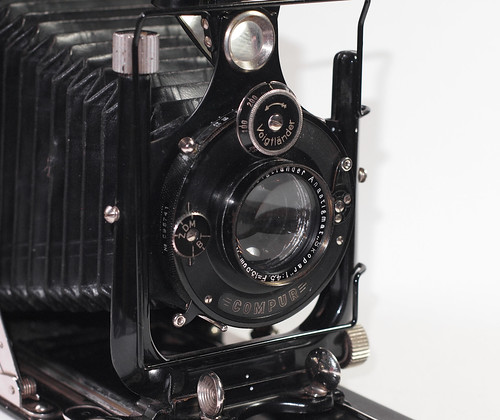
Voigtländer Avus

Voigtländer Avus
The Voigtländer Avus was my first 9x12cm format folding camera. I initially bought it as a relatively inexpensive and compact large format camera; I did subsequently buy a 4x5 camera not long afterwards, but also found other 9x12cm cameras after the Avus: the Kodak Recomar 33 (which was extremely cheap); the Ica Trona; and the Photo Plait camera (as a format, 9x12cm sheet film is still made: it's essentially the continental European metric equivalent of 4x5 inch film, although not as common). The Avus was the mid-range option of Voigtländer's stable of plate cameras, between the lower-priced Vag cameras and the top-of-the-range Bergheil: the Bergheil cameras seem to have been entirely contemporary with the Avus, while the Vag was introduced later, as a more economical option. The Avus appears to be a relatively common camera, and presumably made in fairly large numbers; it was produced from 1913 to 1934 (some sources give 1914-1935, or -1936), with some minor changes throughout the two decades of that run. My camera is the 9x12cm version that appeared in 1927, clearly identified by the centrally-positioned brilliant finder directly above the lens, rather than offset to one side, as with most plate cameras of this date. Two different origins of the camera's name are given in different sources: one suggestion is that the name is formed from the initials A.V.U.S., as seen on the ground glass back on early versions, derived from "Aktiengesellschaft Voigtländer Und Sohn"; Camera-Wiki states that it was named after an early motor racing circuit in Berlin, the AVUS, also an acronym. This AVUS was under construction when the camera appeared, but not opened until 1921, so it seems highly unlikely that Voigtländer would have been deriving some name recognition from the racetrack's popularity.

Voigtländer Avus - side view
The Avus was made in a number of different formats: there is a horizontal 9x12cm plate version, a 10x15cm, one dual-format version for 9x12cm plates and 122 rollfilm, but the most common sizes are the vertically-oriented folding cameras for 6.5x9cm and 9x12cm plates. Like many folding plate cameras of its time, the Avus was provided with different lens and shutter combinations. My version of the Avus has a 13.5cm f4.5 Skopar lens, Voigtländer's own version of the Tessar, in a Compur dial-set shutter, which together would have been the most expensive options at the time.

Detail with Voigtländer Skopar lens in Compur dial-set shutter
The other features of the Avus are double extension bellows; limited movements in the form of front rise and cross; a rotating brilliant finder with spirit level, and a wire frame viewfinder. Focus is with a ground glass screen; the front standard is focussed with a rack and pinion knob, which pulls out to turn, pushing in to lock the focus. There is also a focus scale on the bed - which needed adjusting, as this was initially out of true: when first using the Avus, I relied on the infinity stop of the focus scale, and found most of the images out of focus as a result (the focus scale can be adjusted with a couple of small screws that, once loosened, can be moved backwards or forwards a small amount). The removable ground glass screen was missing from my camera; ground glass screens, unlike spring backs, have a tendency to get separated from their cameras. I made a ground glass screen from a 9x12cm film pack adaptor which came with the camera, and lacking a focus shade it does have the benefit of opening completely out, without a viewing hood, which I found useful when using the camera for night photography, but, for general use, I have tended to use the ground glass screen from the Recomar.

Avus with bellows extended
Over the years, I've picked up various 9x12cm plate holders, some Voigtländer-branded ones, a number of which came with film sheathes, essential for shooting sheet film with the camera. The Avus is compatible with all the plate holders I have, which is not the case with the Recomar. As the Avus was my introduction to large format, I experimented with paper negatives and Harman Direct Positive paper for ease of loading and development under darkroom safelights. I used a sheet of stiff card behind the photographic paper in the plateholders before I had acquired the necessary film sheathes. When I first started to shoot sheet film with the camera, I attempted tray processing, but found it too difficult to get even development with the negatives and also found it too easy to scratch the film: I had been using Foma film, which in my experience has a soft emulsion compared to others, very easy to damage while wet. I subsequently got a Combi-Plan tank to develop large format film and plates, which I have found much easier to develop sheet film with.

Voigtländer Avus - paper negative, digitally inverted
What drew me to the Voigtländer Avus was its compactness in relation to its negative size: the camera is the size of a fat paperback book. Using it handheld, my general procedure was to focus on the ground glass screen, then replace this with a plateholder or rollfilm back, and use the wireframe finder to compose the shot. I've remarked before on my preference for the dial-set Compur shutter over the later rim-set version for ease of use: when focussing with the ground glass screen, with the shutter speed set, the selector for the I/B/T setting can be quickly turned between 'T' to open the shutter and 'I' for taking the shot.

Voigtländer Avus with Agfapan APX100
I also invested in a Rada Plaubel rollfilm back for the 9x12cm format for the ease of using medium format film with the camera, with a much wider selection of films available, as well as being easier to develop.

Voigtländer Avus with Adox CHS 100 in rollfilm back
The Proxar and Distar supplementary lenses that I used with the Ica Trona - which I found at the time I bought the Trona - also fit the 37mm lens mount on the Voigtländer Avus; the Proxar lens can be used as both a close up filter and a wide angle one due to fact that it's possible to reduce the distance between the camera's lens and film plane in order to achieve infinity focus. With a full 9x12 frame, there is some vignetting and distortion towards the edges of the frame, as can be seen in the image below; a narrower aperture might reduce this somewhat.

Voigtländer Avus and Proxar with Fomapan 100
With the roll film back, the 6x9cm medium format frame, normally cropped of course, approaches an equivalent angle of view as the full 9x12cm frame without the Proxar: the two images below give a good comparison in terms of the difference the Proxar makes. On the 6x9cm frame, the vignetting and distortion lies outside the image area; it does appear to make the image softer however.

Voigtländer Avus with Ilford XP2 Super in rollfilm back
Voigtländer Avus with Ilford XP2 Super in rollfilm back and Proxar lens
In use, although the Avus is well-made, I found that the front standard on my camera had a tendency to hold the lens a little out of parallel to the focal plane, possibly due to tension or simply the weight of the bellows on the unsupported top of the front standard, with the result that the plane of focus in photographs taken with the Avus would often shift across the scene in front of the camera, less noticeable with smaller apertures of course. As well as this issue, the Skopar lens on the camera, uncoated of course, was very soft, prone to halation: this is clear in the image below with the sky backlighting the subject, creating a haze around the ruin.

Voigtländer Avus with Rollei Superpan 200 in rollfilm back
Although the Kodak Recomar 33 has a slower lens, and a simpler shutter, I have found this easier to use than the Avus. The Recomar has a triplet lens, the Radionar, which is around the same age as the Avus' Skopar, but on my cameras, it gives a better result, and so I've used the Recomar in recent years in preference: although it was my introduction to large format I found the Voigtländer Avus frustrating to use, and I never felt like I quite got the quality of the images from the camera that I felt it promised.

Voigtländer Avus with Adox CHS 100 in rollfilm back
Voigtländer Avus with Ilford HP5 Plus in rollfilm back
Voigtländer Avus with XP2 Super in rollfilm back and Proxar lens
Voigtländer Avus with Ilford Soft Gradation Panchromatic glass plate (label dated to 1947)
Voigtländer Avus with Ilford HP3 glass plate (1950s)
Voigtländer Avus with Ilford HP3 glass plate (1970s)
Voigtländer Avus with Fomapan 400
Voigtländer Avus with HP5 Plus
Sources/further reading:
Full range of Voigtländer Avus Models

Voigtländer Avus on Camera-Wiki 
Early Photography on the Avus
Voigtländer Avus on J. Noir Cameras
Voigtländer Avus on Collection-Appareils
Camaras sin Fronteras - Avus (with manuals and original adverts) (in Spanish)
Voigtländer Avus manual

Wednesday, 8 May 2019

Agfapan APX 100

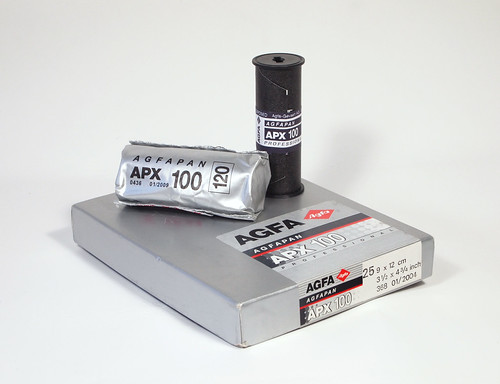
Agfa Agfapan APX 100 in sheet film (9x12cm) and medium format
Among the currently available range of black and white films, there are two films named AgfaPhoto APX, in 100 and 400 speeds. This film is sold by Lupus Imaging, and, it seems, is most likely made by Harman, similar to the Rollei RPX films, and (but perhaps not quite the same as) Harman's Kentmere films. These films from Lupus trade on the name of Agfa's discontinued Agfapan APX 100; this post is about the original Agfapan APX 100 and it is not a comparison to the new APX 100; the new APX 100 films are not the same emulsion or a new version of Agfa's original: apparently Adox Silvermax is close to the original APX 100 recipe.

I first used Agfapan APX 100 in 35mm when it was sold under the name of Rollei Retro 100. The last master rolls of Agfapan APX 100 produced in 2005-06 were bought up by Maco when Agfa ceased production and repackaged under the name Rollei Retro 100, with generic-looking labels, rather like the first RPX films, sold in non-DX coded cassettes; possibly the film's renaming was due to Lupus having already acquired the rights to the AgfaPhoto and APX names (to add some confusion to the matter, it appears that Lupus also sold the old APX 100 film prior to the new APX 100 in 2013; Maco sold two other, different 'Rollei Retro' films: Rollei Retro 100 S and Rollei Retro 100 Tonal, not to be confused with the Rollei Retro 100 that was the old Agfapan APX 100).

Almost unintentionally, Agfapan APX 100 has become one expired film stock that I've used frequently over the past couple of years, some time after first encountering it as Rollei Retro 100. According to the Wikipedia page on discontinued film stocks, Agfapan APX 100 was produced between 1989 to 2005, which would mean that the Rollei Retro 100 that I bought in 2011 would have been a few years old at that point. The reason for buying the Rollei Retro 100 film then was that it was very economical: I can't recall exactly how much I paid for a batch of ten rolls, but Maco were selling ten rolls of 35mm Rollei Retro for less than €20 around the time (prices do seem to have varied somewhat, but Wayback Machine gives an idea of what I might have paid then).

I shot most of the Rollei Retro 100 in the the Spring and Summer of 2011, almost exclusively with the Kodak Retina IIa (one roll was shot with the Agfa Optima Sensor), developed in Agfa Rodinal, which seemed a good fit for bright sunny days, providing relatively tight grain and smooth tonal qualities; as a film, it also seemed to work well with Rodinal, the first developer that I used when coming back to processing film, and I also happened to be using the last of the stocks of the old Agfa Rodinal that the darkroom had, before switching to other generic R09 developers.

Kodak Retina IIa with Agfapan APX 100 (as Rollei Retro 100)
After I'd used up the ten rolls of Rollei Retro 100, fairly quickly, there was a gap of few years before I found a box of 9x12cm APX 100 sheet film, dated 01/2004. I hadn't been looking out for Agfapan APX 100 specifically, rather it was a case of finding cheap sheet film in the 9x12cm size; when buying this, it was a decade past its develop before date but I imagined that, being relatively slow, this would be less affected by age (without knowing how it was stored before I bought it of course), and I shot some of this, handheld in bright conditions, with the Kodak Recomar 33, rating it at box speed, or just below at an exposure index of 80, and subsequently also using it with other 9x12cm format cameras. The box also included a leaflet with developing times for both APX 100 and AP 400 - it's worth noting that the 400-speed film here is not called APX 400, but the instructions inside the 35mm boxes I later used did have APX 400; the reasons for the difference in naming are not clear, the developing times are the same for both.

Agfapan APX 100 - AP 400 leaflet
Then, I bought a batch of medium format APX 100, eight unboxed rolls with a develop before date January 2009. Some of this I cut down to 127 to use for January 2017's 127 Day with the Baby Ikonta, and also used when testing the Baby Box Tengor, as well as using it with 116 backing paper in the Agfa Standard. However, these films, all with the same process before date, were not consistent - some rolls gave good results, but on some the emulsion appeared to have reacted to the backing paper, as in the image below, where the numbering from the backing paper is just visible across the sky; in the second image this isn't present.

Agfa Record III with Agfapan APX 100 (6x9 medium format)
Zodel Baldalux with Agfapan APX 100 (6x9 medium format)
Some of these rolls of film went through X-rays more than one before and after exposure when travelling, although as a medium speed film, this should not affect the emulsion, nor is it clear whether this would increase any reactions to the backing paper, but this was perhaps not unexpected with out-of-date film, with unknown storage conditions - this is, after all, sometimes seen with new film. However, that it did not occur with all rolls, though apparently from the same batch, was frustrating, as it couldn't be anticipated.
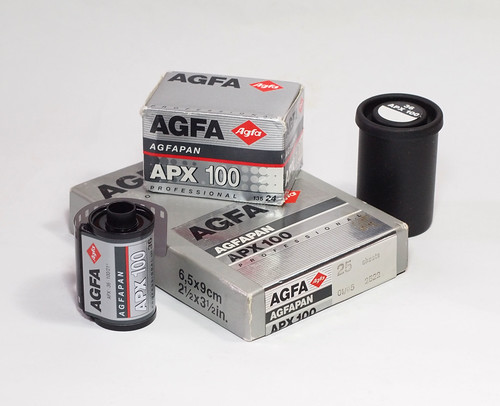
Agfa Agfapan APX 100 in sheet film (6.5x9cm) and 35mm
With the notion that I might write a blog post about Agfapan APX 100, I sought out a couple of rolls of APX 100 in 35mm to make some tests with - ordinarily, I wouldn't do this for discontinued films, although I might test for sensitivity; a latitude test, and tests for pull/push processing I would usually make for my own future reference, less of a necessity with a discontinued film that one might not have the opportunity to use in future (I also found some 6.5x9cm sheet film around the same time, with a process before date of January 95, using this with my Glunz plate camera, making such a sensitivity test with one sheet from this box). For a latitude test with the 35mm film, I shot half a roll of Agfapan APX 100 with a date of January 2002, rather older than the Rollei Retro 100 I'd used a few years previously.

35mm Agfa Agfapan APX 100 latitude test
On the contact sheet above the first two rows were rated EI 400/200/100/50/25/12 from left to right; the third and last row was shot at box speed of 100 ISO. This was developed in Ilfotec LC29 diluted 1+19 for 7m30s at 20ÂşC. Times were taken from the Massive Dev Chart, where Agfapan APX 100 is  listed under 'Discontinued/Unlisted' rather than referring to the data inside the box, which I could have used if I'd developed the film in R09. The results from this test showed that perhaps the film could have benefitted from a little more exposure than box speed, although perhaps not as much as one whole stop; I shot the rest of the first of these two films with the Kiev-4 rated 80. It is also worth mentioning that Ilfoted LC29 may not have been the best developer for this test, but I didn't have any Rodinal at the time of processing; this may have been better historically, even just in relation to the APX 100 I shot as Rollei Retro 100 a few years ago.

Agfapan APX 100 (develop before Jan 2002) at box speed
Agfapan APX 100 (develop before Jan 2002) rated EI 50
When I first used Agfapan APX 100 in its incarnation as Rollei Retro 100, I didn't have much occasion to push the film, shooting just one roll at anything other than box speed: this I rated at an exposure index of 200 as, if I remember rightly, I didn't have any faster films at the time for shooting on an overnight bicycle journey - although I didn't take many pictures during the night itself, more in the early grey dawn hours.

Agfa Optima Sensor with Rollei Retro 100, rated 200
Last year, with the second roll of APX 100 with the develop before date of January 2002, I found myself in a similar situation: taking photographs in a dark interior; with the film already loaded into the Kiev-4, this was not ideal, and I wouldn't normally push expired film this old, especially two stops, but this was a compromise which produced generally acceptable results, with the caveat that there was also some patches of bright sunlight in the otherwise dim building to complicate the exposures, and the density of these highlights rendered noise in the scanning of the negatives.
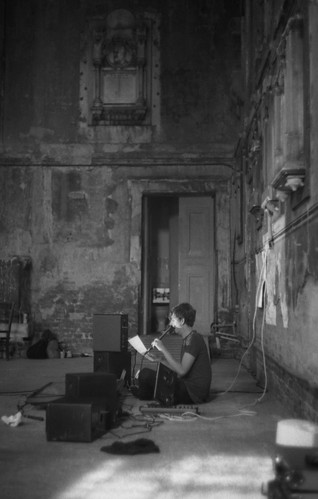
Kiev-4 with Agfapan APX 100, rated 400
As I stated in the introduction to this post, this is not a comparison of AgfaPhoto APX 100 with the original Agfapan APX 100: despite the name, these are different films. From what I've read, Adox Silvermax is close to the original APX 100 emulsion, so a comparison between these two films might have been instructive, and the qualities that I like in Silvermax do seem to be present in APX 100. However, that may not be an entirely equal contest, given that Silvermax is a new film, still very much in production at the time of writing, whereas the most recent stocks of APX 100 would now be coming up to a decade and a half old, and, although, backing paper issues aside, most of the old Agfapan APX 100 I've used has lasted well so far, using existing old stocks of the film such as may still be around must be approached with a little caution - as with any films a fair number of years past their 'develop before' date.
Kiev-4 rangefinder with Agfapan APX 100 (develop before Jan 2002) rated 80
Canon A-1 with Agfapan APX 100 (develop before Jan 2002) rated 100
Kodak Retina IIa with Agfapan APX 100 (as Rollei Retro 100)
Agfa Optima Sensor with Agfapan APX 100 (as Rollei Retro 100) rated EI 200
Kiev-4 rangefinder with Agfapan APX 100 (develop before Jan 2002) rated EI 400
Baby Ikonta with cut down Agfapan APX 100 (127 format)
Zodel Baldalux with Agfapan APX 100 (6x9 medium format)
Glunz Mod 0 with Agfapan APX 100 (6.5x9cm sheet film)
Kodak Recomar 33 with 9x12cm Agfapan APX 100
Rietzschel Heli-Clack with 9x12cm Agfapan APX 100
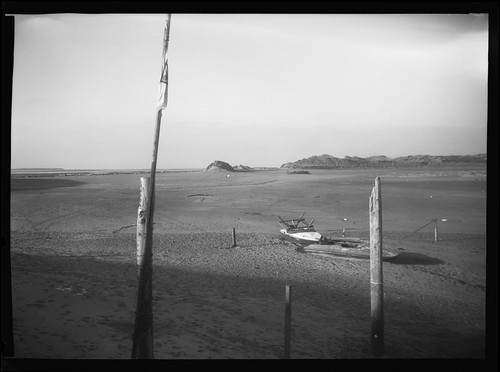
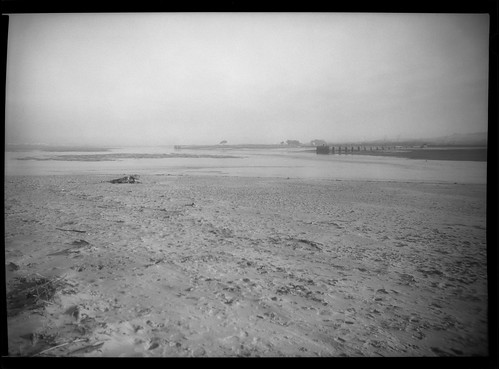
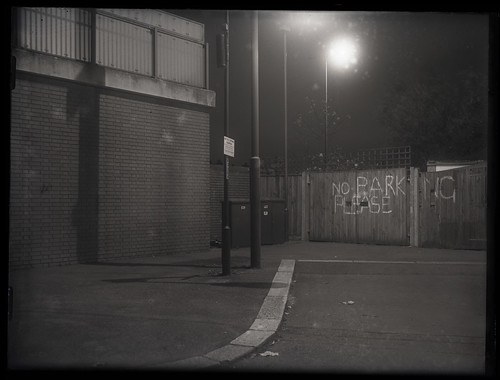
Voigtländer Avus with 9x12cm Agfapan APX 100