Showing posts with label Maco. Show all posts

Wednesday, 10 June 2015

Agfa/Rollei Superpan 200

Superpan 200 in 35mm and medium format
There are very few black and white films manufactured with a nominal speed of 200; currently, just three: Fomapan 200, Ilford SFX 200 Creative, and Agfa Superpan 200Fomapan 200 was discontinued for a few years, but was recently reintroduced in a new formulation; Ilford's SFX 200 shares some characteristics with Agfa Superpan 200: the name denotes that the Agfa film is superpanchromatic, with extended red sensitivity beyond normal panchromatic films, to near infra-red, and with the right filters (like SFX 200) it can produce similar effects to true infra-red film. Of the three films, all are available in 35mm and medium format rollfilm, additionally, Fomapan 200 is also available in large format sheet film. There are few stockists in the UK for Superpan 200, West End Cameras currently has the film in stock; when asked about in Silverprint, they hadn't heard of the film. Superpan 200 is sold by Maco but is produced (as Aviphot Pan 200) by Agfa-Gevaert in Belgium, and Maco's website uses Agfa-Gevaert's Aviphot Pan 200 technical information sheet. As can be seen in the photograph above, the film packaging uses both Agfa and Rollei brand names for the medium format film, while the 35mm labels do not use the Rollei name (the 35mm film is also not DX-coded). In the film rebates, on the medium format version, Rollei is used, while 35mm has just the name Superpan 200.

Agfa-Gevaert's data sheet describes Aviphot Pan 200's applications as:
Aerial photography assignments from low to medium altitudes, for gathering, interpreting and processing information intended for cartography, inventory purposes and exploration studies. This film can be used in industrial recording systems, such as equipment for plotting graphs in control and monitoring devices. It can also be used in stereo image recording devices, either airborne or in ground-based facilities for subsequent production of three-dimensional plans, maps, etc.
Characteristics
With its expanded colour sensitivity into the near infra-red range of the colour spectrum, Aviphot Pan 200 offers excellent penetration through haze, fog and other atmospheric conditions liable to affect the image quality. Obviously, this yields an improved image contrast and therefore more information. With the uniform distribution of the panchromatic sensitivity within the range of visible light, the terrain can be imaged very faithfully without having to revert to the use of special spectral recording filters. Yellow filters can be used to get a higher image contrast. They also decrease the overall film sensitivity.
As with previous film tests I shot a roll of 35mm Superpan using an Olympus OM10 SLR, with a range of meter settings of 25, 50, 100, 200, 400, 800 for film latitude. With no published development times for Ilfotec LC29, the developer I used, on neither the data sheet from Maco, nor the Massive Dev Chart, I used stand development, with a dilution of 1+100 for one hour.

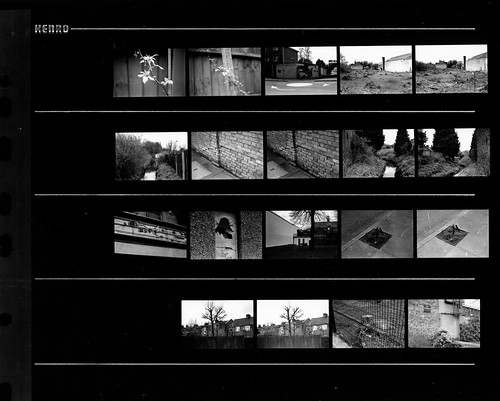
First latitude test contact sheet, stand developed in Ilfotec LC29
The first test showed the film to have narrow latitude, with the best exposure indexes of between 50-200, but developed in Ilfotec LC29, rating the film at 100 (or a little under) seemed to give the best results (the original data sheet states that "Aviphot Pan 200 can be exposed as a 125 to 250 ASA film," although this is with Agfa's G74c developer). Stand development is usually a good technique to get straight negatives from a properly exposed film, but the first results were a little disappointing.

I used the same camera and exposure settings for a second roll, repeating the latitude test of metering for 25, 50, 100, 200, 400, 800, but this time developed the film with R09 One Shot, diluted 1+:25 for Maco's published time of 8 minutes at 20ºC. The results with R09 One Shot were better than the first test, but using normal agitation does appear to have increased the contrast of the film, although lighting conditions were different, with some winter sunlight providing bright highlights.

Second latitude test, developed in R09 One Shot
The two tests show that the latitude range of Superpan 200 is relatively narrow (compare for example, Adox Silvermax's wide latitude range): exposed at 25 and 50, the highlights and midtones begin to lose separation, while with underexposure, the shadows quickly lose detail. The scans below have been adjusted to pull the maximum amount of detail from highlights and shadows: as is typical with black and white negative film, overexposure does give better results than underexposure, but Superpan 200 is less flexible in this regard than some other films.

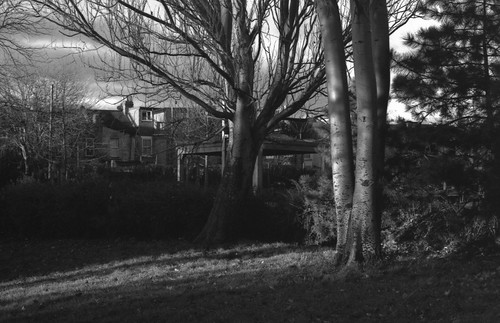
Agfa Superpan 200, rated 25, developed in R09 One Shot 1+25
Agfa Superpan 200, rated 800, developed in R09 One Shot 1+25
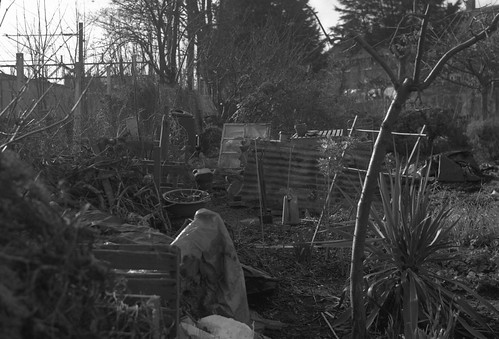
I also shot a first roll in medium format in my Voigtländer Bessa RF, developing this in R09 One Shot at 1+25 for 8 minutes at 20ºC. For this, I relied on the 'Sunny 16' rule for exposure, which I often use for cameras without built-in lightmeters, but as a result, a number of the negatives were rather thin, partly a result of trying to calculate exposure settings for winter sunlight. Despite this, at medium format, Superpan 200's qualities are immediately apparent - its sharpness, relatively tight grain structure, its clear base with very little curl once processed and the contrast; the results were reminiscent of Rollei RPX 25 - despite the difference in speed, both films have a very similar look.
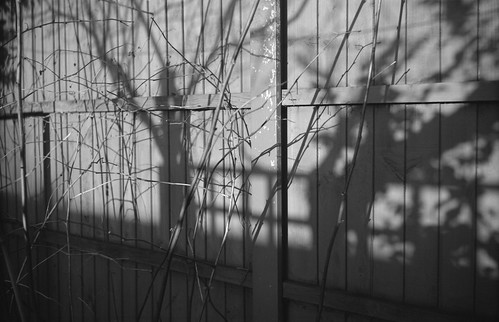
Voigtländer Bessa RF, R09 One Shot 1+25, 8m at 20ºC
Having developed Superpan 200 in both Ilfotec LC29 and R09 One Shot, I suspected that R09 One Shot at higher dilutions would provide better results, notably with higher-contrast scenes; I shot some more 35mm Superpan 200 with both the Kodak Retina IIa, and my Agfa Optima Sensor, and developed at a dilution of 1+50, for 17 minutes at 20ºC. As it's easier to increase contrast in printing or scanning, with a film like Superpan 200, it is important to expose and develop to keep both shadow and highlight detail - as with all films, but some emulsions have greater latitude and lower contrast, making it easier to achieve good negatives while being less exact in approach.
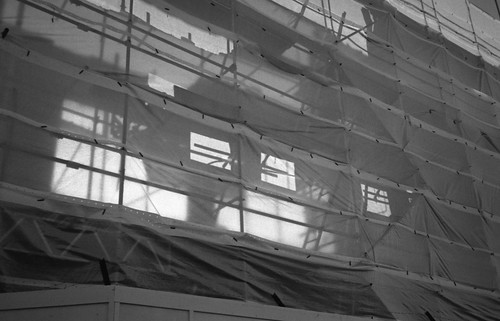
Agfa Optima Sensor with Superpan 200, R09 One Shot 1+50, 17m at 20ºC
The first tests that I made with Superpan 200 reflected the fact that these were not shot in the best lighting conditions, in the middle of winter; with more available light and higher dilutions of developer, the subsequent results in 35mm were better. I also shot medium format film in both the No.2 Brownie and the Ica Trona: even with simple Brownie meniscus lens and the uncoated Tessar on the Ica Trona, the results were good, possibly the inherent contrast of Superpan 200 complements the softness of these old lenses. On a precautionary note, the rolls of film that I shot in medium format showed that the emulsion is easily scratched if not carefully handled and the synthetic base is susceptible to 'light piping' - Maco's website does include a warning about this, and it's important to make sure the medium format films are tightly wound on their spools when removing after exposure in the camera.

Kodak No.2 Brownie with Superpan 200, R09 One Shot, 1+50, 17m at 20ºC
Ica Trona 210 with Superpan 200, R09 One Shot, 1+50, 17m at 20ºC
As well as higher dilutions, I also wanted to try developing the film at lower temperatures in Rodinal. Having used Rodinal, or R09 One Shot, for a number of years, it does seem that some of its best qualities are facilitated by using higher dilutions and lower temperatures: one or two degrees below 20ºC does seem to negate some of the 'roughness' associated with the appearance of grain when developing faster films in Rodinal. This does start to extend development times; for the shot below I used 20 minutes diluted 1+50 at 18ºC. Not having an infra-red filter, one aspect of Superpan 200 that I did not test was the ability to achieve an 'infra-red look', but even without such filtering it's a very apt film for landscape photography. The extended red sensitivity, its "excellent penetration through haze, fog and other atmospheric conditions" provide a good rendition of both skies and distances, even unfiltered; for some of the later medium format shots I used a yellow filter.

Ica Trona 210 with Superpan 200, R09 One Shot, 1+50, 20m at 18ºC
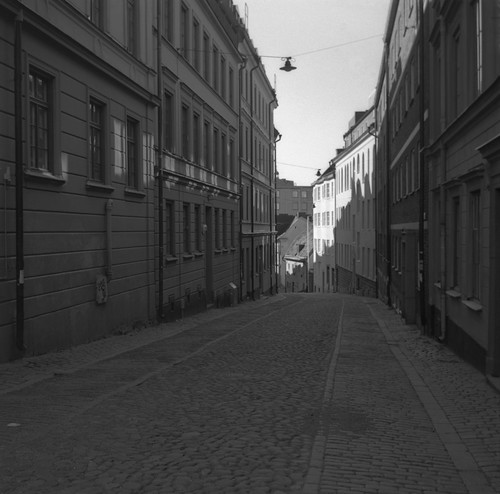
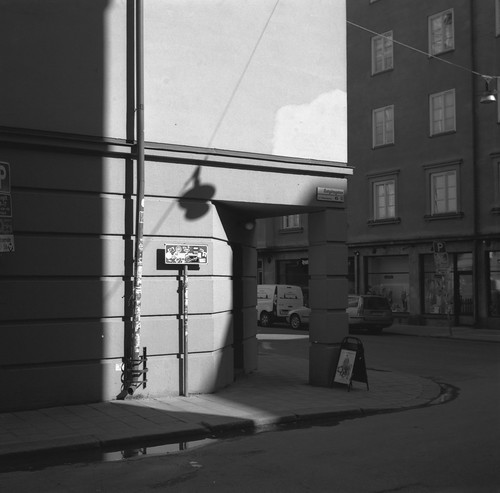
Having made enough tests, Superpan 200 was one of the films that I took with me - in medium format only - on a recent trip through Europe to Stockholm. The medium format camera that I took was the folding Zodel Baldalux, which I've frequently used for travelling. At the Loppmarknaden flea market in Stockholm, I bought an Agfa Isolette III, so shot a few rolls of Superpan 200 with this camera. As with the tests that I had made a couple of months earlier, I found myself taking lots of photographs in low slanting sun, and some of the contrasts between bright sunlight and deep shadows, such as in the third image below, needed careful metering (I used my hand-held Weston meter rather more than usual when shooting Superpan 200). These last few rolls of Superpan 200 I developed in R09 One Shot at 1+50, and used a time of 19 minutes at 19ºC - an easy relationship of time to temperature to remember.
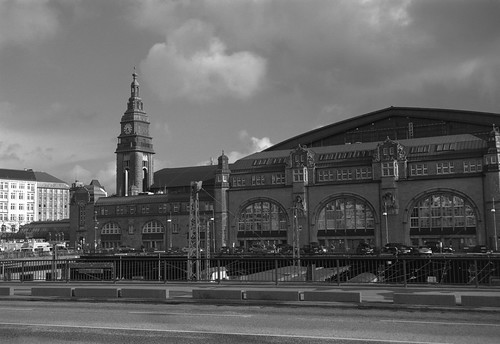
Zodel Baldalux with Rollei Superpan 200 with yellow filter, R09 One Shot 1+50, 19m at 19ºC

Agfa Isolette III with Rollei Superpan 200, R09 One Shot 1+50, 19m at 19ºC
Sources/further reading:  
Agfa's Aviphot product pages
Aviphot Pan 200 data sheet (PDF)
Maco developing times for Superpan 200 (PDF)
Extensive review on 125px

Sunday, 22 February 2015

Four years on

It's now four years since I began this blog, and two years ago I took the opportunity to reflect on the state of film as I then saw it. Appropriately for my 100th post, a further two years, on it's worth reviewing film photography once more. For black and white film at least, the market of available films has been stable, if not actively positive, with more new films appearing than being discontinued; as colour film tends (or tended) to be made by the bigger companies in larger volumes, this appears to be going through a period of rationalisation, although as I very rarely shoot colour film, I am not so aware of issues of its availability and as a result, it is a little outside of my review here.

In terms of formats, the near- (and briefly) obsolete 110 and 127 have both made a return, of sorts. Lomo have produced both colour and black and white 110 cartridge films, while Rera Pan 100 is currently the only available black and white 127 format film (Rollei Nightbird is also available as 127 format film, but being a 'redscale' film this is somewhat limiting).

After the demise of Fotokemika, which affected a number of their lines, Adox has continued to produce film, paper and chemistry. Their 'type II' versions of CHS 100 and CMS 20 films replaced the no longer available original films, and Adox also introduced the entirely new Silvermax 21/100 (which I've tested and liked the results), available in 35mm and Super 8 as Pan-X Reverso.

Notable discontinuations include Kodak BW400CN, a film I have used in the past, but only when unable to get Ilford XP2, which leaves XP2 as the last C41 black and white film. Meanwhile Ilford have had problems with Harman Direct Positive Paper due to Ilford Imaging Switzerland, a separate company which made the emulsion, closing down. Macodirect are currently selling Imago Positive Paper, which is apparently the same emulsion coated onto different paper, and presumably there is a limited supply of the stuff, although I have only previously used the original Harman DPP.

Of Macodirect's wide range, the excellent Rollei RPX films have been supplemented by a RPX 25, and this, as well as RPX 400, are now being manufactured as sheet films. For the large format photographer, this has provided a welcome medium-price range, between Foma's black and white offerings, and the higher priced Ilford and Kodak films.

Finally, although it pertains to colour film, perhaps the most exciting news of recent months has been Film Ferrania reaching their Kickstarter goal to allow them to begin to process of making colour reversal film once more - in 35mm, 120 and Super 8 and 16mm formats- in a scaled down refitting of some of the old Ferrania factory buildings in Liguria. The original company had been bought by 3M with the result that the Ferrania name itself disappeared for decades, but within five years of the factory closing down, the first batch of new Ferrania film is scheduled for production this year.

Monday, 31 March 2014

Rollei RPX 25

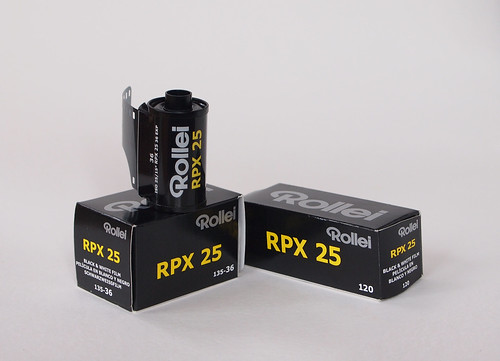
Rollei RPX 25 in 35mm and medium format
Having reviewed both Rollei RPX 100 and 400 in recent months, as Maco also introduced a new low-speed fine grain Rollei RPX 25 at the end of last year, I wanted to test this film too. Like the 100 and 400 ISO versions, it's available in 35mm and medium format, and all films have now been repackaged, in cartons instead of the plastic containers prevously used, and the 35mm cartridges now have DX coding. Previously the 100 and 400 speed films, like other 'Rollei' branded films from Maco, had printed adhesive labels affixed to uncoded generic cartridges. The new packaging suggests that Maco are investing resources in their RPX range for the foreseeable future. Maco have been known for buying stock from other manufacturers, rebranding and repackaging film, and when RPX 100 and 400 appeared, there was much speculation online about its similarities to Harman's Kentmere 100 and 400 films. While there is currently no data sheet available from Maco for Rollei RPX 25, on Macodirect the new film is described as:
...a low-speed panchromatic black and white film with a nominal sensitivity of ISO 25/15° [...] Rollei RPX 25 is characterised by a high sensitivity reserve of one f-stop, depending upon development. The thin-section document-emulsion is poured onto a highly transparent base and offers an extraordinary sharpness, with finest grain.
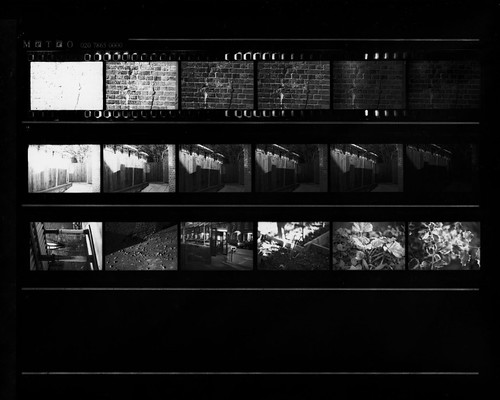
As I have done for the other two RPX films, for a first roll in 35mm, I wanted to test the film for latitude. Shooting the film with a Praktica MTL3 camera, I shot the frames on the first and second rows with exposure indexes of 6-12-25-50-100-200; the frames on the third row were all shot at a rating of 25. I developed the film using the manufacturer's recommendation of 6 minutes in R09 One Shot (Rodinal) diluted 1+25 at 20ºC.

Rollei RPX 25 latitude test contact sheet
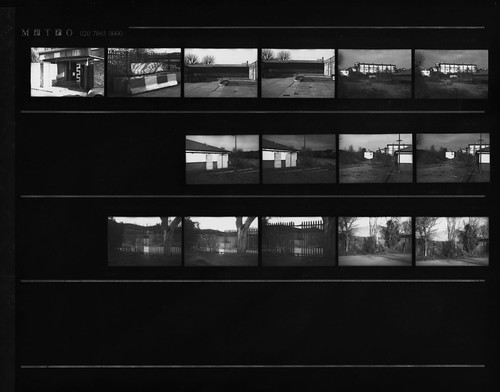
I also shot a second roll at 25 ISO. I used a yellow filter on some of the shots which included the sky. The second roll was also developed in Rodinal, but this time diluted 1+50 for 11 minutes at 20ºC, an alternative recommendation for the film.

Rollei RPX 25 film test contact sheet
My first impressions from developing these two rolls were that Rollei RPX 25 has very different qualities from RPX 100 & 400: it was immediately clear that the negatives were of high contrast; the film base was very clear and tough (I was unable to tear the film). The film also dried very flat, there being almost no curl to the negatives once cut. When printing the contact sheets on Kentmere VC Select paper, I tried making the contact prints without using a multigrade filter, meaning that the contrast should be in the middle of the paper's range, but the contrast was too high with almost no detail showing at either extremes of the latitude tests. I reprinted the contact sheets with a 00 multigrade filter for the minimum of contrast, as with the sheet shown above. As Rollei RPX 25 does not demonstrate the wide latitude of the other RPX films, exposure needs to be more exact, and, I suspect, it also requires more careful development.

Rollei RPX 25 at box speed, developed in Rodinal 1+25, 6m at 20ºC
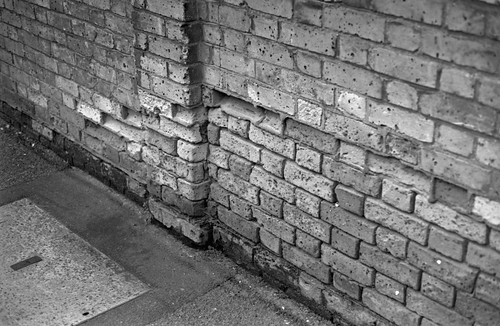
In scanning the negatives, I was able to supress the extremes of the film's inherent contrast and pull detail out of both shadows and highlights, which may not be as easy to do when printing in the darkroom. The above image I shot for the latitude test specifically because the scene showed a very wide contrast range, and would be ideal for testing this (however, the brick wall, also shot for the latitude test, was not as good a subject, tending with underexposure to look more graphic and linear). In terms of grain, the flatbed scanner I used wasn't capable of resolving its fine detail. The latitude test appears to show that highlight detail is quickly lost with overexposure; in the shot of the daffodils, not a great photograph by any means, the highlights are almost entirely featureless, but with less exposure the shadows would have suffered. The film developed with a dilution of 1+50 may have had slightly less contrast, but this was hard to judge as the lighting conditions were different: although many of the scenes are lit by the sun, it was later in the afternoon.

Rollei RPX 25 at box speed, developed in Rodinal 1+50, 11m at 20ºC
I wasn't entirely happy with the results of the first two films in general, although some individual shots were better than others. Due in part to shooting the film on a bright sunny day, the inherent contrast of the film was problematic regardless, and I felt the manufacturer's recommendations for exposure and development were some way off giving satisfactory results. I wanted to try reducing the contrast by developing with a higher dilution of Rodinal. Although the general strategy when attempting to achieve pictorial contrast with document-type emulsions (such as the Ilfodata HS23 film, and Rollei ATO 2.1 - and Maco's own publicity describe RPX 25 as having a "document-emulsion") is to expose more and develop less, with the highlights in danger of blocking out at box speed, such as in the frames rated 12 and 6 in the latitude test, I wanted to try rating the film at 50 to avoid this. Maco's own quote is that RPX 25 has a "nominal sensitivity of ISO 25" with a "high sensitivity reserve of one f-stop" could be read that the film's true ISO is more like 50, but with exposure recommended for 25.

Rollei RPX 25 stand development film test contact sheet
I shot another two rolls of 35mm, one with my Olympus OM10, rating the shots at 25 and 50, and some at an intermediate exposure index of 32, and another film in the Kodak Retina IIa. For the film from the OM10, I used stand development in Rodinal diluted 1+100; the film from the Retina was developed with Rodinal diluted 1+150, but for 12 minutes at 20ºC with normal agitation, a much higher dilution than the 1+50 recommended. At the point of hanging up the negatives to dry I could see that the results were better, with the film developed at 1+150 looking a bit thin; subsequently scanning these negatives was much less trouble than the first two rolls, where I found it difficult to keep highlight detail without making the lower range of midtones lose separation, leading these to become muddy. With a higher dilution of film developer, the highlights were easier to control, although with the stand developed negatives, the shots that had areas of sky within the frame showed these as virtually featureless, and attempting to recover or preserve detail in the scanning caused problems with halos around the branches seen against the sky. The negatives developed at the dilution of 1+150 were better in this regard. Nevertheless, with these dilutions I printed the contact sheets striaght without reducing the paper's contrast.

Rollei RPX 25 at box speed with stand development in Rodinal 1+100
Rollei RPX 25 at EI 32 with stand development in Rodinal 1+100
Rollei RPX 25 at box speed, developed in Rodinal 1+150, 12mins at 20ºC
Feeling that the developer dilution of 1+150 was close to the result I wanted, I shot a roll of RPX 25 in medium format with a Voigtländer Bessa RF, rating it at around 25 using the 'sunny 16' rule for exposure (I noticed that medium format RPX 25 has identical backing paper to Ilford's 120 films, unsurprising perhaps, being made in conjunction with Harman, but the older packaged versions of RPX 100 and 400 had different backing paper, with instructions in both English and German: at the end of the roll there is the injunction 'Hier Falten/Fold Here'). I modified my times and dilutions from the previous 35mm roll, and developed the medium format film in Rodinal at 1+120, for 14 minutes at a lower temperature of 18ºC.

Rollei RPX 25 (medium format) at box speed, developed in Rodinal 1+120, 14mins at 18ºC
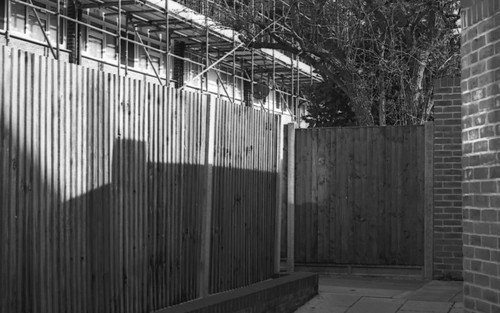
The results from the medium format roll appeared to show that extending development time while lowering dilution, and perhaps importantly temperature, brought less extreme contrast to the tonal range, while keeping good tonal separation. Incidentally, using a pre-war uncoated lens with these medium format shots may have also helped with the contrast a little - I had hoped for an overcast day with flat lighting to shoot the medium format film based on the previous 35mm tests, but highlight detail has held up well. Even with the bottom-of-the range Helomar lens, the negatives hold a huge amount of detail - with the shot below, it's possible in the original scan to count all the bricks in the building in the centre between the two high rise blocks, which promises well for prints made optically, as opposed to flat-bed scans.

Rollei RPX 25 (medium format) at box speed, developed in Rodinal 1+120, 14mins at 18ºC
Rollei RPX 25 is very different from the two faster films that share the RPX name, different enough that for Maco to use the RPX label for this film feels misleading. Both Rollei RPX 100 and 400 are much more flexible films where the recommended exposure and development times give good results with a variety of shooting conditions; from my tests RPX 25 needs far more careful exposure and development to bring out its own distinctive qualities of sharpness and fineness of grain without losing tonality to its high contrast. As a film photographer, while other emulsions are being discontinued, it's heartening to see new products appearing; as a low-speed fine-grain film, Rollei RPX 25 may well not be a good choice for a general all-purpose black and white film, but for the right subject conditions, with attention to exposure and development, it does provide beautifully sharp and clear results.

Wednesday, 13 November 2013

Rollei RPX 400

Rollei RPX 400 in medium format and 35mm
In my post Two Years On, I attempted to sum up the current state of black & white film production, and mentioned the wide range from Maco under the Rollei brand. I used Rollei RPX 400 for this year's 'Take Your Box Camera To Work Day' day, and as it performed well in my very basic Lumiere Scoutbox, especially in comparison with the Fomapan 400 I also used on the day, it seemed worth further investigation. I'd bought the RPX films in medium format before, in both 100 and 400 speeds, partly due to being cheap, although there are very few stockists in the UK. Discussions on internet forums around whether the RPX films are Kentmere films repackaged by Maco have elicited the information that RPX films are coated for Maco by Harman, Ilford's parent company which manufactures the Kentmere 100 and 400 budget films (see this discussion on APUG). The limited availability of the RPX films in the UK provokes the question as to whether there is some agreement over the markets for these films - notably, this page at AG Photographic redirects from RPX to Kentmere for 35mm films.

Medium format (6x9) developed in Rodinal 1:25, 9min45s at 18ºC
At the time of writing, West End Cameras is one of the few stockists of RPX films in the UK, priced at £4 a 36-exposure roll (by comparison, on the same site Kentmere 400 is £4.50; at other stockists Kentmere goes for: Silverprint £3.61; Firstcall £2.99; edit 20/2/14: Silverprint are now stocking the range of RPX films, with both RPX 400 and RPX 100 retailing at £3.60). From Macodirect, RPX 400 is €6.45 for a 35mm twin pack, which, at current exchange rates is roughly £2.75 per film. Obviously shipping from the continent is higher than UK postage; at these prices it makes sense to buy in bulk. In medium format, West End Cameras sells RPX 400 at £4.00 per roll, while from Macodirect it's €3.46, or a pack of five rolls for €16.67. (A further distinction between the two brands is that the Kentmere films are only available in 35mm, unlike the RPX films). For this post I'm only looking at RPX 400, but it would be instructive to compare the two films side by side.

Rollei RPX 400 latitude test contact sheet
Having had good results from the medium format Rollei RPX 400 I'd used previously, I decided to make some tests in 35mm. For the first roll, I tested for the film's latitude. On the contact sheet above, the first six frames are rated, left to right, 200-400-800-1600-3200-6400; the next six frames in the second row run 100-200-400-800-1600-3200; the third row was all shot at 400. The film was developed in Rodinal 1+25 for 8 minutes at 20ºC, the manufacturer's recommended time for RPX 400 at box speed. The results appear to show that the film has a good working range of latitude, although as the tests were shot in good light, a more rigorous approach would also test for latitude in poor light where I'd expect the results not to be as good.

Rollei RPX 400 at box speed, developed in Rodinal 1+25, 8 minutes at 20ºC
The next tests were to push process the film. The ability to push a film must be directly related to its latitude, as push processing is simply underexposing and then overdeveloping to compensate. I shot a second roll at 800. With Rodinal, Maco's only recommended times are for RPX 400 at box speed, while the Massive Dev Chart gives times for 400 and 800 EI in Rodinal. At 800 the Masssive Dev Chart recommends 10 minutes using a dilution of 1+50 at 22ºC; as Rodinal seems to work better at lower temperatures, I used the same time, but diluted 1+25 at 20ºC.

Rollei RPX 400, rated 800 EI, developed in Rodinal 1+25, 10 minutes at 20ºC
I also shot two rolls shot at 1600 EI. With no recommendations for developing RPX 400 in Rodinal at this rating, I extrapolated from the times given for other developers. For the first of two rolls rated 1600, I developed this in Rodinal diluted 1:25 for 14 minutes at 20ºC. As an alternative method for the second roll at 1600, I used stand development with Rodinal diluted 1+150 for three hours. This was based on the good results I'd had with HP5 Plus at 1600. The benefit of using stand development with highly dilute Rodinal is, in theory, lower contrast thanks to the compensating effect, thus countering the inevitable higher contrast inherent in push processing. The film stand developed in this way appeared to bear this out when compared with the film developed more conventionally at 1+25, although the scans below have lessened the difference, and this is more easily seen from examining the negatives.

Rollei RPX 400, rated 1600 EI, developed in Rodinal 1+25, 14m at 20ºC
Rollei RPX 400, rated 1600 EI, stand developed in Rodinal 1+150 for 3 hours
The reasons I'd originally used Rollei RPX 400 and 100 were to do with finding an alternative to the Fomapan films at a similar low price. Having taken the time to do some basic tests, the results show RPX 400 performing very well. Fomapan 400 does have a certain characteristic look that I do like, but the reason for buying Foma films has always been price. Foma also credit their 400 speed film with excellent latitude, but I have not found this to be the case when developing with Rodinal, and certainly when using a box camera with limited exposure controls -or none at all- latitude is very important (see the Massive Dev Chart's 400 ISO film test, where Fomapan appears worst in the latitude comparison). For a recent entry into the black and white film market, Rollei RPX 400 is a very welcome one, especially as it's available in both 35mm and medium format. The film has the look of a traditional cubic-type emulsion, and is quite fine-grained for its speed, in part due to the distinct softness of the grain, which also gives a smooth silvery quality to its tonality, and RPX 400 is a much better film than one might expect from its price.

Rollei RPX 400 at box speed, developed in Rodinal 1+25, 8 minutes at 20ºC
Rollei RPX 400, rated 1600 EI, stand developed in Rodinal 1+150 for 3 hours
Rollei RPX 400, medium format (6x9)
Rollei RPX 400, medium format (6x4.5) developed in Rodinal 1+50
Rollei RPX 400, medium format (6x4.5)

Tuesday, 25 June 2013

Rollei ATO 2.1

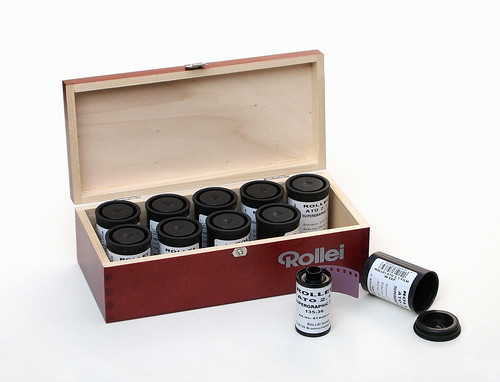
Rollei ATO 2.1 Supergraphic film
The emulsion marketed as Rollei ATO Supergraphic 2.1 used to be available as sheet film only, under the label of Maco Genius Film, but recently Maco has made it available in 35mm and 120 formats. ATO stands for Advanced Technical Orthographic, which might lead one to suppose it's an orthographic version of Rollei ATP, suggested as a replacement film for Kodak Technical Pan. However, these are both more versatile films which can be used for pictorial contrast without too much difficulty. I've had some experience with high contrast technical films, such as the Kodagraph Ortho film and Ilfodata HS23, a document film, and the general approach to using such films for continous tone or pictorial contrast is to rate the film with a low exposure index, and then either develop with a low contrast developer, or a highly dilute compensating developer such as Rodinal, which I use. I have found Rollei ATO 2.1 more difficult to control than the other films. Maco describe it as a 'true lithfilm' and to get continous tone negatives from it requires careful attention to both exposure and development. However, the film is cheap (I bought a box of ten films with an expiry date of 08/12 for €35 from macodirect.de ) and there are some advantages to being able to handle a film under a safelight.

Nominally rated 25 ISO, (although FirstCall post its speed at 32 ISO), with Rodinal, the Massive Dev Chart recommends 1 ISO and a dilution of 1:300. Maco recommend their own Rollei RLC Low Contrast film developer for pictorial contrast, or for 'normal' development (i.e. a very high contrast, lith-film look), Rollei RHC High Contrast document developer.

Rollei ATO 2.1, exposed at 25, 12, 6, 3, and 1 EI
For a first roll to test the film, I shot it with ratings down to 1 EI, and used Rodinal with a dilution of 1:200, rather than 1:300, as this would mean very low amounts of developer: with a 3-reel Paterson tank, 1:200 works out as 6ml Rodinal to 1200ml water. I kept to the Massive Dev Chart's recommended development time of 12 minutes, using 30 seconds agitation at the beginning, and a couple of inversions every minute. The results look overdeveloped, and also overexposed at 1 EI, but by 25 EI, there is no appreciable detail in the shadows (there is also, as one might expect, grain too fine to be resolved by a relatively inexpensive flatbed scanner). As the highlights still register clearly at 25 EI, it's possible to make high-contrast images with less exposure, if printed (or scanned) appropriately. However, there was a portion of this first film subject to a light leak (which may have been 'light piping' due to the particular type of extremely clear synthetic filmbase used for ATO): this suggested one way to lower the contrast of the film would be pre-exposure.

Rollei ATO 2.1 test roll, showing light leak
The principle of pre-exposure is to determine a minimum exposure where the film gains density, and use this to expose the film uniformly, then take the photograph as normal. This has the effect of raising the shadow values, while having no appreciable effect on midtones or highlights. Pre-exposure can be achieved by exposing the film in camera to a featureless, uniform surface such as a grey card which fills the entire frame before taking the shot. This is difficult to do while the film is in a 35mm camera as most do not permit double exposures, so I exposed short lengths of the film in the darkroom using an enlarger after doing a control test. This is easy to do as it's an orthochromatic film and can be handled with a red safelight. (I also spooled some lengths of the film with 127 backing paper for the upcoming 127 Day next month).

For a second test, I shot two rolls at the same time, one pre-exposed in the darkroom. Again, I used a full range of exposure indexes: 1, 2, 4, 8, 16, 32, 64 and also 25 EI. I developed these test rolls in Rodinal 1:200 again, but reduced the time to 10 minutes at 20ºC (I also used water instead of an acidic stop bath, as the emulsion on the first roll seems to have damaged easily). The results were better, and the pre-exposure did have the desired effect of raising the shadow values. In the examples below, the pre-exposed film is on the right of each pair.

Rollei ATO 2.1 exposed at 8 EI
Rollei ATO 2.1 exposed at 16 EI
Rollei ATO 2.1 exposed at 32 EI
As I did want to try the film with Rodinal diluted 1:300, I shot another roll, split in two lengths, and pre-exposed one. To develop the film I used 4ml Rodinal to 1200ml water. Compared to my previous test, the results are disappointing. I had hoped that increasing the dilution might lower ATO's innate contrast further, but instead (or perhaps as well) the negatives are extremely thin, even in the highlight areas. This may be that there was not enough Rodinal in the working solution: as mentioned in my post on stand development, Agfa recommended a minimum amount of 10ml Rodinal per film, which is conservative, as manufacturers usually are; I've found 6ml gives sufficiently consistent results. At this point I did feel frustrated at not quite getting a working combination of exposure and development.

Heygate Estate, Rollei ATO 2.1 at 25 EI
Heygate Estate, Rollei ATO 2.1 at 25 EI with pre-exposure
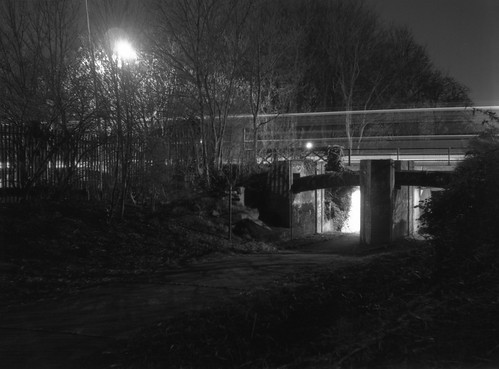
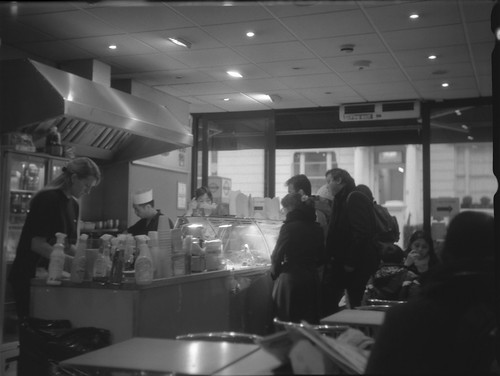
For a fourth roll of film, pre-exposed in the darkroom and shot at 25 EI (with some bracketing), I went back to using Rodinal with a dilution of 1:200, and ideally I would have used 10 minutes at 20ºC, but as the weather was warm and humid, the water from the darkroom tap was 22ºC, even after letting it run for some time. I reduced the development to 8 minutes accordingly, and the results below compare favourably with those using a dilution of 1:300. The high contrast of the film does make shooting any scene of normal contrast problematic if one wants to achieve detail in shadow areas without losing it in the highlights. With a minimum of pre-exposure, I've found this possible at 25 EI, although using an exposure index of 16, 12, or even 10 might provide better results. For hand-held shots using the film with available light, the slow speed of Rollei ATO means shooting at a wide aperture and relatively slow speeds (I generally used 1/50th and no smaller aperture than f4). However, I should finish by stating that this whole post is based on achieving continuous tone negatives from this film, which is not what Rollei ATO 2.1 is designed for.

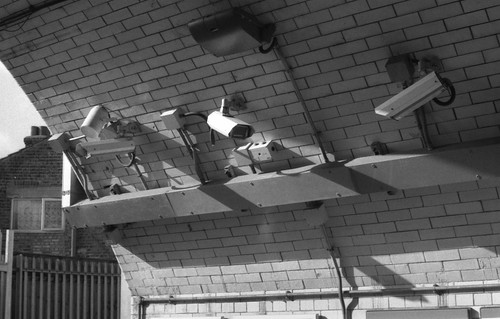
Heygate Estate, Rollei ATO 2.1 at 25 EI with pre-exposure