Showing posts with label Rolleiflex 4x4. Show all posts

Monday, 14 December 2020

127 Day December 2020

Rolleiflex 4x4 with Fomapan 400
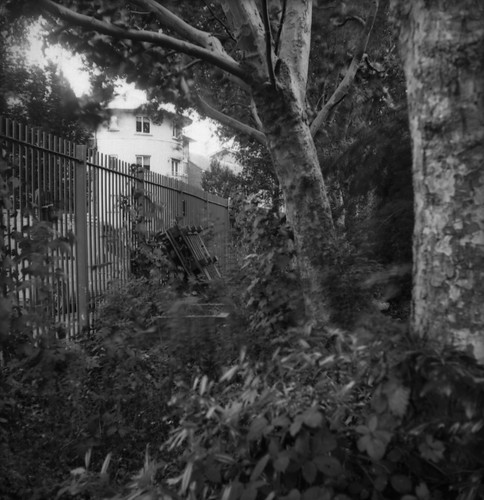
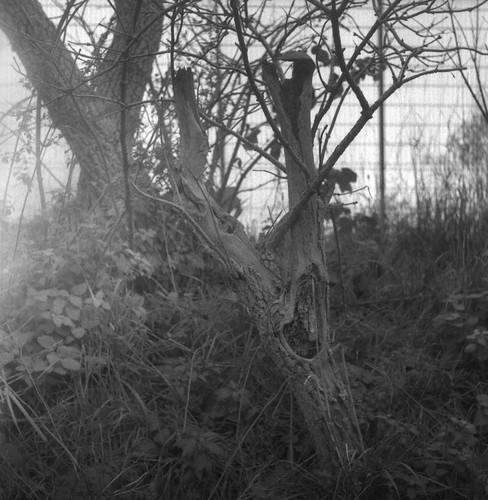
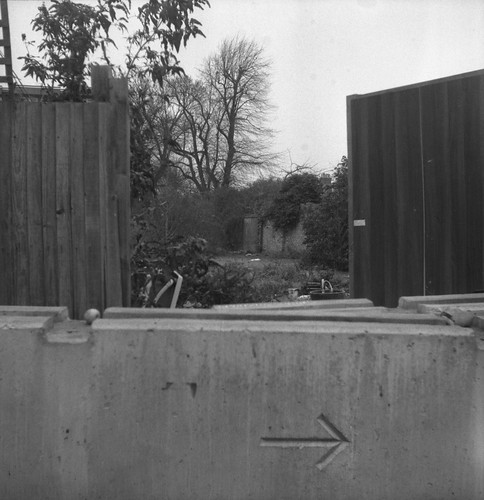
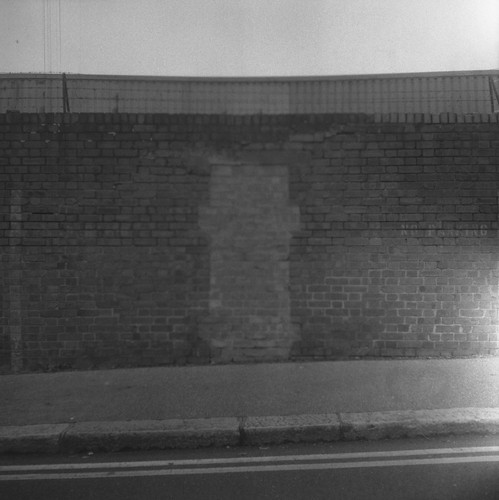
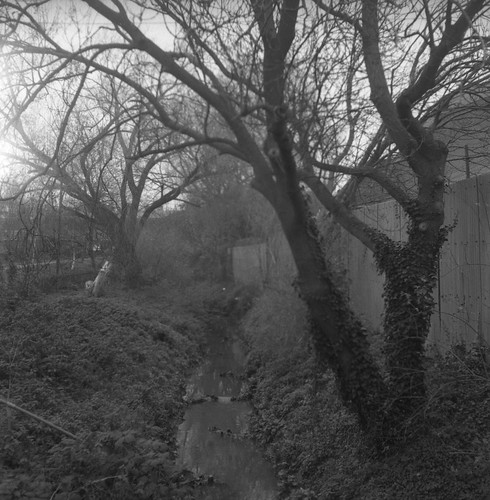
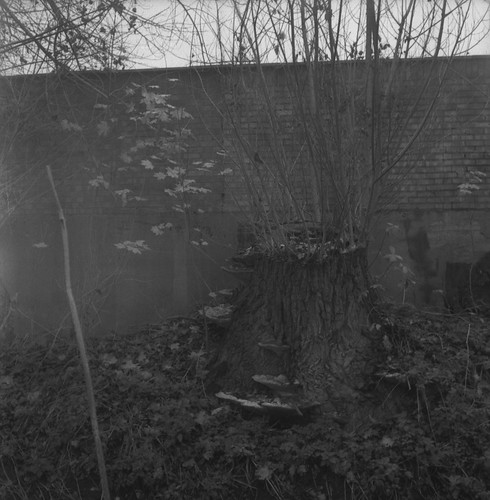
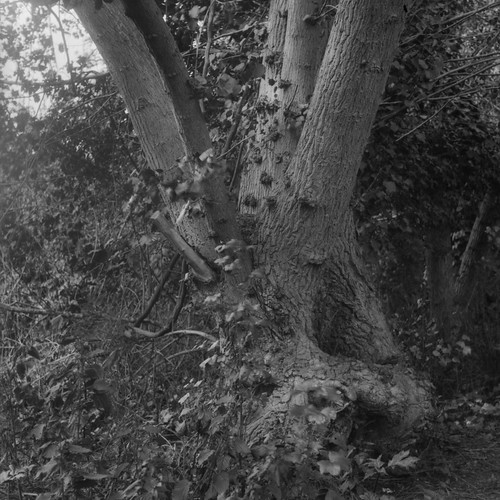
Still recovering from Covid-19, last week's 127 Day coincided with one of the better days when I felt well enough to go for a short walk on a very grey day, but not early enough for the mist to make it interesting. I took the Rolleiflex 4x4, loaded with a roll of cut-down Fomapan 400. Inevitably, or so it felt, the one roll I shot was beset with issues. The start of the roll had some odd spots, visible in areas of the sky, possibly due to some developing problem (although I'm unclear what caused this); then a number of the shots had out-of-focus areas in the frame, which must be due to the film not laying flat inside the camera. This might be down to using cut-down film, possibly cut slightly too wide, and as a result, bowing out in the middle. Then the film got stuck after nine exposures; I couldn't work out why this happened, but after removing the film in a changing bag and developing it, some of the shots have light leaks at the sides, suggestive of a 'fat roll' (although I didn't really notice this at the time): however, if the film was cut just a little wide, this is no surprise. Somehow the unexpected inadequacy of the results feels fitting.


Wednesday, 12 August 2020

127 Day Summer 2020

Rolleiflex 4x4 with Kodak High Resolution Aerial Duplicating Film
For last month's 127 Day on 12th July, I used the Rolleiflex 4x4 as I had done for 2019's summer 127 Day. This time I only used Kodak High Resolution Aerial Duplicating Film, as I didn't have any medium format film to cut down to 127 for the day, and cut this to size under safelights to roll it with 127 backing paper for shooting. I took some interior shots before taking a walk with the Rolleiflex (and a tripod).


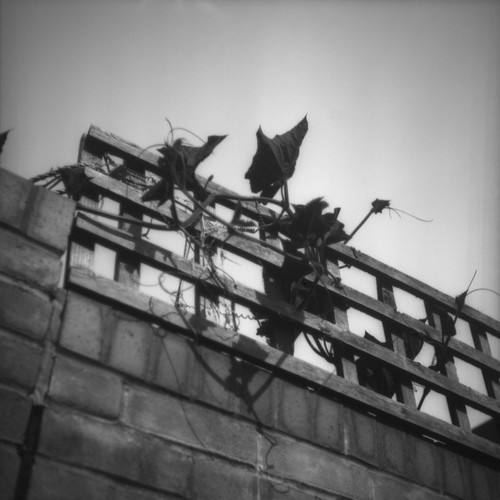
Although I have been rating the High Resolution Aerial Duplicating Film at an exposure index of 2, I did attempt a couple of shots hand-held. Given the brightness of the sunlight mid-afternoon in July, this was just possible - the shot below was taken hand-held wide open (f3.5) at 1/15th; the reason for doing this was that the tripod I was using would not give me a high enough angle, and to help steady the camera I did brace myself for the shot against some convenient street furniture, and partly, I suppose, just to show that it was possible to shoot 2 ISO hand-held. (Most of the other images on this post were shot stopped down and exposed for a few seconds with a tripod in contrast to this).


As the High Resolution Aerial Duplicating Film is blue sensitive - like photographic paper - in sunny weather with blue skies (or blue skies and brightly-lit clouds, as I had last summer's 127 Day), these tend to be overexposed and almost featureless. In the image above, the fact that the camera was pointing upwards into a very deep blue sky with a bright foreground negates this somewhat. Other shots, like that immediately below show this difficulty quite acutely; most of the photographs I took on the day were framed to avoid including much or any sky in the image.


Having used the High Resolution Aerial Duplicating Film a fair bit more in recent months, I feel I've begun to understand how to handle it to get the best pictorial results (a purpose of which the film is not intended for). When I was first testing the film, I found it hard to control the contrast when developing the film with conventional film developers, and, at the time, I felt it was best suited to overcast conditions in order to achieve a good range of tones - taking photographs in bright sun seemed to produce negatives with blown highlights and little shadow detail, even when using Rodinal, which I thought would be ideal for the film at high dilutions. Since I've started using the film again more recently, I've been using Ilford Multigrade print developer, at quite high dilutions, with better results. Although I framed most of the shots I took on the day to avoid including too much sky in the frame for reasons outlined above, a number of shots did have patches of sunlight amid shadows, particularly those surrounded by trees and foliage, but these highlights aren't completely devoid of detail, which I would have feared would be the case previously.

The rolls I shot on 127 Day were tray developed by inspection under safelights using the 'see-saw' method in Ilford Multigrade paper developer diluted to around 1+50 (this wasn't very exact - I had already developed a number of paper negatives and sheets of ortho film in the developer in the same session, which I had diluted at about 1+25, and, before developing the Aerial Duplicating Film, I added more water to dilute it still further). The high dilution seems to affect development time more than contrast, but this does have the effect of making development easier by slowing it down; gentle agitation was provided by the slow see-saw motion of passing the film in and out of the tray of developer until the negatives looked dense enough. As the film itself is pretty transparent, or, perhaps more precisely, translucent, before fixing, it can be held up against the safelights to examine the development fairly closely.


Friday, 19 July 2019

127 Day Summer 2019

Rolleiflex 4x4 with Kodak High Resolution Aerial Duplicating Film
After my recent testing of the Rolleiflex 4x4, I naturally wanted to use it on last week's 127 Day; I didn't have any film in medium format to cut down to 127 to use on the day itself, as I might normally do. However, in cutting down 120 film to the width of 127, as the film is also longer, there's always an offcut of three or four frames, depending on the frame size of course; I did have one such short roll of Ilford FP4 Plus, which I simply shot the same scene over three frames with bracketing.
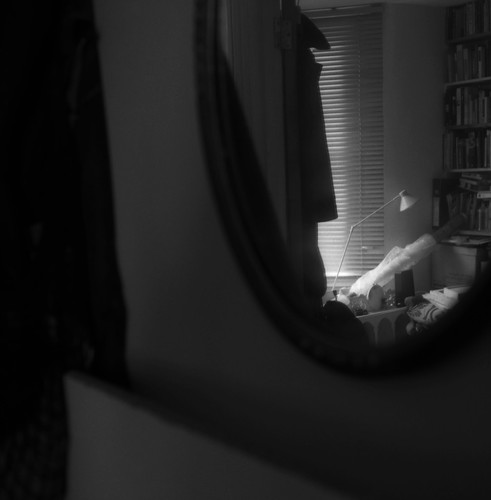
Rolleiflex 4x4 with Ilford FP4 Plus
I also shot the roll of Kodacolor II which had originally come with a Kodak Brownie 127 and which I hadn't previously used: I had low expectations for this film considering its age and that the roll of Agfacolor Special which also came with the camera and that I had short for last year's Summer 127 Day had only yielded one poorly defined image (I might have used the Kodacolor II film then had I not broken the camera). Using the Rolleiflex 4x4 did mean that I could give the film much more exposure than that of the Kodak Brownie 127 which has a single shutter speed and aperture, and so I used a tripod and bracketed exposures, erring on the side of considerable overexposure - which did provide better results than I had achieved with the Agfacolor film twelve months ago.

Rolleiflex 4x4 with Kodacolor II
The metal spool that the film was on was rusty, and the backing paper was partially stuck to the film, although this seemed to be mostly on the reverse of the film, not the emulsion side, and could be gently rubbed off in the wash. I used stand development with the film to get a black and white negative image, successfully for a few frames, although in comparison with the image above, the one below is out focus in the central area, suggesting that film flatness was a problem, perhaps unsurprising given that the film itself had been tightly coiled around the 127 spool for forty years.
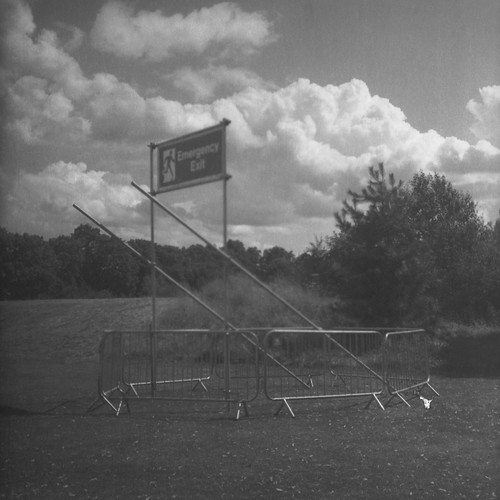
Rolleiflex 4x4 with Kodacolor II
Most of the photographs that I took on the day were with Kodak High Resolution Aerial Duplicating film cut down by hand to 127 size. This was rated at an exposure index of 2, and, having a lot of the film to play with, I also bracketed most of the shots, partially for exposure, but also, shooting long exposures on the shutter's B setting (again with a tripod), I was aware of either the possibility of inadvertent shake from holding the shutter release down (which is one reason for liking older shutters with a T setting), or from the breeze causing elements of the subject to move. As well as being very slow in terms of exposure, the Kodak High Resolution Aerial Duplicating film is also high contrast and blue sensitive, making for an interesting comparison with the black and white version of the Kodacolor II film; the shot below just holds some information in the sky, but essentially bleaches it. Other colours render in very different ways on the film: in the image at the top of the blog, the apples, although far from ripe, are a russet colour, which appears notably dark in the photographs. The look is quite different from the usual panchromatic rendering of most black and white film, and has a distinct feel, even when used for subjects where this effect isn't quite so clear. One of the problems I had when using the Kodak High Resolution Aerial Duplicating film straight after the Kodacolor II film is that there was a fair amount of dust in the camera caused by the rust from the metal spool, which caused a fair bit of spotting on subsequent frames, particularly at the edges from the spool flanges. The grain of the Kodak High Resolution Aerial Duplicating film is so fine as to be virtually invisible, at least within the scope of using a flat bed scanner with the film and this shows how well the Xenar lens on the Rolleiflex 4x4 performs: apart from the spotting - some of which may be due to development - the film's grain is so fine that there is a danger of banding in areas of smooth tonal transition, a problem I've only really experienced before with Kodak Technical Pan.

Rolleiflex 4x4 with Kodak High Resolution Aerial Duplicating Film