Showing posts with label found film. Show all posts

Tuesday, 29 May 2018

Found Film 4


In looking for some 127 film in early anticipation of this Summer's 127 Day in a couple of months, I found a roll of exposed Kodacolor II film that came with a Kodak Brownie 127 and some unexposed rolls. Although Kodacolor II is a C41 colour negative film, not knowing how old the film was and not wanting to pay to develop the film commercially especially if there were no images on it (the roll was not secured with the self-adhesive tab), I stand developed it in RO9 One Shot, diluted to 1+100 for one hour. The negatives that resulted were thin, but relatively easy to get images from them in scanning. The negative frame sizes were eight 4x6cm frames on the 127 film - as one might have predicted, although the film was not in the camera itself, it's the right frame size and the images look exactly like these were shot with the Kodak Brownie 127, down to the evidence of a lack of film flatness in the somewhat wavy edges to the negative frames. One frame was completely over-exposed, including the rebates at top and bottom, with the two frames either side partially exposed - the two images at the top and bottom of this post - which looked exactly like the camera had been opened with the film still inside, partially used.
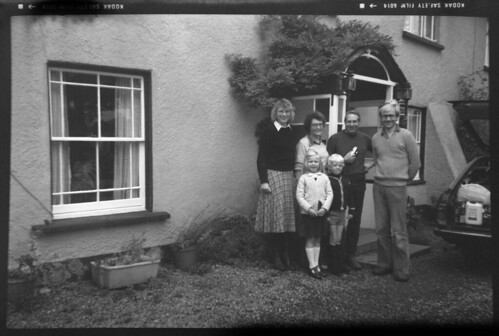
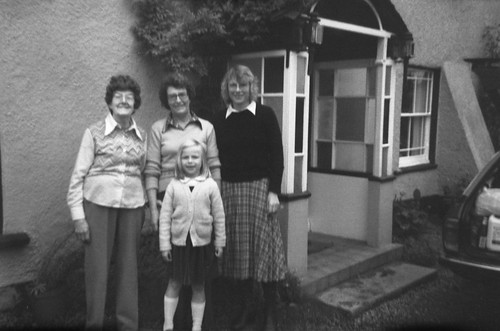

Two images show two portrait groups; the clothes look as though they date to the 1970s. Kodacolor II was introduced in different formats in 1973 after first appearing the year before in 110 format only. It was discontinued in 1982, which gives a possible cut-off date; it seems unlikely that these family photographs would have been taken after this date. Later on the roll is a vertical image of the doorway behind the figures. The top photograph, with an off-centre composition has been taken with a steadier hand than the second; the first photograph was presumably taken by the older woman in the left in the second who does not appear in the first. This second photograph with a little camera shake may have been taken by one of the two men in the first, although the older man has what looks like a 35mm compact camera in his hand, so this shot may have been taken by the younger man - or perhaps the small boy. The open back of a packed car just visible on the right hand side of the photograph suggests a family having just arrived for a holiday.
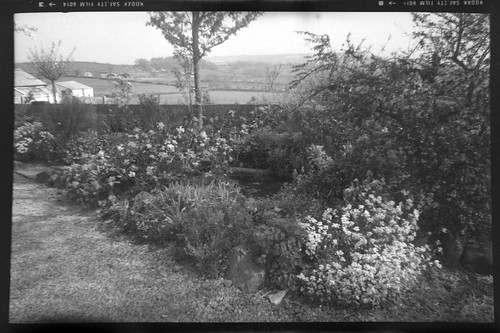
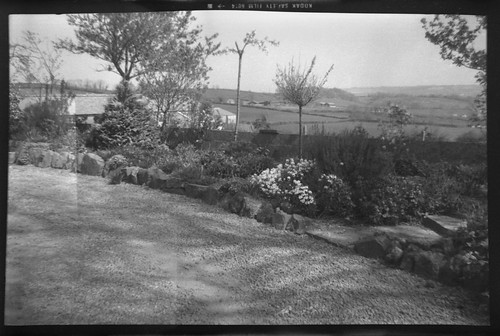

There are also three shots from similar angles of the edge of a garden with gentle hills behind. Separated by the shot of the front door, in sequence, the image at the top of this post appears to show a gap of time, with the first two images looking as though shot in spring, the third photograph of the garden has fuller foliage on the trees and the flowers appear different. The climber around the porch has also flowered in the image of it without the people. This sequence of images is redolent of the uses of photography in the domestic sphere, where a roll of film might be left in a camera for some time after being started, and the camera only coming out for special occasions, suggesting a family visit to the same place in Easter, and then a return in the Summer.

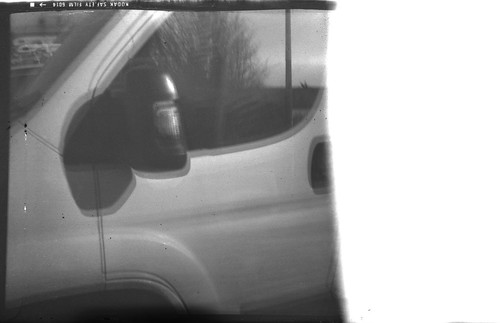
The final shot on the film is a van door, double-exposed, after the blank, over-exposed section. This van looks to be a relatively contemporary model, suggesting the first six frames were shot relatively close in time to each other, possibly on two separate occasions, then the film was left in the camera, later opened, with the realisation there was a film inside, and then the last photograph taken after this, twice, without advancing the frame.

Tuesday, 29 November 2016

Found Film 3


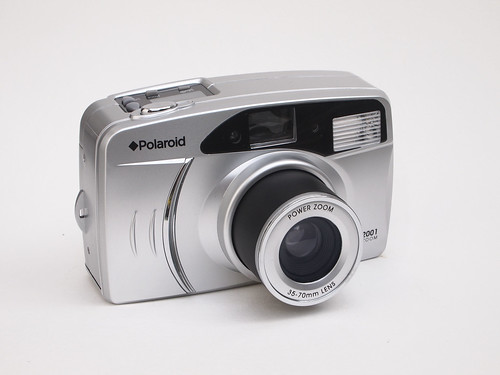
In a recent purchase of a bundle of mostly uninteresting 35mm compact cameras, two of them had part-used rolls of film inside. The cameras were a Polaroid PZ2001 and an Olympus Trip AF.  The films were both Kodak Gold consumer colour negative films, and possibly could have been in both cameras for a number of years, the Trip AF being older, but there was nothing to securely date the films in either. This generation of plastic point and shoot film cameras probably lost value quicker than any other type of camera with the rapid and subsequent replacement of their place in the market by digital, and apart from the odd exceptional model of their kind, these are largely quite forgettable.

Polaroid PZ2001
Both films were stand developed in Ilfotec LC29 1+100 for one hour for monochrome negatives, rather than have them developed as colour: there might be nothing on either film, but stand development uses a minimal amount of chemistry. The Polaroid yielded the most results, although almost all were out of focus, and many over-exposed. As the Polaroid film hadn't been used up, I did shoot a couple of frames with the camera myself (below) - and got better results than everything else on the film in terms of focus and exposure.


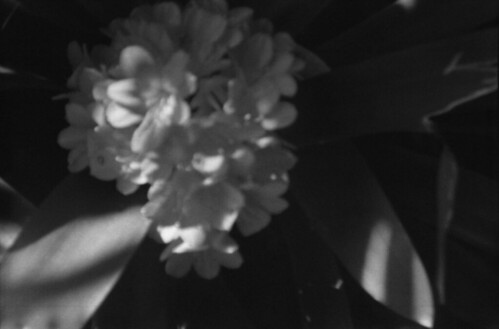
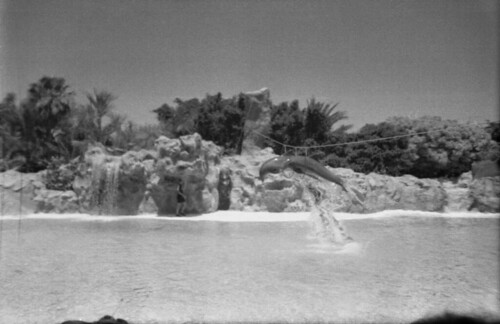
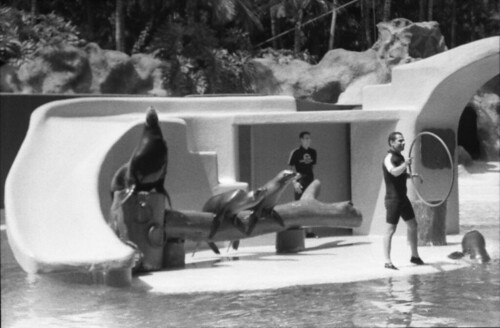
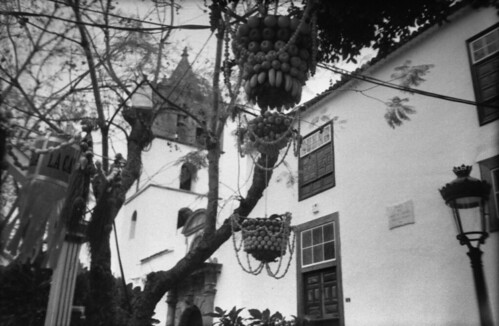
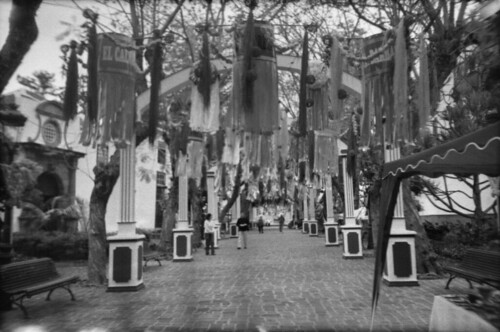
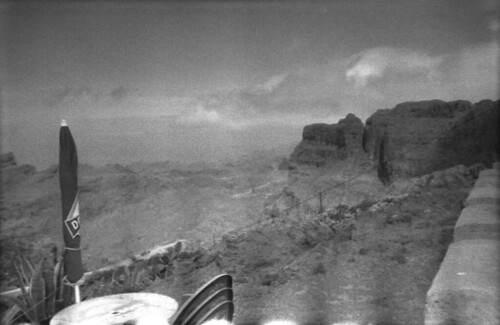
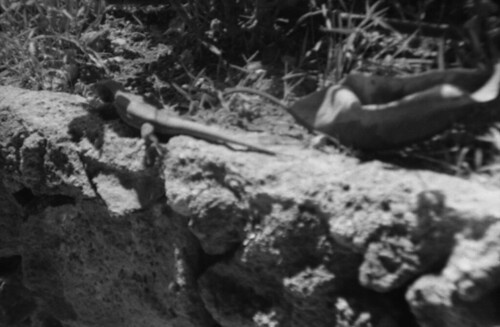
Of the photographs already shot on the roll, most looked liked a holiday somewhere in America, with a Seaworld-type of attraction, what looks like festively decorated holiday apartments - or possibly a church and the decorations are for a wedding, and somewhere in the mountains (this last series of photographs being very overexposed - I imagine that the camera did not possess small enough aperture settings or fast enough shutter speeds to cope with using a fast film in very bright sunlight, but I have attempted to pull all of the detail out of the scans that was there). There are also two close up shots, both out of focus, of a flower and a lizard.


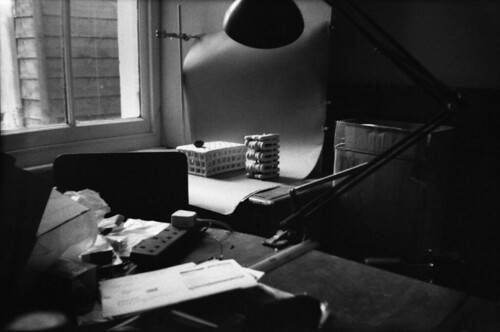
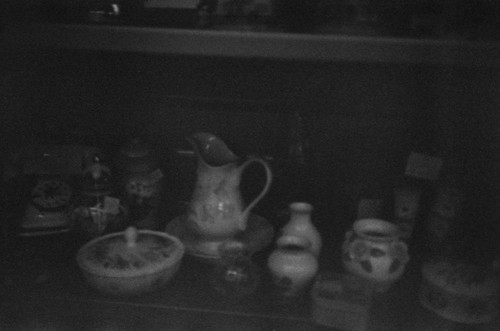
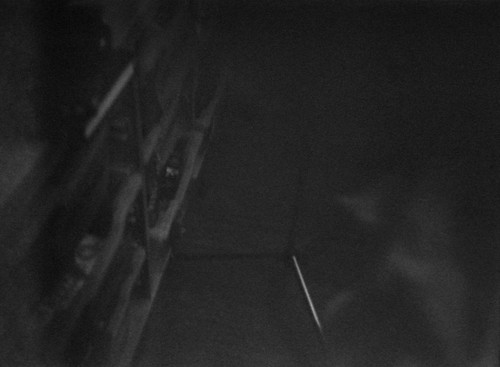
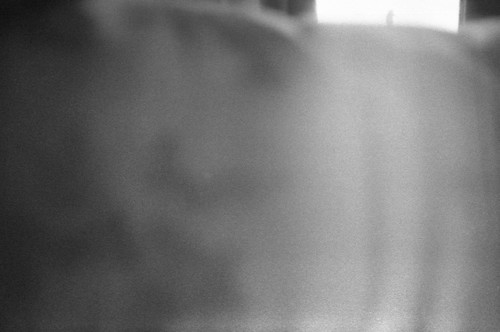
From the Olympus Trip AF there were just three frames that had anything remotely worth scanning - and perhaps not even that - all very underexposed, possibly needing the built in flash which didn't fire. These looked like they were taken in a junk shop, judging from the first photograph, while the other two look like accidental exposures. Given the few shots on the Trip, it feels less precious, but clearly the owner of the Polaroid camera went somewhere special and shot nearly a whole roll of film, before never finishing the roll, never developing it, leading one the speculate as to what the circumstances were that meant they never saw the results; however, this might just be reflective of how photographs were taken by many people before digital: once back from holiday, with the film not quite finished, those last frames weren't to be wasted, and the camera was put away in a drawer to wait for the next special occasion,


Tuesday, 1 November 2011

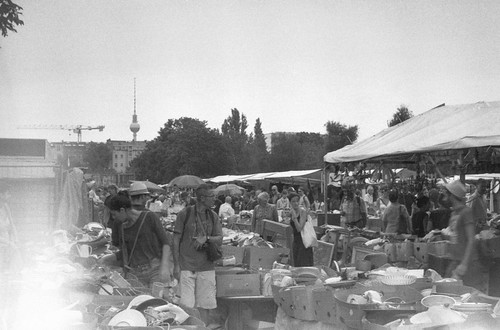
ORWO NP 20: Mauerpark Flea Market & Found Images

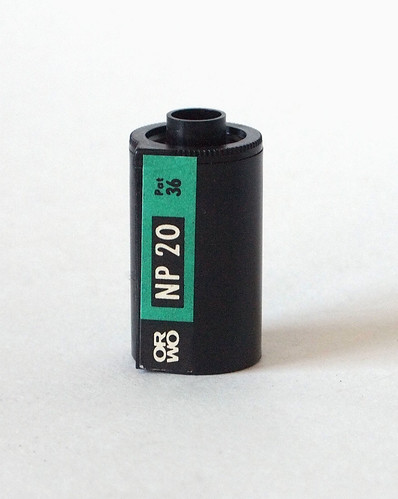
ORWO NP 20 35mm film
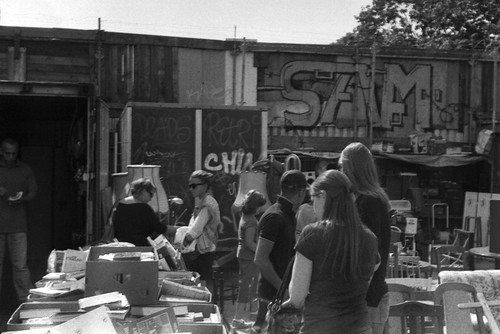
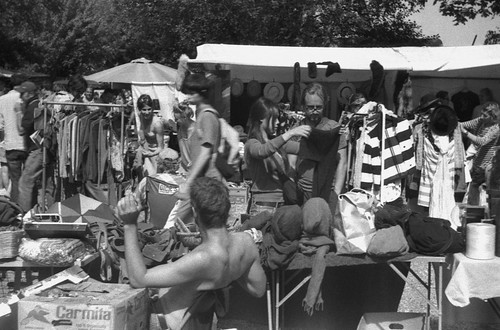
Inside the Werra camera I bought at the Mauerpark flea market in Berlin there was a partly used roll of film, which I inadvertently exposed when opening the camera to check the shutter. On buying the camera, it felt appropriate to use the rest of the film taking photographs in the flea market itself. Being a manual camera, and not knowing what the film's speed was, I used the settings marked out in red on the Werra to shoot the film.

Flohmarkt am Mauerpark, ORWO NP 20 film
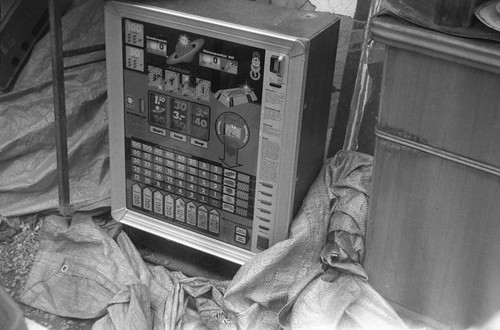
Slot Machine, Flohmarkt am Mauerpark, ORWO NP 20 film
Flohmarkt am Mauerpark, ORWO NP 20 film
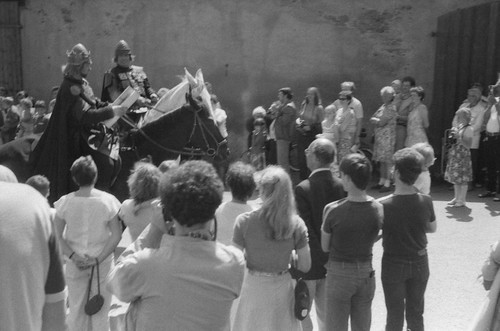
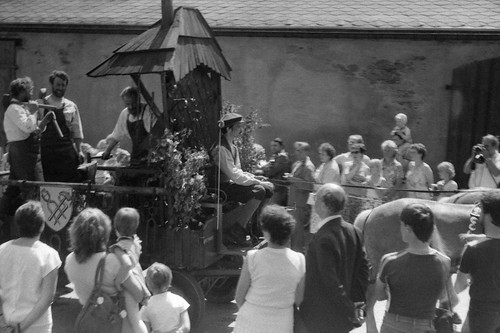
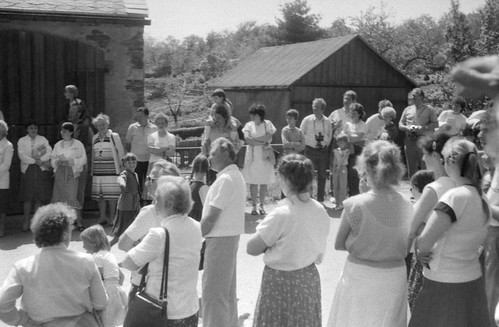
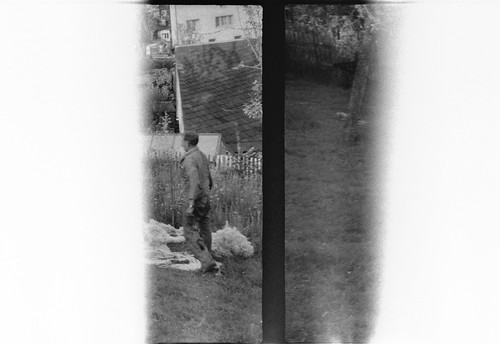
Once I'd finished the film, and could safely open the camera again, I discovered that the film was a roll of ORWO NP 20, an East German black and white film, presumably dating back to before reunification. It was also in a reusable plastic film canister, with the minimal label stuck across the join with the canister's screw top. To develop the film, I used Rodinal, diluted 1:100 for 1 hour stand development, with a couple of inversions at the 30 minute mark. I've previously used stand development with unknown or old films (including colour) with some success as it seems to simply reveal what's actually on the film. The frames I shot on the film came out well enough, apart from the inevitable light leaks. More excitingly, the film that had already been exposed in the camera yielded a number of frames, which I had feared would have mostly been lost due to being exposed to light when I opened the camera, yet a dozen frames came out almost unaffected. After an oblique shot of a fence and a greenhouse, the unaffected frames show some sort of parade or procession (oddly enough, as do some of the photographs on the first roll of old film I developed), while some of the frames largely obliterated by light leaks appear to show sheep shearing on a farm.

Found image on a roll of ORWO NP 20
The images already on the film appear to show a couple of aspects of life in rural Germany. Judging from the haircuts and clothes of some of the younger people watching the parade, the pictures were no doubt taken some time in the 1980s.

Tuesday, 30 August 2011

Berlin Flea Market Finds


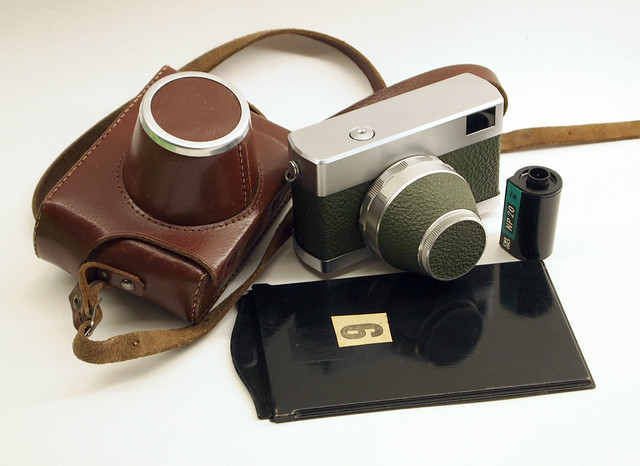
From the Mauerpark flea market: Werra 35mm camera with ever-ready case containing part used Orwo NP20 film, €30.
From stalls opposite the Bode Museum: unbranded 9x12cm metal plate holder with film sheath, €5.
The Mauerpark Flohmarkt had a great number of German and specifically old East German cameras. The Werra has a f3.5 Novonar lens. The same stall also had a Werra with a f2.8 Tessar lens, but in much worse condition; the Werra with the Novonar lens appeared to be barely used and I haggled down from €40.
I also found a couple of 9x12 plate holders on a stall opposite the Bode Museum, one was in far better condition than the other, with a film sheath inside; for €5 it was worth adding to my stock of plate holders.

Friday, 25 March 2011

Photographs developed from a found roll of film 2


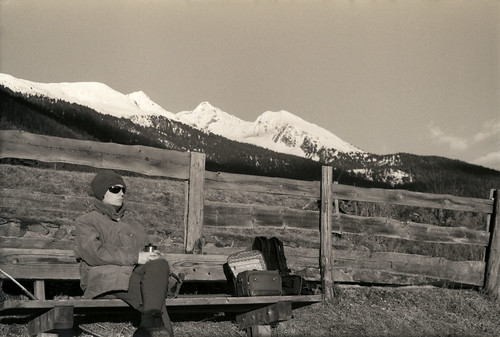
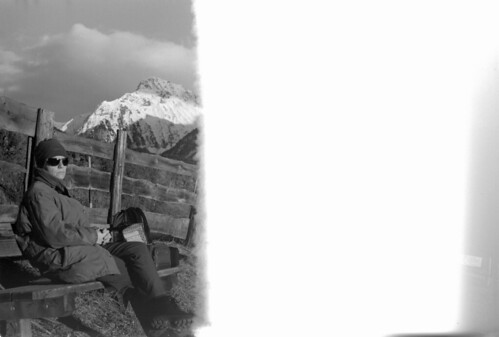
I bought a Rada rollfilm back to use with a Zodel 6x9 plate camera. When I pulled out the darkslide, I found that it had a roll of film inside. This partly exposed the second frame (below). Having spoiled a couple of frames, I shot the remainder of the film. As with the previous post, I stand developed the film in Rodinal 1:100 for one hour. The film is marked 'Kodak GB-4' in the rebate.

The two shots look possibly Alpine, but I don't know if the mountain range is distinct enough to be easily identified. Unlike the film in the previous post, the photographs do look relatively recent, judging by the clothing and the camera bag and rucksack.

The subsequent photographs I took on the roll were all affected by light leaks, possibly due to the roll not being tightly wound.

Monday, 28 February 2011

Photographs developed from a found roll of film

From an undeveloped roll of Kodak colour film found inside a Brownie-type of camera. Using Rodinal diluted 1:100, presoaking the film, and then stand developing it for an hour produced usable monochrome negatives from the film. Colour films can be developed with black and white chemicals, as all films contain silver halides which are the light-sensitve element: in colour films these are replaced by dyes in the developing process. As I had no way of knowing how old the film was, and how viable it was for developing in colour chemicals, it made more sense to me to use black & white chemicals to attempt to process the film.
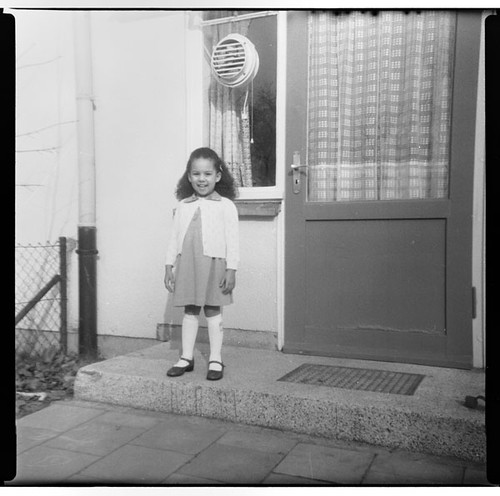
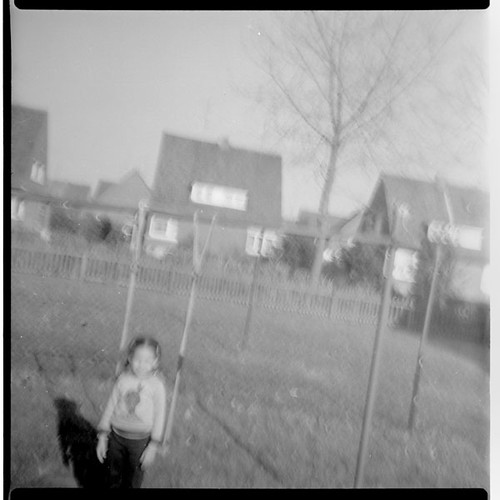
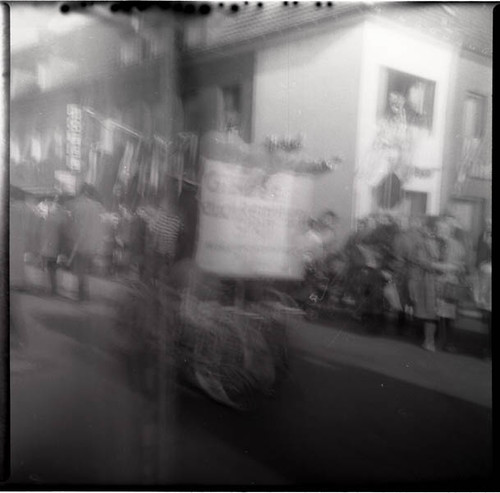
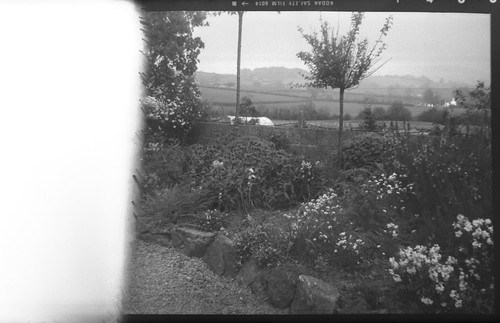
I didn't note down exactly which camera this came from at the time. On the film there are a couple of shots of a girl on a doorstep; the rest of the photographs all suffer from camera shake- there is one shot of the same girl in a back garden, and a two pictures that look like a parade of some sort.


There's something romantic about releasing images that have remained latent on a roll of film for many years. The girl's dress and the domestic architecture date this to any time between the 1960s and early 1980s perhaps.