The principles of colour photography are almost as old as photography itself, a three colour process being described by James Clerk Maxwell in 1855, and
first demonstrated by Thomas Sutton under Maxwell's direction in 1861. James Clerk Maxwell's method was simple: using black and white emulsion, make three separate exposures with red, green and blue filters. The three photographs were then combined through an additive colour process, by projecting lantern slides of each photograph through the same red, green and blue filters, aligning the projections to create a colour image. This process became more successful when panchromatic emulsions, able to represent the whole spectrum of visible light, emerged around 1900. The most celebrated proponent of this technique was
Sergey Prokudin-Gorsky, who documented the Russian Empire before the First World War. The three colour technique was superseded when a convenient, consumer-level colour photography was developed by a number of manufacturers, notably Kodak, during the 1930s with integral tripack colour films.
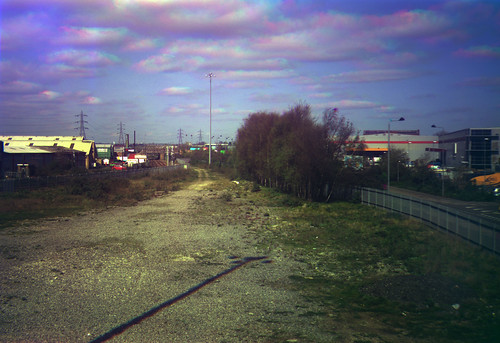
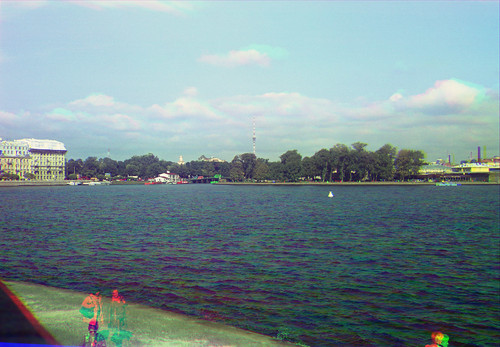
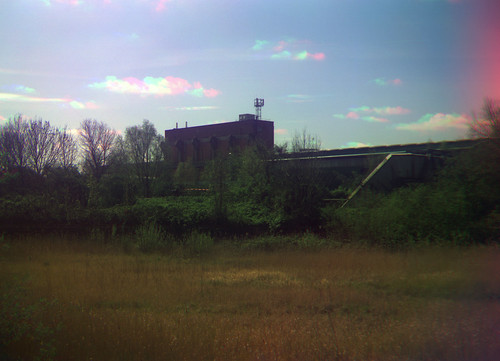
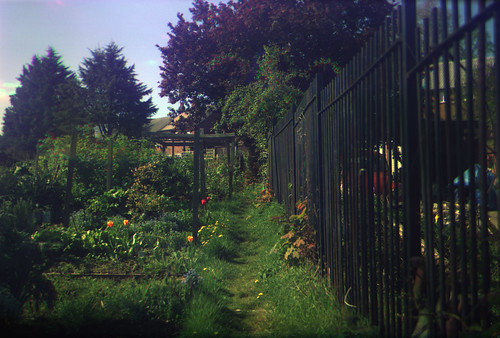
However, there has been renewed interest in the three-colour process in recent years, in part due to digitisation which makes for easy display of the images so produced. There's a
large group on Flickr using the technique, commonly dubbed '
trichromy'. For my first attempt at this technique, I decided to take the approach of making it more difficult than it needed to be by using large format. With taking three separate exposures, I was aware that movement between the images would create ghosting: it would have been quicker to shoot three images in succession on rollfilm, and to shoot more of them, but the challenge of working with large format appealed to me.
 |
| Kodak Tri-Colour Filters |
To take the photographs, I used my
MPP Micro Technical Mk VI camera with Fomapan 400; I had a number of filters which came with a large format lens I'd bought, including a tri-colour set. I took three shots with the RGB filters, using the unsophisticated method of simply holding these over the lens (I took the blue image twice, as I was concerned that the first shot wasn't sufficiently shaded from the oblique sunlight; I also shot it on
a glass plate for good measure). The negatives were developed in Rodinal diluted 1:50, for 11mins at 20ºC.
 |
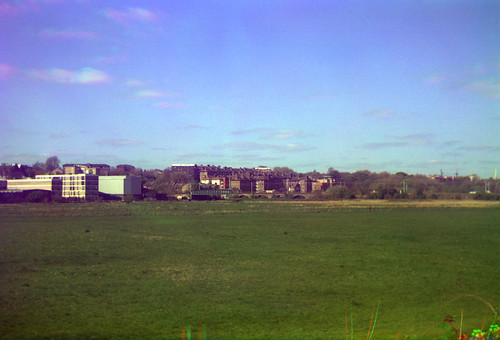
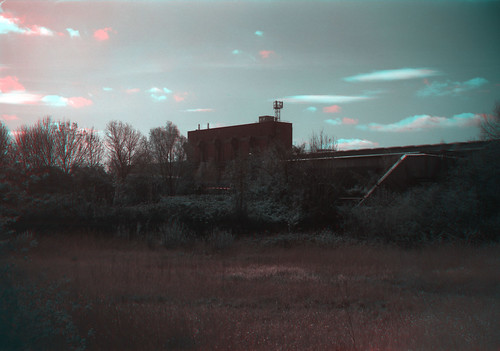
| Red, green and blue exposures |
Scanning the large format negatives was complicated by not having a scanner capable of taking 4x5 sheet film: I had to scan each negative in two halves. To begin with, I attempted to stitch the two halves of each negative together, and then combine them, but this led to problems with registration across the image, so instead I composited the top and bottom halves of the image separately, then stitched these together. To make the colour image, I used Photoshop to combine the three separate grayscale images by pasting each into a separate channel of a new file in multichannel mode, stacking the channels in the order of red-green-blue, then changing this image mode to RGB.
 |
| Uncropped RGB Composite |
Despite taking all four exposures as rapidly as possible, I did realise that the movement of clouds in the sky would cause ghosting in the image; what I hadn't expected was how apparent the movement of the shadows is. With the three colour process, movement between each exposure causes these ghosting effects, making it more appropriate for using with still subjects. Cameras were designed around this problem, initially with backs that could expose three plates in quick succession, followed by dedicated colour separation cameras, which used beam splitters to expose all three plates at same time, such as the
Bermpohl Naturfarben Kamera.
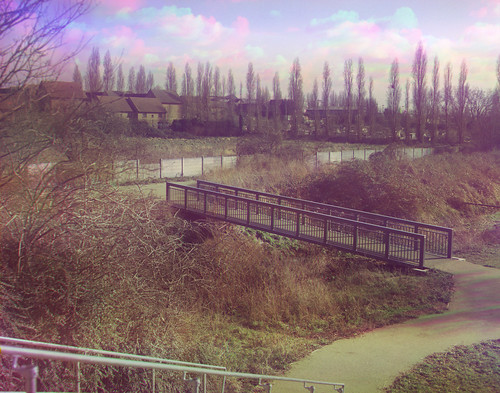 |
| RGB Composite |
Rather than adjusting the colours in RGB, I made adjustments in each channel separately, feeling that this was more appropriate to the enterprise. The image as a whole suffers from being scanned in sections, leading to the colour being patchy and uneven, yet it works. As I've shot the image in large format, it's possible to look at some details at 100% of the 1200 dpi scan. In the detail of the houses which have reproduced well, the shadows of the trees show colour fringing, which could be due to the movement of the sun, but on reflection it's more likely to be wind in the trees. In the second detail below, looking across allotments to the recycling centre, the arm of a JCB is visible in three different positions, in three different colours.
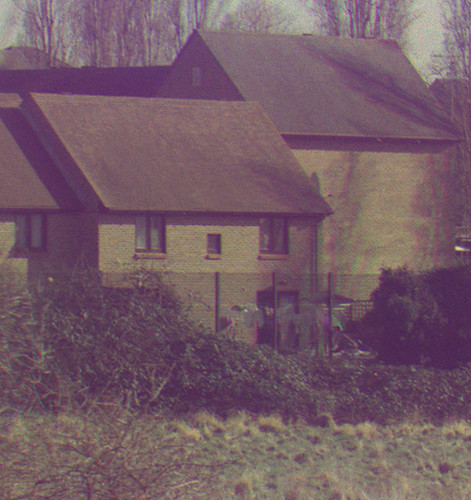 |
| Detail of houses in the upper left |
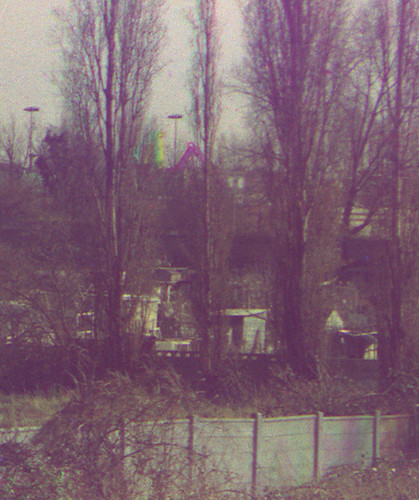 |
| Detail of JCB movement |
Sources/further reading
Wikipedia entry on Colour Photography
James Clerk Maxwell and colour analysis on Wikipedia
Sergey Prokudin-Gorsky in the Library of Congress
Three-Color Camera on Camera-Wiki