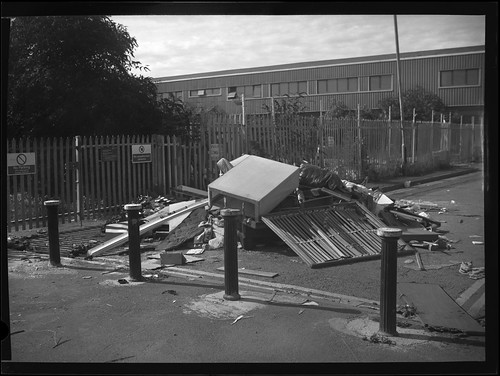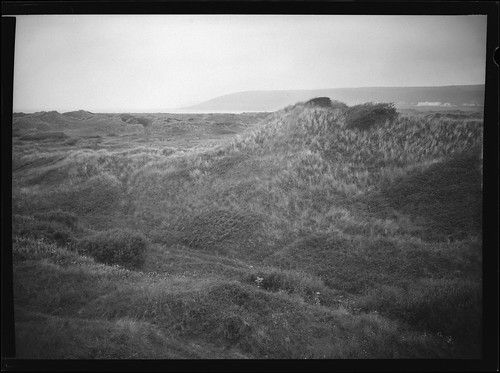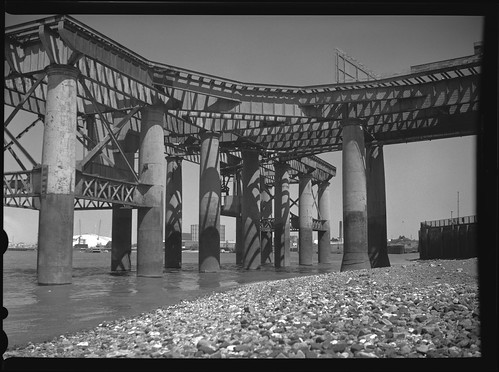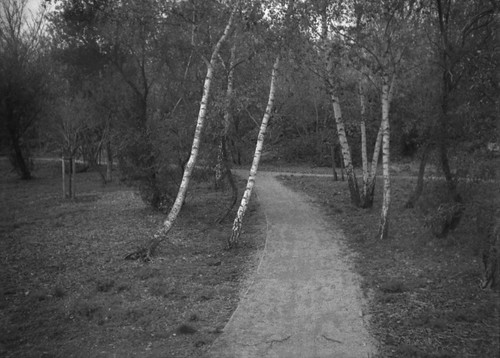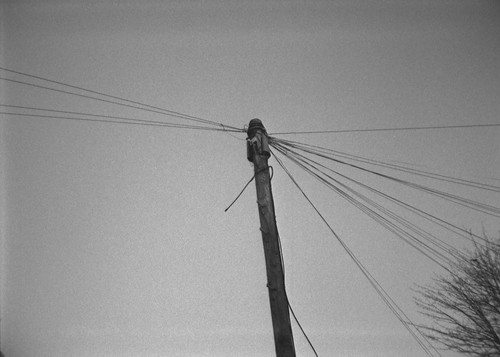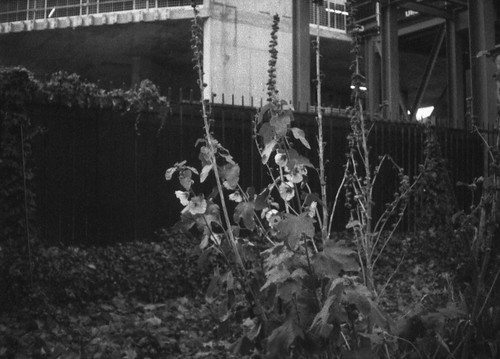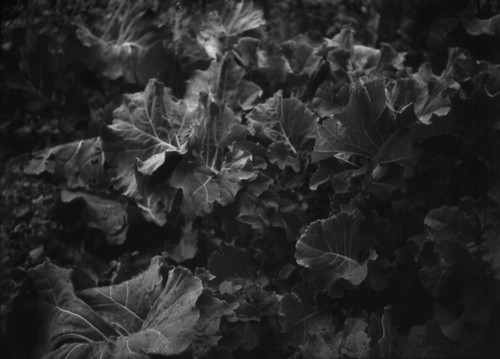
Wednesday, 17 February 2016

Kiev-4

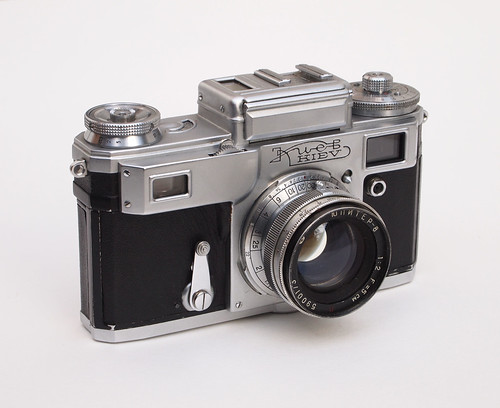
Kiev-4 rangefinder with Jupiter-8M f2 5cm lens
The Arsenal factory in Kiev produced a range of cameras almost all named after the city itself, in a variety of different film formats: 35mm, medium format, and subminiature; the model which began Arsenal's sixty-year history as a camera manufacturer was the Kiev rangefinder. Unlike many other Soviet-era productions, the Kiev rangefinder was not reverse engineered from existing cameras - like the FED and the later Zorki Leica copies - but instead was created from the drawings, dies, tools, and (initially) parts of the pre-war Zeiss Ikon Contax cameras. It's debatable as to whether the Kiev rangefinder should be strictly described as a Contax copy, as it was rather a direct continuation of the pre-war Contax, with a long, drawn-out diminution of quality during its extensive production run. The Kiev Survival Site has probably the most comprehensive history of the camera available online.

The first Kiev rangefinders are named Kiev II and Kiev III to correspond with the Contax II and III: both models designated III have an uncoupled selenium lightmeter. The Kiev cameras were then slightly modified by the addition of a PC socket for flash: these became the IIa and IIIa. The next iterations were the Kiev-4 (with light meter) and 4A (without meter), followed by the last cameras in the series, the 4M and 4AM. (There was also a Kiev-5, a comprehensive redesign from the Contax-based original, which had a relatively short production run). All the different models appear to have overlapping production dates, according to the details provided on SovietCams.com; the 4M and 4AM variants of the Kiev rangefinder were produced until the mid-1980s, remarkable for the fact that, although there were many changes during production, it was still recognisably Zeiss Ikon's camera of fifty years earlier.

Zeiss Ikon produced the first Contax rangefinder in 1932 as a direct response to the Leica. Later known as the Contax I, it was very much a work in progress with numerous changes to the camera while in production; the Contax II from 1936 demonstrated Zeiss Ikon's determination to better Leica in almost all specifications (Cameraquest has a detailed comparison between them), yet the Contax doesn't have the same legendary name or status that the Leica has achieved. Perhaps this is in part due to the post-war legacies of both companies: Leica concentrated on their famous rangefinder, aimed at a small section of the luxury camera market, while Zeiss Ikon AG had a large product range, attempting to cover all aspects of consumer photography, and were essentially put out of business by Japanese competition. Although Zeiss Ikon AG were relatively quick to produce the post-war Contax in 1950, as a camera system it wasn't subsequently supported and developed, while Leica produced the M3 in 1954 - which incorporated a number of features that the pre-war Contax had, with improvements in other areas.

In part due to cost, I'd never bought into the cult of the Leica. However, the Contax, and probably even more, the Kiev rangefinders have a following of their own - for example, there's a wealth of websites dedicated to the Kiev (see bottom of this post): the Kiev gives one a taste of the Contax at a fraction of the price (similarly, with Leica, there are also the FED and Zorki copies; and both the Contax and Leica have numerous cameras inspired by their designed, sometimes combined into one - like the Nikon). Late last year, a box arrived from Ukraine containing a Kiev rangefinder: I'd researched the model I wanted, and spent some time looking online before buying. Unsurprisingly, the Kiev is still largely to be found in its country of origin, and, although not expensive, the postage was half the price of the camera.


I'd found a relatively early version of the Kiev-4 model. The first two letters of the serial number designate the year of production: my camera dates from 1960, with a the standard Jupiter-8M 5cm f2 lens from a year earlier. According to Fotoua, this Kiev-4 is a Type 2b, defined by not having a stop bolt on the accessory shoe, and the "lines of rigidity" on the meter (the raised 'T' shape between the accessory shoe and the meter window). My initial impressions were that I had been expecting the camera to be bigger - it's smaller than an SLR such as the Canon A-1 for example - but also, externally at least, the quality and finish of the body are of a high standard; the aluminium lens barrel less so. Many of the comments in this post relating to the functions of the Kiev-4 are probably equally applicable to the design of the original Contax II/III, including some of its quirks, with a few caveats.
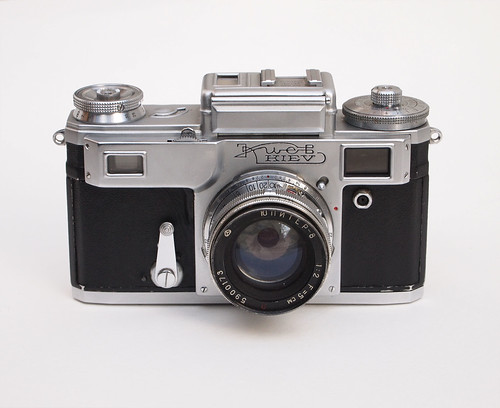
Kiev-4 with Jupiter-8M f2 5cm lens
I'd chosen the Kiev-4 partly thanks to the built-in light meter; early models appear to be fairly common, while it has some refinements over the IIIa. There may be reasons for preferring the meter-less versions, but I decided it might prove a useful feature. Presumably without any direct contact, the post war Contax IIIa prompted the Kiev-4 redesign, with a smaller, lower and simplified meter, and a smaller rewind knob and calculator dial alongside it (the Contax IIIa also had a smaller body with a shorter rangefinder base, neither of which influenced the Kiev-4 design).
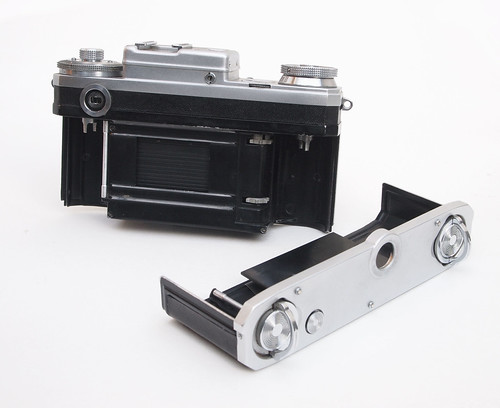
Kiev-4 with back removed for loading
The back removes entirely to load the camera; two flip-up, rotating handles on the camera base unlock the back. The original Contax camera was designed without a fixed take-up spool to provide flexibility: as well as Contax reloadable cassettes, which could be loaded in each chamber, removing the need to rewind the film, there were also 'Contax spools', with the film not in a cassette or cartridge, but with a paper leader and a trailer (rather like the 220 version of medium format rollfilm), this also did not need rewinding but required a removable take up spool; the camera could of course be also used with the (then new) Kodak daylight loading 35mm cassette. The Contax film spool does not appear in the post-war Contax IIIa manual, presumably having been discontinued. The Kiev rangefinders replicated this arrangement, including the metal reloadable cassettes, until the 4M and 4AM versions, which had fixed spools.

My camera came with a metal removable spool with a central slot for the film leader, and to use this would mean either cutting the film leader to a point, or taping it to the spool. Neither approach is entirely impractical but perhaps undesirable when out in the field. Initially, I attempted to use two 35mm cassettes, with the take-up cassette made up in mirror image, much like with the Belomo Agat18k, but this first roll of film tore as the sprocket holes in the film did not quite match up with the sprocket teeth.
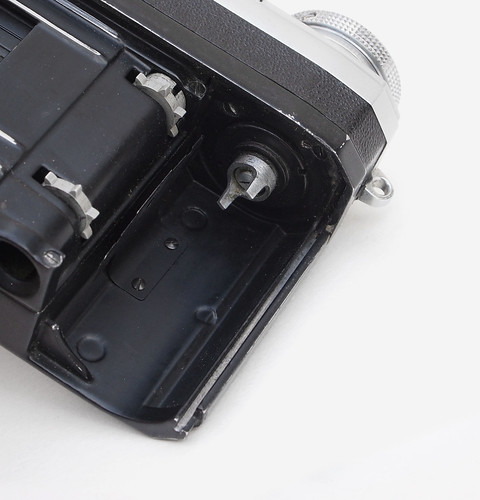
Take up chamber with film advance claw
On close inspection of both the metal spool and the camera itself, I could see why the film wasn't properly aligned: there is a raised rim around the base of the film advance 'claw' (as the Contax III manual describes it), shown above. This raised rim prevents a spool from a standard 35mm cassette aligning perfectly with the film path. I adapted the solid plastic internal spool from a 35mm cassette to use in the take up chamber, in a slightly different fashion than the advice on making a replacement Contax spool from Mike Elek's site, which appears on a number of Kiev/Contax rangefinder sites. In addition to cutting a slot in the plastic with a hacksaw to locate the film leader, I also removed the protruding rim around the base, to make this flush, as with the metal Kiev spool, illustrated below. This was a detail I'd not found while researching online; perhaps the Kiev is different from the Contax in this respect, perhaps not, but sometimes the internet isn't quite so good for minutiae such as this.
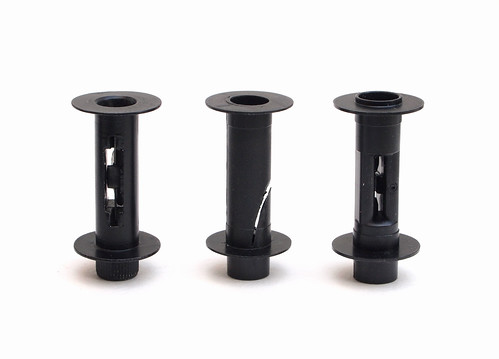
Left to right: original Kiev spool; modified solid spool; unmodified spool
Once loaded, the film counter has to be set manually, and counts up (I have read elsewhere that it counts down, so perhaps this isn't consistent). Shutter speeds are set on the film advance knob, in the centre of which is the shutter release; turning the knob to advance the film also cocks the shutter. To set the shutter speed, the knob is pulled up and rotated to locate an internal pin, which has to be done after the shutter has been cocked. If this is done once the shutter has been released, this internal pin might not be correctly located. As on the Contax II/III, the highest speed is 1/1250th, down to 1/2th, and 'B' (the later 4/4A models and the 4M/4AM versions had the top speed reduced to 1/1000th). On the Contax, using the 'B' setting with the self-timer achieved a shutter speed of 1 second; on the Kiev, this is a rather-less-than-precise range of 1-3 seconds: the Kiev manual recommends to "check its value before using". On my camera, it is around the three-second mark. The focal plane shutter comprises two curtains that are constructed from a series of interlocking vertical metal slats. These are remarkably quiet above 1/50th; at 1/50th and below, the shutter has a muted 'zip' sound.
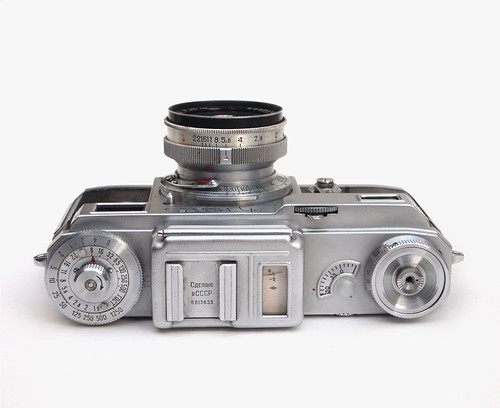
Kiev-4 rangefinder, view of top plate
The Kiev/Contax rangefinder has a very long base - 90mm - and this distance between the two windows makes for very accurate focussing. There are compromises with this: ergonomically, it's easy to cover up the rangefinder window while holding the camera (thus making the 'Contax grip' necessary and the Contax manuals describe how to place the user's right hand to take advantage of this); also, with the standard 5cm lens, the rangefinder's accuracy provides a high degree of rotation to change the focus from infinity to 0.9m. In comparison, the focus lever on the Kodak Retina IIa rotates 90º from infinity down to 3.5 feet, while on the Kiev-4 the 5cm lens rotates 270º from infinity to 0.9m. This makes switching from infinity to close focus not as rapid as it might otherwise be, notably when using the focus wheel on the body.

The Contax/Kiev lens mount has an internal and external bayonet: the internal bayonet is used by the 50mm lenses and has a built-in helical; other lenses use the external mount and this means that the entire 5cm Jupiter-8M lens rotates as it focus. The lens aperture ring thus rotates away from the user until it can no longer be seen from the top of the camera. Some 50mm lenses had the aperture scale engraved twice around the lens to ensure it's always visible, but my lens has only one scale. As the 50mm lenses do not focus themselves, the internal bayonet mount also has focus and depth of field scales engraved around it. There is an infinity lock on the focus, which has two release levers: the tab above the focus wheel on the body, and the sliding pin by the lens itself. To change lenses with the internal bayonet, the lens must be locked at infinity.

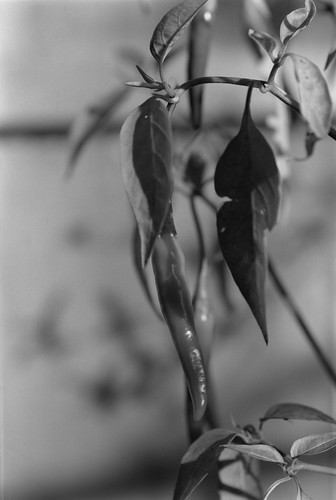
For writing this blog post, I've only been using the standard Jupiter-8M f2 5cm lens that came with my camera, but Arsenal duplicated the Contax range of Zeiss lenses, with the f1.5 50mm lenses - both the Zeiss Sonnar and the Jupiter-3 version - being most sought after and commanding the highest prices. With the 50mm lenses, both the wheel on the body or rotating the lens barrel can be used to focus the lens once the infinity lock has been released. It's not recommended to use the focus wheel on the body for other lenses due to their inertial weight. The rangefinder is clear and easy to use (the viewfinder has no frame lines or parallax indication, merely the square superimposed rangefinder patch), and I did find that I was deliberately choosing subjects to make use of its accuracy, isolating near objects and using wide apertures to throw backgrounds out of focus. The Jupiter-8M lens has a nine-bladed aperture diaphragm that no doubt helps in the smooth rendering of out-of-focus areas, such as in the shot below.
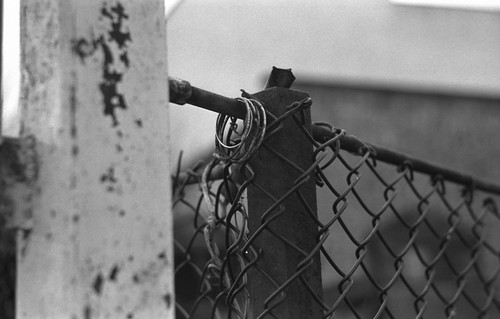
Kiev-4 with Adox Silvermax
For most of the shots taken to illustrate this blog post, I've trusted the built in light meter: cross-referencing with the 'Sunny-16' rule, the meter appeared to be functioning with sufficient accuracy for black and white negative film. As mentioned above, the Kiev-4's meter was based on that of the post-war Contax IIIa, although it differs from it in having 2x and 4x exposure marks, while the Contax IIIa only had one mark for correct exposure. The original Contax III had a light meter scale with markings for multiplying factors of 2, 5, 10, 20, and 40: I imagine that at the highest end of the scale, there's a potential for greatly magnifying a margin of error when using with insufficient light.
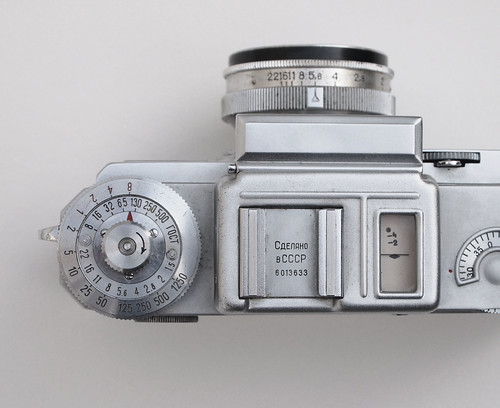
Kiev-4 lightmeter and exposure calculator
To use the Kiev-4's light meter, a pin by the cover's hinge releases the cover, which operates as a shade against the sky skewing meter readings. On the exposure calculator, film sensitivity is marked in the USSR's GOST scale, which is about one tenth less than the comparative ISO. The meter needle can be moved by rotating the outer ring of the calculator until it aligns with the rhombus in the meter window, or, in lower light, to the 2x or 4x exposure compensation marks, and then aperture and shutter speed combinations can be read off the lower side of the calculator dial. There's also a small circle to zero the meter, with a tiny screw on the back of the meter housing for adjustment. Although not very useful for low light situations, I haven't found selenium light meters to deserve the negative reputation that appears to be quite common online; perhaps I've been exceptionally lucky to get camera after camera with working meters.

Having used the Kiev-4 for just a couple of months, and with the standard Jupiter-8M lens only, this is by no means a comprehensive review of the camera. However, the results I've had so far have largely shown the camera to perform very well (the best perhaps are those shot on Adox Silvermax). Once I'd worked out exactly how to adapt a spool for the take-up side, using the camera was largely trouble free, although on a couple of occasions the frame spacing has been erratic, once with larger gaps than normal at the start of a roll, once with overlapping frames on a short roll of film. Operation of the camera isn't as intuitive as it might be, and takes a little getting used to, especially holding it without obscuring the rangefinder window. I've often found it more convenient to use the lens barrel to focus once the infinity lock has been released, although the wheel on the body is good for fine tuning the focus. I've missed having a yellow filter for some of the shots below, and although I generally use standard focal lengths for most of the photographs I like to take, there is the potential to acquire a range of lenses (and accessories) to take advantage of Zeiss Ikon's eighty-year old conception of this rangefinder as a complete professional system camera.
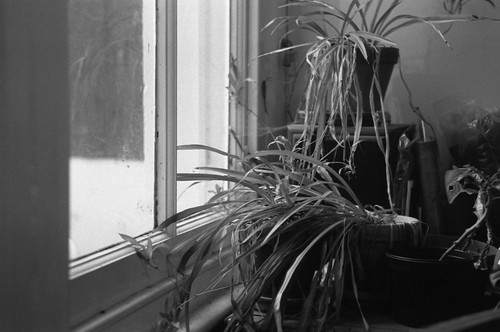
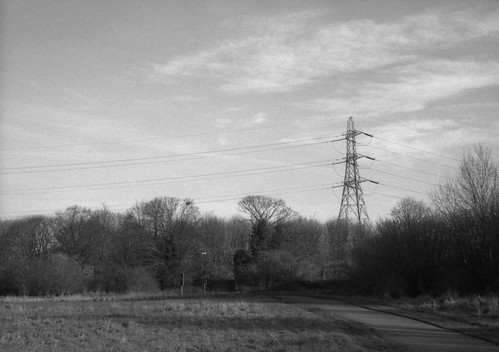
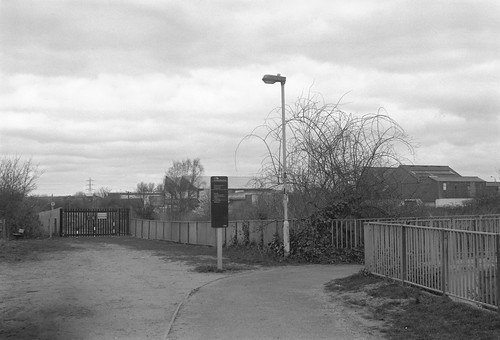
Kiev-4 sample image on Ilford HP5 Plus
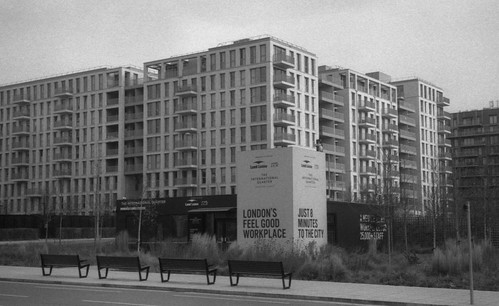
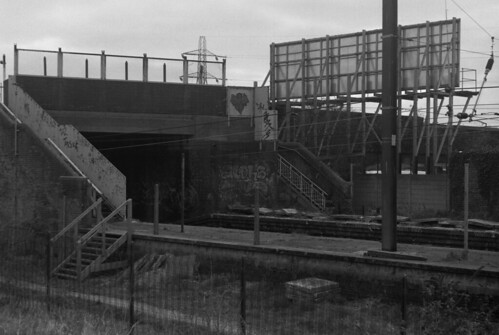
Kiev-4 sample image on Ilford FP4
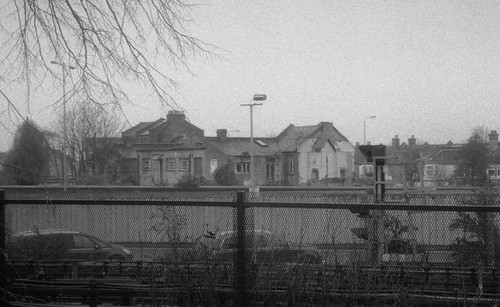
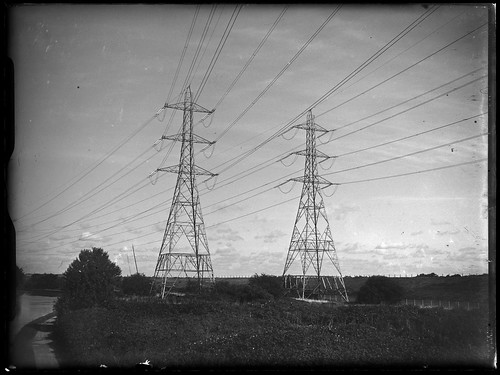
Kiev-4 sample image on Ilford Mark V Motion Picture Film
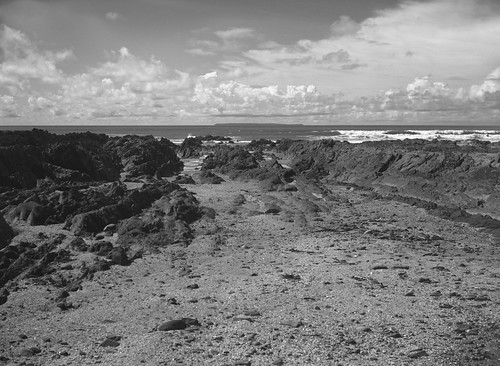
Kiev-4 sample image on Foma Retropan 320
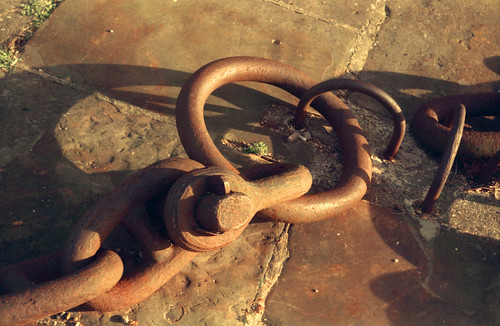
Kiev-4 sample image on expired colour print film
Kiev-4 sample image on Adox Silvermax

Sources/further reading:
SovietCams.com overview of the Kiev/Contax
Kiev-4 manual translated into English
Kiev Survival Site
Kiev-4 schematics on USSRPhoto
Kiev-4 on Photoethnography
Kiev-4 on Matt's Classic Cameras
Kiev-4 on Camerajunky 
Kiev-4 on Early Photography
Kiev-4 on Classic Cameras
Contax manuals from Butkus.org

Thursday, 24 December 2015

Fomapan 400

Fomapan 400 in 35mm, medium format 120 and large format sheet film
Having spent some time testing Foma's new film, Retropan 320, earlier this year, I thought I should also look in a little more detail at Fomapan 400, which I'd used in 9x12cm size sheet film with the Recomar 33, and also shot some in medium format while in Stockholm. I'd first used Fomapan 400 six or seven years ago, shortly after I'd started developing black and white films again after a gap of a few years. The attraction of Fomapan 400 was its price, at that time it was less than £3 a roll in medium format. I tried it in both medium format and 35mm: I didn't like the results of Fomapan 400 in 35mm very much, so I didn't use it again, but I did continue to use it periodically in medium format.

Foma's own reference sheet states that:
FOMAPAN 400 Action is a panchromatically sensitized, black-and-white negative film designed for taking photographs under unfavourable light conditions or using short exposure times. The film meets high requirements for low granularity, good resolving power and good contour sharpness. FOMAPAN 400 Action has a nominal speed rating of ISO 400/27º, but due to its wide exposure latitude the film gives good results even when overexposed by 1 EV (exposure value) (as ISO 200/24º) or underexposed by 2 EV (as ISO 1600/33º) without any change in processing, i.e. without lengthening the development time or increasing the temperature of the developer used.
Foma's films have suffixes for each different speed: Fomapan 400's designation is 'Action' (although this isn't used on the large format packaging). These suffixes 'Action', 'Creative' (Fomapan 200) and 'Classic' (Fomapan 100), now joined by 'Soft' (Retropan 320), don't appear to be used by photographers shooting these films, although I suppose they do function as being a little more descriptive than the nominal film speed rating. Having only used Fompan 400 in medium and large format for a few years, I thought it would be worth shooting 35mm again to make a series of tests for this blog post. Using the smaller format more clearly shows the film's characteristics in terms of grain, which was what I initially disliked about the film. As with other films, I shot a latitude test, partly due to the claims Foma makes for the film; having used the film for a number of years, I was sceptical about the wide latitude described on the data sheet as quoted above.

Fomapan 400 latitude test with R09 One Shot
The first two rows on the contact sheet above were shot with successive frames rated 50, 100, 200, 400, 800, and 1600 (both frames in the third row were rated 400). The film was developed in R09 One Shot, diluted 1+25 for 6 minutes at 20ºC. Rodinal/R09 One Shot is the main developer I use; in the past, I've read online about Rodinal not giving true box speed, especially with faster emulsions, but this isn't something that's apparent with many films. However, this may be the case with Fomapan 400: the data sheet states that the film can be underexposed by two stops "without any change in processing", but the test above shows very little shadow detail at 800, and little shadow and mid-tone detail at 1600, two stops under. The best negatives of the test were probably those rated at 200, while those at box speed appear thin. (The 400 ISO film comparison on digitaltruth.com appears to show Fomapan 400 performing worst in terms of latitude out of the five films tested, confirming the results from my own test).

I shot a second latitude test in 35mm again, but used a different developer, Ilfotec LC29, diluted 1+29 for 9 minutes at 20ºC, to compare the results against the test developed in R09. This test appears to show better latitude with the film; the strips below were exposed as in the first test, with successive frames rated 50, 100, 200, 400, 800, and 1600.

Fomapan 400 latitude test with Ilfotec LC29
This test, although scanned and therefore not a direct comparison with the contact sheet of the first test does appear to show much better latitude, although there is still a lack of shadow detail in the frames two stops underexposed.

Although Foma do not give recommendations for pushing the film, there are times and dilutions for pushing Fomapan 400 up to 3200 on the Massive Dev Chart. Rating the film at 800, I used the Massive Dev Chart timing and dilution of 19 minutes at 1+50 with R09 One Shot (the chart does not provide data for pushing the film with Ilfotec LC29).

Fomapan 400 at 800 in R09 One Shot
The results with a one-stop push in R09 One Shot were fairly encouraging, but most were shot in good lighting conditions: the photographs in fairly bright but flat lighting were easier to scan, while those with sunlight had the raised contrast typical of push processing. Some of the images appear to show a small amount of halation, or possibly irradiation, visible with the foreground post in the shot above. I then exposed a roll of the film at 1600, again with the Massive Dev Chart's dilutions and timings of 1+50 for 24 minutes.

Fomapan 400 at 1600 in R09 One Shot
Some of these frames were shot in more challenging light conditions, such as the sort of low-light scenes where pushing two stops might be necessary for hand-held photography, and the results were better than expected, although in the scanning of the negatives I did have to pay a little more attention to pulling out shadow detail. The grain did not become too pronounced, although I find Fomapan 400 to look quite 'soft' and it appears to have a less uniform distribution than other fast films, the pattern of grain clumps being what gives it a distinct look.

Fomapan 400 at 3200 in R09 One Shot
The Massive Dev Chart also had entries for a three stop push to 3200, with timings for both 1+25 and 1+50. I shot a roll of Fomapan 400 at 3200 and developed this in R09 One Shot, diluted 1+25 for 25 minutes at 20ºC; this entry has the note "high contrast" attached, but the time for 1+50 was 52 minutes, which was far too long to contemplate. At 3200 the negatives were extremely thin, most showing nothing other than highlights, with the above shot being the only frame worth scanning. After my results with the latitude test however, I did also want to try push-processing in Ilfotec LC29. With there being no times listed for push processing with this developer, I estimated, using as a starting point the fact that Fomapan 400's timings are very similar to HP5 Plus. I diluted Ilfotec LC29 to 1+9 and developed for 12 minutes at 20ºC. The results, although perhaps better than R09 One Shot, were generally thin and lacking in any shadow detail, leaving the conclusion that for Fomapan 400, rating it at 3200 is a push of one stop too far. In addition, the longer times with R09 One Shot also appeared to show increased fog - something that increasing these times even further would exacerbate.

Fomapan 400 at 3200 in Ilfotec LC29
Fomapan 400 would not be my first choice for 35mm film in the high speed range, although the results of my recent tests were better than I remember. I've been more likely to use it in medium format, which I have done off and on over the last few years, although I've found its lack of latitude to be less than ideal when shooting with box cameras with limited or no controls over exposure; other films have been better for those purposes. However, Fomapan 400's qualities as a traditional emulsion do come across in medium format, and I most recently shot some in Stockholm with one of my flea market finds there, the Agfa Isolette III.

Plaubel Roll-Op (6x4.5), Fomapan 400, Rodinal 1+25
Agfa Isolette III (6x6), Fomapan 400, R09 One Shot 1+25, 8min 20ºC
Zodel Baldalux (6x9), Fomapan 400, Rodinal 1+50, 12m15s at 19º C.
Where Fomapan 400 really shines is in large format: any reservations about the film's grain or latitude evaporate once price is taken into consideration: it's around half the price of HP5 Plus per sheet and less than a third of the price of Kodak Tri-X, and it's still relatively easy to find 4x5 Fomapan 400 in the UK. In 35mm and medium format the price differences aren't as magnified. Shooting large format with the MPP Micro-Technical, I always use a tripod, which inevitably slows down the process of taking photographs, and I've learnt to rate the film at 320 or 250 ISO (see, for example, the shots in last year's post under Old Lenses); additionally, shooting large format can be more forgiving. In contrast, I've tended to shoot my 9x12cm cameras hand held: as a European manufacturer, Foma's films are all readily available in the 9x12cm format. Even with the increased postage cost of buying the film from Europe, it's still cheaper per sheet than its competitors. On a final note, both examples of large format shots below are also taken with yellow filters.

Kodak Recomar 33 (9x12cm), Fomapan 400, rated 320, developed in Ilfotec LC29 1+29 for 9m 
MPP Micro-Technical (4x5), 150mm Xenar, rated 250, developed in Ilfotec LC29, 1+29 for 9m

Tuesday, 8 December 2015

Kodak Recomar 33

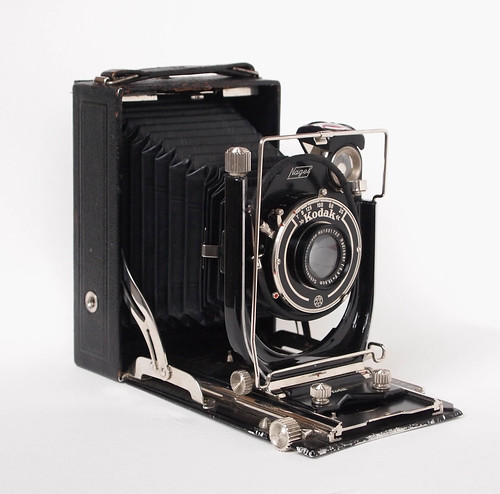
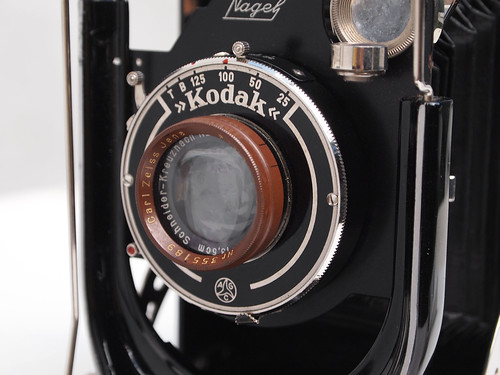
Kodak Recomar 33 with Schneider-Kreuznach Radionar f6.3 135mm lens
After writing about the Ica Trona 210 last year as a "small large format camera", towards the end of summer this year, I took a Kodak Recomar 33 on holiday. Most of the remarks about using the Ica Trona are equally applicable to the Recomar; with a small number of 9x12cm plateholders (oddly, the two Kodak-made holders I have don't fit the Recomar), and fewer film sheathes (just eight), a week away meant taking a dark bag to change the sheet film after exposure, and an empty box to store exposed film. I also took four plate holders without film sheathes, loaded with Ilford HP3 glass plates from the 1970s, which I wrote about last year in the post, 'Some large format glass plates'. I took a box of Fomapan 400 and some old Agfapan APX 100 with a develop before date of January 2004 (I didn't take my 9x12cm rollfilm back, and only shot sheet film while away). As the two different types of film had different notch codes, I used the same box to store them after exposure; I did also find a common development time with one particular dilution of Ilfotec LC29, meaning that I could develop both at the same time in the same tank, but could also distinguish which film was which if I wanted to use a different developer or dilution.

Kodak Recomar 33 with Schneider-Kreuznach Radionar f6.3 135mm lens
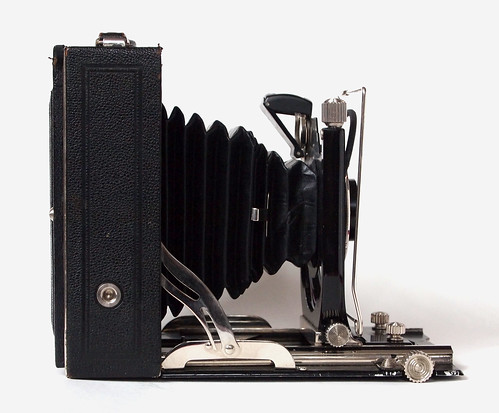
The Recomar camera was first produced by Nagel around 1928, shortly before the company was bought out by Kodak in 1931; production by Kodak A.G. in Germany was continued until 1940. The Recomar camera was available in two plate sizes: as the Recomar 33 in 9x12cm format and the Recomar 18 as 6.5x9cm. My camera is the larger 9x12cm format, and came with a Schneider-Kreuznach f6.3 Radionar lens (datable to 1938), in the standard 135mm focal length for the format, with a Gauthier Telma four-speed shutter (1/125th. 1/100th, 1/50th, 1/25th, as well as 'T' and 'B)'. The camera features all-metal construction, double extension bellows, wire frame sportsfinder, brilliant viewfinder with spirit level, ground-glass back, and both rise/fall and cross lens movements. It also came with a cloth covered cable release, possibly original. It's the most compact of my three 9x12cm folding cameras, just a few millimetres smaller than the Trona in its height and width at 15.8x10.8x5cm.

Kodak Recomar 33 with Schneider-Kreuznach Radionar lens
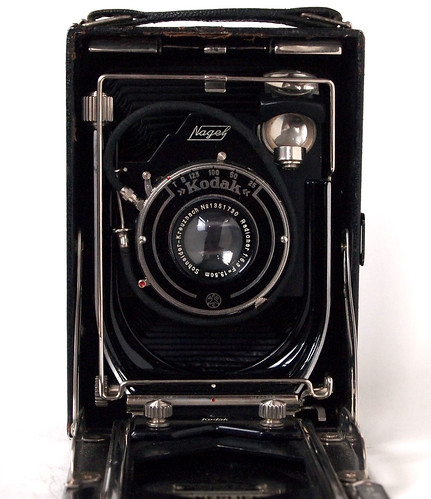
Looking at other images of Recomar cameras on Flickr, this has an unusual lens and shutter combination in the Radionar and Telma, and features Nagel on the front standard where other Recomars have the name Kodak. It does prominently state «Kodak» on the front plate of the shutter, and also on the bed alongside a dealer's decal (J. L. Nerlien, Oslo). The serial number inside the body is 14914Z; whether this is early or late in the production run I don't know, but it is tempting to speculate that the front standard could be old Nagel stock left over from the time of Kodak's takeover, although the late date of the lens' serial number raises more questions than answers. Kodak's manual lists the cameras having f4.5 Xenar lenses, in both the 18 and 33 sizes; the only example of a Recomar 33 with a slower f6.3 lens I've found online is a Nagel one from 1929 (incidentally, the Nagel-branded front standard on my camera cannot fit a wider aperture lens as the shutter/lens flange is much smaller than that for a f4.5 lens). The camera cost just £16 on a well-known auction site, perhaps partly due to its slow(er) triplet lens; given the size of the 9x12cm negative, the quality of lens as compared to the usual Xenar Anastigmat (a Tessar-design) may not be quite so obvious, although when open wide, there does appear to be a falling off in definition towards the corners. The main drawback with the slower lens is a less-bright image when using the ground glass screen to focus, making this more difficult in low-light situations.

Although generally in very good condition for being over seventy years old, I did initially have a slight problem with the underside of the bellows being a little crushed and creased. This meant that this side of the bellows curved up and slightly inwards, and would cast a shadow just interfering with the projected image; this can be seen in the last photograph at the end of this post, shot on HP5 Plus: on the right hand side, the curving, slightly out of focus border is caused by this. I had this show in a number of the first shots taken with the Recomar, before realising that it could be easily rectified by gently pushing out the bellows from the inside, simply done at the point of changing the ground glass screen for a plateholder before making an exposure. As provided with double-extension, there's plenty of 'give' in the bellows, and after gentle encouragement, they tend to stay in position; like some other folding cameras I have, especially with double-extension bellows, when first opened, the mass of the bellows has a tendency to gather at the back of the camera.

Kodak Recomar 33 with Proxar III
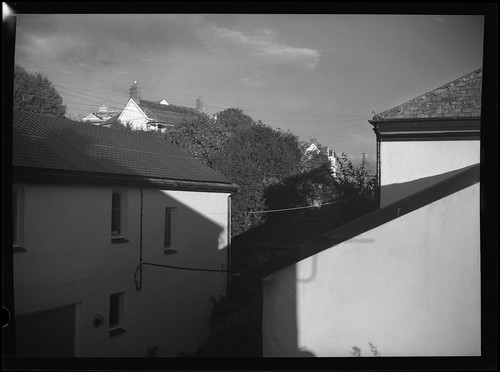
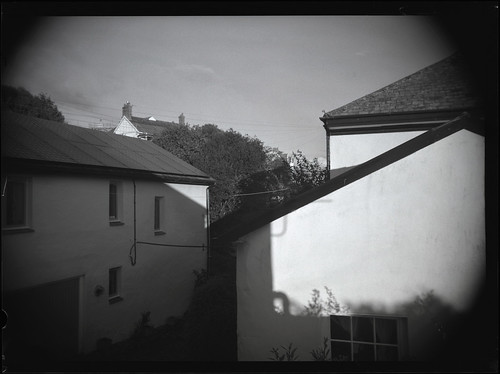
Following my experiences with the Ica Trona, I bought a 32mm Proxar III supplementary lens to use with the Recomar. The 32mm outside dimensions of the f6.3 lens appears to be a common size: I have medium format cameras with f4.5 105mm lenses which can take a 32mm push-fit filter, as well as the Kodak Retina with its f2 50mm lens and the c.180mm f8 Rapid Rectilinear (it's useful to have this standardisation as I already have yellow filters and lens hoods in 32mm). I discovered only later that the coverage of the Radionar lens with the Proxar attached isn't sufficient for 9x12cm when focussed at infinity: using the Proxar, infinity is at 11cm. The two images below shot from the same position demonstrate this, first without and then with the Proxar fitted.

Kodak Recomar 33 with Fomapan 400
Kodak Recomar 33 and Proxar III with Fomapan 400
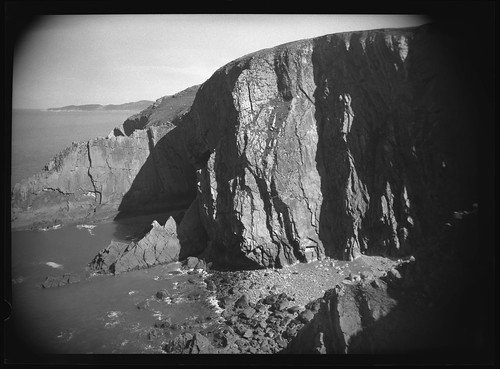
Depending on the subject, this vignetting caused by the edges of the image circle isn't always a distracting problem, such as in the photograph below. The shots taken with the Proxar attachment appear to show that the image circle was not perfectly centred on the film, although I'm certain that the lens was centred according to the white dots which match on the standard for returning the rise and cross movements: in both images here, the image circle appears shifted a small amount to the left, which would equate to a small amount of rise when the camera is held in portrait orientation. Although pure speculation on my part, perhaps this rise is built-in to the camera design to automatically make a slight correction to the perspective of verticals.

Kodak Recomar 33 and Proxar III with Fomapan 400
The other function of the Proxar supplementary lens, that of a close-up filter or adaptor, does not suffer from vignetting by the simple fact that the further away from the film plane that the lens is extended, the greater the size of the projected image circle. Although shot on a forty-year old glass plate, with the usual signs of the losses in quality of an old emulsion, the image below with the Proxar used for its close focus qualities shows no vignetting in the corners.

Kodak Recomar 33 and Proxar III with HP3 glass plate
One of the main reasons for wanting to use the Proxar attachment was when using the rollfilm back on a 9x12cm camera, the 6x9 frame size becomes near a normal angle of view, reducing the crop factor, as seen in the two photographs below: the second shot, although slightly turned, can be compared to this image on 9x12cm film from more or less the same position (the top image is shot with a yellow filter; the image below uses the Proxar on its own as I was wary of stacking the filters).

Kodak Recomar 33 with HP5 Plus in rollfilm back
Kodak Recomar 33 and Proxar III with HP5 Plus in rollfilm back
The image below also shot with the rollfilm back demonstrates the Proxar as used for close-up purposes. For the benefit of composing on the ground glass screen, especially for shots like this with a tripod, I found it useful to draw the outlines of the 6x9cm aperture from the rollfilm back with a sharp pencil directly onto the ground glass. (Apart from the two close-up shots in this post which used a tripod, all the other photographs were shot hand-held).

Kodak Recomar 33 and Proxar III with HP5 in rollfilm back
The Recomar 33 is the most robustly made of my 9x12cm cameras: the lens standard is reassuringly rigid once pulled out of the camera body, the rack and pinion focus is tight enough to remain in place even without locking the focus, and the general condition of the camera, despite the bellows, which are quite light-tight, suggests that it hasn't been that well used during its life. The leather on the side of the camera which has the folding sight of the wireframe finder is rather faded, indicative that it may have sat on a shelf, side-on to the light for many years. Ideally, I would perhaps choose a Recomar with a faster lens and a better shutter with a greater range of speeds, but as a 'small large format camera', the recent results demonstrate just how well it has performed for this purpose.

Kodak Recomar 33 with Fomapan 400 in rollfilm back
Kodak Recomar 33 with Rollei RPX 400 in rollfilm back
Kodak Recomar 33 with Ilford HP3 glass plate
Kodak Recomar 33 with Agfapan APX 100
Kodak Recomar 33 with Fomapan 100
Kodak Recomar 33 with Fomapan 400
Kodak Recomar 33 with HP5 Plus

Sources/further reading:
Kodak Recomar 33 on Camera-Wiki
Manual for the Recomar 18 and 33
Kodak's listings of historic cameras

Tuesday, 1 December 2015

Belomo Agat 18K

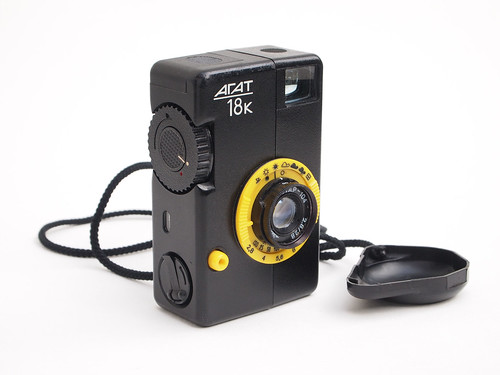
Belomo Agat 18K
Most half-frame 35mm cameras were designed to shoot in portrait format, partly due no doubt as the way a roll of film logically winds through a camera from left to right horizontally, with the wind on lever or wheel operated by the thumb on the right hand. The ergonomics of this on a standard full-frame 24x36mm format camera provides a landscape, horizontally-orientated image; with the same left to right film travel, a half-frame image size of 18x24mm becomes vertical. The very earliest cameras that took 35mm film - before the Leica - often used something approximating the half-frame format, a legacy of 35mm film coming from the motion picture industry. These were often large and bulky cameras however, made to shoot much longer lengths of film; the invention of the standard 35mm cassette allowed camera designs to shrink. However, with the even smaller frame size, half-frame cameras could be scaled down to become smaller still, and compact sizes made it easier to design cameras to be held in different orientations, and a number of half-frame cameras (such as the Yashica Samurai) were made with the film travelling vertically to provide a landscape format image.

The Agat 18K is one such horizontally-orientated half frame camera. It's a very small (95x60x45mm), light-weight (130g) camera mostly constructed from ABS-type of plastic, manufactured by Belomo in the former Soviet republic of Belarus. There was an earlier Agat 18 (presumably the 18 is from the frame size); the 18K model improves on its predecessor in having a wider ISO range, an extra setting on its exposure calculator, a threaded shutter button for cable release, and a redesigned lens cap which covers both lens and shutter release. This lens cap is attached via a cord that has a screw fitting which doubles as a tripod mount. It's designed to be held for horizontal shots, with the film travelling from bottom to top rather than left to right, and held to the right eye with the shutter release operated by the right hand. The camera's ergonomics make holding it for a vertical portrait framing rather more awkward - perhaps it's best held to the left eye and operated by the left hand; using the right eye, the bulk of the camera rests against the user's forehead.

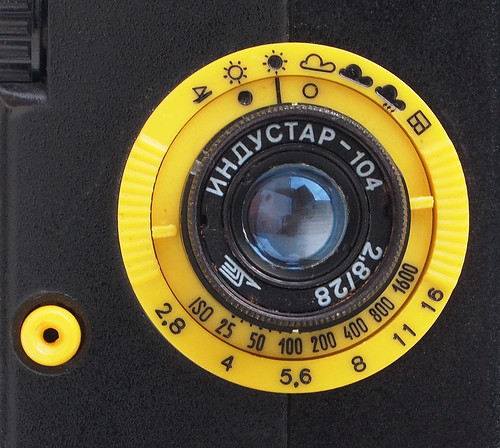
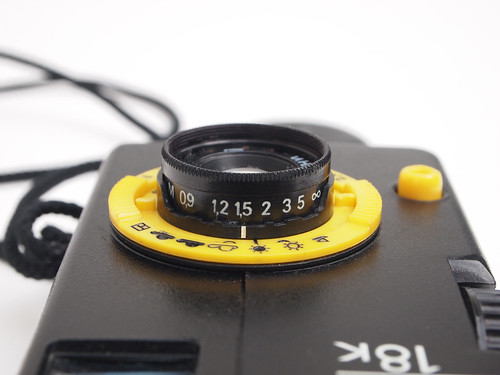
The 18K's manual only appears online in Russian, and so the camera may never have been intended for export (apart from the initials ISO, all other writing on the camera is in Cyrillic): some of the information in this post has been gleaned from other websites, but some from the manual via my own attempts to translate some of it using online tools. The Agat cameras are very easy to find online and very cheaply too: SovietCams.com suggests over half a million of the first version were produced from 1983; the 18K version came out in 1988 and would be the preferred model simply for its extra features. Both versions of the Agat camera have an Industar-104 f2.8 28mm lens (giving a slightly wide angle of view, about 40mm on a full-frame 35mm format), stopping down to f16. The lens has a filter thread and also focuses down to 0.9m, with the viewfinder giving indications of parallax correction for close focus.

Agat 18K lens and exposure calculator
The unique feature about the Agat 18 cameras is the manual calculator which gives a form of programmed exposure. The film's ISO, from 25-1600 on the Agat 18K, is set on the inner ring around the lens, using the white mark underneath the lens first: this ring is difficult to turn using the two tabs on either side of the lens - the manual suggests using a match. The exposure is then set by lining up one of seven symbols on the outer ring with the black line on the inner ring: although largely self-explanatory, the manual provides further information on the lighting conditions they represent:
Object in snow, in the mountains, the sea under clear sun
Bright sun, harsh shadows
Hazy sun, soft shadows
Light cloudy weather, no shadows
Cloudy or shade with open, clear sky
Very cloudy, thunderclouds
Indoors 1 metre away from a window in the absence of direct sunlight
The inner ring also includes dark and light circles at either side of the line for one-stop exposure compensation. With the exposure set, the calculator indicates which aperture is in use, marked off next to the white line where the ISO is set. The shutter is coupled to the aperture setting: the manual lists the possible combinations in a table that appears to suggest that both aperture and shutter speed are continually adjustable as it shows intermediate aperture settings and odd shutter speeds. At f2.8 the shutter is either set to 1/65th or 1/130th, down to 1/540th at f16. The table of apertures and shutter speeds in the manual has asterisks against the intermediate aperture settings, 3.4, 4.8, 6.8 and so on and the asterisk appears to mean something like "The aperture value is not specified on the camera"; as there is also an asterisk against 1/65th at f2.8, this would appear to show that this aperture and shutter combination is set with the exposure ring rotated as far as possible anticlockwise (on the fastest ISO settings, the outer ring is moved some distance past the window symbol to achieve this). As well as the provision for exposure compensation, it is of course easy to override the exposure calculator by simply by either changing the ISO setting or choosing a different symbols.

Agat 18K focus scale and depth of field indicator
There is a depth of field scale around the lens with a series of indentations to indicate different aperture settings; at f11, with the focus at 1.5m, depth of field should be from 0.9m to infinity, although this seems rather generous. The manual has a diagram as to how to interpret the indentations on the scale.

Depth of field diagram from Agat 18K manual
The film advance wheel is the same width as the camera body, which has cutaway sections to give a grip on both sides for ease of turning. The frame counter starts with a dot at 1, resetting with opening the camera, and thereafter goes up in sixes. The shutter is cocked not by the frame advance itself, but by the metal sprocket wheel internally, meaning that without a film, this has to be rotated by hand to cock the shutter for testing. To load the camera, a spring catch on one side is pressed down and the camera body slides into two parts. To insert film, the pressure plate flips down to thread the film across, and this plate has a small cut out and corresponding protrusion inside the body to securely locate it; it also depresses a small pin just visible in the shot below, and, although I'm not sure as to the function of this, given the position, I assume that releasing this pin resets the frame counter.

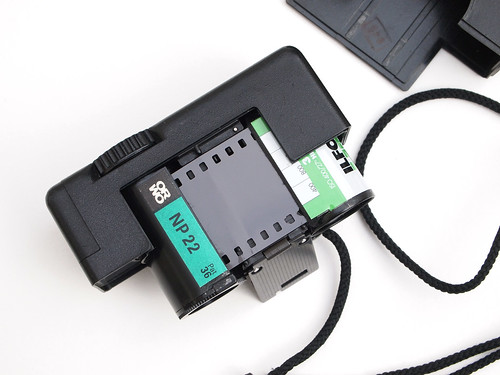
Agat 18K with 35mm cassette on take up side
The Agat 18K has a removable take-up spool; the receiving chamber is also designed to use a second 35mm cassette in its place (my camera came without the take up spool, but it did have a plastic cassette with an Orwo NP22 label). It is possible to use just an inner spool from a 35mm cassette in the take up side if the camera's removable spool is missing, but the film needs to be attached in some way, either with tape, or the spool can be modified with a slot cut into it to receive the film. However, I've only used it with two 35mm cassettes. When doing so, the take up cassette has to be put together with the internal spool upside down to make a mirror image of the cassette loaded with film. The camera's capacity to use two cassettes is something rarely mentioned in reviews; perhaps this design feature is a response to shooting double the amount of frames with the half-frame format, making it much more convenient to remove a part-used film. The manual shows cutting the typical 35mm film leader to a central tapering point to locate it in the small slot in the middle of an internal spool, but I've simply been taping the film instead, in much the same way as bulk-loading 35mm. Obviously it's still possible to rewind the film if using two cassettes in this way; to rewind film, the internal button on the advance knob has to be pushed in and turned to the red dot instead of the white dot for advancing film.

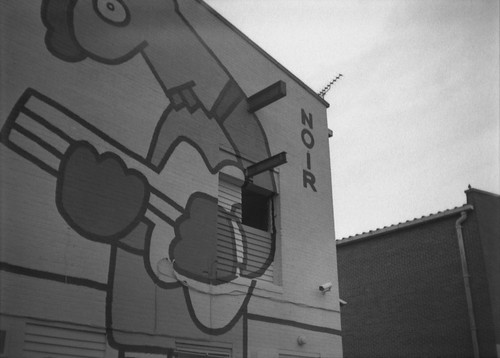
Agat 18K with Ilford FP4 Plus
While testing, I had difficulties using the camera films in the poor light of cloudy days for the past week: there were almost no sunny periods to use smaller apertures and faster shutter speeds. The best results were with Ilford FP4 Plus; although I also shot some HP5 Plus, most of these frames were not exposed properly, due to my own error in not compensating for how weak early winter morning sun can be, although some of these shots, despite being underexposed, do give a small indication of what the lens might be like stopped down. I also used some Foma Retropan 320, but this gave very grainy images, more obtrusive than the HP5. Finally, with the low light levels over the weekend, I shot some Ilfodata HS23, rated 25: by necessity, every shot used the 'dark cloud' symbol setting, giving f2.8 at 25 ISO. With the Ilfodata film, grain is barely visible, but limitations of the lens' quality are much clearer when shot wide open. Also, with a very shallow depth of field, there was little compensation for inaccurate guess focussing. It does appear that the lens might not quite focus at infinity when wide open; this might be a quality control issue over the construction, although it might simply be that I didn't quite take enough care to make sure the lens was actually set dead on infinity. It is also very easy to accidentally rotate the focus on the lens as this seems very loose. There are also some shots with lens flare, but more obvious are internal reflections, something a few Soviet-era cameras are notorious for, given their shiny plastic insides. The exposure calculator does have some limitations: at the slowest ISO settings, it can't be rotated to the thundercloud or window symbols: at the other end of the scale, being unable to use the bright sun or beach symbol at 1600 ISO would mean overexposure by one or two stops, although I was very far from having this latter problem while making my tests.

The Agat 18K looks and feels like a toy camera in many aspects, but in its design, if not in its construction, it's far more ambitious than that, despite the caveats above. The features such as the focussing lens, the wide ISO range, the ability to remove film partially shot from cassette to cassette, and the exposure calculator coupled to both apertures and shutter speeds, more than just a 'sunny 16' set of symbols, there's also a hotshoe hidden under a sliding cover for flash: all these suggest something more than a toy. I've used an Olympus Pen EE3, which has been my half-frame camera that I've relied on for many years, and although the Agat 18K's Industar lens doesn't compare with the performance of the Pen's Zuiko, it does have a wider maximum aperture, a wider ISO range, and the ability to focus its lens. It's also a much lighter and smaller camera, and very pocketable: perhaps the fun of using it locates the Agat 18K in the toy camera category.

Agat 18K with Ilford FP4
Agat 18K with Ilford HP5 Plus
Agat 18K with Foma Retropan 320
Agat 18K with Ilfodata HS23 rated 25
Sources/further reading:
Agat 18K on SovietCams.com
Agat 18K manual in Russian 
Belomo cameras on Camera-Wiki
Agat 18 review on BKS Picture Blog