Showing posts with label Ilford Pan 100. Show all posts

Tuesday, 6 August 2019

July's #ShittyCameraChallenge


After being awarded second prize for May's #ShittyCameraChallenge, shooting with the Wide Pic Panoramic camera for July's challenge, I wasn't expecting to be placed (my entries weren't perhaps as gimmicky as those with the Action Sampler in May) but when the results were announced, I found I'd come second again; July's first prize winner was @VisualSly - and there was a third prize this time around that went to @Grrlish (winning second prize - for a second time  - for some reason made me think of a Pot Noodle advert from the 1990s with Peter Baynham dressed as a Pot Noodle shouting out of a car window at a runner being left behind "SILVER! SILVER!"). July's 'mystery' second prize arrived today, again donated by @196photo and again all beautifully wrapped: another thematically-appropriate book of humour, Pring's Photographer's Miscellany, and, individually wrapped in an Analogue Wonderland box, another four different rolls of 35mm film, Fomapan 200, Kodak Gold 200, Ilford Pan 100 (which I used quite a lot last year), and there was again a roll of film new to me - JCH Streetpan 400 - as well as Ilford FP4 and HP5 badges - and a 'Pile of Poop' game.

< imageanchor="1" style="margin-left: 1em; margin-right: 1em;">


Friday, 31 May 2019

'Uboot' Action Sampler

Uboot Action Sampler
With another #ShittyCameraChallenge announced for this May, having recently been given an Action Sampler, this seemed serendipitous, and it felt a good choice: the Action Sampler is a 35mm point and shoot camera, almost entirely plastic in construction, including lenses, bar the odd metal screw holding it together and the clip for the handstrap. Its unique design, however, features four lenses that take four shots in quick succession in the space of a standard 35mm frame, with a shutter that rotates behind the lenses to achieve this. Apart from this, in keeping with the #ShittyCameraChallenge aspirations, the Action Sampler's specifications are very basic: the 28mm plastic meniscus lenses are fixed focus, fixed aperture at f11, and the shutter fires at a single speed, 1/100th, with a delay of 0.22 seconds between each lens, with the result that the four images are separated by less than a second. There is a simple, flip-up frame as a viewfinder, with a manual advance that cocks the shutter: internally there are two toothed wheels, one for setting the shutter, the other simply to turn the frame counter on the base of the camera; without a film loaded inside the camera it is possible to check the shutter operation by turning the first of these wheels manually. There is a manual rewind knob on top of the camera with a button on the base of the camera to depress for rewinding; this does not pull-up like many a manual rewind: when loading the camera, there is a cut-out section of the base, completed by a corresponding section in the camera back, so that on loading the camera, the 35mm film cartridge simply slides onto the rewind spool.

My example of the camera has 'uboot' printed on the back (the downwards pointing arrow on the front appears to be the uboot logo and is also printed on the back); in smaller type it has 'powered by www.lomo.com'; as with a number of cheap plastic novelty cameras, including the similar Action Tracker, the Action Sampler is s typical example of Lomography's modus operandi: take a cheap plastic novelty camera, rebrand it, market it, and sell it for many times its value. This 'uboot edition' was apparently given away free in the early 2000s to promote a social networking website (see this discussion on Flickr); there were a number of variations of the camera, in different colours, some with different coloured filters over the lenses, a flash version, and so on: the Lomography website is currently selling a clear version for £29.

My initial thought was to use the four sequential frames to make short animated loops as GIF files, in part inspired by recent research into early moving images, by the work of Muybridge and Marey, and by reading Rudolf Arnheim (notably, 'The Thoughts that Made the Picture Move’, from Film as Art). Given the very limited parameters of what the camera was capable of, the limit of four frames, I began to think of simple, repetitious cycles of motion that the camera could represent, and might work as a short animated loop. The sequences would have to be circular, not linear, to work as loops, and I thought of some of the ideas behind my piece 'Paper Cinema' and the descriptions of how the movement of the inanimate had fascinated early viewers of cinema at its inception, epitomised in the motion of leaves in the wind. A further example of the movement of the inanimate which is present in many of the Lumiere's early films is water in its various forms: the water from a hose, waves on the surface of the sea, steam rising. In addition, I then thought of visible states which represented binaries, on/off states; all of these subjects would have to be comprehended in less than a second.

As I hadn't shot with the Action Sampler before the start of the #ShittyCameraChallenge, I looked for these subjects with the first roll through this camera, without knowing what to expect in terms of the results other than conceptually what the camera does (I had, of course, seen examples online).
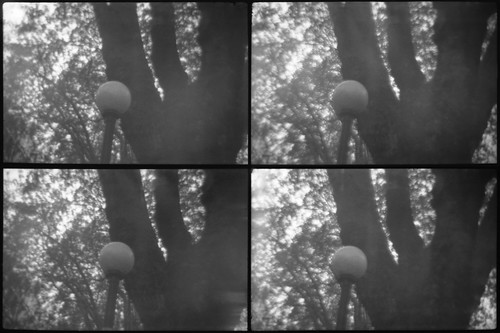
Action Sampler with Ilford Pan 100
Developing the first roll through the camera suggested that I may have been too ambitious in regards of what I thought the Action Sampler capable of: to begin with, the quality of the images is rather poor, perhaps what one might expect with a plastic meniscus lens and one quarter of the resolution of a normal 35mm frame; in addition, one lens on the bottom right doesn't seem to be properly aligned and this frame in all the photographs has worse definition that the others, the upper right frame being little better. The lenses are prone to flare, and pronounced aberrations (coma, showing up in the highlights, seems to be particularly bad), and despite the stepped recesses behind each lens, the plastic interior frequently resulted in internal reflections. The shutter also is not very consistent: the exposure varies across all four frames, sometimes starting very dark, and getting brighter, suggesting that it slows as it completes its cycle.
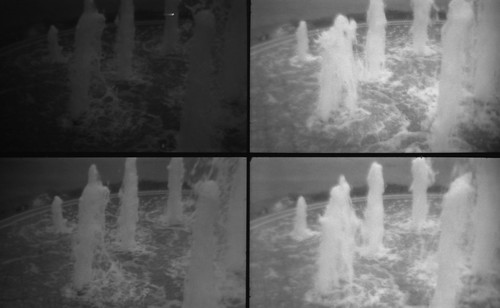
Action Sampler with Ilford Pan 100
The shutter slowing as it rotates also overexposed the film: I used Ilford Pan 100, but this was too fast for many scenes with bright sunlight, suggesting that the shutter was slower than 1/100th (the density of the negatives did also make scanning difficult and did not improve the resolution of the images). However, when I began to create animated GIFs from some of the frames, something of my original intentions had survived despite all the technical compromises.


The best of these images were generally the simplest: it hadn't always been easy to find subjects which fitted with the limitations of the four frames in less than a second, and in addition, the parallax caused by the separate positioning of the four lenses I hadn't really taken into account. This meant that it was not a simple matter of literally stacking the four frames one after the other, but it made more sense to find a focal point to each sequence and align this in each four frames, then crop to a consistent whole, clearly seen in the image below.


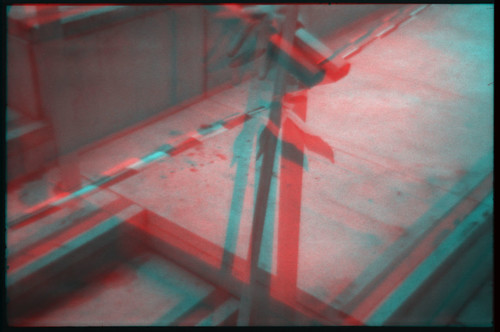
This parallax effect is essentially 'wiggle stereoscopy', and, even while I was still shooting the first roll, I thought that it would be possible to make stereo pairs from static scenes. Given the design of the four lenses, to shoot on a single standard 24x36mm frame of 35mm film, there isn't much lens separation, but the parallax is clear when put together as an animated GIF from the shifting position, both horizontal and vertical, as above. I chose some scenes with close subjects contrasting with some form of recession that could give relatively good separation despite the close stereo baseline, and the first image below is perhaps the best demonstration of this; the second image I had intended to make into an animated GIF, but the breeze which had been animating the tape did not sufficiently do so at the point at which I took the photographs, but the tape itself stands out well enough from the background as a stereo anaglyph.
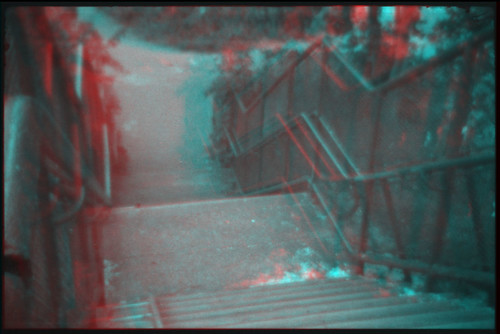
Stereo anaglyph from two Action Sampler frames
Having shot and developed one roll of film during the first week of May, aware of the results, the camera's limitations and what to expect from it, I loaded a second roll of film into the Action Sampler, only to find that the camera stopped working. Initially, I did think that the shutter was simply jammed - I could advance the film, but pressing the shutter release did nothing; on closer inspection, the film advance was cocking and tripping the shutter all in one action - which I only realised once I'd taken the film out of the camera; evidently, the mechanism which is supposed to 'catch' the cocked shutter and prevent further film advance was somehow slipping: at some future point I may attempt to disassemble the camera and investigate, but, as far as May's #ShittyCameraChallenge, I decided to content myself with just the one roll of photographs, rather than pick another camera that could fulfil its conditions.


Sources/further reading:
Lomography Acton Sampler microsite
Action Sampler on Camera-Wiki
Alfred Klomp's review of the Action Sampler - includes scans of the (2-page) manual

Tuesday, 15 May 2018

Ilford Pan 100

Ilford Pan 100 35mm film
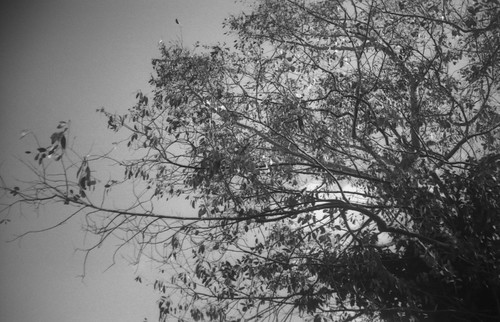
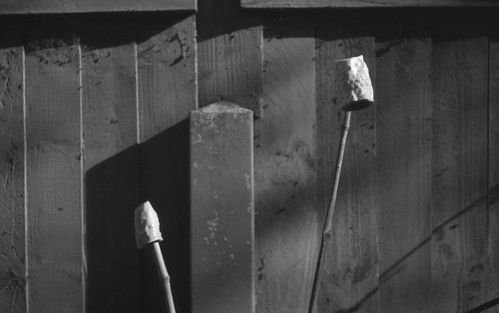
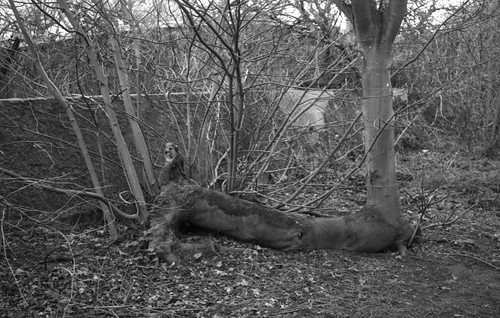
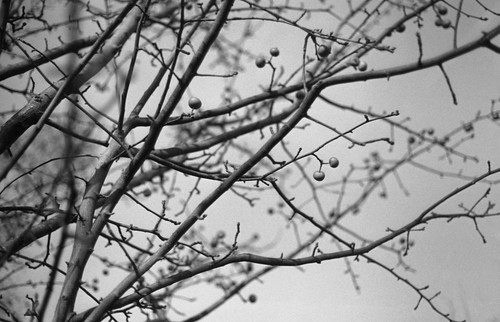
Ilford Pan 100 is a traditional cubic-type emulsion medium-speed black and white panchromatic film from Harman under the Ilford brand, which is complemented with a fast Ilford Pan 400 film. Ilford FP4 Plus and HP5 Plus are Ilford's well-known traditional emulsion films in the same (or similar; see comments below) speed ratings; however, the Ilford Pan films have not been generally available in the UK. The data sheet states:

The ILFORD range of PAN 100 and PAN 400 black and white camera films are not generally distributed and sold worldwide, they are only made available in selected markets.

The name, 'Pan', simply standing for panchromatic, is indicative of the basic nature of these films (panchromatic is, of course, the 'P' in FP4 and HP5). Recently a number of UK retailers have been stocking the films, which may represent a change of policy by Ilford in terms of market strategy for their particular products. I bought a number of rolls of Ilford Pan 100 at Process Supplies Ltd - now my 'drop-in' shop in central London (on the closure of film photography shops, see my post Seven Years On), where I noticed a display under the glass counter of the Pan films - despite these not being listed on their website.

There are some suggestions online that the Pan 100 and 400 films currently available are the old formulas of FP4 and HP5; there's an unattributed 'Ilford employee' quoted on a thread on the Amateur Photographer forum given as stating: "They are based on FP4+ and HP5+ technology, but are produced to lower specifications and tolorances [sic]. While the quality is acceptable, these films are lower in quality than other ILFORD films." Having used the older version of FP4, before the 'Plus' iteration, I was able to compare times from the leaflet inside the box of FP4 with times given for Ilford Pan 100, and the times are different in all developers, some are close, but not the same. However, in some developers the times are the same for the current version of FP4 Plus and Ilford Pan 100 (notably for the developers I used for this post, R09/Rodinal and Ilfotec LC29), with the important caveat that FP4 Plus is of course rated 125 ISO at box speed, one-third of a stop faster than the box speed of Pan 100 - not a great difference in sensitivity, but worth noting. It's also worth remarking that the Kentmere films, made by Ilford's parent company Harman, have been their low-price traditional films available in recent years, but these have different times from the Pan films. The data sheet referenced earlier states that the Pan 100 and 400 are available in 35mm and 120, but the sheet itself is dated March 2002; there are a few posts online suggesting that the Pan films were discontinued some years ago; it may be that the production ceased for a period, and was then restarted for 35mm film only.

When researching Ilford Pan 100, I did not find any in-depth, serious reviews of the film online - there are, however, plenty of forum posts along the line of 'what is this film?' Incidentally, Pan 400 appears to be a bit more popular, or at least seems to come up more often than Pan 100, and in searches, there's a lot of results for Ilford Pan F - which is quite a different film altogether. Developing times for Pan 100 (and Pan 400) are not listed on Ilford's standard development chart listing their other Ilford-branded films (except Ortho Copy Plus); for this post I used the times printed inside the box, which are the same as those on the Massive Dev Chart.

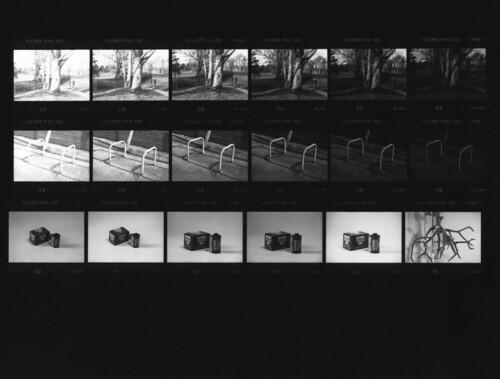
Ilford Pan 100 latitude test contact sheet
For a latitude test, I shot a half roll of Ilford Pan 100 with the Canon A-1. The first two rows on the contact sheet above were rated at exposure indexes of 25/50/100/200/400/800; the last row was shot at box speed, but with some bracketing. I developed the film in R09 One Shot, diluted 1+25 for 9 minutes at 20ºC. The contact sheet appears to show a swift falling off with underexposure; with scanning, it was possible to pull detail from the shadows (likewise with the highlights with overexposure) for a stop under without any difficulty, but with three stops there was very little detail there.

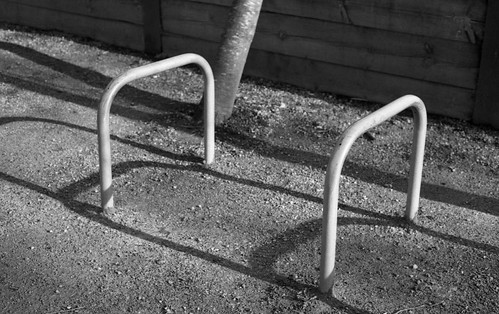
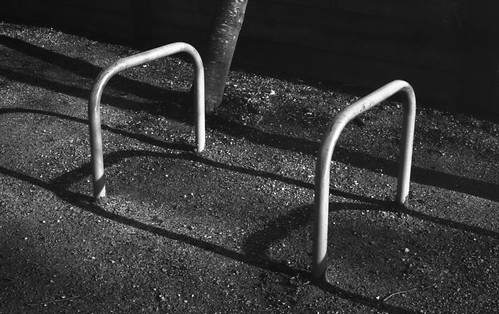
Ilford Pan 100 one stop underexposed
Ilford Pan 100 three stops underexposed
With overexposure, the compression of the tonal range is problematic: the detail is all present, but the flattened tones are perhaps unattractive, and makes scanning more difficult.

Ilford Pan 100 two stops overexposed
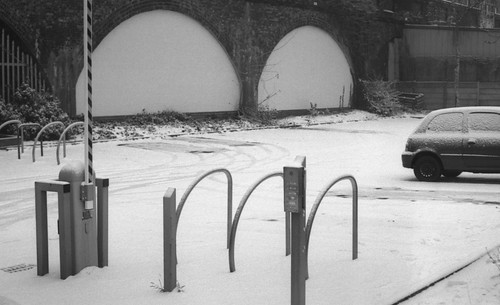
Departing from box speed, I shot some Ilford Pan 100 at 50, a one-stop pull. Developed in Ilfotec LC29, diluted 1+19 for 6m30s at 20ºC, the results may show a slightly reduced contrast, although for most conditions, pull-processing is a compromise relied on less often, and so as a general rule, less critical than push-processing - I very rarely pull-process. However, in high-contrast situations, it may well be a useful corrective.

Kiev-4 with Ilford Pan 100 at 50
Ilford's developing chart in the box also has times for a one-stop push to an exposure index of 200. I shot a roll with the Kiev-4; however on the day I shot the film, I was not really shooting in 'normal' lighting conditions - the snow made for relatively high-contrast subjects, but the lighting was heavily overcast and grey. In addition, this one-stop test was mostly shot at end of afternoon as the light itself was fading. I developed this roll in Ilfotec LC29 diluted 1+19 for 9 minutes at 20ºC.

Kiev-4 with Ilford Pan 100, rated 200
The results from the latitude test were not as good as other films I've tested (my benchmark for a film that demonstrates especially good latitude is Adox Silvermax 100), but I did want to try a two-stop push with Ilford Pan 100; rating it at 400 is not recommended by Ilford themselves. On the Massive Dev Chart there are a couple of results for rating it at 400 (as well as 800 and 1600), but none in developers I habitually use. For a first test, I used Ilfotec LC29 diluted 1+19, and made an estimate at 14 minutes (in retrospect, this probably should have been more like 18 minutes, using a rule of thumb of a two-stop push needing 2.25x normal development). The results were mixed; with good, diffused light, as in the image below, this developing regime worked well enough.

Ilford Pan 100 at 400, developed in Ilfotec LC29, 1+19 for 14m at 20ºC
However, with high contrast subjects, the lack of shadow detail was clear. In the first of the two images below, this matters less, but the landscape image underneath suffers: the bright but low angle of the sunlight casts deep shadows that are nearly featureless. Highlight detail (as in the clouds) is also difficult to retrieve (I also shot some of this roll at night, further adding to the contrast).

Ilford Pan 100 at 400, developed in Ilfotec LC29, 1+19 for 14m at 20ºC
In either case, I doubt that extending the development time to a full 18 minutes would have helped. Rather than assume that pushing Pan 100 to 400 to be a compromise hardly worth attempting, I tried a different tack: stand development. Using R09 One Shot diluted to 1+150, I stand developed another roll of Pan 100 rated 400 for 3 hours (agitating on each hour interval). It's a method I have used with Ilford HP5 Plus previously and I've liked the results. The theory behind using such a high dilution of R09 is to reduce the contrast that accompanies push-processing; no doubt most of the development has occurred by the one-hour stage, but I wanted to give the shadow areas as much opportunity to develop as possible. The grain in the photographs developed in this way appears smoother than the push-processing in Ilfotec LC29, although of course the subject matter is not entirely comparable. Incidentally, both rolls shot at an exposure index of 400 were taken with the Canon A-1, which should eliminate the vagaries of metering, although lighting conditions were quite varied; further tests might be taken to refine this approach, but, in a pinch, a two-stop push with Pan 100 can produce acceptable results.

Ilford Pan 100 rated 400, stand developed in RO9 diluted 1+150 for 3 hours
Ilford Pan 100 is certainly not a good substitute for FP4 Plus - but it may be for Kentmere 100, if one is looking for a budget black and white film. The grain of Pan 100 does not appear as smooth as FP4 Plus, and, to my eye, it also has a different look: something about it reminds me somewhat of the Fomapan films, the pattern of the grain being more random and less evenly dispersed. The price, of course, is what is attractive about the Ilford Pan films: I bought my 36-exposure rolls of Pan 100 at £3.99 apiece, which is admittedly a little more expensive than Kentmere 100 (perhaps the extra twenty-something pence is for the Ilford name) - and it may of course be possible to find the film even cheaper elsewhere online.

Ilford Pan 100 shot with Agat 18K (half frame)
Ilford Pan 100 shot with Halina 35X
Ilford Pan 100 shot with Praktica nova I
Ilford Pan 100 shot with Voigtländer Vito IIa
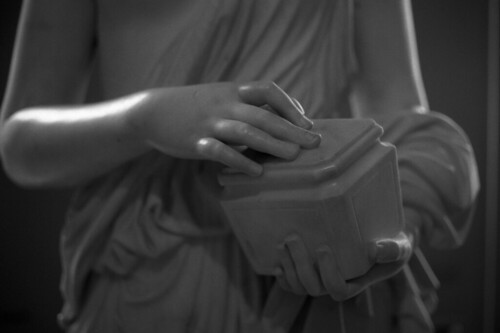
Ilford Pan 100 shot with Canon A-1
Ilford Pan 100 shot with Kiev-4, rated 200
Ilford Pan 100, rated 400, shot with Canon A-1
Ilford Pan 100 and Pan 400 data sheet (PDF)