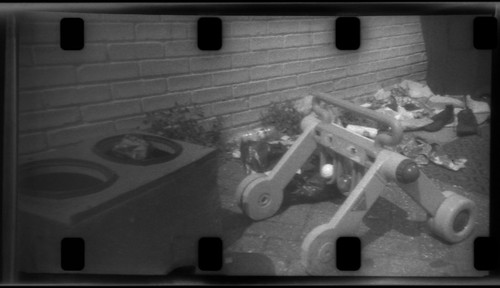
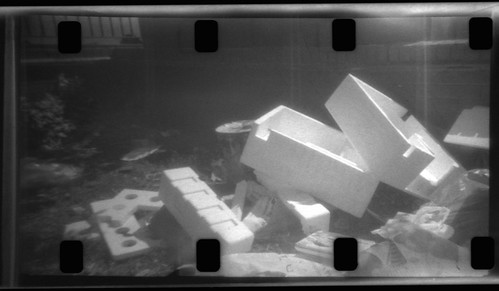
|
| 'Wide Pic' Panoramic Camera |
The title of this post has the words '
Wide Pic' with inverted commas, as this appears to be a genuine
no-name camera, at least in the variant I've been using this past month for July's #ShittyCameraChallenge. It's listed on Camera-Wiki as the
Panorama Wide Pic, and the term 'Wide Pic' is probably what it's best known as, or at least this brings up numerous results in an online search. With the printing on the camera itself, it seems to me that the makers of this particular camera are describing naming the lens 'Wide Pic', and that perhaps 'Panorama' next to the viewfinder may be the camera's
intended name, written in a Cinerama-style expansive logotype. However the camera box has the phrase 'Panoramic Camera' written on it in large letters and the description below (with capitals) as a "35mm Panoramic Camera".
 |
| 'Wide Pic' Panoramic Camera box |
The box reveals little else about the camera: the number 41-665 on the side is presumably a production code or stock number. There's no manufacturer's name nor country of origin on either box or camera (although intriguingly there is a lightly recessed rounded rectangle on the bottom of the camera which is where one might expect an engraved serial number or alternatively a 'Made in..." legend - but there is a serial number printed inside the camera back). Camera-Wiki also has an entry for an
Ultronic Panoramic camera, which is the same camera with a grey-silver face and different printing (and the name Ultronic Panoramic is printed in the same place that 'Panorama' is on the camera in this post); the 'Wide Pic' variant also has different coloured faces, with the back part of the cameras moulded in black. The camera is almost entirely plastic in construction, almost certainly dating from the 1990s when the panoramic format became popular, most notably through the panoramic format included in the
short-lived APS system.
 |
| Wide Pic camera open to show frame mask |
This camera creates a panoramic effect by masking the top and bottom of a standard 35mm frame and producing an image 13mm high by 36mm long. On Camera-Wiki the Ultronic-branded variant is listed as having a 28mm lens, giving a wide angle field of view, appropriate to the panoramic feel. The focal plane is curved to compensate for the limitations of the lens; the lens itself has elements either side of an internal aperture stop. The masking is moulded separately from the camera's rear body section, and looks as though this could be removed completely, thus giving a full-frame wide-angle camera.
 |
| Top view |
The camera has a fixed focus, a fixed aperture lens and, with a single shutter speed (these are given as f11 and 1/125th on Camera-Wiki), gives the camera the simplest of user controls. The lens has a sliding cover which, when closed, also blocks the shutter release button. Frame advance is manual with a thumbwheel rather than a lever; there is a small frame counter window on the top of the camera, with economic numerals marking every third frame. Rewind is also manual, with a button to depress before rewinding on top of the camera, indicated by a symbol no doubt more familiar from an LCD screen of rather more sophisticated cameras of the same era.
 |
| Camera back with format label |
The viewfinder is a reverse-Gallilean type, relatively small but clear. The back of the camera has a door latch, a label giving instructions to the user to request panoramic format when processing film and also has a film cassette window to remind the user if the camera is loaded or not.
 |
| Wide Pic Panoramic camera with Fomapan 400 |
For the first roll through the camera, I used
Fomapan 400, and, aptly, this was one of the rolls in my
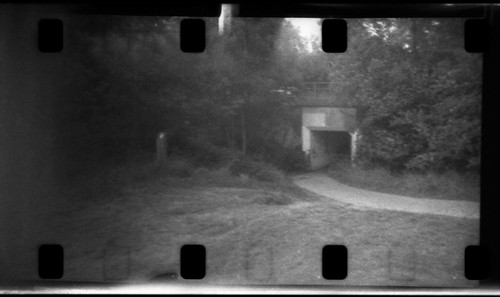
second prize package prize from May's #ShittyCameraChallenge - and I decided to shoot with the camera for July's #ShittyCameraChallenge. With regards to this, there's a price written in pencil on the box - £2.50 - which qualifies the Wide Pic camera on the criterion that the value is markedly increased once one puts a roll of film inside, let alone its other, obvious 'qualities'. The results with the Fomapan 400 adequately demonstrated all the design flaws embedded in the camera. That the camera simply crops the negative, using half the available area to create the panoramic look (as well as needlessly wasting photographic material) means that the negatives have around half the possible definition of the 35mm format; using Fomapan 400 developed in RO9 provided very pronounced grain relative to the image size as a result.
 |
| Wide Pic Panoramic camera with Fomapan 400 |
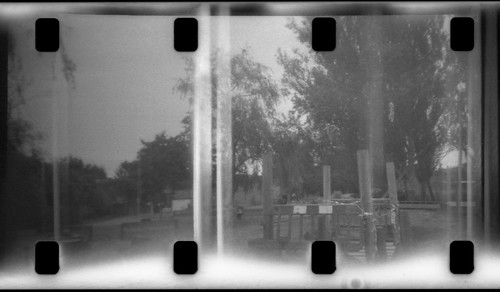
The lens, despite the curved focal plane, has a clear falling-off of both illumination and definition towards both edges of the frame. In addition, the 'focus-free' boast of the camera is dependent on the depth of field provided by the short focal length of the wide-angle lens combined with a relatively small aperture - and the lens being positioned at a hyperfocal distance. However, the 'Wide Pic' camera appears to have the lens set at a distance whereby any relatively far distances are
not in focus at all, as in the image above. The focus of the lens seems to be roughly positioned at around 2 metres, if not a little closer, which is not untypical of a cheap snapshot camera, designed no doubt for taking photographs of people, groups rather than portraits, such as what one might take on holiday. However, the panoramic format itself suggests that, for many users, this particular camera might not be ideally suited for photographing people, and therefore the lens seems to be set at the wrong focal distance for the kind of pictures that the camera otherwise would inspire. In the shot below the road sign to the left of centre is just discernibly more in focus than the houses behind.
 |
| Wide Pic Panoramic camera with Fomapan 400 |
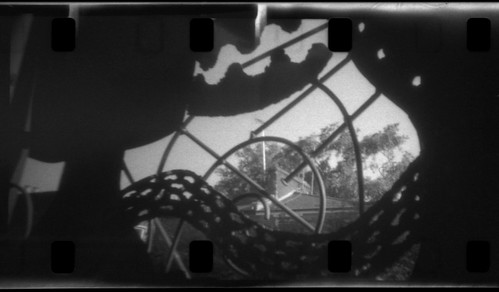
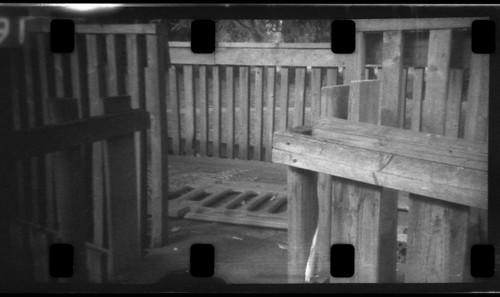
When shooting the first roll of film, I had thought that I would try a slower film next, in order to have finer-grained results to make up for the smaller negative format, but on developing the film I found that the frames shot in overcast conditions were thin, and even some shot in sunny conditions had little to no detail in deep shadows, as in the image below, taken early evening with weak sunlight, but sunlight nonetheless. This suggests that perhaps either the aperture may be smaller than f11, or the shutter speed is faster than 1/125th, or a little of both - the shots with subjects in full sunlight on a 400-speed film do not look overexposed.
 |
| Wide Pic Panoramic camera with Fomapan 400 |
For a second roll of film, I used
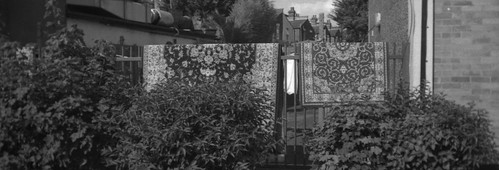
Ilford HP5 Plus, which, in general, resulted in better images. This was partly due to HP5 Plus having better latitude than Fomapan 400, and partly due to simply knowing what subjects were better suited to the camera's limitations after shooting my first roll with the camera.
 |
| Wide Pic Panoramic camera with Ilford HP5 Plus |
 |
| Wide Pic Panoramic camera with Ilford HP5 Plus |
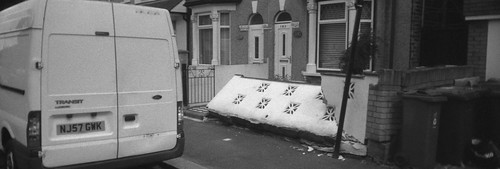
Overall, there are many poor design decisions built into the camera: the focus the lens is set to, the poor definition of the lens itself, the lack of any exposure controls, and the waste of film that the masked format requires. The ergonomics of the camera aren't ideal either: the wide angle lens means it is relatively easy to get fingers in the edge of the shot - there is a shallow finger rest (rather than strictly a grip) for the right hand, but as the lens is offset towards the right hand side of the camera instead of being centred, it does need a little care not to hold it in such a way that this may be a problem. The wide angle lens also is prone to flare when shooting into the light. However, using the Wide Pic, like many a point and shoot camera, but especially so given its elongated image format, simply requires one to think about
composition and light above all else.
 |
| Wide Pic Panoramic camera with Fomapan 400 |
 |
| Wide Pic Panoramic camera with Fomapan 400 |
 |
| Wide Pic Panoramic camera with Fomapan 400 |
 |
| Wide Pic Panoramic camera with Fomapan 400 |
 |
| Wide Pic Panoramic camera with Ilford HP5 Plus |
 |
| Wide Pic Panoramic camera with Ilford HP5 Plus |
 |
| Wide Pic Panoramic camera with Ilford HP5 Plus |
 |
| Wide Pic Panoramic camera with Ilford HP5 Plus |
Sources/further reading:
Camera-Wiki: Panorama Wide Pic & Ultronic Panoramic entries
Panorama Wide Pic on Canny Cameras
Wide Pic Panoramic camera vs Fuji TX-1 by Ryan Minchin