Friday, 18 July 2014

127 Day - Summer 2014

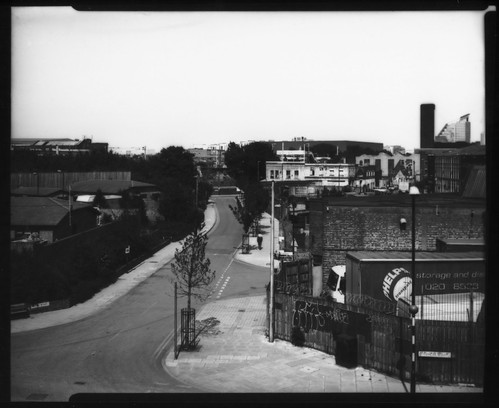
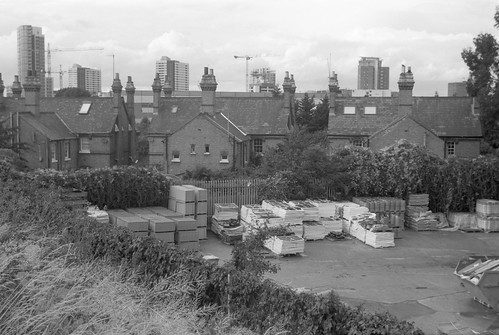
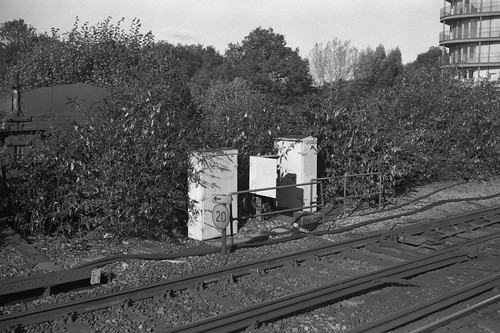
Dagenham Brook, Baby Ikonta, Kodak High Resolution Aerial Duplicating Film
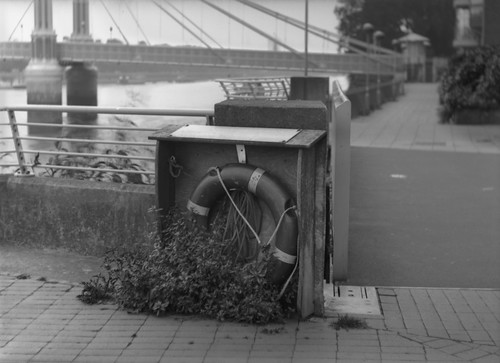
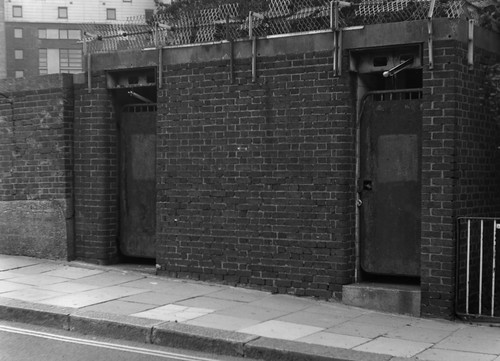
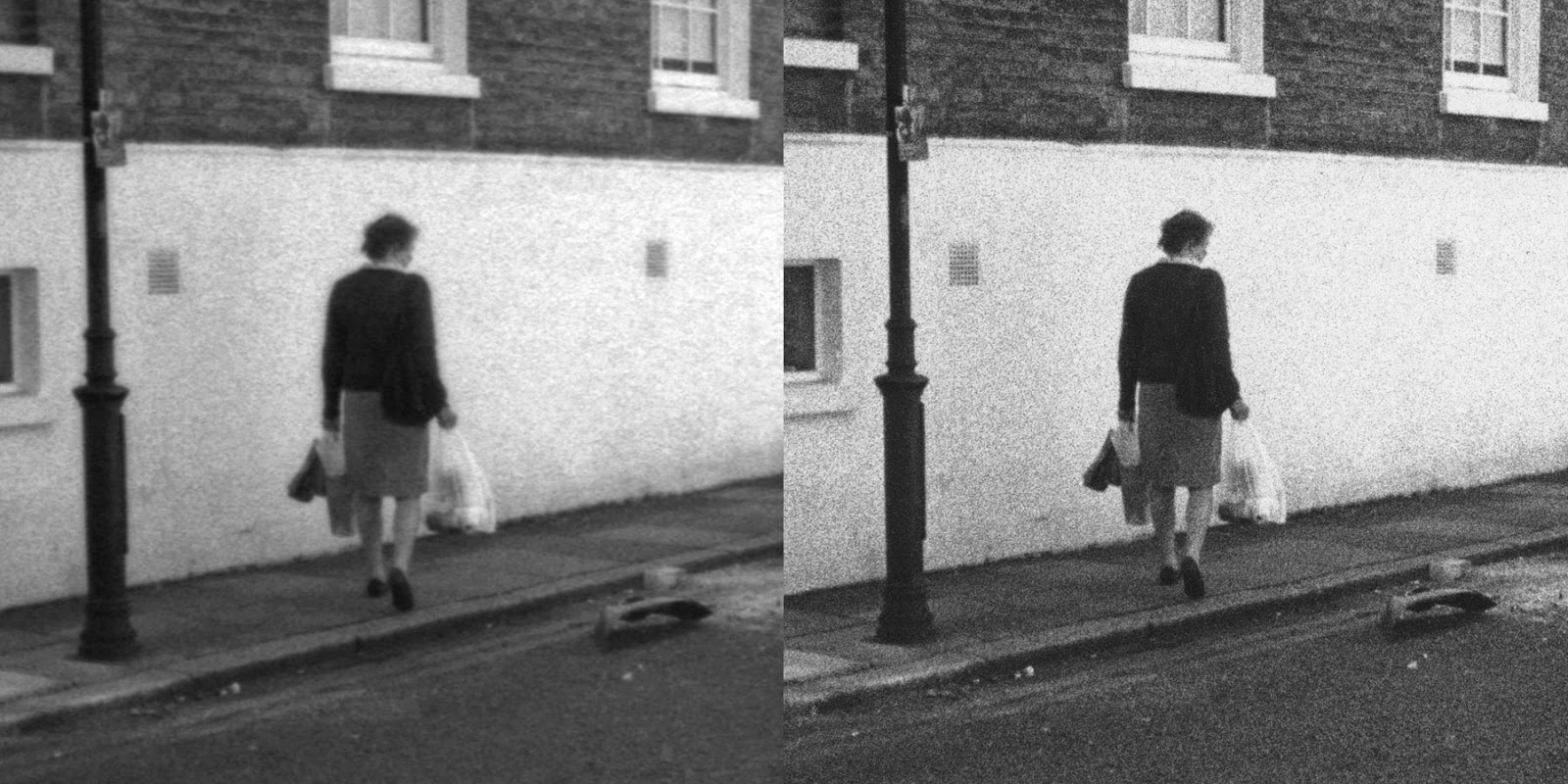
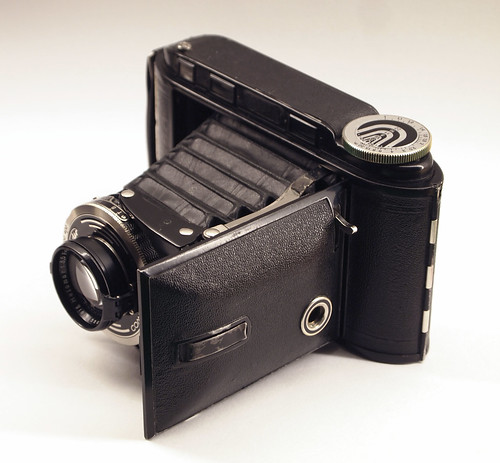
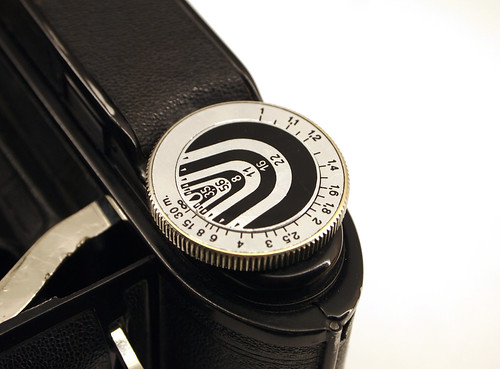
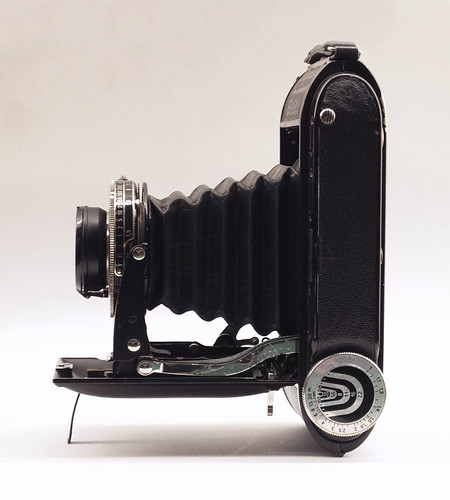
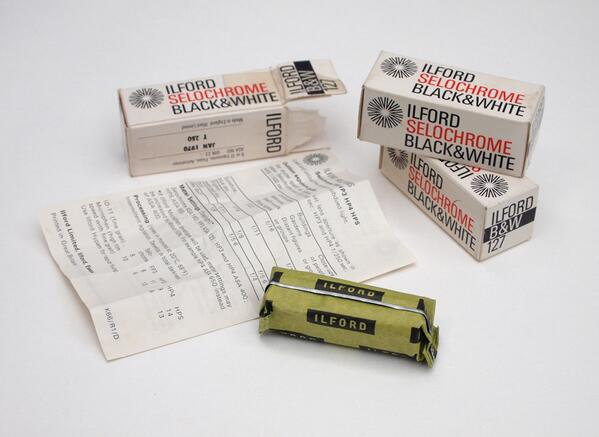
On last Saturday's 127 Day, I shot two rolls of Ilford Selochrome and Kodak High Resolution Aerial Duplicating Film apiece with my Baby Ikonta. The Selochrome films had a develop before date of January 1970, but I've had fairly good results with out of date Ilford 127 format films before, notably FP4 on last December's 127 Day. These Selochrome films were originally rated 160 ISO, but I shot the rolls at 40 EI to compensate for the loss of sensitivity with age. Selochrome was a brand name that Ilford used for a number of emulsions - the Selochrome roll film I used was panchromatic, whereas I have used older versions of Selochrome which were orthochromatic. To develop the Selochrome films, I extrapolated a time from the leaflet inside the box, which has data for ID-11 and Microphen. I used Ilfotec LC29; to determine a developing time, I compared the Selochrome times in ID-11 with FP3, which are the same, then used the FP4 Plus developing times with Ilfotec LC29,  but added another minute and thirty seconds as an additional margin of error.

Ilford Selochrome 127 format
I developed the first of the Selochrome films only to find that I didn't have any fixer. This oversight can be explained by the fact that I wasn't using my normal darkroom due to refurbishment, instead developing at home using a dark bag and a single reel tank. I had acquired a number of bottles of various chemicals and was under the impression one of these was fixer. Instead, I had three different types of developer, and one bottle of stop. As it was a Sunday afternoon, I wasn't able to buy some fixer there and then. Rather than leave the film in the rinse unfixed overnight, I looked online for suggestions of household chemicals that could be substituted for fixer, and came across several discussions (mainly with the same participants, such as here and here) about the use of common salt. From others' experiments, the use of a salt solution requires the film to be soaked for considerable time in a highly saturated solution. Apparently, the time can be reduced by being heated, but I didn't want to so with such an old film, fearing that the emulsion might simply separate from the base, quite apart from the chance of reticulation. Recommendations for the salt solution suggested a mix of 300g salt to 1 litre of water, which I heated to disolve the salt, cooled the solution, and then left the film soaking overnight. I also soaked an undeveloped film end to use as a control. The next morning, after around 18 hours, the film end was nearly clear, but not so transparent that I would be confident of its archival stability. I bought some Ilford Rapid Fixer to fix the Selochrome film, which was also fairly clear after being soaked overnight. Although I did take the precaution of re-fixing the film, this experiment seemed to demonstrate that it would be possible to use such a technique in an emergency, but not in a hurry.

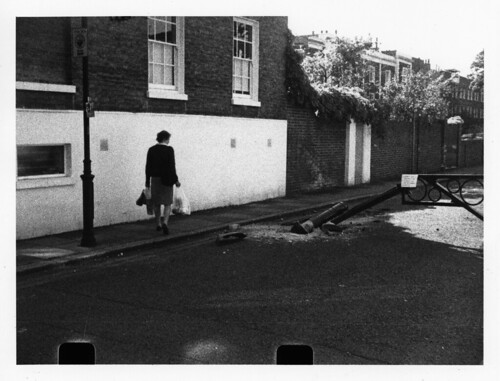
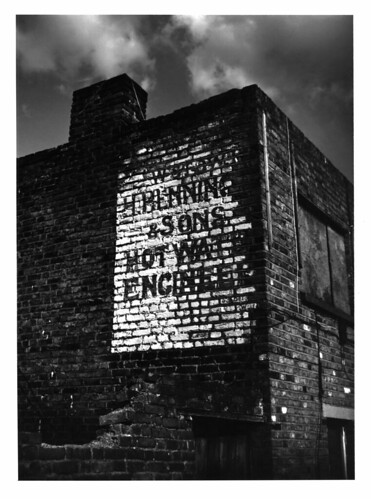
Brick Wall & Shadows, Baby Ikonta, Ilford Selochrome
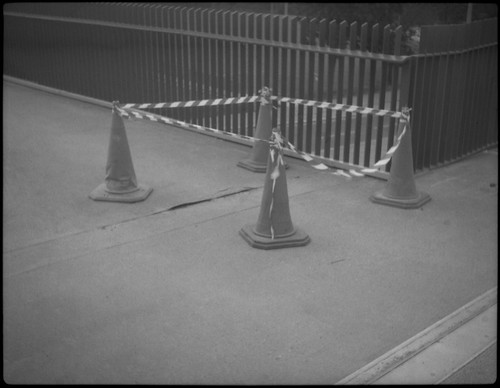
Cones, Baby Ikonta, Ilford Selochrome
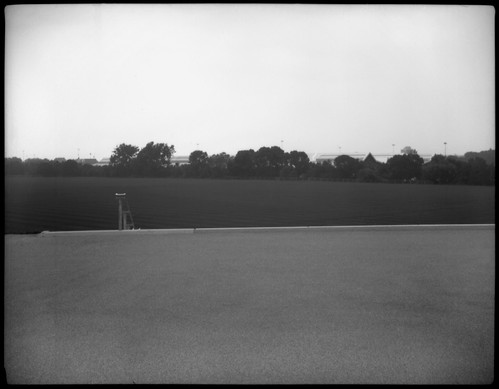
127 Day, Baby Ikonta, Ilford Selochrome

The Selochrome negatives looked a little overexposed, with some fog as to be expected with films over forty years old, and there was a texture imparted on the emulsion from the backing paper, but this mainly showed up in larger areas of more even tone, such as the sky in the last photograph above.

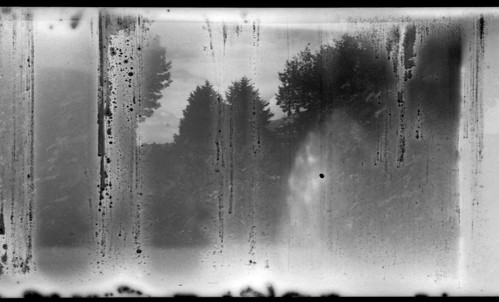
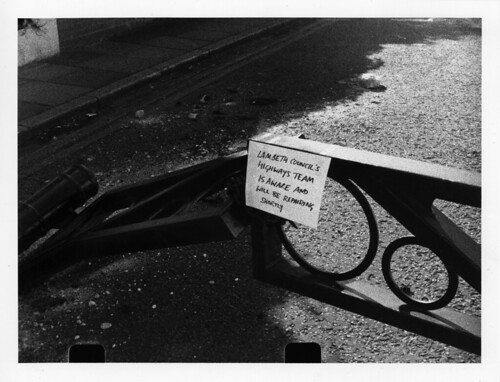
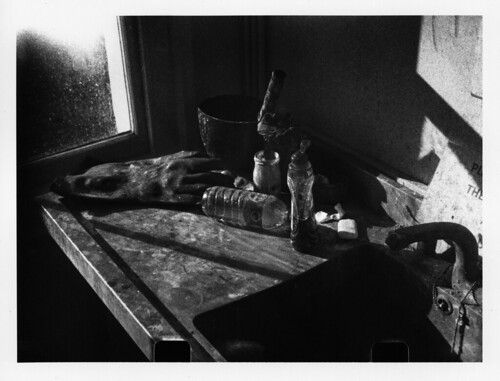
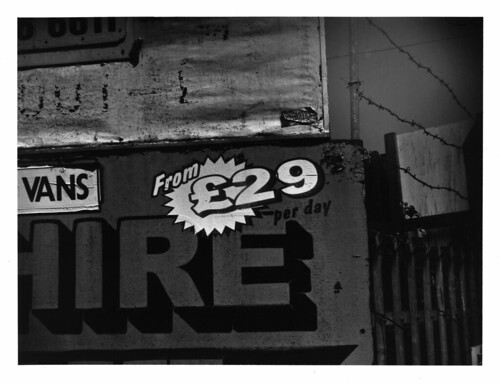
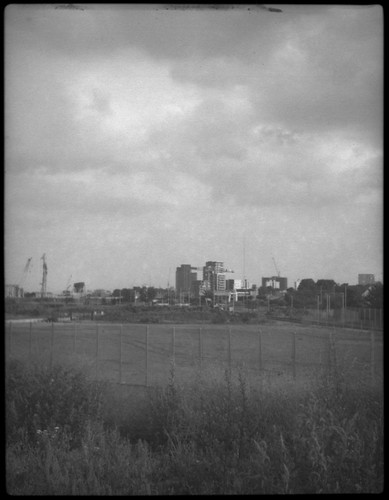
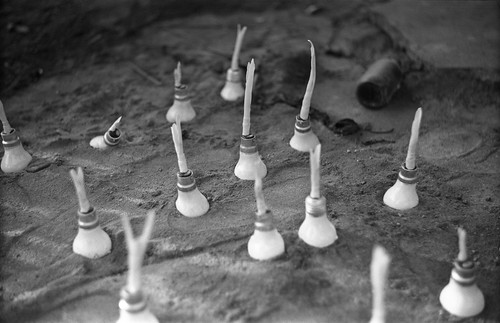
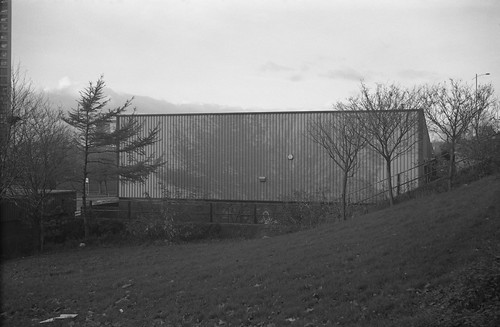
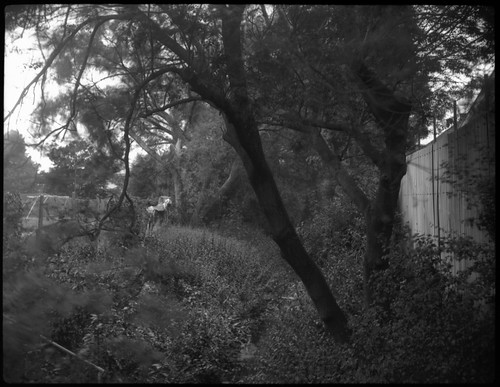
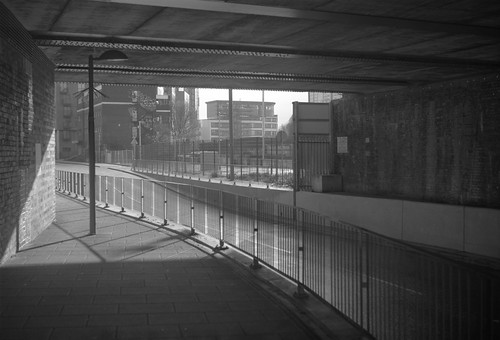
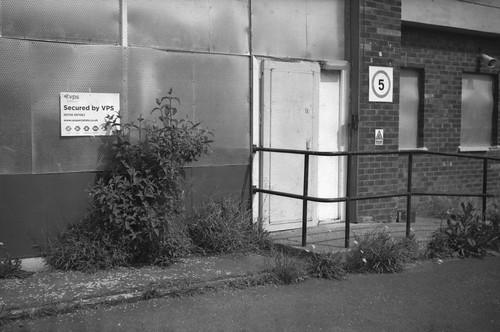
I also shot two rolls of Kodak High Resolution Aerial Duplicating film cut to 127 size. One film I pre-exposed in the darkroom to raise shadow values, the other was shot without, although the results show no real difference. Having recently tried stand development with Ilfotec LC29, rather than Rodinal/R09 One Shot, I also used it here. The first of these High Resolution Aerial Duplicating films was stand developed in Ilfotec LC29 at a dilution of 1+200, but, looking a little thin, I used a dilution of 1+150 for the second film. I was also using a small tank, which only held a maximum of 400ml, so the actual amounts of developer used was very small, 2ml and 3ml respectively. The best shot from the High Resolution Aerial Duplicating film is at the top of this post, all the other photographs had featureless skies, which I did expect from this high contrast blue-sensitive film, which also exaggerates the vignetting of my Ikonta's Novar lens, even stopped down.

Lea Interchange, Baby Ikonta, High Resolution Aerial Duplicating film
East Marsh, Baby Ikonta, High Resolution Aerial Duplicating film
Leyton Sign, Baby Ikonta, High Resolution Aerial Duplicating film

Friday, 11 July 2014

Kodak High Resolution Aerial Duplicating Film

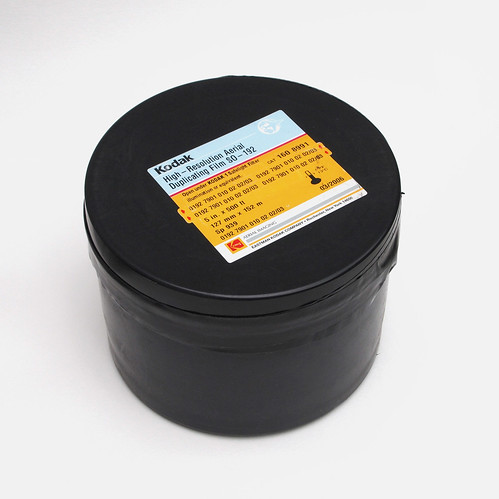
Kodak High Resolution Aerial Duplicating Film SO-192
Sometimes when searching for photographic materials online, one finds quite obscure films on auction sites. This drum of Kodak High-Resolution Aerial Duplicating film was a entirely speculative bid, not really knowing exactly what it was; I calculated, that, being 5 inches wide, the 500ft of film could be cut to 1,500 sheets of 4x5. That's a lot of photographic material. It has a date of 03/2006, but given the nature of the emulsion type, unless stored in the worst conditions, this age would have little bearing on the film.

Kodak High-Resolution Duplicating Film label
Research online brought up a data sheet which provided more information about the film. The name itself is entirely descriptive, but the data sheet elaborates:
The blue-sensitive, hardened emulsions of this film is extremely fine grain and of extremely high resolving power. The film is designed for duplicating very fine grain, high-definition aerial negatives. It is intended for use as a second-generation positive and a third-generation negative.
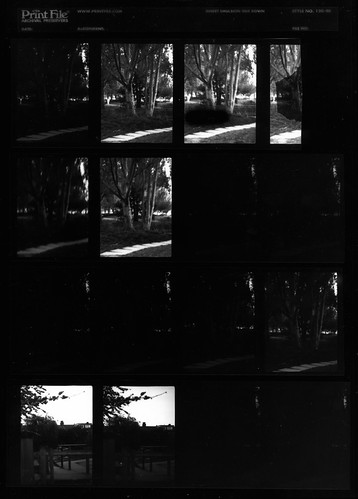
Kodak still make a number of films for aerial imaging. This film is available to buy from selective suppliers, which may mean that Kodak are still producing it, although, like other recently discontinued films, it may be that there are sufficient stocks to meet demand for some time to come. The SO-192 code stands for 'special order': a number of Kodak films have special order numbers which denotes not only the type of emulsion, but also substrate, and other aspects such as format, perforations and so on. High Resolution Aerial Duplicating film is available on two thicknesses of film base, and each has its own SO number, SO-192 on 3.9 mils (0.10 mm), and SO-187 on 7.0 mils (0.178 mm) Estar base. As the film is blue-sensitive, it can be handled under normal darkroom safelights, Kodak recommending Safelight No.1, a red safelight, although as blue-sensitive, presumably yellow or amber would also be safe. Although not intended as a camera film, I wanted to use it as such. Information about exposure and development from Kodak is purely for its use as a duplicating film, but having used similar films before, I had some idea of the parameters of both. To make some initial tests, I cut a couple of lengths of the film (inside the large tub, the film is on a metal spool) with a rotary trimmer to the width of medium format, 62mm, and rolled these with 120 backing paper. Notably, the film itself is bright yellow. I used the first test to get a usable exposure index. I had read online that the film has a sensitivity around 2 ISO, and so shot the first tests with this in mind, bracketing exposure. The film was stand developed in R09 One Shot at 1+150 for one hour. The contact sheet below shows the results. The frames run right to left, and are rated (first row) 1, 2, 3, 4, (second row) 8, 16, then 3, 6, (third row) 6, 12, 24, 24, (fourth row) 50, 50, with the last two frames at 6 and 3 EI.

Kodak High Resolution Aerial Duplicating Film contact sheet
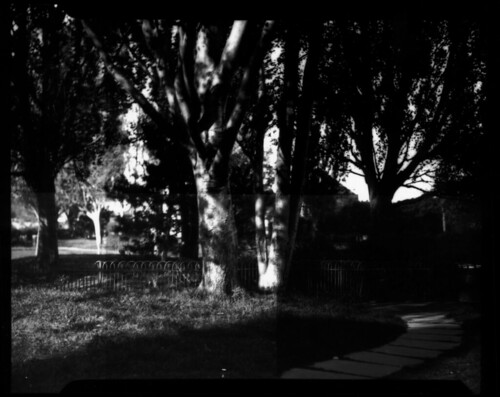
I did have problems with shooting this test roll: the shots needed long exposures, some of several seconds, and as the Baldalux camera I used does not sit very securely on a tripod, there was camera shake blurring these shots, such as the image below. When developed, the film exhibited very high contrast, grain too fine to show when scanned from the negatives, very clear film base, and, as the contact sheet above demonstrates, no real latitude to the exposure. At 2 ISO, Kodak High Resolution Aerial Duplicating Film is slower than normal paper emulsions, and slower than almost all of the old glass plates I have been using recently.

Kodak High Resolution Aerial Duplicating Film (6x4.5cm), Zodel Baldalux
For a second test, I cut a couple of pieces to 4x5 inches, and shot them with the MPP Micro-Technical Mk VI camera. In this test I wanted to see if pre-exposure would reduce apparent contrast by raising the shadow values, and exposed a strip across both of the two sheets in the darkroom when loading the film holders. This is most evident in the upper of the two images below, although in the second shot this pre-exposed strip is across the top of the shot amongst the branches making it harder to judge. Both sheets were stand developed in R09 One Shot, diluted 1+120 for one hour. The two photographs below show how important accurate exposure is with Kodak High Resolution Duplicating film as it has very little latitude: the shutter on the Xenar lens is sluggish at the slow speeds, leading to over-exposure, whereas perhaps the Tessar's shutter speeds were running a bit fast.

Kodak High Resolution Aerial Duplicating Film 5x4 inch test shot, 16.5cm Tessar, rated 5EI,
three successive exposures by progressively withdrawing the darkslide,
giving effective exposure indexes of 5, 2.5, 1.25 (left to right)
Kodak High Resolution Aerial Duplicating Film 5x4 inch test shot, 150mm Xenar, rated 6EI,
three successive exposures by progressively withdrawing the darkslide,
giving effective exposure indexes of 6, 3, 1.5 (left to right)
I shot some more of the film in large format, although in bright sunny conditions, which meant that the inherent contrast was a problem. There is very little detail in either highlight or shadow areas. The image below was scanned from a contact print, scanning from the negative may possibly provide a little more detail at either end of the contrast range.

Kodak High Resolution Aerial Duplicating Film 5x4 with 16.5cm Tessar
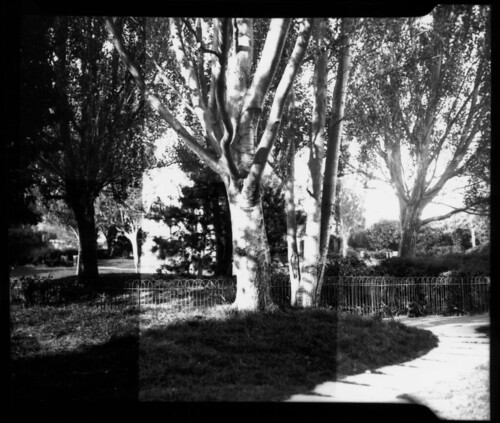
Under overcast conditions, I shot another roll cut to medium format. Here I exclusively used long exposures of several seconds, perhaps more accurate than slow shutter speeds such as 1/2 or 1/5th, although I did not adjust for reciprocity law failure (on the data sheet it suggests adjusting an exposure of 1 second to 2 seconds). For this film I increased developer dilution, using stand development with R09 One Shot at 1+200 for one hour. The combination of flat lighting, accurate (but not adjusted) long exposures, and highly dilute film developer provided the best results. Although Kodak High Resolution Aerial Duplicating film has very specific applications, and is not intended as camera negative material, with the right treatment this is possible. No doubt the film would also be useful for creating negatives and positives by enlargement for alternative and contact processes.

Kodak High Resolution Aerial Duplicating Film (6x4.5cm), Wallace Heaton Zodel

Sources/further reading:
http://www.kodak.co.uk/ek/GB/en/High_Resolution_Aerial_Duplicating_Film_SO-192.htm
Kodak Aerial Films
Tom Philo's Kodak Film Number Cross Reference Table

Saturday, 28 June 2014

Kiev-30M

Kiev-30M (open, the red dot, just visible, indicates the shutter is cocked)
The Kiev-30M is the penultimate model in a series of 16mm subminiature cameras produced by the Arsenal factory in Kiev, Ukraine. The original model of the Kiev subminiature series, the Vega, was based very closely on the Minolta-16. Like other Eastern Bloc post-war cameras copied from (mostly German) cameras, the Kiev Vega then evolved separately from the camera it was based on as the design was modified with each successive model. The second version of the Kiev Vega added the ability to focus the lens, something that the Minolta-16 cameras didn't have until much later models (though there were close-up filters available). The cassette was redesigned for the Vega 2 with a smaller spool than that of the Minolta-16, increasing the number of frames on a roll of film from 20 to 30. The Kiev Vega 2 was succeeded by the Kiev-30, which utilised a larger frame size (13x17mm) in a redesigned body. This larger frame size reduced the number of frames on a roll of film from 30 to 25 (although I wonder that the reason for the camera being called the Kiev-30 is due to this change to the preceding model). The Kiev-30M had a couple of minor changes from the Kiev-30, simplifying the camera by losing the PC flash sync socket and the manual exposure calculator on the back. The last 16mm model from Arsenal was the Kiev-303, which featured a redesigned plastic body in a variety of colours, and had four speeds rather than three, with 1/125th and 1/250th instead of the previous top speed of 1/200th.
Kiev-30M box contents
My Kiev-30M came in a box set from the Lubitel shop in St Petersburg (I wrote a post about the camera shortly afterwards, but, recently, having used it more, I felt it was worth substantially rewriting this). Although the box had seals that had been broken, everything inside appeared as new. As well as the camera, the contents are: a camera strap and case; a second film cartridge, in a plastic box; a reducing frame for using the 16mm negatives in a 35mm enlarger; a reel to fit in a developing tank; the camera manual; and a piece of paper with a list, possibly of suppliers. The manual is dated with a stamp of April 1989. The three rolls of Svema Foto 65 film (which came from a different camera box) have a 'develop before' date of 'IX/1986'.

Kiev-30M (closed)
The Kiev-30M is very compact 86x47x28mm when closed, extending to 108mm wide when open. Despite the camera's small size it is relatively heavy at 190 grams as the camera is constructed almost exclusively from metal and is entirely manual and mechanical. The controls visible on the side of the camera are two wheels, one to set the limited range of shutter speeds, 1/30th, 1/60th and 1/200th; the other controls the aperture, from f3.5 to f11. On the underside of the camera is a window showing the exposure number. To take photographs, the camera's outer body shell slides to the open position (as in the image at the top of this post), which uncovers the shutter release and focus control; the two glass windows align to the viewfinder and lens. The window that covers the lens can be removed by sliding it out sideways: the Minolta-16 had filters which could be inserted here, although the Kiev-30M box didn't come with any filters. The lens is a 23mm Industar-M, which on the 13x17mm frame size provides roughly a (horizontal) 40º angle of view. The lens focuses down to 0.5 metres, markings are also provided for 1 and 2 metres, in black, while picked out in red are the infinity mark and, close to this, a dot. The red dot is the focus setting for 5 metres, which serves as a hyperfocal position for all apertures. Also uncovered on the camera's top plate is a film plane indicator, while the serial number is engraved on the underneath.

Depth of focus table from the manual;
the '15' in the focus setting column must be a misprint for 0.5
Opening the camera cocks the shutter and advances the film: the shutter appears to be a guillotine-type, and when cocked, there is a red dot to indicate this visible in the lens window. The push-pull film advance does mean that opening and closing the camera without taking a shot results in a blank frame, but without opening the camera it isn't possible to look through the viewfinder.

Kiev-30M opened for loading
To load and unload the Kiev-30M, the outer shell has to be removed completely: there is a catch which can be released only when the camera is in the open position. This lays bare the exposure counter wheel: when loading a film, this needs to be manually reset by aligning a red line on the wheel with another line on the bottom plate. The film cassette is loaded by opening a cover on the top. The film cassettes have two chambers, one smaller, without a spool, for the supply side, with take-up side being slightly larger to accommodate the spool. As a legacy of the camera's origins as a copy, Minolta 16 cassettes are said to be compatible with the Kiev cameras. With a frame size of 13x17mm rather than 10x14mm, the Kiev-30M is designed for unperforated 16mm film (perforations will be visible in the image area). The cassette takes a 45cm length of film: the frame counter goes up 25, with every third number represented with two dots between (there is also a red dot between the numbers 16 and 19). When loading the cassette, a small pressure plate with a tiny tab needs to be pulled back to slide the section of film between the two chambers into position, not immediately obvious on a first attempt.
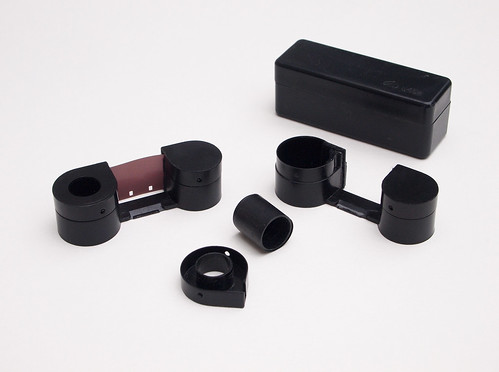
Kiev-30M cassettes
Kiev-30M with expired Svema Foto 65 film
I shot two of the Svema films while in St Petersburg, loading the cartridges inside the hotel room cupboard with all the lights in the room turned off. I finished the second roll of film once I had  returned home and stand developed it in Rodinal diluted 1:100 for one hour, using the technique I'd tried with film from the Mamiya-16 Automatic of taping the 16mm film, emulsion side out, to a length of 35mm film and loading this on a normal 35mm developing reel. The film is Foto 65, the 65 being the film's GOST value, the Russian speed scale, equivalent to 20 DIN/80 ASA. Translating the text on the box, the film was originally priced at 10 kopecks, surely very cheap even 30 years ago, and has a developing time of 5 minutes, although there's no indication of the developer required. The price of the film refills perhaps reveal why the 16mm subminiature format persisted in the Soviet bloc (the last Arsenal subminiature camera, the Kiev-303, was produced c.1990), while elsewhere Kodak's 110 format essentially used market dominance to push out all the previous competing 16mm systems twenty years earlier, where most cameras had proprietary cassette designs.
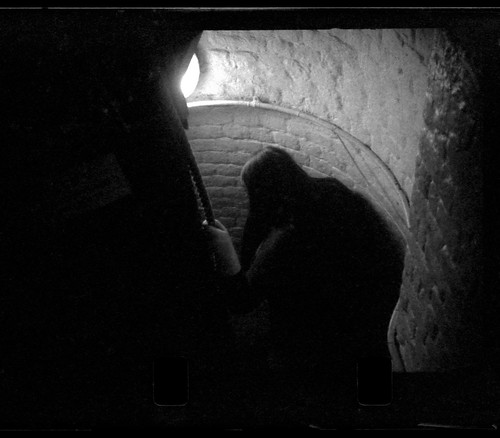
Kiev-30M with Kodak WL Surveillance 2210 film, scan from negative
When loading the cartridges with 16mm film from 100ft rolls, it is possible to get more than 45cm of film into the supply side chamber, and it's relatively easy to get around 30 rather than 25 frames, although the frame counter doesn't turn around any further after the number 25. With single perforated film, if the film is loaded into the cassettes with the perforation side towards the plastic bridge between the chambers, the perforations appear at the bottom of the frame, to my mind less obtrusive to the resulting photographs. As I found when using the Mamiya-16 Automatic, subminiature negatives are too small when scanned with flat bed scanners to properly resolve detail. To really appreciate the results from the camera, I recently printed a number of shots from the Kiev-30M in the darkroom. The 16mm reducing frame which came in the box proved very useful when printing, and given the small size of the negatives, I had to wind the enlarger head almost to the top of its post to achieve a print size of 5x7 inches. The images below are all scanned from prints on Kentmere VC Select paper.
Kiev-30M with Kodak WL Surveillance 2210
Left: scan from negative at 3200dpi; right scan from 5x7 inch print for comparison
Kiev-30M with Kodak WL Surveillance 2210
The Kodak WL Surveillance 2210 film for the shots above is a 400 ISO film, and the grain is particularly pronounced as a result of the subminiature frame using approximately a quarter of the film area compared to a standard 35mm frame. I also shot some Agfa Copex HDP 13 microfilm with the Kiev-30M (although not stated, it's a reasonable assumption that HDP stands for High Definition Panchromatic). Typically for a microfilm, it's very slow and very high contrast, but extremely fine grained, which is a great benefit to the subminiature frame size. My first tests with stand development in R09 One Shot at 1+150 suggested an exposure index of 25, but I subsequently shot another roll rated 16 and using a developer dilution of 1+200, which provided better results. The images below were printed on Kentmere VC Select with a 00 Mulitgrade filter, the lowest contrast possible when printing (it is easier to reduce contrast further when scanning).
Kiev-30M with Agfa Copex HDP 13
Detail from the above image showing fine grain structure and high resolution
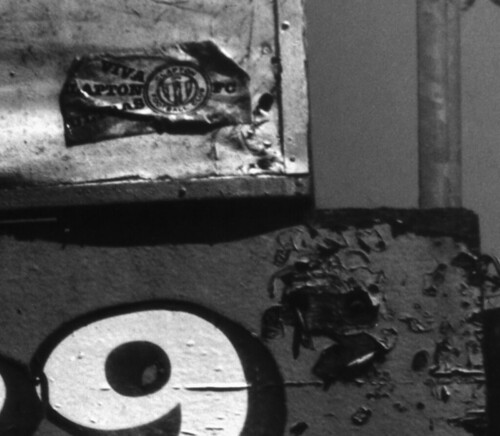
The enlarged detail above demonstrates both the high resolution of the Agfa Copex HDP film and the resolving power of the lens in relation to the negative size. The sticker in top left is approximately 0.6mm high on the negative: the small lettering in the roundel on the sticker itself which is just legible is considerably less than a tenth of the size of the sticker. Evidently the film resolution exceeds that of the lens, but the extremely fine grain makes it ideal for the subminiature format, although the inherently high contrast means that it has very little latitude and may be more suitable for low contrast scenes and subjects, although both images above were taken on a bright sunny day, and the slow speed of the film is more appropriate for bright conditions.

As with many cameras from the former Soviet Union, the Kiev-30M is not without problems. The push-pull frame advance is not always reliable: occasionally the shutter does not cock, and so a frame is wasted in opening and closing the camera again; the catch on the underside of the body can be forced under the outer casing itself, the remedy to this is to bend this catch upwards to engage the outer casing more securely (Minolta cameras abandoned the push-pull advance as new models were introduced after the Minolta-16 II). I have also had odd vignetting on a number of frames, such as in the last shot above, which may be due to the shutter not opening fully. The cassettes are prone to light leaks, this happens more with perforated film. The limited aperture and shutter settings can fall a little short when using a fast film in bright light: 1/200th at f11 with a 400 ISO film in bright sunlight means accepting some overexposure (a yellow or neutral density filter would help in such circumstances). Conversely, a faster lens and a B setting would be useful for low-light situations. Set against these issues, the Kiev-30M is enjoyable to use for a number of reasons: its small size, when closed, easily the smallest camera I own; 16mm film is very cheap by the frame, a standard 100ft/30.5m) roll will fill many cassettes at 45cm each; and the simplicity of the camera itself.

Sources/further reading:
Kiev 16mm cameras on SovietCams.com
Kiev 16mm variations on Submin.com
Soviet-era subminiature camera list on Commie Cameras
Kiev-30M variations on Fotoua.com
Kiev-30M on USSRPhoto.com
Saturday, 14 June 2014

Ilford ULF Film Order 2014

Every year Ilford invites orders to manufacture film in a number of non-standard or obsolete sheet and roll film sizes. It's known as the ULF film order, but it isn't restricted to ultra-large format film. Among the various sheet film sizes, one of the notable items last year was the provision of HP5 Plus in 50ft lengths of 46mm, the size of 127 format; evidently last year's run had sufficient demand for Ilford to offer this size again.

The deadline for orders this year is Friday 27th June. For more information see Ilford's website: http://www.ilfordphoto.com/products/page.asp?n=137

Friday, 13 June 2014

Agfa Record I

Agfa Record I
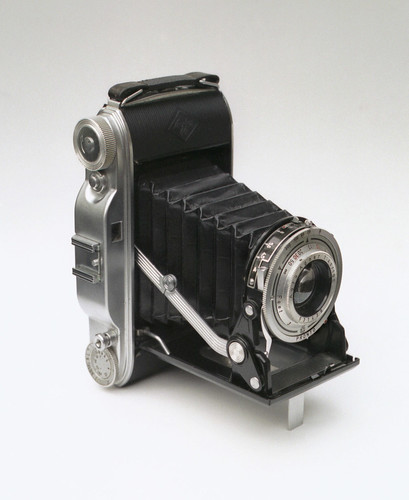
The Agfa Record I was the camera that got me into the 6x9cm format. I had previously used a Zeiss Ikon Nettar camera, which was my first folding camera, picked up form a charity shop, but found the 75mm focal length on the 6x6cm negative just a little wide, and I've also thought that the square format does require more consideration when composing the image. 6x9cm was the negative size that 120 medium format film was initially designed for, introduced with Kodak's No.2 Brownie camera in 1901. At the time most amateur photographs were contact printed from negatives rather than enlarged (a fact which lead to much larger roll negative sizes, such as the 122 postcard format); 6x9cm, although small by modern standards, was just acceptably large enough for snapshots. As I've previously written about in my post for the Baldalux camera, the folding 6x9 format camera is an ideal travelling companion, a good compromise between portability and negative size.
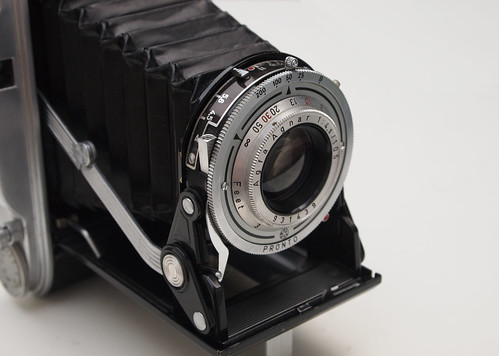
There were three models of Agfa Record cameras: the Record I was the least expensive model; models II and III were not successive designs of the Record, but contemporaneous, more sophisticated and expensive models with better lenses and shutters (the top-of-the-range Record III also featured an uncoupled rangefinder). The Record I was supplied with a 105mm f4.5 Agnar lens, Agfa's own triplet lens, which has front element focus down to 3 feet, and stops down to f32 (an aperture setting which I may never have used), in a four speed Pronto shutter (25, 50, 100, 200 plus B).
Agfa Record I - Lens and shutter detail
The camera is simply and robustly constructed. The metal body is covered in leatherette with a pattern of fine cording, providing a good grip. To open the camera, the front catch button is nestled beside the large winding knob, and when pressed the lens pops out into position with a snap, and the shutter release on the body also pops up. The arms lock to hold the lens and shutter quite rigid.  Unlike the Voigtländer Bessa RF from my previous post, the shutter linkage is a solid bar along the bed underneath the lens. The viewfinder is relatively large compared to other folding cameras of similar date. Focus is by estimation: there are markings around the lens of distances in feet, with 30 and 10 picked out in red; there is also a red dot next to f11. These settings must be for 'view' and 'group' shots: with the focus set for 30 feet, at f11, depth of field extends from infinity to just short of 13 feet; set at 10 feet, it's a bit broader than 8 to 13 feet.

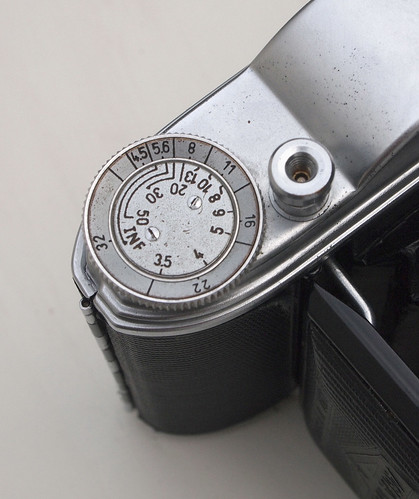
Depth of field scale
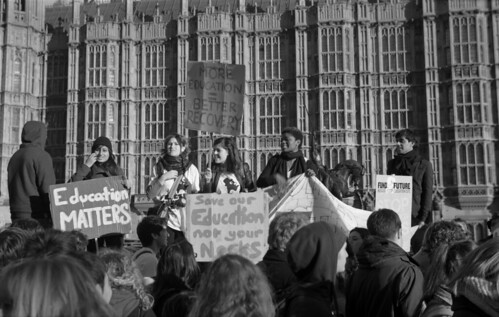
Using both the Nettar and subsequently the Record I were amongst my earliest experiences of using guess focus. I did also have a Lomo LCA at the time, but this has a wide angle lens on a small format: with the longer focal lengths of medium format folding cameras, compared to standard lenses on 35mm, for the first time calculating depth of field became very important. The Agfa Record's depth of field scale (in the image above) was extremely useful. The outer ring rotates so it is possible to align the small tick in the aperture section on the outside against the focus setting inside. With experience, guess focus for anything other than near scenes at wider apertures is relatively easy, but when I began using the camera, this small scale calculator was a welcome reassurance. I used the camera very frequently over a period of about three years, taking it abroad and on a number of protests and demonstrations. I inadvertently dropped it onto the pavement during the first of the student fees protests in 2010, which put a dent in the bottom, deforming the body just a little to make opening and closing the camera rather more tight than previously, but otherwise it still worked fine. Despite being fitted with the lowest specification lens, the negative size is very forgiving, especially when used with smaller apertures. The Pronto's four shutter speeds were restricting on occasion but I found, for its simplicity, the Agfa Record a pleasant camera to use.

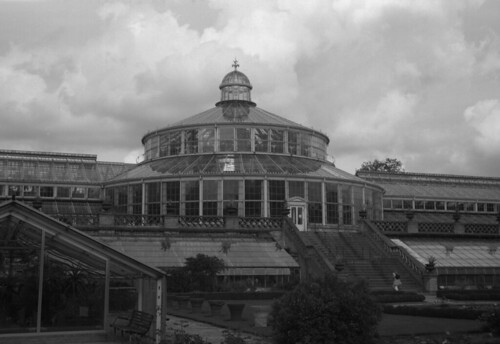
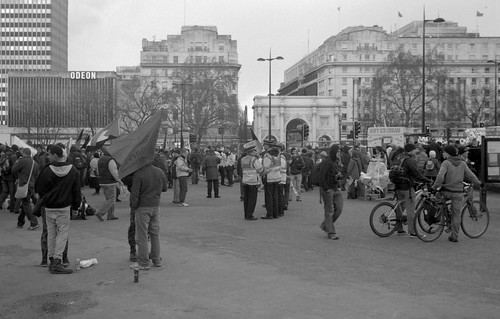
Agfa Record I with Ilford Delta 100
Agfa Record I with Adox CHS 100
Agfa Record I with Ilford Delta 400
Agfa Record I with Ilford HP5 Plus
Agfa Record I with Fomapan 400
Sources/further reading:
Agfa Record cameras at Camera-Wiki
Agfa Record I at Historic Camera
Agfa Record and Billy Record Cameras at Certo 6

Wednesday, 4 June 2014

Voigtländer Bessa RF

Voigtländer Bessa Entfernungsmesser or Rangefinder
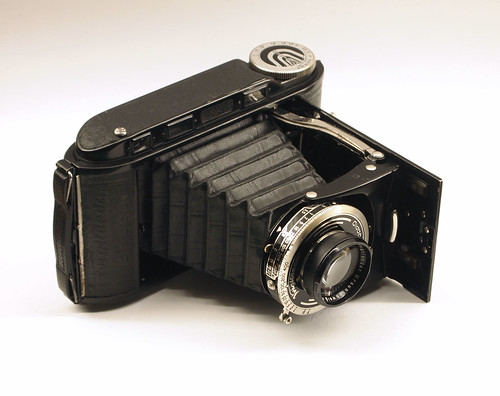
The Bessa Rangefinder or Bessa RF (also known as the Bessa E or Bessa E Messer, from Entfernungsmesser, the German for 'rangefinder') was introduced in 1936, one of a long-running series of Bessa folding cameras made by Voigtländer (the Bessa name has also been recently revived by Cosina for their Voigtländer-branded 35mm and medium format rangefinders).  It is a 6x9 folder using 120 roll film, with a mask for 6x4.5 pictures. It was available with three different lenses, the most expensive variant carrying the Heliar lens, all with a hinged filter. Production of the Bessa RF was restarted after the second world war, until the model was superceded by a 1950s Bessa Rangefinder, the Bessa II.

Having used the Bessa RF to shoot the expired Verichrome 620 film which was the subject of my last post, I thought this would be a good opportunity to write about the camera. Voigtländer had previously produced the Prominent, a fully-featured 6x9 rangefinder, but the rather Baroque design must have been expensive to manufacture. The Bessa design represents a complete rethink: it was based around the body of an optical-finder Bessa that Voigtländer made to replace their earlier Inos folding cameras. One aspect that remained the same is like the Prominent, the Bessa's rangefinder also has both windows offset from the eyepiece, not a common arrangement. Unlike the Prominent, the rangefinder and viewfinder are both housed under the camera's top plate, which is uncluttered except for the focus knob. On the other end of the top plate is a small button with a ridged grip. This is used to rotate a mask hidden inside the viewfinder to narrow the view from the 6x9 format down to 6x4.5 proportions when using with the internal mask. The camera's black painted trim and other components, rounded corners and curving lines lend the Bessa RF a touch of Art Deco elegance (compare, for example, the contemporaneous Super Ikonta, with similar features in a very different arrangement).

To open the camera there is a small release button on the bottom plate. The lens is self-erecting, although with my camera the front standard needed to be securely locked into place manually, it may have had more spring when new. The metal tab underneath the lens is depressed to unlock it and close the camera. When opened, the unusual shutter release is erected from the slot in the hinge-side of the door close to the body, shown in the image below. This shutter release trigger was a common feature to Voigtländer's folding cameras of the 1930s and 40s, and one which the company patented.

Voigtländer Bessa RF
The split image rangefinder is a separate window from the viewfinder, but it is coupled to the lens. As the rangefinder eyepiece shows a magnified and cropped image, allowing for very accurate focus, the separate viewfinder is needed for framing. Focussing is by turning the knob on the top plate which also provides a depth of field scale. This moves the whole lens and shutter unit forwards on two brass rails inside the bed. Interestingly, the camera can be focussed when closed, and as a result the focus does not have to be set to inifinity when closing the camera, unlike some rangefinders. The camera focuses down to just under 1 metre.

Detail of focus knob and depth of field scale
One of the curious effects of the Bessa's layout is that the user controls are on the left hand side of the camera, which makes for odd ergonomics for a right-handed person. However, I have read somewhere that the reason for this was that it designed to be used comfortably when held vertical, in the portrait format. I habitually use the 6x9 format for landscapes, but turning the camera through 90º this makes sense: the user's right hand can support the camera with either fore- or middle finder on the shutter release, while the left hand can rotate the focus wheel. In the horizontal format, one has to use the same hand to focus, then depress the shutter. The controls around the lens are placed in such a way that these can be easy adjusted in either vertical or horizontal position when looking down at the camera. In particular, the shutter speeds are represented on two scales, visible from the front, as is standard with Compur rim-set shutters, but also just above the aperture settings on the side of the shutter.

Voigtländer Bessa RF in vertical format
My camera has the Helomar f3.5 105mm lens, which was the least expensive option; the Bessa RF was also supplied with a Skopar, or, the most prized, a Heliar lens. According to this scan of the  British Journal Photographic Almanac 1939, there was a £5 difference between the bottom of the range Bessa RF with the Helomar lens, and that with the Heliar lens, which does not sound like much, but the cheapest optical-finder Bessa was just £2.17.6. The results I've had from this camera demonstrate that the Helomar lens performs as might be expected from a pre-war uncoated triplet: soft at the edges at wider apertures but still very capable of resolving fine detail in the central image area, as shown in the recent tests of Rollei RPX 25 shot with this film; stopped down beyond f8 the Helomar is acceptably sharp, especially in relation to the size of a 6x9 negative (such as the example shot on Fomapan 400 below, possibly shot at f16). Incidentally, the lens is dated to 1936, the year the Bessa RF was introduced, although the shutter's serial number is dated two years later, to 1938.

Voigtländer Bessa RF sample image with Fomapan 400
When using the Bessa RF there are a few quirks to watch out for. My camera has seen a fair amount of use, judging from the paint losses and other signs of wear. As well as having to ensure that the lens is rigidly locked in place on opening, the shutter linkage sometimes needs to be reset: the pivoting arm which trips the release lever on the shutter has a pin connecting to a slot which descends when the shutter trigger is pressed. This pin sometimes comes loose and needs to be located back in the slot by hand. I don't know if this is a common problem with old Bessas, a weak point in the design: there does appear to be a fair bit of play with these components, which no doubt has increased with use. I also found when I first received the camera that the shutter release was not very 'soft', which meant that I had to use faster shutter speeds to ensure against camera shake, and as a consequence I had to use the lens at wider apertures to compensate. This was resolved by loosening the retaining ring inside the camera and turning the whole shutter and lens assembly by just a small amount, to reduce the distance the pivoting linkage arm has to travel to trip the shutter (existing scratches on the retaining ring were evidence that the lens and shutter had be removed at some point, and perhaps not positioned entirely right when replaced). One of the shots on Rollei RPX 25 was hand-held at 1/50th, taken after this adjustment, which I wouldn't have been confident about previously. My Bessa is missing the yellow filter, but still has the hinged filter ring, so it may be possible to finder a filter to fit this. It is also missing the 6x4.5 mask, and I may attempt to make one to fit the camera at some point. The main reason I haven't used the Voigtländer Bessa RF more is that it is bigger and heavier than my other 6x9 folding cameras, such as the Baldalux, and when shooting the kind of landscape or cityscape photography I typically use this format for, the ability to judge focus accurately with the rangefinder is less critical. However, I did find that it was invaluable when using 620 film due to the way the spools fit in the cradle of the supply-side, something none of my other medium format cameras are capable, with the exception of the Lumière Scout Box.

Voigtlander Bessa RF, close-focussed sample image with Fomapan 400
Voigtländer Bessa RF sample image with HP5 Plus
Voigtländer Bessa RF sample image with Rollei RPX 400
Voigtländer Bessa RF sample image with expired Verichrome Pan
Voigtländer Bessa RF sample image with Fomapan 400
Sources/further reading:
Bessa RF on Camera-Wiki
Early Photography's page on the Bessa RF