Showing posts with label Selochrome. Show all posts

Friday, 24 March 2017

Take Your Box Camera To Play Day 2017

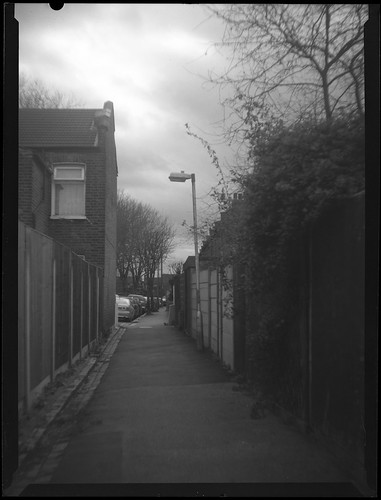
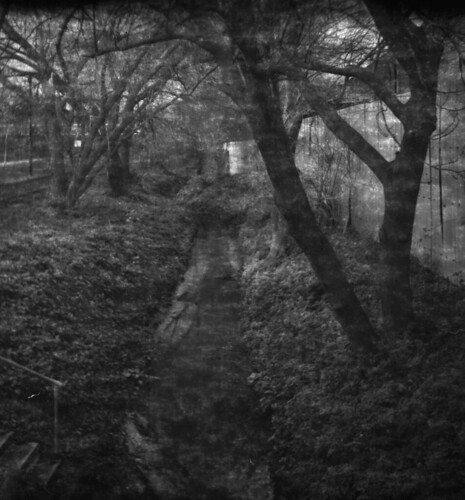
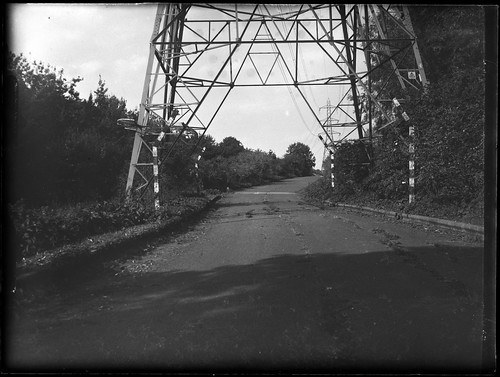
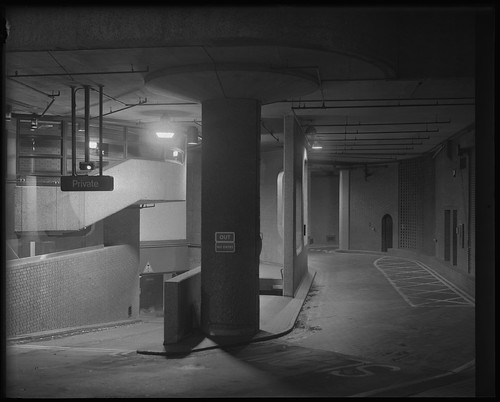
Midg Falling Plate Camera with Ilford Selochrome glass plate
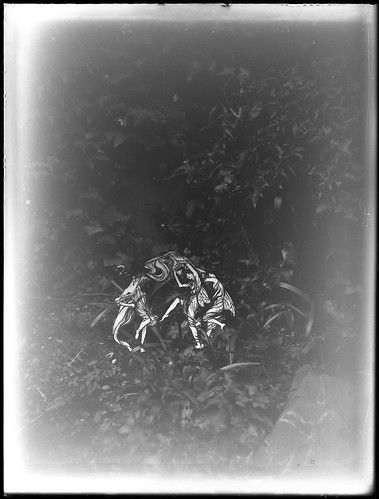
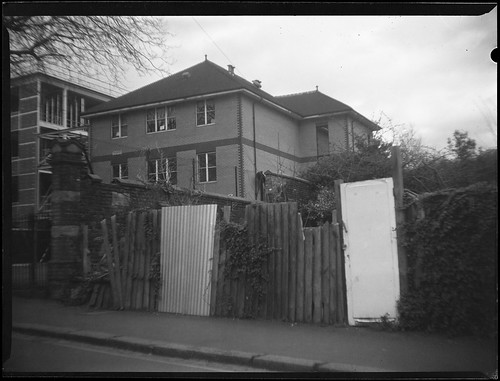
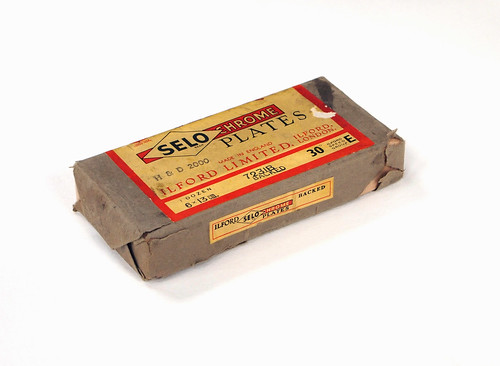
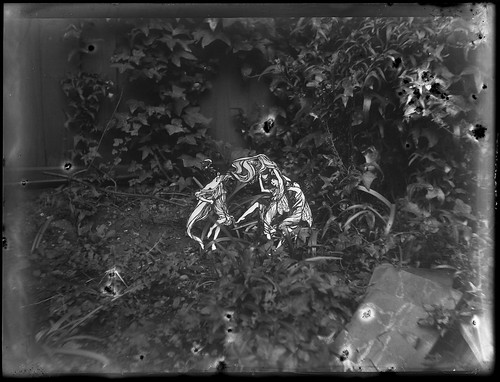
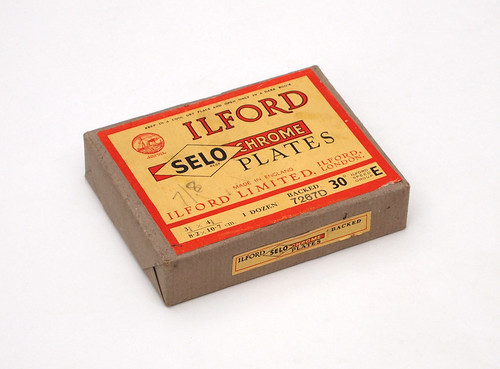
To mark one hundred years since the first photographs that became known as the Cottingley Fairies were taken, I decided to use last weekend's 'Take Your Box Camera To Play Day' to make a homage to the young photographers of this hoax. A counterpart to 'Take Your Box Camera To Work Day', I had been thinking of using the Midg falling plate camera for this event; as Elsie Wright and Frances Griffiths used a Midg camera for their first set of photographs, this appeared to be a fitting subject to shoot on the day. For the fairies, I went back to the source material that the girls had used for their first published photograph, known as 'Frances and the Fairies', figures taken from an illustration in Princess Mary's Gift Book, as pointed out by the debunker James Randi. I shot the scene at the bottom of the garden on glass plates, as would have originally been used in the Midg. I didn't have any glass plates from 1917; I used some Ilford Selochrome plates from a box which had a label inside dated to February 1945 (as a footnote to this date, the paper that the box was wrapped in had a cheaper, coarser feel than the more usual brown paper that Ilford used for wrapping plate boxes until the end of the 1950s, which might reflect on wartime paper shortages).

Ilford Selochrome plates
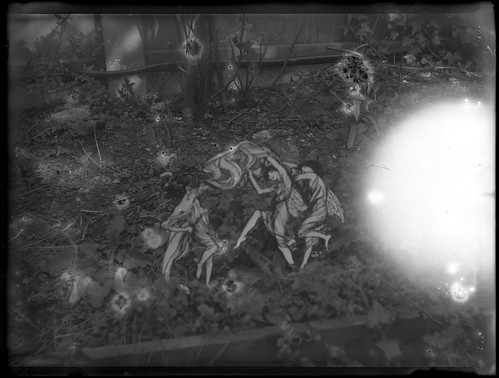
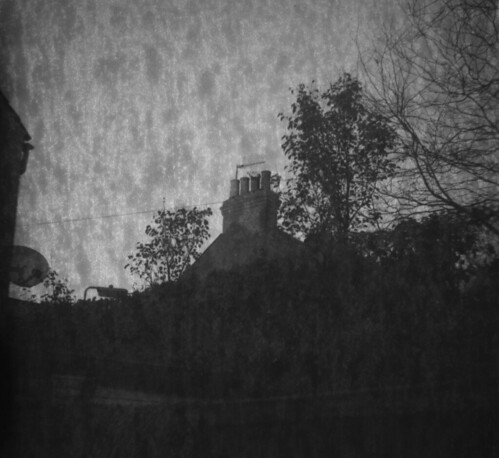
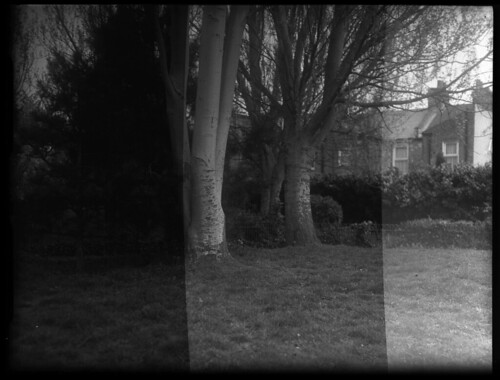
I had problems with the first set of glass plates that I shot not falling down cleanly inside the camera when released; some of these, such as the image below, fell flat against the inside of the front of the camera, and the large white circle on the right hand side is from the plate being exposed directly behind the lens. Other plates then had the shadow of the plates stuck at the front of the camera partially obscuring the projected image during exposure. It was also clear that the focus distance wasn't very accurate; when I had used the camera before I had discovered that the 3 feet setting was actually more like 4 feet: the image at the top of the post was much closer to this distance (as was the last shot on FP4 film at the bottom of this post). After developing the first set of glass plates, I then shot another set, with more success, but I did still have problems with the plates not falling down inside the camera as they should, anticipating that, I was able to open the camera in a black bag and manually place the exposed plates flat at the bottom of the camera. When writing about the Midg, I had used a quote describing how the mechanism would jam at critical moments; this seemed to be one such moment.

Midg Falling Plate Camera with Ilford Selochrome glass plate
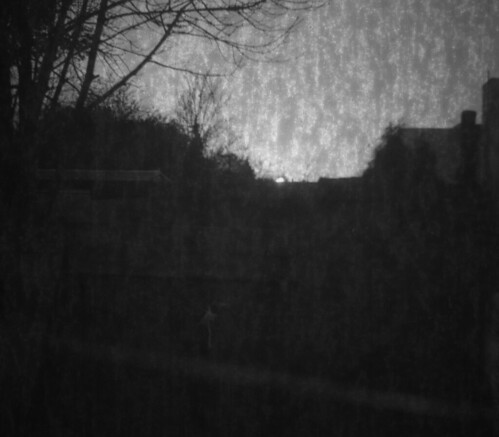
As well as the Selochrome plates, I also shot some Ilford G.30 Chromatic plates from the mid-1960s. I'd used a number of these plates over the past few years, mostly with a fair amount of success. The plates from this current box suffer from a large amount of fogging around the edges, something I've experienced with some glass plates. I rated these at 10 as well, but with the light fading in the late afternoon to early evening when I took a second set of photographs, the photographs probably needed more exposure then I gave them to mitigate the fogging; the lighting had been better earlier in the day: in the image above, softer light integrates the cut out into its surroundings better. Had I taken more time over the photographs, I would have also painted in the cut out figures to provide a better tonal range.

Midg Falling Plate Camera with Ilford G.30 Chromatic glass plate
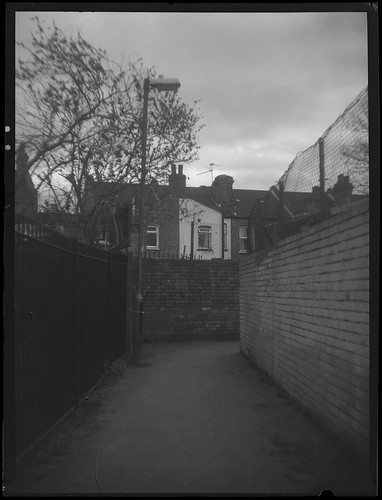
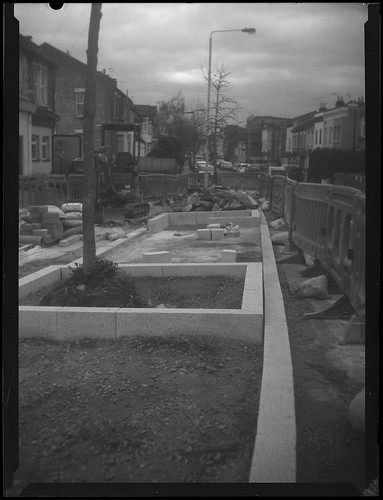
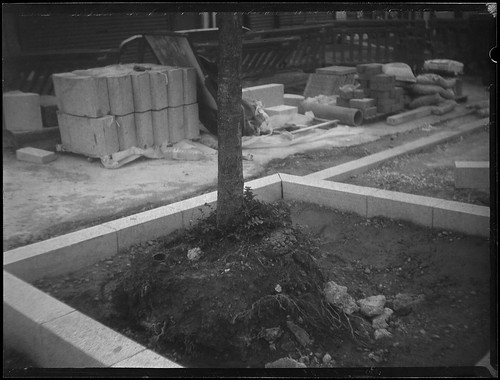
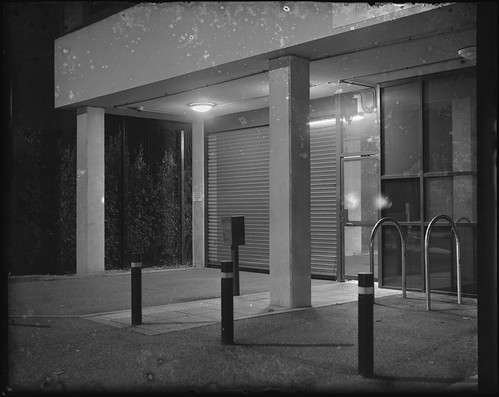
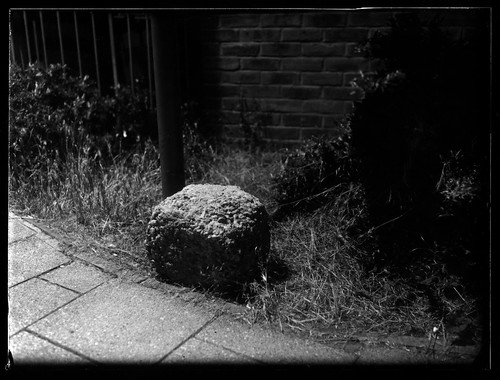
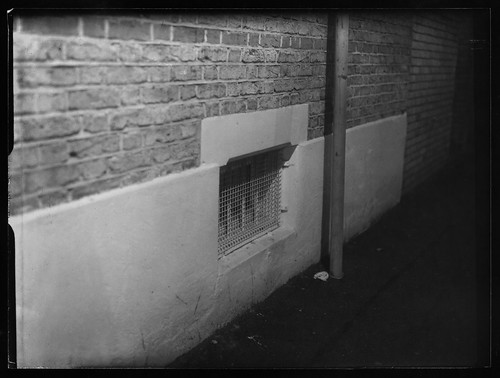
I also shot a magazine's worth of Ilford FP4 film, from a box with a handwritten date of 16/11/78 (a leaflet inside the box dates to December 1977). None of these photographs suffered from the mechanism failing, which might reflect using the camera in the hand, rather than the fairy photographs, for which I used a tripod, and had to tip up the camera while still on the tripod to tilt it forward to get the plates to fall. When I'd used the Midg previously, I had shot some FP3 film, dating back to around 1950, and rated it with an exposure index of around 12; with the more recent FP4, I wanted to use the Midg hand-held. One of the problems with the Midg is that its shutter only fires at one speed, as the adjustment mechanism does not appear to change the 'instant' setting at all. The shutter fires around 1/50th, so I shot all the film with the lens wide open at f8; lighting conditions were fairly overcast, so I gave the film a one-and-a-half stop push in development (although a couple of sheets were stand developed with the plates). Some of the negatives were very thin, but the results from most of the shots were surprisingly good, and an instructive comparison to many of the photographs taken two years ago when I first wrote about the Midg.

Midg Falling Plate Camera with Ilford FP4 film

Tuesday, 26 April 2016

Other glass plates

Ilford R.40 Rapid Process Panchromatic glass plate
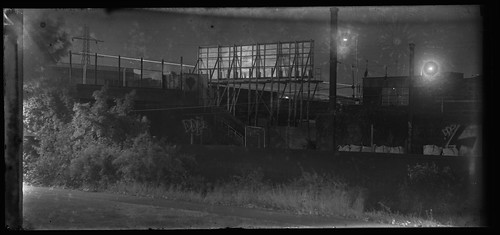
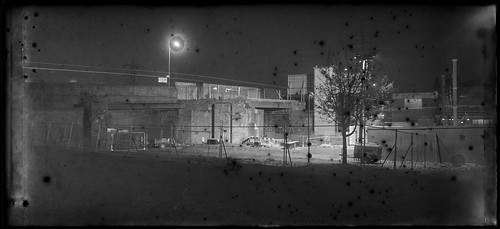
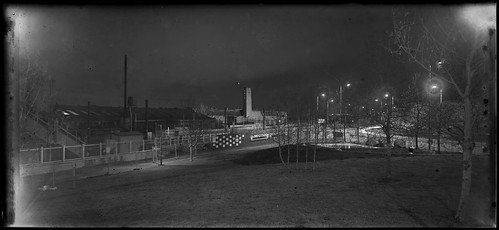
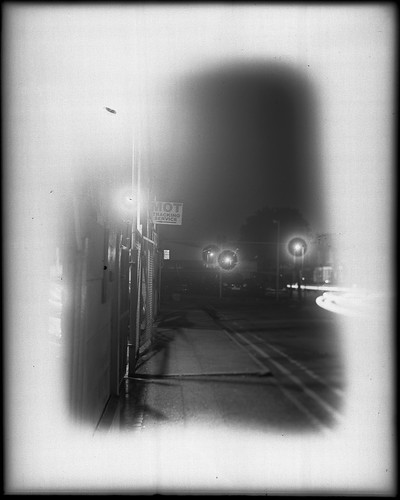
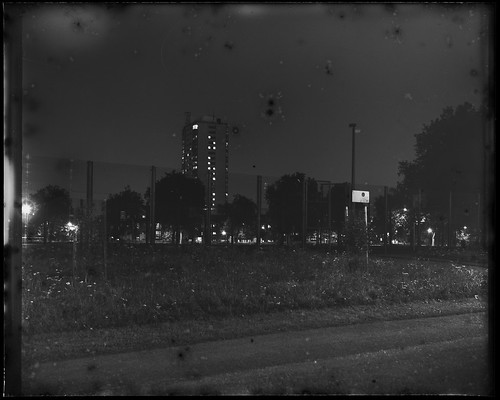
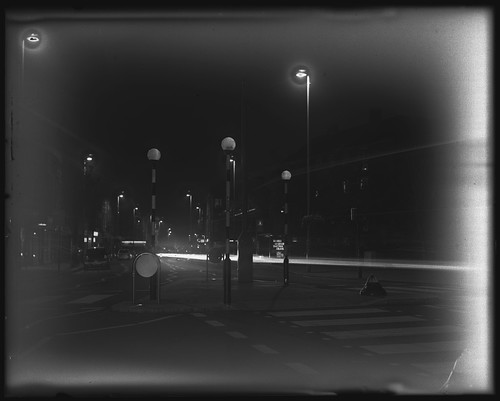
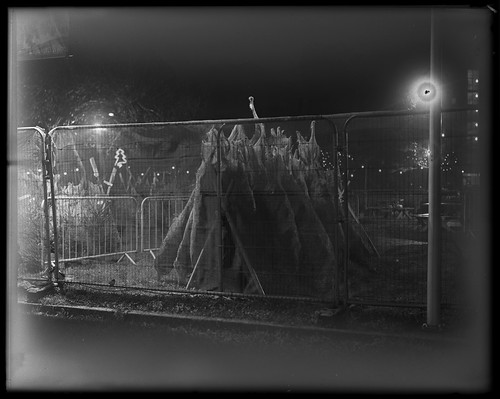
As well as the Selochrome stereo plates written about in my last post, I have also shot a number of different plates for night photography in recent months. I've used the last of the large format Selochrome plates written about in 2014 with some good results. Also mentioned in that blogpost were the Wratten & Wainwright Metallographic plates which were heavily fogged around the edges, so much so that I had all but written off using the plates. However, as I'd had a couple sitting in a plateholder for months, I decided to expose one on the same night as exposing this image on one of the Selochrome plates, and giving a moderately long exposure provided an image far less obscured by the fogging around the edges than I'd previously experienced.
Kodak Wratten & Wainwright Metallographic plate
As the Wratten & Wainwright box was sealed when I got it, I don't have a good theory as to why the plates shot recently should be less fogged than the others, except perhaps the fact that these plates would be from the central portion of the box, with a number of plates stacked on top (and below) the two illustrated here - although the edges of the plates themselves remain in the same relation to the edges of the box as those at the top or bottom of the stack.
Wratten & Wainwright glass plate
Incidentally both plates shown here exhibit true solarisation - the brightest highlights in the streetlamps have turned black. The term solarisation (when not describing a digital filter) is usually applied to what is more properly known as the Sabatier effect: the exposure in these highlight areas is such that the negative begins to lose density beyond the shoulder section of the characteristic curve (this phenomenon gets a brief mention in Ansel Adams' The Negative when describing his photograph The "Black Sun", Owens Valley, California). There's still a fair amount of fogging, and exposing for longer to combat this has resulted in what appears to be grain seen in the highlight areas, but this is scanner noise caused by the high density.

Late last year, I found two boxes of 4x5 inch plates, both Ilford R.40 Rapid Process Panchromatic - one box had been previously opened, but then resealed with black tape, and no plates had been used from it. I opened the other box for the information leaflet inside, which provided a date - August 1959.
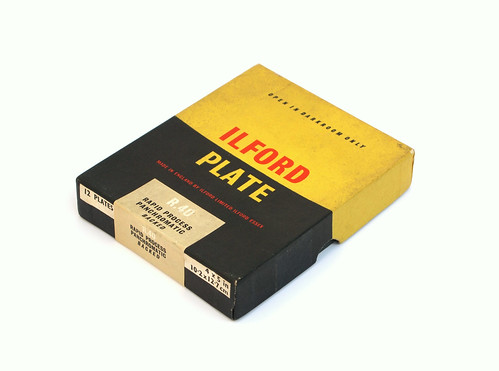
Ilford R.40 Rapid Process Panchromatic glass plates
As described in the Ilford Manual of Photography (1946), Rapid Process Panchromatic plates were "For copying coloured originals. A plate of high contrast. The standard plate for colour separation screen negatives for photo-lithography." These were fifth highest in the list of plates by contrast in the Manual, and, as a process plate, it isn't given a speed: these plates were not intended for pictorial photography. The word Rapid in the name refers I think more to the speed of development rather than sensitivity - the information leaflet with the plates gives a development time of 2 1/2 minutes in ID13. The plates were introduced in 1918, and, according to Silver By The Ton, were rated 8 ASA in the post-1960 standard: other plates with the term Rapid in the name around the same time were rated 20 ASA.
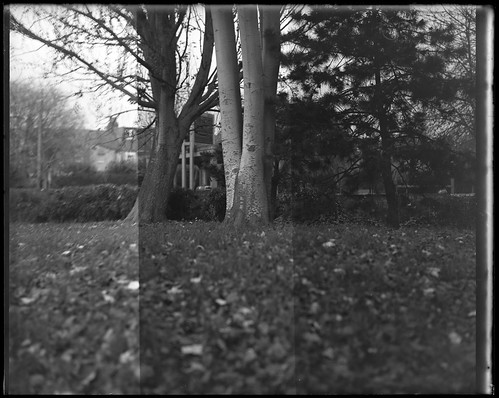
Ilford R.40 Rapid Process Panchromatic test plate
For a test exposure, I rated one plate with an exposure index of 10 as a reasonable starting point, and with three successive exposures by progressively withdrawing the dark slide, gave the plate effective exposure indices of 10, 5, and 2.5 from right to left in the shot above. This was stand developed in RO9 One Shot, diluted 1+150 (to reduce contrast) for one hour. The results were very encouraging. The central section, with an effective rating of 5, looked best from the test plate. However, when shooting them at night, the first set of plates did appear to be overexposed, not helped by using a developer dilution of 1+100, rather than 1+150. The highlights in these negatives are very dense, and this again added noise when scanning in these areas, much like the Wratten & Wainwright plates: the image at the top of this post is one of the plates shot and developed in this fashion. I reduced my exposure times for the next shots by around one stop, and developed these plates at 1+150, as below.
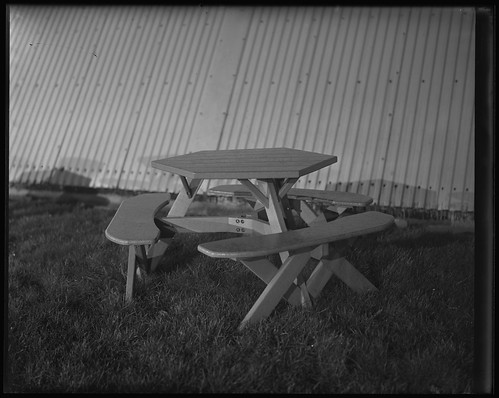
Ilford R.40 Rapid Process Panchromatic plate
The Rapid Process Panchromatic plates are amongst the best I've used, in terms of the emulsion showing very little age-related deterioration; when coupled with getting the exposure right and developing to reduce the inherent contrast, the plates produce excellent results.
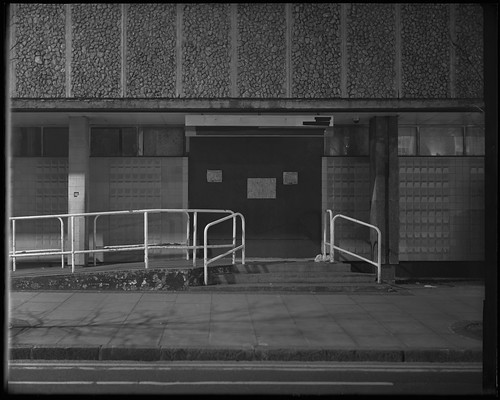
Ilford R.40 Rapid Process Panchromatic plate
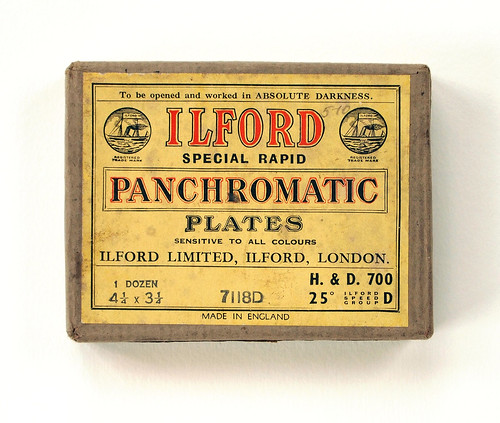
Special Rapid Panchromatic plates
I've also recently used some quarter-plate size Special Rapid Panchromatic plates. First produced in 1919 at 32 ASA, these are "Fine grain. Fairly high contrast. General purpose plate. Widely used in scientific; and in the photo-mechanical trade for block making, offset work and photogravure." These are just above the middle of the contrast range of Ilford plates at the time. A leaflet inside the box was dated to 1946.
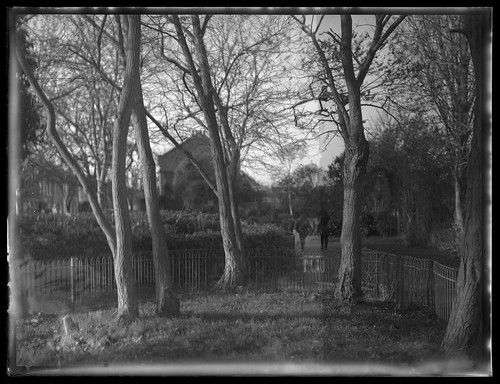
Special Rapid Panchromatic plate test
Rather than shooting these plates for the ongoing night photography project, I used most of the plates from the box on the LAPC photo walk last month; these were just fast enough to use handheld, rated around 10. The test plate above was also rated 10: with three successive exposures, the middle section at an exposure index of 5 provides a fuller negative. The plate below was one that I did shoot at night with a twenty-minute exposure which captured people queuing at a bar better than expected, if still very faint.
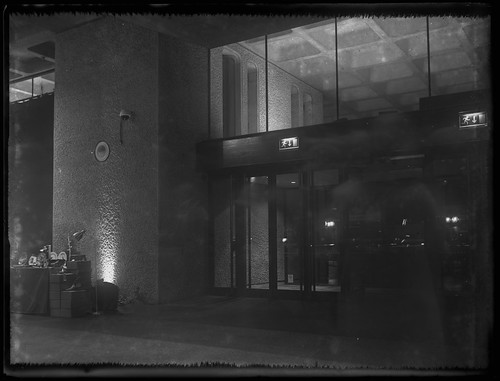
Special Rapid Panchromatic plate
Some time around 1950 Ilford's plate names gained prefixes with a letter and numerals: the Special Rapid Panchromatic above were later given the prefix R.20 as seen on this leaflet. I've wondered for some time about how these were constructed, what was the logic to them. The Hypersensitive Panchromatic and Fine Grain Panchromatic emulsions, being new just before the second world war, were not abbreviated in same way as other emulsions later: these were already abbreviated to HP and FP while the films went through their numerical iterations. Most other plates were given the alphabetical prefixes R, G and N (although not all - Selochrome didn't gain a prefix, but this was more of a brand name than a descriptor). Looking at the spectral sensitivity of the plates, as all panchromatic plates are given an R, it would appear that the letter are R denotes red sensitive; G plates are 'highly orthochromatic' with sensitivity extended into the yellow part of the spectrum that perhaps G is for green sensitive; and N for 'ordinary' plates would possibly mean not colour sensitive. I haven't found a logic to the numbers. One wonders if photographers stopped calling Soft Gradation Panchromatic plates that, and started referring to them simply as R.10 plates?

References
The Negative, Ansel Adams, 1981
Silver By The Ton, RJ Hercock and GA Jones,1979
The Ilford Manual of Photography, James Mitchell (ed.), 1946
Friday, 15 April 2016

Ilford Selochrome stereo plates

Ilford Selochrome Plates
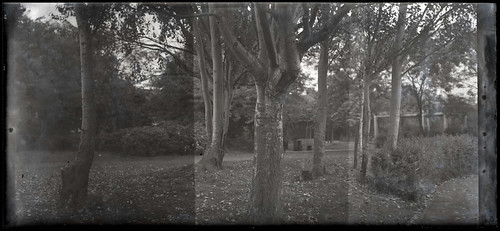
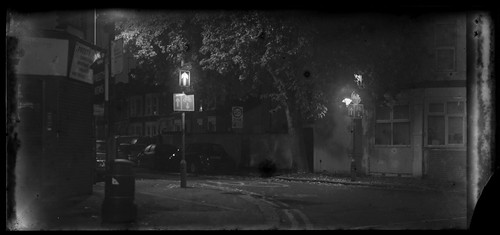
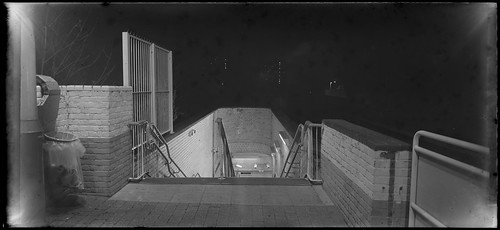
Although my ongoing project of shooting old, previously unexposed photographic glass plates at night had become more sporadic in recent months (and I had been shooting plates in other situations such as the LAPC Photo Walk), a period of unseasonably warm nights last Autumn into December encouraged me to shoot more. Of the plates shot recently, a box of previously unopened Selochrome 6x13cm plates provided some interesting results due in part to the unusual format: the 6x13cm plate size is a stereo format; the box is the same size as the HP3 plates written about in the post 'Some odd sized glass plates', but those plates had been cut down by hand to a quarterplate length. The outer wrapping of the plates was torn and tatty, and the outer label itself isn't designed for the box: it's the same size as those used on 4x5 inch boxes, such that the label wraps around the box. The inner label under the wrapping is dated to February 1948.

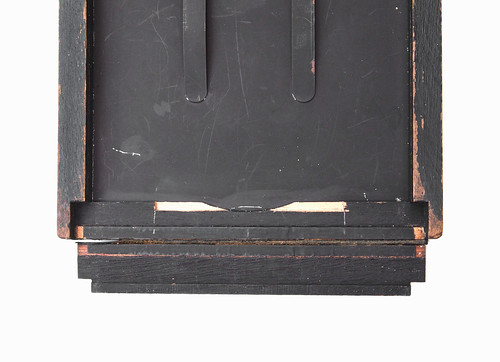
As the plates are just a few millimetres too long to fit into 4x5 inch plates holders (5 inches being 127mm, although actual plate sizes vary a small amount), I converted two MPP holders which needed reconditioning. I made a cut in the bottom edge of the holders, which, being made from wood, was fairly easy to do, and removed enough material to sit the glass plates flush once loaded. These alterations were then painted matt black.

Detail of cut in bottom of holder
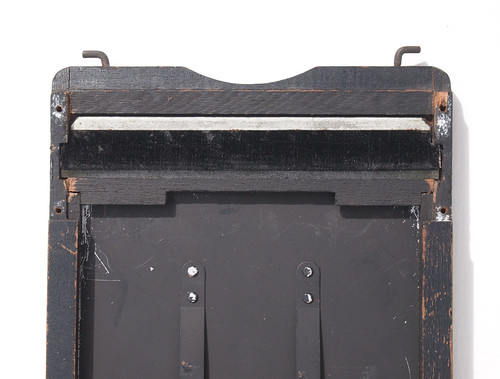
Interestingly, when removing the metal covers on the plateholders to access the felt light traps, I discovered that they had a similar slot already cut into the top edge of the holder, normally invisible. This was almost exactly the right size for the stereo plates.

Detail of slot in top of holder
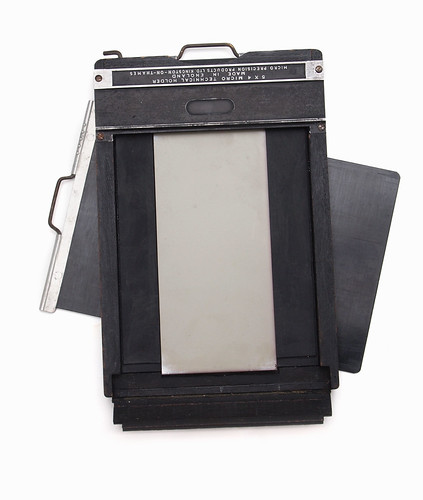
I also found that some printed matter had been used to shim the metal covers to the right clearance for the darkslides, intriguing evidence of the hand-made nature of these wooden plateholders. To make sure the stereo plates sat securely in place, I also made card inserts in the manner detailed in my post on 'Glass plate adaptors'; I sacrificed one of the plates from the box as a template to ensure a good fit with both the alterations to the holders and the adaptors I'd made.

Completed conversion with plate loaded
Having used some 4x5 Selochrome plates before, of a similar age, I was hopeful that the box would contain usable plates; I shot a test plate with a starting exposure index of 50, and with three successive exposures on the plate, giving effective exposure indices of 50, 25, 12 from left to right,

Ilford Selochrome stereo plate test
The plates do show a number of features of age-related deterioration (aside from a broken corner) to the emulsion, although this was not consistent across the plates: some have a large amount of pinholing, while a couple have what appears to be 'star-burst' shapes of the emulsion lifting around a central point of stress. Most of the plates have strips along the edges where there's been a reaction to the cardboard runners holding the plates in pairs, although this is within the width of the rebate from the plateholders.

Ilford Selochrome plate shot with 16.5cm Tessar
Ilford Selochrome plate shot with 150mm Xenar
Ilford Selochrome plate shot with 90mm Angulon
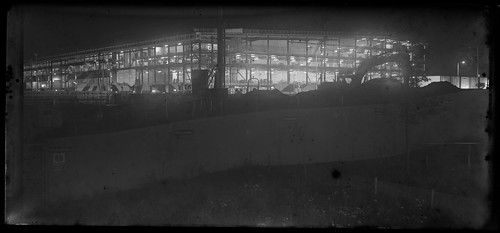
Given that the stereo plate dimensions appear somewhat panoramic, I shot some of the plates with a 90mm Angulon lens - a lens I've hardly ever used for large format - which seemed more appropriate with the format (some stereo plate cameras, such as the Jumelle Stéreo-panoramique were designed to shoot both stereo pairs or single, panoramic images). I also used these plates to shoot three photographs of the rebuilding of a local station which has been disused for over thirty years.

Ilford Selochrome plate shot with 16.5cm Tessar
Ilford Selochrome plate shot with 90mm Angulon

Monday, 8 December 2014

127 Day - Winter 2014

Studio window, Baby Ikonta with Ilford Selochrome
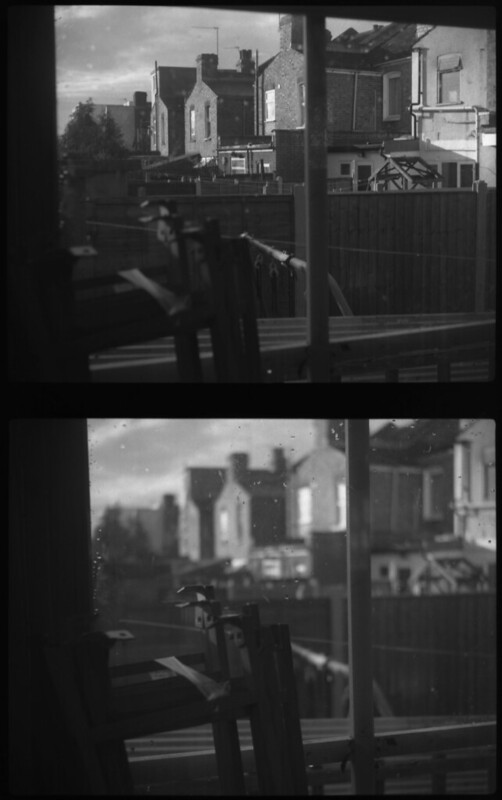
One aspect of taking photographs on certain annual recurring days, such as the '127 Days', is that repetition can become an archive when photographing the same scenes as time (and the seasons) passes, such as the shot of Dagenham Brook below, which I had shot in July; in December last year, I took a walk along the same route I'd taken the year before. For yesterday's 127 Day I had one roll of Ilford Selochrome with a develop before date of January 1970 which I hadn't shot on this year's 127 Day in July. I also shot two rolls of Kodak Verichrome Pan in 828 format with a develop before date of August 1974 which I'd rolled with 127 backing paper, and similarly, a roll of 35mm Rollei ATO 2.1 Supergraphic. All films were shot with my Zeiss Ikon Ikonta 520/18 - otherwise known as the 'Baby Ikonta'. I shot half the roll of Selochrome around the house, which allowed me to make a couple of diptychs shooting through windows, and, although the skies briefly cleared, by the time I went out to take some more photographs, it was a typically grey December afternoon (the weather being one reason I tend not to shoot on 27th January, the other 1/27 in the calendar when written in the form used commonly in the US).

Dagenham Brook, Kodak Verichrome Pan
Both rolls of Verichrome Pan exhibited very pronounced texturing from the backing paper. The Ilford Selochrome also showed a trace of this effect, but having retained more sensitivity, with a denser negative this was much less apparent and only really showed up in shots which were underexposed. The lighting conditions weren't sympathetic to shooting the Verichrome Pan film with a slower rating than 50 EI which may have helped. The film also had a very strong curl which caused problems with film flatness: it seems this was enough to force back the camera's pressure plate in a number of shots.

Kodak Verichrome Pan, showing a lack of film flatness
The poor lighting conditions were less than ideal for using Rollei ATO 2.1, which has a nominal rating of 25 ISO, but performs better at lower exposure indexes, and, unlike July this year, I did not have a tripod with me for longer exposures (most of the shots illustrating this post were at fairly wide apertures and at shutter speeds of either 1/50th or 1/25th). The image below was the best shot from the roll of ATO; I attempted some shots at 1/10th, but the Baby Ikonta's shutter was beginning to stick at that speed.

Leyton Sign, Rollei ATO 2.1
All films were stand developed in Ilfotec LC29 for one hour, at 1:100, except for the ATO 2.1, for which I used a dilution of 1:200. As I was developing the first couple of rolls of film, the clouds began to break up again in time for the sun to set and I shot the second roll of Verichrome Pan.

Winter Afternoon, Kodak Verichrome Pan
Sunset, Kodak Verichrome Pan

Wednesday, 5 November 2014

Some large format glass plates

Ilford Selochrome 4x5 inch glass plate
In my posts about the ongoing glass plate night photography project, I've written about how some sizes are more common than others. Of all the relatively standard formats, 4x5 inches appear less frequently than quarterplate or the small metric and imperial sizes: in the past year I have only acquired two boxes in this size since using up the box of Air Ministry plates.

Wratten & Wainwright Metallographic Dry Plates
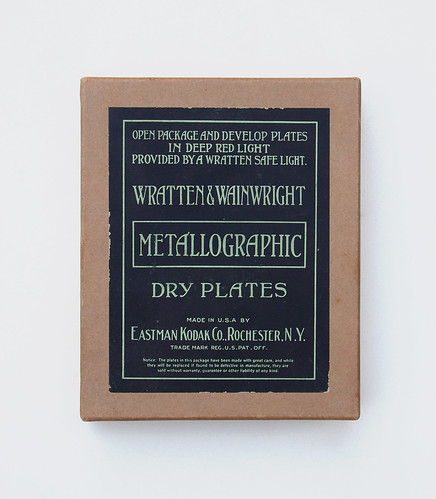
The first of these are Wratten and Wainwright Metallographic Dry Plates. Wratten and Wainwright were a British company bought by Eastman Kodak in 1912 (a few years earlier, Eastman Kodak had made approaches to buy or merge with Ilford, presumably to gain larger market share in the UK). The Wratten name was used as a Kodak brand for many years afterwards, notably for filters and safelights, as demonstrated by the instructions at the top of the box. The Art Nouveau typeface used on the box label suggested that the plates were old, as did the explicit use of the phrase 'Dry Plates'; dry plates had been around since the last quarter of the 19th century and superseded the wet plate process, such that it quickly became reasonable to assume that photographic plates were all of the dry variety, and none of the many other boxes of plates I've collected and used are described as 'dry plates'; indeed, even at the time one would never have found boxes of wet plates as a commodity, as the wet plate process required the photographer to coat a sheet of glass and then expose this in the camera before the emulsion had time to dry. The development of the dry photographic plate itself allowed the emergence of companies such as Eastman and Ilford to supply material to photographers, taking the step of preparing a light sensitive surface away from the photographer and into the business of mass production (however, as there are contemporary photographers who have revived the wet plate process prominently enough, when I mention shooting with glass plates, this becomes an occasional misunderstanding). The reverse of the card inside the box has the numbers '5/35' at the bottom, which may be a date of printing. I have used a later version of Metallographic plates before with some success.

Wratten & Wainwright Metallographic plate test
The test shot shows the Wratten & Wainwright Metallographic plates to be heavily fogged at the edges, but clear in the central portion. I did shoot a couple of these plates at night, but I was disappointed with the impenetrable fog around the edges of the plates. I had previously achieved some good images from the box of Air Ministry plates which were of a similar age, but as I have found as a very general rule, Kodak plates on the whole have tended not to age as well as Ilford plates; most of the glass plates I've used over the last couple of years have been either Kodak or Ilford, and I tend not to buy Kodak plates now unless in a rare size such as 4x5 inches (I do not have any information as to which manufacturer supplied the Air Ministry plates).

Wratten & Wainwright Metallographic glass plate
Ilford Selochrome 4x5 inch plates
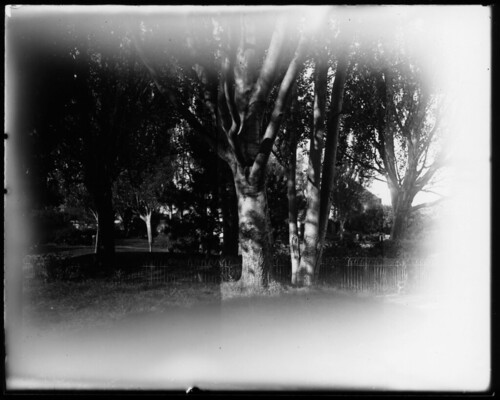
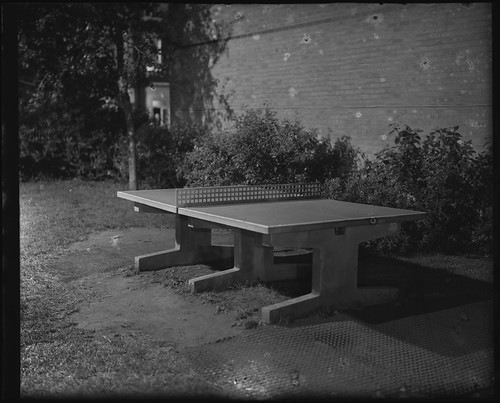
Around the same time I also bought an unopened box of Ilford Selochrome 4x5 inch plates. These had a leaflet inside which was dated to 1951. The wrapper around the box has two different styles of label: on the side, the narrow label is a newer design, with Ilford written in a sans serif font. Like the Wratten and Wainwright plates, Selochrome is also orthochromatic (a panchromatic version of Selochrome was later made, at least as a roll film by Ilford, which I used on the last 127 Day). The Ilford Manual of Photography describe Selochrome as "a fast plate for general purposes. Of average contrast. Fine grain and highly orthochromatic." I shot a test at the same time as the Metallographic plate. The result below looks relatively high in contrast, but this is in part due to the image being scanned from a contact print. The plates have aged quite well, with a few spotting marks, appearing on some plates more than others. The image at the top of this post is the best example of a photograph shot on these plates. I also shot the same scene on one of the Wratten & Wainwright Metallographic plates for comparison.

Ilford Selochrome plate test
Ilford Selochrome 4x5 inch plate
As well as 4x5 inch plates, I am also including in this post 9x12cm plates. As mentioned in my post on the Ica Trona 210, 9x12cm usually qualifies for large format. Last year, I wrote about finding three previously opened boxes of 9x12cm plates, which I got a few good results from two of the boxes. Earlier this year, I bought a job lot of three boxes of Ilford HP3, all previously unopened.

Ilford HP3 9x12cm glass plates
I could see from the box style before bidding on the lot that these were possibly late 1960s or early 70s. When the boxes arrived, one was not sealed, but was full; I opened one of the other boxes to find the leaflet inside. This was dated to 1973, just two years from the end of plate manufacture at Ilford. What the leaflet shows is just how many different types of plates (eight) were still being made at that late date. HP4 was introduced in 1966, but was made alongside HP3, and did not replace it for a number of years according to Photomemorabilia's Ilford Chronology, possibly HP3 as a plate emulsion was continued until glass plate manufacture ceased, and HP4 is not listed on the leaflet from the box. At this late date the HP name is also given in full: Hypersensitive Panchromatic. The boxes also contained 36 plates each - all previous boxes of photographic plates I've used contained, at least originally, one dozen (except for one half-dozen box). I suspect that at this stage it was uneconomical to sell plates in smaller amounts.

Ilford HP3 plate test
The test above shows that the plates are quite low in contrast, but there is little age deterioration beyond a loss in sensitivity. I rated the plate at 40 EI with three successive exposures, giving effective exposures of 40, 20 and 10. I shot some of the HP3 plates at night with my Voigtländer Avus where the low contrast was an advantage, but having three boxes of 36 plates, I was happy to divert some of the plates from my night photography project, and shot some with the Ica Trona handheld, rated 50, which I used to illustrated my post on the camera.

Ilford HP3 9x12cm plate, shot with Voigtländer Avus
Ilford HP3 9x12cm plate, shot handheld with Ica Trona 210
Sources/further reading
Company details from Early Photography
Ilford Chronology on Photomemorabilia