Sunday, 25 April 2021

#FP4Party April 2021

Two years ago, less a couple of months, for the #FP4Party in February 2019, I used my Ensign Folding Klito de Luxe No.9 with some old Ilford FP4 sheet film in quarterplate size; two boxes of this had come as part of a larger job lo: both were unopened boxes of 50 sheets each, both with the handwritten date of 16/11/78. I'd used film from this stock for the January and March #FP4Parties in 2019 too, in different cameras; for April 2021's #FP4Party, when considering what format to use, I saw that I had seven sheets of the last box of this film left, assuming I'd tallied my usage correctly. Thus, I decided to simply shoot one sheet a day for each day of shoot week, and the choice of camera had to be the Ensign Folding Klito de Luxe No.9 as it's the best of the three quarterplate-sized cameras I have. In 2019, in the three successive months, I'd shot two sheets a day, hopefully providing a 'good' and a 'spare'; with only seven sheets left this was not a luxury I could allow myself. In the event, I did accidentally use two sheets on one day, a result of unclear labelling of my plateholders. 

Although I was exposing just one sheet of FP4 each day, I also photographed each subject on other film stocks, some Ilford F.P.3 from the 1940s, and Ilford Fine Grain Ordinary N5.31 film (this box has a handwritten date of 11/3/70): without thinking, I picked up a second plateholder when photographing on the Friday, thinking it was the latter film when instead it was a second sheet of the FP4. In order to shoot FP4 film each day of the shoot week with two days to go and only one sheet of quarterplate-size FP4, I then cut down some larger FP4 Plus film to fit the format. Having made a jig that I taped to a cutting mat to cut the film to size inside a changing bag, I found this more difficult than expected. I tried to cut some 9x12cm film to quarterplate size–8.2x10.8cm–but found it was far too easy for the film to move around while changing from a cut in one orientation to the second cut in the other. After spoiling one sheet of 9x12cm FP4 Plus, and badly cutting another, I then cut down a sheet of 5x4-inch FP4 Plus. For this I only made one cut, going from 5 inches to 3¼ inches; quarterplate film measures 4¼ by 3¼ inches, but for ease of cutting down film to use in the Klito, 4 inches by 3¼ would have to do.

Part way through shoot week, I developed the first four sheets, partly as I didn't have enough spare film sheathes to load seven plateholders at the start of the week. This was also instructive: I had overestimated the bellows factor on the sheets already exposed, resulting in dense negatives, especially Thursday's; as a result, on Friday and Saturday I didn't compensate in exposure for bellows factor, and the negatives developed fine (Saturday's shot was taken on the cut-down 5x4, rated the same as the FP4 from the 1970s, although its process before date was only April 2010). As a consequence of simply being at home throughout the week, almost all the photographs were of close-focus subjects around the house and garden (such subjects needing to compensate for bellows factor–or not as the case seemed to be). The weather was almost uniformly sunny, with the brief exception of showers on the Saturday afternoon, which I tried to record somewhat obliquely.

The first shot of the week I'd hoped to have been better, but there was too much of a breeze to use an exposure time of 1/5th and expect the subject to be sharp; Sunday's subject, the last sheet of the 100, I chose the tree outside my window which I had been photographing for an entire year, and had indeed only recently finished that project, but wanted to record its new growth after being heavily pruned in the autumn. This shot suffered from a light leak which I think may have been due to mixing up darkslides and plateholders: some of the plateholders which fit the Klito camera are branded Klito; some are AP Paris; and others are unbranded, and, although very close in all respects, it's easy to mix up the darkslides and then find some are a better fit than others. 
 
Monday
Tuesday
Wednesday
Thursday
Friday
Saturday
Sunday

Friday, 9 April 2021

Camerascope Stereo Viewer

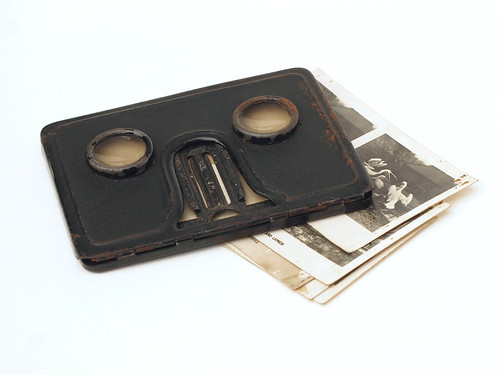
Camerascope stereo viewer with London Zoo stereo cards

Following last week's post on the Thornton-Pickard Stereo Puck, I pulled out from the back of a drawer an old folding stereo viewer I'd picked up somewhere many years ago on the vague notion that contact prints from the Stereo Puck negatives might fit. When I was growing up, the View-Master was a not-uncommon novelty encountered at friends' houses, although we never had one at home; ubiquitous and manufactured for decades, the View-Master perhaps became the mental archetype for a portable stereo viewer in the second half of the twentieth century. It was one such system among many, and its success no doubt depended in part on the technology of the colour transparency on film which emerged towards the end of the 1930s. There had been a number of colour photographic systems before Kodachrome, such as the Autochrome and Dufaycolor, but these would not have been able to resolve fine enough detail on the miniature scale that the View-Master took advantage of in producing a format that used a revolving disc, known as a reel, containing seven stereo pairs that can be seen in sequence before the reel returns to the first image and can be changed.

Camerascope stereo viewer folded

The Camerascope has little of the View-Master's technical sophistication: it feels as though it belongs to an earlier era. Online references date it to 1927, not separated by too great a period of time from the View-Master–only a decade or so–but it represents the application of very different technology The View-Master's use of plastic and Kodachrome appears to usher in a colourful mid-century modernity. In contrast, the Camerscope viewer is made from pressed and stamped metal with a craquelure paint effect on front and back, and the cards which came with my viewer, black and white, are photographic prints, almost certainly made from duplicate negatives by contact (rather than photo-lithography for example). The Camerascope does at least possess some flexibility in the format of stereo cards which fit the viewer. The London Zoo stereo cards which came with it are 2¾ x 4¼ inches (approximately 10.7x7cm). These fit in a slot across the whole width of the back of the viewer. It also takes single-image cards, one card for each side of the stereo pair in two different sizes, 1⅜ or 2 inch wide (approximately 3.7cm or 5cm wide) that fit in slots either in front or behind the two rectangular openings in the back, the smaller width cards fitting behind these apertures, the larger in front. (It's also possible that a fourth size may fit the viewer, double-image cards that use the two outside slots of the larger single-image cards for each edge). 

Camerascope stereo viewer showing slots for different card formats

It was the smaller of these fittings that I thought would be the right size for contact prints of the Thornton-Pickard Stereo Puck negatives. These are designed for cigarette cards: there's a good article in Stereo World from May/June 1990 (available online) by John Bradley, which briefly places the stereo cigarette card amongst other novelty cards before detailing the cigarette card series that came with Cavanders Army Club cigarettes produced for viewing in the Camerascope. The full list of cigarette card series from the article runs thus: 
Black & White Series 
Peeps in to Many Lands, A Series, 1927, 36 pairs, small 
Peeps in to Many Lands, A Series, 1927, 36 pairs, medium
Peeps in to Many Lands, A Series, 1927, 36 cards, large 
Peeps in to Many Lands, 2nd Series, 1928, 36 pairs, small 
Peeps in to Many Lands, 2nd Series, 1928, 36 pairs, medium 
Peeps in to Many Lands, 3rd Series, 1929, 24 pairs, small 
Peeps in to Many Lands, 3rd Series, 1929, 24 pairs, medium 
Peeps in to Prehistoric Times, 4th Series, 1930, 24 pairs, small 
Peeps in to Prehistoric Times, 4th Series, 1930, 24 pairs, medium 
Colour Series 
Glorious Britain, 1930, 25 pairs, medium 
Coloured Sterescopic [sic], 1931, 25 pairs, medium 

The article also mentions that the "small cards were always issued as separate "left" and "right" images, as were most of the medium sized black and white cards, while the coloured series are more often found as joined pairs of views. In the case of the large series they contained both images on one single card." As "most" medium sized black and white cards were separate left and right pairs, it suggests some were not, and both colour series are medium, this suggests the fourth size I described above, 'medium' double-image cards. Not having any of the cigarette cards myself, this is speculation based on the descriptions; the London Zoo stereo cards which came with my viewer are not part of the cigarette card series issued by Cavanders: these cards have a very small logo, almost too small to be read by the naked eye, 'Sunbeam Tours'. The Army Club cigarette cards have instructions for viewing on one card from the pair and the offer that "A 5s Camerascope will be supplied post free for 1/– in Great Britain (other countries at different prices"; presumably Sunbeam Tours sold the Camerascope and its cards at tourist attractions such as London Zoo (the entry on Early Photography for the Camerascope has exactly the same set of London Zoo cards that my viewer came with). 

To make cards from the Stereo Puck negatives, I took the cheap and quick method of using Silverprint's 'Solar Paper', essentially a form of pre-prepared cyanotype paper, and contacted some of the best negatives; after the paper was dry I mounted these on card, finding that the width was a little wider that the small single-image card slots, thus losing a little of the image each side, but the height fitted perfectly, with the exception that as the images from the Stereo Puck are not very well aligned vertically, I had to shift the right-hand card a few millimetres up in its slot. I also discovered that the stereo pairs needed to be swapped around: the right hand image from the contact print needed to be in the left hand slot on vice-versa. This initially surprised me: I had thought that in a straight contact from the negative of the stereo pair, these would be the correct way around for viewing (when making the anaglyphs on last week's post, I had instinctively used the right-hand image in the red channel, so did not consciously think about which side was which). Needing to swap the left and right contact prints must be a result of how the images are actually reversed when projected by the lenses inside the camera: for correct orientation, negatives are viewed through the base of the film. One of the images illustrating the page on the Stereo Puck on Camera-Wiki shows both the viewer that was sold with the camera–a folding metal viewer not entirely dissimilar to the Camerascope–as well as stereo cards for it, which are quite clearly two separate contact prints mounted on card, with left and right images in the correct positions for viewing. Unmentioned in my post about the Stereo Puck is the small design detail that a metal tab inside the camera in the middle of the frame shows up in the top right and left corners of the negatives: possibly this is there to indicate which image is for which side when printed and separated: as the sides of the pair are swapped around, the right-hand image has this visible in the top right corner, and the left in the left corner, making it clear which side is which when mounting, or, as with the separate cards I've made, which card fits in which side of the stereo viewer.

Scan of negatives from the Stereo Puck, showing the tab between frames,
visible at top centre

For all this effort in making the contact prints to view them in the Camerascope viewer, the experience was underwhelming: given the lighting conditions when I shot the negatives, the fact these are fairly low in contrast does not make for good contact prints in the method I used and the surface quality of the paper itself disrupted the image when magnified (it would have been far better to have used photographic paper, both for the detail and the ability to control contrast; there is also the issue of the narrow lens separation in the Stereo Puck too). However, the best negatives did yield acceptable results, when seen in good light, allowing for all the compromises of the Stereo Puck camera, the conditions in which I shot the recent couple of rolls of film with it, and the method of making the prints.

Camerascope viewer with stereo card made from Silverprint Solar Paper

Sources/further reading:
Camerascope Viewer on Early Photography
Camerascope on Viewmaster.co.uk (also see pages on the View-Master itself)
Stereo World May/June 1990

Friday, 2 April 2021

Thornton-Pickard Stereo Puck

Thornton-Pickard Stereo Puck
"It is often said in praise of a particularly good print that it is “almost stereoscopic.’’ With the Stereo Puck every good exposure is given full stereoscopic effect by dual lenses—and the cost of the outfit is now within everyone's reach." 
Thornton-Pickard advertisment
"...the New Wonder Camera The STEREO PUCK MAKES YOUR PICTURES LIVE"
Thornton-Pickard advertisment, BJP Almanac 1932
The prominent legend announcing the fact of the Thornton-Pickard Stereo Puck being "British Made" on the front plate above its lenses, much clearer than the faintly embossed name itself beneath them, brings to mind a scene from the sitcom The I.T. Crowd: in attempting to fight a fire, the character Moss points an extinguisher towards the fire, which promptly bursts into flame itself. Asking "Why's it done that?", Moss looks intently at the extinguisher, and there's a cut to a close up of a label: "Made in Britain", which provokes a knowing sigh from Moss. Intended, on the Stereo Puck, one imagines, to imply a mark of quality, this "British Made" assertion (as indeed for many a product) is at the very least an injunction for the consumer to patriotically 'buy British'. Something about this–the injunction and its instinctive reaction, as exemplified by Moss's sigh–as a general attitude, has an undercurrent of anxiety, of Britain's contemporary place in the world in relation to its long history, a history here of manufacture, but, by broader implication, its imperial history, a notion of a once-held 'greatness' (such a notion untroubled by any deeper examination), although Britain never seriously challenged the German, and then later, Japanese camera industries, and the Stereo Puck, "British made", was of course produced many decades ago. The association I've drawn with the example of the scene from The IT Crowd may be, perhaps, an unfair reaction, a knee-jerk attitude that itself needs examining, but in the case of the Stereo Puck, it's not entirely unwarranted.

I've long had an (occasional) interest in stereo photography, and when I saw the Stereo Puck come up in an online auction for not very much, I bought it on a whim; I used the camera for the first time two years ago for 'Take Your Box Camera To Play Day'; the film I shot then came out with scratches running through all the negatives, which was a little disheartening, and it had sat on a shelf since then, awaiting some remedial action. I was prompted to pick it up again by the #filmweekender box camera challenge from Twitter user Jason Avery: with a number of box cameras to choose from, I thought that the Thornton-Pickard Stereo Puck was sufficiently niche to warrant using it for this challenge.

Apart from its ability to take stereo pairs, the Stereo Puck is quite typical of the box camera form: it uses 120 medium-format rollfilm (itself introduced for the Kodak No.2 Brownie, the archetypal box camera); it has a fixed-focus simple lens; a single shutter speed; and a small reflecting finder for framing. It's wooden bodied, at a time when many box cameras were being made from metal (and early plastics like Bakelite were beginning to be used; the Stereo Puck's advance knob seems to be made from Bakelite) and the build quality suggests a certain cheapness: as an example, in the image below, the shutter lever on my camera can be seen to be not fixed entirely square-on to the camera body.
Thornton-Pickard Stereo Puck - top view

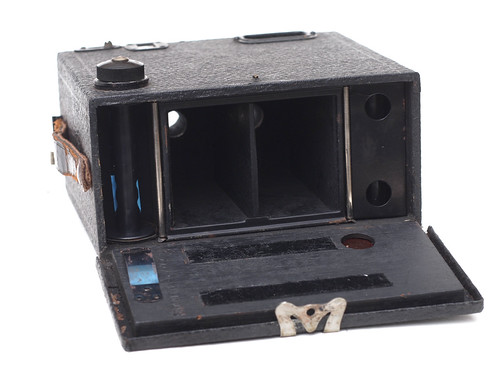
Thornton-Pickard did produce some fairly high quality cameras from the last decades of the nineteenth century, field and studio cameras, and, in particular, their reflex cameras and roller blind shutters. The Stereo Puck dates from the 1930s, by which time the company was in decline: it ceased manufacture in 1939 (it was preceded by the Puck, a more conventional box camera). In one of the advertisements quoted at the top of this post, three models are described, enumerated as the No.1, No.2, and No.3, all of which appear to have been available concurrently (at the time of the advert; when researching the Stereo Puck online, these numbers aren't usually used to differentiate its different variants). Sources online date the first version to around 1930, although the given dates vary. I've also observed that there were two versions of the model described as 'No.1': some show the metal tab in front of the handle which provides three different aperture settings, while some do not and presumably have just the one aperture setting. My version of the Stereo Puck is the No.2 and has the most commonly noted difference: this has the 'portrait' supplementary lenses, filters which swing in front of the lenses, easy to identify from the small lever next to the viewfinder, absent from the No.1. Finally, the advertisement describes the No.3 Stereo Puck, which has the ability to photograph either stereo pairs or single images (it's not clear how this works, and, from images of the camera online, I can't tell what might differentiate the No.3 in external appearance; it would be possible to shoot single images with the other models of the Stereo Puck by using a lens cap on one lens at a time–not easy to do due to the recessed lens fittings, with the 'cap' needing to be more like a plug–and not advancing the film until each side of the pair has been exposed).

The Stereo Puck takes (nominally) 6x4.5cm stereo pairs on medium format film, giving eight pairs on a roll of film; by necessity this image format creates a compromise in that the lens separation is noticeably narrower than that of human binocular vision. This is, apparently, a remarkably consistent physiological trait, with a distance of 6.5cm. Ideally, each lens then would be separated by this same distance to simulate stereo vision, but with the Stereo Puck, the lenses are separated by 4.2cm (I've read other distances online, but measuring my camera gives 4.2cm). There are circumstances in which lenses for stereoscopy would need to differ from that of the human eye, but these would be for extreme distances, both near and far, for microscopy or for imaging at distant ranges (to achieve a stereo image of a distant landscape, for example, it helps to have a much greater lens separation, otherwise both images appear too similar to create the illusion of depth). In the 35mm format, in order to construct a camera with a sufficient lens separation, the images have to be recorded on the film in a discontinuous series (i.e., the stereo pairs are not adjacent on the film), the most common method is to have the frame advance periodically 'jump' already exposed frames on the film, such as with the Stereocrafters Videon, where each pair is separated by two images of subsequent pairs on the film, which means that, as a sequence, after a first exposure, the film advances one frame twice in a row, then has to advance three whole frames to avoid double exposing one half of each stereo pair; other methods include exposing the film diagonally to avoid double exposure, as with the Meopta Stereo 35 and the Sawyers View Master. In medium format, the 6x6 image size is more typically used for stereo cameras as the wider image format means that the lens separation is greater; however, at the time that the Stereo Puck was produced, 120 medium format film only had numbers on the backing paper for the 6x9 frame size, which no doubt accounts for the Stereo Puck's design and use of the 6x4.5 stereo pairs, with the understandable compromise on lens separation (roughly concurrent with the Stereo Puck, the Rolleiflex popularised the 6x6 frame size on 120 film; while the Rolleiflex did not depend on frame numbers printed on the film's backing paper, evidently the format was attractive to manufacturers of cameras and film, and 6x6 frame numbers were introduced for less high-end 6x6 format cameras).

The user controls on the Stereo Puck are simple and limited. The shutter, tripped by a lever on the top right of the body from the user's position, has a single speed, reported between 1/20th-1/50th online, and a 'time' mode, with a small metal tab that pulls out to keep the shutter open until either pushed in or the shutter lever is flipped back to its original position: the shutter lever does not spring back to its original position, and so, like many older box cameras, this lever trips the shutter in either direction (on most single-lens box cameras of course, this lever runs up and down, rather than side-to-side), left-to-right or vice-versa. The lenses are fixed-focus four-inch f12.5 achromats; absent on some 'No.1' Stereo Pucks, there are three aperture settings with a metal tab in front of the handle that pulls out a strip of metal with holes punched behind the lens with click stops to provide smaller apertures. The aperture settings aren't marked, but logically these two smaller apertures are one stop successively smaller than the maximum aperture, giving approximately f18 and f25. The 'portrait' auxiliary close-up filters are hidden behind the front panel and pivot between the lenses. These can be swung in to position using the smaller lever next to the viewfinder. This lever is sprung, so the close-up filters return out of the way behind the front panel as soon as the lever is let go.

Thornton-Pickard Stereo Puck opened for loading

Loading the camera, the back is hinged on its leatherette covering; the back is made from wood, like the rest of the camera body, but has a metal outer rim that acts as a light trap with a clasp to secure it to the body. On one side, a curved spring attached to the back acts to provide pressure on the take-up spool. The two strips of felt inside the camera back appear to function as a pressure plate on the film behind the lenses; film advance it by red window using the 6x9 numbers. The supply side spool has a removable metal holder rather than the spring attached to the back; it's hard to see exactly what the design of this achieves, other than perhaps avoiding adding a knob on the supply side to secure the toll of fresh film. There is also a standard trip fitting in the base of the camera, but, for some reason, not centred either side-to-side or front to back.

Thornton-Pickard Stereo Puck with supply-side spool holder removed
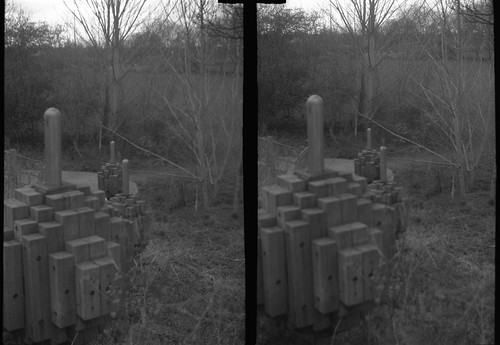
When I first used the Stereo Puck a couple of years ago, its limitations were apparent. Some of these are an unavoidable part of the design, such as the narrow lens separation, but other issues are a result of the camera's construction, largely due to a lack of care in the manufacturing tolerances of the Stereo Puck. One of the first things I noticed is the disparity between the two sides of the stereo pair: the images are not well aligned in their vertical dimension, and, in addition, the focus on each side is different. These two aspects together might matter less in an inexpensive box camera with a single lens, but with two lenses, especially with a narrow stereo base, a good stereo image would be approved by the focus and alignment being better.

Thornton-Pickard Stereo Puck with Ilford HP5 Plus
In the image above, the left hand image is lower than the right; the left hand image also has better focus at the bottom of the frame, with the right hand image better at the top. The disparity in focus can be mitigated a little with using the smaller aperture settings, if lighting conditions allow when using the shutter on 'instant'. When creating stereo anaglyphs, the vertical alignment can easily be overcome simply by lining up the two images better, with a small amount of cropping. The ergonomics of the Stereo Puck take a little getting used to, especially if one is familiar with the more typical box camera form, as the shutter release and close-up filter lever are on top of the camera rather than at the sides; as with many a box camera, the viewfinder is merely an adequate indication of what direction the camera is facing and what might be generally in the centre of the frame.

Thornton-Pickard Stereo Puck (close-up filter) with Ilford HP5 Plus at 800
Picking up the Stereo Puck again to use it for the #filmweekender challenge, I carefully rubbed down the rollers at either side of the inside of the camera, which had some spots of corrosion, then polished these in an attempt to prevent the scratches that I had with my first roll of film and which can be clearly seen in the image above. I wasn't entirely successful, but the rather obvious gouges have become thin hairlines, much less obtrusive–in the image above, one has to enlarge it a fair bit to discern these lines. Possibly more polishing might remove these completely. I had a roll of Ilford HP5 Plus, and some Rollei Superpan 200; shooting on the afternoon of the 21st March, the weather was heavily overcast, with the result that I chose to push the HP5 Plus one stop in development, giving an effective exposure index of 800 (as I have remarked before, the idea that one should use a low ISO film in box cameras as these were the films available at the time such cameras were designed only holds true if one uses box cameras in the same way as they would have been used at the time: only taking photographs hand-held outside in bright weather conditions; in addition, possibly tray developing the film by inspection to make up for shortcomings in exposure, and possibly using intensification on the negatives as well). Most of the shots with HP5 Plus were hand-held although I did brace the camera against railings in at least one shot, and some used the close-up filter, supposedly for subjects of 1-3 metres, such as the image above. For comparison, I also took a couple of stereo pairs with and without the close-up filters, as below. Comparing the two pairs, the discrepancy in focus without the close up filter is as described above, with the focus better on the lower part of the left hand frame (although this is also closer to the lens), while focus it better towards the top of the right hand frame. Oddly, the close-up filter appears to reverse this trend, or at least, focus is better closer to the camera on the right, while on the left, the middle distance appears better.

Thornton-Pickard Stereo Puck with HP5 Plus at 800 (without close-up filter)
Thornton-Pickard Stereo Puck with HP5 Plus at 800 (with close-up filter)
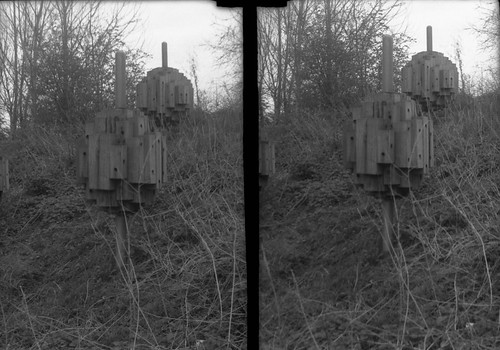
Opening the camera to remove the HP5 Plus, I was faced with something of a 'fat roll', and before loading the camera again, I bent all the springs forward in order to apply more pressure to the film; the HP5 had some light leaks at the edges of the last couple of stereo pairs, but not as bad as I had feared. When using Rollei Superpan, with an ISO of 200, this was too slow to use the camera hand-held; I could have attempted to push the film a couple of stops, but I've found Superpan to have relatively low latitude and pushing the film would be far from ideal. Instead, I used the odd wooden sculptures I had been photographing to place the camera on in lieu of a tripod and use the time setting on the shutter, generally stopping the lens down and exposing for around a second.

Thornton-Pickard Stereo Puck with Rollei Superpan (without close-up filter)
Thornton-Pickard Stereo Puck with Rollei Superpan (with close-up filter)
For the last couple of stereo pairs, I had inadvertently pushed in the tab for the shutter, so, without realising it, these were shot on the 'instant' setting, and, as a result, almost nothing registered on the negative. I developed both rolls of film in Rodinal, diluted 1+50 for 19 minutes at 19ºC, the time, temperature, and dilution that I'd settled on in my previous testing of Superpan, and close enough to the published times for HP5 Plus at 800 (16 minutes at 20ºC).

The Stereo Puck was sold with a stereo viewer, which my camera came without, but for which the negatives from the camera would be contacted for a print to fit the viewer. This should perhaps be also taken into consideration with the camera: at the scale of a contact print, the discrepancy in focus and alignment would be less obtrusive than in a larger print, or indeed a high resolution scan viewed on a screen. Instead of contact prints for physical viewing, I have been making red-cyan anaglyphs from the stereo pairs as the easiest iteration of the images, particularly online, correcting the alignment images while doing so.


One doesn't use a box camera for accuracy and precision, so perhaps the limitations and compromises of the Stereo Puck that I've outlined should be expected and accepted, particularly within its historical context. One imagines that, before the boom in 35mm stereo cameras during the 1950s, it made the taking of stereo photographs an affordable novelty at the time it was produced. For contemporary use, all these factors are hardly likely to make it a stereo camera of choice but, using it again for the #filmweekender challenge, after cleaning it up to prevent it scratching the film, perhaps it shouldn't have sat on a shelf for a couple of years.

Sources/further reading:
Stereo Puck on Camera-Wiki
Stereo Puck on Early Photography
Stereo Puck variants on Red Belllows
Model 1 without close-up filters or aperture stops on Welt Der Stereoskopie
Model 1 on Wood and Brass


Wednesday, 24 March 2021

Expired Film Day 2021

Voigtländer Bessa RF with Ilford HP3
Monday last week was Expired Film Day. Like a number of other film-themed days throughout the year, it's one I tend to observe, and last year's happened to be a little over a week before the pandemic restrictions came in to force in the UK; indeed, the weekend of Expired Film Day 2020 I received notification that my employer was moving to remote working for the foreseeable future. Expired Film Day 2021, on the 15th of March was a week after schools had reopened for face-to-face teaching, but the general stay at home order was still in place in England, but the allowance of daily exercise provided the opportunity to take some photographs while taking a walk around my local area. 

Ilford HP3 roll film, dated June 1965
At Christmas, I'd been given some expired film, two rolls of Kodak Tri-X and one roll of medium format Ilford HP3. This was dated June 1965 on the box, with a leaflet inside with Ilford's date code for November 1961; the date on the box is not prefixed by "develop before" or "process by", so this could just conceivably be the date of manufacture, which I've seen used on glass plates before. It is of course more likely to be a 'develop before' date, which would mean that the film would have probably been manufactured three or four years earlier, making it very close to 60 years old. The felicity of having this roll as a recent, thoughtful present made it a natural choice for the day.

ORWO NP20 refill tin
As well as the medium format HP3, I also shot some 35mm film. This wasn't the Kodak Tri-X though: I wanted to test a few frames from one of the two rolls for exposure and development, something easier to do with 35mm film (the Tri-X weren't in their cartons, so had no 'process before' date, but the style of the metal film canisters looked as though these were also from the 1960s. However, I decided not shoot these as). Instead, I shot a roll of Orwo NP20 film. This had come in a metal tin which contained three lengths of 170cm-long film for reloading 35mm cassettes, complete with ready-cut leaders. Having seen boxes of 35mm Ilford refills in the past, it seems that this was not an uncommon way to buy 35mm film, as opposed to 100ft bulk film, which requires a bulk loader. In contrast, the 35mm refills simply need to be loaded into a reusable cassette in the dark. The Orwo NP20 film had a date of January 1973, and I had already used two of the three refills, so knew a rough exposure index for the film, which I generally rated at 40 (the '20' in the name is its speed in DIN rating, equivalent to 80 ISO). I had also discovered this film to be fogged quite considerably at its top and bottom edges.

Although the day had periodic clear spells, by the time I left the house for my allowed exercise, it was towards the end of the afternoon, and a large, long bank of clouds had moved in, obscuring the setting sun. As a result, the lighting conditions weren't as good as I had hoped, and I pretty much shot all the frames on both films with the lenses of both cameras wide open (I could have taken a tripod, but this feels as though it goes against the spirit, at least, of the current regulations: leaving the house to take a walk for exercise, and taking some photographs while doing so, as opposed to leaving the house to take photographs). I shot the Ilford HP3 film with the Voigtländer Bessa, which has an f3.8 lens, the fastest of my medium format folding cameras; I used the Kiev-4 for the Orwo NP20. Both cameras are rangefinders, which might make focussing easier in low-light, certainly when compared to scale-focus cameras when hand-holding the cameras demanded wide apertures (and relatively slow shutter speeds too). With the Orwo film, I did bracket quite a few shots, daring to use as low as 1/10th in a few instances with some form of support (a tree, or a railing) whereas, with only eight shots on the HP3 in 6c9 format, I didn't bracket. I did start shooting the Bessa at 1/100th at f3.8, but by the last couple of shots where I could tell the light was lower than when I had first left the house, I used 1/25th, hardly ideal for a medium format camera with a 105mm lens.


Ordinarily, I might have stand developed both films, both being long-discontinued emulsions, and something which is usually a good strategy to get a useable negative in such circumstances. However, the leaflet inside the HP3 box did provide some developing times for a handful of developers, and one, PQ Universal, was one that I happened to have to hand. PQ Universal was one of a number of 'universal' developers which could be used for both film and paper development; it's still made by Ilford at the time of writing, but is listed as a paper developer and is not recommended for 35mm or medium format; the leaflet with the film does state that PQ Univeral can be used "if contact prints are to be made". I considered that, given its age, I wasn't too concerned with obtaining a fine-grained negative from the roll of HP3, so used the PQ Universal as directed, diluting it at 1+19, and developing the film for 7 minutes at 20ºC. Allowing for the age of the film and the lighting conditions when taking the photographs, the PQ Universal worked well enough.

Voigtländer Bessa RF with Ilford HP3
The first couple of frames (above) from the roll did have a lot of blank spots on the negative, showing up as black in the scans above, which I think may have been from the decaying strip of tape, originally holding the film to its backing paper. When advancing the film to the first frame, this needed a moderate amount of force, and was rather noisier than expected: the tape had hardened over the decades and the adhesive given up, and when I came to develop the film, the tape was loose, and must have come off the film when it flattened in moving through the camera to the take-up spool. Fortunately, the rest of the film came with it.

I also had a few issues with focus, possibly less critical had I not shot everything wide open. One shot was out of focus simply due to user error: the last of the two shots above was focused down to 1 metre; after taking the shot, I recall distinctly thinking that the Bessa allows the user to close it when focused at any distance, unlike some other folding cameras (notably the Retina); minutes later, I opened the camera again to photograph a cloud formation without remembering to re-focus it (the rangefinder window is separate from the viewfinder, which makes this an easier mistake to make). I subsequently took another photograph of the sky, successfully focussed at infinity (at the time, the subject of these shots I thought would be sufficiently bright to register on the film if nothing else came out).

Voigtländer Bessa RF with Ilford HP3
In the first shot below, I had thought I had focussed the camera on the furthest chairs in the middle distance, but the buildings in the distance are in focus, which, again, might be user error or that the rangefinder is a little out of calibration, less obvious at smaller apertures. The second shot below isn't especially well framed, possibly I hadn't taken into account parallax error - the Bessa's viewfinder has no framelines or adjustments for this (I could have cropped the frame to centre to subject–and probably would if I were to print the negative–but have chosen not to here).

Voigtländer Bessa RF with Ilford HP3
To develop the Orwo NP20 film, I found that it's listed on the Massive Dev Chart, under the 'discontinued & obsolete' category: I used the time from the chart with Rodinal diluted 1+50. This film had aged less well than the Ilford HP3, and the edge fogging was particularly obtrusive in some frames, but, with sufficient exposure, this was much less apparent. Subject also made a difference: some compositions suffered less as a result, others more so. In some cases I also used the burn tool in Photoshop along the edges, but only doing what I would do when printing in the darkroom

Kiev-4 with Orwo NP20
As an example of how sufficient exposure mitigates the edge fogging, the three frames below show three successive exposures, with shutter speeds from 1/50th, to 1/25th and 1/10th, and the fogging is hard to discern on the last frame (I also trust the rangefinder on my Kiev-4, so any softness of focus is that of the Helios lens and camera shake). Of course, too much exposure starts to compress the tones in the highlights and mid-tone range, and I think this may just be making itself apparent in the third frame in the sequence below.

Kiev-4 with Orwo NP20
Having 36 frames on the roll of Orwo NP20 at least allowed for such bracketing, which I did not want to do on the more limited length of the medium format roll; naturally, though, I did shoot some of the same subjects on both films in both formats, but pretty much prefer the medium format versions in all cases.

Kiev-4 with Orwo NP20

Sunday, 28 February 2021

'ADDITIONAL POURTRAYALS [sic]'

"One of the internet's most intriguing capabilities, for a topographical film-maker, was that it offered contemporaneous views of distant landscapes. During 1996, I had heard that there were websites where one could access the cameras that observe traffic on UK motorways, and immediately conceived a strong desire to explore, and perhaps to sample, what I imagined would be a large and increasing number of real-time moving images of landscapes throughout the world. I wondered, perhaps, one day, I might be able to make a film without leaving the house."
Patrick Keiller, 'The Robinson Institute'

"And then, again, a sudden light, and recurring darkness.”
O. Winter, ‘The Cinematograph’, May 1896

Just short of a year ago, I filmed two views in Ilford, with an 8mm camera facing the locations which had once been entrances to Britannia Works, a large factory site that was the main manufacturing base for the photographic company that became Ilford, Limited, and wrote about this as 'Workers Not Leaving The Factory'. Due to a sense of dissatisfaction with the results, I had a desire to revisit the location and film the site again. In the latter part of last year, I realised that the opportunity might coincide with either one of two significant anniversaries: in December, it would 125 years since August and Louis Lumière demonstrated projected moving photographic images to a paying audience, which, despite other prior claimants, is seen to mark 'the birth of cinema'. The other anniversary was 21st February, when the Lumières' films were first shown before a paying audience in London in 1896.

Original 2x8mm negative, digitally inverted

Last year, I shot the film on Ilford FP4 Plus, using a length of 16mm-wide film cut down from medium format. As a result, this did not have perforations, but I found that, imperfectly, this would be driven through a Bolex B8 camera by the friction of the pull-down claws alone. Using this film involved many compromises, particularly in duration, so I had been looking out for Ilford ciné film on a certain well-known auction site, and, eventually, a couple of rolls of 16mm Ilford Fast Pan film turned up, and were purchased. The labels on both read "date of test 6.1.69", meaning that the film would have been made at the Britannia Works site in Ilford before production there stopped in the mid-1970s. In addition, I also acquired a couple of Kodak 16mm movie cameras, one of which was made in England, so I was set to film a new version of 'Workers Not Leaving The Factory' at the site of the now-demolished factory, with vintage Ilford film made there, and possibly with an English-made 16mm camera. The ideas that I had touched upon in writing about the filming last year were still appropriate of course, but I hoped the material aspect of this action now had more resonance.

Ilford Fast Pan 16mm Film

The current coronavirus pandemic, and its particular severity in the UK, upset my plans. I had filmed last year on the 3rd of March. Less than two weeks later, my workplace moved to remote working, preceding the government's general 'stay at home' injunction by a little over a week itself. In December 2020, I was still recovering from Covid-19, having contracted the virus in mid-November, which precluded filming on the 28th, the date of the Lumières' first public showing at the Salon Indien du Grand Café, Paris, in 1895. With daily new infection rates in the tens of thousands, and infections in London running at an estimated rate of around 1 in 30 of the population by the beginning of January, new restrictions were put in force across the UK. Having largely recovered from the virus myself by the second anniversary date of 21st February when the Lumières' films were first shown in London, I could have returned to Ilford to shoot these two locations again. However, the 'stay at home' injunction still applied. Reasons to leave home included travelling to a workplace if that work could not reasonably be carried out at home; arguably, this filming could have come under this definition of 'work', but I felt it was hardly within the spirit of the rules. Another reason for leaving home would be for daily exercise, once a day, and I have used my daily exercise to take photographs while walking a route around my local area; in this rule, the 'local' is stressed: although Ilford is less than 5 miles from where I currently live, again, this feels outside the spirit of the rules, particularly so when one uses a tripod, which makes the act of taking photographs (or filming) seem less like an incidental aspect of daily exercise and something more intentional.

Given the 'stay at home' order, nevertheless I still wanted to mark this anniversary. The act of projection itself, appropriately, would take the place of location in importance. Last year's film physically existed as two negatives, 16mm-wide, without perforations, the frames running in both directions along their lengths. Having been given a dual-format 8mm/Super-8 projector for Christmas, if I could make a positive print from these negatives, I could project my film. With perforations it would have been possible to make a contact print by sandwiching the negative film on top of a roll of unexposed film and, running both through a camera, this would expose the fresh film through the negative, and, once developed, this would result in a positive print. However, in using cut down Ilford FP4 Plus film, my original negative didn't have perforations. Although the film had gone through the camera without perforations at the time I shot it, trying to run this back through the camera with perforated film underneath might have worked, but my Bolex B8 had developed a fault with its motor, and wasn't running properly (I also think that there would be a high likelihood of the unperforated negatives slipping against the fresh film; if the negative had perforations this would keep the two layers of film aligned while running through the camera).

The only practical solution within easy reach was to expose the two separate negative lengths as a contact print with fresh film underneath. As the original negative had erratic frame spacing, there was no way of ensuring that the frames would be correctly aligned with the perforations in the positive print, so, as a fait accompli, there was simply no point in worrying about accurate registration. The hardest part of the exercise was lining up the long strips of 16mm-wide film in complete darkness before exposing these, only partly successful, and this became another contingent fact in the print, whereby the successive frames wander in both horizontal and vertical directions as a result. Not having a single sheet of glass large enough to cover the whole film, I used two sheets in an attempt to keep the film as flat as possible during exposure, with some of the film not held flat at either end and the edges of the glass showing in the prints. 
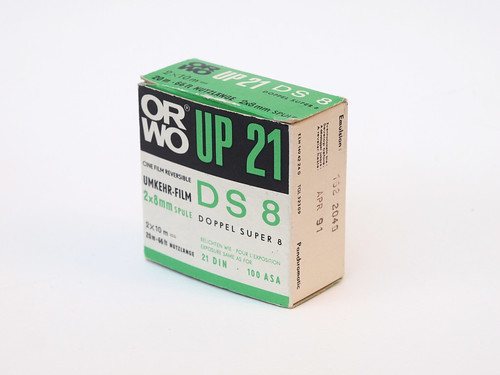
Orwo UP21 DS8 Film
I tried a test with 1970s Orwo UP15 2x8mm film stock, which, although I've had good results in the past from similar vintages, was too fogged to be of any use. For the final prints I used Orwo UP21 double Super-8 film with a develop before date of April 1991. Double Super-8 (or DS8) film and cameras use the principle of 2x8mm film in that the camera exposes frames on one half of the width of roll of 16mm-wide film, which is then flipped around at its end and run through the camera a second time, exposing the other half; once developed the film is split into two 8mm widths which are then spliced together–the crucial difference is that the DS8 format uses the much smaller Super-8 perforations, ensuring a larger frame size, while taking advantage of not using the plastic Super-8 cartridge with its built-in plastic film gate, supposedly allowing for better frame registration, as well as other aspects of 2x8mm, such as being able to run the film backwards through the camera for in-camera effects like dissolves made by the double-exposure of a fade-in over a fade-out.

I made one test with the UP21 DS8 film to get a rough idea of exposure, then contact printed the negatives onto the film, developing it in Ilfotec LC29 diluted 1+19 for 9 minutes at 20ºC. I cut these prints to 8mm width by hand, somewhat imperfectly (I had ordered a 2x8mm splitter the day before, realising this would be useful, but I went ahead with cutting the prints by hand, not thinking that the splitter would arrive a couple of hours later).
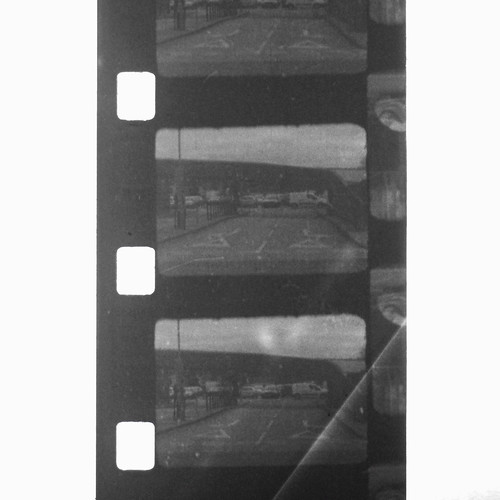
Contact print on Orwo UP21 DS8 film;
the diagonal white line lower right is the edge of one sheet of glass

Unable to film in Ilford on the 21st, I wanted to connect–visually–the projection of my film from last year to the site with some form of simultaneousness to Ilford on the 21st of February. I conceived that the manner of achieving this could be through streaming a live projection of a webcam from the town and recording both projections at the same time. I found just one such instance online with any kind of proximity to the site of Britannia Works: a traffic camera on the A118 Romford Road looking in the direction of Ilford Hill, across the river Roding underneath the A406 flyover. Britannia Works would have been off to the right of the field of view of this camera, but at some point Ilford Limited had expanded their operations to include properties between Roden Street and Ilford Hill, including the use of a skating rink, which would have been somewhere in the location of the building with the white double-height ground floor seen on the camera. Close by, there is another camera on Mill Lane, offline at the time of writing: in my research I found no connection between the paper mill which gives the road its name and the raw materials supplied to Ilford for the manufacture of photographic paper. There is also a webcam focused on a depth gauge in the Roding, although this only provided a still image; this could be 'animated' through refreshing a web browser window to update the image, but this had less of the 'liveness' of the traffic camera, although there was an association there to be had with the anecdote in Silver by the Ton of drying the glass used for photographic plates by the banks of the river while the area was still semi-rural at the end of the nineteenth century, as well as the risk of flooding on Riverdene Road that caused the houses that once backed onto Britannia Works there to be built with a slightly raised lower storey.

Contact print on Orwo UP21 DS8 film; 
the second location on Riverdene Road

The passage from Patrick Keiller's 'The Robinson Institute' that continues from the quote at the top of this post quickly punctures its utopian idea: Keiller goes on to write about how this promise of electronic flânerie was more imagined than realised at the time, in the late 1990s, there being relatively few websites providing actual live streams rather than, like the flood gauge in the Roding, still images that needed constant refreshment. At the time of writing twenty-five years later, the idea of scouring the internet for websites showing live images from anywhere around the world–for some experiential form of spatially-dislocated dérive–seems to me something of a relic of the idealistic promise of those early years. Other forms have supplanted the simple live webcam view: the experience of Google Street View, for example, while affording the opportunity to travel virtually through many towns and cities around the world does not allow the user to experience the simultaneousness of the live stream; this simultaneousness is now part of the everyday with various videoconferencing platforms, but using these has a tendency to subsume any kind of pleasure in the experience of dislocation into pragmatic and productive concerns.

The traffic camera I found looking in the direction of Ilford Hill only provides a short loop of a few seconds: this loop is updated every few minutes online. However, this suited my purposes as the short lengths of film that I projected are only seconds long (I didn't have the right equipment to splice the film together into one continuous length), and each section would have to be separately threaded into the projector; in the interim I could refresh the page to update the loop from the traffic camera to its most recent version. This webcam stream also had a date and timestamp, functioning as evidence to the specificity of the day I projected and recorded it as 'live', returning to the location remotely. There was a provisional quality to the composition of these two projections, utilising an otherwise neglected corner of a room, furnishing it with some of the ephemera that I'd collected in my research into the history of the Britannia Works site in Ilford, sufficient to give a texture to the white walls. I had envisaged the possibility of recording this set up with multiple camera angles, close ups of the various elements within the frame: the business of just projecting the film and documenting this action took precedence over anything more complex than a single angle, static camera.

I had problems in the actual projection of the film I had made. The short lengths had no leader: I had made the contract prints longer than the negative strips, with this extra length acting as a leader, but leader material tends, I think, to be a little thicker than the film itself. The projector I used has automatic threading, which frequently refused the prints I'd made; sometimes these would go through smoothly, but did not always come out the other end of the film path of the projector (also an issue to do with the material's thickness), which then had a tendency to fold itself up inside the projector, and, once creased, was even less likely to cleanly run through the projector, jamming in the gate, which sometimes could be shepherded through by toggling the frame. In addition, thanks to being hand cut, some parts of the film were a millimetre or so too wide, which was relatively easily solved by trimming a sliver from the edge; some parts of the film were not wide enough, and this caused it to jam, possibly by having too much side-to-side play when engaging the projector's pull down mechanism. Despite these issues I was able to film the four separate parts of the footage (each location's filming having been broken over the two lengths of the original cut-down negative); I also kept a section where one length of film jammed in the projector's gate, partly as this print shows a good deal of the lettering in the film rebate, notably 'ILFORD' itself. The duration is shorter than the original film: this was shot at 12 frames per second; although the projector does have adjustable frame rates, it seems to only run at 16fps. I tried slowing the playback to 75%, but found the distortion of the slower audio (even at its original pitch) more distracting than anything gained by seeing the film at the rate intended. With all these contingent factors, the film itself as projected has become fragmentary and somewhat abstract, the image sliding across the frame, hard to fix. Perhaps, in terms of "photographs in motion" (a phrase from David Campany in Photography and Cinema, on the Lumières' first film) the least obstructive section is the very brief few frames in which a pedestrian crosses the screen, but the focus here is off, partly due to the contact print, compounded by the projection itself, in which, thanks to the hand-made quality of the material, needed constant readjustment.

Contact print on Orwo UP21 DS8 film showing both
irregular vertical and horizontal framing

Writing about the beginnings of Ilford, Limited under Alfred Harman last year, I described it as "literally a cottage industry" in that, having outgrown his basement on Cranbrook Road, Harman rented a cottage on the Clyde Estate as his first expansion into the location which would become Britannia Works, rapidly incorporating many more cottage buildings, some of which remained on the site until demolition nearly a century later. This use of domestic space as a site of production was something I wrote about at the end of 'Workers Not Leaving The Factory', or rather, more specifically, the de-localising or re-localising of production outside of a strict spatial definition of 'the workplace'. The global pandemic has accelerated some of these trends, while delineating what kind of work could be moved online easily (although not always pursued) against work impossible to carry out remotely. Surrounding the filming in Ilford a year ago, the consumption the supermarket that has replaced Britannia Works allows relies on the productive work, necessarily tied to a number of spatially-located specificities, non-virtual, culminating in the supermarket itself; the construction work just off-frame is also solidly tied to the real, real bricks, real concrete, and the physical labour required to configure these materials into living spaces, such spaces now co-opted into being the site of production for many, unforeseen a year ago.

The title used here comes from a reproduction of the original programme of the Lumière films shown in London in 1896: their first film, of workers leaving the Lumière factory, is not among the titles listed, but the possibility that it may have been shown is tantalisingly suggested by the promise that the programme "will be selected from the following subjects, and will be liable to frequent changes, as well as ADDITIONAL POURTRAYALS [sic]".


Sources/Further reading:
David Campany, Photography and Cinema, Reaktion Books, London 2008 (2012 reprint)
RJ Hercock and GA Jones, Silver by the Ton - A History of Ilford Limited 1879-1979, McGraw-Hill, London, 1979
Patrick Keiller, 'The Robinson Institute', The View From the Train, Verso 2013
O. Winter, ‘The Cinematograph’, The New Review, May 1896 (https://picturegoing.com/?p=4166 retrieved 21/3/20)


See also the bibliography of 'Workers Not Leaving The Factory'.