Sunday, 5 June 2011

Foth Derby - Part two

Foth Derby II
Having repaired the cloth shutter to my Foth Derby, I ran a roll of Efke R100 film through it. The aspect of shooting with this camera which needs most attention to those unfamiliar with it is cocking the shutter.

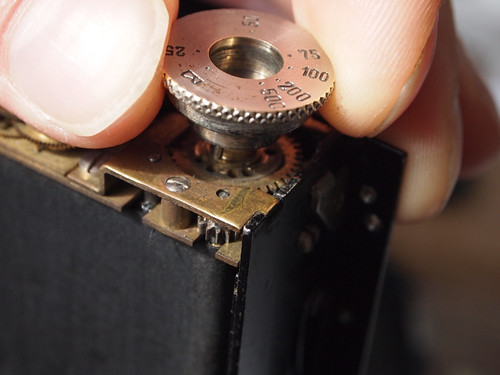
Unlike more modern cameras, where the shutter is 'cocked' as a consequence of winding on the film, and so appears a seamless operation not noticed by the user, most cameras the age of the Foth Derby require the shutter to be cocked manually (the exception being rotary shutters typically found on box cameras). With leaf shutters, this is done by turning a lever on the side of the lens, a simple operation. On a focal plane shutter, cocking it involves turning a knob to wind the shutter curtains past the film gate, where they travel back at speed with a gap between them to expose the film when the shutter release is pressed.

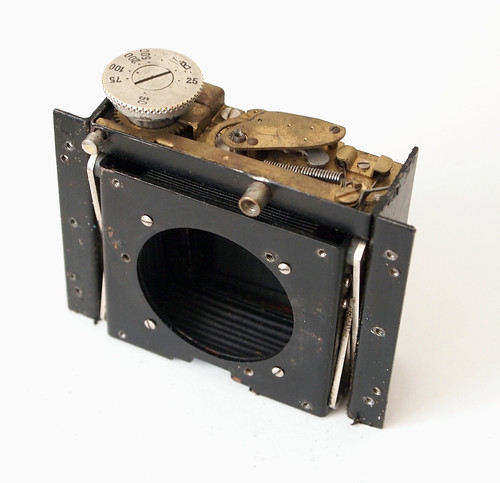
Foth Derby shutter unit showing the pin and corresponding holes for selecting different shutter speeds.
On the Foth Derby, the knob has to be turned through three quarters before it catches. Turning this has to be done in one swift decisive movement, which takes a little practice; the springs tensioning the shutter are quite strong, and if the shutter knob slips before it's wound all the way until it catches, the shutter curtains slip backwards- potentially with a gap between them, accidentally exposing the film. On my camera, someone had cut away crudely the leather from under the shutter knob, done, I imagine, to make it easier to turn. In my restoration of the camera I painted the bare metal black to make this less obvious. My technique for cocking the shutter is to turn the camera one way while turning the knob the other. It's interasting to note that the last incarnation of the Foth Derby, the Gallus Derby-Lux had a shutter knob that stands rather more proud from the camera's top plate, making it a similar size to the winding knob.

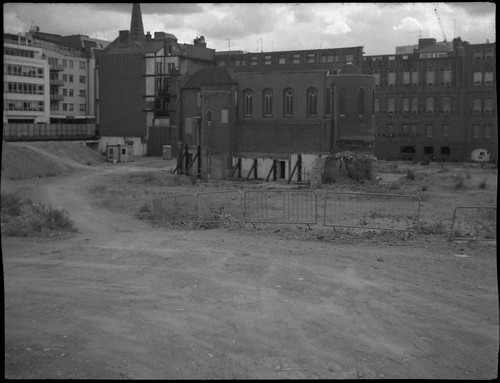
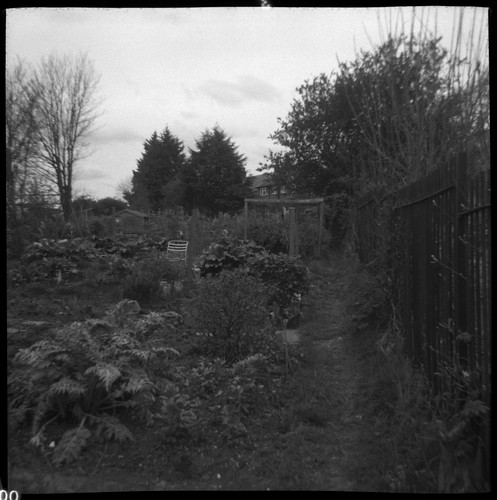
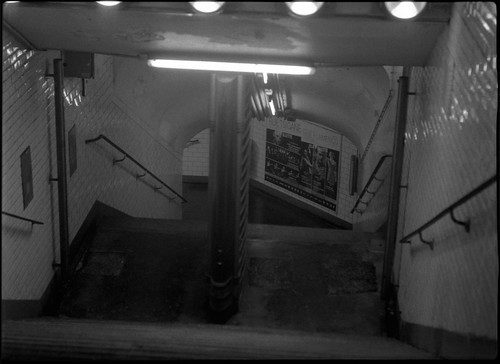
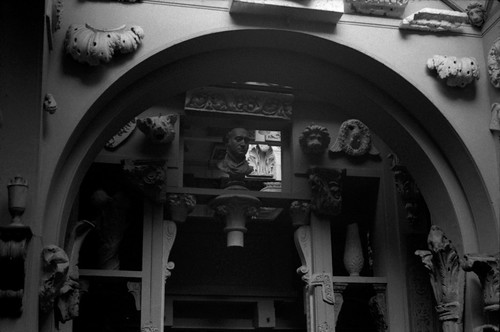
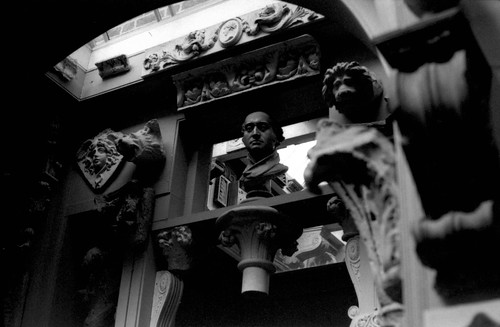
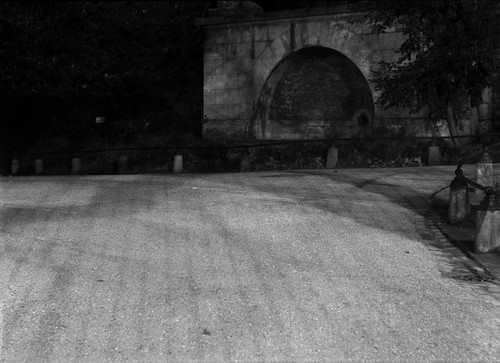
Middlesex Hospital Chapel, Efke R100, developed in Rodinal 1:25
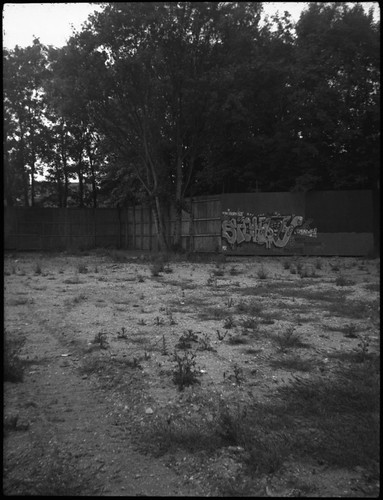
Site of Railway Buildings, Hackney, Efke R100, developed in Rodinal 1:25

Friday, 13 May 2011

Foth Derby

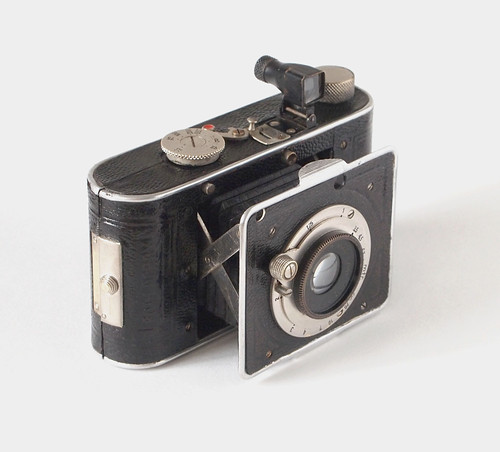
Foth Derby with f3.5 Foth Anastigmat lens
The Foth Derby is a strut-folding camera for 127 film produced by C.F. Foth of Berlin during the 1930s. Unusually for compact cameras of that date, it features a focal plane shutter with speeds of 1/25th-1/500th of a second, and 'B'. The camera pictured above is a type 2 Derby, with a Foth Anastigmat f3.5 lens, self timer and telescopic viewfinder.

I bought the camera 'as is' from a certain auction site, and it arrived in working condition, but in need of a little repair. The shutter comprises two cloth curtains, one of which had deteriorated. This was more than just a few pinholes, so I decided to disassemble the camera to see if I could remedy the problem.

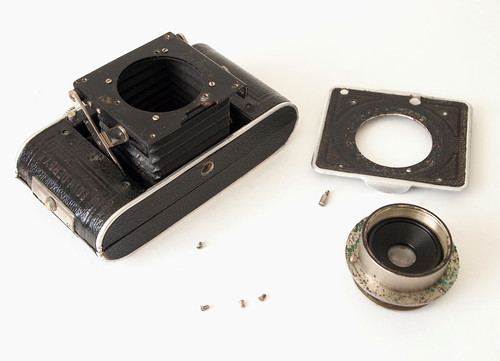
Camera with lens and lensboard removed
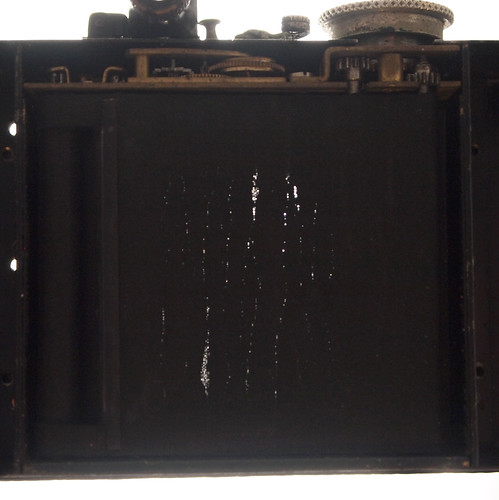
The first step was to remove the lens, held by three screws including the long focus stop. The lens was relatively clear, and I simply separated the front and back elements for a light clean. I then removed the lens board, held on by four screws. Once the lens had been removed, it was easier to see the condition of the shutter curtains. From the front of the camera, the surface of the shutter cloth was cracked; held up against the light there were lots of pinholes. The other curtain which covers the film when the shutter is cocked was fine: possibly without a lens cap, light through the lens caused the deterioration of the one curtain, the other being rolled out of the way.

Close up showing the cracked surface of the coating on the inside of the cloth shutter curtain.
Pinholes in the shutter curtain seen against the light
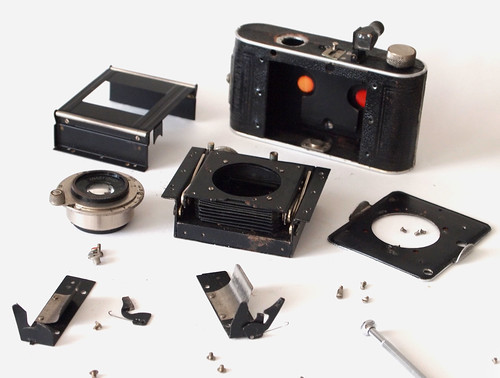
I thought that the four screws that can be seen through the front of the camera might enable me to remove the shutter, but these screws hold the bellows to the shutter. Opening the back of the camera, I removed the spool holders to either side, then from the front of the camera, I unscrewed the six screws either side of the bellows, covered by the lensboard with the lens collapsed. These six screws hold the film gate and rollers around the shutter unit. Having removed this, the shutter unit was still held to the camera body by something. This was the self-timer, secured with a screw through the top plate into the shutter. Having unscrewed this I could remove the shutter.

Foth Derby disassembled
Foth Derby shutter unit
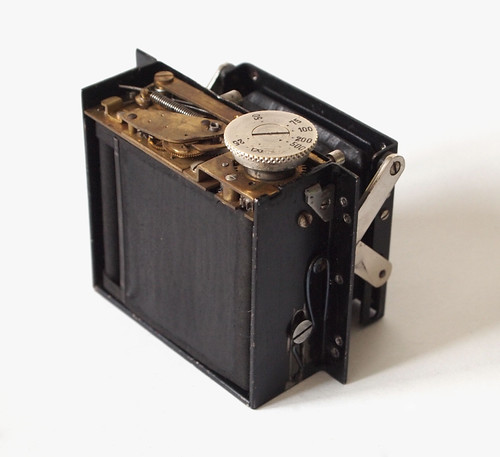
With the film gate removed, the whole of the shutter curtain was exposed. The next stage of disassembly would have been to remove the shutter curtains; however I wanted to attempt a repair without doing this if possible. For the repair I used black acrylic paint, thinned with water to the consistency of milk, which I thought would be flexible enough for occasional use. The paint was applied to the back of the curtain, i.e. on the other side of the fabric from the cracked surface, which I left as it was. There were so many holes it was simpler to paint the whole surface of the curtain. One coat of paint left some holes visible against the light, and I gave the cloth another three coats. Once the paint was dry, the shutter curtain appeared to be flatter than before, presumably the fibres of the cloth swelled with the moisture from the paint, then tightened in the process of drying.

Shutter repaired with acrylic paint
I polished both the metalwork and the leather while the camera was disassembled after gluing down some of the leather, which was peeling, and the light seals inside, then put it back together after leaving it overnight as a precaution against the fumes from the glue and polish affecting the shutter mechanism, lens or anything else.

Foth Derby continued

Tuesday, 19 April 2011

127 Format

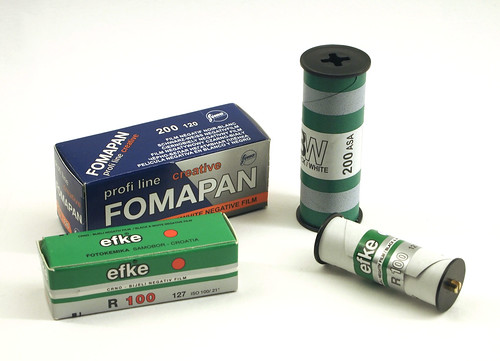
Front: Efke R100 127 film/Back: Fomapan 200 120 film for comparison, boxes and film rolls
127 film is a paper-backed roll format, originally introduced by Kodak in 1912. In many respects similar to 120, the negative size depends on the camera:- the original 'vest-pocket' cameras took 4x6cm exposures; in the 1930s a 'half-frame' format of 4x3cm was introduced, and also a 4x4cm format for the original 'Baby' Rolleiflex, a scaled down version of the Rolleiflex. The paper backing has two sets of numbers: 1-8 for 4x6, and 1-12 for 4x4; cameras for the 4x3 format have two red windows to use the 1-8 set for sixteen exposures: the film is advanced so each number appears twice, once in each window. At the time of writing, two companies currently manufacture 127 film, Efke and Maco under the Rollei brand, and there are also colour films from Bluefire, and Maco, which are spliced from larger rolls of film.
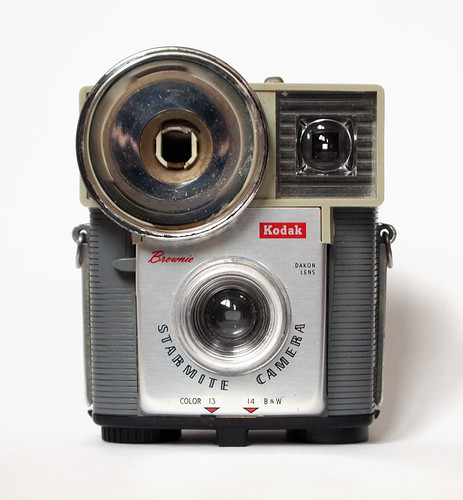
Kodak Brownie Starmite camera, taking 127 format film
My interest in the format was piqued by the fact I had a Kodak Brownie Starmite which uses 127 film, and I had never used it. The Starmite is essentially a simple box camera with a flash unit attached. It has a fixed-focus plastic lens, a single shutter speed, and two aperture settings, marked 'Color' and 'B&W'. This was given to me years ago in its original box. There were two films in the box, Kodak Verichrome, and Efke R21, both out of date. The Efke film is obviously newer, and I doubt original to the box set, whereas perhaps the Kodak Verichrome is original. As I don't collect cameras just for the sake of collecting, I wanted to use the camera before disposing of it and I didn't want to use the old films in the box just to test it, so I bought some Efke R100.

Efke R100 test roll shot in Kodak Brownie Starmite

The resultant photographs are typical of a cheap box camera: the lens is fairly sharp in the middle, but with the focus falling off at the corners. Interestingly, the Starmite has a curving film plane, which I imagine is designed to reduce this effect. A couple of the other images on the film show that the film wasn't always kept tight to the film plane, as evidenced by the wobbly edges to the film rebate. I haven't been able to find out anything about the 'Dakon' lens that the Starmite is fitted with, but I imagine it is of the meniscus type.

One can speculate as to why the 127 format has survived this long, with no new cameras made for 127 film since c.1970, whereas other film formats which were used in greater volumes more recently have quickly become obsolete, most notably the two 'easy-load' formats aimed at consumers, 126 and 110. The overriding reason appears to be the higher quality of cameras made for 127 film, as opposed to 126 and 110 (with the exception of the Pentax 110 SLR): cameras for these formats were generally (like the Brownie Starmite) simple point-and-shoot snapshot cameras. In the 1950s there was a resurgence in the format with the second version of the Rollei 'Baby' Rolleiflex, and a whole series of Japanese TLR cameras following the Yashica 44, which were essentially scaled down version of medium format cameras, using lenses, shutters and other components of comparable quality, hence the use of 'Baby' to refer to these cameras.
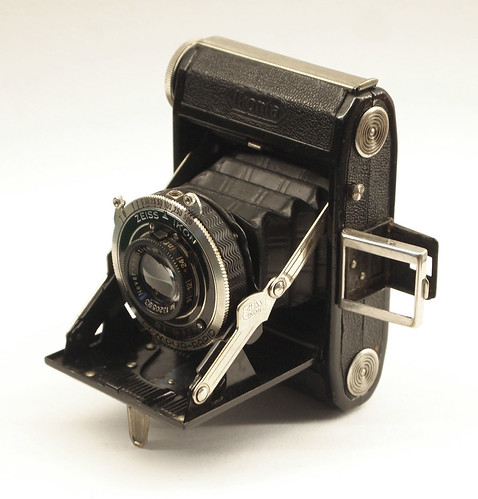
Zeiss Ikon Ikonta 520/18 - Baby Ikonta camera
I subsequently bought a Zeiss Ikon Ikonta 520/18 folding camera- otherwise known as the 'Baby Ikonta', a 127 version of the original Ikonta. Dating from the 1930s, this camera has a Compur-Rapid shutter and a Novar f3.5 lens (the top of the range has a Tessar lens). When folded the camera is comparable in size to a modern digital compact, easily pocketable, yet produces a negative nearly twice the size of a standard 35mm frame. Having shot a couple of rolls of film with the camera, I noticed that despite the film backing having 8 numbers Efke R100 has 18 numbers in the film rebate, and quite a lot of film either end of the sequence of negatives. It was very easy to shoot a 17th frame on the Baby Ikonta, simply by an extra 3/4 turn on the winding knob after the final number on the film backing (I used the words 'Made in Germany' on the knob to check the position: looking at the letter at the 12 o'clock position, I turned this to 9 o'clock to shoot the final frame). It would be less easy to shoot an 18th frame, simply as this would mean taking a shot before lining up the first number on the film backing with the first red window.
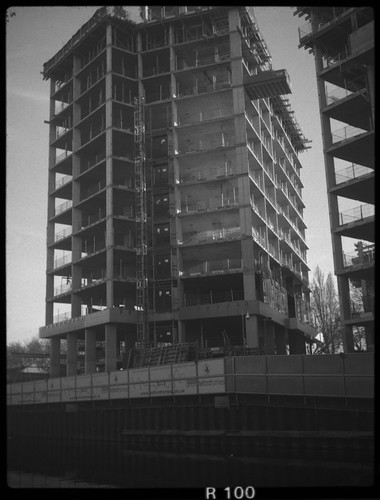
Test roll from Baby Ikonta 127 folding camera, Efke R100,
developed in Rodinal 1:50, 12m30s at 18 degrees C.
Sources/references/further information:

http://camera-wiki.org/wiki/127
http://www.onetwoseven.org.uk/
http://www.flickr.com/groups/127/
http://www.nwmangum.com/Kodak/FilmHist.html

Thursday, 7 April 2011

Ilford Delta 3200

Metro Entrance, Ilford Delta 3200, handheld at 1/50th, f4.5

Along with Kodak T-Max P3200, Ilford Delta 3200 is the fastest black & white film currently on the market. Despite the prominent '3200' in the name, its true emulsion speed is 1000 ISO: essentially this means the film is recommended by Ilford to be exposed at a range of speeds, including 3200 ISO, and developed accordingly (incidentally, T-Max P3200 has similar characteristics: Kodak state it to be 1000 ISO in their proprietory T-Max developers, or 800 ISO otherwise). Delta 3200's main advantage over T-Max P3200 is that it is available in medium format as well as 35mm. When in Paris recently I shot a roll at night, as an experiment, to use the film in medium format; I had previously shot Delta 3200 in 35mm but found the results unsatisfactory. This may have been partly due to using Rodinal as a developer. Being a high-acutance developer, Rodinal tends to be recommended for slower films with more traditional emulsions, as the acutance effect can emphasise film grain considerably; with larger negatives in medium format, this is less noticeable.

Kodak T-Max P3200, developed in ID11 stock solution, 12 minutes at 20 degrees C.
When I first began to take and develop photographs as a student, I frequently found myself wanting to shoot hand-held pictures in low-light situations, often in museums, or on the Underground. I carefully annotated my contact sheets with the ISO ratings and the developing times and dilutions I used at the time, so now, looking back, they provide a useful reference for comparison. I did use T-Max P3200 a couple of times, which was the fastest film on the market (Delta 3200 was introduced in 1998), although more often I pushed Ilford HP5+, frequently to 800 ISO, and occasionally to 1600 and to 3200, with variable results. I can't recall the prices, but I imagine T-Max P3200 was more expensive than HP5. I suspect the reason that I did not use T-Max P3200 more was that the I perceived the difference in quality insufficient for the price. Another factor was using ID11 to develop the film,  which is reputedly better than Rodinal for push-processing.

Ilford HP5, rated at 3200 ISO, developed in ID11, 18 minutes at 20 degrees C. A comparison to the previous shot of Sir John Soane's museum does show a lack of shadow detail, though not a considerable difference.

One consideration against push-processing film for night and low-light photography is that an effect of pushing a film is an increase in contrast. Often night scenes are themselves inherently high contrast: bright light sources and reflections, and dense shadow areas, therefore pushing a film can result in a negative with blocked highlights and very little- if any- detail in shadow areas. In this regard it would be more appropriate to pull-process the film, and so reduce contrast, which however negates the use of a higher ISO rating, a real consideration for hand-held photography.

Rue Lacepede, Ilford Delta 3200, handheld at 1/50th, f4.5
The current photographs were shot using a Baldalux medium format folding camera, with a 6x4.5 mask, a compromise between larger negatives, and getting more shots from a roll of film. One drawback with the camera is the lack of a built in light meter; for daylight shots I use a Weston light meter, but being a selenium cell meter, there isn't enough light for it to work at night, so the photographs I took in Paris are not metered. The hand-held shots were all taken wide open, at the maximum aperture of f4.5, at a 50th of a second; for the Jardin De Plantes photograph I held the camera flat against a hole in the iron gate. I developed the film in Rodinal 1:25 at 19 degrees C, 15m 45s (3 and a half minutes longer than Ilford's recommended time), with the last four minutes 'stand', meaning without agitation, preferring to potentially over-develop the film as an insurance against under-exposure.

Jardin des Plantes, Delta 3200, roughly 60 seconds at f11.

Friday, 25 March 2011

Photographs developed from a found roll of film 2


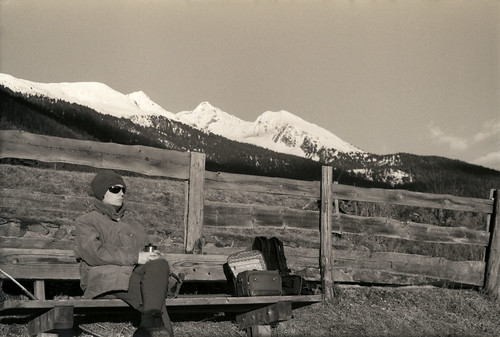
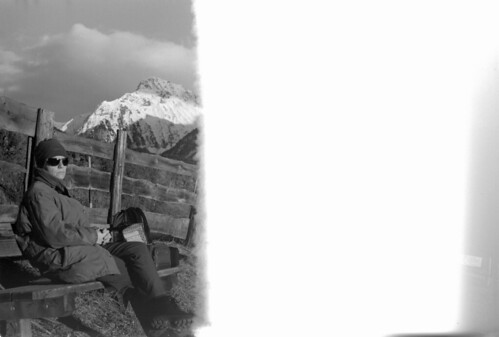
I bought a Rada rollfilm back to use with a Zodel 6x9 plate camera. When I pulled out the darkslide, I found that it had a roll of film inside. This partly exposed the second frame (below). Having spoiled a couple of frames, I shot the remainder of the film. As with the previous post, I stand developed the film in Rodinal 1:100 for one hour. The film is marked 'Kodak GB-4' in the rebate.

The two shots look possibly Alpine, but I don't know if the mountain range is distinct enough to be easily identified. Unlike the film in the previous post, the photographs do look relatively recent, judging by the clothing and the camera bag and rucksack.

The subsequent photographs I took on the roll were all affected by light leaks, possibly due to the roll not being tightly wound.

Thursday, 17 March 2011

Anthony Carr, A Month of Nights, Format Festival Derby


The above image shows one of artist Anthony Carr's pinhole cameras, disguised as, or protected from the elements in, a bird box. Over a number of recent projects and exhibitions Carr has developed pinhole cameras with a shutter driven by a clockwork mechanism which controls the exposure of the film inside. For the Format Festival Carr is exhibiting a number of prints from these cameras placed around Derby which recorded images on film at night, over the course of a month, as well as having installed cameras to expose film for the duration of the photography festival itself.


At Pickford's House until 17th April 2011


Format Festival Derby


Anthony Carr on Axis


Images ©Anthony Carr

Thursday, 3 March 2011

New Silverprint Catalogue

For the first time in four years they say, Silverprint have produced a print catalogue. Made like a tabloid newspaper, it's so much more than a list of all the products they sell- there's lots of historical background to different techniques, processes, suppliers, all representing a bit of a resurgence in analogue photography (they're even selling reconditioned Olympus Trips):-

www.silverprint.co.uk