Showing posts with label Olympus OM10. Show all posts

Sunday, 31 December 2023

Retracings

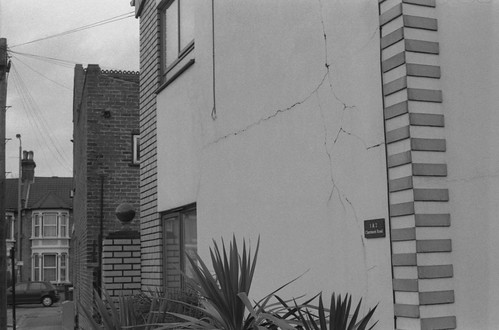
Dyers Hall Road, Leytonstone, 31st December 1993

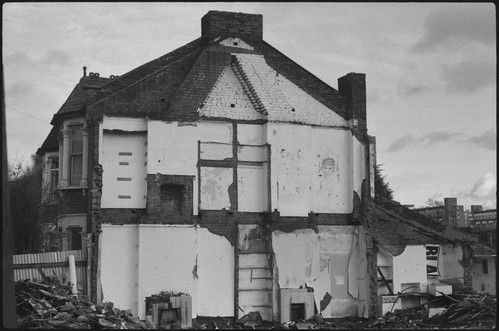
In a post that I wrote for this blog ten years ago, 'Twenty Years Since', I mentioned–almost in passing–photographs taken of houses being demolished to make way for what was then called the M11 Link Road, now the A12. The few words that described the experience of taking these photographs belies what was, in retrospect, an important formative experience or experiences. The taking of the these photographs was tied up with learning the craft of photography itself, following a basic introduction to photography as part of my Foundation Course in Art & Design a few weeks earlier, then receiving a secondhand Praktica BCA for Christmas in 1993.

I had been aware of the planning blight that accompanied the road scheme years earlier, although I hadn’t known that this was what it was. A journey into central London would involve taking the Central Line from Gants Hill or Redbridge stations; this branch of the Central Line is in a tunnel under Eastern Avenue, resurfacing just before Leytonstone station for a couple of stops, making this brief view from the windows of the tube train a diverting contrast to the darkness of the rest of the way. Houses backing on to the line where it runs above ground here had begun to be demolished or fall into disrepair years earlier: I distinctly remember the graffiti spelling out WHY BOTHER? on the back of a house from the late 1980s, later to provoke the rejoinder WHY NOT? (These were then joined by CRAWLING KING SNAKES KICK YO ASS.)

What had been an occasional journey while I was at school in nearby Wanstead became a daily one when I started college in 1993; I was all the more aware then that the demolitions were something that was actively happening, rather than what might have appeared to be a few streets fallen into desperate disrepair that I’d see whenever travelling into town. The protests around the tree on George Green in the autumn term was the moment that the active resistance to the road scheme made itself felt. (Rather pointlessly, one night after being kicked out of The George with a friend, we pulled down a fence post that had just been put up around the tree–there appeared to be no security at that stage–delaying the construction of the road by what must have been minutes at best, my only attempt at direct action).

The weather around Christmas in 1993 had been largely cold and wet, with some snow; the last day of the year, a Friday, turned fine and sunny, prompting me to decide that it was the perfect opportunity to use my new secondhand camera, with a roll of Ilford HP5 Plus bought for a holiday college project, which was to illustrate a number of words that we had been given. The photos are a record of that change in the weather. I took the tube to Leytonstone, and walked to Leyton, taking photographs along the way. I took some photographs in the British Museum afterwards on the same day; the last two photographs of the M11 Link Road sequence were taken from a moving train. These may have been from Leyton in the direction of Stratford, or I think I may have taken an eastbound train from Leyton back to Leytonstone, before then switching over (or under as the case is at Leytonstone) to take a Westbound train to Tottenham Court Road for the museum.

I returned on a number of occasions in the following months to take more photographs, neither systematic not comprehensive, but with the awareness that this felt like something of which it was worth making a visual record (the one time that I chanced upon evictions happening on Claremont Road in the summer of 1994, I had a part-used roll of film in my camera and no spare). The photographs were printed in the darkroom at college, rather inexpertly, and the images ended up used in artwork then, in collages and paintings, and I drew on these the following year when I’d left London and started a degree in Fine Art.

Dyers Hall Road, Leytonstone, 31st December 2013

I had occasion to revisit these photographs earlier this year, and needed to find the original negatives; in doing so I also found a set of negatives from 2013 in which I had attempted to match the locations from the photographs of what was then twenty ago as closely as possible. These negatives weren’t scanned at the time–I had intended a blog post then–and the moment passed. I had scanned the original negatives in 2007, and had posted these online in 2008, and rather over-promised the content of these images by calling this the ‘M11 Link Road Archive’ (an actual archive of material related to the M11 Link Road and the protests resides at the Museum of London). Returning to some of the original files, the quality of these original scans was relatively poor, with scanning artefacts and clipped highlights and shadows in many of the frames. (Scanning issues–software and hardware–partly explain the absence of posts on this blog this year, although the main excuse was the writing up of my PhD). Having found the negatives from both 1993 and 2013, I was able to scan these recently with better results for this post.

What I didn’t know at the time was that many of the houses along the route were or had been inhabited by artists. Acme Studios had been offered a number of the compulsorily-purchased houses by the Department of Transport in the 1980s; by the time I was taking these photographs, the houses along the route were occupied by the few original residents who had not moved away, some of the Acme artists who became involved in resisting the demolitions, and the first wave of anti-roads protestors, some of whom had come from Twyford Down, just outside Winchester–where I was going on to study–and many subsequently moved onto to protest the Newbury Bypass after the M11 campaign.

For a few years I probably didn’t think about this part of my life very much; I happened to cycle over the road on the Quartermile Lane bridge from Hackney just before it opened in 1999. I didn’t have a camera on me at the time, and thought I’d return to take photographs of the empty road, but I never did. Then in 2003, a site-specific sound piece by the artist Graeme Miller called LINKED was installed along the route. This required collecting a radio receiver and headphones, available from local amenities–we got ours from Wanstead Leisure Centre–and walking a route from Wanstead to Hackney Wick, along which one would encounter transmitters that broadcast audio loops consisting of extracts of oral history weaved with music into soundscapes.

Related to Miller’s LINKED, in 2008 I attended a number of seminars at LCC’s Photography and the Archive Research Centre (PARC), part of their research project Road: Artists and the Stop The M11 Link Road Campaign, 1984–1994; the ninth issue of PARC’s journal, Fieldstudy, was devoted to this research project, and featured a few of my photographs from 1993-94. Last year, Graeme Miller revisited LINKED: since its initial installation, with most of the receivers being placed on lamp posts along the road, a slow attrition had reduced these in number over time, some going as the Hackney Wick end of the route was swallowed up by the 2012 Olympic Park, others from the streetlights being knocked over, or the transmitters being unknowingly discarded by contractors. In anticipation of the project’s 20th anniversary, Miller revisited it for Re-LINK last year where the receivers were made available again for 48 hours and a roundtable discussion was hosted by Leytonstone Library; in conjunction with the exhibition Radical Landscapes at the William Morris Gallery, three open days for LINKED were planned, the first was in November, the next on 20th January and 17th February 2024. (In the intermediate years I had other opportunities to revisit Miller’s LINKED a few times, re-walking the route in different groups, thanks to the artwork being used as a PhD case study by Dr. Sarah Wishart.)

In 2013, attempting–as best I could–to find the same viewpoints as the photographs taken in 1993, it wasn’t always clear as to where exactly each picture had been taken then: I hadn’t taken any notes. However, the sequence on the contact sheet, and the linear nature of the route from station to station made this relatively easy in most cases, but for some photographs this would have meant hovering above the A12 itself, as with most of those taken along Claremont Road itself. Some of the photographs in my retracings from 2013 and 2014 were taken with a Zenit 11, some with Praktica MTL3, but for both cameras I used a Prakticar f1.8 50mm lens, the same design lens as I would have had on my Praktica BC1, and then the BCA which replaced it later in 1994 (Edit 25/01/24: Having rediscovered the contact prints from the photographs taken on the 31st December 2013, I had actually used an Olympus OM10 for this set of photographs).

The photographs from 1993 start at Dyers Hall Road. This road formed a shallow loop underneath the Gospel Oak to Barking branch of what was then the North London Line, joining Grove Green Road either end in a slightly more direct route along the Central Line. The A12 reduced Dyers Hall Road into two stubs, the shorter one now with the suffix 'South'.
For the pedestrian, or cyclist, the two ends of Dyers Hall Road are joined by a footpath and cycle lane which runs alongside the brick wall of the A12 here. At the end of Dyers Hall Road South, there is a footbridge that crosses the A12 to Norman Road on the eastern side; there had been a shorter footbridge here in 1993, which afforded a view across cleared ground to the railway bridge, a section of its brick arches already replaced by a long straight steel span.
A second photograph from the bridge looks over back gardens on Dyers Hall Road; the houses in the background face onto Grove Green Road. I took one photograph in 2013 looking across from the far end of the bridge towards the rear of those same houses on Grove Green Road, but a truer position would be on the footbridge itself, just past the line of the railway, where the previous footbridge would have ended–as in the third image below.
The next photographs are from Claremont Road, which became the focus of protest in 1994. The first of these are at the end of the right angle where it comes off Grove Green Road, two houses, one with a gibbet fixed to a chimney and a poster in a window: M11 LINK ROAD/DEVASTATING OUR COMMUNITIES. I’m reasonably sure that these houses were at the northern end of the road: the fence that runs alongside borders the Central Line. Behind would have been the Cathall Road bridge over the railway. In 2013 I took two photographs looking in the same general direction, one from that bridge, which would be somewhat behind the location of these houses, the other from the wide pavement before the bridge, which would be to the west.
A photograph of a house with a front door, curtains and a cat painted on breeze blocks is one of the pictures that would now be entirely where the A12 is now, or above, as the road sits in a cutting here.
There are two photographs at the southern end of Claremont Road where it turns back to Grove Green Road. After the A12 was built a small section of the southern end of Claremont Road remained; there was a little space here to build some houses, facing onto the road, thus ensuring that Claremont Road as a residential address still exists. A photograph looking back from here to Grove Green Road roughly replicates the same view of that from 1993.
The next photographs are from Colville Road. This was set a little further back from the Central Line than Claremont Road: houses which backed onto the railway were all demolished, along with some houses facing those at its northern end, where the angle of Colville Road was changed to accommodate the A12, running behind its brick wall but a stretch of terraced housing on the road’s western side survived.
This change in the course of the road can be clearly seen in the photograph from 2013 which looks along the wall, replicating a picture from 1993 looking over the corrugated iron fence to the end of terrace, side-on to the first photograph of Colville Road.
From here another photograph looks across to the Central Line, showing a 1962 stock Central Line train passing St. Patrick’s Roman Catholic cemetery in the far background (these trains, which I had grown up with, were phased out during that year I spent commuting on the Central Line, going to college, replaced by the current 1992 stock). A photograph of this view would be straight on to the brick wall; I took a picture in 2013 which I think must be looking up and more to the right.
There are two photographs from 1993 that mark the end of the walk from the entrance to the rail yard that lay to the southwest of Leyton Station; this would seem to extend down to Temple Mills, although I haven’t been ably to find whether Leyton Rail Yard was separate from that of Temple Mills, which is now the Eurostar depot. The view from here shows the horizon opening up to take in a skyline in which one can see One Canada Square in Canary Wharf, new in 1993 and the tallest building in the country at that point, past three tower blocks by Bow Church station, the Bryant and May match factory, across what is now the 2012 Olympic Park, marked by the two squat UEL residential towers, to the tower blocks clustered around Wick Lane and Victoria Park. The view now is almost entirely different: trying to locate the exact viewpoint would take one to the edge of the Leyton Mills retail park; slightly to the left, on the bridge over the A12 itself, shows a broadly similar view to that of 1993, with most of the horizon filled with development on the 2012 Olympic site. One Canada Square can still just be seen, as can the tower blocks by Wick Lane.
A second photograph in 1993 was taken at right angles to the first, looking back towards Leyton station, dominated by railway buildings facing the rise in the high road as it passes over the railway line; the current station building’s roof can just be see to their left, mostly obscured. A similar view today looks across the ramp and stairs into the retail park, with the station’s pitched roof in roughly the same position. I didn’t try to replicate the two photographs shot from the moving train in 1993, as I couldn’t be at all sure exactly where they were taken.
Although never directly involved in the campaigns and protests, not knowing about the community of artists there, feeling like an outsider despite it being relatively local, seeing and recording the progress of these demolitions in 1993 and 1994 affected me in part I think as the houses were very much like that I had grown up in, and was something that I could see happening as I took the tube to college every day. There was also an aspect of being confronted by the arbitrary use of the power of the state at this formative age, bound up as it felt at the time with the Criminal Justice Bill, much in the news at the time, passed into law in November 1994, with many of its measures seemingly targeted at the young and politically active, and how this galvanised, pre-internet, before social media, a grassroots opposition (Labour, under Tony Blair–first as shadow home secretary as the bill made its way through parliament, then as leader of the opposition following John Smith’s death–abstained when the bill received its third reading). My awareness of this came through a very different media ecology from today: posters on the streets, what alternative press I happened to come across, like SchNEWS, but mostly how it filtered through into the music of the time and the wider conversations around it in part through the ‘polytextuality’ (as Dean L. Biron describes it) of the music’s physical artefacts–the artwork and liner notes–and how this was reflected in the music press and the conversations that were part of meeting new people, new ideas, starting a college course, anticipating leaving home. When I took the photographs on the last day of 1993, photography was physical (it would be many years before I even saw a digital camera, though I did have my first experiences with Adobe Photoshop then, with a faint intuition that this would be a transformative technology), enabling me to return to the negatives thirty years later and create images anew from their matrices.

Fieldstudy issue 9 (PDF file)
Graeme Miller LINKED
Sarah Wishart, 'A Provenance of Performance'
SchNEWS Issue 3 December 1994
Dean L. Biron, 'Writing and Music: Album Liner Notes'

Wednesday, 10 June 2015

Agfa/Rollei Superpan 200

Superpan 200 in 35mm and medium format
There are very few black and white films manufactured with a nominal speed of 200; currently, just three: Fomapan 200, Ilford SFX 200 Creative, and Agfa Superpan 200Fomapan 200 was discontinued for a few years, but was recently reintroduced in a new formulation; Ilford's SFX 200 shares some characteristics with Agfa Superpan 200: the name denotes that the Agfa film is superpanchromatic, with extended red sensitivity beyond normal panchromatic films, to near infra-red, and with the right filters (like SFX 200) it can produce similar effects to true infra-red film. Of the three films, all are available in 35mm and medium format rollfilm, additionally, Fomapan 200 is also available in large format sheet film. There are few stockists in the UK for Superpan 200, West End Cameras currently has the film in stock; when asked about in Silverprint, they hadn't heard of the film. Superpan 200 is sold by Maco but is produced (as Aviphot Pan 200) by Agfa-Gevaert in Belgium, and Maco's website uses Agfa-Gevaert's Aviphot Pan 200 technical information sheet. As can be seen in the photograph above, the film packaging uses both Agfa and Rollei brand names for the medium format film, while the 35mm labels do not use the Rollei name (the 35mm film is also not DX-coded). In the film rebates, on the medium format version, Rollei is used, while 35mm has just the name Superpan 200.

Agfa-Gevaert's data sheet describes Aviphot Pan 200's applications as:
Aerial photography assignments from low to medium altitudes, for gathering, interpreting and processing information intended for cartography, inventory purposes and exploration studies. This film can be used in industrial recording systems, such as equipment for plotting graphs in control and monitoring devices. It can also be used in stereo image recording devices, either airborne or in ground-based facilities for subsequent production of three-dimensional plans, maps, etc.
Characteristics
With its expanded colour sensitivity into the near infra-red range of the colour spectrum, Aviphot Pan 200 offers excellent penetration through haze, fog and other atmospheric conditions liable to affect the image quality. Obviously, this yields an improved image contrast and therefore more information. With the uniform distribution of the panchromatic sensitivity within the range of visible light, the terrain can be imaged very faithfully without having to revert to the use of special spectral recording filters. Yellow filters can be used to get a higher image contrast. They also decrease the overall film sensitivity.
As with previous film tests I shot a roll of 35mm Superpan using an Olympus OM10 SLR, with a range of meter settings of 25, 50, 100, 200, 400, 800 for film latitude. With no published development times for Ilfotec LC29, the developer I used, on neither the data sheet from Maco, nor the Massive Dev Chart, I used stand development, with a dilution of 1+100 for one hour.

First latitude test contact sheet, stand developed in Ilfotec LC29
The first test showed the film to have narrow latitude, with the best exposure indexes of between 50-200, but developed in Ilfotec LC29, rating the film at 100 (or a little under) seemed to give the best results (the original data sheet states that "Aviphot Pan 200 can be exposed as a 125 to 250 ASA film," although this is with Agfa's G74c developer). Stand development is usually a good technique to get straight negatives from a properly exposed film, but the first results were a little disappointing.

I used the same camera and exposure settings for a second roll, repeating the latitude test of metering for 25, 50, 100, 200, 400, 800, but this time developed the film with R09 One Shot, diluted 1+:25 for Maco's published time of 8 minutes at 20ºC. The results with R09 One Shot were better than the first test, but using normal agitation does appear to have increased the contrast of the film, although lighting conditions were different, with some winter sunlight providing bright highlights.

Second latitude test, developed in R09 One Shot
The two tests show that the latitude range of Superpan 200 is relatively narrow (compare for example, Adox Silvermax's wide latitude range): exposed at 25 and 50, the highlights and midtones begin to lose separation, while with underexposure, the shadows quickly lose detail. The scans below have been adjusted to pull the maximum amount of detail from highlights and shadows: as is typical with black and white negative film, overexposure does give better results than underexposure, but Superpan 200 is less flexible in this regard than some other films.

Agfa Superpan 200, rated 25, developed in R09 One Shot 1+25
Agfa Superpan 200, rated 800, developed in R09 One Shot 1+25
I also shot a first roll in medium format in my Voigtländer Bessa RF, developing this in R09 One Shot at 1+25 for 8 minutes at 20ºC. For this, I relied on the 'Sunny 16' rule for exposure, which I often use for cameras without built-in lightmeters, but as a result, a number of the negatives were rather thin, partly a result of trying to calculate exposure settings for winter sunlight. Despite this, at medium format, Superpan 200's qualities are immediately apparent - its sharpness, relatively tight grain structure, its clear base with very little curl once processed and the contrast; the results were reminiscent of Rollei RPX 25 - despite the difference in speed, both films have a very similar look.

Voigtländer Bessa RF, R09 One Shot 1+25, 8m at 20ºC
Having developed Superpan 200 in both Ilfotec LC29 and R09 One Shot, I suspected that R09 One Shot at higher dilutions would provide better results, notably with higher-contrast scenes; I shot some more 35mm Superpan 200 with both the Kodak Retina IIa, and my Agfa Optima Sensor, and developed at a dilution of 1+50, for 17 minutes at 20ºC. As it's easier to increase contrast in printing or scanning, with a film like Superpan 200, it is important to expose and develop to keep both shadow and highlight detail - as with all films, but some emulsions have greater latitude and lower contrast, making it easier to achieve good negatives while being less exact in approach.

Agfa Optima Sensor with Superpan 200, R09 One Shot 1+50, 17m at 20ºC
The first tests that I made with Superpan 200 reflected the fact that these were not shot in the best lighting conditions, in the middle of winter; with more available light and higher dilutions of developer, the subsequent results in 35mm were better. I also shot medium format film in both the No.2 Brownie and the Ica Trona: even with simple Brownie meniscus lens and the uncoated Tessar on the Ica Trona, the results were good, possibly the inherent contrast of Superpan 200 complements the softness of these old lenses. On a precautionary note, the rolls of film that I shot in medium format showed that the emulsion is easily scratched if not carefully handled and the synthetic base is susceptible to 'light piping' - Maco's website does include a warning about this, and it's important to make sure the medium format films are tightly wound on their spools when removing after exposure in the camera.

Kodak No.2 Brownie with Superpan 200, R09 One Shot, 1+50, 17m at 20ºC
Ica Trona 210 with Superpan 200, R09 One Shot, 1+50, 17m at 20ºC
As well as higher dilutions, I also wanted to try developing the film at lower temperatures in Rodinal. Having used Rodinal, or R09 One Shot, for a number of years, it does seem that some of its best qualities are facilitated by using higher dilutions and lower temperatures: one or two degrees below 20ºC does seem to negate some of the 'roughness' associated with the appearance of grain when developing faster films in Rodinal. This does start to extend development times; for the shot below I used 20 minutes diluted 1+50 at 18ºC. Not having an infra-red filter, one aspect of Superpan 200 that I did not test was the ability to achieve an 'infra-red look', but even without such filtering it's a very apt film for landscape photography. The extended red sensitivity, its "excellent penetration through haze, fog and other atmospheric conditions" provide a good rendition of both skies and distances, even unfiltered; for some of the later medium format shots I used a yellow filter.

Ica Trona 210 with Superpan 200, R09 One Shot, 1+50, 20m at 18ºC
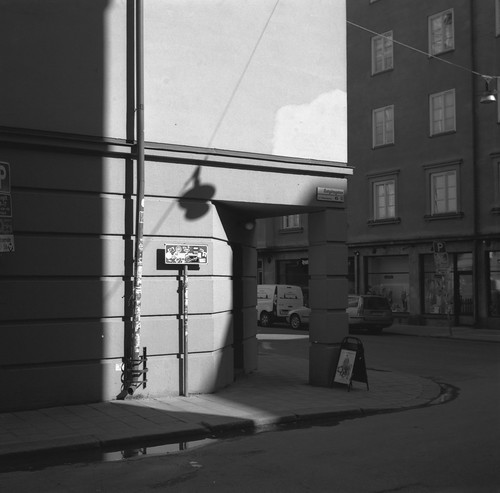
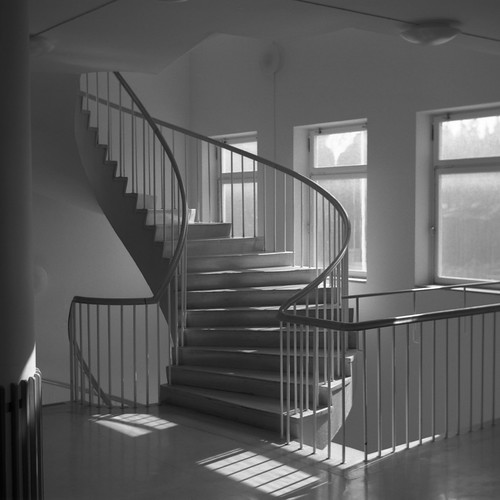
Having made enough tests, Superpan 200 was one of the films that I took with me - in medium format only - on a recent trip through Europe to Stockholm. The medium format camera that I took was the folding Zodel Baldalux, which I've frequently used for travelling. At the Loppmarknaden flea market in Stockholm, I bought an Agfa Isolette III, so shot a few rolls of Superpan 200 with this camera. As with the tests that I had made a couple of months earlier, I found myself taking lots of photographs in low slanting sun, and some of the contrasts between bright sunlight and deep shadows, such as in the third image below, needed careful metering (I used my hand-held Weston meter rather more than usual when shooting Superpan 200). These last few rolls of Superpan 200 I developed in R09 One Shot at 1+50, and used a time of 19 minutes at 19ºC - an easy relationship of time to temperature to remember.

Zodel Baldalux with Rollei Superpan 200 with yellow filter, R09 One Shot 1+50, 19m at 19ºC

Agfa Isolette III with Rollei Superpan 200, R09 One Shot 1+50, 19m at 19ºC
Sources/further reading:  
Agfa's Aviphot product pages
Aviphot Pan 200 data sheet (PDF)
Maco developing times for Superpan 200 (PDF)
Extensive review on 125px

Thursday, 1 November 2012

Ilford Ilfodata HS23

Ilford Ilfodata HS23 Type J500 document film

This tin of bulk film was a speculative buy from a well known auction site, specifically because I'd never heard of the film before. The only reference to the film I've found online is Viewfinder from June 1979, Ilford's in house magazine; indeed typing "Ilford Ilfodata HS23 Type J500" into Google returns just that one result. The underside of the tin has a label with the code "SZ 79 C" - possibly meaning it was manufactured in Swizterland in 1979 by Ciba (who bought out Ilford in 1969) although the label on the front of the tin does state "Made in England". The film is referred to on page 4, in an article headed 'Ilford in Microrecording'. It's worth quoting at length:

The ever-expanding range of ILFORD microrecording films ensures that the right product exists for the majority of applications. Where business documents, continuous stationery, cheques, statements or invoices are to be microfilmed, one of the ILFODATA High Speed films is particularly recommended.
  • HS 22 2.5/1000 polyester base dye resin backing.
  • HS 23 5/1000 acetate base dye resin backing.
  • HS 24 5/1000 acetate base carbon resin backing.
These products offer the combination of fine grain, high speed, high resolving power and - because of their panchromatic sensitivity - are recommended for accurate recording of multicoloured originals.

The article then goes on to mention Ilfodata HR31 specifically having an anti-halation underlayer, so I assume that the other films do not, although they have the backing as described. After loading a length of film into a canister to use, the colour of the backing was quite noticeable, being a deep, intense, almost ultramarine blue.

Vine Leaves, Ilfodata HS23

I shot two rolls of the film using my Olympus OM10. For the first roll I didn't accurately meter the shots I took: on the film canister I did note "last grapes 1000th at f5.6", but I may have meant 'eucalyptus' as that was the last series of shots on the roll. I stand developed the film with Rodinal diluted 1:100. The results were mixed: many frames were barely legible; those that were are clearly high contrast as one would expect from a document film. The film itself has a very clear base, with no markings in the film rebates and in the frames I scanned the grain is as good as indiscernible. In the image below the bright sky appears to have a 'glowing' effect, which may be a result of the absence of an anti-halation layer.

Eucalyptus, Ilfodata HS23

I shot a second roll less impulsively, exposing five frames successively with the camera's film speed dial set at 25, 50, 100, 200, and 400 in an attempt to work out an ISO setting for the film. Using Rodinal diluted 1:100, I stand-developed the film for 1 hour. The results on the contact sheet shown below indicate clearly that an exposure index of either 25 or 50 gives a usable result: the highlight areas are becoming blocked on the top row of 25 EI; some shots in the second row of 50 EI show very little detail in the deeper shadows. The Viewfinder quote about the film describes it as 'high speed' which, like the Kodak Technical Pan film in my previous post (which can be used at 200 EI), may refer to its use as a document film; using the film for pictorial purposes would indicate a much lower EI setting. Possible directions for further tests might be to use a lower exposure index and to dilute the film developer even further to lower the contrast.

Second test roll contact sheet of Ilfodata HS23
Tomatoes, Ilfodata HS23, exposed at 25 EI
Tomatoes, Ilfodata HS23, exposed 50 EI
Climbing Beans/Tomatoes/Clematis, Ilfodata HS 23, exposed 25 EI
Climbing Beans/Tomatoes/Clematis, Ilfodata HS 23, exposed 50 EI
Sources

Viewfinder, June 1979 (PDF file)