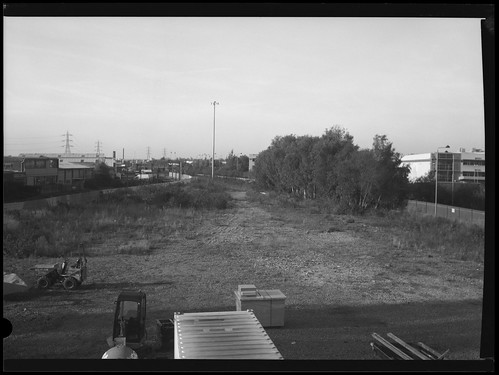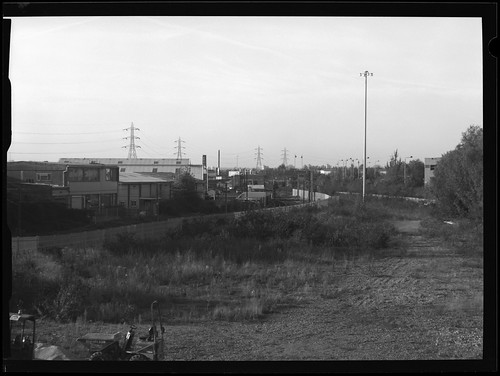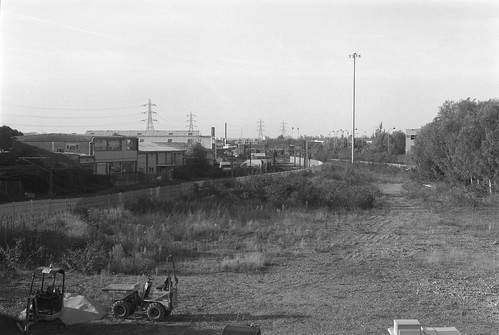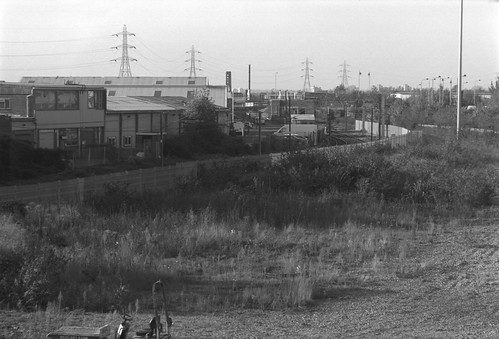
Showing posts with label Ica Trona 210. Show all posts

Wednesday, 10 June 2015

Agfa/Rollei Superpan 200

Superpan 200 in 35mm and medium format
There are very few black and white films manufactured with a nominal speed of 200; currently, just three: Fomapan 200, Ilford SFX 200 Creative, and Agfa Superpan 200.  Fomapan 200 was discontinued for a few years, but was recently reintroduced in a new formulation; Ilford's SFX 200 shares some characteristics with Agfa Superpan 200: the name denotes that the Agfa film is superpanchromatic, with extended red sensitivity beyond normal panchromatic films, to near infra-red, and with the right filters (like SFX 200) it can produce similar effects to true infra-red film. Of the three films, all are available in 35mm and medium format rollfilm, additionally, Fomapan 200 is also available in large format sheet film. There are few stockists in the UK for Superpan 200, West End Cameras currently has the film in stock; when asked about in Silverprint, they hadn't heard of the film. Superpan 200 is sold by Maco but is produced (as Aviphot Pan 200) by Agfa-Gevaert in Belgium, and Maco's website uses Agfa-Gevaert's Aviphot Pan 200 technical information sheet. As can be seen in the photograph above, the film packaging uses both Agfa and Rollei brand names for the medium format film, while the 35mm labels do not use the Rollei name (the 35mm film is also not DX-coded). In the film rebates, on the medium format version, Rollei is used, while 35mm has just the name Superpan 200.

Agfa-Gevaert's data sheet describes Aviphot Pan 200's applications as:
Aerial photography assignments from low to medium altitudes, for gathering, interpreting and processing information intended for cartography, inventory purposes and exploration studies. This film can be used in industrial recording systems, such as equipment for plotting graphs in control and monitoring devices. It can also be used in stereo image recording devices, either airborne or in ground-based facilities for subsequent production of three-dimensional plans, maps, etc.
Characteristics
With its expanded colour sensitivity into the near infra-red range of the colour spectrum, Aviphot Pan 200 offers excellent penetration through haze, fog and other atmospheric conditions liable to affect the image quality. Obviously, this yields an improved image contrast and therefore more information. With the uniform distribution of the panchromatic sensitivity within the range of visible light, the terrain can be imaged very faithfully without having to revert to the use of special spectral recording filters. Yellow filters can be used to get a higher image contrast. They also decrease the overall film sensitivity.
As with previous film tests I shot a roll of 35mm Superpan using an Olympus OM10 SLR, with a range of meter settings of 25, 50, 100, 200, 400, 800 for film latitude. With no published development times for Ilfotec LC29, the developer I used, on neither the data sheet from Maco, nor the Massive Dev Chart, I used stand development, with a dilution of 1+100 for one hour.

First latitude test contact sheet, stand developed in Ilfotec LC29
The first test showed the film to have narrow latitude, with the best exposure indexes of between 50-200, but developed in Ilfotec LC29, rating the film at 100 (or a little under) seemed to give the best results (the original data sheet states that "Aviphot Pan 200 can be exposed as a 125 to 250 ASA film," although this is with Agfa's G74c developer). Stand development is usually a good technique to get straight negatives from a properly exposed film, but the first results were a little disappointing.

I used the same camera and exposure settings for a second roll, repeating the latitude test of metering for 25, 50, 100, 200, 400, 800, but this time developed the film with R09 One Shot, diluted 1+:25 for Maco's published time of 8 minutes at 20ºC. The results with R09 One Shot were better than the first test, but using normal agitation does appear to have increased the contrast of the film, although lighting conditions were different, with some winter sunlight providing bright highlights.

Second latitude test, developed in R09 One Shot
The two tests show that the latitude range of Superpan 200 is relatively narrow (compare for example, Adox Silvermax's wide latitude range): exposed at 25 and 50, the highlights and midtones begin to lose separation, while with underexposure, the shadows quickly lose detail. The scans below have been adjusted to pull the maximum amount of detail from highlights and shadows: as is typical with black and white negative film, overexposure does give better results than underexposure, but Superpan 200 is less flexible in this regard than some other films.

Agfa Superpan 200, rated 25, developed in R09 One Shot 1+25
Agfa Superpan 200, rated 800, developed in R09 One Shot 1+25
I also shot a first roll in medium format in my Voigtländer Bessa RF, developing this in R09 One Shot at 1+25 for 8 minutes at 20ºC. For this, I relied on the 'Sunny 16' rule for exposure, which I often use for cameras without built-in lightmeters, but as a result, a number of the negatives were rather thin, partly a result of trying to calculate exposure settings for winter sunlight. Despite this, at medium format, Superpan 200's qualities are immediately apparent - its sharpness, relatively tight grain structure, its clear base with very little curl once processed and the contrast; the results were reminiscent of Rollei RPX 25 - despite the difference in speed, both films have a very similar look.

Voigtländer Bessa RF, R09 One Shot 1+25, 8m at 20ºC
Having developed Superpan 200 in both Ilfotec LC29 and R09 One Shot, I suspected that R09 One Shot at higher dilutions would provide better results, notably with higher-contrast scenes; I shot some more 35mm Superpan 200 with both the Kodak Retina IIa, and my Agfa Optima Sensor, and developed at a dilution of 1+50, for 17 minutes at 20ºC. As it's easier to increase contrast in printing or scanning, with a film like Superpan 200, it is important to expose and develop to keep both shadow and highlight detail - as with all films, but some emulsions have greater latitude and lower contrast, making it easier to achieve good negatives while being less exact in approach.

Agfa Optima Sensor with Superpan 200, R09 One Shot 1+50, 17m at 20ºC
The first tests that I made with Superpan 200 reflected the fact that these were not shot in the best lighting conditions, in the middle of winter; with more available light and higher dilutions of developer, the subsequent results in 35mm were better. I also shot medium format film in both the No.2 Brownie and the Ica Trona: even with simple Brownie meniscus lens and the uncoated Tessar on the Ica Trona, the results were good, possibly the inherent contrast of Superpan 200 complements the softness of these old lenses. On a precautionary note, the rolls of film that I shot in medium format showed that the emulsion is easily scratched if not carefully handled and the synthetic base is susceptible to 'light piping' - Maco's website does include a warning about this, and it's important to make sure the medium format films are tightly wound on their spools when removing after exposure in the camera.

Kodak No.2 Brownie with Superpan 200, R09 One Shot, 1+50, 17m at 20ºC
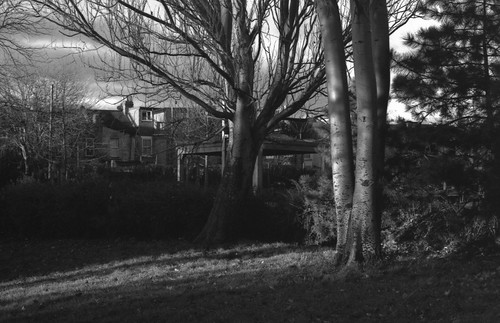
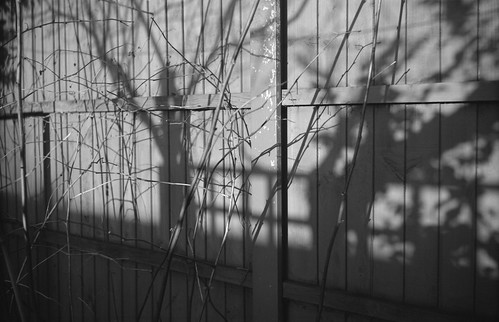
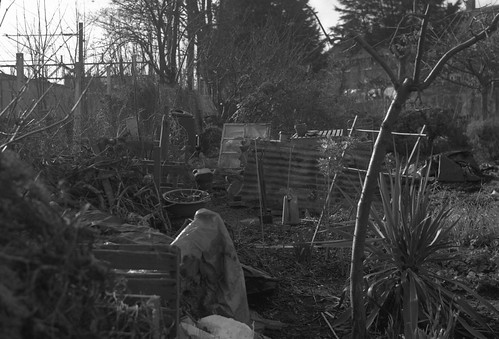
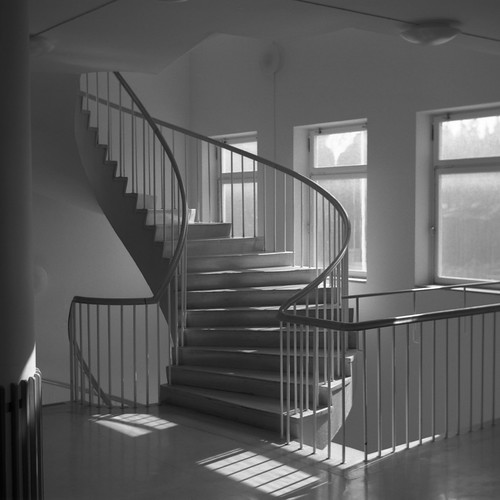
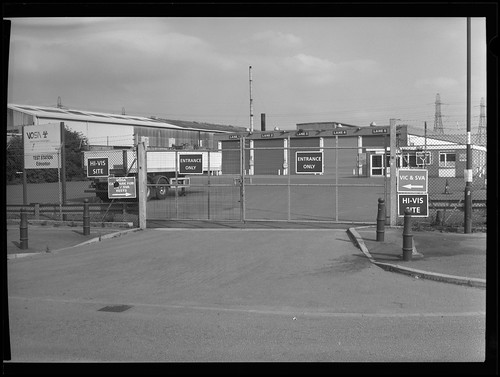
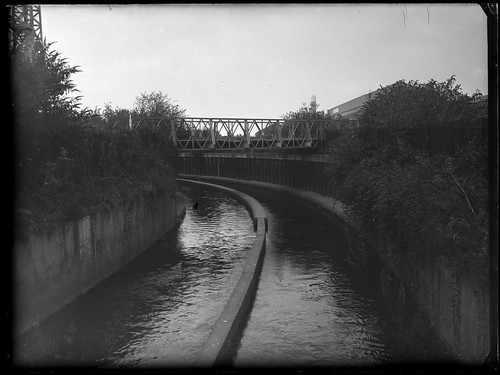
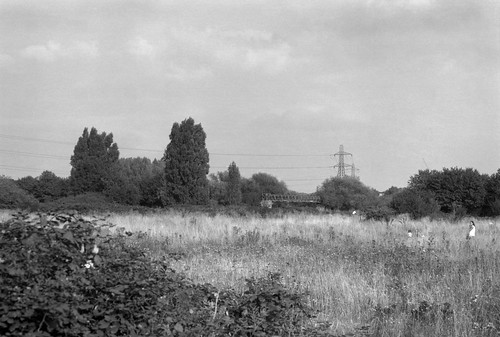
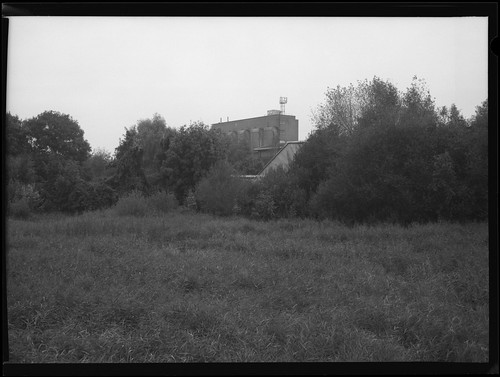
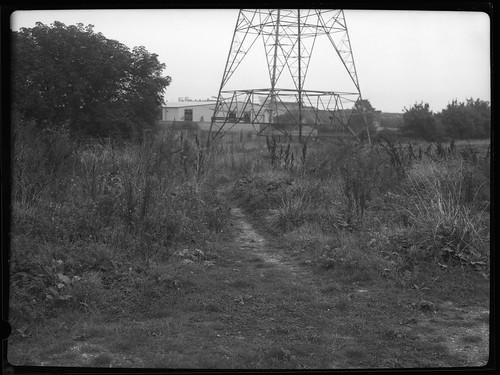
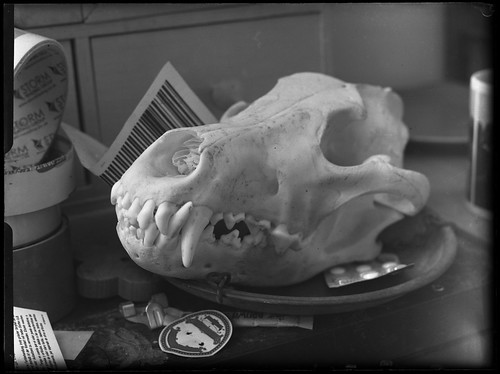
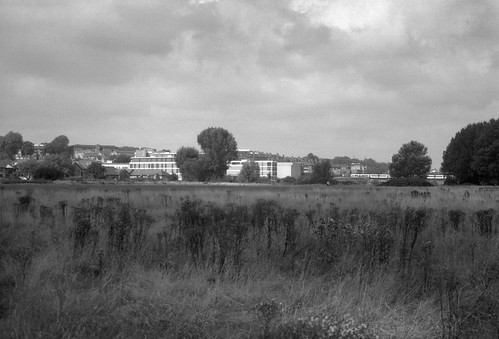
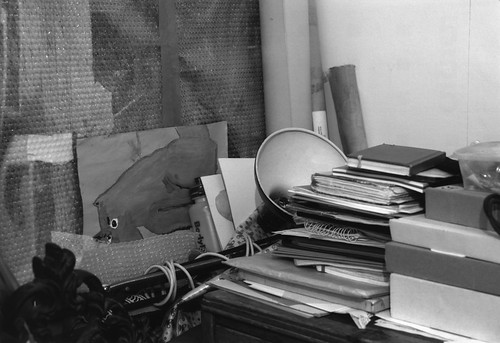
Ica Trona 210 with Superpan 200, R09 One Shot, 1+50, 17m at 20ºC
As well as higher dilutions, I also wanted to try developing the film at lower temperatures in Rodinal. Having used Rodinal, or R09 One Shot, for a number of years, it does seem that some of its best qualities are facilitated by using higher dilutions and lower temperatures: one or two degrees below 20ºC does seem to negate some of the 'roughness' associated with the appearance of grain when developing faster films in Rodinal. This does start to extend development times; for the shot below I used 20 minutes diluted 1+50 at 18ºC. Not having an infra-red filter, one aspect of Superpan 200 that I did not test was the ability to achieve an 'infra-red look', but even without such filtering it's a very apt film for landscape photography. The extended red sensitivity, its "excellent penetration through haze, fog and other atmospheric conditions" provide a good rendition of both skies and distances, even unfiltered; for some of the later medium format shots I used a yellow filter.

Ica Trona 210 with Superpan 200, R09 One Shot, 1+50, 20m at 18ºC
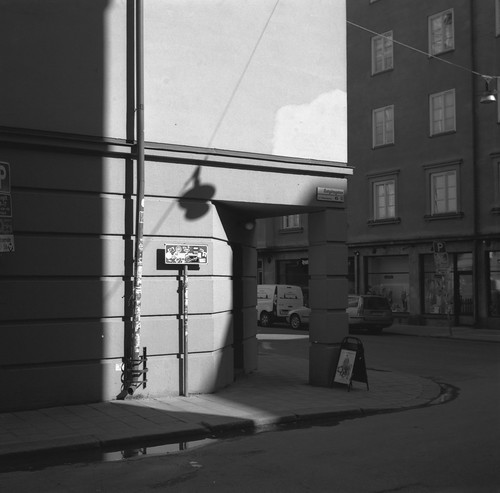
Having made enough tests, Superpan 200 was one of the films that I took with me - in medium format only - on a recent trip through Europe to Stockholm. The medium format camera that I took was the folding Zodel Baldalux, which I've frequently used for travelling. At the Loppmarknaden flea market in Stockholm, I bought an Agfa Isolette III, so shot a few rolls of Superpan 200 with this camera. As with the tests that I had made a couple of months earlier, I found myself taking lots of photographs in low slanting sun, and some of the contrasts between bright sunlight and deep shadows, such as in the third image below, needed careful metering (I used my hand-held Weston meter rather more than usual when shooting Superpan 200). These last few rolls of Superpan 200 I developed in R09 One Shot at 1+50, and used a time of 19 minutes at 19ºC - an easy relationship of time to temperature to remember.

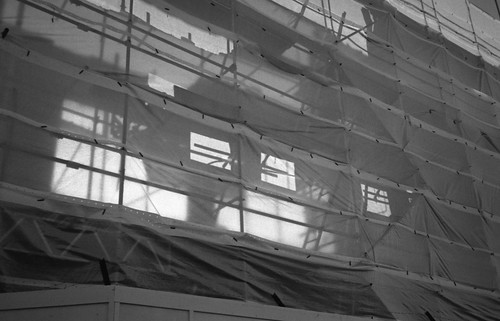
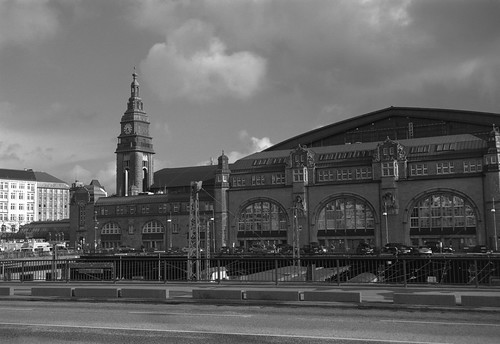
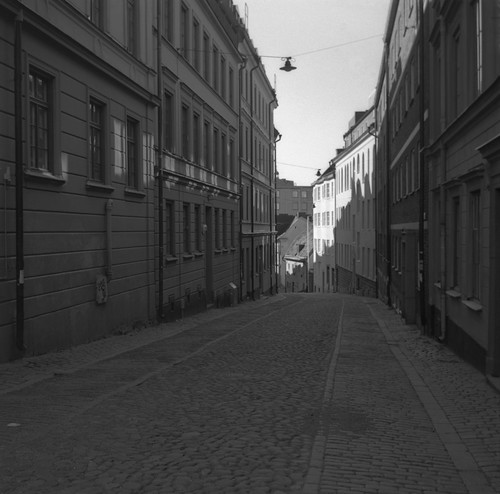
Zodel Baldalux with Rollei Superpan 200 with yellow filter, R09 One Shot 1+50, 19m at 19ºC

Agfa Isolette III with Rollei Superpan 200, R09 One Shot 1+50, 19m at 19ºC
Sources/further reading:  
Agfa's Aviphot product pages
Aviphot Pan 200 data sheet (PDF)
Maco developing times for Superpan 200 (PDF)
Extensive review on 125px

Wednesday, 19 November 2014

Distars and Proxars

Ica Trona with Distar supplementary lens
Having achieved some good results recently with the Ica Trona, use of the camera's full 9x12cm frame size is limited by the number of plateholders with films sheathes I possess, and also limited to the few films manufactured in the 9x12cm size. Using a rollfilm back with the camera is convenient and means being able to shoot with any medium format film available. However, this leads to cropping the image, or, to put it another way, using the rollfilm back provides an image with a narrower angle of view. For most of the cameras I habitually use, I'm almost always happy shooting everything with the 'normal' focal length lens for the format and most of my cameras have fixed, non-interchangeable lenses. For cameras of a similar age or design to the Ica Trona, if the photographer wanted to use different focal length lenses, there were three approaches to achieve this: more expensive cameras did have interchangeable lenses, often with a bayonet mount, like the Voigtländer Bergheil (although this did require each lens to also have its own shutter); certain lenses were designed to be convertible or combinable, where front and rear lens elements were each sufficiently well corrected to be used individually either behind or in front of the shutter; and there were also supplementary lenses, to be used like filters, which change the focal length of the lens they are attached to. The Ica Trona has a Tessar lens, the design of which does not lend itself to being used as a convertible lens. When writing the blog post for the Trona, the Zeiss catalogues on Camera Eccentric were an invaluable resource; the 1933 catalogue includes a detailed section on Zeiss's supplementary lenses. Zeiss introduced the Distar first (seen in the 1927 catalogue, page 18), which increases the focal length of a lens; this was then added to by the Proxar, decreasing the focal length. The Proxar proved to be the more useful of the two, and was produced to fit many cameras for a number of decades. Other manufacturers also produced supplementary lenses.
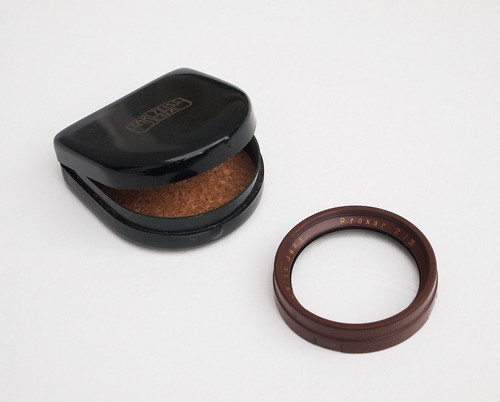
Zeiss Proxar supplementary lens with case
The Distars and Proxars were initially made as push-fit accessories to fit onto a camera lens in the same manner as a filter, in a variety of sizes and different powers of magnification. Both have gold lettering inscribed around the mounts and the pre-war Proxars are brown, perhaps to be easily identifiable at a glance. On the Camera Eccentric website, the reproduced Zeiss lens catalogue from 1933 has both Distars and Proxars listed with a full description and tables for use (the 1929 catalogue also lists both, but the 1933 one has better illustrated examples). To quote from the catalogue:
The Distars are single lens components of small diverging power [...]. When placed in front of the camera lens they increase its focal length with corresponding increase of the camera extension. They thus add to the scope of camera lenses, especially those of an unsymmetrical type, since these, from their very nature, are only adapted for use on cameras with single extension in that their components are not corrected independently for use as long-focus lenses. In conjunction with the Tessars the Distars form wide-range sets of convertible lenses.
[...]
PROXARS are lenses of small converging power [...]. When attached in front of the camera lens, they produce an effect opposite to that of the Distars in that they shorten the focal length. Thus, Tessar F/4.5, f=13.5cm has its focal length reduced to about 13cm, 12.5cm, 12cm, or 11.5cm according to the converging effect of the Proxar selected. The range of uses of the Tessar is thereby widely extended in a twofold direction, viz:

For obtaining large figures of near objects [i.e. close focus images]
[...]
For taking wide-angle photographs at greater distances
Use of the Distar depends on the camera having sufficient bellows extension to achieve infinity focus, the greater the power of the Distar, the longer this distance needs to be, while the Proxars, to focus on infinity, need less bellows extension than the lens would normally require. This last fact is the reason for the Proxar's greater usefulness: on rigid-body cameras, it is usually impossible to reduce the lens-to-film plane distance, meaning that a Proxar could not be used for wide angle photographs ("at greater distances") as the lens would not focus on infinity, but it would still work as a close-up accessory, which Proxars were sold as, post war, no longer brown, as either push-fit accessories or with screw threads for mounting.
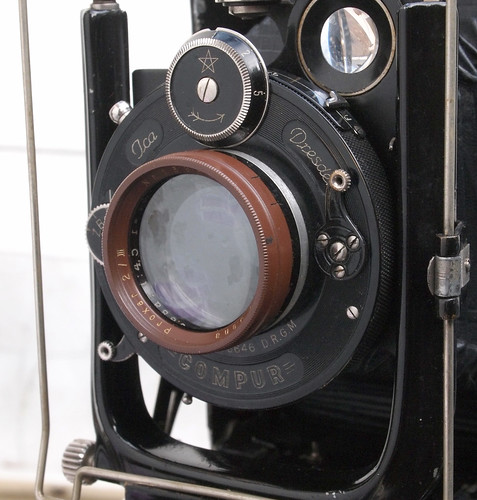

Ica Trona 210 with Proxar supplementary lens
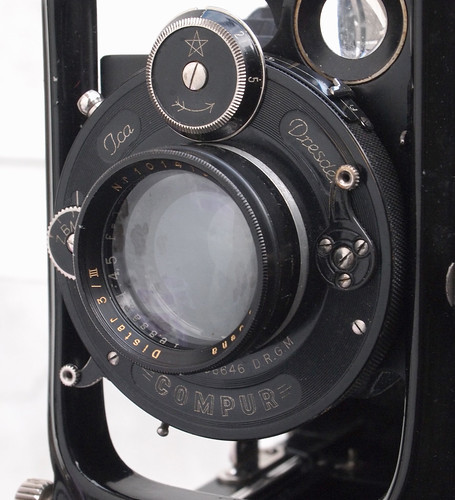
I recently bought one of each: a Distar 3/III and a Proxar 2/III. According to the table in the Zeiss 1933 catalogue, the Distar 3 increases the equivalent focal length of the 13.5cm Tessar lens to 22.5cm, needing a bellows extension of 23cm to focus on infinity; the Proxar 2 reduces the equivalent focal length of the lens to 11cm, with infinity focus at 10.5cm. Reiterating what I've written earlier in this post, one reason I wanted the Proxar was to be able to use the rollfilm back with a 'normal' angle of view: a standard lens for the 6x9cm frame size is 105mm, so 11cm is very close.

The first set of test photographs I made with the Proxar were all out of focus, initially confusing as I'd used the ground glass screen to focus the images. When I shot a second set of test images, I realised where the problem arose: once the image was focussed, I discovered the tendency of the lens to slide forward on its runners when removing the back and replacing it with a plateholder, especially when pointing the camera downwards. On the Trona, the lens is designed to be pulled forwards to the infinity stop at 13.5cm, the focus knob is then used for closer focus and partly as a result of use, the lens moves with relative ease to the infinity stop itself (there is some friction, but perhaps the additional weight of the Proxar helps overcome the inertia). The Distar attachment provided different concerns: what's known as bellows effect, not mentioned in the Zeiss catalogue, which, for purposes of exposure and using the ground glass screen, results in a dimmer image. As the bellows are extended, moving the lens further away from the film plane, the relationship between aperture size and lens to film plane distance are changed significantly. To simplify the numbers for the purposes of giving an example, an aperture of f4 on a lens of 100mm focal length has a diameter of 25mm. If that lens is extended to a distance of 200mm from the film plane, that 25mm diameter of the f4 aperture is now one-eighth rather than one quarter, giving an effective aperture of f8, two stops difference in terms of exposure. Returning to the Distar 3 on my Tessar lens, as the focal length wasn't doubled, being nearer to an increase of half the focal length, for ease of calculation, I increased exposure by one stop (the same effect in reverse would be the case with the Proxar at infinity focus, but a decrease in focal length from 13.5cm to 11cm is not as dramatic, and although logically the image should be brighter, it is not different enough to compensate for in exposure).

The images below were all shot hand held: although for testing the qualities of the Distar and Proxar themselves it would have been better to use a tripod, I wanted to use the supplementary lenses in conditions that I have been using the Ica Trona camera. I push processed the 9x12cm Fomapan 100 to 200 in order to provide an extra stop in exposure, to use a smaller aperture at a faster shutter speed. The images are arranged from shortest focal length to longest.
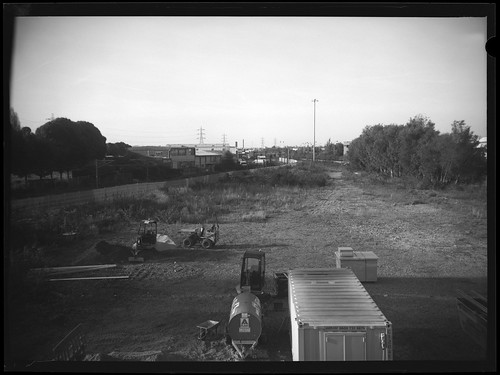
Ica Trona 210 with Proxar supplementary lens, Fomapan 100 rated 200 EI
Ica Trona 210, Fomapan 100 rated 200 EI
Ica Trona 210 with Distar supplementary lens, Fomapan 100 rated 200 EI
When shooting the tests, I focused with the ground glass screen, then used the wire frame finder (the 'Iconometer') for framing once the screen had been replaced with a plateholder. The wire frame finder continues to give a fairly accurate framing as the angle of view changes relative to how near or far the finder is to the eye piece (this is also true with the front rise and cross movements). The top image of the three, taken with the Proxar shows some vignetting and also has a shadow at the left had edge due to the bellows on my camera being slightly deformed. In addition, the bellows on my Trona do not have the clips that many double extension folding plate cameras often possess to gather the bellows when the lens is closer to the film plane, i.e. at or near to infinity focus.

I also shot a sequence of images with the rollfilm back. Using Rollei RPX 400, I gained an extra stop in exposure from the push-processed Fomapan 100 sheet film. On the frames with and without the Proxar, I stopped the lens down further; with the increased focal length using the Distar, I chose a faster shutter speed to guard against camera shake. These provide a better example of the change in angle of view than the sheet film shots above as the framing is more consistent across all three photographs.
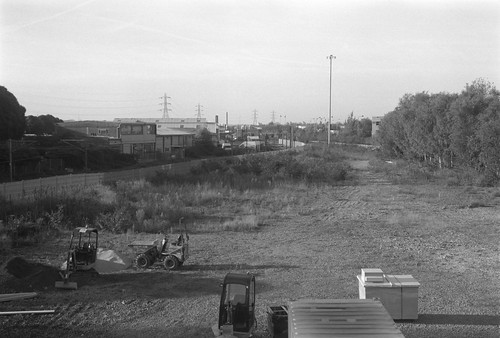
Ica Trona 210 with Proxar supplementary lens, Rollei RPX 400 in rollfilm back
Ica Trona 210, Rollei RPX 400 in rollfilm back
Ica Trona 210 with Distar supplementary lens, Rollei RPX 400 in rollfilm back
For comparison with the images from the rollfilm back, I also shot the same scene with the Zodel Baldalux: the 6x9cm frame size is the same and the focal length with the Proxar and the rollfilm back is close to the 105mm lens on the Baldalux - the reason for my interest in the supplementary lenses. Using the Proxar as a close up attachment rather than for wide angle, with the double extension bellows on the Trona, it is possible to focus very close to a subject. Bellows effect also applies, as with the Distar, and I also found focus difficult: even with the lens fully opened the image on the ground glass was still dim, and depth of field was extremely shallow. The photograph below was stopped down to f25 and by necessity, this was shot with a tripod (exposure was around 30 seconds). Although the shallow depth of field limits the use of such extreme close up photography, the scale of the mouse on the negative is actually larger than life size.
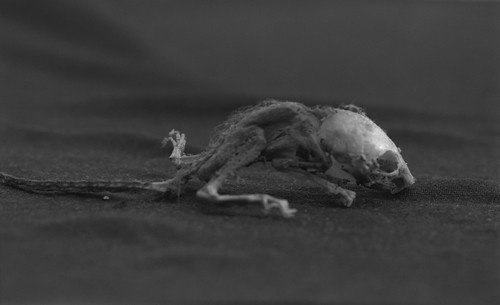
Ica Trona 210 with Proxar supplementary lens, Rollei RPX 400 in rollfilm back
The 1933 Zeiss catalogue contains an illustration (p30) showing six different views achievable from the same standpoint with a 15cm Tessar and Distars and Proxars of different powers with the caption, "Convert your ZEISS TESSAR at small cost into an objective of wide utility." Most of the remarks about the use of Distars and Proxars in the Zeiss catalogues relate directly to their use with the Tessar lens. The other designs listed under 'Universal Lenses' are Dagors and Protars, the first being symmetrical and the second composed of components of different focal lengths, but both can be used as convertible lenses. The introduction of the Distars and Proxars was intended to add this flexibility to the Tessar;
The Tessar is [...] pre-eminently the lens for hand cameras with single extension. In the course of recent years it has more and more taken the place of symmetrical and semi-symmetrical lenses in cameras with double extension, thanks to the introduction of our Distars and Proxars. These are single attachable front lenses whose curvatures are so computed as to increase or decrease the focal length of the objective within certain limits. They form, therefore, with the Tessar a very comprehensive convertible set, so that it can be used on hand cameras with single extension, and to a still greater extent on cameras with double extension, with a new range of applications. 
Zeiss lens catalogue, 1933
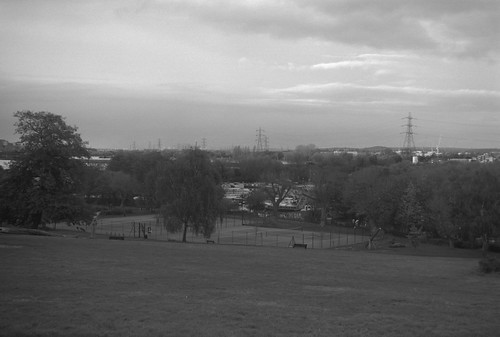
Ica Trona 210 with Proxar supplementary lens, Rollei RPX 400 in rollfilm back

Sources/further reading:
Zeiss Lenses Catalogue 1933
Supplementary lenses on Early Photography

Wednesday, 15 October 2014

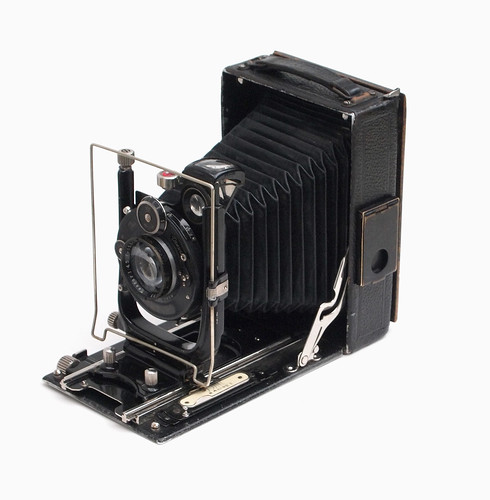
Ica Trona 210

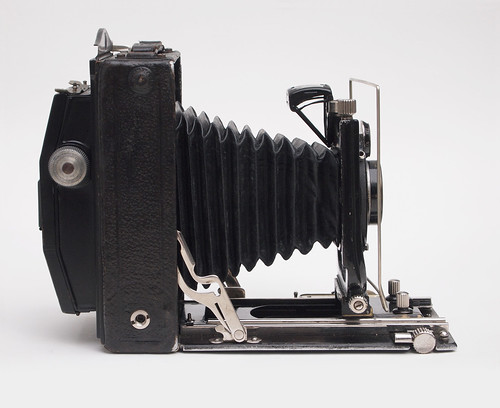
Ica Trona 210
For some time I have been thinking about writing a post on 'small large format', to discuss my 9x12cm folding plate 'hand and stand' cameras, the Kodak Recomar 33 and Voigtländer Avus, but there always seemed too much information to convey in such a post and I hadn't used either camera enough, for a number of reasons. However, having begun developing films at home over the summer, rather than the darkroom I usually use (which is being refurbished), and having bought an Ica Trona 210, the ease and speed of turnover for developing sheet film (or glass plates) has meant, in a short space of time, I've used the camera quite a bit. One reason I was going to call the post on 9x12cm cameras 'small large format' was firstly that, although it is open to debate, and opinions differ, 9x12cm is considered the smallest sheet film format to be sufficiently large to be labelled such - if it's considered at all, that is. Many would use 4x5 inches as a starting point, but as 9x12cm is less common in the UK and US, it's hardly thought about as a format (the Wikipedia entry begins "Large format refers to any imaging format of 4×5 inches (102×127 mm) or larger..." then adds "Less common formats include [...] metric formats, including 9×12 cm"). Indeed, when I bought the Voigtländer Avus some years ago, I was not aware of it, yet in continental Europe it is not uncommon as a sheet film size (Ilford also manufactures film in 9x12cm, although possibly only during its annual ULF production run). I saw the Ica Trona in an online auction with a prominent warning that "it is NOT possible to obtain film which will work in this camera. It is sold for DISPLAY ONLY." At the time I had a mostly full box of Fomapan 100 and three boxes of HP3 glass plates in the size, the buyer's warning was a goad for me to place a bid on the camera, and the auction went for its starting price.

A second reason I was going to call the post 'small large format' was also the size of the cameras. By no means small in themselves, compared to most 4x5 inch cameras, these 9x12cm cameras are compact, being around the size of a thick paperback book (a doorstep airport novel, say): the Trona is 16 x 11.7 x 5cm when folded. One notable reason for these cameras' compactness is that most do not possess rotating backs, a feature which would make the cameras square to the longest dimension of the plate or film holders. My Ica Trona dates to the early 1920s, but the design of these folding plate cameras was remarkably similar across various manufacturers from the early years of the century until the later 1930s, when most of these cameras seem to have been discontinued, their functions being replaced by professional view and press cameras, while for amateur photography all kinds of rollfilm cameras had made the 'hand and stand' camera seem awkward and obsolete (a quick glance at the folding hand page of Early Photography shows how similar many of the cameras are).

I briefly wrote about Ica's history in my post about the Icarette; unlike the Icarette, the Trona was one of the cameras that Ica continued to manufacture from one of its founding companies, and, when Ica became combined into the new Zeiss Ikon, the Trona was continued (alongside many other similar models - Zeiss Ikon's range of cameras in the early 1930s contained numerous near-identical but different models, many of which had come from the once-rival companies which came together to  make up Zeiss Ikon). The '210' after the Trona name is the code for the camera's image size - the 210 is 9x12cm, while there was a 6.5x9cm model, the 110 (there was also a quarterplate model, apparently sold in the US and UK markets only). Zeiss Ikon continued these model codes, with variations. The 1925 Ica catalogue reproduced on Camera Eccentric lists the Trona 210 with a f4.5 Tessar at 218 marks, making it one of the more expensive models, after the Niklas and the Ideal.

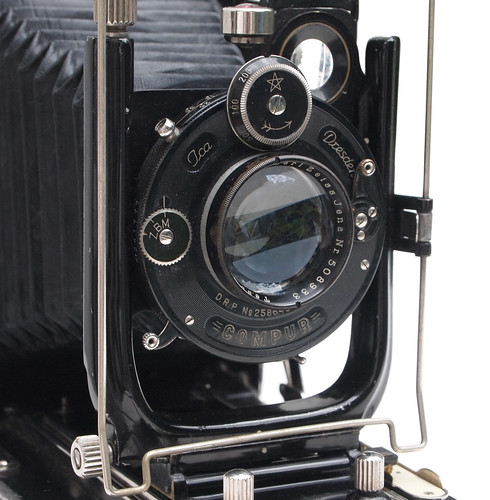
Conceived in the age of photographic plates, focus is by removable ground glass screen (the spring back appears to have been a later innovation), with each photographic plate loaded into individual plate holders. The Trona has features common to many 9x12cm folding plate cameras of a similar age: double extension bellows for a near 1:1 scale image when extended, front rise and cross movements, a rotating brilliant finder with spirit level, and a wire frame viewfinder. As with many pre-war cameras, the Trona was provided with a number of different lens and shutter combinations. My model has what would have been the top-of-the-range f4.5 13.5cm Tessar in a dial-set Compur shutter (later Zeiss Ikon Tronas were provided with a faster f3.5 Tessar). The shutter's rotating selector is marked 'ZBM', which seems an unusual variant, standing for Zeit, Bulb, Moment. Other Compur shutters I have of a similar age have 'D' for the German 'Dauer', rather than B, or 'TBI', standing for Time, Bulb, Instant - and some shutters have both. It appears that later Compur shutters were standardised with the letters representing the English terms.

Ica Trona lens and shutter detail
Although the ground glass screen has a wooden frame, the camera body and drop bed are both metal as are all the 9x12cm plate holders I've picked up over the past few years. Most of these work in all three of my cameras in this size, with the exception of two Kodak holders, which, oddly enough, do not fit the Kodak Recomar. The inter-war period appears to mark the transition from glass plate negatives to film, although in the 1940s Ilford were still producing many more different types of emulsions as glass plates rather than film. However the folding plate cameras of this era were provided with all the accessories needed to shoot film as well as glass. Firstly, film sheathes or septums were produced for film holders: to ensure flatness and the correct focal-plane distance, the sheathes hold sheet film in the place of a rigid glass plate. Secondly, film packs were made which held several sheets of film in an arrangement of light tight backing or covering paper (the special backs or holders for film packs often show up with the cameras themselves, not infrequently in the place of the ground glass screen). Thirdly, roll film backs were made to use medium format film.

Ica Trona with rollfilm back
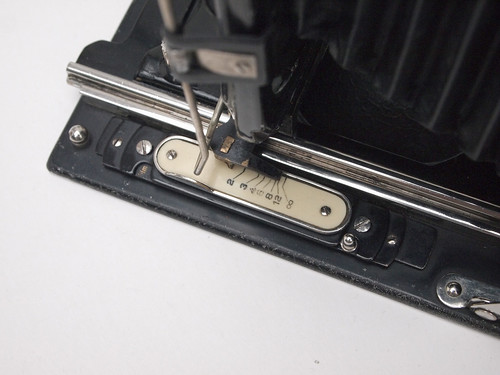
On the 9x12cm size, the rollfilm back does mean the image is cropped to 6x9cm, essentially a 'half-frame' size (one of my rollfilm holders also included masks for 6x6cm and 6x4.5cm frames, but this would mean sacrificing a large amount of the camera's size for a narrow angle of view to get more shots on a roll of film). The Ica Trona has a lever by the focus scale to switch this from Plate to Film, which moves the focus scale/infinity stop back by a very small amount. This only affects focus when using the scale itself, as it does not move the lens standard - unless this is locked into the infinity stop. Like most folding cameras from this era, the lens is not self-erecting, the lens needs to be pulled out by hand along the rails as far as the infinity stop, which then needs to be disengaged to use the rack and pinion focus. This is done by pulling out the sliding lever next to the focus knob which is connected to the focus scale on the other side of the drop bed. It can also be used to lock the focus knob at any point by pushing it back inwards.

Ica Trona focus scale
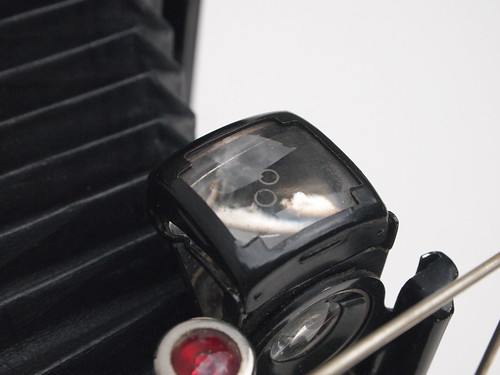
A reason to use such cameras today is their relative compactness for the large negative size, and the ease of hand held use - although historically large format press-type cameras were generally used hand held, I would not want to risk camera shake from trying to use my MPP Micro-Technical camera in the same way (by no means light, the Ica Trona is 1.2kg and the MPP 2.9kg). When shooting hand held, I have been using the ground glass screen to focus, then removing and replacing the screen with either a plateholder or the rollfim back, and framing the shot with the wire frame finder, or for a few shots, using the brilliant finder, holding the camera against my body for stability. The brilliant finder has a feature that I have seen on other cameras, but none of my other cameras with such finders possess: the glass is etched with two small circles which should be aligned to ensure that the framing of the finder is accurate and not at an oblique angle.

Brilliant finder with etched circles
Some shots, notably the still life and studio photographs below, required a tripod for stability, but, more importantly, for accurate framing and focus. The Trona has one tripod screw fitting for landscape orientation, and two for portrait - one of these is placed towards the front of the drop bed to balance the camera when the lens is fully extended. The Tessar lens, although uncoated, is still capable of great definition and character. For initial tests with the camera, I shot a few Ilford HP3 glass plates from the early 1970s, which I was able to use hand held, rating them at 50 to compensate for age (most of the other plates I've been using are much slower), and Fomapan 100 sheet film and some rolls of Rollei RPX 100 in the rollfilm back. The dial-set Compur shutter has one advantage over the later rim-set designs in that it's useful to be able to switch between Z and M functions when focussing with the ground glass without having to change the shutter speeds on the dial.

Ica Trona with Fomapan 100
Ica Trona with HP3 glass plate
Ica Trona with Rollei RPX100 in rollfilm back
I was fortunate to have bright sunny weather for the photographs above, taken hand held with the Trona, which meant I was able to use relatively small apertures and faster shutter speeds. On a subsequent occasion, with lighting conditions less favourable, I rated the Fomapan 100 at 200. Developing with Ilfotec LC29, I couldn't find any times for a one stop push online, neither from Foma nor the Massive Dev Chart, so with a dilution of 1:19, I estimated a time of 12 minutes at 18ºC. The image below suffers from a lack of detail in the sky which a yellow filter may have helped to a degree, although the sky itself may have just been flat and overcast. The front lens standard is also not as rigid as it could be, and some of the photographs appear to show that, with wide apertures at least, if the lens isn't quite parallel to the film plain, the image isn't in focus across the whole surface of the negative, as the second image below demonstrates, as it becomes out of focus towards the left hand edge (some of my other old folding cameras seem to suffer from the same problem). This may in part be due to inadvertently pulling the lens with a backward motion while tripping the shutter, and being aware of this, with care can be avoided.

Ica Trona with Fomapan 100, push processed at 200
Although in the past I've used my Kodak Recomar 33 as a more portable large format camera, the Recomar has a more limited four-speed Telma shutter and a slower lens and, although most of the time the lens is stopped down for shooting, a faster lens is useful to focus and compose using the ground glass screen. The Avus had no ground glass screen when I bought it, having an empty film pack back in its place, which I did eventually convert into a ground glass screen, but the Avus also has a very stiff shutter dial, and, although trivial, the small clip which secures the plateholders, ground glass screen or rollfilm backs to the camera is very difficult to move in and out. In comparison, the spring clip on the Trona is designed to allow a plateholder to be inserted without pulling it aside as a separate action. The differences between all three cameras are small, but nonetheless, the Trona feels more sympathetic in use.

Ica Trona with Fomapan 100, push processed at 200
Ica Trona with HP3 glass plate
Ica Trona with Rollei RPX 100 in rollfilm adaptor
Sources/further reading:
Ica Trona on Early Photography
1925 Ica Catalogue