Showing posts with label black and white film. Show all posts

Saturday, 6 August 2022

Silberra S25 Limited Edition - single roll review

Silberra S25 Limited Edition
Silberra S25 is limited edition black & white photographic film. Extra fine grain, moderate contrast and high resolution of the image are the main typical qualities of S25 film. Initial batch of S25 consists of 400 rolls and, possibly, the overall quantity of the batch will be extended up to 800 rolls.

Silberra S25 perfectly suits architectural and landscape photography; due to its great photographic latitude S25 film shall perform nicely at bright scenes also preserving impressive level of detalisation through shadows without significant loss in highlights.

Silberra S25 has high sensibilization level which makes it possible to use S25 for IR-photography with corresponding IR-filter (we recommend to use filters at wavelength shorter than 725nm for optimal result).

I have previously posted a couple of 'single roll' reviews of film stocks, which came from being gifted some films I might not ordinarily have used, or might not use again, and although I prefer to work with an emulsion for a few rolls at least, to get a feel for how it might respond in different exposure situations and approaches to development, this single roll review came about through realising I might not use another roll of Silberra S25 black and white film. As the description above (from Silberra's website) states, at the lower limit, there may have only been 400 rolls of film made, or 800 in total if production was 'extended'. I wasn't aware of this at the time, if so I might have picked up more than one roll. I believe I picked it up from the Photographer's Gallery shop, before the current pandemic, with the intention of using it to photograph some text, thinking that its 25 ISO speed would mean that the grain would be fine enough for the purpose I had in mind; I didn't use it for that, but took it with me to Dresden in the Spring, and shot it with the Kiev-4 over a couple of days.

Understandably, there's not much on line about Silberra S25, and with just the one roll, I simply rated it at 25 ISO, and didn't really think that much about how I was to use the film. The film cassette is a plastic reusable one, but it is DX coded, and also has check-boxes for exposure at 12, 25, and 50 ISO, indicating that it does have sufficient latitude for this to be worth the manufacturers including on the label. Silberra's webpage has a small development chart, presumably all times listed are for box speed, although this isn't stated. I used Adox Rodinal, and the time/dilution given (at 20ÂșC) is for 6 minutes at 1+100. This seems a high dilution for 'standard' development, but, again thanks to having just a single roll, I used the published time and dilution. (There is also R09 listed for 30 seconds less than Rodinal, where one might have expected this to be the same: I have used both Foma's version of R09 and Compard's R09, and treated these both as any named version of Rodinal).

Kiev-4 (Helios 103 lens) and Silberra S25 film
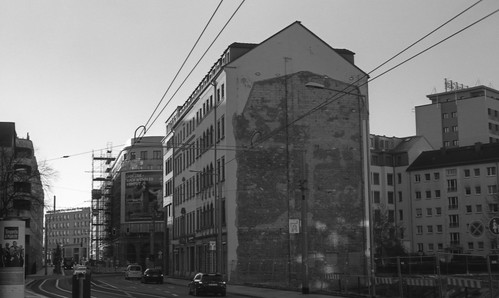
When developed, the negatives looked relatively high in contrast, with a clear base and no edge markings whatsoever. The film dried very flat and appeared to show a small amount of 'light-piping': the film base appears to be polyester and not tri-acetate (it doesn't tear and needs cutting). Ideally, I would have made prints in the darkroom from the negatives, but the results on this post are all from scans from a desktop scanner. The scans have almost no discernible grain, and no doubt show up the limitations of the desktop scanner rather than the ultimate resolution of the film itself. I'd shot the film outside, half in bright sunny weather one afternoon, ideal for it relatively slow speed of 25, with the other half shot early on a sunny morning, which was more challenging in terms of exposure, thanks to the low angle of the sunlight creating a very wide range of contrast between brightly lit surfaces and deep shadow with little in-fill from reflected light. Some of these latter frames (as below) struggled to record shadow detail without losing detail in the highlights, which didn't quite match the assertion that "due to its great photographic latitude S25 film shall perform nicely at bright scenes also preserving impressive level of detalisation[sic] through shadows without significant loss in highlights".

Kiev-4 (Helios 103 lens) and Silberra S25 film
It would have been instructive to see how scenes lit with well-diffused light, such as on an overcast day, might have been recorded, but almost every single frame I shot with the film was sunlight and shadows. The nearest equivalent was one photograph of a sign in a gallery window, below, illuminated by light reflecting off the pavement and surrounding buildings, almost certainly the one negative with the narrowest exposure range (this, incidentally, showed that my original intention for the film–photographing text–would have been an entirely appropriate use).

Kiev-4 (Helios 103 lens) and Silberra S25 film
Not having an IR filter I was unable to verify the film's 'high sensibilization level': given the suggestion for the use of an infra-red filter, this must mean extended red sensitivity. For some frames I might have used a light yellow filter, regardless, the tonality of the sky in some frames possibly indicates a more balanced spectral sensitivity than standard panchromatic film. My general impressions are that Silberra S25 has the feel of some kind of technical film–for me, how it handled and how it responded to exposure was very reminiscent Kodak Technical Pan–with both the positives and drawbacks of that discontinued emulsion. Given the very limited production run, it would be interesting, if it was possible to quantify, how many rolls of Silberra S25 are still out there, yet to be exposed: it's still listed on the Photographer's Gallery shop online, but sold out.




Further information:

Tuesday, 29 June 2021

Lomography Berlin Kino 400 - single roll review

Lomography Berlin Kino 400 - Formula 2019

For some time now, when using a film stock that's new–to me at least–I like to test a few rolls, starting by rating a number of frames both under and over its box speed, then giving this normal development for a test of the film's latitude. This often provides some indication whether the film might be sympathetic to both push (and pull) development. I'll typically shoot it in a few different cameras, sometimes in different formats if available. I also like to try at least a couple of different developers, dilutions, and sometimes different temperatures. Usually the manufacturers' recommendations for exposure and development give perfectly good results; however, for some film and developer combinations, there's not much information available online, particularly with new stocks, and it's always worth being attuned to what one wants to get from a film stock if not using a lab: having that degree of control is the main reason for developing black and white film myself, as much as, if not more than, the economy. The Massive Dev Chart is also a fantastic resource, but I have found a few stocks for which I've specifically established my own exposure/development practices through testing - most notably Ferrania P30, but also Rollei RPX 25 and Agfa/Rollei Superpan 200. This is all a preamble just to state that, in normal circumstances, I prefer to live with a film for a while before committing to write about it; this post goes against that preference.


Earlier this year I received a prize for my efforts in the #ShittyCameraChallenge, four different rolls of 35mm black and white film, none of which I'd used before: Rollei Ortho 25 Plus; Film Washi D; and two Lomography films, Fantome 8 and Berlin Kino 400. This carefully-curated prize, sponsored by David Walster (@196photo on Twitter), was an invitation for me to try some films I might not ordinarily use; due to the pandemic, lockdown, work and other circumstances, I hadn't shot any of them until earlier this month. An impromptu road trip to Cornwall was the occasion: I took my Kodak Retina IIa (a German-made Kodak, although from Stuttgart, not Berlin). This was already loaded with Kentmere Pan 100, but I put the roll of Lomography Berlin Kino in my bag as I thought I'd probably finish the part-used Kentmere film. In the event, I only loaded the Berlin Kino 400 for the return trip; having a 400-speed film was at least appropriate for taking photographs from a moving vehicle–from the passenger side–and not all of these were that successful. I finished the roll in the succeeding few days over the week, partly at the same time as I shot the 12-exposure cartridge of FP4 for June's '126 Day'.

Kodak Retina IIa with Lomography Berlin Kino 400
Most of the frames were shot using the 'sunny-16' rule, although I did meter some with my Weston Master II; most shots were made at box speed, or as near as. I did shoot a couple of frames just to compare the use of a yellow filter; unsurprisingly these did give better definition in the cloudy sky in the examples below. Quite possibly a number of the other frames would be better for the use of a yellow filter, as a general rule with most black and white panchromatic emulsions. I didn't try other filters, as I rarely use anything except a yellow, mostly a light yellow filter, sometimes a deep yellow.

Kodak Retina IIa with Lomography Berlin Kino 400-no filter
Kodak Retina IIa with Lomography Berlin Kino 400-yellow filter
For developing the film, I went straight to the Massive Dev Chart. At the time of writing, this has just one entry for Berlin Kino in Rodinal: 13 and a half minutes at a dilution of 1+50. Only after I'd developed the film did I come across Lomography's recommendation of 17m30s with Rodinal 1+50, which seems rather long. When I pulled the film from the wash, to my eye, the negative roll looked more than a little reminiscent of Foma Retropan 320 Soft: very low contrast on a noticeably grey base (initially, I did think it might be under-fixed, but I'd developed other films at the same time with clearer bases in the same fixer that I could compare to the Berlin film, and these looked properly fixed). When I scanned the negatives, my feeling of the comparison was that it was more than apt: the frames showed very prominent grain, and with a very irregular pattern, something that Foma films tend to show. Where the comparison seems to falls down is the lack of halation around the highlights: with Retropan, very bright highlights have a 'glow'. This doesn't seem to be the case with Lomography Berlin Kino 400: the image below would be a good subject to test this out, and it doesn't obviously appear around the bright sunlit barriers and the lintel over the underpass entrance.

Kodak Retina IIa with Lomography Berlin Kino 400
Whenever a 'new' film appears on the market there's always a fair amount of online speculation over what it 'really' is: there are only a few manufacturers of photographic material. Some new film is genuinely new, newly formulated emulsions; some 'new' film depends on specialist emulsions which would not have been previously available to consumers in any convenient format (for example, until relatively recently, a still photographer wanting to use Eastman Double-X would have had to purchase a 400ft roll as a minimum, then somehow get this into 35mm cartridges for use). Some apparently new films are simply existing emulsions rebranded and repackaged. When Lomography first brought Berlin Kino to market, it was pretty quickly established that it was Orwo N74–not a film I've used–and apparently had the same edge markings. However, the roll of Berlin Kino that I shot was clearly marked on the box 'Formula 2019' (intriguingly, Orwo also updated their fast negative emulsion in 2019, now named N75, but with a speed rating of 320, rather than 400 ISO). Having not tried neither the first iteration of Berlin Kino, nor either versions of Orwo N74 or N75, I can't comment on how the Formula 2019 compares. Interestingly, the negatives had no edge markings whatsoever once developed, not even frame numbers (as was the case with Retropan), but I did note it does have standard 35mm still film perforations, and not the more rounded Bell & Howell perforations for motion picture negative stock, which suggests it is not simply or no longer repackaged Orwo N74; the 2019 formula is also available in medium format, but as a one-roll review, I can't comment on what it's like. Perhaps entirely coincidentally, Foma Retropan 320 Soft has been widely reported as discontinued, although still listed on Foma's website (which doesn't have much information in general).

Kodak Retina IIa with Lomography Berlin Kino 400
Lomography's marketing on their website does hint at the origins of the first iteration of Berlin Kino film:
A Refined Formula for True Film Lovers
Inspired by the New German Cinema sweeping through Berlin in the 1960s, our original Berlin Kino Film emulsion was an utter blockbuster. However, as German cinema evolved through time, adapting to meet the innovatory spirit of its founding fathers, so did our film formula. Refined and brimming with greater artistic control, the Berlin Kino B&W 400 2019 Formula will allow you to capture moments of your life in an eternalized enchanting monochrome.

As a West German phenomenon, the film makers of the New German Cinema quite possibly would not have used Orwo, an East German film stock, as speculated on in the Casual Photophile's review. Having researched a little into New German Cinema myself, and into the films of Wim Wenders in particular, the only film for which I've found that specific information is Wenders' Im Lauf der Zeit/Kings of the Road (1975): this was shot on Eastman Plus-X and 4-X negative stocks (one could also quibble about the name: Munich might be as–if not more–resonant to New German Cinema than Berlin; maybe they should have called the film Oberhausen, but perhaps that's too obscure for the casual film photographer). Nevertheless, the association is there, and one Lomography has kept with the Formula 2019 version. Again, I'd have liked to have shot a roll of the initial Berlin Kino for a comparison.

Kodak Retina IIa with Lomography Berlin Kino 400
My impressions from shooting a single roll of the film are that Berlin Kino 400 does at least have quite a distinctive look, which comes from two factors: its very low contrast, and its prominent (and irregular) grain. These qualities do feel like they would suggest the film's use for specific subjects, although such ideas–that a particular film stock is necessarily good for a particular subject–should never go unexamined. It certainly wouldn't be replacing my 400-speed film of choice in 35mm (Ilford HP5 Plus), but would be a clear replacement for Foma Retropan 320 Soft–if the latter film has indeed been discontinued. I'd be interested to see how it prints in the darkroom (all images on this post are scanned from the negatives), how it performs in medium format and what it's like in different developers, how it stands up to push-processing, but as a one-roll review, these are outside the remit of this post.


Sources/further reading:
Lomography's page on Berlin Kino 400
The Casual Photophile's review
Random Camera Blog on Lomography Berlin and Potsdam films
Alex Luyckx on the original Berlin Kino 400