Showing posts with label Rodinal. Show all posts

Saturday, 6 August 2022

Silberra S25 Limited Edition - single roll review

Silberra S25 Limited Edition
Silberra S25 is limited edition black & white photographic film. Extra fine grain, moderate contrast and high resolution of the image are the main typical qualities of S25 film. Initial batch of S25 consists of 400 rolls and, possibly, the overall quantity of the batch will be extended up to 800 rolls.

Silberra S25 perfectly suits architectural and landscape photography; due to its great photographic latitude S25 film shall perform nicely at bright scenes also preserving impressive level of detalisation through shadows without significant loss in highlights.

Silberra S25 has high sensibilization level which makes it possible to use S25 for IR-photography with corresponding IR-filter (we recommend to use filters at wavelength shorter than 725nm for optimal result).

I have previously posted a couple of 'single roll' reviews of film stocks, which came from being gifted some films I might not ordinarily have used, or might not use again, and although I prefer to work with an emulsion for a few rolls at least, to get a feel for how it might respond in different exposure situations and approaches to development, this single roll review came about through realising I might not use another roll of Silberra S25 black and white film. As the description above (from Silberra's website) states, at the lower limit, there may have only been 400 rolls of film made, or 800 in total if production was 'extended'. I wasn't aware of this at the time, if so I might have picked up more than one roll. I believe I picked it up from the Photographer's Gallery shop, before the current pandemic, with the intention of using it to photograph some text, thinking that its 25 ISO speed would mean that the grain would be fine enough for the purpose I had in mind; I didn't use it for that, but took it with me to Dresden in the Spring, and shot it with the Kiev-4 over a couple of days.

Understandably, there's not much on line about Silberra S25, and with just the one roll, I simply rated it at 25 ISO, and didn't really think that much about how I was to use the film. The film cassette is a plastic reusable one, but it is DX coded, and also has check-boxes for exposure at 12, 25, and 50 ISO, indicating that it does have sufficient latitude for this to be worth the manufacturers including on the label. Silberra's webpage has a small development chart, presumably all times listed are for box speed, although this isn't stated. I used Adox Rodinal, and the time/dilution given (at 20ºC) is for 6 minutes at 1+100. This seems a high dilution for 'standard' development, but, again thanks to having just a single roll, I used the published time and dilution. (There is also R09 listed for 30 seconds less than Rodinal, where one might have expected this to be the same: I have used both Foma's version of R09 and Compard's R09, and treated these both as any named version of Rodinal).

Kiev-4 (Helios 103 lens) and Silberra S25 film
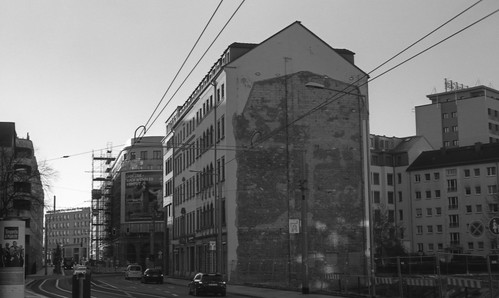
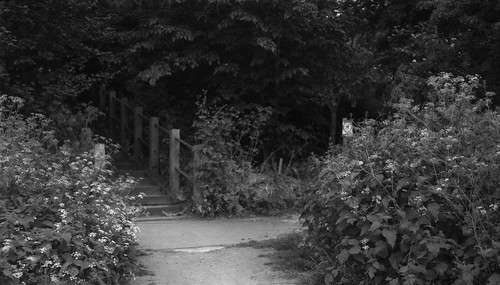
When developed, the negatives looked relatively high in contrast, with a clear base and no edge markings whatsoever. The film dried very flat and appeared to show a small amount of 'light-piping': the film base appears to be polyester and not tri-acetate (it doesn't tear and needs cutting). Ideally, I would have made prints in the darkroom from the negatives, but the results on this post are all from scans from a desktop scanner. The scans have almost no discernible grain, and no doubt show up the limitations of the desktop scanner rather than the ultimate resolution of the film itself. I'd shot the film outside, half in bright sunny weather one afternoon, ideal for it relatively slow speed of 25, with the other half shot early on a sunny morning, which was more challenging in terms of exposure, thanks to the low angle of the sunlight creating a very wide range of contrast between brightly lit surfaces and deep shadow with little in-fill from reflected light. Some of these latter frames (as below) struggled to record shadow detail without losing detail in the highlights, which didn't quite match the assertion that "due to its great photographic latitude S25 film shall perform nicely at bright scenes also preserving impressive level of detalisation[sic] through shadows without significant loss in highlights".

Kiev-4 (Helios 103 lens) and Silberra S25 film
It would have been instructive to see how scenes lit with well-diffused light, such as on an overcast day, might have been recorded, but almost every single frame I shot with the film was sunlight and shadows. The nearest equivalent was one photograph of a sign in a gallery window, below, illuminated by light reflecting off the pavement and surrounding buildings, almost certainly the one negative with the narrowest exposure range (this, incidentally, showed that my original intention for the film–photographing text–would have been an entirely appropriate use).

Kiev-4 (Helios 103 lens) and Silberra S25 film
Not having an IR filter I was unable to verify the film's 'high sensibilization level': given the suggestion for the use of an infra-red filter, this must mean extended red sensitivity. For some frames I might have used a light yellow filter, regardless, the tonality of the sky in some frames possibly indicates a more balanced spectral sensitivity than standard panchromatic film. My general impressions are that Silberra S25 has the feel of some kind of technical film–for me, how it handled and how it responded to exposure was very reminiscent Kodak Technical Pan–with both the positives and drawbacks of that discontinued emulsion. Given the very limited production run, it would be interesting, if it was possible to quantify, how many rolls of Silberra S25 are still out there, yet to be exposed: it's still listed on the Photographer's Gallery shop online, but sold out.


Further information:

Friday, 29 April 2022

'Homage'

What is an artistic medium? Encountering a work of art in a museum or gallery, or when this encounter takes place secondhand, through a book, magazine, or online, adjacent to the work there’s almost always a line of text, after the name of the artist (if known), after the title, and possibly the date, which will inform the reader of specific material substance or substances that constitute the object or artefact. On the website for the Marian Goodman gallery New York, Tacita Dean’s film Sound Mirrors is listed as follows: 
Sound Mirrors, 1999
16 mm b/w film; optical sound; 7 minutes
Edition of 4 plus 1 artist's proof
An artistic medium is not just the material basis for an artwork. It can be defined by its use, its practice, and the user’s intentions, as well as its constituent material. I am currently typing these words on a keyboard derived from a mechanical typewriter where once the pressure of my fingers would move metal keys, each with a raised–and reversed–letter, compressing an inked ribbon onto the surface of paper, a matrix with which to create legible, repeatable and standardised text. Now the words appear on a screen by an opaque process, the digital interface being one in which inputs become outputs by an inscrutable process. However, the medium is still writing. In the last two or three decades, with the rapid assimilation (and emulation) of what had once been long-established physical processes, there can be a tendency to see this shift creating a flat, surfaceless, frictionless digital world–a digital ’monomedium’–especially when so many tools to create anything can all be accessed through one device. Yet an artistic medium is both “‘at one and the same time’” the physical material used and the “emergent work” being created (Joseph Margolis, quoted by Nannicelli and Turvey in ‘Against Post-Cinema).  This ‘emergent work’ is situated within a set of distinct social practices - production, distribution, exhibition, and, mirroring these, audience expectation.

Tacita Dean’s films are made to be seen as projections in a contiguous space with their material matrix or substrate and the apparatus for doing so. Access to Dean’s film work outside of an exhibition context is all but impossible. Digital versions do not exist. UbuWeb does have a page for Tacita Dean, but the visitor is welcomed by the note: “These films have been temporarily removed by request of the Marian Goodman Gallery. For all inquiries please contact The Marian Goodman Gallery.” There is an insistence on the physicality of the medium, and its uniqueness in the encounter with the viewer, which can only occur when both are brought together in the same space and time, an odd inversion of Walter Benjamin’s sense of the aura: as artwork originating on film, these become that unique instance that needs direct experience, not encountered in reproduction.

Voigtländer Bessa RF with Fomapan 400
I must have seen Sound Mirrors in 2001 as part of the exhibition 'Tacita Dean: Recent films and other works' at the relatively newly renamed Tate Britain–and I have not seen it since. (In my unreliable memory, before referencing exhibition dates, I had thought that I might have seen Sound Mirrors in the Turner Prize exhibition in 1999–I used to go every year–but Dean was nominated for the Turner Prize in 1998, one year before Sound Mirrors was made [Edit 10/04/23: Having recently found the exhibition guide to the 2001 exhibition, this was indeed where I saw the film–there is one small image in the booklet which could be a frame from the film itself, and a much larger reproduction of a 'location photograph']). Like Dean’s films, access to the sound mirrors on Denge Marsh is strictly limited, sited on a managed nature reserve. With an institutional trip arranged to Dungeness and to the sound mirrors, the possibility arose–especially since I had begun using 16mm film recently–of making something in response to the site, and to my own memories of seeing a film, once, long ago.

Dungeness, Canon A-1 with Silberra Pan 160
The edge of England where the sound mirrors are located has has a sense of having been rather mythologised in recent years, partly through the restricted access to the sound mirrors themselves, partly due to the particularity of the flat landscape, the coast road, the nuclear power station, and the presence of Derek Jarman’s Prospect Cottage and his garden, and Tacita Dean was not the first to commit the sound mirrors to film. Hal Foster, in ‘An Archival Impulse’, describes the sound mirrors, among other subjects of Dean’s films, as being "archival objects", and, pointedly, as “found arks of lost moments in which the here-and-now of the work functions as a possible portal between an unfinished past and a reopened future.” In 1999, encountering moving image works in a gallery or exhibition setting, the difference in image quality between film and video was still (just) marked: the ‘poor image’ of video in the hands of artists was used for its distinct qualities as a medium, oversaturated, bleeding colours, light trails, noise, all contributing to video’s immediacy. Now, film as a medium has a doubly-archival sense to it, becoming its own ‘archival object’, embodying a broad range of historical practices, once more prevalent and present, but now vanished (or still-vanishing) from a common everyday experience, like the sound mirrors, being overtaken by new technology. New technologies continue to be haunted by older forms, however, through their adoption of existing language, through emulation of processes, and through the very conception of what the medium is.

Voigtländer Bessa RF with Fomapan 400
In Tacita Dean (Tate, 2001) there are images of the sound mirrors, but these are described as ‘location photographs’, not actual frames from the film itself. Here it may be worth making a distinction between still frames–the individual frames which comprise the moving image–and production stills, often called film stills: it was common practice in film productions to have a still photographer on set to produce images for publicity purposes and Dean’s location photographs fit this mould. I also took a handful of photographs on medium format film with a Voigtländer Bessa rangefinder camera, my own ‘location photographs’ (I took additional 35mm photographs, not of the sound mirrors themselves, with a Canon A-1 SLR), but ones which do not need to stand in for the film itself: for this, I used a single magazine loaded with 16mm Eastman Kodak Plus-X film manufactured in 1999, the same date as Dean's Sound Mirrors. The film was exposed using a Magazine Ciné-Kodak camera from 1936, around the time that the research on the methods embodied by the sound mirrors was becoming obsolete. The length of film in the magazine determined the duration of the film: nominally 50 feet (15 metres), this provides 2 minutes when shot at 16 frames per second, the camera's standard frame rate, that of silent non-sound synchronised film. I used the lens with which the camera was provided on purchase: a 25mm f1.9 Kodak Anastigmat. On regular 16mm film (not Super-16), this gives a slightly narrow angle of view. No sound was recorded: the Magazine Ciné-Kodak does not record sound; few 16mm cameras do.
“No one who went unprejudiced to watch a silent film missed the noises which could have been heard if the same events had been taking place in real life [...] People took the silence of the movies for granted because they never quite lost the feeling that what they saw was after all only pictures.”
Rudolf Arnheim, Film as Art (my emphasis)
Although naturalised, the sound film is a hybrid medium: the nature of a recorded image–a representation–and the nature of recorded sound–a reproduction–are different: when sound is reproduced–however it is recorded–it becomes sound again. Three-dimensional reality becomes a two dimensional image in the process of filming, a representation. With cameras which do (or did historically) record sound on film, most commonly through a magnetic stripe, a problem arises in that the recording of sound requires the substrate to be moving continuously, while the images require intermittent motion. Rudolf Arnheim, along with other writers on film who experienced the shift from silent to sound, and from black and white to colour, as a formalist, was wary of what he called the ‘complete film’, subjected to sound, colour, the widescreen, and stereoscopy, becoming inartistic, his conception of film as a medium depending on its limitations informing its possibilities: “…what might be called the ‘drawbacks’ of film technique (and which engineers are doing their best to ‘overcome’) actually form the tools of the creative artist.” The history of moving images is more complicated of course: films were hand coloured, tinted and toned, with the earliest ‘indexical’ colour experiments dating to around 1900. Sound was also present from film’s beginnings, harnessed to Edison’s phonograph in the ‘Dickson Experimental Sound Film’ from 1894 or 1895, synchronised with varying degrees of fidelity in the first decade of the 20th century, only for the form of film to outstrip its duration: with reproduction from a disc, sound had the same limitation as when Edison first experimented with images on a cylinder: sound needed to catch up with images and find its medium whereby the physical carrier, a spatially circular and cyclical recording, as Muybridge had achieved with projected images before Edison, became linear, allowing for expansion.

Voigtländer Bessa RF with Fomapan 400
My memory of seeing Dean’s Sound Mirrors twenty-one years ago is indistinct: there was no question of trying to emulate any aspects of shot length, composition, sequencing. There was also no real way of planning the film, only having access to the site on the day, with a limited time, with the result that the filming itself had to be simply improvised. The only consideration to structure was an attempt to begin with details, before building up to wider, more comprehensive angles of view, the opposite of using an establishing shot or shots to describe the space in which any action takes place. The result is ‘edited in camera’, or otherwise unedited, the continuous sequence of fifty feet unspooling through the camera. The only physical edit was removing a couple of fragmentary frames to create a clean splice at the end of the film. The nature of ‘editing in camera’ creates a coherent sequence in time, like a contact sheet of a single roll of film. The act of editing is another form of mediation of course, whether in camera or at the editing table. 

16mm fragment of Plus-X film
That Tacita Dean’s film Sound Mirrors exists in an edition of 4 plus 1 artist’s proof suggests that this was originated on negative stock and subsequently printed, whether with internegatives or interpositives, or any other stages in between, unlike being filmed on reversal film to produce a single, unique positive. The introduction of 16mm film as an amateur format relied on reversal processing, not negative-positive printing. However, even reversal film begins as a negative, the first stage of processing develops the latent image into a negative, which is subsequently bleached and the remaining undeveloped photographic emulsion re-exposed and developed. Theoretical or philosophical approaches to the the nature of photographic mediums, whether moving or still, have drawn the photograph’s beguiling power from its semiotic status as an indexical sign, that is, the necessary direct relationship between the photographic image and its referent: light reflecting off a surface passes through a lens (or other aperture) and leaves its trace as an imprint on a light sensitive matrix. In some respects, the photographic negative functions like any other matrix to print from, like a woodblock or etching plate, and this, and its initial monochrome nature, was conceptualised as printing, and borrowed the older mediums’ language. Unlike a woodblock, a tool for making a print, the negative is different, it cannot but embody this indexicality: in some senses it is more direct than the positive which it generates: it is like a daguerreotype or Polaroid. Semiotically, the index doesn’t have to look like its referent, only to possess a direct relationship. This is, in a sense, incidental: that photographs look like their referents extends their nature as signs from indexical to icons. The most famous (and most reproduced) photographic negative is William Henry Fox Talbot’s window at Lacock Abbey, with his note in which he described being able to count every individual pane of glass. Although not an established practice, especially at its very beginnings, negatives were sometimes shown as negatives–and have been shown again as such, as with Benjamin Brecknell Turner’s calotype negatives at the Victoria & Albert Museum. In an essay by Sarah Lea, ‘Tacita Dean: Mediums’, in the catalogue to accompany the co-ordinated 2018 LANDSCAPE/PORTRAIT/STILL LIFE exhibitions of Dean’s work, Lea emphasises the importance of contact, direct and unmediated, with the real physical material that comprises the many aspects of the work, the found photographs, the blackboard drawings, and film: film “embodies that contact with the actual: to some extent photochemical film retains an aspect of a document, or perhaps a chronicle, for we are only ever a step away from fabrication.” A negative may be the slightest of steps here.


In the book to accompany the 2001 Tate Britain exhibition, the credits to Sound Mirrors list Tacita Dean as ‘camera’, with four assistants, a sound editor, and various editing and post production facilities. Given the complicated nature of film as a medium, it is often a collaborative one, with specialised division of labour: often, in gallery and exhibition contexts, such aspects of production are often hidden. My camera, film, and film magazines were all bought secondhand; the coach trip to the location was provided by the institution (as improvised, each shot was framed in an attempt to avoid other members of this party appearing on-screen; a figure can be seen just walking into the edge of the frame in one shot). Photographic chemicals (in small quantities) were bought new. I developed my film by hand, using Adox Rodinal, in two halves, followed by a water bath, fixed, then washed, dried, and then the two separate sections spliced together with presstapes (the join is at the 42-second mark in the film). It was then physically posted to Gaugefilm to be scanned (the single most expensive aspect of the whole production process), creating a (positive) digital file which was then turned back into a negative using Adobe Premiere Pro, and vertically flipped. In the camera, when exposed, the image that the lens projects is upside down, and back to front on the surface of the photographic emulsion. When I first developed black and white film, I did not fully realise that this was what was happening inside the camera, obscured by the nature of the transparent substrate, reinforced by the orientation of edge printings, but obvious when working with opaque processes, direct positives or paper negatives–and a feature of the daguerreotype, its mirror image no doubt benefitting its use for portraiture, the subjects used to seeing themselves in the same orientation. 

The Eastman Plus-X negative film stock used for 'Homage', manufactured in the year that Tacita Dean made Sound Mirrors, was discontinued by Kodak over a decade ago. Dean has been active in preserving film as viable medium–the material basis–for the moving image. Perhaps, ideally, I would only show ‘Homage’ as a projection, from the unique 50ft length of original camera negative, an edition of one, physically degrading as it moves through the projector’s sprockets, pull-down claw, intermittently moving through the gate, loop after loop; but, thinking of the distinct practices of production, distribution, exhibition, and access to these channels of distribution and exhibition, the digital hybrid medium created by scanning the film allows for a flat, online distribution on such platforms as currently exist, possibly lost in a sea of content clamouring for attention, but there nonetheless.


Bibliography

Richard Abel and Rick Altman (editors), The Sounds of Early Cinema, Indiana University Press 2001
Rudolf Arnheim, Film as Art, Faber and Faber, London 1958. First published as Film als Kunst, 1933
Walter Benjamin, ‘The Work of Art in the Age of Mechanical Reproduction’ (originally published 1936) in One Way Street and Other Writings, translated by J. A. Underwood, Penguin Books, London 2009.
Tacita Dean, Tate 2001. Published on the occasion of the exhibition 'Tacita Dean: Recent films and other works', Tate Britain 15 February - 6 May 2001
Brian Dillon, 'Listening for the Enemy', Cabinet Magazine, Fall/Winter 2003 https://www.cabinetmagazine.org/issues/12/dillon.php
Hal Foster, ‘An Archival Impulse’, October, Autumn 2004
Jonathon Griffin, 'Tacita Dean: “I don’t care about the long run. I care about now.”', Royal Academy Magazine, 21/03/18 https://www.royalacademy.org.uk/article/magazine-tacita-dean
Sarah Lea, ‘Tacita Dean: Mediums’, in LANDSCAPE/PORTRAIT/STILL LIFE 
Patrick Loughney, ‘Domitor Witnesses the First Complete Public Presentation of the 'Dickson Experimental Sound Film' in the 20th Century’, Film History, 1999, Vol. 11, No. 4, Special Domitor Issue: Global Experiments in Early Synchronous Sounds (1999), pp. 400-403
Ted Nannicelli and Malcolm Turvey, 'Against Post-Cinema', Cinema & Cie, vol. XVI, no.26-27, Spring/Summer 2016, pp31-43.


Sunday, 17 April 2022

Workers Not Leaving The Factory (Once More)

Two years ago, I made a very short film called 'Workers Not Leaving the Factory'. The rationale for this was to record moving images onto Ilford film of the sites of the Ilford’s Britannia Works factory in the town of the same name, identifying two locations that would have been exits from the site at the time that the Lumière brothers filmed La Sortie de l'Usine Lumière à Lyon, its title variously translated into English as Workers Leaving The Lumière Factory in Lyon, Employees Leaving the Lumière Factory, or Exiting the Factory, the first film to be projected in front of an audience, at the Société d'Encouragement de l'Industrie Nationale, on 22nd March 1895. Last year I had the desire to revisit this, 125 years to the day on which the Lumières’ films were first shown to a paying audience in London, but did not do so due to the pandemic restrictions in force on that date. Instead, I made a rather imperfect contact print of the first film to project it at home, alongside a digital projection from a webcam that provided the nearest possible view to those which I had filmed, a visual representation of how the moving image and its dissemination has fundamentally changed the experience of time and space, echoing Patrick Keiller’s desire to make a film of “distant landscapes […] without leaving home.” This was 'ADDITIONAL POURTRAYALS [sic]', the name derived from a phrase in the original programme for the Lumières’ first exhibition of the cinématographe in England, in which I speculated, that, although La Sortie de l'Usine Lumière à Lyon was not named as one of the films shown, it could have appeared as one of these ‘ADDITIONAL POURTRAYALS’.

ADDITIONAL POURTRAYALS [sic]
The original Lumière programme appears in reproduction in a souvenir booklet produced for an event in 1936 to mark forty years since the first public exhibition of the Lumières' Cinématographe in London at the Polytechnic on Regent Street. As well as recreating the Lumières' original programme of short films in the same institution (which now boasted a School of Kinematography), there was also an exhibition showcasing the history and development of the technology of moving pictures, with a number of manufacturers keen to display the very latest advances. Among these were Ilford and Kodak Ltd: Kodak Ltd had a number of Ciné-Kodak cameras and projectors “Showing how Cine Kodak has advanced since introduction in 1923” with dates: the last camera listed is the “Cine Kodak “BB” Junr. f3/5” from 1930. Subsequent to 'Workers Not Leaving the Factory', I’d acquired a Ciné-Kodak Model BB Junior, but that with the faster f1.9 lens. In the exhibition, Ilford showed Dufaycolor, frame enlargements from 9.5mm Selo film and also the “ILFORD CINE SERVICE. Showing processing and control of 16 mm. and 9.5 mm. Ilford Cine Films”. Ilford stopped manufacturing ciné film many years ago, and when making 'Workers Not Leaving the Factory', specifically to shoot this on an Ilford emulsion, I cut FP4 Plus film down to 16mm, unperforated of course, but was able to use this–not without problems–in a Bolex 8mm camera. 

Ilford Fast Pan 16mm Film
For an Ilford motion picture film stock to use in the Ciné-Kodak BB Junior camera, I’d found a couple of 100ft rolls of 16mm Ilford Fast Pan film. On the labels of both there is a stamp "date of test 6.1.69", meaning that the film would almost certainly have been made at the Britannia Works site in Ilford before production there stopped in the mid-1970s. This is very reminiscent to the Ilford Mark V film I used a few years ago, presumably being an emulsion test; when researching that particular film stock, I found a suggestion that this lead to the fifth iteration of Ilford’s HP film, currently HP5 Plus today. It’s possible then that the Fast Pan film could be a version of the FP emulsion, although in the original FP film, the letters stood for Fine grain Panchromatic.

Roden Street, Ilford
Unable to revisit the Ilford sites in February 2021, enacting 'ADDITIONAL POURTRAYALS [sic]' to mark the date instead, I did then return last year as soon as the general 'stay at home' order was lifted on 29th March. I shot the Ilford Fast Pan film where it was originally manufactured in the Ciné-Kodak BB Junior–and subsequently did not develop the film for several months, until very recently, almost a year since the film was exposed. The Ilford Fast Pan film labels do not specify a film speed, and over fifty years since being made, I supposed that the film would have lost sensitivity regardless. My initial tests showed the film had a lot of fog, and I shot the film at an exposure index of 25. 

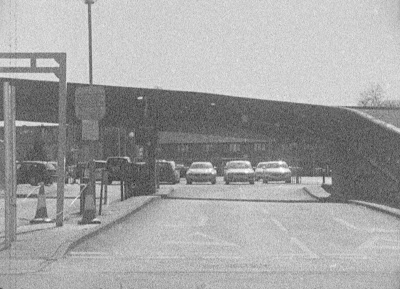
The Ciné-Kodak BB Junior takes 50ft daylight loading spools, which equates to around 2 minutes at the camera’s frame rate of 16 frames a second. When I filmed 'Workers Not Leaving the Factory', as the 2x8mm format requires the film to be passed through the camera twice, there was a logic to shooting two separate scenes, between which the film needed to be unloaded from the camera, the spools flipped over and then reloaded to shoot the second side of the film. In doing this, I chose the locations where two entrances to the Britannia Works site had been, having researched the site history in some detail in 2013. The first location was the entrance to Sainsbury's car park on Roden Street, the other a section of brick wall on Riverdene Road, which appears to align with what was once the entrance to an alley that led into Britannia Works. The Ciné-Kodak BB Junior runs for just over 30 seconds with its clockwork motor fully wound, this would determine the duration of each scene: I assumed that I would then get four different shots on the 50ft spool; in the event, there was enough film for five scenes, partly due to unloading the camera after shooting in the dark (the footage indicator on the camera suggests that there’s about five feet of film after the zero mark which would usually be exposed when removing the film from the camera). 
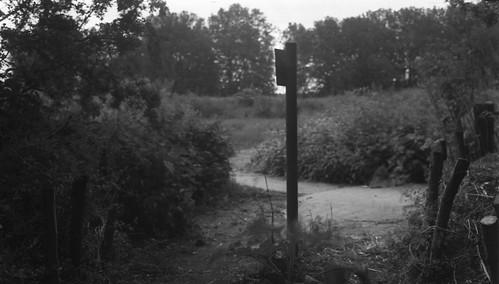
Riverdene Road, Ilford
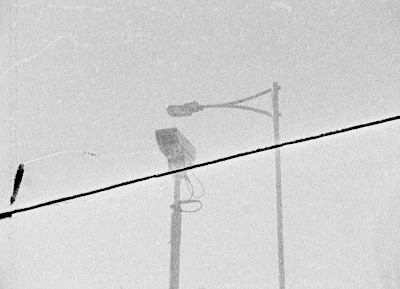
I filmed the same two locations as in 'Workers Not Leaving the Factory' for the first two shots. The next two sites where those related to 'ADDITIONAL POURTRAYALS [sic]': the CCTV camera which records the scene that I had projected digitally, and then I pointed the BB Junior in the same direction as this CCTV camera, but from the ground level of course. This viewpoint was as close as I could get to the scene of the Britannia Works site remotely: at some point in the evolution of Ilford’s sprawling site, it might have been possible to see part of it from here, namely the skating rink which Ilford rented in the 1930s. Reading accounts of the history of early film in Britain in In the Kingdom of Shadows recently, I couldn't help noticing that the cinema was linked to skating in a couple of accounts, usually in the nature of popular fads or crazes:
“SEVERAL EXPLANATIONS have been given of the bad theatrical business in the provinces, reports of which daily reach the managers most concerned in sending out companies. […] Mr. George Dance, who has as much experience of the business side of the theatre as anyone in England, is inclined to think that the comparative effect of cinematograph shows and skating rinks has been exaggerated.”
The World’s Fair, 30 October 1909

“AT THE PRESENT MOMENT the popularity of picture palaces and the reason for it are directing a good deal of attention to the public mind. But these sudden crazes are not new: 30 years ago it was croquet, 15 years ago it [was] cycling, ten years ago it was roller skating…”

The Times, 9th April 1913

Site of Alfred Harman's house, Cranbrook Road
With the nominally-50ft roll not entirely used up, I went to the site of Alfred Harman’s house on Cranbrook Road, where Harman first coated glass plates in the basement, the very beginnings of what would become Ilford, Limited. When I developed the film, I used the developing times for Ilford FP4 Plus with Adox Adonal, an iteration of Rodinal. The developing tank I have been using for 16mm is really designed for 2x8mm: a normal 2x8mm camera roll is 25ft, but, with enough film for a leader and trailer, usually removed after processing, the actual length is closer to 33ft; this does still mean that a 50ft daylight spool has to be developed in two parts, if not strictly halves. The cut appears part way through the third scene shot, spliced together again after developing. 

Cut between two lengths of the film developed separately
The direction of the film through the camera means that the second half of the film was first to be developed first, for which I used a dilution of 1+50 for 15 minutes; the negative looked dense, so I reduced the time for the second half of the film to 12 minutes, which possibly could have been cut further (subsequently using the Ilford Fast Pan film, I’ve rated it at 40 or 50 rather than 25; in the image above it's just possible to discern that the image is brighter, thus the negative is denser, below the cut.). The nature of the film's age and overexposure and/or overdevelopment is that the images have quite pronounced grain as a result. Having developed the film by hand, the cleanness of the process itself could clearly be improved. In addition, by letting the camera’s motor run down entirely while exposing the film is that the frame rate slows close to the end, before the motor stops, with the result that the exposure time increases, the image getting brighter at the end of each scene. With the methodology determining the location and duration of each shot, anything happening in front of the camera was at the mercy of what Siegfried Kracauer would describe as ‘the contingency of the street’: the entrance to the supermarket car park and the road underneath the A406 flyover inevitably provided movement; the CCTV camera was shot hand-held, and a bird can be discerned flying through the shot at one point; the brick wall on Riverdene Road is only animated by subtle signs of the wind in the netting on the scaffolding which appears in the corner of the frame and the shadows from a tree on the right. Movement is also provided by the lack of stability of the frames and the vibrations the camera itself is subject to as the motor unwinds, rotating the shutter, pulling the film from supply to take up spool inside the camera, the intermittent motion briefly pausing its travel at the film gate for sixteen exposures every second.

'With Workers Not Leaving The Factory', showing the two individual frames next to each other had a logic thanks to the nature of the 2x8mm film format. In 16mm, there was a coherence to keeping the revisited scenes in juxtaposition; with the following shots as an angle-reverse angle pair, this had also had a reason to be placed together after the first two. The fifth shot I discarded.

Sources/Further reading:
Colin Harding and Simon Popple, In the Kingdom of Shadows, Cygnus Arts, London 1996
Patrick Keiller, 'The Robinson Institute', The View From the Train, Verso 2013
Siegfried Kracauer, Nature of Film: The Redemption of Physical Reality, Dobson Books, 1970


Tuesday, 29 June 2021

Lomography Berlin Kino 400 - single roll review

Lomography Berlin Kino 400 - Formula 2019

For some time now, when using a film stock that's new–to me at least–I like to test a few rolls, starting by rating a number of frames both under and over its box speed, then giving this normal development for a test of the film's latitude. This often provides some indication whether the film might be sympathetic to both push (and pull) development. I'll typically shoot it in a few different cameras, sometimes in different formats if available. I also like to try at least a couple of different developers, dilutions, and sometimes different temperatures. Usually the manufacturers' recommendations for exposure and development give perfectly good results; however, for some film and developer combinations, there's not much information available online, particularly with new stocks, and it's always worth being attuned to what one wants to get from a film stock if not using a lab: having that degree of control is the main reason for developing black and white film myself, as much as, if not more than, the economy. The Massive Dev Chart is also a fantastic resource, but I have found a few stocks for which I've specifically established my own exposure/development practices through testing - most notably Ferrania P30, but also Rollei RPX 25 and Agfa/Rollei Superpan 200. This is all a preamble just to state that, in normal circumstances, I prefer to live with a film for a while before committing to write about it; this post goes against that preference.


Earlier this year I received a prize for my efforts in the #ShittyCameraChallenge, four different rolls of 35mm black and white film, none of which I'd used before: Rollei Ortho 25 Plus; Film Washi D; and two Lomography films, Fantome 8 and Berlin Kino 400. This carefully-curated prize, sponsored by David Walster (@196photo on Twitter), was an invitation for me to try some films I might not ordinarily use; due to the pandemic, lockdown, work and other circumstances, I hadn't shot any of them until earlier this month. An impromptu road trip to Cornwall was the occasion: I took my Kodak Retina IIa (a German-made Kodak, although from Stuttgart, not Berlin). This was already loaded with Kentmere Pan 100, but I put the roll of Lomography Berlin Kino in my bag as I thought I'd probably finish the part-used Kentmere film. In the event, I only loaded the Berlin Kino 400 for the return trip; having a 400-speed film was at least appropriate for taking photographs from a moving vehicle–from the passenger side–and not all of these were that successful. I finished the roll in the succeeding few days over the week, partly at the same time as I shot the 12-exposure cartridge of FP4 for June's '126 Day'.

Kodak Retina IIa with Lomography Berlin Kino 400
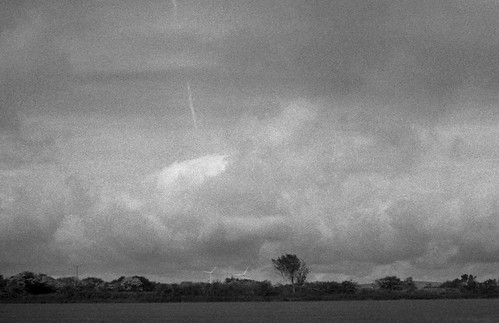
Most of the frames were shot using the 'sunny-16' rule, although I did meter some with my Weston Master II; most shots were made at box speed, or as near as. I did shoot a couple of frames just to compare the use of a yellow filter; unsurprisingly these did give better definition in the cloudy sky in the examples below. Quite possibly a number of the other frames would be better for the use of a yellow filter, as a general rule with most black and white panchromatic emulsions. I didn't try other filters, as I rarely use anything except a yellow, mostly a light yellow filter, sometimes a deep yellow.

Kodak Retina IIa with Lomography Berlin Kino 400-no filter
Kodak Retina IIa with Lomography Berlin Kino 400-yellow filter
For developing the film, I went straight to the Massive Dev Chart. At the time of writing, this has just one entry for Berlin Kino in Rodinal: 13 and a half minutes at a dilution of 1+50. Only after I'd developed the film did I come across Lomography's recommendation of 17m30s with Rodinal 1+50, which seems rather long. When I pulled the film from the wash, to my eye, the negative roll looked more than a little reminiscent of Foma Retropan 320 Soft: very low contrast on a noticeably grey base (initially, I did think it might be under-fixed, but I'd developed other films at the same time with clearer bases in the same fixer that I could compare to the Berlin film, and these looked properly fixed). When I scanned the negatives, my feeling of the comparison was that it was more than apt: the frames showed very prominent grain, and with a very irregular pattern, something that Foma films tend to show. Where the comparison seems to falls down is the lack of halation around the highlights: with Retropan, very bright highlights have a 'glow'. This doesn't seem to be the case with Lomography Berlin Kino 400: the image below would be a good subject to test this out, and it doesn't obviously appear around the bright sunlit barriers and the lintel over the underpass entrance.

Kodak Retina IIa with Lomography Berlin Kino 400
Whenever a 'new' film appears on the market there's always a fair amount of online speculation over what it 'really' is: there are only a few manufacturers of photographic material. Some new film is genuinely new, newly formulated emulsions; some 'new' film depends on specialist emulsions which would not have been previously available to consumers in any convenient format (for example, until relatively recently, a still photographer wanting to use Eastman Double-X would have had to purchase a 400ft roll as a minimum, then somehow get this into 35mm cartridges for use). Some apparently new films are simply existing emulsions rebranded and repackaged. When Lomography first brought Berlin Kino to market, it was pretty quickly established that it was Orwo N74–not a film I've used–and apparently had the same edge markings. However, the roll of Berlin Kino that I shot was clearly marked on the box 'Formula 2019' (intriguingly, Orwo also updated their fast negative emulsion in 2019, now named N75, but with a speed rating of 320, rather than 400 ISO). Having not tried neither the first iteration of Berlin Kino, nor either versions of Orwo N74 or N75, I can't comment on how the Formula 2019 compares. Interestingly, the negatives had no edge markings whatsoever once developed, not even frame numbers (as was the case with Retropan), but I did note it does have standard 35mm still film perforations, and not the more rounded Bell & Howell perforations for motion picture negative stock, which suggests it is not simply or no longer repackaged Orwo N74; the 2019 formula is also available in medium format, but as a one-roll review, I can't comment on what it's like. Perhaps entirely coincidentally, Foma Retropan 320 Soft has been widely reported as discontinued, although still listed on Foma's website (which doesn't have much information in general).

Kodak Retina IIa with Lomography Berlin Kino 400
Lomography's marketing on their website does hint at the origins of the first iteration of Berlin Kino film:
A Refined Formula for True Film Lovers
Inspired by the New German Cinema sweeping through Berlin in the 1960s, our original Berlin Kino Film emulsion was an utter blockbuster. However, as German cinema evolved through time, adapting to meet the innovatory spirit of its founding fathers, so did our film formula. Refined and brimming with greater artistic control, the Berlin Kino B&W 400 2019 Formula will allow you to capture moments of your life in an eternalized enchanting monochrome.

As a West German phenomenon, the film makers of the New German Cinema quite possibly would not have used Orwo, an East German film stock, as speculated on in the Casual Photophile's review. Having researched a little into New German Cinema myself, and into the films of Wim Wenders in particular, the only film for which I've found that specific information is Wenders' Im Lauf der Zeit/Kings of the Road (1975): this was shot on Eastman Plus-X and 4-X negative stocks (one could also quibble about the name: Munich might be as–if not more–resonant to New German Cinema than Berlin; maybe they should have called the film Oberhausen, but perhaps that's too obscure for the casual film photographer). Nevertheless, the association is there, and one Lomography has kept with the Formula 2019 version. Again, I'd have liked to have shot a roll of the initial Berlin Kino for a comparison.

Kodak Retina IIa with Lomography Berlin Kino 400
My impressions from shooting a single roll of the film are that Berlin Kino 400 does at least have quite a distinctive look, which comes from two factors: its very low contrast, and its prominent (and irregular) grain. These qualities do feel like they would suggest the film's use for specific subjects, although such ideas–that a particular film stock is necessarily good for a particular subject–should never go unexamined. It certainly wouldn't be replacing my 400-speed film of choice in 35mm (Ilford HP5 Plus), but would be a clear replacement for Foma Retropan 320 Soft–if the latter film has indeed been discontinued. I'd be interested to see how it prints in the darkroom (all images on this post are scanned from the negatives), how it performs in medium format and what it's like in different developers, how it stands up to push-processing, but as a one-roll review, these are outside the remit of this post.


Sources/further reading:
Lomography's page on Berlin Kino 400
The Casual Photophile's review
Random Camera Blog on Lomography Berlin and Potsdam films
Alex Luyckx on the original Berlin Kino 400

Thursday, 17 June 2021

116 Day June 2021

Zeiss Ikon Cocarette 519/15 with Kodak Verichrome Pan
Having not taken many photographs recently and having posted even less, last Friday, 11th June, was my prompt to shoot a roll of film in my Zeiss Ikon Cocarette 519/15 for '116 Day'. I had intentions of shooting more, but I'd been working all day on the day itself, so only went out in the early evening, which had become overcast, and took a walk, following a route familiar from earlier in the year, my allowed daily exercise during lockdown and recovery. I shot a roll of Verichrome Pan, usually quite reliable for a fairly out-of-date film, and with no new film in the 116 format for decades, expired film is the only alternative to some form of conversion to use 120 medium format film or rolling film (120 or 65mm) with 116 backing paper; using an expired roll of 116 provides a spool and backing paper in order to be able to do this.

The Verichrome Pan had a 'develop before' date of June 1972, and I rated it at 24 against its original speed of 125 ISO. As a result, I took all the photographs using a tripod, with speeds varying from 1/5th through to 6 seconds; although I could have used smaller apertures and longer exposures, the camera did not feel especially sturdy on the tripod I was using and there was a bit of wind when I was taking the photographs to contend with too.

Kodak Verichrome Pan, process before date of June 1972
I stand developed the film in Ars-Imago #9, diluted 1+100, a developer replicating the original Agfa Rodinal formula (earlier in the year, when I bought this developer, it seemed very hard to find Rodinal in the UK, and I did wonder whether this might have been due to the UK leaving the EU, given that all the versions of Rodinal I've used come from manufacturers in the EU: Adox Rodinal/Adonal, Compard R09 One Shot, Fomadon R09). In terms of exposure, the results were acceptable enough in the main: with only eight frames on the roll, I didn't want to bracket any shots; I had one accidental light leak due to not properly aligning the shutter to the T setting and the shutter didn't close properly. There were some scratches on most frames, more prominent in some than others. On a couple, the focus was off, a problem I've realised that the Cocarette suffers from. I've ascertained that infinity is closer to the 30ft mark on the focus lever than the infinity stop, and I've assumed that each focus mark was offset the same, although I haven't properly checked this with measuring each focus mark. Focus issues besides, six frames felt worth posting; perhaps the best shot from the roll is the one at the top of this post, the last frame on the roll, just as the clouds began to lift.


Thursday, 12 December 2019

127 Day December 2019

Baby Box Tengor with Ilford HP5 Plus
For last weekend's 127 Day I chose to shoot with the Baby Box Tengor, a choice partly influenced I think by also taking photographs for the current #shittycamerachallenge. The Baby Box Tengor is capable of reasonable results, but it is just a simple small box camera with no adjustable aperture, focus or shutter, other than the choice between instant or time exposures. I used just two offcut ends of Ilford HP5 Plus: when cutting down a roll of medium format to 127 size, after rolling the right length for the format, there's always some film left over, around five 4x3cm frames, although it's hard to be exact when cutting the film in a dark bag (this operation would be easier if the film was unrolled on a worktop in the dark and some form of jig made to get the correct length). There were a few light leaks, but also one roll could have been better developed, more attention paid to agitation, with air getting trapped between the film and plastic spool; I wound up with ten shots in total, a couple of instances where I'd taken two shots of the same subject from similar positions, and two where the frame partly overlapped the end of the film - one of which was too slight to be worth scanning.

Baby Box Tengor with Ilford HP5 Plus