 |
| Belomo Agat 18K |
Most half-frame 35mm cameras were designed to shoot in portrait format, partly due no doubt as the way a roll of film logically winds through a camera from left to right horizontally, with the wind on lever or wheel operated by the thumb on the right hand. The ergonomics of this on a standard full-frame 24x36mm format camera provides a landscape, horizontally-orientated image; with the same left to right film travel, a half-frame image size of 18x24mm becomes vertical. The very earliest cameras that took 35mm film - before the Leica - often used something approximating the half-frame format, a legacy of 35mm film coming from the motion picture industry. These were often large and bulky cameras however, made to shoot much longer lengths of film; the invention of the standard 35mm cassette allowed camera designs to shrink. However, with the even smaller frame size, half-frame cameras could be scaled down to become smaller still, and compact sizes made it easier to design cameras to be held in different orientations, and a number of half-frame cameras (such as the
Yashica Samurai) were made with the film travelling vertically to provide a landscape format image.
The
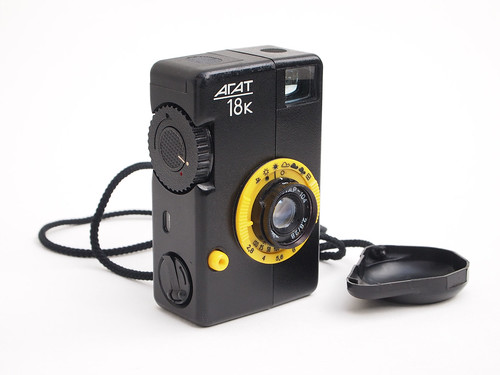
Agat 18K is one such horizontally-orientated half frame camera. It's a very small (95x60x45mm), light-weight (130g) camera mostly constructed from ABS-type of plastic, manufactured by Belomo in the former Soviet republic of Belarus. There was an earlier
Agat 18 (presumably the
18 is from the frame size); the 18K model improves on its predecessor in having a wider ISO range, an extra setting on its exposure calculator, a threaded shutter button for cable release, and a redesigned lens cap which covers
both lens and shutter release. This lens cap is attached via a cord that has a screw fitting which doubles as a tripod mount. It's designed to be held for horizontal shots, with the film travelling from bottom to top rather than left to right, and held to the right eye with the shutter release operated by the right hand. The camera's ergonomics make holding it for a vertical portrait framing rather more awkward - perhaps it's best held to the left eye and operated by the left hand; using the right eye, the bulk of the camera rests against the user's forehead.
The 18K's manual only appears online in Russian, and so the camera may never have been intended for export (apart from the initials ISO, all other writing on the camera is in Cyrillic): some of the information in this post has been gleaned from other websites, but some from the manual via my own attempts to translate some of it using online tools. The Agat cameras are very easy to find online and very cheaply too:
SovietCams.com suggests over half a million of
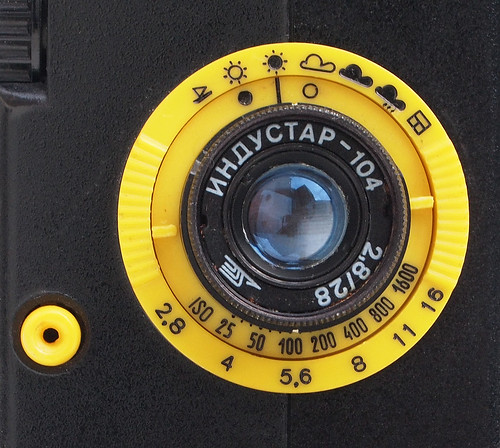
the first version were produced from 1983; the 18K version came out in 1988 and would be the preferred model simply for its extra features. Both versions of the Agat camera have an Industar-104 f2.8 28mm lens (giving a slightly wide angle of view, about 40mm on a full-frame 35mm format), stopping down to f16. The lens has a filter thread and also focuses down to 0.9m, with the viewfinder giving indications of parallax correction for close focus.
 |
| Agat 18K lens and exposure calculator |
The unique feature about the Agat 18 cameras is the manual calculator which gives a form of programmed exposure. The film's ISO, from 25-1600 on the Agat 18K, is set on the inner ring around the lens, using the white mark underneath the lens first: this ring is difficult to turn using the two tabs on either side of the lens - the manual suggests using a match. The exposure is then set by lining up one of seven symbols on the outer ring with the black line on the inner ring: although largely self-explanatory, the manual provides further information on the lighting conditions they represent:
Object in snow, in the mountains, the sea under clear sun
Bright sun, harsh shadows
Hazy sun, soft shadows
Light cloudy weather, no shadows
Cloudy or shade with open, clear sky
Very cloudy, thunderclouds
Indoors 1 metre away from a window in the absence of direct sunlight
The inner ring also includes dark and light circles at either side of the line for one-stop exposure compensation. With the exposure set, the calculator indicates which aperture is in use, marked off next to the white line where the ISO is set. The shutter is coupled to the aperture setting: the manual lists the possible combinations in a table that appears to suggest that both aperture and shutter speed are continually adjustable as it shows intermediate aperture settings and odd shutter speeds. At f2.8 the shutter is either set to 1/65th or 1/130th, down to 1/540th at f16. The table of apertures and shutter speeds in the manual has asterisks against the intermediate aperture settings, 3.4, 4.8, 6.8 and so on and the asterisk appears to mean something like "The aperture value is not specified on the camera"; as there is also an asterisk against 1/65th at f2.8, this would appear to show that this aperture and shutter combination is set with the exposure ring rotated as far as possible anticlockwise (on the fastest ISO settings, the outer ring is moved some distance past the window symbol to achieve this). As well as the provision for exposure compensation, it is of course easy to override the exposure calculator by simply by either changing the ISO setting or choosing a different symbols.
 |
| Agat 18K focus scale and depth of field indicator |
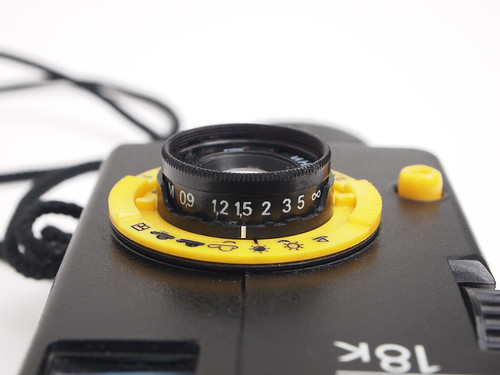
There is a depth of field scale around the lens with a series of indentations to indicate different aperture settings; at f11, with the focus at 1.5m, depth of field should be from 0.9m to infinity, although this seems rather generous. The manual has a diagram as to how to interpret the indentations on the scale.
 |
| Depth of field diagram from Agat 18K manual |
The film advance wheel is the same width as the camera body, which has cutaway sections to give a grip on both sides for ease of turning. The frame counter starts with a dot at 1, resetting with opening the camera, and thereafter goes up in sixes. The shutter is cocked not by the frame advance itself, but by the metal sprocket wheel internally, meaning that without a film, this has to be rotated by hand to cock the shutter for testing. To load the camera, a spring catch on one side is pressed down and the camera body slides into two parts. To insert film, the pressure plate flips down to thread the film across, and this plate has a small cut out and corresponding protrusion inside the body to securely locate it; it also depresses a small pin just visible in the shot below, and, although I'm not sure as to the function of this, given the position, I assume that
releasing this pin resets the frame counter.
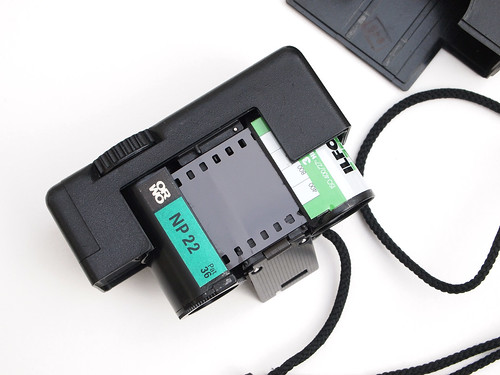 |
| Agat 18K with 35mm cassette on take up side |
The Agat 18K has a removable take-up spool; the receiving chamber is also designed to use a second 35mm cassette in its place (my camera came without the take up spool, but it did have a plastic cassette with an Orwo NP22 label). It is possible to use just an inner spool from a 35mm cassette in the take up side if the camera's removable spool is missing, but the film needs to be attached in some way, either with tape, or the spool can be modified with a slot cut into it to receive the film. However, I've only used it with two 35mm cassettes. When doing so, the take up cassette has to be put together with the internal spool
upside down to make a mirror image of the cassette loaded with film. The camera's capacity to use two cassettes is something rarely mentioned in reviews; perhaps this design feature is a response to shooting double the amount of frames with the half-frame format, making it much more convenient to remove a part-used film. The manual shows cutting the typical 35mm film leader to a central tapering point to locate it in the small slot in the middle of an internal spool, but I've simply been taping the film instead, in much the same way as bulk-loading 35mm. Obviously it's still possible to rewind the film if using two cassettes in this way; to rewind film, the internal button on the advance knob has to be pushed in and turned to the red dot instead of the white dot for advancing film.
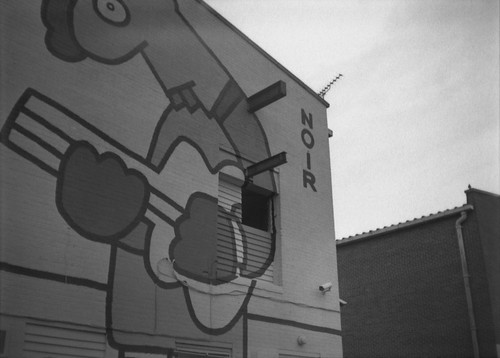 |
| Agat 18K with Ilford FP4 Plus |
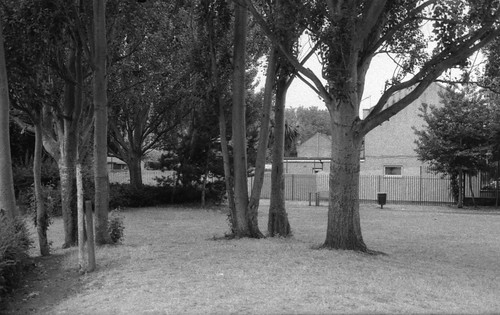
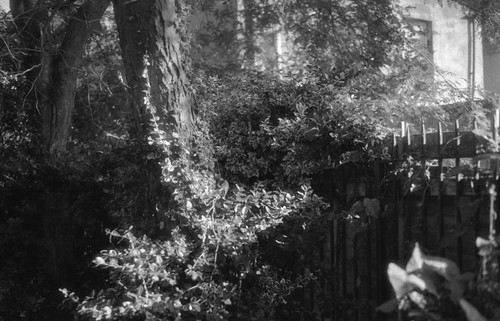
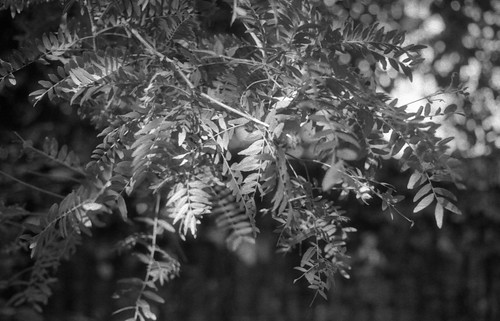
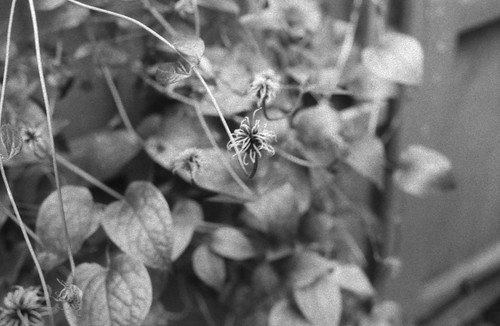
While testing, I had difficulties using the camera films in the poor light of cloudy days for the past week: there were almost no sunny periods to use smaller apertures and faster shutter speeds. The best results were with
Ilford FP4 Plus; although I also shot some
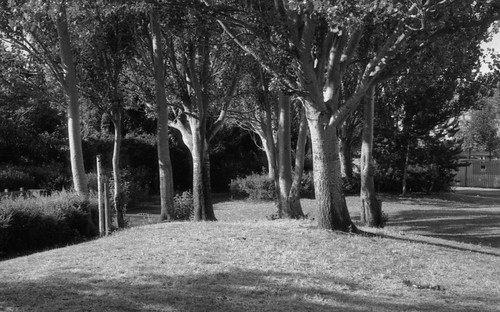
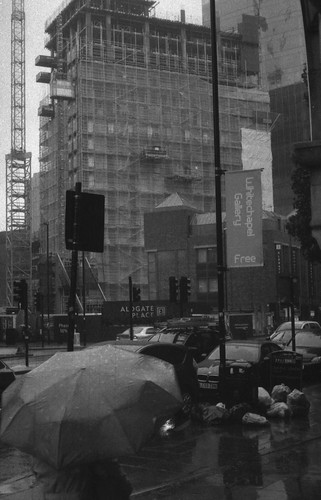
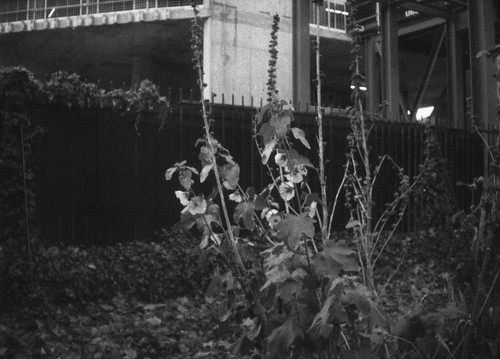
HP5 Plus, most of these frames were not exposed properly, due to my own error in not compensating for how weak early winter morning sun can be, although some of these shots, despite being underexposed, do give a small indication of what the lens might be like stopped down. I also used some
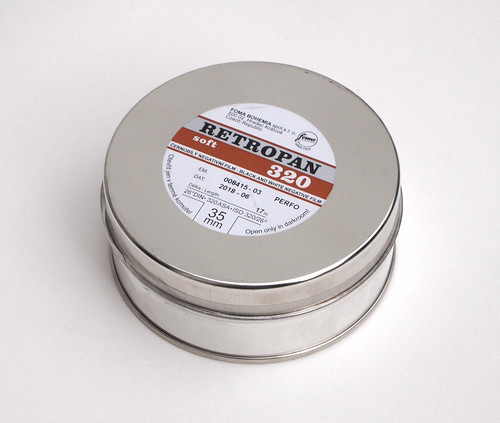
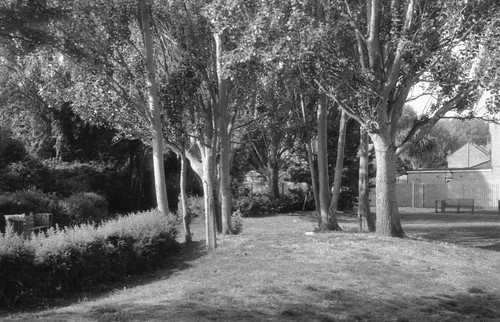
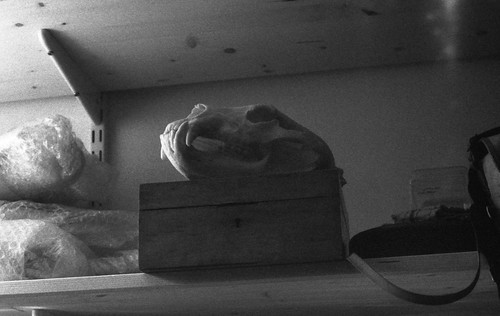
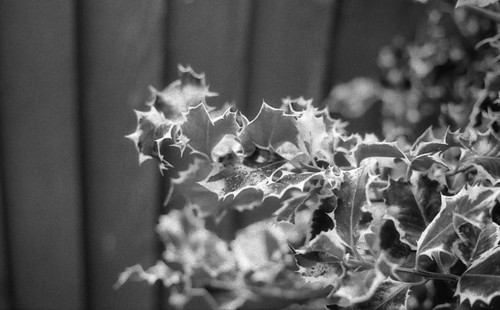
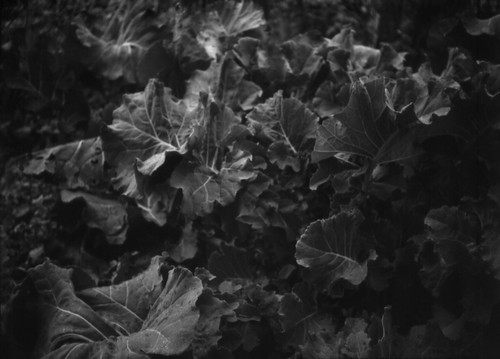
Foma Retropan 320, but this gave very grainy images, more obtrusive than the HP5. Finally, with the low light levels over the weekend, I shot some
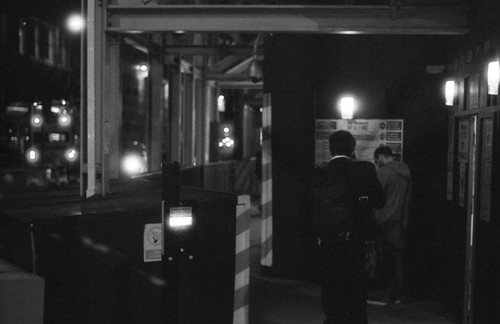
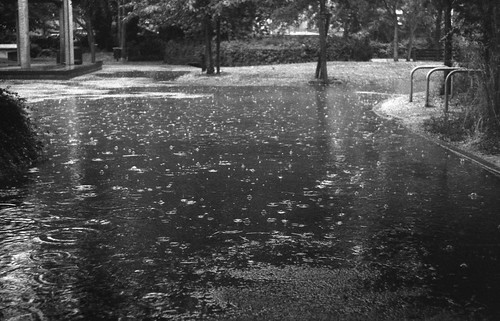
Ilfodata HS23, rated 25: by necessity, every shot used the 'dark cloud' symbol setting, giving f2.8 at 25 ISO. With the Ilfodata film, grain is barely visible, but limitations of the lens' quality are much clearer when shot wide open. Also, with a very shallow depth of field, there was little compensation for inaccurate guess focussing. It does appear that the lens might not quite focus at infinity when wide open; this might be a quality control issue over the construction, although it might simply be that I didn't quite take enough care to make sure the lens was actually set dead on infinity. It is also very easy to accidentally rotate the focus on the lens as this seems very loose. There are also some shots with lens flare, but more obvious are internal reflections, something a few Soviet-era cameras are notorious for, given their shiny plastic insides.
The exposure calculator does have some limitations: at the slowest ISO settings, it can't be rotated to the thundercloud or window symbols: at the other end of the scale, being unable to use the bright sun or beach symbol at 1600 ISO would mean overexposure by one or two stops, although I was very far from having this latter problem while making my tests.
The Agat 18K looks and feels like a toy camera in many aspects, but in its design, if not in its construction, it's far more ambitious than that, despite the caveats above. The features such as the focussing lens, the wide ISO range, the ability to remove film partially shot from cassette to cassette, and the exposure calculator coupled to both apertures and shutter speeds, more than just a 'sunny 16' set of symbols, there's also a hotshoe hidden under a sliding cover for flash: all these suggest something more than a toy. I've used an
Olympus Pen EE3, which has been my half-frame camera that I've relied on for many years, and although the Agat 18K's Industar lens doesn't compare with the performance of the Pen's Zuiko, it does have a wider maximum aperture, a wider ISO range, and the ability to focus its lens. It's also a much lighter and smaller camera, and very pocketable: perhaps the fun of using it locates the Agat 18K in the toy camera category.
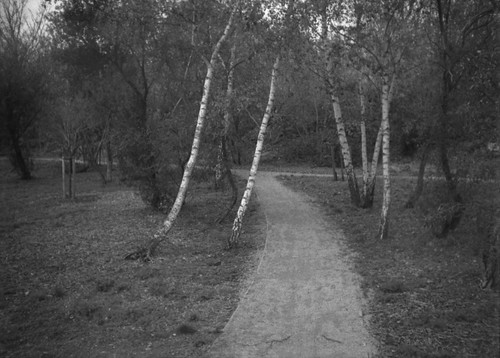 |
| Agat 18K with Ilford FP4 |
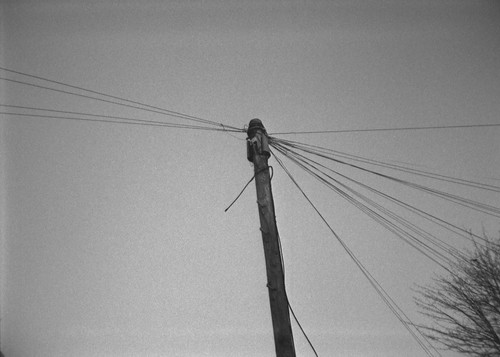 |
| Agat 18K with Ilford HP5 Plus |
 |
| Agat 18K with Foma Retropan 320 |
 |
| Agat 18K with Ilfodata HS23 rated 25 |
Sources/further reading:
Agat 18K on SovietCams.com
Agat 18K manual in Russian
Belomo cameras on Camera-Wiki
Agat 18 review on BKS Picture Blog