Showing posts with label Agat 18K. Show all posts

Sunday, 10 May 2020

Eastman Double-X - Part Two

In the three years since my post on Eastman Double-X film, observing interest online, the popularity of this motion picture film stock amongst still photographers has steadily increased. As a motion picture stock Eastman Kodak produce Double-X in 35mm and 16mm in bulk lengths, the minimum length being 100ft/33m in 16mm; since my previous post about Double-X, a number of companies now provide 35mm canisters ready loaded with the films for still photographers (I previously bought a 100ft roll of 35mm to load my own canisters); the film is marketed as CineStill BwXX, Film Photography Project's X2, as Double-X from Camera Film Photo, and Nik & Trick among others. My motivation for revisiting Double-X in this post came about through using the film with a different developer from those I'd used previously - D96. D96 is Kodak's recommended developer for black and white negative motion picture stock - which now comprises of just Double-X; comments on my original blog post recommended that I use D96 after my somewhat ambivalent conclusion to the film from using it in 35mm for the best part of a year. It didn't seem particularly fine-grained for its speed, and the speed itself didn't seem fast enough to make it a good all-round film in comparison with 400 ISO films on one side, or finer grained 100 speed films on the other.

Formulas for making D96 from its raw ingredients are readily available online, and it has also been available as a powder, but recently Bellini have produced a liquid version of D96. Evidently there are many advantages to the convenience of liquid developer, especially as a stock solution; my habitual developers are Rodinal/R09 and Ilfotec LC29, which I have used for a number of years: it makes sense, especially when starting out with developing black and white film, not to change too many variables at any point, one of these obviously being film developer. However, I recently shot two rolls of 2x8mm Double-X (reperforated for the format and repackaged by the Film Photography Project) in a Bolex ciné camera, and, wanting to develop the films myself, it seemed wise to try the manufacturer's recommended developer with the film, especially given the small size of the 8mm frame. The short film below was shot on 2x8mm Double-X and developed in D96; for reasons too complicated to detail here, I pushed the film three stops in development, which does account for the contrast, while the appearance of the grain is mostly down to the degree of enlargement necessary from the tiny 8mm frame.

Having used the D96 for a couple of rolls of 2x8mm Double-X, having a litre of D96, I wanted to test the film in 35mm with the developer and it seemed timely to revisit Double-X for a new blog post. For a first test with 35mm, I shot a roll with in a Canon A-1 SLR for a latitude test, rating the film at successive exposure indexes of 64, 125, 250, 500, 1000, 2000 for two sets of six exposures, as seen in the first and second rows below, and developed the film for 6 minutes in stock D96 at 21ºC.

Eastman Double-X latitude test, developed in D96
Eastman Double-X latitude test, developed in Ilfotec LC29
Comparison with the same film developed in Ilfotec LC29 (above) from my previous tests appears to show greater latitude when developed in D96, although the conditions with the Ilfotec LC29 were higher in contrast; the same film when developed in Ilfotec LC29 looks as though the shadow detail drops away faster. It's also possible that the test film developed in D96 is slightly underdeveloped: Kodak's published time for Double-X is 7 minutes at 21ºC (rather than the more usual 20ºC); my notes indicate I developed the film for just 6 minutes at 21ºC.

Double-X at EI 64 (two stops overexposed)
Double-X at EI 2000 (three stops underexposed)
I was a little surprised at the latitude range which this test demonstrated as evidenced in the two shots from either end of the scale above: scanning the film, I was able to pull out as much detail as possible from the negatives when underexposed. This was easier than the equivalent exposures with Ilfotec LC29. Overexposure did compress the tonal range from mid-tones to highlights, giving the images more of a flat look than the lighting alone. The latitude in this test is no doubt due in part to the diffused, low contrast lighting when I shot the the film to try D96, as well as the developer itself.

When I'd previously used the film, I did try pushing it one, two and three stops, with very uneven results at two and three stops. Published times for Double-X in D96 are very limited, but the Massive Dev Chart and Bellini's own data sheet give a time of 25 minutes at 20ºC when rated at 1600. I shot a roll at 1600 in (mostly) challenging lighting conditions. This test was possibly overdeveloped, using 21ºC for 25 minutes, rather than 20ºC.

Double-X at EI 1600
Most of these shots were taken under artificial light, in a low-lit museum setting, with spot-lit displays creating inherently high contrast subjects, the above image being a good example; the Double-X rated 1600 did give relatively good results in these difficult circumstances. There were only a couple of shots that I took under daylight conditions, and these on a fairly dark day in February, not enough to draw any meaningful conclusions, but the results look good enough, as below; generally, daylight would of course give enough light to rate the film at 250. Although the times for push-processing Double-X in D96 are limited, it would be possible to make reasonable guesses for one and two stops, perhaps around 12 minutes to rate the film at 400 and 18 minutes for 800, although I haven't tested for these times.

Double-X at EI 1600
As well as trying 35mm Double-X with D96, I also wanted to see how it would perform in 16mm for various subminiature cameras, notably the Rollei 16 camera (this has reputedly one of the sharpest lenses on any subminiature camera). The results on this post are scanned from the negatives; printing in the darkroom, it might be possibly to resolve more detail from the 12x17mm negative. The best of the shots from the Rollei 16, such as that below, showed D96 to give fairly fine-grained development: with the negative very nearly a quarter of the size of a standard 35mm frame, at a modest enlargement, the quality does hold up (albeit perhaps suggesting the grain of a faster film, but I think the general point holds true).

Rollei 16 with Eastman Double-X
As a motion-picture negative developer, fine grain is paramount. Grain is inherent to the film's emulsion, but obviously, the appearance of the grain is affected by a number of factors. D96 contains sodium sulfite, which acts as a solvent (as well as a preservative), softening the look of the grain; equally, some of the fineness of the grain in my results may be in part due to the developer's low contrast, particularly on a micro level, smoothing out the look of the grain. This also makes it a good choice of developer for using Double-X in half-frame cameras, as well as subminiature cameras. I did shoot some Double-X in a couple of half-frame cameras for this post, but, again, under fairly poor lighting conditions, which perhaps didn't provide the best conditions for testing the film.

Olympus Pen EE3 (half-frame) with Eastman Double-X
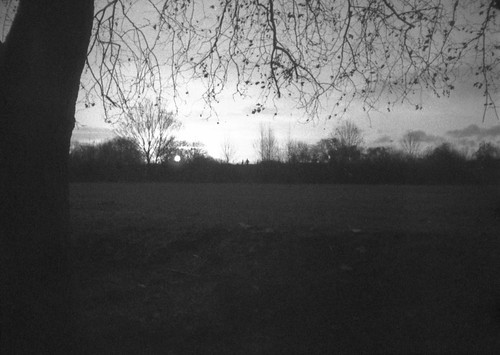
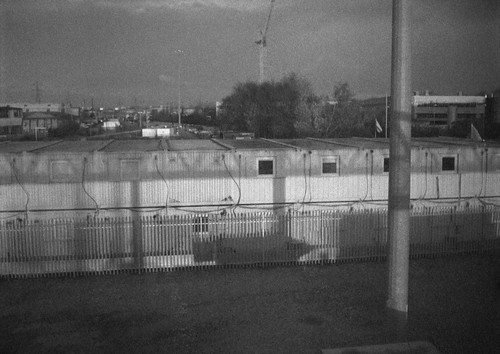
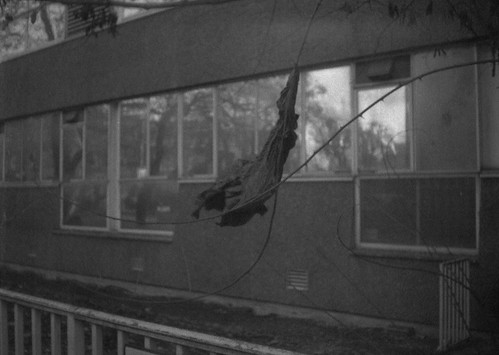
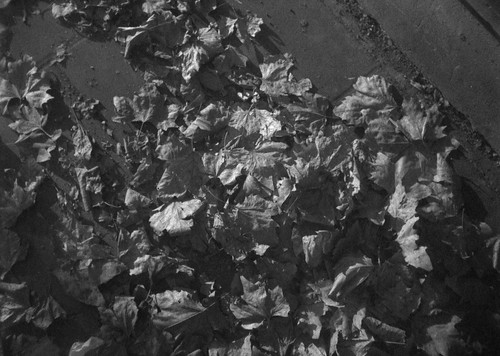
Belomo Agat 18K (half-frame) with Eastman Double-X
I had been fairly ambivalent about Eastman Double-X prior to using it with D96: it almost felt like a different film, testing it again with a more sympathetic developer. The grain appears finer, the film does seem to have better latitude, and, on my limited tests, it pushes better, with more consistent results. However, a few further reflections on using D96 might be apposite here. The developers I have mostly used for black and white films - Rodinal and Ilfotec LC29 - I have treated as 'one-shot' developers, Rodinal, which I've generally used as Compard's R09 One Shot clearly being so, but also Ilfotec LC29, which Ilford recommend using as a one-shot developer when diluted 1+29, or indeed for best results. At lower dilutions, 1+9 or 1+19, I've tended to use it for just one session, but have developed a number of rolls of film, one after the other. Using a stock solution such as D96 does provide some consideration, namely around temperature and exhaustion. With a highly concentrated one-shot solution, I get the water to dilute the film developer up to temperature simply by adding hot and cold together until these reach 20ºC, then add the concentrated developer. Even if this is cold, adding one 30th part at 15ºC for example, 12ml to 300ml, will not significantly alter the temperature. With D96, I found warming the bottle of stock solution took more care, especially when using this early in the year, when the stock solution might be at less than 10ºC off the shelf. Plunging this into a jug of water somewhat warmer than 20 or 21ºC to bring it up to a working temperature more quickly often meant it would get too warm, and then would need to cool before use. The other consideration, exhaustion, was more difficult to calculate. I bought my bottle of Bellini D96 from Nik & Trick; on their website, the suggestion is that a litre of D96 will process "about 100ft". Presumably this is 35mm film. I developed two lengths of 25ft 2x8mm film, 16mm wide, which probably equates to 25ft of 35mm; I also shot four rolls of 27-exposure 35mm film, and some 16mm film with both the Rollei 16 and Mamiya 16 subminiature cameras. In addition, I used the D96 for some Plus-X too, and the FP4 Plus that I'd shot in the Bolex. With the FP4 film, I developed half the film and the negatives were very thin. This might be partly due to user error of course - most of the roll of Double-X I shot with the Agat 18K produced thin negatives, but this was one of the first rolls of film I developed in D96. Returning to comments earlier in this post about not changing too many variables, obviously, using several different cameras, with different metering systems or none, and also developing different emulsions with the same stock solution of D96 made it more difficult to see when the developer was beginning to exhaust: the last films I was developing with the D96, I found myself having to double their published times in order to get good results - clearly, accurate record keeping would have helped here. Comments about developer exhaustion notwithstanding, using Eastman Double-X film with D96 has lead me to reappraise this film stock - and understand the enthusiasm that still photographers do have for it.

Rollei 16 (16mm subminiature) with Eastman Kodak Double-X rated 200
Belomo Agat 18K (half-frame) with Eastman Kodak Double-X rated 250
Olympus Pen EE3 (half-frame) with Eastman Kodak Double-X rated 250
Kodak Retina IIa with Eastman Kodak Double-X, rated 250
Canon A-1 with Eastman Kodak Double-X rated 250
Canon A-1 with Eastman Kodak Double-X rated 1600

Saturday, 21 September 2019

Ilford Pan 400

Ilford Pan 400
Having used Ilford Pan 100 last year, and from the research online for my post on the film, I wrote then that "Pan 400 appears to be a bit more popular, or at least seems to come up more often than Pan 100"; as a companion piece to my tests of Ilford Pan 100, it was natural to want to do the same for the 400-speed film. I bought my Ilford Pan 400 at Process Supplies Ltd where I'd also got the Pan 100 film previously; when buying the film, I was told that the Ilford Pan films are to be discontinued in favour of the two Kentmere films, Kentmere 100 and 400. The implication from this is that the Pan films and Kentmere films are not the same emulsion, although it's not exactly clear how different they may be: the two brands do have different development times. To support the idea that the Kentmere films are replacing the Ilford Pan films, the Kentmere films have recently had their packaging redesigned - and the words 'PAN 100' and 'PAN 400' are as prominent as the Kentmere brand: on Ilford's website, there's a post from last year about the redesign that states "Kentmere 100 and 400 are now officially known as Kentmere PAN 100 and PAN 400..." (Edit 8/11/19: see the post on Kentmere Pan 400 here).

As I wrote in my post on Pan 100, the Ilford Pan films have not been generally available in the UK; the data sheet states that:

The ILFORD range of PAN 100 and PAN 400 black and white camera films are not generally distributed and sold worldwide, they are only made available in selected markets.

Like Pan 100, Ilford Pan 400 is a traditional, cubic-type emulsion black and white film from Harman under the Ilford brand, 'Pan', an abbreviation of panchromatic, is indicative of the basic nature of these films. A thread on the Amateur Photographer forum quotes an unattributed 'Ilford employee' on the Ilford Pan films that: "They are based on FP4+ and HP5+ technology, but are produced to lower specifications and tolorances [sic]. There are also a few posts online that suggest the Ilford Pan films were discontinued some years ago and I speculated in my post on Pan 100 that production might have ceased for a period - a data sheet from 2002 mentions both 35mm and 120 - the films are only available in 35mm, for the time being of course. By contrast to the Ilford Pan 100 films that I used last year, the Pan 400 that I used this year had no printing inside the box - an indication of imminent discontinuation perhaps, or just their budget status.

As is my usual approach when testing a new film, I made a latitude test, rating the film successively from an exposure index of 100 through to 3200, in effect going from two stops over-exposed to three stops underexposed. Developing times for Ilford Pan 400 (and Pan 100) are not listed on Ilford's standard development chart listing their other Ilford-branded films (except Ortho Copy Plus); for this post I used times from the Massive Dev Chart (the data sheet from 2002 does give times - the same as on the Massive Dev Chart - for Ilford Pan 400 at meter settings from 200 to 3200). The film for the latitude test was developed in R09 One Shot at a dilution of 1+25 for 6 minutes at 20ºC.

Ilford Pan 400 latitude test
The test showed the film to have reasonably good latitude: two stops overexposed and the compression of tones towards the highlights begins to become unattractive; underexposed, shadow detail starts to be lost, although in scanning the negatives it was possible to pull out more detail. Inevitably, with a lower contrast subject, over- and underexposure have less effect than higher contrast subjects - the top row on the contact sheet above is higher in contrast, with brighter highlights and deeper shadows; the subject in the second row is more even across the frame.

Ilford Pan 400, two stops overexposed
Ilford Pan 400, three stops underexposed
Following the latitude test, I wanted to try both push- and pull-processing. Pull-processing tends to be less demanded by shooting conditions, though with a 400-speed film there may be occasions when it might be advisable. I shot one roll of Ilford Pan 400, rated 200 and developed in R09 One Shot at a dilution of 1+25 for 5 minutes and 30 seconds at a temperature of 19ºC. Pull-processing does reduce contrast, but faster films are inherently lower in contrast than slow films, so this may be less necessary as a result. Some of the shots on this roll were on subjects with differing degrees of contre-jour illumination; the pull-processing may have helped a little here, though the second shot below, with a brightly lit late afternoon sky towards a low sun would always be problematic in terms of retaining detail across the frame: a simple scan of the negative (as is the case here) might not be as good as a darkroom print, albeit no doubt needing plenty of burning-in for the sky, and possibly spilt-grade contrast printing too.

Ilford Pan 400, exposed at EI 200 and pull-processed
For push-processing, a test for a one stop push to 800 did not seem necessary: frames rated at 800 on the latitude test showed a reasonably full range of tones without extra development. I did push the film to 1600 and 3200 respectively, using Ilfotec LC29 as a developer for these tests rather than R09. The two-stop push to 1600 emphasised the grain but not unattractively so; the increased contrast made for negatives which were easy to scan. I shot most of these in the British Museum, with some galleries being illuminated with low-light levels, making the two-stop push an ideal compromise.

Ilford Pan 400, rated 1600, developed in Ilfotec LC29 1+19, 14m at 20ºC
I then shot a roll at 3200, some at dusk on an overcast day, some on the London Underground. With a three-stop push, the contrast of some subjects meant an inevitable lack of shadow detail, but, again, the push-processing here was an acceptable compromise.

Ilford Pan 400, rated 3200, developed in Ilfotec LC29 1+9, 11m at 20ºC
Ideally, this post would then test the Kentmere Pan 400 film to compare it with Ilford Pan 400 (edit 8/11/19: I have now tested Kentmere Pan 400, posted here); I suspect that for most uses, the differences would not be significant: both films are fast, traditional black and white panchromatic emulsions at a lower price than Ilford HP5 Plus or Kodak Tri-X. Generally, the results with Ilford Pan 400 were perfectly acceptable, if lacking anything to distinguish it from other lower-priced black and white films that seem to have proliferated in recent years. In my post on its slower companion, Pan 100, I wrote how that film reminded me of the Foma films in terms of grain; by comparison, Ilford Pan 400 doesn't seem to me as alike to Fomapan 400: Pan 400's grain is perhaps a little more regular, a little less gritty. Perversely, perhaps, I found the results when either pull- or push processing more to my liking: down rated, the grain feels a little tighter, smoother, while pushing the film a couple of stops gives the negatives enough of a contrast boost to make the images feel tonally more dynamic as well as providing better results from a straight scan (of course, mush also depends on the subject contrast of the original scene photographed). Again, ideally I would also test these assertions with printing in the darkroom too; however all the images on this post (except the contact sheet) are scanned from the negative.

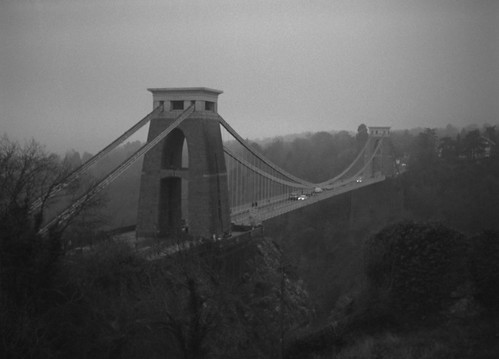
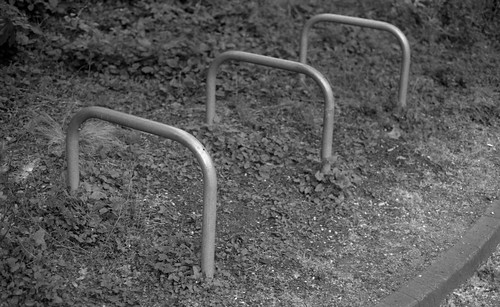
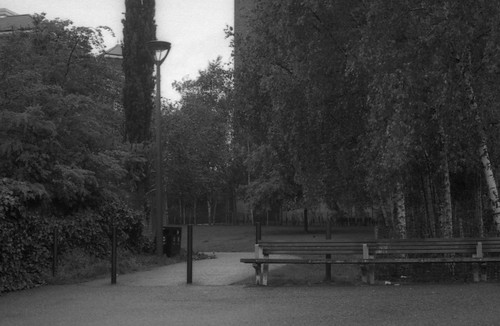
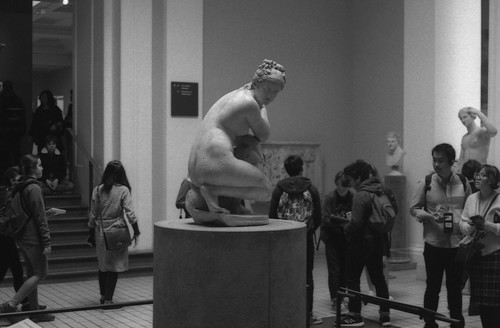
Ilford Pan 400 shot with Agat 18K (half frame)
Kiev-4 with Ilford Pan 400 rated 200
Canon A-1 with Ilford Pan 400 at box speed
Canon A-1 with Ilford Pan 400 rated 1600
Canon A-1 with Ilford Pan 400 rated 3200
Ilford Pan 100 and Pan 400 data sheet (PDF)

Sunday, 24 December 2017

FP4 Half-Frame Diary

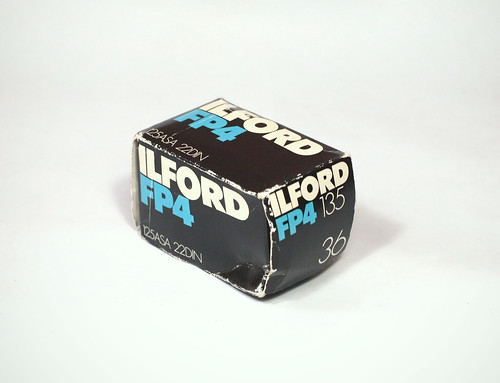
Ilford FP4, develop before date January 1991
A few months ago, I was given a roll of Ilford FP4 with a 'process before' date of Jan 91; this roll predates the introduction of the 'Plus' version of FP4 from 1990. The film itself was probably made in 1988-89, given 24 months or so between manufacture and 'expiry'. Looking for a reason to use the film, the announcement of the return of the #FP4Party for December provided the excuse if one was needed; last year, this was held three months in a row, although I only shot the old version of FP4 on one of the designated months in sheet film from the 1970s with the Butcher's Cameo.

Ilford FP4, develop before date January 1991
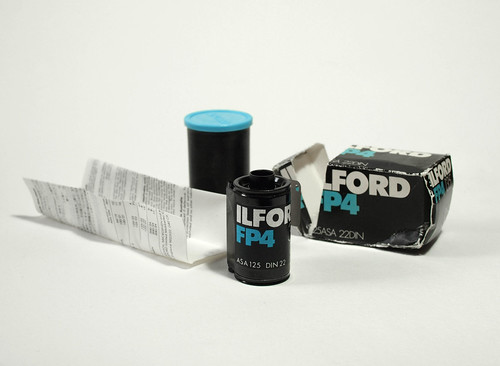
Inside the box, the plastic tub that the film was in has a blue top: Ilford films used to have colour co-ordinated tops (I mostly remember the red XP2 tops from the late 1990s to early 2000s, as this was the film I probably would have shot most). The metal film canister itself has easy-to-remove lid (making it easier to re-use), and the developing information is printed on a separate leaflet rather than inside the box.

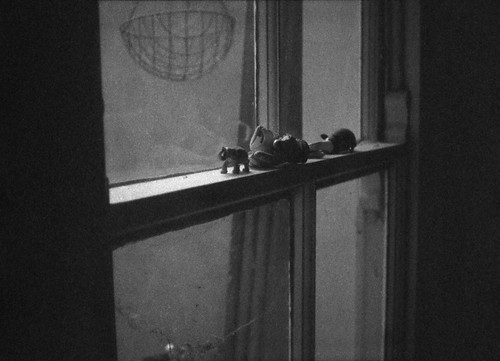
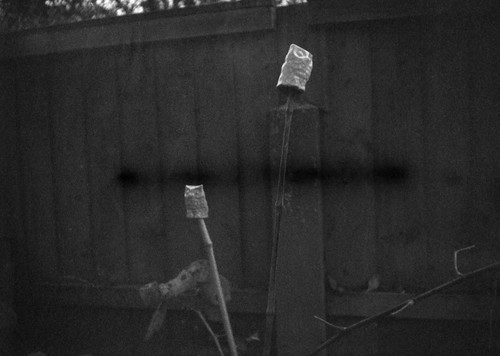
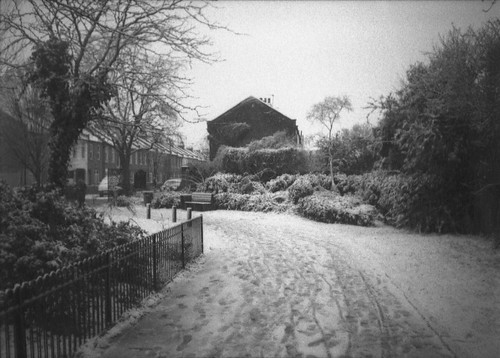
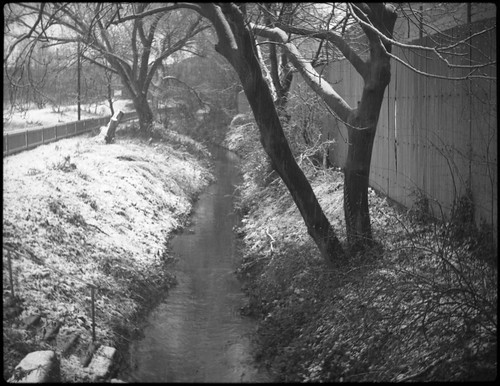
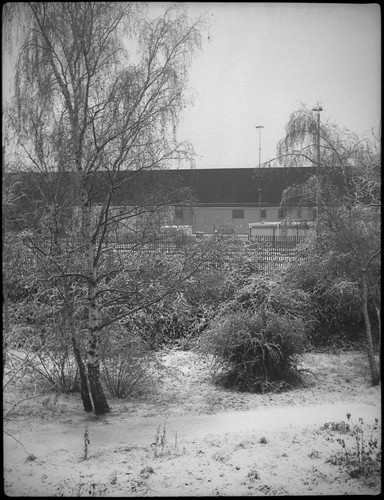
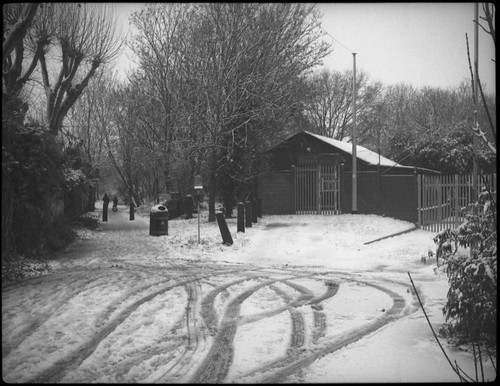
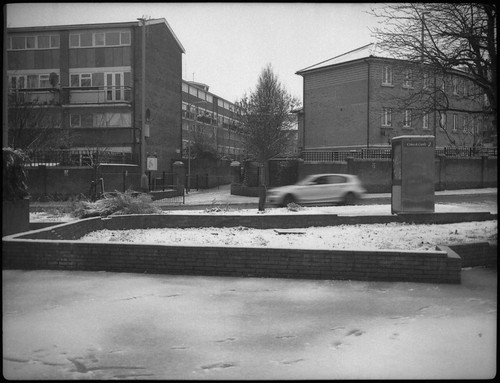
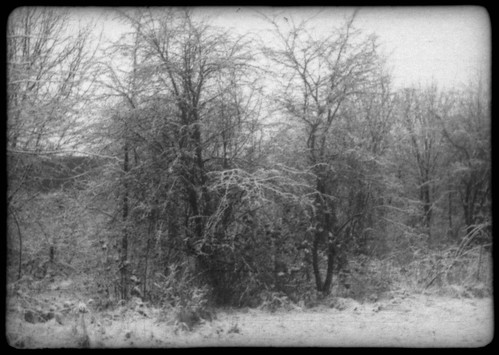
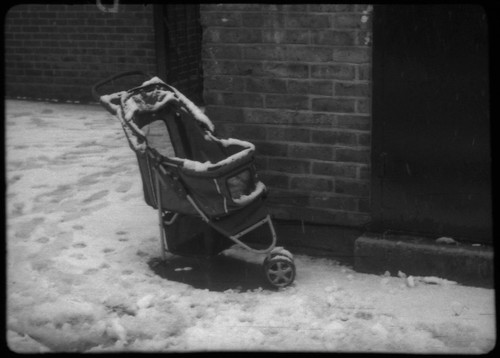
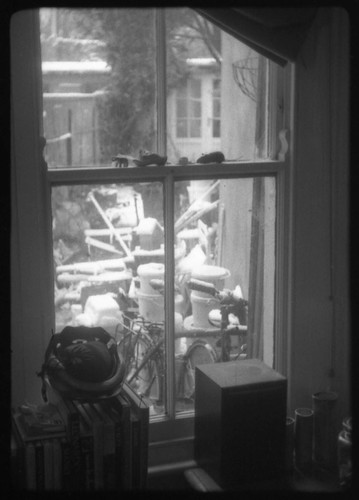
I chose the Belomo Agat 18K; as a half-frame camera, I could get twice the number of shots (72) with it. This gave me the idea to shoot the film throughout the week - ten shots a day - like a diary of sorts (the idea of a half-frame diary dates back to when I was a student, learning about the 35mm half-frame format from a photography tutor, Mick Williamson who used an Olympus Pen for his photo-diary; later, I found an Olympus Pen EE3 and used this for a number of years, with a similar idea, although without any strict rigour). To compensate for age, I exposed the roll at EI 64, and also developed it as if rated 200, giving it an effective 2/3-stop push. Development was with RO9 One Shot, diluted 1+50 for 20 minutes at 20ºC. The results appear to show I was a little optimistic about how well this particular roll had lasted - the negatives were mostly very thin and grainy - and would no doubt have been better exposed at 25 (there were also a number of horizontal marks, as seen in the second image below, where the emulsion seemed to have failed to react to the exposure, showing up every few frames, but fading away after the first dozen or so). During 'shoot week', a combination of short daylight hours and very overcast weather conditions proved challenging when shooting the film with available light when rated 64, and many of the photographs were taken with the lens wide open at f2.8, and show up my guess focussing to be not always as accurate as I might have liked. I did attempt to use flash for a few shots - such as the last frame on Tuesday below, but the camera did not consistently trip the flash, leading to a number of blank frames. Towards the end of the week, there was some sunnier weather, then, almost unexpectedly, the final day of shoot week coincided with the first decent snowfall in southern England for a few years, which providing a more interesting end to the project.

Monday


Tuesday


Wednesday


Thursday


Friday


Saturday


Sunday


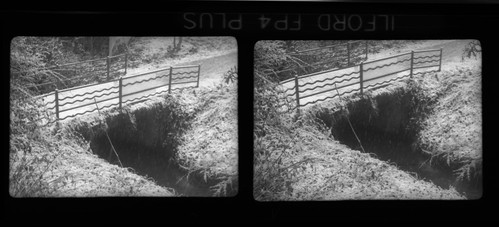
In addition to the roll of 35mm FP4, the shoot week happened to with the December 127 Day on the 7th; having cut down some FP4 Plus to use with my Baby Ikonta, I had a number of 'short ends' of film cut down to 127 width - as the length of 120 film is longer than 127, cutting down a roll of medium format film, one ends up with a short length of film leftover. This was enough for up to six shots in 3x4 negative size. I used a few of these short rolls of FP4 Plus on the final day of the shoot week.

Baby Ikonta with Ilford FP4 Plus
Finally, on the last day of shoot week, I also shot a roll of 16mm film with the Mamiya 16 Automatic, an off-cut from cutting down the width of FP4 from medium format - the first image below I scanned as a diptych to include the film name in the rebate.

Mamiya 16 Automatic with Ilford FP4 Plus