Showing posts with label Fomapan 400. Show all posts

Monday, 14 December 2020

127 Day December 2020

Rolleiflex 4x4 with Fomapan 400
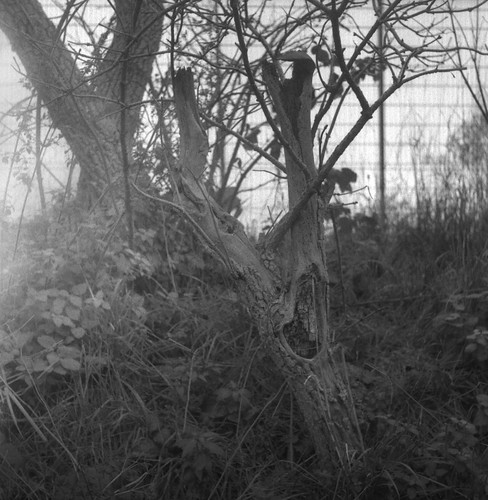
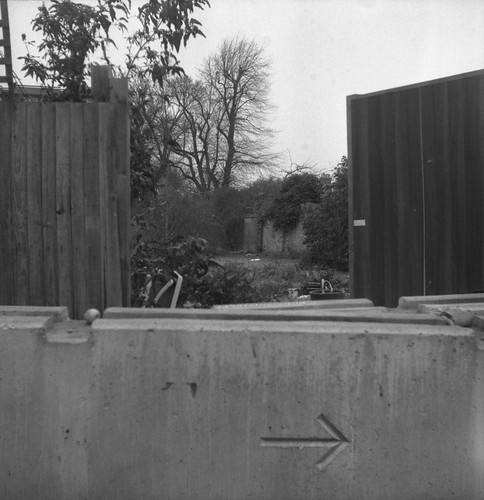
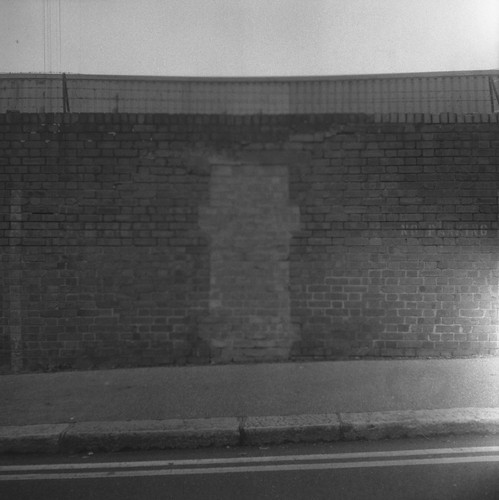
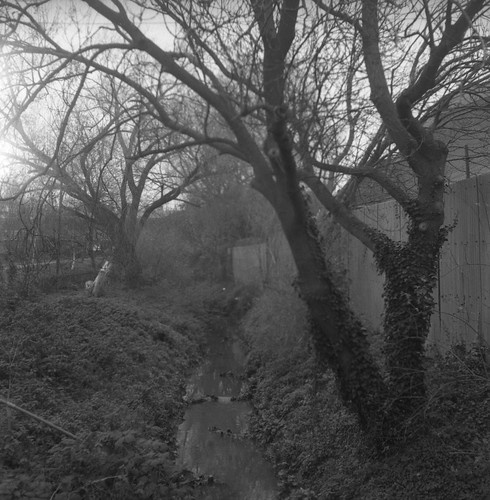
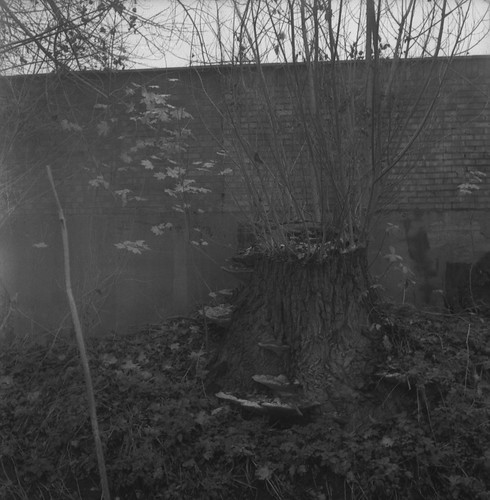
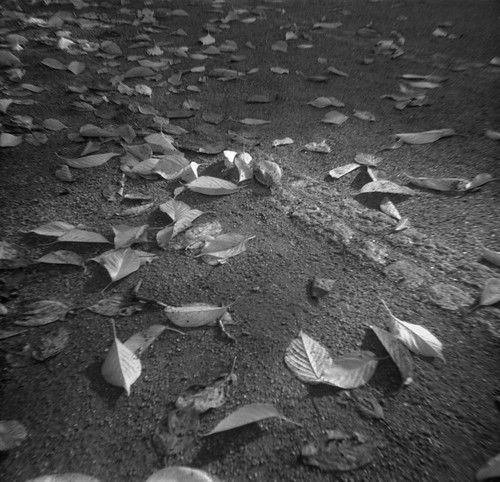
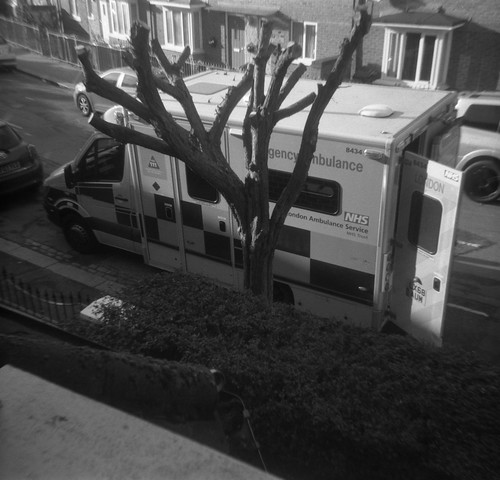
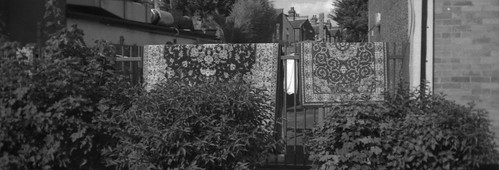
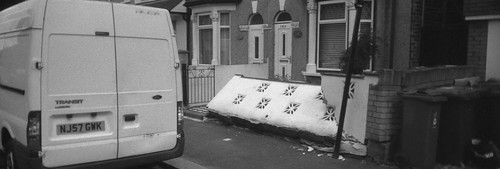
Still recovering from Covid-19, last week's 127 Day coincided with one of the better days when I felt well enough to go for a short walk on a very grey day, but not early enough for the mist to make it interesting. I took the Rolleiflex 4x4, loaded with a roll of cut-down Fomapan 400. Inevitably, or so it felt, the one roll I shot was beset with issues. The start of the roll had some odd spots, visible in areas of the sky, possibly due to some developing problem (although I'm unclear what caused this); then a number of the shots had out-of-focus areas in the frame, which must be due to the film not laying flat inside the camera. This might be down to using cut-down film, possibly cut slightly too wide, and as a result, bowing out in the middle. Then the film got stuck after nine exposures; I couldn't work out why this happened, but after removing the film in a changing bag and developing it, some of the shots have light leaks at the sides, suggestive of a 'fat roll' (although I didn't really notice this at the time): however, if the film was cut just a little wide, this is no surprise. Somehow the unexpected inadequacy of the results feels fitting.


Tuesday, 1 December 2020

Coronet 6-6

Coronet 6-6 camera
The start of the new #shittycamerachallenge's 'holiday apocalypse' last month, running from November to January, almost neatly coincided with the new coronavirus lockdown restrictions coming into force in England on November 2nd. As with the previous period of 'lockdown' from March this year, the restrictions have not been as stringent as in many continental European countries: working in education, moving from the only then recently introduced tiered system to the lockdown had essentially no difference to my daily life, as I was still physically going to work, face-to-face, in the same way I had been since the start of September, while watching the rolling seven-day figures of cases, hospital admissions, and deaths, rise with what felt like inevitability, once schools and colleges opened at the start of term, and stayed open throughout. I was taking my photographs for the #shittycamerachallenge on my way to work, at lunchbreaks, and, on a couple of occasions, during exercise, alone, which was permitted. Despite taking all the precautions that were practical at work, again, with what felt like inevitability, I became ill halfway through the month, and a test confirmed that this was Covid-19. As a result, I finished my last roll of film while isolating at home.

The camera I had picked for the #shittycamerachallenge was the Coronet 6-6. I felt it fitted the spirit of the exercise due to being largely made from plastic, and with the most minimal user controls - and also that the camera had mould inside the body when I first opened it. The camera's name is sometimes written as the Coronet 66; above the lens, the two numerals are separated by the coronet logo, and, taking nominally 6x6cm images, no doubt the name would be said as "six-six" (it's also worth remarking that Coronet made a 127 format camera called the Coronet 4-4 from its negative size, and this is written on the camera as '4-4'). The Coronet 6-6 is a simple point-and-shoot Bakelite-bodied camera from the 1950s, using 120 medium format roll film, taking twelve 6x6cm images. This camera belongs to a class of mid-twentieth century cheap point-and-shoot models which can essentially be considered derivations of the box camera, and, as with the Coronet 6-6, not necessarily as well featured as many of those box cameras. These cameras also tend to reflect the availability of new materials: Kodak's Brownies began with cardboard bodies, before being replaced by metal; by the mid-twentieth century, many of these cameras were made from early plastics. The Coronet 6-6's body is made from Bakelite, one the most popular plastics of the era.

Coronet 6-6 camera
The Coronet 6-6 was manufactured by Coronet, a Birmingham-based company specialising in a broad range of cheap cameras, many of which share very similar features across different models. The Coronet 6-6 is clearly based on the body moulding of the Coronet Cadet and the Coronet Flashmaster, but with a different lens and shutter unit: the wider-angle lens of the Coronet 6-6 allows for a more compact camera. The Coronet 6-6 was also the basis for the Coronet Rapier, which uses an internal mask (and a different position of red window) to achieve sixteen 4x4 exposures on 120 film. (There is also a name variant of the Coronet 6-6 which has 'Flashmaster' on the name plate under the lens, but this is otherwise exactly the same model; there's also a variant of the Coronet Cadet which looks the same as the 6-6).

The Coronet 6-6 has fixed-focus meniscus lens, which looks and feels to be made from plastic. The focal length is reputedly 65mm, which gives a wide-angle image on the 6x6 format frame. Behind the lens and shutter is a metal plate with a smaller aperture punched into it, possibly around f11 or slightly smaller, such as a non-standard setting like f14. The shutter has a single speed, possibly around 1/30th to 1/50th, and is not provided with a bulb or time setting: it does have a flash sync for a proprietary flash, connecting to two metal ports on the side of the lens unit, as seen in the image above (an image of the flash here shows it to be almost as big as the camera). The viewfinder, placed directly above the lens, is of the reverse Galilean type. Frame advance is manual, by turning the large plastic knob to the side of the viewfinder, and using the red window on the back of the camera to follow the frame numbers on the film's backing paper.

Coronet 6-6 opened for loading
The back of the Coronet 6-6 is made from a piece of stamped metal with riveted spool holders and pressure springs. To load the camera, two catches either side of the camera, to which the carrying strap is attached, slide downwards, and the whole back slides off. Inside the camera, the Bakelite behind the lens is painted with a matte black, presumably to cut down on internal reflections from the smooth surface of the Bakelite. Loading film is simple: the take up spool is placed under the advance knob on the sprung spool holder, the new roll of film positioned in the other holder, and the backing paper stretched across to the take up spool. There is a serial number on the inside of the camera back, printed in very blotchy paint, a little hard to read.

I shot one roll of Ilford HP5 Plus with the Coronet 6-6, and two rolls of Fomapan 400. Although both are 400 ISO films, even on sunny days, due no doubt to the late time of year, these were not overexposed. I often read opinions online that, in box cameras (and the Coronet 6-6 can be considered a box camera here) one should use a slow film, as this is what these cameras were designed for. Indeed, the cameras were designed for films which might have been the equivalent of 25 ISO, but they were also intended to only be shot handheld, outside, in sunny weather in the summer months. Using a 400-speed film means being able to use the kind of simple camera that the Coronet 6-6 is in more conditions than those originally intended by the manufacturers, November in the northern hemisphere, with short days, sometimes sunny, sometimes very grey, embodying such conditions. The image below for example, looks like it was shot at dusk (helped, of course, in that interpretation by the lit streetlamp); it was actually taken around noon, but on a very overcast day; with a 100 ISO film it would have been quite underexposed. With a single shutter speed and aperture setting, when using the Coronet 6-6, to get acceptable results in a variety of the lighting conditions relies heavily on the latitude of whichever film is used; far better to use a faster film and potentially overexpose it for some shots, than a slower film and not take a shot because the sun isn't shining.

Coronet 6-6 with Fomapan 400
In use, I found the wideness of the lens occasionally surprised me: I'd see what I thought might make a fitting subject, raised the camera to my eye, then realised I had to get closer for a composition anything like what I had thought I'd get. I also hadn't anticipated how slow the shutter was - after developing the first roll from the Coronet, a number of exposures had camera shake. This is also partly due to the shutter button, a big plastic lever offset from the lens. There is a small amount of travel which evidently tensions the shutter, but then it gets quite stiff just before the shutter actually releases. It is also quite flimsy, and bends backwards, and on occasion got caught on a small protrusion on the moulding behind it, none of which made for a smooth release. I was more conscious of this as I shot more with the camera.

Coronet 6-6 with Ilford HP5 Plus
The lens displays all the classic aberrations one would expect from a plastic meniscus: the above image, from my first roll through the camera, does have some camera shake, but also clearly evident is pincushion distortion, seen in the verticals. Without camera shake, the lens is moderately sharp in the centre, but this falls off quickly towards the sides and corners. I haven't used colour film with the camera, but no doubt some chromatic aberration would be seen. Also discernible is astigmatism and coma, flare, and in a few shots what looks like internal reflections, despite the matte paint. Given the limitations of the lens, it's quite understandable that there would be a version of the camera which only used the central portion of the image in the guise of the Coronet Rapier. The fact that the Coronet 6-6 uses medium format film is somewhat negated by the qualities of the lens: unlike a Kodak Brownie (and there are simple box cameras with much better lenses), for example, here the larger negative format is lost on the poor definition of much of the image.

Coronet 6-6 with Fomapan 400
Being aware of the limitations of the Coronet 6-6 meant I sought out subjects and compositions where these limitations either didn't matter, were less obvious, or even added something to the image. With the photograph above, some vignetting, and falling off of definition helps with the sense of depth recession, enhancing the concentration on the lit leaves in the middle of the frame. I also tended to avoid any compositions with clearly rectilinear subjects, choosing more oblique angles where appropriate.

Coronet 6-6 with Fomapan 400
Sometimes none of these approaches really worked, and the photographs that resulted were just unsatisfactory, despite whatever impulses made me press the shutter at the time; frequently, the wide angle of the lens, the lack of definition towards the edges and other aspects just produced images which had a distracting 'busyness' to them. However, the pleasure in using a simple point-and-shoot camera like the Coronet 6-6 largely resides in the fact that the operation of the camera is entirely about the subject and composition with no other concerns in the taking of the photograph.

Coronet 6-6 with Ilford HP5 Plus
Coronet 6-6 with Fomapan 400
Sources/further reading:
Coronet 6-6 on Camera-Wiki

Wednesday, 31 July 2019

'Wide Pic' Panoramic Camera

'Wide Pic' Panoramic Camera
The title of this post has the words 'Wide Pic' with inverted commas, as this appears to be a genuine no-name camera, at least in the variant I've been using this past month for July's #ShittyCameraChallenge. It's listed on Camera-Wiki as the Panorama Wide Pic, and the term 'Wide Pic' is probably what it's best known as, or at least this brings up numerous results in an online search. With the printing on the camera itself, it seems to me that the makers of this particular camera are describing naming the lens 'Wide Pic', and that perhaps 'Panorama' next to the viewfinder may be the camera's intended name, written in a Cinerama-style expansive logotype. However the camera box has the phrase 'Panoramic Camera' written on it in large letters and the description below (with capitals) as a "35mm Panoramic Camera".

'Wide Pic' Panoramic Camera box
The box reveals little else about the camera: the number 41-665 on the side is presumably a production code or stock number. There's no manufacturer's name nor country of origin on either box or camera (although intriguingly there is a lightly recessed rounded rectangle on the bottom of the camera which is where one might expect an engraved serial number or alternatively a 'Made in..." legend - but there is a serial number printed inside the camera back). Camera-Wiki also has an entry for an Ultronic Panoramic camera, which is the same camera with a grey-silver face and different printing (and the name Ultronic Panoramic is printed in the same place that 'Panorama' is on the camera in this post); the 'Wide Pic' variant also has different coloured faces, with the back part of the cameras moulded in black. The camera is almost entirely plastic in construction, almost certainly dating from the 1990s when the panoramic format became popular, most notably through the panoramic format included in the short-lived APS system.

Wide Pic camera open to show frame mask
This camera creates a panoramic effect by masking the top and bottom of a standard 35mm frame and producing an image 13mm high by 36mm long. On Camera-Wiki the Ultronic-branded variant is listed as having a 28mm lens, giving a wide angle field of view, appropriate to the panoramic feel. The focal plane is curved to compensate for the limitations of the lens; the lens itself has elements either side of an internal aperture stop. The masking is moulded separately from the camera's rear body section, and looks as though this could be removed completely, thus giving a full-frame wide-angle camera.

Top view
The camera has a fixed focus, a fixed aperture lens and, with a single shutter speed (these are given as f11 and 1/125th on Camera-Wiki), gives the camera the simplest of user controls. The lens has a sliding cover which, when closed, also blocks the shutter release button. Frame advance is manual with a thumbwheel rather than a lever; there is a small frame counter window on the top of the camera, with economic numerals marking every third frame. Rewind is also manual, with a button to depress before rewinding on top of the camera, indicated by a symbol no doubt more familiar from an LCD screen of rather more sophisticated cameras of the same era.

Camera back with format label
The viewfinder is a reverse-Gallilean type, relatively small but clear. The back of the camera has a door latch, a label giving instructions to the user to request panoramic format when processing film and also has a film cassette window to remind the user if the camera is loaded or not.

Wide Pic Panoramic camera with Fomapan 400
For the first roll through the camera, I used Fomapan 400, and, aptly, this was one of the rolls in my second prize package prize from May's #ShittyCameraChallenge - and I decided to shoot with the camera for July's #ShittyCameraChallenge. With regards to this, there's a price written in pencil on the box - £2.50 - which qualifies the Wide Pic camera on the criterion that the value is markedly increased once one puts a roll of film inside, let alone its other, obvious 'qualities'. The results with the Fomapan 400 adequately demonstrated all the design flaws embedded in the camera. That the camera simply crops the negative, using half the available area to create the panoramic look (as well as needlessly wasting photographic material) means that the negatives have around half the possible definition of the 35mm format; using Fomapan 400 developed in RO9 provided very pronounced grain relative to the image size as a result.

Wide Pic Panoramic camera with Fomapan 400
The lens, despite the curved focal plane, has a clear falling-off of both illumination and definition towards both edges of the frame. In addition, the 'focus-free' boast of the camera is dependent on the depth of field provided by the short focal length of the wide-angle lens combined with a relatively small aperture - and the lens being positioned at a hyperfocal distance. However, the 'Wide Pic' camera appears to have the lens set at a distance whereby any relatively far distances are not in focus at all, as in the image above. The focus of the lens seems to be roughly positioned at around 2 metres, if not a little closer, which is not untypical of a cheap snapshot camera, designed no doubt for taking photographs of people, groups rather than portraits, such as what one might take on holiday. However, the panoramic format itself suggests that, for many users, this particular camera might not be ideally suited for photographing people, and therefore the lens seems to be set at the wrong focal distance for the kind of pictures that the camera otherwise would inspire. In the shot below the road sign to the left of centre is just discernibly more in focus than the houses behind.

Wide Pic Panoramic camera with Fomapan 400
When shooting the first roll of film, I had thought that I would try a slower film next, in order to have finer-grained results to make up for the smaller negative format, but on developing the film I found that the frames shot in overcast conditions were thin, and even some shot in sunny conditions had little to no detail in deep shadows, as in the image below, taken early evening with weak sunlight, but sunlight nonetheless. This suggests that perhaps either the aperture may be smaller than f11, or the shutter speed is faster than 1/125th, or a little of both - the shots with subjects in full sunlight on a 400-speed film do not look overexposed.

Wide Pic Panoramic camera with Fomapan 400
For a second roll of film, I used Ilford HP5 Plus, which, in general, resulted in better images. This was partly due to HP5 Plus having better latitude than Fomapan 400, and partly due to simply knowing what subjects were better suited to the camera's limitations after shooting my first roll with the camera.

Wide Pic Panoramic camera with Ilford HP5 Plus
Overall, there are many poor design decisions built into the camera: the focus the lens is set to, the poor definition of the lens itself, the lack of any exposure controls, and the waste of film that the masked format requires. The ergonomics of the camera aren't ideal either: the wide angle lens means it is relatively easy to get fingers in the edge of the shot - there is a shallow finger rest (rather than strictly a grip) for the right hand, but as the lens is offset towards the right hand side of the camera instead of being centred, it does need a little care not to hold it in such a way that this may be a problem. The wide angle lens also is prone to flare when shooting into the light. However, using the Wide Pic, like many a point and shoot camera, but especially so given its elongated image format, simply requires one to think about composition and light above all else.

Wide Pic Panoramic camera with Fomapan 400
Wide Pic Panoramic camera with Ilford HP5 Plus
Sources/further reading:
Camera-Wiki: Panorama Wide Pic & Ultronic Panoramic entries
Panorama Wide Pic on Canny Cameras
Wide Pic Panoramic camera vs Fuji TX-1 by Ryan Minchin


Friday, 7 June 2019

May's #ShittyCameraChallenge


Having written up my experiences of using the Uboot Action Sampler as part of May's #ShittyCameraChallenge, sharing some of the animated GIFs on Twitter of course, I was then rather surprised to learn that I'd been awarded second prize; first prize went to Kevin Spaghetti - @SpaghettiKevin. The second prize had been previously announced as 'a book about poo' donated by @196photo; yesterday I picked up my prize parcel to find that it was indeed that, but much more besides, all beautifully wrapped, two thematically-appropriate books for the challenge, Michael Freeman's The Photographer's Pocket Book, a USB card reader, and, individually wrapped, and eminently useful, a surprise addition of four different rolls of 35mm film, Fomapan 400, Ilford Delta 3200, Fuji Superia 200, and a film I've not shot before, Adox Scala 160.


Thursday, 24 December 2015

Fomapan 400

Fomapan 400 in 35mm, medium format 120 and large format sheet film
Having spent some time testing Foma's new film, Retropan 320, earlier this year, I thought I should also look in a little more detail at Fomapan 400, which I'd used in 9x12cm size sheet film with the Recomar 33, and also shot some in medium format while in Stockholm. I'd first used Fomapan 400 six or seven years ago, shortly after I'd started developing black and white films again after a gap of a few years. The attraction of Fomapan 400 was its price, at that time it was less than £3 a roll in medium format. I tried it in both medium format and 35mm: I didn't like the results of Fomapan 400 in 35mm very much, so I didn't use it again, but I did continue to use it periodically in medium format.

Foma's own reference sheet states that:
FOMAPAN 400 Action is a panchromatically sensitized, black-and-white negative film designed for taking photographs under unfavourable light conditions or using short exposure times. The film meets high requirements for low granularity, good resolving power and good contour sharpness. FOMAPAN 400 Action has a nominal speed rating of ISO 400/27º, but due to its wide exposure latitude the film gives good results even when overexposed by 1 EV (exposure value) (as ISO 200/24º) or underexposed by 2 EV (as ISO 1600/33º) without any change in processing, i.e. without lengthening the development time or increasing the temperature of the developer used.
Foma's films have suffixes for each different speed: Fomapan 400's designation is 'Action' (although this isn't used on the large format packaging). These suffixes 'Action', 'Creative' (Fomapan 200) and 'Classic' (Fomapan 100), now joined by 'Soft' (Retropan 320), don't appear to be used by photographers shooting these films, although I suppose they do function as being a little more descriptive than the nominal film speed rating. Having only used Fompan 400 in medium and large format for a few years, I thought it would be worth shooting 35mm again to make a series of tests for this blog post. Using the smaller format more clearly shows the film's characteristics in terms of grain, which was what I initially disliked about the film. As with other films, I shot a latitude test, partly due to the claims Foma makes for the film; having used the film for a number of years, I was sceptical about the wide latitude described on the data sheet as quoted above.

Fomapan 400 latitude test with R09 One Shot
The first two rows on the contact sheet above were shot with successive frames rated 50, 100, 200, 400, 800, and 1600 (both frames in the third row were rated 400). The film was developed in R09 One Shot, diluted 1+25 for 6 minutes at 20ºC. Rodinal/R09 One Shot is the main developer I use; in the past, I've read online about Rodinal not giving true box speed, especially with faster emulsions, but this isn't something that's apparent with many films. However, this may be the case with Fomapan 400: the data sheet states that the film can be underexposed by two stops "without any change in processing", but the test above shows very little shadow detail at 800, and little shadow and mid-tone detail at 1600, two stops under. The best negatives of the test were probably those rated at 200, while those at box speed appear thin. (The 400 ISO film comparison on digitaltruth.com appears to show Fomapan 400 performing worst in terms of latitude out of the five films tested, confirming the results from my own test).

I shot a second latitude test in 35mm again, but used a different developer, Ilfotec LC29, diluted 1+29 for 9 minutes at 20ºC, to compare the results against the test developed in R09. This test appears to show better latitude with the film; the strips below were exposed as in the first test, with successive frames rated 50, 100, 200, 400, 800, and 1600.

Fomapan 400 latitude test with Ilfotec LC29
This test, although scanned and therefore not a direct comparison with the contact sheet of the first test does appear to show much better latitude, although there is still a lack of shadow detail in the frames two stops underexposed.

Although Foma do not give recommendations for pushing the film, there are times and dilutions for pushing Fomapan 400 up to 3200 on the Massive Dev Chart. Rating the film at 800, I used the Massive Dev Chart timing and dilution of 19 minutes at 1+50 with R09 One Shot (the chart does not provide data for pushing the film with Ilfotec LC29).

Fomapan 400 at 800 in R09 One Shot
The results with a one-stop push in R09 One Shot were fairly encouraging, but most were shot in good lighting conditions: the photographs in fairly bright but flat lighting were easier to scan, while those with sunlight had the raised contrast typical of push processing. Some of the images appear to show a small amount of halation, or possibly irradiation, visible with the foreground post in the shot above. I then exposed a roll of the film at 1600, again with the Massive Dev Chart's dilutions and timings of 1+50 for 24 minutes.

Fomapan 400 at 1600 in R09 One Shot
Some of these frames were shot in more challenging light conditions, such as the sort of low-light scenes where pushing two stops might be necessary for hand-held photography, and the results were better than expected, although in the scanning of the negatives I did have to pay a little more attention to pulling out shadow detail. The grain did not become too pronounced, although I find Fomapan 400 to look quite 'soft' and it appears to have a less uniform distribution than other fast films, the pattern of grain clumps being what gives it a distinct look.

Fomapan 400 at 3200 in R09 One Shot
The Massive Dev Chart also had entries for a three stop push to 3200, with timings for both 1+25 and 1+50. I shot a roll of Fomapan 400 at 3200 and developed this in R09 One Shot, diluted 1+25 for 25 minutes at 20ºC; this entry has the note "high contrast" attached, but the time for 1+50 was 52 minutes, which was far too long to contemplate. At 3200 the negatives were extremely thin, most showing nothing other than highlights, with the above shot being the only frame worth scanning. After my results with the latitude test however, I did also want to try push-processing in Ilfotec LC29. With there being no times listed for push processing with this developer, I estimated, using as a starting point the fact that Fomapan 400's timings are very similar to HP5 Plus. I diluted Ilfotec LC29 to 1+9 and developed for 12 minutes at 20ºC. The results, although perhaps better than R09 One Shot, were generally thin and lacking in any shadow detail, leaving the conclusion that for Fomapan 400, rating it at 3200 is a push of one stop too far. In addition, the longer times with R09 One Shot also appeared to show increased fog - something that increasing these times even further would exacerbate.

Fomapan 400 at 3200 in Ilfotec LC29
Fomapan 400 would not be my first choice for 35mm film in the high speed range, although the results of my recent tests were better than I remember. I've been more likely to use it in medium format, which I have done off and on over the last few years, although I've found its lack of latitude to be less than ideal when shooting with box cameras with limited or no controls over exposure; other films have been better for those purposes. However, Fomapan 400's qualities as a traditional emulsion do come across in medium format, and I most recently shot some in Stockholm with one of my flea market finds there, the Agfa Isolette III.

Plaubel Roll-Op (6x4.5), Fomapan 400, Rodinal 1+25
Agfa Isolette III (6x6), Fomapan 400, R09 One Shot 1+25, 8min 20ºC
Zodel Baldalux (6x9), Fomapan 400, Rodinal 1+50, 12m15s at 19º C.
Where Fomapan 400 really shines is in large format: any reservations about the film's grain or latitude evaporate once price is taken into consideration: it's around half the price of HP5 Plus per sheet and less than a third of the price of Kodak Tri-X, and it's still relatively easy to find 4x5 Fomapan 400 in the UK. In 35mm and medium format the price differences aren't as magnified. Shooting large format with the MPP Micro-Technical, I always use a tripod, which inevitably slows down the process of taking photographs, and I've learnt to rate the film at 320 or 250 ISO (see, for example, the shots in last year's post under Old Lenses); additionally, shooting large format can be more forgiving. In contrast, I've tended to shoot my 9x12cm cameras hand held: as a European manufacturer, Foma's films are all readily available in the 9x12cm format. Even with the increased postage cost of buying the film from Europe, it's still cheaper per sheet than its competitors. On a final note, both examples of large format shots below are also taken with yellow filters.

Kodak Recomar 33 (9x12cm), Fomapan 400, rated 320, developed in Ilfotec LC29 1+29 for 9m 
MPP Micro-Technical (4x5), 150mm Xenar, rated 250, developed in Ilfotec LC29, 1+29 for 9m