Sunday, 28 April 2013

Ilford Mk V Motion Picture Film

The 35mm film format was originally developed for motion picture cameras, but the convenience of the format's small size soon led to its adoption for still photography (35mm was known as 'miniature' film, by comparison to the 'medium' format of rollfilms, and large format sheet films and plates). The famous Leica wasn't the first still picture camera to use 35mm film, but it did help to popularise the format; subsequently the Kodak Retina was designed around the 35mm daylight loading cartridge, and by the second half of the 20th century, 35mm film became the dominant film format. Meanwhile, it continued (and continues) to be used for motion pictures and was only challenged by the quality of digital very recently. There were (and still are) some film emulsions produced explicitly for motion picture use which have never been generally available in short lengths for still camera use. However, there are photographers that use motion picture stocks for still photography, with online communities catering for this niche such as Project Double-X, and the Double-X and Orwo Flickr groups.

Ilford Mark V Motion Picture Film
Looking for unusual film stock online, I found, and bought, a lot of 4 cans of Ilford Mark V motion picture film from a well-known auction site. Each can contains 50 ft of film; given roughly 5ft per 36 exposure roll of film, each can would hold about 10 rolls' worth of film. On a generic label, 'Ilford Photographic Materials', the particulars of the film are printed underneath and "Date of test 21.5.73". Shooting 35mm film at 24 frames per second uses 90 feet of film per minute: 35mm motion picture film is usually sold in 400ft to 1000ft lengths. A 50ft roll of film would last just over 30 seconds. Returning to the label, it's a question as to what the 'test' actually refers to: was the film in these cans produced for quality control purposes, to test the Mark V emulsion, or film base, or coating machinery? Or are these short reels produced for film makers to make tests with (although the syntax suggests otherwise)?

Top: Ilford Mark V perforations. Bottom: HP5 Plus
As a motion picture film, it has different perforations from still camera film, but should run through  35mm cameras without any problems: problems occur when using 35mm still camera film in cine cameras, not the other way around. The general practice of edge marking on 35mm film is to print it to be read from the same side as the negative frames, but the lettering on the Mark V film is reversed. It's marked simply "IlFORD SAFETY FILM", obviously without frame numbering, but there are numbers at intervals on the edge of the film.

For a first test, I shot a roll of Mk V with successive exposures at 400, 200, 100, 50, and 25 EI, and then stand developed the film in Rodinal diluted 1:100 for an hour, to give me a rough guide to exposure to make further tests with.

Contact sheet of Ilford Mk V test roll
After developing the first roll of film, I was struck by how grey the film looked. I assumed this to simply be fog due to age, although I later discovered the film also has a grey base. Exposures at 25 and 50 EI yielded usable results (it looks as though the highlights are beginning to block at 25); I had hoped that the film might be faster than that. At this point I didn't know what the film was originally rated at, but I had read online that it was 500 ISO; the results of scanning the negatives show them to be as grainy as a fast film, and in my experience of out of date film, as a broad general rule, faster emulsions are more affected by loss of sensitivity with age. There were also no indications of how these cans of film were stored over the past 40 years.

Ilford Mk V, shot at 25 EI
Ilford Mk V, shot at 50 EI
As a consequence of my research into Ilford Limited's operations in Ilford, I was also able to find out more about Mk V film. Silver By The Ton has an appendix of the company's products. Mark V film is listed under 'Cine and Aerial Films' with an introduction date of 1965. However, this list, unlike the lists for plates, sheet films and rollfilms, does not have ASA/ISO values attached. There is also no mention of any Mark I - IV iterations of the film: I have read some speculation that Mark V may have used a version of the HP emulsion, which was HP4 at the time (HP5 appeared in 1976). For the next couple of test rolls I tried developing Mk V as if it was HP5 Plus, using exposure to compensate for the film's loss of sensitivity, but using the same development times as HP5+. For a second test roll, I exposed the film at 25 and 32 EI, using my Agfa Optima Sensor. Cutting the roll of film in to two lengths, I developed half the roll in Rodinal 1:25 for 6m30s at 19ºC and the other half for 8m45s at 19ºC (I also shot and developed a roll using the Ilford Sportsman at the same time). I had hoped that a shorter development time might reduce the fog without the need to add anti-fog agents, but the effect seemed negligible. Comparing these results to the first roll of film which had been stand developed, I felt like the grain might be a little more pronounced, but, without shooting exactly the same subject matter, making an accurate comparison is difficult.

Mk V film, 32 EI, developed 6m30s in Rodinal 1:25
Mk V film, 25 EI, developed 8m45s in Rodinal 1:25
Further to my research on Ilford at Redbridge Central Library, I subsequently found the Ilford Technical Information Book. Rather than a book exactly, these are four ring bound manuals containing information sheets on Ilford's various products, and could be updated with new sheets when required. Dates on the information sheets of the Technical Information Book that Redbridge Library holds range from the early 1960s to the mid-1970s; Volume 1 contained the sheet for Mark V Negative Motion Picture Film, dated L68, i.e. December 1968. Although this was after I'd exposed and developed a few rolls of film, and had found workable parameters for using it, the sheet provided a wealth of information about the film:
This film has fine grain and wide exposure latitude. These characteristics, together with its high speed, make the film suitable for the production of pictures of very high quality under a wide variety of lighting conditions. Newsreel photography in poor light, filming at night and television work generally are situations in which this film is particularly useful. In the studio the high speed of the film makes great depth of field possible without the need for exceptionally powerful lighting units.
The information sheet provides the original speed ratings, two of which are given: a 'daylight average' of 250 ASA and a 'minimum' of 500 (ratings for tungsten lighting are given as 200 and 400 respectively). Under 'Special Development Techniques' it also mentions Microphen for push processing for speeds up to 1300, although it gives no development times.
Two speed ratings are quoted. The minimum exposure rating is recommended when it is necessary to achieve the maximum film speed and image quality, but this is only possible when the processing conditions are strictly related to the exposure conditions. The average exposure ensures image quality of a very high order in a wide range of exposure and processing conditions.
Sensitometric curves when developed in ID11 at 20ºC (continuous agitation).
From Technical Information Sheet A50.7
The film couldn't really be described as having 'fine grain' now, but the wide latitude does appear to still be present even with the loss of sensitivity with age: having initially thought the film might now be as slow as 25, I shot another roll at 50 EI, and bracketed either side of this with usable results (the first test had been shot on a grey winter's day, not the best lighting conditions for this). For this roll I returned to stand development, developing half in Rodinal 1:100 for one hour, and half in Rodinal 1:150 for 3 hours (I had tried this time and dilution with HP5 recently, with good results).

I wouldn't want to be prescriptive about appropriate uses of different types of film: the grain of Mark V is more pronounced than that of modern 400 speed films, and so the choice of subject matter is a consideration when using this film. The grain can appear disruptively prominent in the skies of landscape shots, but from the results of the rolls I've developed so far the subjects that work best with Mark V film, in the examples below, are those such as the dim station interior or the photograph of Dagenham Brook in fading light.

Mk V film, 50 EI, stand developed in Rodinal 1:100 for 1 hour
Mk V film, rated 50 EI, stand developed in Rodinal 1:150 for 3 hours
Ilford Mk V, 50 EI, stand developed in Rodinal 1:150 for 3 hours
Ilford Mk V, 32 EI, developed in Rodinal 1:25 for 8m45s

Sources/Further reading
Silver by the Ton - A History of Ilford Limited 1879-1979, RJ Hercock and GA Jones
Ilford Technical Information Book Volume 1

Labeauratoire (with which I am in no way affiliated) is currently selling Mark V with an expiry date of 1979. Their recommendation is 400 or 200 ISO, which suggests their film was kept better than my stock.

Wednesday, 17 April 2013

Ilford, Limited, Ilford

Corner of Cranbrook Road and Park Avenue
In the basement of a house at the corner of Cranbrook Road and Park Avenue, Ilford, Alfred Harman began the production of photographic plates in 1879. Silver gelatin dry plates had only recently been invented in 1871: in the preceding wet-plate process, photographers would have to coat glass plates themselves just prior to exposure. With dry plates, as these could be produced in advance, there was the opportunity for commercial production. Initially named 'Britannia' plates, a dispute over the use of the name1 resulted in the adoption of the place of manufacture, Ilford, for Alfred Harman's plates. Trading as the Britannia Works Company, this also changed its name in 1901, with Ilford Council insisting on the company using the word 'Limited' in full and with a comma separating the two words: Ilford, Limited. The house where it began was demolished in the 1930s to make way for a cinema which was never built; after the second world war the Cranbrook pub was built on the plot, which is currently the London Dartbar, shown in the picture above.

My family moved to Ilford in 1983, a few years after Ilford Limited had closed its base in the town, moving operations to its site in Mobberley, Cheshire, where it continues to this day. I first became aware of the company some ten years later, learning black and white photography at college: the iconic bold san serif lettering on boxes of photographic paper bearing the name of my home town had quite a visual impact, beyond any personal associations. At the time I had little interest in the history of the company, but, partly due to finding Maurice Fisher's excellent Photo Memorabilia website as a result of researching old Ilford plates more recently, this interest in Ilford's history has grown.

I conceived a project to photograph the sites of Ilford Limited in Ilford with an Ilford camera. I bought an Ilford Sportsman camera for 99 pence online, and armed with some Ilfodata HS23 document film, I spent two consecutive afternoons in Ilford taking photographs. After taking the photographs on the first day, I went to Redbridge Central Library. In the local museum there's a small display about Ilford, entitled 'A Worker's Story', about the photographic company told through the experience of Mary Davis, who worked for Ilford between 1958 and 1976, when the company closed in Ilford. Surrounding the documents and photographs in this display are cases filled with Ilford cameras, including the same model Sportsman camera that I had just been using, and films, plates and papers. The highlight of the display is perhaps an Ilford Falling Plate camera, representing the company's first entry into the camera market, something they would not attempt again until the 1940s. Objects from the museum's collection are also displayed throughout the library itself in appropriate places: looking in the photography section, I found a display case on the shelf amongst the books containing an Ilford Sprite, a box of R.52 Panchromatic plates, three rolls of 35mm HPS film and a packet of lantern slide masks.

In the local studies section of the library, I asked if they held any material on Ilford Limited and the helpful staff provided me with a folder full of clippings, a copy of Silver by the Ton- A History of Ilford Limited 1879-1979,2 and four pages of a typed document called 'The Ilford Story'.3 Useful for this project, Silver By The Ton has an appendix detailing the early properties of the company, with sections of the 1864 Ordnance Survey map, showing the original buildings, although it does state that "very little documentary evidence has survived about the factory between 1879 and 1891".4

Entrance to Sainsbury's Ilford
Most histories of Ilford Limited describe the company moving to Roden Street after its beginnings on Cranbrook Road, a site now occupied by Sainsbury's supermarket. Although the company's address was 29-37 Roden Street by the time it closed, this is misleading: Alfred Harman initially rented a cottage on the Clyde Estate,5 followed by the nearby Grove Terrace, which was converted into the plate coating department and warehouses.6 As the business expanded, the Britannia Works Company quickly acquired the parcel of land bounded on two sides by Clyde Cottages and Grove Terrace and built a factory. A wood engraving of the Britannia Works Company factory was used in an advertisement for Ilford Plates in 1888.7 It shows the factory bounded by a private road on the north-western side: this runs parallel to Back Street, called Roding Street on the OS map of 1896, and then Roden Street by 1919. In Silver By The Ton, the engraving of 1888 is described as using artistic licence, "presumably to show the rural setting of the factory"; at the time the factory did face open land on two sides, to the River Roding on the west, and to the south.8 The choice of the site was important as being away from the pollution of London, but close enough for business: Alfred Harman used to drive daily to London to deliver his plates by pony and trap. However, the town of Ilford expanded rapidly at the end of the 19th century and the start of the 20th. In 1891 Ilford's population was 10,711, "a large village with outlying hamlets and farms, but with little urban development".9 Ten years later, the population had nearly quadrupled to 41,235 (it reached 78,188 in 1911, and continued to grow, though more slowly, after the First World War).10 Increased pollution was an inevitable result of this expansion: in 1899 25,000 plates were spoiled due to atmospheric pollution,11 which appears to have prompted the acquisition of a site in Brentwood12 at the turn of the century- further out into the Essex countryside, but on the same railway line to Liverpool Street as Ilford.13

Riverdene Road, looking north-west
Britannia Works expanded again in 1895, with a plate-cutting factory (this had previously been done by hand). An illustration from an article about the Britannia Works Company in The British and Colonial Printer and Stationer, reproduced in Silver By The Ton,14 shows the site viewed from the fields by the Roding to the south-west. The Britannia Works Company bought all the land from the factory site to what is now Bengal Road, with most of the land being sold to a developer, who built the houses on the lane that Grove Terrace faced, becoming Uphall Road in 1907, but some of the land was subsequently bought back in 1908 to build a new plate factory.15 Terraced houses were built on the land to the south as well, with the next road but one to the south-east of Britannia Works named Britannia Road, unlikely to be a coincidence. Uphall Road is now known as Riverdene Road, suggesting the long-disappeared bucolic surroundings of the 19th century Britannia Works. Looking at the ground plan of Grove Terrace as shown on the OS maps, the current wall of Sainsbury's car park with its recessed bays at regular intervals echoes the shapes of the original buildings.

Riverdene Road, looking south-east
At the corner of Riverdene Road and Roden Street stands The Papermakers Arms, and two derelict houses. The earliest reference to The Papermakers Arms I've found is 1872,16 although the shape of the property isn't consistent on successive OS maps, suggesting the pub has been redeveloped during its history. It's a logical to suppose the pub was so named for the paper mill close to the Roding by the railway, which also gives its name to Mill Road, and this was in operation during the early years of Britannia Works.17 The earliest reference to photographic paper made by Ilford is 1884,18 however Silver By The Ton lists Harman's paper suppliers as "the Coloured Paper and Glue Company, Blanchett Freres and Kleber (Rives paper) and Steinbach (Sixe paper)",19 ruling out a very local supplier (in the local studies archive, documents relating to the Ilford Paper Mills were bundled with those of Ilford, Limited, which naturally became a line of enquiry).

Derelict houses next to The Papermakers Arms
The derelict houses on the eastern side of Riverdene Road next to The Papermakers Arms back on to Sainsbury's car park. These would have been adjacent to Grove Terrace; the projecting section of the newer brick wall was at one point the entrance to an alley alongside Britannia Works, the edge of the site before it later extended to Roden Street in 1896. In the 1864 map, the building on the corner where the pub stands appears to extend as far as the alleyway; in 1896 there are four houses here and Grove Terrace has been replaced by Britannia Works. Successive maps show these four reduced to the current two houses and the pub apparently enlarged. Grove Terrace disappeared early in the development of Britannia Works (although one house appears to have been incorporated into the factory), while Clyde, Magdala and Napier Cottages survived well into the 20th century: these all appear on the 1919 OS map, with just Magdala Cottages disappearing by 1938. The cottages are undifferentiated from surrounding factory buildings by 1961-63, however, on Maurice Fisher's Ilford Chronology under 1976 he quotes an employee, Tom Borg, stating that at the time the site closed in 1976 it still had "the old cottages where the business started".20

Sainsbury's car park, view from the top of Audrey Road
Clyde Cottages ran parallel to the terraced houses on Audrey Road, seen end on at the left hand side of the image above. These would have stood in a line roughly from the overhanging canopy in the middle of the picture, but perhaps a little to the right. This is currently a delivery bay for Sainsbury's at the eastern corner of the existing car park. By overlaying the OS maps onto a satellite photograph, enough buildings surrounding the site remain to register the images. Referring to the 1888 engraving, the position of the other cottages can be plotted. The fronts of Magdala Cottages, which look like four buildings in the engraving, and five on the maps, would coincide with edge of the upper deck of the car park as seen in the image below, stopping short of the ramp on the left, with a lane or alley in front. The north eastern end of this terrace stopped a little short of the car park entrance to the supermarket, seen earlier in this post.

Sainsbury's car park, looking west
Sainsbury's car park, looking south
The lane that Magdala Cottages were at right angles to would have followed the direction of the ramp, on the its near side in the photographs above. Napier Cottages appear to have been on this lane between Magdala and Clyde Cottages, facing south west, a terrace of five buildings running to the south east from around the position of the white van in the picture of the car park above. The rest of the Britannia Works factory buildings of the 1880 and 90s would have all fitted into Sainsbury's car park.

Entrance to Sainsbury's car park from Roden Street
The earliest reference to Ilford's site being extended to Roden Street is from 1896, "the latest improvement to the firm's premises" being new offices, "the large and imposing front is in Roden-street [sic], and at the side is a wide entrance, or rather exit for the comapny's conveyances".21 In the image above, taken from a position standing on the pavement of Roden Street, the ramp represents the edge of Britannia Works as seen in the OS map of 1896, evidently the new offices opened that year are not represented on the map; this shows a row of terraced houses or shops on what was then Roding Street, these would have been located in the immediate foreground of the photo; in the map of 1919, the 'new' offices of 1896 are presumably the large building with the alley alongside; with references to purchases of properties in 1922 and 1924, by 1938 the terraced buildings to the east on Roden Street have been replaced with larger properties.22 In 1928 a new head office building was constructed on Roden Street, to the east of the 1896 offices, and looking at photographs of this, the distinctive corner entrance makes it easy to locate on the maps of 1938 and 1961-63. This was roughly at the northern corner of Sainsbury's car park, and used as for office space after Ilford left, only being demolished in 1985,23 situated where the trees are in the image below.

Roden Street, looking west
North of Roden Street, in 1911 the company purchased two houses and land on Ilford High Road, the present day Ilford Hill (these two names appear to be interchangable on different OS maps).24 There was clearly some expansion in this area between Roden Street and Ilford Hill: the company rented part of Ilford Skating Rink which extended from one road to the other (the edge of the skating rink was roughly where the hoarding beyond where the cars are turning in the image above), with plans to build a central sales office, but this was abandoned, and the new despatch office was converted to this function in 1931, complete with what was known as the 'Bonus Garden': as no bonuses were paid to staff that year, it was said that the money was used for the garden instead.25 The continued development of Ilford's premises in the area between Roden Street and Ilford Hill I have found difficult to plot: large buildings appear either side of the skating rink in the 1919 and 1938 maps and in the 1961-63 map these are simply labelled 'Works'. I was unable to find evidence that these were all Ilford premises. Silver By The Ton, refers to developments in the 1930s, such as the new central engineering department, but it isn't always clear whether these are further expansions of the site or redevelopments of existing buildings.

View of Sainsbury's supermarket across Winston Way
From the top of the multi-storey car park on Clements Road, there's a partial view over Sainsbury's, which gives some indication of the size of Ilford's site, developed piecemeal over nearly a century. The decision to leave Ilford was taken in 1973: the last plates were coated on 11th November 1975, with the site finally closing in February 1976.26 Administative functions were relocated to Basildon, and finally consolidated to the current premises in Mobberley, Cheshire when Basildon and Brentwood closed in the 1980s.27

Golding Court, Riverdene Road
Possibly the last expansion of the Ilford site was the Renwick Laboratory, built on the west side of Uphall/Riverdene Road on land where some of the terraced houses built in 1907 had been destroyed by bombing in the Second World War. The laboratory, named after a former director of research, F. F. Renwick, opened in 1954;28 the site is now a relatively modern apartment block called Golding Court. Intriguingly, there are two industrial buildings situated behind the terraces of Riverdene Road, one immediately to the north of the Renwick Laboratory site, and runs up to the far end of Roden Street, and the other to the south, the northern one listed simply as 'Works' as far back as 1919; the other appears more recent and currently belongs to the council. The immediate proximity to other Ilford premises is cause for speculation. The second image below shows the building to the north of the Renwick Laboratory site in relation to Riverdene Road and Roden Street, with The Papermakers Arms on the corner. It also shows the hoarding around a car park on the site of Britannia Music Club (1969-2007), which I remember as large modern office block. This was on the site of the skating rink that Ilford rented in the 1930s. Britannia Music Club may have been so named from Britannia Works; the company sponsored the Brit Awards.

Industrial building behind Riverdene Road
View from Chapel Road towards Roden Street

Notes
1 Alfred Harman's plates were first distributed by Marion & Co of Soho Square: Marion & Co began using the Britannia name for their own plates, and Alfred Harman lost a court case over the trade name in 1886. Silver by the Ton - A History of Ilford Limited 1879-1979, RJ Hercock and GA Jones, and The Ilford Story, unpublished typescript, initialled JCS, dated 11.5.60, held in Redbridge Central Library local studies section.
2 Silver By The Ton.
3 See note 1 above. The document states it was "Reproduced by the Ilford Azoflex Process". Azoflex was Ilford's dyeline document copying process, see advertisement here.
4 Silver By The Ton, p28.
5 At this point Alfred Harman was still making the emulsion in his basement in Cranbrook Road, but coating the plates in the cottage, transporting the emulsion in light-tight jars along Cranbrook Road by handcart.
6 The Ilford Story.
7 British Journal of Photography, June 29, 1888, reproduced in a centenary article in Amateur Photographer, May 16, 1979, p99.
8 The reproduction of the engraving in Silver By The Ton is provided with a key, which locates one of the houses from Grove Terrace, the rest of the terrace does not appear. The engraving does not show Clyde Cottages, which should be in the hazy countryside in the distance behind the factory, but it does show Magdala Cottages, and also mentions Napier Cottages, not shown.
9 'The borough of Ilford', A History of the County of Essex Volume 5 (1966), pp. 249-266.
10 A History of the County of Essex, pp. 249-266.
11 Essex Countryside Vol 32, no. 332 Sept 1984, p35. The source appears to be Silver By The Ton, which states 25,000 plates were ruined in April 1899, Silver By The Ton, p47.
12 Silver By The Ton, p20. However quality control at the new factory at Brentwood was inadequate, and production was concentrated back at Ilford, as, by 1905, "modifications at the drying rooms at Ilford had overcome the problems of atmospheric pollution." Silver By The Ton, p48.
13 Incidentally, Alfred Harman moved out to Chelmsford along this axis in 1886, but returned to another house on Cranbook Road, called 'Langsett', at the corner with Wellesley Road. Silver By The Ton, p150.
14 'The Britannia Works Company Limited A Progressive Institution', The British and Colonial Printer and Stationer, October 1st, 1896, p4. Illustrations reproduced in Silver By The Ton, pp36-37.
15 This may account for the incomplete terrace on the northern side of Audrey Road. Silver By The Ton, pp49-50.
16 At some point this was called the Sheepwalk Inn, but it has now reverted to its original name. http://pubshistory.com/EssexPubs/Ilford/papermaker.shtml
17 "Paper making was carried on at the Ilford Paper Mills, near Ilford Station, from c. 1862 to c. 1923. This business, which gave its name to Mill Street, appears to have been founded by William Simpson & Co., but later passed through the hands of several owners." 'The borough of Ilford', A History of the County of Essex, Vol. 5 (1966), pp. 249-266.
18 "1884: Introduction of Bromide & 'ALPHA' paper", http://www.photomemorabilia.co.uk/Ilford/Chronology.html
19 Silver By The Ton, p137.
20 Silver By The Ton, p137.
21 The British and Colonial Printer and Stationer, October 1st, 1896, p4.
22 A property called 'Rodenside' in a lane south of Roden Street, and the Loxford Social Club in Roden Street itself. Silver By The Ton, p61.
23 Ilford Recorder, Thursday February 28th, 2002.
24 Silver By The Ton, p50.
25 Silver By The Ton, pp61-62.
26 Silver By The Ton, p91.
27 Ilford Recorder, Thursday February 28th, 2002.
28 Silver By The Ton, p37, and The Ilford Story, which gives the opening as 1960, or more specifically "work was completed".

Sources/Further reading
Ilford Chronology on Photo Memorabilia
Silver by the Ton - A History of Ilford Limited 1879-1979, RJ Hercock and GA Jones
The Ilford Story, unpublished typescript, initialled JCS, dated 11.5.60, held in Redbridge Central Library local studies section
The British and Colonial Printer and Stationer, October 1st, 1896
Amateur Photographer, May 16, 1979
A History of the County of Essex Volume 5, 1966. Retrieved from http://www.british-history.ac.uk/report.aspx?compid=42730
Essex Countryside Vol 32, no. 332 Sept 1984
Graces Guide British Industrial History
Ordnance Survey maps dated 1864,1896,1919,1938, and 1961-63, retrieved from old-maps.co.uk; but also a large scale rates map, based on the 1896 OS map with revisions of 1912, and a scale model of Ilford town centre from the mid-1980s, both held at Redbridge Central Library.

Ilford Sportsman

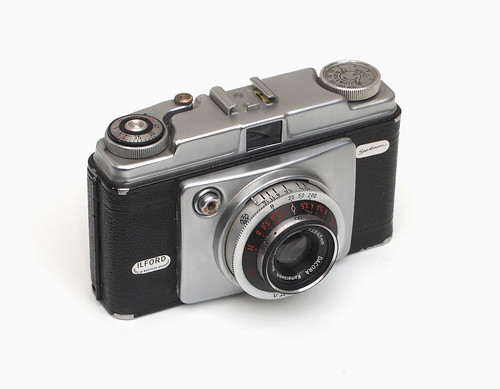
Ilford Sportsman 35mm camera
For the purpose of taking photographs for my post on the history of Ilford Limited in Ilford, I wanted to use an Ilford camera. Perhaps described as the lower end of the middle market, the Ilford Sportsman is a little more sophisticated than a simple point and shoot camera: Ilford's competition in the domestic market at the time was the Kodak Retinette (specifically, the first Sportsman model looks very similar to the Kodak Retinette Type 022 model) and the Agfa Silette. As was the case with all Ilford-branded cameras (which continues with the current Titan cameras, made by Walker), Ilford didn't manufacture the Sportsman: it is a rebadged Dacora Dignette, a German-made rigid-body 35mm camera. Peter Wallage's page about the Sportsman gives a good potted history of Ilford entering the mid-priced 35mm camera market after the Second World War, following problems with their expensive high-specification Witness camera and the moderately more successful Advocate.

This model is the earliest iteration; later Sportsman/Dignette cameras had larger viewfinders, then rangefinders, and selenium cell lightmeters. The camera is of all metal construction, the main section of the solid body appears to be cast, while the top plate and lens/shutter housing are stamped. The lens is a 45mm f3.5 Dacora Dignar, in a Gauthier Vario 3-speed shutter, with speeds of 1/25th, 1/50th, 1/200th and 'B'.  The lens focuses down to 3 1/3 feet (for export Dacora simply converted their existing markings in metres to feet), with a depth of field scale around the lens. There is also a PC socket for flash and an accessory shoe on the top plate.

Ilford Sportsman top view
The film counter is built into the rapid advance lever, this counts down, and needs to be set manually, with figures 'A' and 20 marked in red. There is also a film reminder dial set into the top of the rewind knob: half of this dial is marked for black and white with film speeds from 25 to 400; for colour the other half is marked 'D', 'A' and 'F' corresponding to Ilford's colour films available at the time. The shutter release is positioned on front of body with a screw thread for a cable release.

The Ilford Sportsman was first marketed in 1957 (the Dacora Dignette itself appeared two years earlier); the manual which came with my camera is dated 1958. There are some very minor variations during the production run of the first body style, notably in the badging: the earliest versions had the word "Foreign" stamped into the leatherette underneath the Ilford name printed in white. This was then replaced by a small metal badge with 'Ilford' and "Made In Western Germany". In 1959 a new version of the Sportsman/Dignette appeared with a redesigned top incorporating a larger viewfinder, a change common to the design of cameras in the late 1950s (a contemporary example being the Vito B, with a larger viewfinder in its 1959 variant).

An interesting curiosity about the Sportsman's Dignar lens is that, although the smallest aperture marked on the camera is f16, the aperture lever goes further, perhaps to f22. The Dacora version of the camera was also available with a faster f2.8 lens. Obviously the aperture lever needs to travel further for the f2,8 lens and as the camera body housing has the same length slot for this lever, with f3.5 as the widest aperture, the slot is wide enough for the aperture lever to move further in the other direction, i.e. to a smaller aperture setting (this is a speculative explanation as I do not have a Dacora Dignette for comparison). The two images below were shot at f16 and the smaller aperture. From the results, any benefits of increased depth of field are offset by the increased and very clear vignetting.

Exposures of one second at f16, left, and the smaller aperture, right
Despite the pleasures the Sportsman's simplicity of operation, the Sportman's Dignar lens' performance is fairly undistinguished: relatively sharp in the centre at smaller apertures, there is vignetting, and, especially towards the top right hand side of the images, the focus falls off, and in some of the images at wider apertures this is very intrusive, like the first photograph below. This looks like distortion caused by the lens plane not being entirely parallel to the film plane, essentially a tilt effect. The lack of choice of speeds with the Vario shutter is limiting, and eccentric: a 1/100th speed would have been useful in terms of determining exposures; 1/200th was simply too short an exposure with the slow films I've used with the Sportsman for this blogpost.

Sample image on Ilfodata HS23
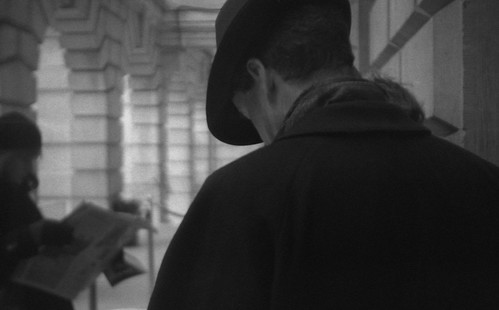
Sample image on Ilford Mark V film

Sources/further reading
Ilford Sportsman on Photomemorabilia
Peter Wallage's Ilford page
Ilford Sportsman on Camera Wiki
Dacora Dignette on Lippisches Kamera Museum (in German)
Ilford Sportsman in Sylvain Halgand's collection (in French)

Thursday, 28 March 2013

The MPP Micro-Technical Camera

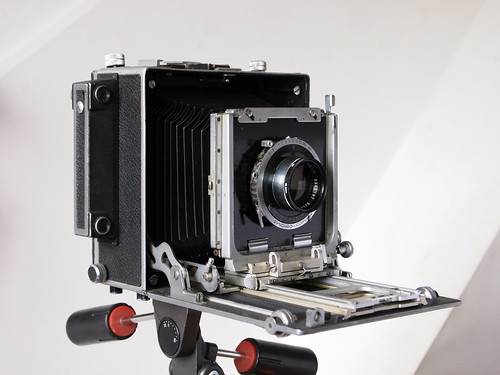
MPP Micro-Technical Mark VIII with Schneider Kreuznach 150mm f4.5 lens
In the latter half of the 20th century there weren't many UK-based camera makers of note: companies like Ensign Ross and AGI failed to capitalise on their expertise with medium format cameras and follow consumers into the 35mm market, and as a result disappeared by the start of the 1960s. One exception was Micro Precision Products, which became MPP Photographic Products Ltd, which, as the name suggests, produced high-quality cameras aimed at the professional market. MPP were notable for the Microcord and Microflex TLR cameras based on the Rolleicord and Rolleiflex, and its large format cameras, the Micro-Press, and the Micro-Technical camera. The Micro-Technical became the mainstay of many professional photographers in the UK, as well as institutions such as the police and the armed forces in particular: the UK government ordered one S92 camera (a Micro-Technical variant) for every RAF base.

As a result of MPP's homegrown market dominance, for many students of photography in the UK, the Micro-Technical camera was the large format field camera: it seems every university photography department had one in the 1990s and 2000s. My first experience with large format was in asssisting a friend studying in the early 2000s and using the college MPP Micro-Technical camera.

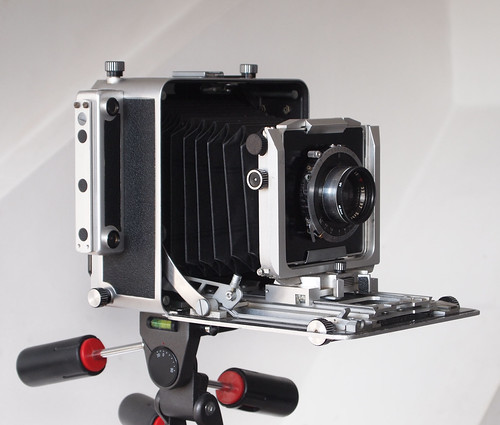
MPP Micro-Technical Mark VI with Schneider Kreuznach 150mm f4.5 lens
I first bought a MPP Micro-Technical Mark VI as an affordable introduction to large format photography after winning a prize for painting. Common to all the Micro-Technical cameras, it's a 4x5 triple extension folding bed camera. The design is essentially that of a field camera, but its designation as a 'technical camera' indicates the nearly full list, albeit limited, of view camera movements ("15 degrees of everything" as I once read on a large format forum). It has a rotating spring back, rise, cross and tilt front movements, a swing front and swing back, and a 15 degree drop front. As a view camera, the ground glass screen is typically used for focusing, but the camera also has a rangefinder with an interchangeable cam assembly for lenses of different focal lengths: my camera came with a Schneider Kreuznach 150mm f4.5 Xenar lens, which must be original, as the lens' serial number matches that etched on the rangefinder cam. The serial number dates the lens to 1952-54, which fits neatly within the production dates of the Mark VI body, 1951-1956. There are also interchangeable focus scales on the drop bed: my camera has scales for 150mm, 135mm, and 89mm lenses. Both the rangefinder and focus scales can only be used when the camera back is flush to the body of course: with any back movements (and, ideally, any movements), the ground glass screen must be used to focus the camera.

MPP promotional leaflet showing Micro Technical Mark VIII camera movements
Shortly after buying the Micro-Technical Mark VI, I came across an auction listing for a Micro Technical Mark VIII body, which had a couple of fittings broken or missing, and a missing hood for the ground glass, but at just over £100, this seemed rather good value. The Mark VIII was the last of the series of Micro Technical cameras, produced from 1963 until the company wound up in the 1980s. The camera body and lensboard were redesigned from the Mark VII, which had retained much of the Mark VI design (the rounded corners to the body with more exposed metal make the Mark VIII design a little reminiscent of the Kern Bijou). As well as the body, the lensboard was also redesigned: the Mark VIII board is smaller with rounded corners, meaning earlier Micro Technical lensboards are not compatible with the Mark VIII body. Improvements from the earlier body styles are that the drop bed now has two positions, at 15 and 30 degrees and it also has an additional tripod bush on the side of the body. Both Mark VII and Mark VIII had an international standard back (some Mark VI bodies were retrofitted with an international standard back, although mine has the spring back).
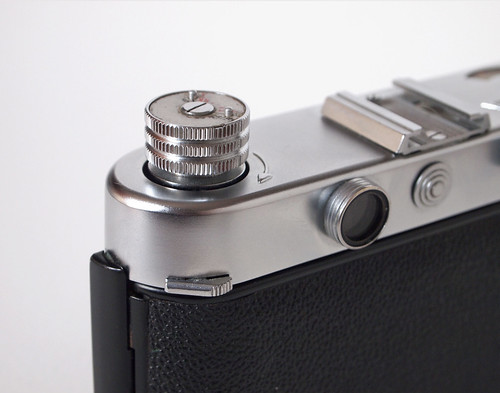
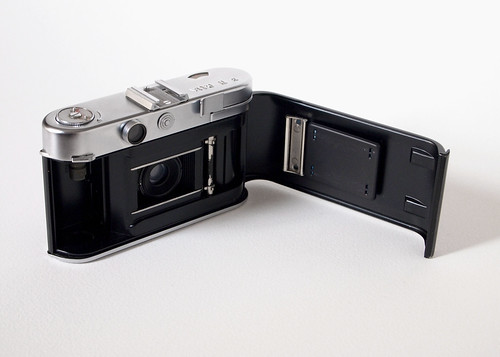
Laser cut 3mm MDF for Mk VII lensboard and replacement front tilt knob
The missing fittings were two knobs that control the front tilt, one releases the lensboard from its perpendicular position, the other secures the angle of the tilt. I replaced the missing knob that secures the tilt, but not the other (it's more complicated to fix), however rising the front sufficiently frees it for tilt movements anyway and it can be lowered it again in a tilted position. To make the replacement knob, I could simply have found a wingnut that would fit the screw thread, but for a more elegant solution, I made the replacement with two pieces of laser cut 3mm MDF, glued to a nut with epoxy resin. I also made new lensboards for my existing lenses to use these with the Mark VIII body: the 150mm Xenar which came with the Mark VI body had a lensboard to match, and I'd subsequently bought a 90mm Angulon lens which also had a Mark VI-style board. The new lensboards were made from the same laser cut MDF, two sheets glued together with wood glue, painted with matt black acrylic, and varnished on the front only, the inside face left matt of course.

MPP Micro-Technical Mark VIII with 'homemade' lensboard
Other than the international standard back, the additional drop bed position and tripod bush already mentioned, the main advantages of the Mark VIII body over the Mark VI are that its construction appears more solid and sturdy, exuding confidence when using the camera movements: parts seem to lock into place more securely, and the vibrations caused by actions such as inserting and changing film holders feel less likely to upset carefully positioned tilts and shifts. However, my Mark VIII body is currently awaiting further repair as the locking bolts for the drop bed are both jammed, and I have been using the Mark VI again, and it's the camera I've been using for my recent large format posts on this blog.

Harman Direct Positive Paper, Schneider Kreuznach 150mm Xenar lens
Adox Ortho, Schneider Kreuznach 150mm Xenar lens
Adox Ortho, Schneider Kreuznach 90mm Angulon lens
Kodak Ektar 100, 150mm Xenar lens. Image courtesy Sarah Wishart:
taken with my Mk VIII camera, shown here to demonstrate 'tilt-shift' effects
(specifically, diverging front and rear tilts)
Sources/further reading
The MPP Users' Club
MPP on Camera-Wiki
The MPP Micro Technical group on Flickr

Friday, 15 March 2013

An Experiment with Three Colour Photography

The principles of colour photography are almost as old as photography itself, a three colour process being described by James Clerk Maxwell in 1855, and first demonstrated by Thomas Sutton under Maxwell's direction in 1861. James Clerk Maxwell's method was simple: using black and white emulsion, make three separate exposures with red, green and blue filters. The three photographs were then combined through an additive colour process, by projecting lantern slides of each photograph through the same red, green and blue filters, aligning the projections to create a colour image. This process became more successful when panchromatic emulsions, able to represent the whole spectrum of visible light, emerged around 1900. The most celebrated proponent of this technique was Sergey Prokudin-Gorsky, who documented the Russian Empire before the First World War. The three colour technique was superseded when a convenient, consumer-level colour photography was developed by a number of manufacturers, notably Kodak, during the 1930s with integral tripack colour films.

However, there has been renewed interest in the three-colour process in recent years, in part due to digitisation which makes for easy display of the images so produced. There's a large group on Flickr using the technique, commonly dubbed 'trichromy'. For my first attempt at this technique, I decided to take the approach of making it more difficult than it needed to be by using large format. With taking three separate exposures, I was aware that movement between the images would create ghosting: it would have been quicker to shoot three images in succession on rollfilm, and to shoot more of them, but the challenge of working with large format appealed to me.

Kodak Tri-Colour Filters
To take the photographs, I used my MPP Micro Technical Mk VI camera with Fomapan 400; I had a number of filters which came with a large format lens I'd bought, including a tri-colour set. I took three shots with the RGB filters, using the unsophisticated method of simply holding these over the lens (I took the blue image twice, as I was concerned that the first shot wasn't sufficiently shaded from the oblique sunlight; I also shot it on a glass plate for good measure). The negatives were developed in Rodinal diluted 1:50, for 11mins at 20ºC.

Red, green and blue exposures
Scanning the large format negatives was complicated by not having a scanner capable of taking 4x5 sheet film: I had to scan each negative in two halves. To begin with, I attempted to stitch the two halves of each negative together, and then combine them, but this led to problems with registration across the image, so instead I composited the top and bottom halves of the image separately, then stitched these together. To make the colour image, I used Photoshop to combine the three separate grayscale images by pasting each into a separate channel of a new file in multichannel mode, stacking the channels in the order of red-green-blue, then changing this image mode to RGB.

Uncropped RGB Composite
Despite taking all four exposures as rapidly as possible, I did realise that the movement of clouds in the sky would cause ghosting in the image; what I hadn't expected was how apparent the movement of the shadows is. With the three colour process,  movement between each exposure causes these ghosting effects, making it more appropriate for using with still subjects. Cameras were designed around this problem, initially with backs that could expose three plates in quick succession, followed by dedicated colour separation cameras, which used beam splitters to expose all three plates at same time, such as the Bermpohl Naturfarben Kamera.

RGB Composite
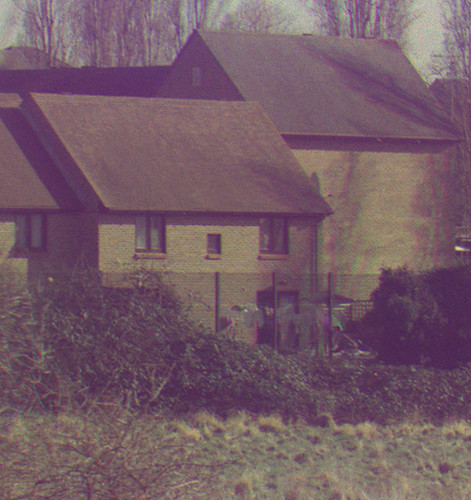
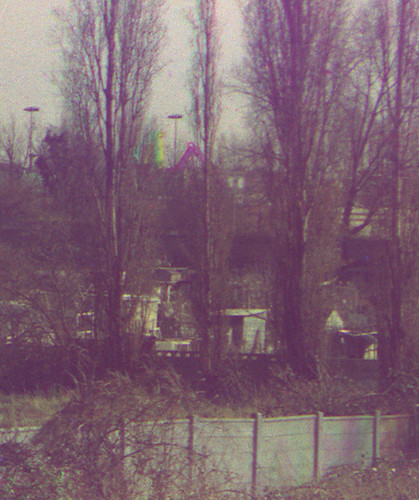
Rather than adjusting the colours in RGB, I made adjustments in each channel separately, feeling that this was more appropriate to the enterprise. The image as a whole suffers from being scanned in sections, leading to the colour being patchy and uneven, yet it works. As I've shot the image in large format, it's possible to look at some details at 100% of the 1200 dpi scan. In the detail of the houses which have reproduced well, the shadows of the trees show colour fringing, which could be due to the movement of the sun, but on reflection it's more likely to be wind in the trees. In the second detail below, looking across allotments to the recycling centre, the arm of a JCB is visible in three different positions, in three different colours.

Detail of houses in the upper left

Detail of JCB movement


Sources/further reading
Wikipedia entry on Colour Photography
James Clerk Maxwell and colour analysis on Wikipedia
Sergey Prokudin-Gorsky in the Library of Congress
Three-Color Camera on Camera-Wiki

Thursday, 7 March 2013

Voigtländer Vito IIa

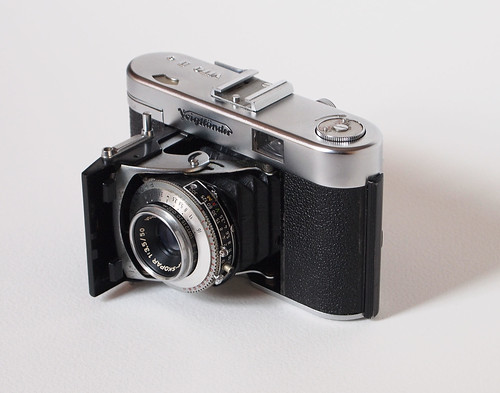
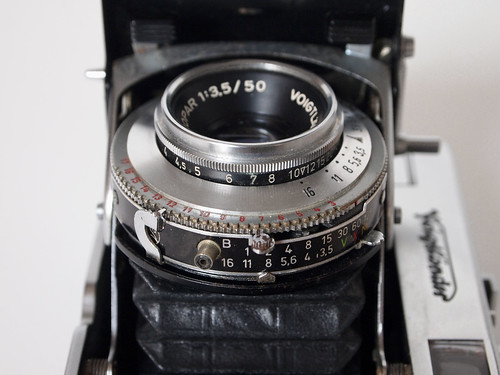
Voigtländer Vito IIa
Reputedly the last folding 35mm camera in production, Voigtländer's Vito IIa was just one of many cameras the company produced bearing the Vito name. Introduced in 1955, the Vito IIa was a refinement of the Vito II, which itself improved on the original pre-war Vito (the Vito III was an altogether different rangefinder model). The Vito cameras also have specific model numbers to identify changes made to the cameras during production: my example is a Type 135/99. The Vito IIa's production run overlapped with the rigid bodied Vito models which superseded the folding models: concurrent to the Vito IIa was the Vito B, essentially a non-folding version of the camera, based on a very similar body, lens and shutter. (Although one suspects that folding cameras were more complex and therefore more expensive to make, which led to their disappearance in the market of 35mm cameras, interestingly, both folding and rigid bodied Vito cameras appear to have cost the same however, and the Vito B also offered the option of a faster lens). Common to the family of Vito cameras was the Color-Skopar lens. The original Skopar was Voigtländer's version of the Tessar; the Color-Skopar, as its name suggests, was the post-war coated version. The folding Vito cameras all have a f3.5 Skopar or Color-Skopar 50mm lens.

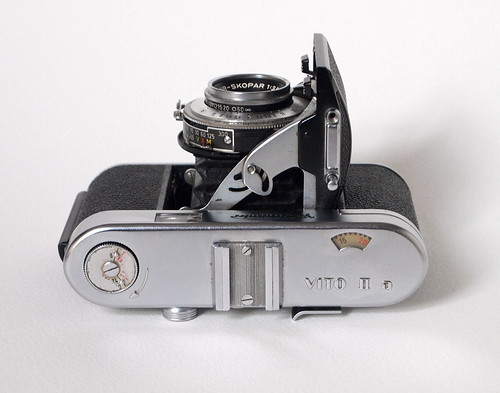
Top view
The improvements from the Vito II were not sufficiently groundbreaking to warrant an entirely new name for the camera: the significant changes are across the top plate of the camera, the Vito IIa gained a rapid advance lever, a rewind knob that's recessed into the top plate and an accessory shoe. The rewind knob pops up when it's released by a lever below to rewind the film. Releasing this when loading the camera also allows the button next to the viewfinder window to advance the film counter, which doesn't reset automatically.

Rewind crank, released by the lever below;
film counter reset button on right hand side of viewfinder
The camera opens by depressing a recessed button on the bottom plate. There's a small metal prop on the bottom of the door which functions as a stand when the camera is on a flat surface. Unusually, the shutter release and cable release socket are located on the top edge of the door, not on the top plate itself, an evolution from the original Vito's unusual bar release. In my experience, this provides a more comfortable position holding the camera, with the forefinger forward on the shutter release. To close the camera, there are two tabs inside the door which need to be pushed down at the same time. Loading the camera, the back opens with a sprung latch that runs the height of the camera back on the left hand side. There's a double-exposure prevention which releases when the film is advanced; this also prevents the shutter firing if there's no film inside, although in the shutter can still be cocked. The interlock depends on the roller with sprocket teeth being turned, which can be done manually without a film of course, to fire the shutter when the camera isn't loaded, to check the shutter, exercise it and so on.

Camera opened for loading
The serial number on my camera dates the lens to 1958, which appears to be the last year of the Vito IIa's production. The other features that date it to the end of the Vito IIa's production run are the Prontor SVS shutter (it was also offered with the cheaper 4 speed Pronto shutter) with a new style run of shutter speeds - 1, 2, 4, 8, 15, 30, 60, 125, 300 (rather than 25, 50, 100 for example) and it also has a light-value (LV) system built into the shutter. This is a mechanism which links the shutter speed and aperture together by an arm which extends from the aperture ring to connect with teeth along the edge of the shutter speed ring. These settings are numbered (the red numbers in the picture below), and these would have related to numbers on exposure meters, meaning that the aperture and shutter speeds can be changed in sync to give the same exposure. In practice the LV mechanism is fairly easy to ignore when setting the aperture: simply by pulling the arm outwards when selecting an aperture disengages the connection, however to do this when setting shutter speed does need two hands. This doesn't seem to be an especially useful function now, but it was clearly an innovation at the time. The shutter also has PC flash sync and a V/X/M switch: the X and M settings are for flash, X for electronic flash, M for bulbs. The V setting is for a self-timer, missing on my camera.

LV mechanism around lens
Focus is by estimation: there are markings on the distance scale around the lens between 10 and 12 feet (a triangle, presumably for group shots) and between 20 feet and 60 feet (a circle for distance shots). When folded, the Vito IIa has a streamlined profile, if somewhat compromised by the accessory shoe, and, although it's not much smaller than the Kodak Retina for example (obviously it has no rangefinder), its rounded edges make for a more pocketable camera, or at least make it easier to get in and out of a pocket. In the examples below, the first shot on Ilfodata document film is a good demonstration of the sharpness of the Color-Skopar lens; the third shot below was a long exposure taken without a tripod by standing the camera flat on a low wall.

Sample image on Ilfodata HS23
Sample image on HP5 Plus rated 1600 EI
Sample image on FP4 rated 64 EI
Edit 19/2/20: Further examples

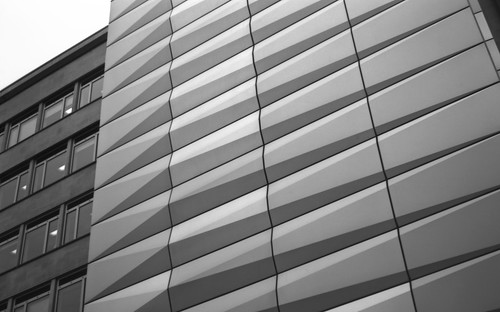
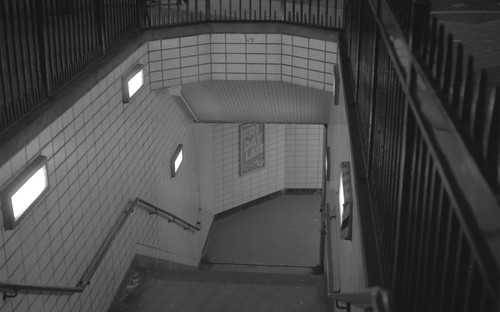
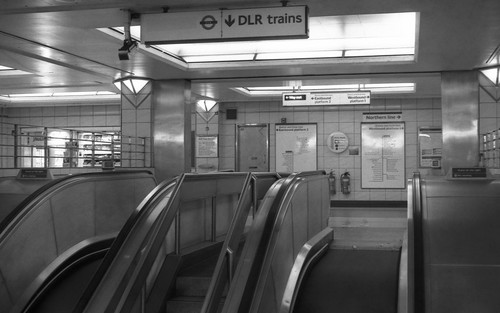
Voigtländer Vito IIa with Ilford Mark V Motion Picture Negative Film
Voigtländer Vito IIa with Ferrania P30 Alpha
Voigtländer Vito IIa with Ilford Pan 100
Voigtländer Vito IIa with Foma Retropan Soft rated 650

Sources/further reading:
Vito IIa on Mike Elek's Classic Cameras
Vito IIa in Hans Lißberger's Voigtländer Collection (in German)