Showing posts with label Kodak HC-110. Show all posts

Sunday, 4 February 2024

127 Day January 2024

Kodak Baby Brownie with Fomapan 200

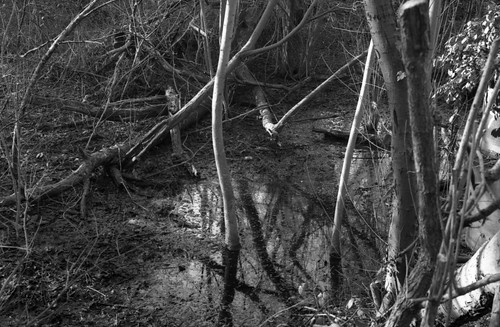
Last weekend's 127 Day provided an excuse to use the Kodak Baby Brownie, the subject of my previous post. I had cut down two rolls of medium format film to 127 size and rolled these with the appropriate backing paper and spools: one roll of Kentmere Pan 400 and one of Fomapan 200. I shot the Kentmere Pan 400 first, then the Fomapan 200, but developed them in the reverse order. The lighting conditions had been light cloud giving way to hazy sunshine. When I took the roll of Fomapan 200 from the tank, the negatives looked very thin, something that I had noticed with the film shot in the Baby Brownie last summer. With hazy sunshine, and a nominal exposure of 1/50th at f16 (or however close to this the Baby Brownie's aperture and shutter speed are), a 200 ISO film should have given adequate results. Although a stop faster, given that the lighting was perhaps a little less bright for the Kentmere Pan 400, I extended development time to push it another stop. 

Kodak Baby Brownie with Kentmere Pan 400

The results from the Kentmere Pan 400 were much denser, and this push was probably unnecessary. I had used Kodak HC-110 for both films; a little research online reveals lots of comments about Fomapan 200 and HC-110 not being a good combination. I had used the times from the Massive Dev Chart, and when subsequently developing another roll of Fomapan 200 (not from the 127 Day), I pushed this a stop, and the results were much better (it would probably be preferable to rate the film a stop lower instead however).

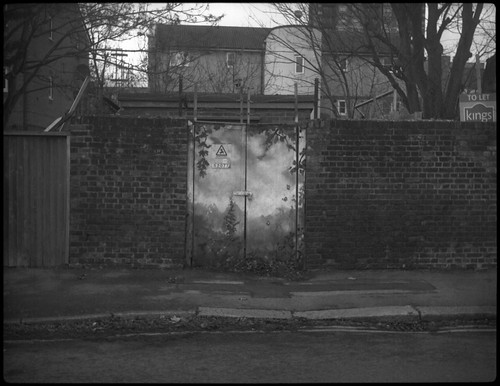
Another aspect of using the camera again was checking the lens' angle of view.I had suspected that this was wider than the viewfinder–probably to give the casual user a margin of error not to lose heads from the top of the frame–and took a couple of photographs with this in mind, particularly the one below. Here the shot was framed with the second pillars from the centre at the edge of the viewfinder, demonstrating that the actual shot is notably wider than what the viewfinder does show, although one wouldn't chose a Bakelite box camera from the 1930s or 40s if accuracy was really important, but worth bearing in mind.

Kodak Baby Brownie with Kentmere Pan 400

I had a few problems with development thanks to the slightly uneven cut edge of the film: the Kentmere Pan roll was a little taller once cut to fit well into the developing spiral, causing a little buckling and a few section of negatives not processing properly due to contact while developing. This also created a bit of a 'fat roll' with some light leaks as a result. By contrast the Fomapan cut much more smoothly, but scratched more easily in the process of being cut down, due I think to the emulsion being softer, and possibly the film substrate too. The thin negatives of the Fomapan film in combination with the choice of subject–as in the image at the top of this post–was vaguely reminiscent of Pictorialist landscape work, something not entirely unsympathetic in the use of a camera such as the Kodak Baby Brownie.

Kodak Baby Brownie with Kentmere Pan 400

Kodak Baby Brownie with Kentmere Pan 400

Kodak Baby Brownie with Kentmere Pan 400

Kodak Baby Brownie with Fomapan 200

Kodak Baby Brownie with Fomapan 200

Kodak Baby Brownie with Fomapan 200

Saturday, 25 February 2023

Lomography Fantôme 8 - single roll review

Lomography Fantôme 8 35mm film

Approaching two years ago at the time of writing, I posted a short 'single roll' review on the Lomography Berlin Kino 400 film. This had been one of the rolls of film that I had won as part of the #ShittyCameraChallenge prize (sponsored by David Walster - @196photo on Twitter), four different rolls of 35mm black and white film, all of which were new to me. One of the other rolls was Lomography Fantôme 8; like the other Lomomgraphy film, the box has the description '35mm KINO film', but unlike the 'Berlin' film, Fantôme 8's origins are not those of a camera film, used to generate a negative–which its low ISO of 8 indicates. According to Alex Luyckx, Fantôme 8 is Orwo DP31. Orwo's data sheet describes it thus:

ORWO duplicating positive film DP 31 serves as a film for the production of intermediate positives (master positives). Due to is panchromatic sensitisation this film can be used for duplicating from black & white negatives as well as from colour negatives producing well-balanced grey values referring to original colours. Special features of this film are the excellent resolving power and the extraordinary fine grain

As a very low ISO film, I had been anticipating that I'd want to use the roll of Fantôme 8 for something specific which would take advantage of its particular characteristics, rather than 'everyday' film photography. Last week I wanted to make an interpositive to create a print in negative from a negative, and naturally thought of the Fantôme 8 for precisely the qualities the data sheet describes (this, incidentally, was for the Undertow exhibition). I shot half the roll and developed it as needed, then decided that I may well as well find the time to use the remainder of the film. For the purposes of making the interpositive, I used a tripod and my Canon A-1 SLR; at 8 ISO, there are few situations in which hand-holding a camera with Fantôme 8 is practical, but I did expose a couple of frames hand-held, both of which were with the lens wide open at f1.8 and a fairly slow shutter speed. The second image below was at 1/20th, which will have probably introduced a small amount of camera shake, leading it to be less sharp as a result; the first image, silhouetting bare branches against a bright sky at a medium distance was rather easier 

Canon A-1 with Lomography Fantôme 8

Canon A-1 with Lomography Fantôme 8

The first image above was shot on the end of the half of the roll I had used first, and the high contrast of the image was fairly evident. I used Kodak HC-110 at dilution H, 1+63 from concentrate, with a time of 14 minutes at 20ºC (the Orwo data sheet, unsurprisingly for a motion picture film, gives D96 as a developer). The film has probably the clearest base of any I've used–and was also extremely curly once developed. Having used half the film first, and assessing the results, this gave me an idea of how to approach using the remainder of the film. Thanks to its high contrast, in terms of subjects, for most frames I avoided including much or any sky in the composition, concerned it would render almost entirely bright and featureless (as a panchromatic film, it would have been possible to use a yellow filter); the image below was one of the few with a significant area of sky in the frame.

Canon A-1 with Lomography Fantôme 8
I may have been cautious in this, but the few frames with bright sky and bare branches silhouetted against it brought up a different problem in scanning: the clear base introduced a form of halation in the  scanning of the negatives, with the light of the scanner passing through these clear areas and reflecting back inside the scanner. This is an effect I've noticed with a few other films, but this was particularly intrusive here. In the image below it is a rather disruptive artefact of the scanning process; I imagine that darkroom printing would not have the same problem.

Canon A-1 with Lomography Fantôme 8

Close-up crop from scan

Given Fantôme 8's characteristics, I had hoped for overcast weather conditions for photographing, not uncommon here in February, but instead I found it was an afternoon of intermittent, if hazy sunshine. To lessen the high contrast of the film, using the Canon A-1, with its double exposure capability, on a number of frames, I was able to use the technique of pre-exposure to raise the shadow values. To do this, I first shot a frame of a grey card without focussing three and a half stops below the camera's indicated exposure, then pushed in the multiple exposure switch before engaging the film advance, which, with the multiple exposure switch engaged, simply cocks the shutter without moving the film. After development, the frames which had pre-exposure were easily distinguishable on the negatives, although in scanning, with many frames the differences were not as great as I might have expected.

Canon A-1 with Lomography Fantôme 8
Canon A-1 with Lomography Fantôme 8 and pre-exposure
The most successful use of this technique is demonstrated in a pair of frames in which the subject was the low winter sun reflecting of a puddle, with the surroundings otherwise in shadow, which wouldn't be a subject easy to expose for a film with greater latitude: the pre-exposure here opens up the shadow detail just enough to define the landscape which becomes a little lost in the first image, where more exposure would lose detail in the highlights.

Canon A-1 with Lomography Fantôme 8
Canon A-1 with Lomography Fantôme 8 and pre-exposure
A better test would be to print from these negatives in the darkroom, to be able to properly appreciate the difference the pre-exposure has made. However, for some of the images here, it does appear to have benefitted the negatives. As a general preference, longer tonal scales in negatives I find easier to work with (which was, in part, the frustration I felt with Ferrania P30); for many or most subjects it's a general look that I prefer, and, as a technique, using pre-exposure with Fantôme 8 here has softened some of the film's particular qualities. Many of the examples of the film that I've seen online play on these high-contrast qualities, and, had I been wanting that look, and found subjects appropriate for it, Fantôme 8 would have been ideal: I do feel that I found it a bit more flexible than I had anticipated. With the some of the compositions in which I was mindful in not including the sky, I found that there was something–a little–of the 'ungrounded' quality of some of Muybridge's photographs of Yosemite (on a much less grand scale of course) which I had been looking at again recently, in which the lack of a horizon or discernible foreground places the viewer in an uncertain relation to the scene depicted. Having used the film initially for a purpose not dissimilar to its original usage, then, finding the right subject matter and an appropriate technique for the film's limitations, I found myself liking Lomography Fantôme 8 rather more than I had expected to.


Sources/further reading

Sunday, 29 January 2023

127 Day January 2023

Baby Ikonta with Kentmere Pan 400
Last Friday was the first of the year's calendrical 127 Days, and I had time during the early afternoon to expose a roll of cut-down Kentmere Pan 400 in the Zeiss Ikon Ikonta 520/18–the 'Baby Ikonta'–a favourite for its small size, relatively good Novar lens and Compur shutter. I used cut-down medium format Kentmere Pan 400. The weather was mostly overcast, and having a 400 ISO film certainly fitted the lighting conditions typical this time of year in the Northern hemisphere. Even then, in a few situations, such as under the dense branches of bare trees, the light levels were pretty low, and I didn't accurately guess-focus as accurately as I might in a few frames, with the aperture wider than I might have liked to provide little assistance in careless focussing. Developing the film in Kodak HC-110 (at dilution E, 1+47 from concentrate) provided low contrast negatives, no doubt compounded by the uncoated Novar lens of the Baby Ikonta, some flare in a few frames (such as in the second image below), on top of the lighting conditions. In retrospect, a one-stop push might have benefitted both the contrast, as well as being able to use a smaller aperture in some situations. However, regardless of the results of this one roll, having an inexpensive 400-speed film newly available in medium format is ideal for the purposes of being cut down to 127 size–a rather cheaper alternative to the few films currently available in the niche 127 rollfilm format, which, somehow, still survives in 2023.


Monday, 12 December 2022

127 Day December 2022

Baby Ikonta with cut-down Rollei Superpan

Despite neglecting this blog for a few months now, I couldn't not observe last week's 127 Day. I used the Baby Ikonta again, but had just a couple of rolls of Kodak High Resolution Aerial Duplicating film cut to 127 size, and a short off-cut from a previously-cut-down roll of Rollei Superpan 200 (when cutting down 120 film to 127, the length of the 120 roll is longer than that needed for 127, meaning that with every cut down roll of 120, there's a remainder of film long enough for 5-6 'half'-frames on the '16-on' format); the image above is from the beginning of the short roll which shows that I hadn't accurately lined up the cut end of the film with the start of the numbers on the backing paper. The frames on the Superpan film were hand-held; the Kodak High Resolution Aerial Duplicating film when used as a negative film has a workable ISO of 2. I took most of these photographs in the Victoria & Albert Museum, without a tripod, placing the camera on any level and stable surface I could find that might provide an interesting viewpoint, mostly parapets and benches. I did take one frame, handheld outside, at (I think) 1/10th at f3.5 (the image of Second World War bomb damage to the museum's exterior; another photograph taken outside with this film was made placing the camera on a brick wall).

Baby Ikonta with Kodak High Resolution Aerial Duplicating film

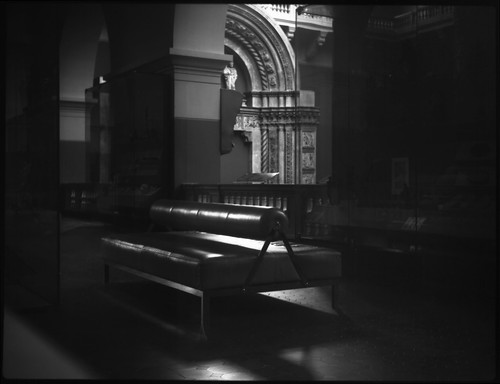
On a winter's day, the light levels in the museum are often quite low: exposure times were between 8 seconds and approximately 1 minute. When I developed the film using PQ Universal, it was clear that I could have bracketed more, and, possibly at longer times, the film does exhibit some reciprocity law failure. Scanning the negatives, there was a lot of digital 'spotting' to do: the extremely clear shadow areas show up any specks of dust or dirt incredibly well. The blue-sensitive high-contrast nature of the film also shows how the daylight entering the galleries from skylights caused the floor appearing in some of the frames to appear very bright in comparison to almost everything else in the image, with the exception of some of the plaster casts (such as Michelangelo's David). 

Baby Ikonta with Kodak High Resolution Aerial Duplicating film

There was also a denser band along one side of one roll of this film, which I haven't found the cause of, but this may be fogging due to cutting the film down by hand under safelights in an insufficiently-dark darkroom, with something partially shading the film. I did think that this could be due to not using enough chemistry when developing, but usually this would show up as a pattern with the image of bubbles from the surface of the developer. This line can be seen to the left of the cast of the architectural façade in the image below.

Baby Ikonta with Kodak High Resolution Aerial Duplicating film

The Kodak High Resolution Aerial Duplicating film may also have benefitted from flashing before exposure to raise the shadow values, perhaps something to remember for January's 127 Day. The Rollei Superpan film was less problematic (despite not being taped at quite the right place to the backing paper), but I did use Kodak HC-110 to develop the film, having previously tested this with Rodinal, and worked out a time/temperature/dilution regime to get the best results for my own approach, which I haven't done with HC-110, merely taking the Massive Dev Chart's single recommendation: 6 minutes at dilution B, 1+31 from concentrate.

Baby Ikonta with Kodak High Resolution Aerial Duplicating film

Baby Ikonta with Kodak High Resolution Aerial Duplicating film

Baby Ikonta with Kodak High Resolution Aerial Duplicating film

Baby Ikonta with Kodak High Resolution Aerial Duplicating film

Baby Ikonta with Rollei Superpan 200

Baby Ikonta with Rollei Superpan 200

Baby Ikonta with Kodak High Resolution Aerial Duplicating film