Showing posts with label Panchro-Royal. Show all posts

Friday, 18 March 2016

Expired Film Day 2016

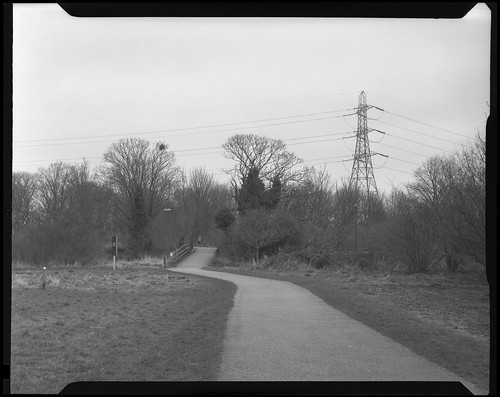
Kodak Plus-X, develop before date of July 1972
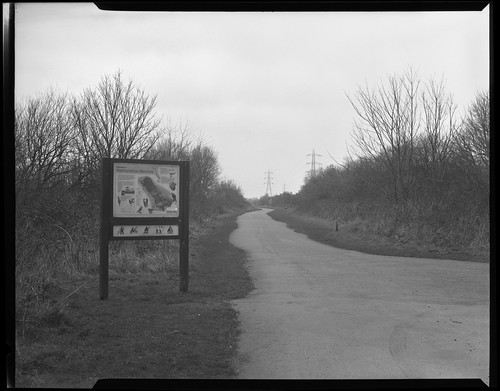
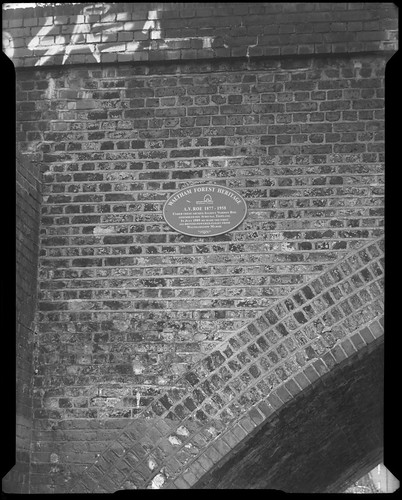
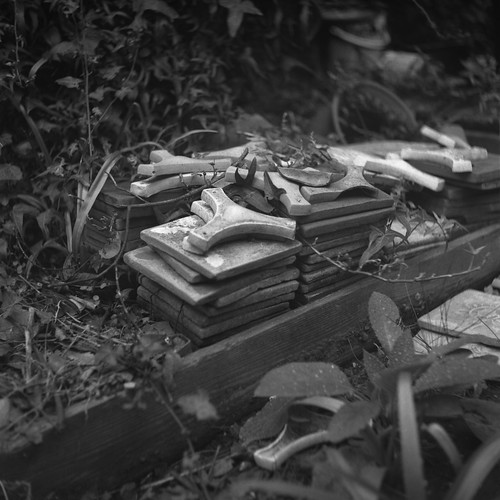
Having missed the last couple of 127 Days for a variety of reasons, on the 15th this week I participated in the new Expired Film Day ('Take Your Box Camera To Play Day' also happens to be this weekend, 18th-20th March). I frequently use decades-old photographic emulsions, notably in glass plate night photography. I did consider shooting some glass plates on the day, but instead, as part of an unrelated ongoing project of large format photographs around Walthamstow Marshes, I used the opportunity of Expired Film Day to shoot some 4x5 sheet film with the MPP Micro-Technical Mk VI: a box of Ilford FP4 with a hand written date of 11/4/78; Kodak Plus-X with a develop before date of July 1972; and Kodak Panchro-Royal, not dated, but the box looks older than the Plus-X, possibly 1960s. I had previously tested all three films to get a usable exposure index: the FP4 was rated half box speed, while the other two were shot at an exposure index of 25.

Ilford FP4, with handwritten date 11/4/78
Both the FP4 and Plus-X provided results which do not look like forty-year old film (and as such wouldn't win the Expired Film Day prize categories 'Most Obviously Expired Film' or 'Best Use of Overexposure'), but the Panchro-Royal clearly shows characteristic deterioration with age. I used both the 16.5cm Tessar and the Bausch & Lomb Rapid Rectilinear which I've written about in the post Old Lenses; the Rapid Rectilinear is the oldest lens I have, and so it seemed appropriate to use it for the day.

Kodak Plus-X, develop before date July 1972
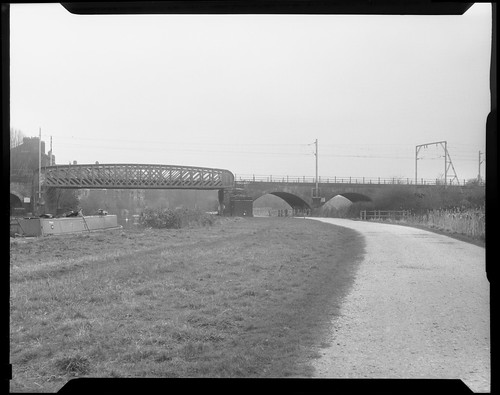
Kodak Panchro-Royal sheet film, possibly 1960s
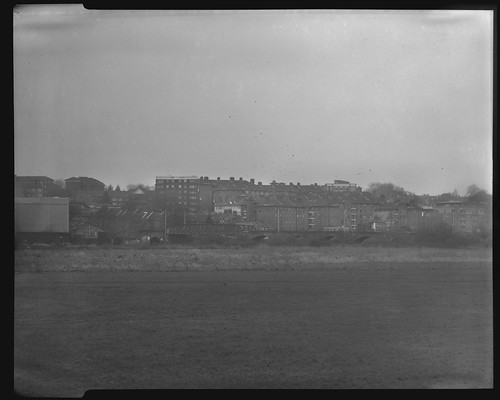
There's very little information on Kodak Panchro-Royal online, and this gave the worst performance of the three films I shot (the FP4 and Panchro-Royal came from the same collection of photographic material, and may - or may not - have been stored in the same conditions). As well as having much more obvious fog, it also suffered from a good deal of cusping, the film being far from flat, and this made scanning more difficult. Some of the shots were taken using only the rear elements of the Rapid Rectilinear lens, as described in Old Lenses, as the Panchro-Royal image above, and the shot below on Plus-X. All the sheet film was stand developed in R09 One Shot diluted 1+100 for one hour, partly due to developing all the films together, but some unevenness was evident in the development discernible in the featureless skies of most of the negatives.

Kodak Plus-X, develop before date July 1972
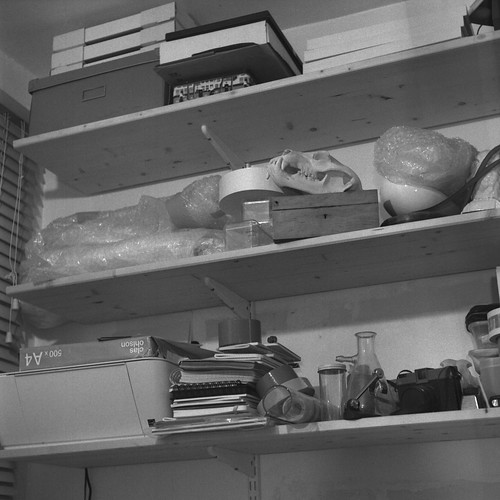
In addition to the sheet film I also finished a part-used roll of medium format Kodak Plus-X, which had a develop before date of 03/2006 - a neat ten years out of date. This was exposed at box speed and developed in R09 One Shot diluted 1+29 for 9 minutes at 20ºC. Incidentally, I had intended to use this time and dilution with Ilfotec LC29, and only realised my mistake when the wrong developer was mixed and in the tank. However, the times and dilutions being relatively similar, I stuck with the time for Ilfotec LC29, which resulted in perfectly usable negatives.

Medium format Kodak Plus-X, develop before March 2006


Wednesday, 27 August 2014

A job lot of films and plates


Although I haven't written about my glass plate project recently, other than advertising the talk I am giving next week, I've shot a few plates over the past few weeks, and I have been continuing to look out for boxes of unexposed plates to use. One successful online bid for a collection of plates and paper was remarkable enough for me to write a post last year about it. From that particular box, I've used most of the HP3 plates, in adaptors, notably the 6x10.8cm plates, and some of the Kodak ones, although the Kodak plates were far more deteriorated with age. Since then I've found a few boxes, but yesterday I picked up a job lot of mostly sheet film from the 1960s-70s, with a couple of boxes of plates too. It was an online auction that went for its starting price of £4.99, probably in part to being 'collection only'. Even factoring in the cost of the trip to the coast to pick the lot up, I probably would have paid that just for the two 5x4 inch plateholders on their own. The three unopened boxes of FP4 (150 sheets in total) are promising; although I won't know the condition of the film until tested, I have used several rolls of Ilford FP4 from the 1970s for a couple of the 127 Days with good results.

The contents in full:
  • 3 boxes of Ilford FP4 sheet film, one 4x5 inch, two quarterplate size (3 1/4 x 4 1/4 inch), all unopened, all with the handwritten date "16/11/78".
  • 1 box of Ilford HP4 sheet film, 4x5 inch, previously opened, a handwritten number on the box could read either "4170" or "4/70". Box label has "K66".
  • 1 box of of Ilford Ilfoline IN.5 sheet film, 4x5 inch, previously opened, box printing has "H70".
  • 1 box of Kodak Panchro-Royal 4x5 inch sheet film, unopened, no information on dates
  • 1 box of Kodak Ektachrome Type B 9x12cm colour reversal film, unopened, process before Jan 1969, handwritten date "22/10/68".
  • 2 boxes of Ilford N5.31 Fine Grain Ordinary film, quarterplate size (3 1/4 x 4 1/4 inch), both previously opened, one with the handwritten date "-/10/67", the other "11/3/70"
  • 1 box of R.10 Ilford Soft Gradation Panchromatic plates (3 1/4 x 4 1/4 inch), previously opened, label style of late 1940s-1950.
  • I box of Kodak Kodalith Ortho Type 3 Photomechanical sheet film (3 1/4 x 4 1/4 inch), previously opened, develop before date Apr 1970.
  • 1 boxes of H.P.3 plates, previously opened, label style of late 1940s-1950.
  • 2 MPP 5x4 plateholders.
  • 5 quarterplate holders, four by Klito, one AP, two containing film sheathes or septums.

Wednesday, 29 May 2013

Recent Glass Plate Work - part one

Electricity Substation, MPP Micro-Technical Mk VI, Ilford G.30 Chromatic Plate
Having had some success with using a number of different types of vintage glass plates, I wanted to design a project to use them for. These glass plates are a finite resource, although they do appear frequently in online auctions (photographic plates are still manufactured, but only for very specialist applications, and are prohibitively expensive). So, to use those plates I've already collected, I decided to undertake an ongoing project of urban night photography. There are a couple of examples in my post on Ilford G.30 plates, although it was only when photographing the disused cinema that the idea began to formulate.

Mimosa Porträtyp-Antihalo plate test
With the exception of the Ilford G.30 plates, most of the plates I've used are from previously opened boxes, which does mean that there is a chance that contents may have been exposed to light at some stage in their history. This has only been the case with the Mimosa Porträtyp-Antihalo and Kodak B 40 plates, and it hasn't been all of the plates in the box. The Mimosa plates have nothing to date them securely, but these could be as old as 1930s-40s (the box says these are "Made in Germany" and presumably date from before East and West Germany). I shot a test of these, which did come out with heavy fogging, and a number of Kodak plates. I have been systematically testing the plates in my Icarette L with successive exposures to a get a rough idea of the exposure needed.

Kodak B 40 Fine-Grain Regular plate test
Kodak B.4 Half-Tone plate test
Some of the plates were originally for specialist applications, such as the Kodak B.4 Half-Tone plates, which as the name suggests, are high-contrast; many of the plates are not panchromatic, meaning that they can be loaded under a safelight, useful when there are loose plates in a box, making it easier t to determine which is the emulsion side. The safelight for the B.4 Half-Tone plates is given as 'OB'. Although OB doesn't appear on Kodak's safelight data sheet, all the other 'O' series safelights are yellow. Considering the given safelight for these plates would be yellow, I made a guess that these are blue-sensitive only and loaded the plate under a red safelight. (Given my limited experience of different Kodak plates, panchromatic plates have a 'P' prefix, orthochromatic, 'O', so it would make sense for blue-sensitive to have 'B' - although I have found nothing to confirm this).

Kodak P 300 Special Rapid Panchromatic and P.1600 Panchro-Royal plates
Two previously unopened boxes of plates I've made tests from are Kodak P 300 Special Rapid Panchromatic and P.1600 Panchro-Royal plates. As sealed boxes, these have information sheets inside, useful for the original meter settings and developing times: I've posted the P 300 Special Rapid Panchromatic sheet and the P.1600 Panchro-Royal sheet on Flickr. I've generally been using a starting point of increasing the exposure by 1 or 2 stops for the tests to compensate for the age of the plates, then the succesive exposures provide a more accurate exposure index to shoot with. Although both boxes were sealed, the Panchro-Royal plates have not aged as well as the Special Rapid plates, which are 'tropically hardened': this may or may not have an effect on the longevity of the emulsion.

Kodak P 300 Special Rapid Panchromatic plate test
Kodak P.1600 Panchro-Royal plate test
Shooting them at night adds an extra layer of difficulty and not only in terms of getting the exposure right (I haven't touched on reciprocity law failure). The shot of the ghost train below proved hard to focus, even with the lens wide open at f4.5: the image on the ground glass screen was very dull, simply because the scene was at a considerable distance from any streetlights. Stopping down to f5.6, I calculated a ten minute exposure. Using a smaller aperture with greater depth of field would have meant that the accuracy of focus would be less critical, but this would have given much longer exposure times. The 4x5 G.30 Chromatic glass plates (shot with my MPP Micro-Technical Mk VI camera) are still the best plates I've used, and both subjects using them on this post were well-lit, in terms of night photography.

Branches and Shadows,  MPP Micro-Technical Mk VI, Ilford G.30 Chromatic plate
Concrete Stairwell, Wallace Heaton Zodel with Kodak O.250 plate
Ghost Train, Ica Icarette L with Kodak O.250 plate