Showing posts with label 120 Format. Show all posts

Tuesday, 31 January 2023

Kentmere Pan 400 - part 2


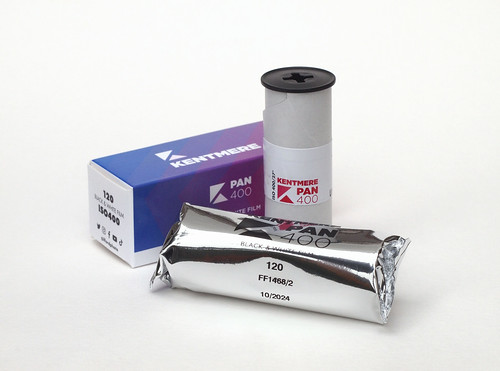
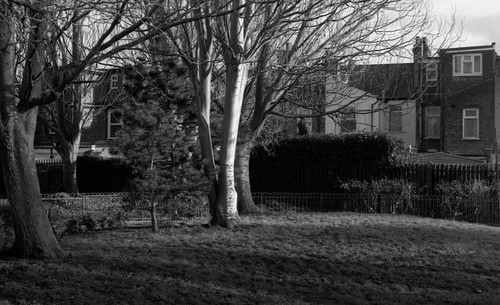
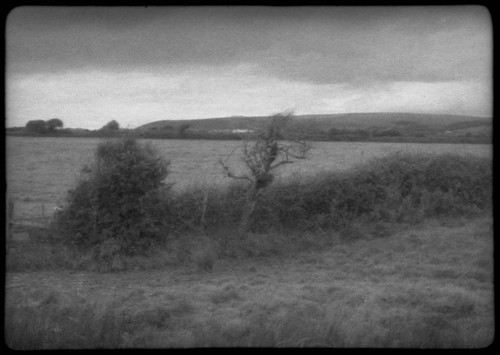
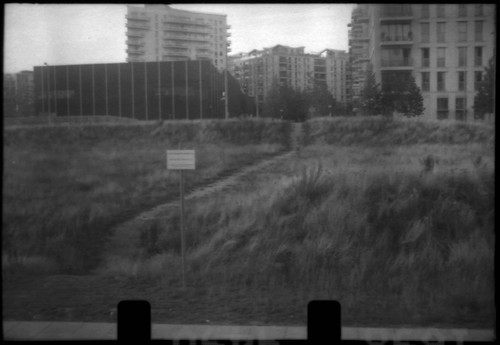
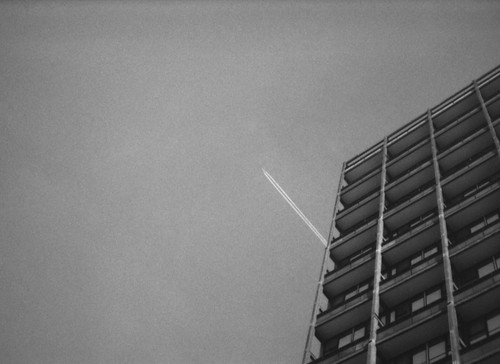
Kentmere Pan 400 in medium format

When I wrote my original post on Kentmere Pan 400 in 2019, it was then available in 35mm only; in December 2022, in a surprise announcement from Harman, the film's manufacturer, that the two black and white Kentmere emulsions were now to be available in medium format, having previously been available in 35mm only. I did write in my original post three years ago that "having been around for many years [Kentmere Pan 400] is unlikely to suddenly be offered in medium and large format, although this is not impossible: Ilford's Ortho Plus film, a niche sheet film emulsion for decades, has just been introduced in 35mm and 120." As described in the recent post on its slower-speed companion, Kentmere Pan 100, there's a logic to Harman complementing their Ilford brand with lower-priced films in medium format, to compete–in particular, it seems–with cheaper films such as Fomapan 100 and 400. The original post on Kentmere Pan 400 was written to compare the film with Ilford Pan 400, which I had been told was going to be discontinued (although at the time of writing, this film is still available), and one can see the logic in rationalising Harman's budget film lines. 

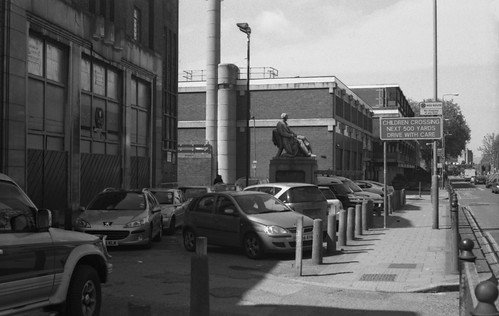
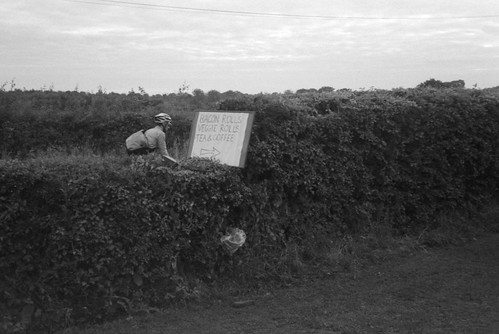
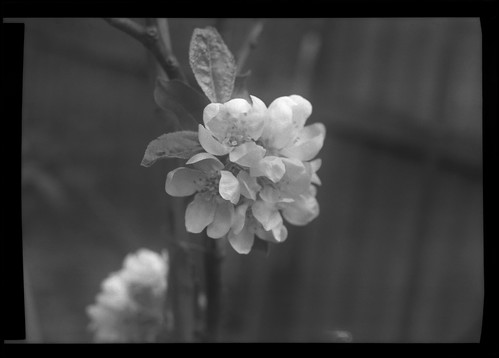
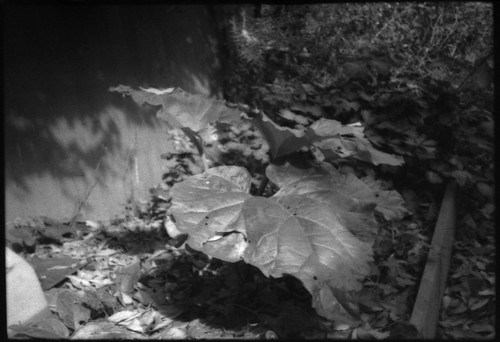
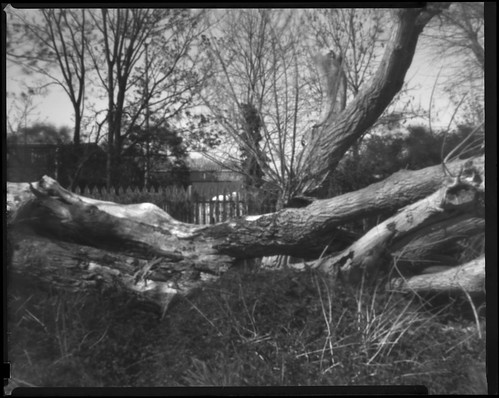
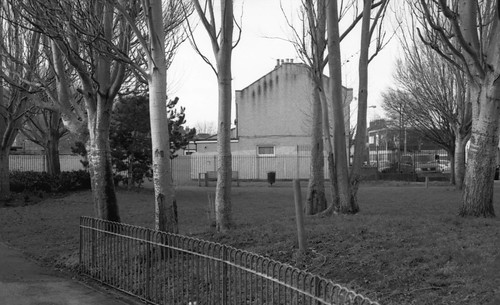
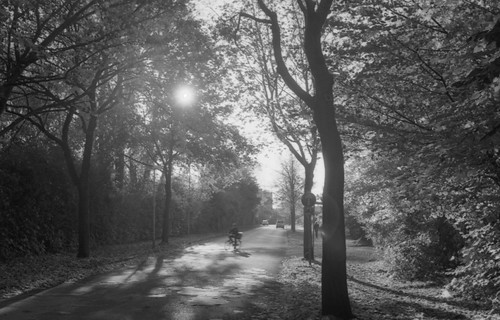
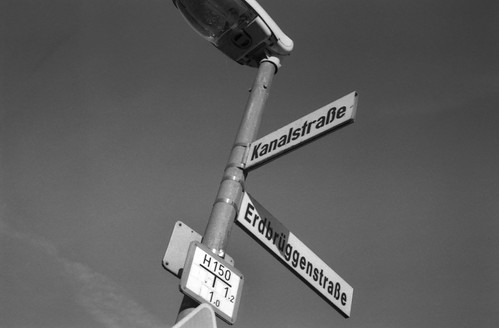
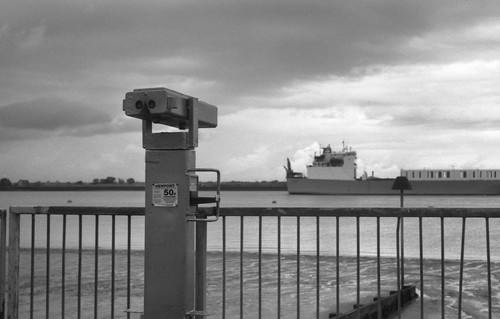
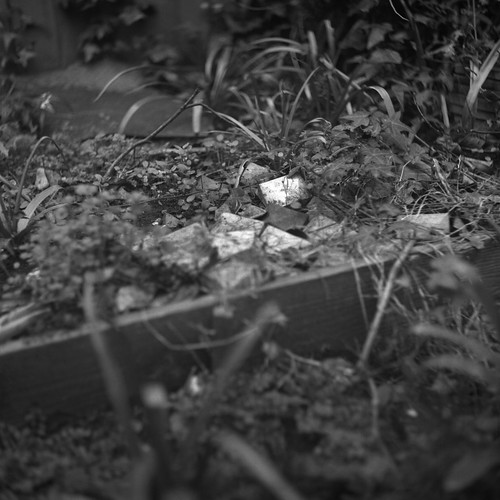
After the announcement of the film's new availability in medium format, I bought a couple of rolls and used the film, cut down, for last week's 127 Day (I used the 16mm off-cut in a subminiature camera, but this suffered from successive overlapping exposures due to issues with the film advance, and so not worth illustrating here); I shot the other roll on New Year's Day, with the Ica Icarette II/L. The reason for choosing this particular medium format camera was simply not having used it for a while. As with the comments in the last post on 127 Day, with overcast winter weather, a one-stop push might have improved the contrast of the negatives; the Icarette's Tessar lens–99 years old–is uncoated, and the somewhat hazy conditions were no doubt emphasised in the results thanks to the low-contrast of the uncoated lens.

Ica Icarette II with Kentmere Pan 400
The image above, directed towards the sun, just about discernible on the day through the clouds, shows this quite well (thanks to the weather conditions, there may also–just–have been some haze as a remainder of the fireworks a few hours before). In the original post on Kentmere Pan 400, I did test both pushing and pulling the film, and used Rodinal (or a Rodinal clone) and Ilfotec LC29 for developers, and in particular, having used Rodinal for many years, I was familiar with it and what to expect; with the medium format Kentmere Pan 400, I used Kodak HC-110 (at dilution B here), a developer new to me: with one or two rolls of film and a new developer, there wasn't the opportunity to work out how exactly to tailor the developer to exposure to get the particular result I wanted–or to use a different camera, which might have produced better results for these couple of rolls of Kentmere Pan 400 in medium format (as with the roll shot on 127 Day, the low contrast of the negatives was notable). As with my summary in the original post from just over three years ago, I feel there's nothing really distinctive about Kentmere Pan 400: I ended by writing then that the film is "a perfectly good, competitively priced, all-round 35mm black and white film with a certain flexibility in exposure and development"–which it is, but also now very welcome in medium format too.

Ica Icarette II with Kentmere Pan 400

Ica Icarette II with Kentmere Pan 400

Ica Icarette II with Kentmere Pan 400

Ica Icarette II with Kentmere Pan 400

Friday, 2 April 2021

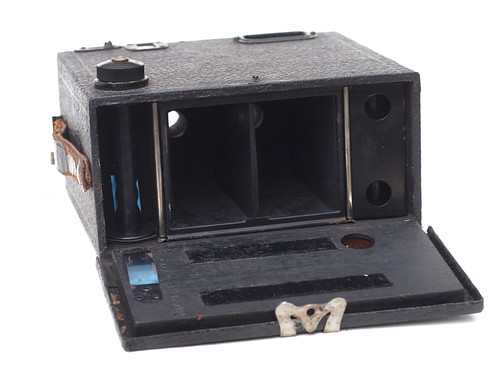
Thornton-Pickard Stereo Puck

Thornton-Pickard Stereo Puck
"It is often said in praise of a particularly good print that it is “almost stereoscopic.’’ With the Stereo Puck every good exposure is given full stereoscopic effect by dual lenses—and the cost of the outfit is now within everyone's reach." 
Thornton-Pickard advertisment
"...the New Wonder Camera The STEREO PUCK MAKES YOUR PICTURES LIVE"
Thornton-Pickard advertisment, BJP Almanac 1932
The prominent legend announcing the fact of the Thornton-Pickard Stereo Puck being "British Made" on the front plate above its lenses, much clearer than the faintly embossed name itself beneath them, brings to mind a scene from the sitcom The I.T. Crowd: in attempting to fight a fire, the character Moss points an extinguisher towards the fire, which promptly bursts into flame itself. Asking "Why's it done that?", Moss looks intently at the extinguisher, and there's a cut to a close up of a label: "Made in Britain", which provokes a knowing sigh from Moss. Intended, on the Stereo Puck, one imagines, to imply a mark of quality, this "British Made" assertion (as indeed for many a product) is at the very least an injunction for the consumer to patriotically 'buy British'. Something about this–the injunction and its instinctive reaction, as exemplified by Moss's sigh–as a general attitude, has an undercurrent of anxiety, of Britain's contemporary place in the world in relation to its long history, a history here of manufacture, but, by broader implication, its imperial history, a notion of a once-held 'greatness' (such a notion untroubled by any deeper examination), although Britain never seriously challenged the German, and then later, Japanese camera industries, and the Stereo Puck, "British made", was of course produced many decades ago. The association I've drawn with the example of the scene from The IT Crowd may be, perhaps, an unfair reaction, a knee-jerk attitude that itself needs examining, but in the case of the Stereo Puck, it's not entirely unwarranted.

I've long had an (occasional) interest in stereo photography, and when I saw the Stereo Puck come up in an online auction for not very much, I bought it on a whim; I used the camera for the first time two years ago for 'Take Your Box Camera To Play Day'; the film I shot then came out with scratches running through all the negatives, which was a little disheartening, and it had sat on a shelf since then, awaiting some remedial action. I was prompted to pick it up again by the #filmweekender box camera challenge from Twitter user Jason Avery: with a number of box cameras to choose from, I thought that the Thornton-Pickard Stereo Puck was sufficiently niche to warrant using it for this challenge.

Apart from its ability to take stereo pairs, the Stereo Puck is quite typical of the box camera form: it uses 120 medium-format rollfilm (itself introduced for the Kodak No.2 Brownie, the archetypal box camera); it has a fixed-focus simple lens; a single shutter speed; and a small reflecting finder for framing. It's wooden bodied, at a time when many box cameras were being made from metal (and early plastics like Bakelite were beginning to be used; the Stereo Puck's advance knob seems to be made from Bakelite) and the build quality suggests a certain cheapness: as an example, in the image below, the shutter lever on my camera can be seen to be not fixed entirely square-on to the camera body.
Thornton-Pickard Stereo Puck - top view

Thornton-Pickard did produce some fairly high quality cameras from the last decades of the nineteenth century, field and studio cameras, and, in particular, their reflex cameras and roller blind shutters. The Stereo Puck dates from the 1930s, by which time the company was in decline: it ceased manufacture in 1939 (it was preceded by the Puck, a more conventional box camera). In one of the advertisements quoted at the top of this post, three models are described, enumerated as the No.1, No.2, and No.3, all of which appear to have been available concurrently (at the time of the advert; when researching the Stereo Puck online, these numbers aren't usually used to differentiate its different variants). Sources online date the first version to around 1930, although the given dates vary. I've also observed that there were two versions of the model described as 'No.1': some show the metal tab in front of the handle which provides three different aperture settings, while some do not and presumably have just the one aperture setting. My version of the Stereo Puck is the No.2 and has the most commonly noted difference: this has the 'portrait' supplementary lenses, filters which swing in front of the lenses, easy to identify from the small lever next to the viewfinder, absent from the No.1. Finally, the advertisement describes the No.3 Stereo Puck, which has the ability to photograph either stereo pairs or single images (it's not clear how this works, and, from images of the camera online, I can't tell what might differentiate the No.3 in external appearance; it would be possible to shoot single images with the other models of the Stereo Puck by using a lens cap on one lens at a time–not easy to do due to the recessed lens fittings, with the 'cap' needing to be more like a plug–and not advancing the film until each side of the pair has been exposed).

The Stereo Puck takes (nominally) 6x4.5cm stereo pairs on medium format film, giving eight pairs on a roll of film; by necessity this image format creates a compromise in that the lens separation is noticeably narrower than that of human binocular vision. This is, apparently, a remarkably consistent physiological trait, with a distance of 6.5cm. Ideally, each lens then would be separated by this same distance to simulate stereo vision, but with the Stereo Puck, the lenses are separated by 4.2cm (I've read other distances online, but measuring my camera gives 4.2cm). There are circumstances in which lenses for stereoscopy would need to differ from that of the human eye, but these would be for extreme distances, both near and far, for microscopy or for imaging at distant ranges (to achieve a stereo image of a distant landscape, for example, it helps to have a much greater lens separation, otherwise both images appear too similar to create the illusion of depth). In the 35mm format, in order to construct a camera with a sufficient lens separation, the images have to be recorded on the film in a discontinuous series (i.e., the stereo pairs are not adjacent on the film), the most common method is to have the frame advance periodically 'jump' already exposed frames on the film, such as with the Stereocrafters Videon, where each pair is separated by two images of subsequent pairs on the film, which means that, as a sequence, after a first exposure, the film advances one frame twice in a row, then has to advance three whole frames to avoid double exposing one half of each stereo pair; other methods include exposing the film diagonally to avoid double exposure, as with the Meopta Stereo 35 and the Sawyers View Master. In medium format, the 6x6 image size is more typically used for stereo cameras as the wider image format means that the lens separation is greater; however, at the time that the Stereo Puck was produced, 120 medium format film only had numbers on the backing paper for the 6x9 frame size, which no doubt accounts for the Stereo Puck's design and use of the 6x4.5 stereo pairs, with the understandable compromise on lens separation (roughly concurrent with the Stereo Puck, the Rolleiflex popularised the 6x6 frame size on 120 film; while the Rolleiflex did not depend on frame numbers printed on the film's backing paper, evidently the format was attractive to manufacturers of cameras and film, and 6x6 frame numbers were introduced for less high-end 6x6 format cameras).

The user controls on the Stereo Puck are simple and limited. The shutter, tripped by a lever on the top right of the body from the user's position, has a single speed, reported between 1/20th-1/50th online, and a 'time' mode, with a small metal tab that pulls out to keep the shutter open until either pushed in or the shutter lever is flipped back to its original position: the shutter lever does not spring back to its original position, and so, like many older box cameras, this lever trips the shutter in either direction (on most single-lens box cameras of course, this lever runs up and down, rather than side-to-side), left-to-right or vice-versa. The lenses are fixed-focus four-inch f12.5 achromats; absent on some 'No.1' Stereo Pucks, there are three aperture settings with a metal tab in front of the handle that pulls out a strip of metal with holes punched behind the lens with click stops to provide smaller apertures. The aperture settings aren't marked, but logically these two smaller apertures are one stop successively smaller than the maximum aperture, giving approximately f18 and f25. The 'portrait' auxiliary close-up filters are hidden behind the front panel and pivot between the lenses. These can be swung in to position using the smaller lever next to the viewfinder. This lever is sprung, so the close-up filters return out of the way behind the front panel as soon as the lever is let go.

Thornton-Pickard Stereo Puck opened for loading

Loading the camera, the back is hinged on its leatherette covering; the back is made from wood, like the rest of the camera body, but has a metal outer rim that acts as a light trap with a clasp to secure it to the body. On one side, a curved spring attached to the back acts to provide pressure on the take-up spool. The two strips of felt inside the camera back appear to function as a pressure plate on the film behind the lenses; film advance it by red window using the 6x9 numbers. The supply side spool has a removable metal holder rather than the spring attached to the back; it's hard to see exactly what the design of this achieves, other than perhaps avoiding adding a knob on the supply side to secure the toll of fresh film. There is also a standard trip fitting in the base of the camera, but, for some reason, not centred either side-to-side or front to back.

Thornton-Pickard Stereo Puck with supply-side spool holder removed
When I first used the Stereo Puck a couple of years ago, its limitations were apparent. Some of these are an unavoidable part of the design, such as the narrow lens separation, but other issues are a result of the camera's construction, largely due to a lack of care in the manufacturing tolerances of the Stereo Puck. One of the first things I noticed is the disparity between the two sides of the stereo pair: the images are not well aligned in their vertical dimension, and, in addition, the focus on each side is different. These two aspects together might matter less in an inexpensive box camera with a single lens, but with two lenses, especially with a narrow stereo base, a good stereo image would be approved by the focus and alignment being better.

Thornton-Pickard Stereo Puck with Ilford HP5 Plus
In the image above, the left hand image is lower than the right; the left hand image also has better focus at the bottom of the frame, with the right hand image better at the top. The disparity in focus can be mitigated a little with using the smaller aperture settings, if lighting conditions allow when using the shutter on 'instant'. When creating stereo anaglyphs, the vertical alignment can easily be overcome simply by lining up the two images better, with a small amount of cropping. The ergonomics of the Stereo Puck take a little getting used to, especially if one is familiar with the more typical box camera form, as the shutter release and close-up filter lever are on top of the camera rather than at the sides; as with many a box camera, the viewfinder is merely an adequate indication of what direction the camera is facing and what might be generally in the centre of the frame.

Thornton-Pickard Stereo Puck (close-up filter) with Ilford HP5 Plus at 800
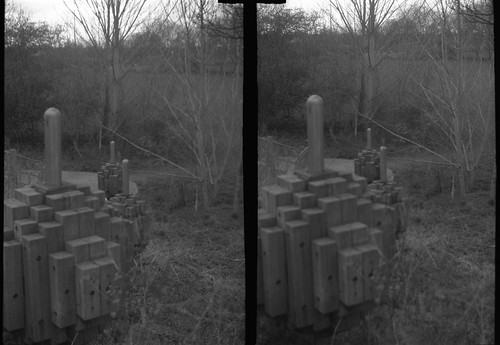
Picking up the Stereo Puck again to use it for the #filmweekender challenge, I carefully rubbed down the rollers at either side of the inside of the camera, which had some spots of corrosion, then polished these in an attempt to prevent the scratches that I had with my first roll of film and which can be clearly seen in the image above. I wasn't entirely successful, but the rather obvious gouges have become thin hairlines, much less obtrusive–in the image above, one has to enlarge it a fair bit to discern these lines. Possibly more polishing might remove these completely. I had a roll of Ilford HP5 Plus, and some Rollei Superpan 200; shooting on the afternoon of the 21st March, the weather was heavily overcast, with the result that I chose to push the HP5 Plus one stop in development, giving an effective exposure index of 800 (as I have remarked before, the idea that one should use a low ISO film in box cameras as these were the films available at the time such cameras were designed only holds true if one uses box cameras in the same way as they would have been used at the time: only taking photographs hand-held outside in bright weather conditions; in addition, possibly tray developing the film by inspection to make up for shortcomings in exposure, and possibly using intensification on the negatives as well). Most of the shots with HP5 Plus were hand-held although I did brace the camera against railings in at least one shot, and some used the close-up filter, supposedly for subjects of 1-3 metres, such as the image above. For comparison, I also took a couple of stereo pairs with and without the close-up filters, as below. Comparing the two pairs, the discrepancy in focus without the close up filter is as described above, with the focus better on the lower part of the left hand frame (although this is also closer to the lens), while focus it better towards the top of the right hand frame. Oddly, the close-up filter appears to reverse this trend, or at least, focus is better closer to the camera on the right, while on the left, the middle distance appears better.

Thornton-Pickard Stereo Puck with HP5 Plus at 800 (without close-up filter)
Thornton-Pickard Stereo Puck with HP5 Plus at 800 (with close-up filter)
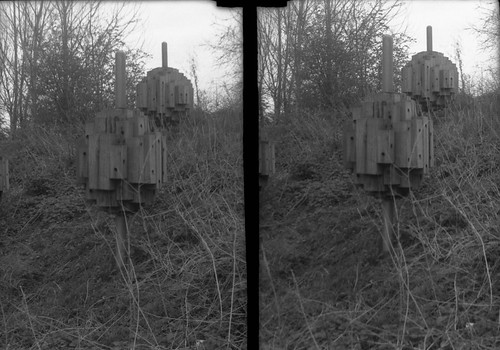
Opening the camera to remove the HP5 Plus, I was faced with something of a 'fat roll', and before loading the camera again, I bent all the springs forward in order to apply more pressure to the film; the HP5 had some light leaks at the edges of the last couple of stereo pairs, but not as bad as I had feared. When using Rollei Superpan, with an ISO of 200, this was too slow to use the camera hand-held; I could have attempted to push the film a couple of stops, but I've found Superpan to have relatively low latitude and pushing the film would be far from ideal. Instead, I used the odd wooden sculptures I had been photographing to place the camera on in lieu of a tripod and use the time setting on the shutter, generally stopping the lens down and exposing for around a second.

Thornton-Pickard Stereo Puck with Rollei Superpan (without close-up filter)
Thornton-Pickard Stereo Puck with Rollei Superpan (with close-up filter)
For the last couple of stereo pairs, I had inadvertently pushed in the tab for the shutter, so, without realising it, these were shot on the 'instant' setting, and, as a result, almost nothing registered on the negative. I developed both rolls of film in Rodinal, diluted 1+50 for 19 minutes at 19ºC, the time, temperature, and dilution that I'd settled on in my previous testing of Superpan, and close enough to the published times for HP5 Plus at 800 (16 minutes at 20ºC).

The Stereo Puck was sold with a stereo viewer, which my camera came without, but for which the negatives from the camera would be contacted for a print to fit the viewer. This should perhaps be also taken into consideration with the camera: at the scale of a contact print, the discrepancy in focus and alignment would be less obtrusive than in a larger print, or indeed a high resolution scan viewed on a screen. Instead of contact prints for physical viewing, I have been making red-cyan anaglyphs from the stereo pairs as the easiest iteration of the images, particularly online, correcting the alignment images while doing so.


One doesn't use a box camera for accuracy and precision, so perhaps the limitations and compromises of the Stereo Puck that I've outlined should be expected and accepted, particularly within its historical context. One imagines that, before the boom in 35mm stereo cameras during the 1950s, it made the taking of stereo photographs an affordable novelty at the time it was produced. For contemporary use, all these factors are hardly likely to make it a stereo camera of choice but, using it again for the #filmweekender challenge, after cleaning it up to prevent it scratching the film, perhaps it shouldn't have sat on a shelf for a couple of years.

Sources/further reading:
Stereo Puck on Camera-Wiki
Stereo Puck on Early Photography
Stereo Puck variants on Red Belllows
Model 1 without close-up filters or aperture stops on Welt Der Stereoskopie
Model 1 on Wood and Brass


Wednesday, 8 May 2019

Agfapan APX 100

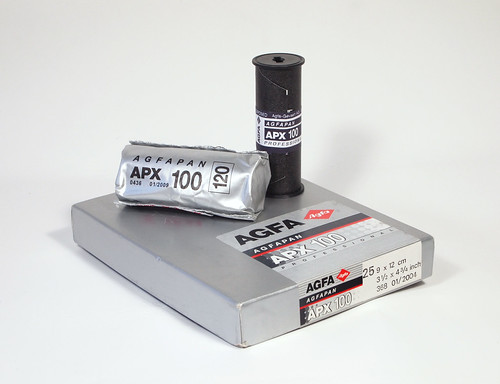
Agfa Agfapan APX 100 in sheet film (9x12cm) and medium format
Among the currently available range of black and white films, there are two films named AgfaPhoto APX, in 100 and 400 speeds. This film is sold by Lupus Imaging, and, it seems, is most likely made by Harman, similar to the Rollei RPX films, and (but perhaps not quite the same as) Harman's Kentmere films. These films from Lupus trade on the name of Agfa's discontinued Agfapan APX 100; this post is about the original Agfapan APX 100 and it is not a comparison to the new APX 100; the new APX 100 films are not the same emulsion or a new version of Agfa's original: apparently Adox Silvermax is close to the original APX 100 recipe.

I first used Agfapan APX 100 in 35mm when it was sold under the name of Rollei Retro 100. The last master rolls of Agfapan APX 100 produced in 2005-06 were bought up by Maco when Agfa ceased production and repackaged under the name Rollei Retro 100, with generic-looking labels, rather like the first RPX films, sold in non-DX coded cassettes; possibly the film's renaming was due to Lupus having already acquired the rights to the AgfaPhoto and APX names (to add some confusion to the matter, it appears that Lupus also sold the old APX 100 film prior to the new APX 100 in 2013; Maco sold two other, different 'Rollei Retro' films: Rollei Retro 100 S and Rollei Retro 100 Tonal, not to be confused with the Rollei Retro 100 that was the old Agfapan APX 100).

Almost unintentionally, Agfapan APX 100 has become one expired film stock that I've used frequently over the past couple of years, some time after first encountering it as Rollei Retro 100. According to the Wikipedia page on discontinued film stocks, Agfapan APX 100 was produced between 1989 to 2005, which would mean that the Rollei Retro 100 that I bought in 2011 would have been a few years old at that point. The reason for buying the Rollei Retro 100 film then was that it was very economical: I can't recall exactly how much I paid for a batch of ten rolls, but Maco were selling ten rolls of 35mm Rollei Retro for less than €20 around the time (prices do seem to have varied somewhat, but Wayback Machine gives an idea of what I might have paid then).

I shot most of the Rollei Retro 100 in the the Spring and Summer of 2011, almost exclusively with the Kodak Retina IIa (one roll was shot with the Agfa Optima Sensor), developed in Agfa Rodinal, which seemed a good fit for bright sunny days, providing relatively tight grain and smooth tonal qualities; as a film, it also seemed to work well with Rodinal, the first developer that I used when coming back to processing film, and I also happened to be using the last of the stocks of the old Agfa Rodinal that the darkroom had, before switching to other generic R09 developers.

Kodak Retina IIa with Agfapan APX 100 (as Rollei Retro 100)
After I'd used up the ten rolls of Rollei Retro 100, fairly quickly, there was a gap of few years before I found a box of 9x12cm APX 100 sheet film, dated 01/2004. I hadn't been looking out for Agfapan APX 100 specifically, rather it was a case of finding cheap sheet film in the 9x12cm size; when buying this, it was a decade past its develop before date but I imagined that, being relatively slow, this would be less affected by age (without knowing how it was stored before I bought it of course), and I shot some of this, handheld in bright conditions, with the Kodak Recomar 33, rating it at box speed, or just below at an exposure index of 80, and subsequently also using it with other 9x12cm format cameras. The box also included a leaflet with developing times for both APX 100 and AP 400 - it's worth noting that the 400-speed film here is not called APX 400, but the instructions inside the 35mm boxes I later used did have APX 400; the reasons for the difference in naming are not clear, the developing times are the same for both.

Agfapan APX 100 - AP 400 leaflet
Then, I bought a batch of medium format APX 100, eight unboxed rolls with a develop before date January 2009. Some of this I cut down to 127 to use for January 2017's 127 Day with the Baby Ikonta, and also used when testing the Baby Box Tengor, as well as using it with 116 backing paper in the Agfa Standard. However, these films, all with the same process before date, were not consistent - some rolls gave good results, but on some the emulsion appeared to have reacted to the backing paper, as in the image below, where the numbering from the backing paper is just visible across the sky; in the second image this isn't present.

Agfa Record III with Agfapan APX 100 (6x9 medium format)
Zodel Baldalux with Agfapan APX 100 (6x9 medium format)
Some of these rolls of film went through X-rays more than one before and after exposure when travelling, although as a medium speed film, this should not affect the emulsion, nor is it clear whether this would increase any reactions to the backing paper, but this was perhaps not unexpected with out-of-date film, with unknown storage conditions - this is, after all, sometimes seen with new film. However, that it did not occur with all rolls, though apparently from the same batch, was frustrating, as it couldn't be anticipated.
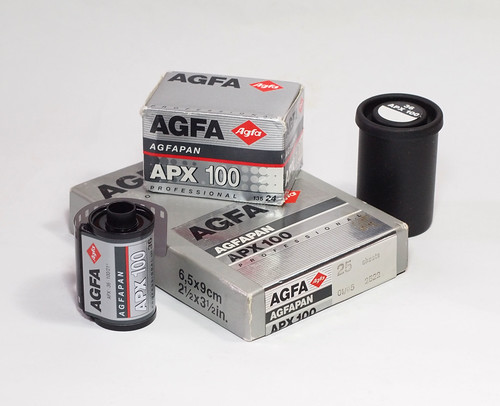
Agfa Agfapan APX 100 in sheet film (6.5x9cm) and 35mm
With the notion that I might write a blog post about Agfapan APX 100, I sought out a couple of rolls of APX 100 in 35mm to make some tests with - ordinarily, I wouldn't do this for discontinued films, although I might test for sensitivity; a latitude test, and tests for pull/push processing I would usually make for my own future reference, less of a necessity with a discontinued film that one might not have the opportunity to use in future (I also found some 6.5x9cm sheet film around the same time, with a process before date of January 95, using this with my Glunz plate camera, making such a sensitivity test with one sheet from this box). For a latitude test with the 35mm film, I shot half a roll of Agfapan APX 100 with a date of January 2002, rather older than the Rollei Retro 100 I'd used a few years previously.

35mm Agfa Agfapan APX 100 latitude test
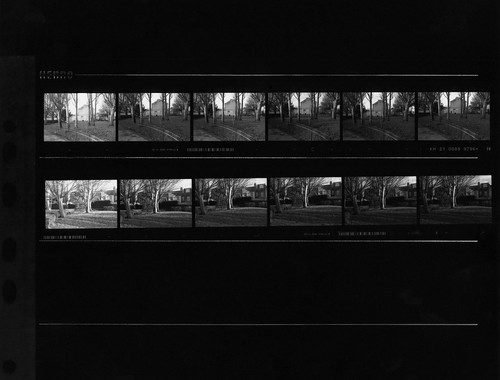
On the contact sheet above the first two rows were rated EI 400/200/100/50/25/12 from left to right; the third and last row was shot at box speed of 100 ISO. This was developed in Ilfotec LC29 diluted 1+19 for 7m30s at 20ºC. Times were taken from the Massive Dev Chart, where Agfapan APX 100 is  listed under 'Discontinued/Unlisted' rather than referring to the data inside the box, which I could have used if I'd developed the film in R09. The results from this test showed that perhaps the film could have benefitted from a little more exposure than box speed, although perhaps not as much as one whole stop; I shot the rest of the first of these two films with the Kiev-4 rated 80. It is also worth mentioning that Ilfoted LC29 may not have been the best developer for this test, but I didn't have any Rodinal at the time of processing; this may have been better historically, even just in relation to the APX 100 I shot as Rollei Retro 100 a few years ago.

Agfapan APX 100 (develop before Jan 2002) at box speed
Agfapan APX 100 (develop before Jan 2002) rated EI 50
When I first used Agfapan APX 100 in its incarnation as Rollei Retro 100, I didn't have much occasion to push the film, shooting just one roll at anything other than box speed: this I rated at an exposure index of 200 as, if I remember rightly, I didn't have any faster films at the time for shooting on an overnight bicycle journey - although I didn't take many pictures during the night itself, more in the early grey dawn hours.

Agfa Optima Sensor with Rollei Retro 100, rated 200
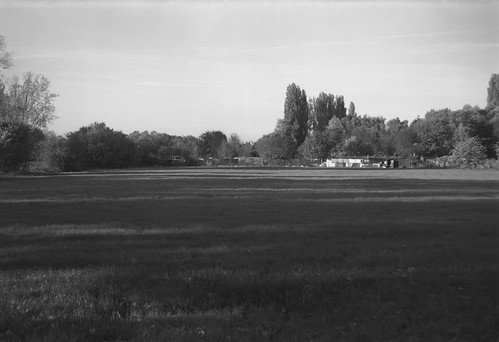
Last year, with the second roll of APX 100 with the develop before date of January 2002, I found myself in a similar situation: taking photographs in a dark interior; with the film already loaded into the Kiev-4, this was not ideal, and I wouldn't normally push expired film this old, especially two stops, but this was a compromise which produced generally acceptable results, with the caveat that there was also some patches of bright sunlight in the otherwise dim building to complicate the exposures, and the density of these highlights rendered noise in the scanning of the negatives.
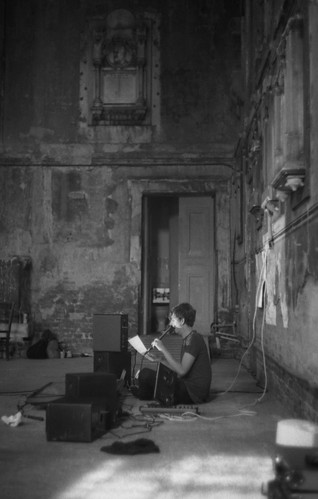
Kiev-4 with Agfapan APX 100, rated 400
As I stated in the introduction to this post, this is not a comparison of AgfaPhoto APX 100 with the original Agfapan APX 100: despite the name, these are different films. From what I've read, Adox Silvermax is close to the original APX 100 emulsion, so a comparison between these two films might have been instructive, and the qualities that I like in Silvermax do seem to be present in APX 100. However, that may not be an entirely equal contest, given that Silvermax is a new film, still very much in production at the time of writing, whereas the most recent stocks of APX 100 would now be coming up to a decade and a half old, and, although, backing paper issues aside, most of the old Agfapan APX 100 I've used has lasted well so far, using existing old stocks of the film such as may still be around must be approached with a little caution - as with any films a fair number of years past their 'develop before' date.
Kiev-4 rangefinder with Agfapan APX 100 (develop before Jan 2002) rated 80
Canon A-1 with Agfapan APX 100 (develop before Jan 2002) rated 100
Kodak Retina IIa with Agfapan APX 100 (as Rollei Retro 100)
Agfa Optima Sensor with Agfapan APX 100 (as Rollei Retro 100) rated EI 200
Kiev-4 rangefinder with Agfapan APX 100 (develop before Jan 2002) rated EI 400
Baby Ikonta with cut down Agfapan APX 100 (127 format)
Zodel Baldalux with Agfapan APX 100 (6x9 medium format)
Glunz Mod 0 with Agfapan APX 100 (6.5x9cm sheet film)
Kodak Recomar 33 with 9x12cm Agfapan APX 100
Rietzschel Heli-Clack with 9x12cm Agfapan APX 100
Voigtländer Avus with 9x12cm Agfapan APX 100

Saturday, 17 December 2016

Kodak Plus-X

Kodak/Eastman Plus-X in 16mm, 35mm, medium format and large format sheet film
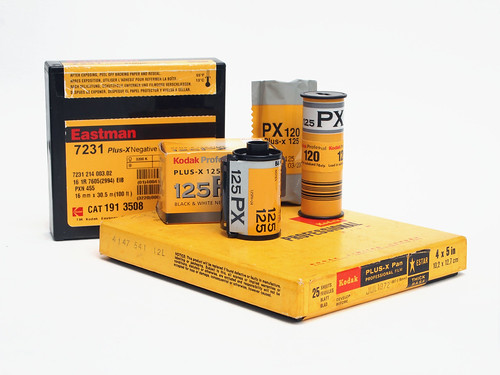
Eastman Plus-X was first introduced as a motion picture film in 1938, and shortly afterwards produced for still cameras in a number of different formats as Kodak Plus-X. The emulsion number for Plus-X as a motion picture film was -231, with Kodak's standard prefix codes of 7 for 16mm, and 5 for 35mm. As a motion picture film, Plus-X was available in both negative and 16mm reversal stock. For still camera film, Kodak Plus-X had the code PX for many years (with PXP for medium format 'professional' films; PXE for Estar-based 70mm film; and PXT for thick-based sheet film), but it was reformulated around a decade ago, and was then designated 125PX. A comparison of development times shows these to be broadly similar, but changed in many cases by 15-30 seconds in many developers. Kodak's technial data sheet for the new version states:
"To reflect our enduring commitment to black-and-white photography, black-and-white film production will take place in an even more advanced film-coating facility. New technology applied to these superior, time-tested emulsions will result in slightly different processing times for the film family. But the same great films—those you've known and trusted for years—will still deliver the same breathtaking results."
One notable difference between the two versions was the new Plus-X was provided with development times for a three-stop push to EI 1000, while the earlier film was only recommended to be pushed no more than two stops; both films' data sheets stated that a one-stop push to 250 could be achieved without a change to development times. In my own tests below, I did not attempt more than one-stop push, given that I was working with discontinued film, although the 35mm motion picture film was manufactured in 2010, not old enough to really be concerned with increasing exposure to compensate for a loss of sensitivity with age; in some other formats, the Plus-X film I shot was much older.

In the Kodak Reference Handbook from 1946 it is described under 'General Properties' for Roll Film and Film packs as being:
"High speed, fine grain, excellent gradation, wide exposure latitude. The speed and balanced color sensitivity make this film particularly suited to a wide range of outdoor conditions. It also has ample speed for well-lighted indoor subjects. The low graininess and high resolving power permit high quality enlargements many times the size of the original negative."
While for 35-mm and Bantam (828) films:
"High speed and fine grain. For general miniature camera work this film should be used unless light conditions are very adverse or unless a very high degree of enlargement is intended."
Plus-X was originally rated 50 ASA, but at some point in the 1950s this was increased to 80 ASA (this thread gives some information on Plus-X ratings). When speed ratings were changed for black and white films in 1960, Plus-X was rated at 160 ASA for a time, before gaining its 125 ISO rating, which it retained for nearly fifty years (Kodak's reference hand book implies the presence of the one-stop safety factor in the statement about Plus-X that, "When it is desired to reduce the exposure to a minimum, these values can be doubled with little danger of serious underexposure..." ). Additionally, the motion picture stock was recommended to be shot at a slower speed, 80 ISO in daylight and 50 under tungsten, which may just reflect the process of striking a positive from motion picture negative film, rather than a slower emulsion.

Eastman Plus-X was discontinued in 2010, with the notice for the still camera version announced the following year - although the production runs may have both stopped at the same time if the emulsion itself was the same. Incidentally, the Massive Dev Chart still has Plus-X on its main chart, not on its discontinued/unlisted page. Kodak's rationalising of the film stocks it produces in recent years has meant the discontinuation of many of its classic films. This does leave Kodak without a medium-speed traditional emulsion film (Ilford's FP4 Plus being the closest equivalent still available). Kodak suggests TMax 100 as a replacement for Plus-X; this film uses a modern T-grain emulsion. For most of the period that Kodak was manufacturing Plus-X, it also produced Verichrome Pan, another still picture film with a traditional cubic emulsion at the same speed as Plus-X, only discontinued in 2002; Verichrome Pan does appear to have been available in some formats (126, 127) that Plus-X was not, but both were available in the most common formats - 35mm, medium format and sheet film.

Minolta 16QT with 16mm Kodak Plus-X, develop before date Sept 1971
MPP pinhole with 4x5 Kodak Plus-X, develop before date July 1972
I had first used Plus-X in a ready-loaded Minolta-16 cartridge with a "develop before" date of September 1971. Around the same time, I also acquired a box of large format Plus-X from 1972 in a job lot, which I used for both this year's 'Expired Film Day' and on Worldwide Pinhole Photography Day, which I rated at 25 to compensate for the loss of the film's sensitivity over the more than four decades since it was made. Apart from this loss of sensitivity, the quality of neither film appears to have been much compromised with age. Unintentionally, I had begun to use Plus-X after it had been discontinued almost by accident; I subsequently bought a 100-foot roll of 16mm film for 110 cartridge reloads and other subminiature formats, after using up two rolls of Kodak WL Surveillance film, and finding the Photo Instrumentation film rather grainy. As Plus-X had been a motion picture stock, I wanted to use it for a separate project that I have been pursuing, looking at film locations; given how recently it has been discontinued, I found it relatively easy to find across Plus-X in 35mm and 120 online.

35mm Kodak Plus-X motion picture film latitude test
To test the film in 35mm, I bought some bulk motion picture Eastman Plus-X 5231. According to Kodak's guide, the date of manufacture for the 35mm Plus-X that I bought is 2010, which would mean that it was in the very last batches made before discontinuation that year, based on the edge code once developed. I tested the latitude of the film, as shown in the contact sheet above. For the first row, the film was exposed at indexes of 40, 80, 100, 125, 160, and 200. However, with the light changing due to quick-moving thin clouds, shooting manually, I couldn't be sure that I had a perfect set of exposures, so I repeated the latitude test a couple of days later. For the second row I used the same set of exposure indices, but the lighting on the day was more consistent. The film was shot with a Canon A-1 SLR and developed in Ilfotec LC29 at a dilution of 1+19 for 6 minutes at 20ºC. Both tests showed good latitude with a moderate amount of contrast over the fairly short range of exposures, and a relatively clear base, presumably being good for motion picture use, as well as possibly useful when scanning. Part of the reason for choosing these speeds was an attempt to be precise over whether any adjustments for age needed to be made, given that the motion picture stock is recommended to be shot at a slower speed (80 ISO in daylight) than the still camera version (125 ISO), which may just reflect the process of striking a positive from motion picture negative film.

Canon A-1 with Plus-X rated 40
Canon A-1 with Plus-X rated 200
Although I used a narrower range for the test than for other films I've tested, the results appeared to show the Plus-X has fairly good latitude; the two examples above from either end of the scale of exposures I used are both quite acceptable, in the lower image it might have been possible to pull more detail from the shadow areas. Other than the Plus-X from the 1970s, the last batches of 35mm motion picture stock and the medium format from the past decade were either shot at box speed, or generally rated at 100 rather than 125. I haven't tested Plus-X for push processing apart from one roll at 200, pushing one stop (or 2/3 of a stop) in Ilfotec DD-X. With the lighting conditions when the film was shot, the results were fairly high in contrast, I also shot the film with a yellow filter, which helped provide detail in the sky. As Plus-X has only been discontinued within the last decade, there's still a lot of the film around in different formats, although since I bought my last bulk roll, I have seen that prices have increased online. Perhaps Kodak Plus-X isn't significantly different from Ilford's FP4 Plus to make shooting it today anything other than a historical curiosity - I had never used the film before it was discontinued - although as a motion picture stock, it's a fortunate curiosity, appropriate enough to the ongoing project shooting film locations.

Mamiya-16 Automatic with 16mm Eastman Plus-X
Pentax Auto 110 with 16mm Eastman Plus-X
Agat 18K (35mm half frame) with Kodak Plus-X motion picture film, developed in Ilfotec LC29
Kodak Retina IIa (35mm) with Kodak Plus-X motion picture film, developed in Ilfotec LC29
Kodak Retina IIa (35mm) with Kodak Plus-X, rated 200, push processed in Ilfotec DD-X
Kiev-4 rangefinder (35mm) with Kodak Plus-X motion picture film, developed in Ilfotec LC29
Ikoflex Ic (medium format 6x6) with Plus-X, develop before date of 03/2006, developed in R09 One Shot
Zodel Baldalux (medium format 6x9) with Plus-X, develop before date 02/2007, developed in Ilfotec DD-X

Sources/further reading:
Kodak's history of motion picture film stocks
Plus-X Pan (PXP) tech sheet on 125px.com
Plus X (PX125) tech sheet on 125px.com
Kodak Reference Handbook 1946
http://silverbased.org/plus-x-kodak-woes/
https://blog.jimgrey.net/2014/06/25/shooting-kodak-plus-x-pan/
http://adambhalalough.com/post/572281627/thoughts-on-kodak-discontinuing-plus-x-bw-film