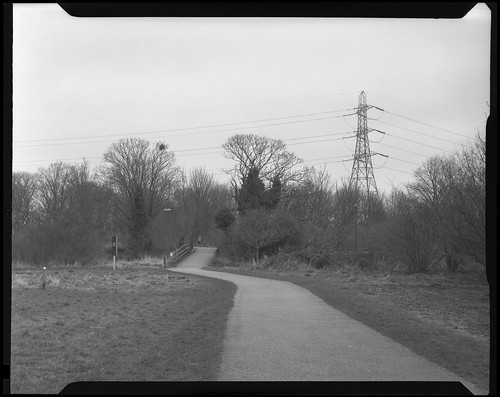
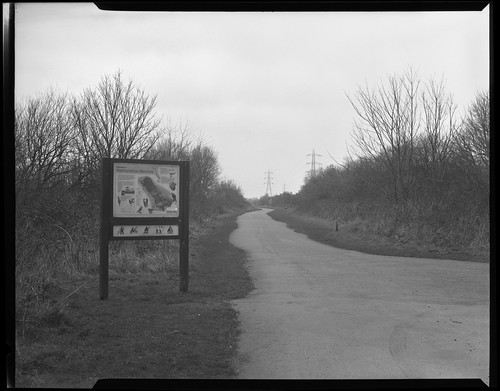
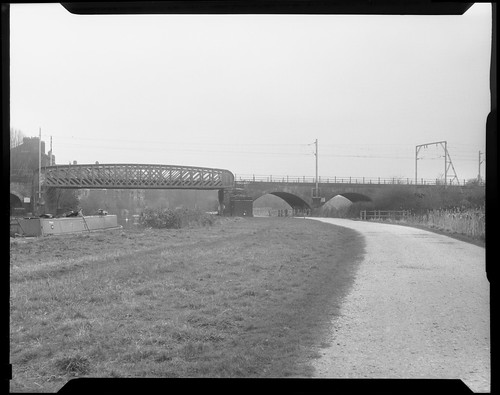
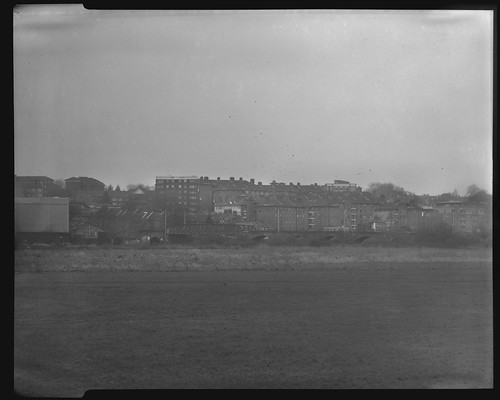
Showing posts with label sheet film. Show all posts

Sunday, 24 February 2019

#FP4Party February 2019

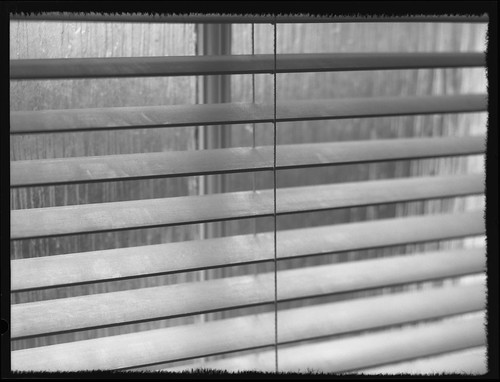
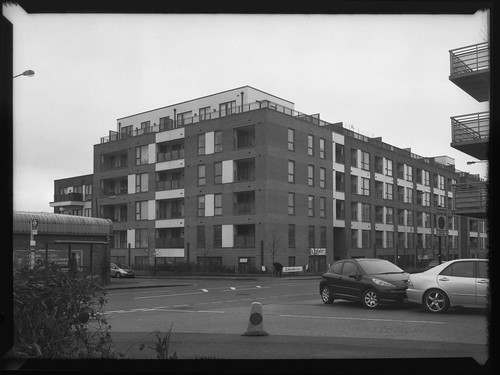
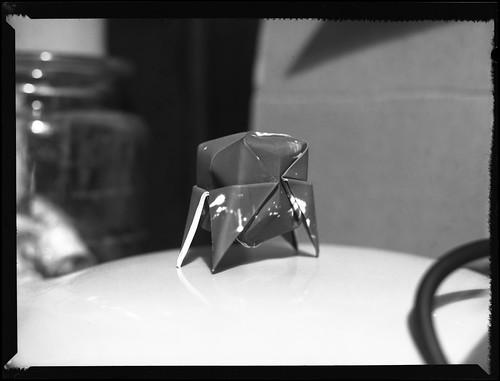
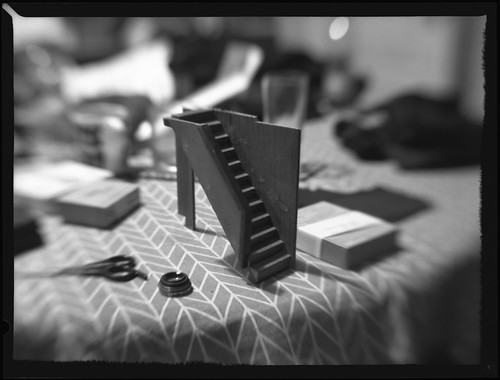
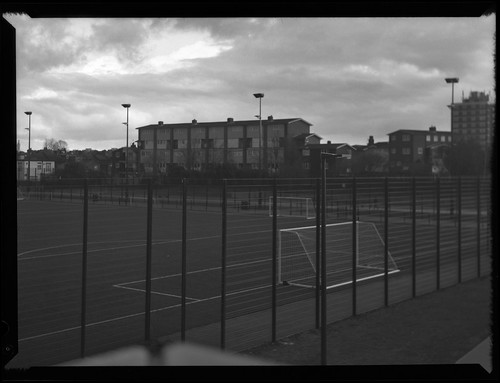
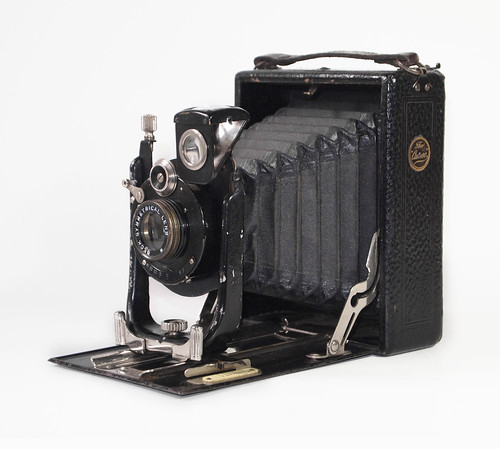
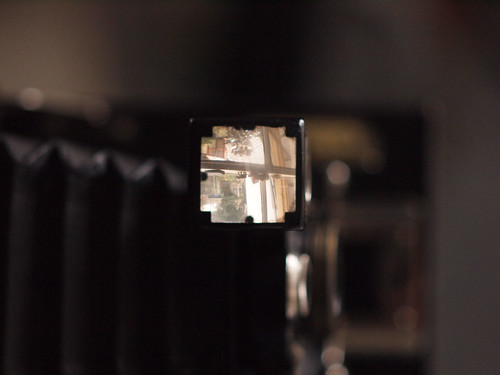
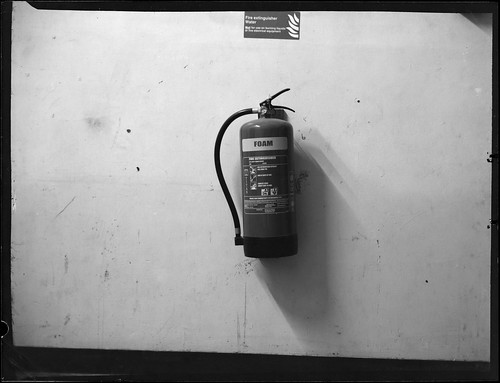
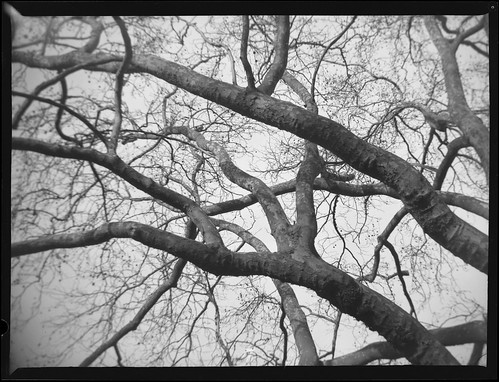
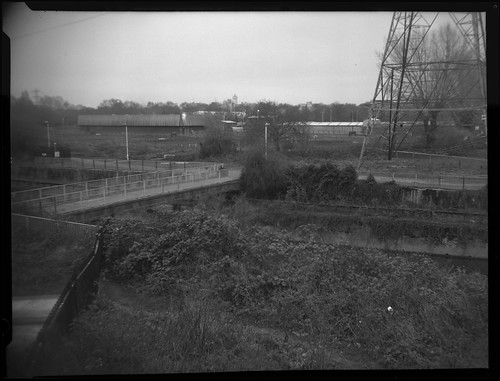
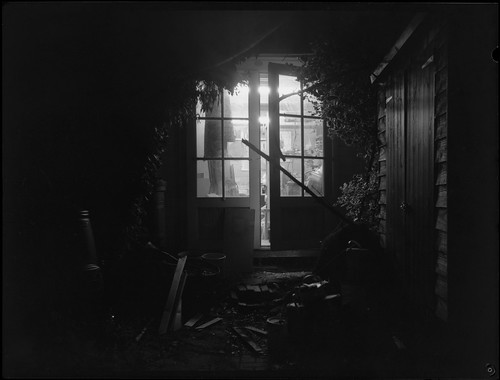
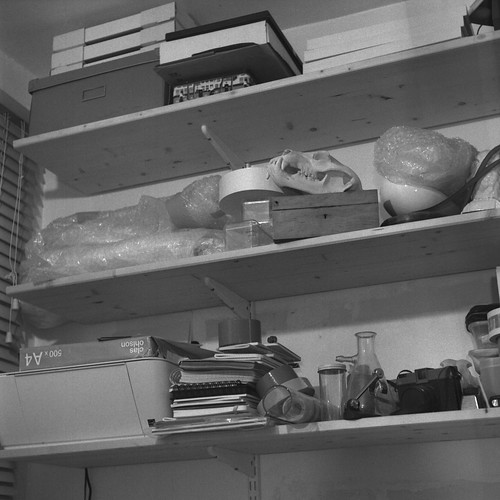
With February being announced as 2019's second #FP4Party, after shooting with the Cameo in January, it felt logical that I should use my other quarterplate-sized folding camera - the Ensign Folding Klito de Luxe No.9. Last month, I had set myself the task of simply photographing with two sheets of forty-year old Ilford FP4 each day during the 'shoot week', and so I did the same for February. The Ensign Folding Klito is a superior camera when compared to the Cameo; the most immediate difference in use is the rack and pinion focus on the Klito, rather easier to finely adjust against the Cameo's spring clamp. The Klito has its original ground glass focus screen with a hood; using the Klito with faster lenses than the Cameo also made accurate focus easier to achieve. Like the Cameo, it has front rise and cross movements, the rise controlled by beautiful circular gearing around the lens and shutter assembly.  Finally, the Ensign Folding Klito also has double extension bellows, allowing for close focus, without the need for a close-up lens attachment, as I used with the Cameo.

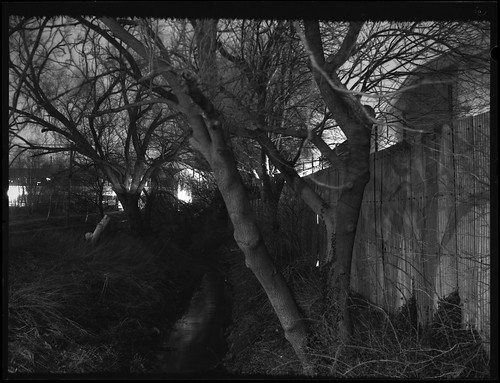
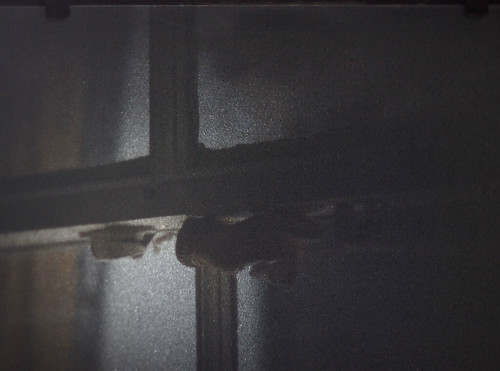
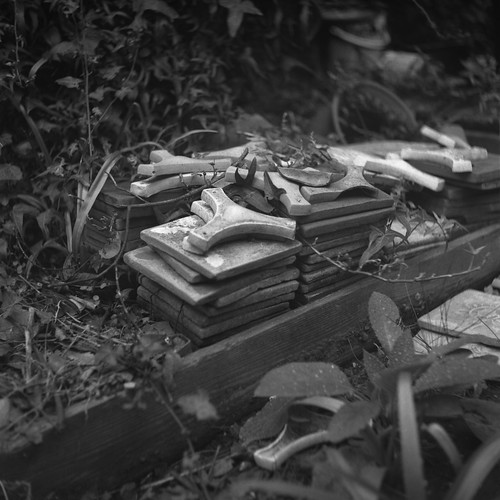
Over the first three days of the shoot week, I used the Klito with a 12cm Ica Dominar lens; the original lens is a No.2 Aldis Plano Anastigmat; I had replaced this with the Dominar lens while using the Klito to take night photographs on glass plates, being f4.5 against the f6.8 Plano: having a faster lens makes for a brighter image on the ground glass when composing and focussing, especially advantageous when working at night. However, wanting to use the Klito with this original lens, I reinstated the Aldis Plano, and shot with this for the remainder of the week. The Aldis Plano is a classic triplet design; while cleaning the thread on its retaining ring, I removed the rear element - and realised that it, a positive meniscus, formed an image on its own. The results (Thursday's image, with a diagram of the Plano shot for Friday) are very much as one would expect from a meniscus lens - it would appear that the front elements, a doublet, correct all the classic distortions present in the meniscus; the rear element on its own provides a wider angle - which I hadn't expected.

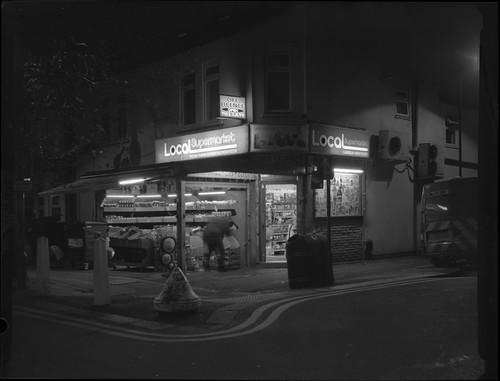
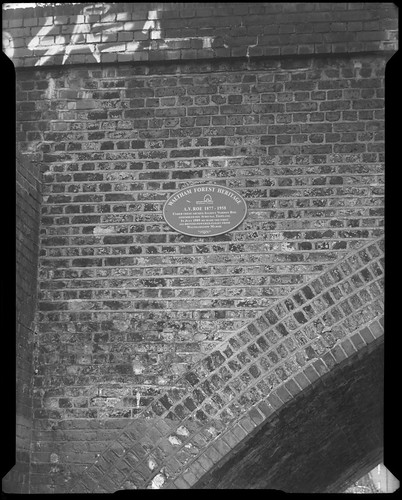
All the shots on this post were taken with a tripod. As in January, low light was a factor, but as much as the weather, being otherwise busy meant that a number of the shots were taken at home in the evening. Tuesday's photograph was taken on Fulbourne Road in Walthamstow, North London - the site of Houghton's factory - where the Ensign Folding Klito de Luxe No.9 was almost certainly made, a little over a century ago.

Monday
Tuesday
Wednesday
Thursday
Friday
Saturday
Sunday

Sunday, 27 January 2019

#FP4Party January 2019/Revisiting the Butcher's "Cameo"

Ilford FP4 shot on Ilford FP4 with Butcher's Cameo and close up lens attachment
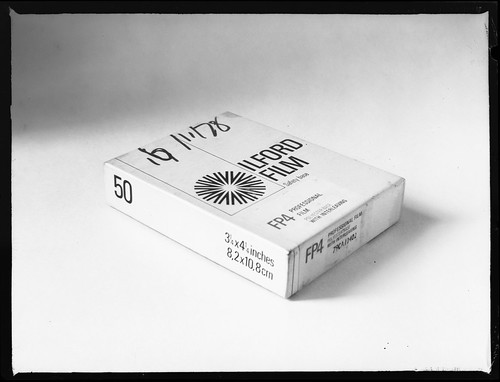
When choosing a camera for January's #FP4Party, a clear deciding factor for me was already having a fair stock of quarter-plate (8.2x10.8cm) FP4 sheet film. With one part or mostly used box of 50 and one unopened box, I decided not to buy any new rolls of FP4 and use this instead. Both boxes have a handwritten date of 16/11/78 (one box looks like it starts with 17/- which was then changed to 16); the film dates to well before the 'Plus' iteration was introduced in 1990 but I've previously used it with just one stop of extra exposure to compensate for age (I have also shot it at an exposure index of 100, and pushed the development by one stop instead). Possessing three cameras for the format: the Klito, Midg, and Cameo, all plate cameras, all of a similar age, over a hundred years old, I picked the Cameo, having used it for the first #FP4Party in September 2016, being the smallest and lightest of the three, and it seemed time to revisit it for this month's #FP4Party.

Butcher's and Sons "Cameo"
I restricted myself to expose just two sheets a day over the 'shoot week' (although on the first day I actually shot three sheets; I also didn't count the shot of the FP4 box in the total, but it made sense to photograph this on the film itself, using the lens attachment, during shoot week). Low light and short daylight hours in the northern hemisphere in January do not make for using a film rated at an exposure index of 50 necessarily sympathetic. In addition, using the Cameo handheld is not without a number of difficulties. Not entirely trusting the focus scale on the drop bed, to focus the camera using the ground glass screen requires one to use the spring clamps to position the front standard at the correct distance on the rails of the drop bed: it needs a certain amount of dexterity to put one's hand in such a way to move the front standard without obscuring the image on the ground glass with it: I miss rack-and-pinion focussing with the Cameo, particularly when using it hand-held.

Home-made ground glass screen; lens wide open
Even in relatively bright light, the Cameo's Beck Symmetrical lens produces a dim image: its widest aperture is nominally f8 (although it's most likely f7.7 when fully open beyond the f8 mark), slow by modern standards, and the screen is missing its hood to shade the ground glass, making this image difficult to assess. The ground glass was missing from my camera when I acquired it; I replaced this with some glass that I ground myself, but used too coarse a grade of grit, which adds to the difficulty in focussing. Once the image is in focus (as close as one can tell) on the ground glass, one then has to remove the focus screen and replace it with a plate holder, adjust both aperture and shutter speed to the desired settings, remove the darkslide from the plate holder, then frame the subject using the brilliant finder - and then gently press the shutter release lever. The Lukos II shutter has three 'instantaneous' speeds of 1/100th, 1/50th and 1/25th, and, while it would have been possible to get usable exposures at 1/25th, wide open on f8, for overcast, dull days, I only used the Cameo hand-held on a couple of days (Tuesday and Friday) when there was some winter sun, partly to use smaller apertures in the hope that a greater depth of field might compensate for any errors in focus.

Brilliant finder on the Cameo
For most of the shots during the week, I used a tripod or simply balanced the Cameo on a flat surface for long exposures, low-light shots, interiors and those at night. I also used the wide angle/close up lens attachment for some shots (Friday and Saturday) and the image of the box itself. I did my first batch of development during the shoot week rather than the 'development week' that followed. This acted as a check on my exposure and development regime: the first batch of film I developed with a one-top push - on top of the one and a third stop extra exposure - but developing the first few sheets appeared to show that extra development was unnecessary and the rest of the week's shots were developed in RO9 One Shot for the recommended time, 9 minutes, at a dilution of 1+25 at 20ºC.

Revisiting the Cameo, the quality of the results from the shoot week varied. Some of this was down to user error of course; other aspects were to do with the camera's limitations. When using the wide angle/close up lens attachment, there is clear vignetting, with a falling off of both illumination and definition towards the edges of the frame. This is less obvious when used as a close up attachment, as the lens' image circle would be wider the more the bellows are extended; when used as a wide angle attachment, the bellows are extended less than normal, making the image circle smaller. As well as the difficulties of focus set out above, there were also problems with film flatness (notably visible in the middle of the shot from Saturday); this might be due to the motley group of film sheathes I've been using, with some clearly home made, and others professional: some fit the sheet film better than others. The film itself stands up remarkably well: over four decades old, with only a little loss in sensitivity, the quarterplate-sized FP4 is still very usable.

Monday
Tuesday
Wednesday
Thursday
Friday
Saturday
Sunday

Friday, 18 March 2016

Expired Film Day 2016

Kodak Plus-X, develop before date of July 1972
Having missed the last couple of 127 Days for a variety of reasons, on the 15th this week I participated in the new Expired Film Day ('Take Your Box Camera To Play Day' also happens to be this weekend, 18th-20th March). I frequently use decades-old photographic emulsions, notably in glass plate night photography. I did consider shooting some glass plates on the day, but instead, as part of an unrelated ongoing project of large format photographs around Walthamstow Marshes, I used the opportunity of Expired Film Day to shoot some 4x5 sheet film with the MPP Micro-Technical Mk VI: a box of Ilford FP4 with a hand written date of 11/4/78; Kodak Plus-X with a develop before date of July 1972; and Kodak Panchro-Royal, not dated, but the box looks older than the Plus-X, possibly 1960s. I had previously tested all three films to get a usable exposure index: the FP4 was rated half box speed, while the other two were shot at an exposure index of 25.

Ilford FP4, with handwritten date 11/4/78
Both the FP4 and Plus-X provided results which do not look like forty-year old film (and as such wouldn't win the Expired Film Day prize categories 'Most Obviously Expired Film' or 'Best Use of Overexposure'), but the Panchro-Royal clearly shows characteristic deterioration with age. I used both the 16.5cm Tessar and the Bausch & Lomb Rapid Rectilinear which I've written about in the post Old Lenses; the Rapid Rectilinear is the oldest lens I have, and so it seemed appropriate to use it for the day.

Kodak Plus-X, develop before date July 1972
Kodak Panchro-Royal sheet film, possibly 1960s
There's very little information on Kodak Panchro-Royal online, and this gave the worst performance of the three films I shot (the FP4 and Panchro-Royal came from the same collection of photographic material, and may - or may not - have been stored in the same conditions). As well as having much more obvious fog, it also suffered from a good deal of cusping, the film being far from flat, and this made scanning more difficult. Some of the shots were taken using only the rear elements of the Rapid Rectilinear lens, as described in Old Lenses, as the Panchro-Royal image above, and the shot below on Plus-X. All the sheet film was stand developed in R09 One Shot diluted 1+100 for one hour, partly due to developing all the films together, but some unevenness was evident in the development discernible in the featureless skies of most of the negatives.

Kodak Plus-X, develop before date July 1972
In addition to the sheet film I also finished a part-used roll of medium format Kodak Plus-X, which had a develop before date of 03/2006 - a neat ten years out of date. This was exposed at box speed and developed in R09 One Shot diluted 1+29 for 9 minutes at 20ºC. Incidentally, I had intended to use this time and dilution with Ilfotec LC29, and only realised my mistake when the wrong developer was mixed and in the tank. However, the times and dilutions being relatively similar, I stuck with the time for Ilfotec LC29, which resulted in perfectly usable negatives.

Medium format Kodak Plus-X, develop before March 2006


Thursday, 24 December 2015

Fomapan 400

Fomapan 400 in 35mm, medium format 120 and large format sheet film
Having spent some time testing Foma's new film, Retropan 320, earlier this year, I thought I should also look in a little more detail at Fomapan 400, which I'd used in 9x12cm size sheet film with the Recomar 33, and also shot some in medium format while in Stockholm. I'd first used Fomapan 400 six or seven years ago, shortly after I'd started developing black and white films again after a gap of a few years. The attraction of Fomapan 400 was its price, at that time it was less than £3 a roll in medium format. I tried it in both medium format and 35mm: I didn't like the results of Fomapan 400 in 35mm very much, so I didn't use it again, but I did continue to use it periodically in medium format.

Foma's own reference sheet states that:
FOMAPAN 400 Action is a panchromatically sensitized, black-and-white negative film designed for taking photographs under unfavourable light conditions or using short exposure times. The film meets high requirements for low granularity, good resolving power and good contour sharpness. FOMAPAN 400 Action has a nominal speed rating of ISO 400/27º, but due to its wide exposure latitude the film gives good results even when overexposed by 1 EV (exposure value) (as ISO 200/24º) or underexposed by 2 EV (as ISO 1600/33º) without any change in processing, i.e. without lengthening the development time or increasing the temperature of the developer used.
Foma's films have suffixes for each different speed: Fomapan 400's designation is 'Action' (although this isn't used on the large format packaging). These suffixes 'Action', 'Creative' (Fomapan 200) and 'Classic' (Fomapan 100), now joined by 'Soft' (Retropan 320), don't appear to be used by photographers shooting these films, although I suppose they do function as being a little more descriptive than the nominal film speed rating. Having only used Fompan 400 in medium and large format for a few years, I thought it would be worth shooting 35mm again to make a series of tests for this blog post. Using the smaller format more clearly shows the film's characteristics in terms of grain, which was what I initially disliked about the film. As with other films, I shot a latitude test, partly due to the claims Foma makes for the film; having used the film for a number of years, I was sceptical about the wide latitude described on the data sheet as quoted above.

Fomapan 400 latitude test with R09 One Shot
The first two rows on the contact sheet above were shot with successive frames rated 50, 100, 200, 400, 800, and 1600 (both frames in the third row were rated 400). The film was developed in R09 One Shot, diluted 1+25 for 6 minutes at 20ºC. Rodinal/R09 One Shot is the main developer I use; in the past, I've read online about Rodinal not giving true box speed, especially with faster emulsions, but this isn't something that's apparent with many films. However, this may be the case with Fomapan 400: the data sheet states that the film can be underexposed by two stops "without any change in processing", but the test above shows very little shadow detail at 800, and little shadow and mid-tone detail at 1600, two stops under. The best negatives of the test were probably those rated at 200, while those at box speed appear thin. (The 400 ISO film comparison on digitaltruth.com appears to show Fomapan 400 performing worst in terms of latitude out of the five films tested, confirming the results from my own test).

I shot a second latitude test in 35mm again, but used a different developer, Ilfotec LC29, diluted 1+29 for 9 minutes at 20ºC, to compare the results against the test developed in R09. This test appears to show better latitude with the film; the strips below were exposed as in the first test, with successive frames rated 50, 100, 200, 400, 800, and 1600.

Fomapan 400 latitude test with Ilfotec LC29
This test, although scanned and therefore not a direct comparison with the contact sheet of the first test does appear to show much better latitude, although there is still a lack of shadow detail in the frames two stops underexposed.

Although Foma do not give recommendations for pushing the film, there are times and dilutions for pushing Fomapan 400 up to 3200 on the Massive Dev Chart. Rating the film at 800, I used the Massive Dev Chart timing and dilution of 19 minutes at 1+50 with R09 One Shot (the chart does not provide data for pushing the film with Ilfotec LC29).

Fomapan 400 at 800 in R09 One Shot
The results with a one-stop push in R09 One Shot were fairly encouraging, but most were shot in good lighting conditions: the photographs in fairly bright but flat lighting were easier to scan, while those with sunlight had the raised contrast typical of push processing. Some of the images appear to show a small amount of halation, or possibly irradiation, visible with the foreground post in the shot above. I then exposed a roll of the film at 1600, again with the Massive Dev Chart's dilutions and timings of 1+50 for 24 minutes.

Fomapan 400 at 1600 in R09 One Shot
Some of these frames were shot in more challenging light conditions, such as the sort of low-light scenes where pushing two stops might be necessary for hand-held photography, and the results were better than expected, although in the scanning of the negatives I did have to pay a little more attention to pulling out shadow detail. The grain did not become too pronounced, although I find Fomapan 400 to look quite 'soft' and it appears to have a less uniform distribution than other fast films, the pattern of grain clumps being what gives it a distinct look.

Fomapan 400 at 3200 in R09 One Shot
The Massive Dev Chart also had entries for a three stop push to 3200, with timings for both 1+25 and 1+50. I shot a roll of Fomapan 400 at 3200 and developed this in R09 One Shot, diluted 1+25 for 25 minutes at 20ºC; this entry has the note "high contrast" attached, but the time for 1+50 was 52 minutes, which was far too long to contemplate. At 3200 the negatives were extremely thin, most showing nothing other than highlights, with the above shot being the only frame worth scanning. After my results with the latitude test however, I did also want to try push-processing in Ilfotec LC29. With there being no times listed for push processing with this developer, I estimated, using as a starting point the fact that Fomapan 400's timings are very similar to HP5 Plus. I diluted Ilfotec LC29 to 1+9 and developed for 12 minutes at 20ºC. The results, although perhaps better than R09 One Shot, were generally thin and lacking in any shadow detail, leaving the conclusion that for Fomapan 400, rating it at 3200 is a push of one stop too far. In addition, the longer times with R09 One Shot also appeared to show increased fog - something that increasing these times even further would exacerbate.

Fomapan 400 at 3200 in Ilfotec LC29
Fomapan 400 would not be my first choice for 35mm film in the high speed range, although the results of my recent tests were better than I remember. I've been more likely to use it in medium format, which I have done off and on over the last few years, although I've found its lack of latitude to be less than ideal when shooting with box cameras with limited or no controls over exposure; other films have been better for those purposes. However, Fomapan 400's qualities as a traditional emulsion do come across in medium format, and I most recently shot some in Stockholm with one of my flea market finds there, the Agfa Isolette III.

Plaubel Roll-Op (6x4.5), Fomapan 400, Rodinal 1+25
Agfa Isolette III (6x6), Fomapan 400, R09 One Shot 1+25, 8min 20ºC
Zodel Baldalux (6x9), Fomapan 400, Rodinal 1+50, 12m15s at 19º C.
Where Fomapan 400 really shines is in large format: any reservations about the film's grain or latitude evaporate once price is taken into consideration: it's around half the price of HP5 Plus per sheet and less than a third of the price of Kodak Tri-X, and it's still relatively easy to find 4x5 Fomapan 400 in the UK. In 35mm and medium format the price differences aren't as magnified. Shooting large format with the MPP Micro-Technical, I always use a tripod, which inevitably slows down the process of taking photographs, and I've learnt to rate the film at 320 or 250 ISO (see, for example, the shots in last year's post under Old Lenses); additionally, shooting large format can be more forgiving. In contrast, I've tended to shoot my 9x12cm cameras hand held: as a European manufacturer, Foma's films are all readily available in the 9x12cm format. Even with the increased postage cost of buying the film from Europe, it's still cheaper per sheet than its competitors. On a final note, both examples of large format shots below are also taken with yellow filters.

Kodak Recomar 33 (9x12cm), Fomapan 400, rated 320, developed in Ilfotec LC29 1+29 for 9m 
MPP Micro-Technical (4x5), 150mm Xenar, rated 250, developed in Ilfotec LC29, 1+29 for 9m

Monday, 15 September 2014

Rollei RPX 25 & 400 available in large format

Casually browsing Macodirect.de last night, I saw that two of the Rollei RPX films, RPX 25 and RPX 400 are now available as 4x5 inch sheet film. These are competitively priced, not as cheap as Fomapan sheet film, but considerably less than Ilford or Kodak large format films (at the time of writing only Macodirect.de is stocking the sheet versions of the films). Of the RPX range, I have particularly been impressed by the RPX 400, which is a very versatile fast black and white film; while RPX 25 I found needed more careful exposure and development, however, as all the other slow black and white films currently available are orthochromatic (Rollei and Adox), a panchromatic 25 ISO film is welcome.

Wednesday, 27 August 2014

A job lot of films and plates


Although I haven't written about my glass plate project recently, other than advertising the talk I am giving next week, I've shot a few plates over the past few weeks, and I have been continuing to look out for boxes of unexposed plates to use. One successful online bid for a collection of plates and paper was remarkable enough for me to write a post last year about it. From that particular box, I've used most of the HP3 plates, in adaptors, notably the 6x10.8cm plates, and some of the Kodak ones, although the Kodak plates were far more deteriorated with age. Since then I've found a few boxes, but yesterday I picked up a job lot of mostly sheet film from the 1960s-70s, with a couple of boxes of plates too. It was an online auction that went for its starting price of £4.99, probably in part to being 'collection only'. Even factoring in the cost of the trip to the coast to pick the lot up, I probably would have paid that just for the two 5x4 inch plateholders on their own. The three unopened boxes of FP4 (150 sheets in total) are promising; although I won't know the condition of the film until tested, I have used several rolls of Ilford FP4 from the 1970s for a couple of the 127 Days with good results.

The contents in full:
  • 3 boxes of Ilford FP4 sheet film, one 4x5 inch, two quarterplate size (3 1/4 x 4 1/4 inch), all unopened, all with the handwritten date "16/11/78".
  • 1 box of Ilford HP4 sheet film, 4x5 inch, previously opened, a handwritten number on the box could read either "4170" or "4/70". Box label has "K66".
  • 1 box of of Ilford Ilfoline IN.5 sheet film, 4x5 inch, previously opened, box printing has "H70".
  • 1 box of Kodak Panchro-Royal 4x5 inch sheet film, unopened, no information on dates
  • 1 box of Kodak Ektachrome Type B 9x12cm colour reversal film, unopened, process before Jan 1969, handwritten date "22/10/68".
  • 2 boxes of Ilford N5.31 Fine Grain Ordinary film, quarterplate size (3 1/4 x 4 1/4 inch), both previously opened, one with the handwritten date "-/10/67", the other "11/3/70"
  • 1 box of R.10 Ilford Soft Gradation Panchromatic plates (3 1/4 x 4 1/4 inch), previously opened, label style of late 1940s-1950.
  • I box of Kodak Kodalith Ortho Type 3 Photomechanical sheet film (3 1/4 x 4 1/4 inch), previously opened, develop before date Apr 1970.
  • 1 boxes of H.P.3 plates, previously opened, label style of late 1940s-1950.
  • 2 MPP 5x4 plateholders.
  • 5 quarterplate holders, four by Klito, one AP, two containing film sheathes or septums.