Showing posts with label Voigtländer Avus. Show all posts

Wednesday, 27 November 2019

Voigtländer Avus

Voigtländer Avus
The Voigtländer Avus was my first 9x12cm format folding camera. I initially bought it as a relatively inexpensive and compact large format camera; I did subsequently buy a 4x5 camera not long afterwards, but also found other 9x12cm cameras after the Avus: the Kodak Recomar 33 (which was extremely cheap); the Ica Trona; and the Photo Plait camera (as a format, 9x12cm sheet film is still made: it's essentially the continental European metric equivalent of 4x5 inch film, although not as common). The Avus was the mid-range option of Voigtländer's stable of plate cameras, between the lower-priced Vag cameras and the top-of-the-range Bergheil: the Bergheil cameras seem to have been entirely contemporary with the Avus, while the Vag was introduced later, as a more economical option. The Avus appears to be a relatively common camera, and presumably made in fairly large numbers; it was produced from 1913 to 1934 (some sources give 1914-1935, or -1936), with some minor changes throughout the two decades of that run. My camera is the 9x12cm version that appeared in 1927, clearly identified by the centrally-positioned brilliant finder directly above the lens, rather than offset to one side, as with most plate cameras of this date. Two different origins of the camera's name are given in different sources: one suggestion is that the name is formed from the initials A.V.U.S., as seen on the ground glass back on early versions, derived from "Aktiengesellschaft Voigtländer Und Sohn"; Camera-Wiki states that it was named after an early motor racing circuit in Berlin, the AVUS, also an acronym. This AVUS was under construction when the camera appeared, but not opened until 1921, so it seems highly unlikely that Voigtländer would have been deriving some name recognition from the racetrack's popularity.

Voigtländer Avus - side view
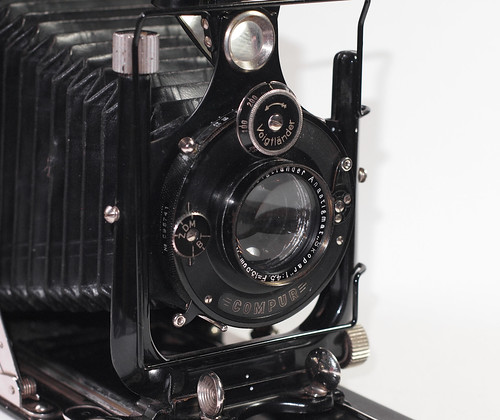
The Avus was made in a number of different formats: there is a horizontal 9x12cm plate version, a 10x15cm, one dual-format version for 9x12cm plates and 122 rollfilm, but the most common sizes are the vertically-oriented folding cameras for 6.5x9cm and 9x12cm plates. Like many folding plate cameras of its time, the Avus was provided with different lens and shutter combinations. My version of the Avus has a 13.5cm f4.5 Skopar lens, Voigtländer's own version of the Tessar, in a Compur dial-set shutter, which together would have been the most expensive options at the time.

Detail with Voigtländer Skopar lens in Compur dial-set shutter
The other features of the Avus are double extension bellows; limited movements in the form of front rise and cross; a rotating brilliant finder with spirit level, and a wire frame viewfinder. Focus is with a ground glass screen; the front standard is focussed with a rack and pinion knob, which pulls out to turn, pushing in to lock the focus. There is also a focus scale on the bed - which needed adjusting, as this was initially out of true: when first using the Avus, I relied on the infinity stop of the focus scale, and found most of the images out of focus as a result (the focus scale can be adjusted with a couple of small screws that, once loosened, can be moved backwards or forwards a small amount). The removable ground glass screen was missing from my camera; ground glass screens, unlike spring backs, have a tendency to get separated from their cameras. I made a ground glass screen from a 9x12cm film pack adaptor which came with the camera, and lacking a focus shade it does have the benefit of opening completely out, without a viewing hood, which I found useful when using the camera for night photography, but, for general use, I have tended to use the ground glass screen from the Recomar.

Avus with bellows extended
Over the years, I've picked up various 9x12cm plate holders, some Voigtländer-branded ones, a number of which came with film sheathes, essential for shooting sheet film with the camera. The Avus is compatible with all the plate holders I have, which is not the case with the Recomar. As the Avus was my introduction to large format, I experimented with paper negatives and Harman Direct Positive paper for ease of loading and development under darkroom safelights. I used a sheet of stiff card behind the photographic paper in the plateholders before I had acquired the necessary film sheathes. When I first started to shoot sheet film with the camera, I attempted tray processing, but found it too difficult to get even development with the negatives and also found it too easy to scratch the film: I had been using Foma film, which in my experience has a soft emulsion compared to others, very easy to damage while wet. I subsequently got a Combi-Plan tank to develop large format film and plates, which I have found much easier to develop sheet film with.

Voigtländer Avus - paper negative, digitally inverted
What drew me to the Voigtländer Avus was its compactness in relation to its negative size: the camera is the size of a fat paperback book. Using it handheld, my general procedure was to focus on the ground glass screen, then replace this with a plateholder or rollfilm back, and use the wireframe finder to compose the shot. I've remarked before on my preference for the dial-set Compur shutter over the later rim-set version for ease of use: when focussing with the ground glass screen, with the shutter speed set, the selector for the I/B/T setting can be quickly turned between 'T' to open the shutter and 'I' for taking the shot.

Voigtländer Avus with Agfapan APX100
I also invested in a Rada Plaubel rollfilm back for the 9x12cm format for the ease of using medium format film with the camera, with a much wider selection of films available, as well as being easier to develop.

Voigtländer Avus with Adox CHS 100 in rollfilm back
The Proxar and Distar supplementary lenses that I used with the Ica Trona - which I found at the time I bought the Trona - also fit the 37mm lens mount on the Voigtländer Avus; the Proxar lens can be used as both a close up filter and a wide angle one due to fact that it's possible to reduce the distance between the camera's lens and film plane in order to achieve infinity focus. With a full 9x12 frame, there is some vignetting and distortion towards the edges of the frame, as can be seen in the image below; a narrower aperture might reduce this somewhat.

Voigtländer Avus and Proxar with Fomapan 100
With the roll film back, the 6x9cm medium format frame, normally cropped of course, approaches an equivalent angle of view as the full 9x12cm frame without the Proxar: the two images below give a good comparison in terms of the difference the Proxar makes. On the 6x9cm frame, the vignetting and distortion lies outside the image area; it does appear to make the image softer however.

Voigtländer Avus with Ilford XP2 Super in rollfilm back
Voigtländer Avus with Ilford XP2 Super in rollfilm back and Proxar lens
In use, although the Avus is well-made, I found that the front standard on my camera had a tendency to hold the lens a little out of parallel to the focal plane, possibly due to tension or simply the weight of the bellows on the unsupported top of the front standard, with the result that the plane of focus in photographs taken with the Avus would often shift across the scene in front of the camera, less noticeable with smaller apertures of course. As well as this issue, the Skopar lens on the camera, uncoated of course, was very soft, prone to halation: this is clear in the image below with the sky backlighting the subject, creating a haze around the ruin.

Voigtländer Avus with Rollei Superpan 200 in rollfilm back
Although the Kodak Recomar 33 has a slower lens, and a simpler shutter, I have found this easier to use than the Avus. The Recomar has a triplet lens, the Radionar, which is around the same age as the Avus' Skopar, but on my cameras, it gives a better result, and so I've used the Recomar in recent years in preference: although it was my introduction to large format I found the Voigtländer Avus frustrating to use, and I never felt like I quite got the quality of the images from the camera that I felt it promised.

Voigtländer Avus with Adox CHS 100 in rollfilm back
Voigtländer Avus with Ilford HP5 Plus in rollfilm back
Voigtländer Avus with XP2 Super in rollfilm back and Proxar lens
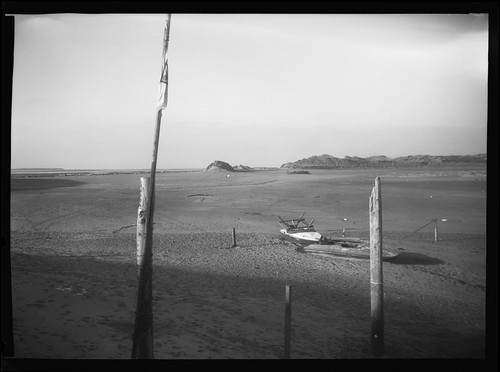
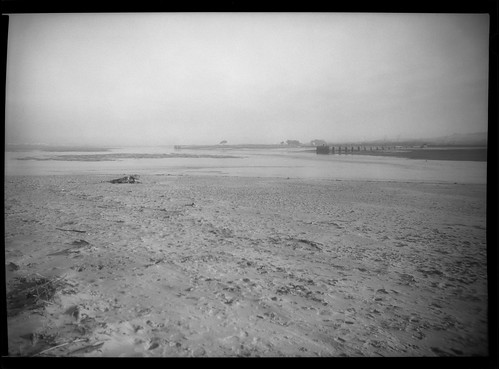
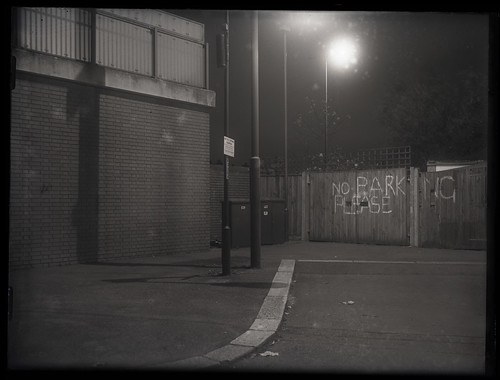
Voigtländer Avus with Ilford Soft Gradation Panchromatic glass plate (label dated to 1947)
Voigtländer Avus with Ilford HP3 glass plate (1950s)
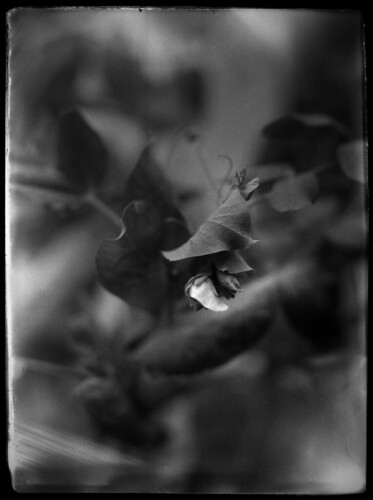
Voigtländer Avus with Ilford HP3 glass plate (1970s)
Voigtländer Avus with Fomapan 400
Voigtländer Avus with HP5 Plus
Sources/further reading:
Full range of Voigtländer Avus Models

Voigtländer Avus on Camera-Wiki 
Early Photography on the Avus
Voigtländer Avus on J. Noir Cameras
Voigtländer Avus on Collection-Appareils
Camaras sin Fronteras - Avus (with manuals and original adverts) (in Spanish)
Voigtländer Avus manual

Thursday, 13 June 2013

Recent Glass Plate Work - part two

Ensign Folding Klito de Luxe No.9
Over the past few months of looking out for unused vintage photographic plates, I have noticed that the most common size of plates to find in online auctions (in the UK at least) are in 'quarter-plate' format (3 1/4x4 1/4 inch/8.2x10.8cm). Smaller formats, like 6.5x9cm and their Imperial equivalent are also relatively common, while 4x5 inch plates are rare in comparison. I had been intending to make adaptors for my 4x5 format holders to fit the quarter-plate size, but it was as easy to buy a camera in the right format specifically to shoot the plates: the Ensign Folding Klito de Luxe No.9. This would have been a fairly well-featured hand-and-stand camera of its time. My model has an Aldis-Plano Anastigmat f6.8 lens in an Ensign-Sector everset shutter. The camera features double extension bellows, held by the distinctive hinged metal arms at each side, significant front rise and fall, and front cross movements.

Ilford G.30 Chromatic plate, Ensign Folding Klito
With the Ensign Folding Klito, I loaded a number of plate holders to test plates from some of the already open boxes in the quarter-plate size. Apart from the Ilford G.30 Chromatic plate, which I shot as a single exposure based on my previous experience of the plates (the results were more fogged than the other boxes I used), I made graduated tests with successive exposures on each plate. FP4 first appeared as a plate emulsion in 1955, and as Ilford's packaging changed around 1960, these plates could be dated to 1955-60 (Ilford didn't produce FP4 for roll film until 1968 - and according to Photomemorablia this was not the same emulsion as the plate version: the plates were rated 160 ASA post-1960, unlike the rollfilm FP4, which remains 125 ISO to this day in its 'Plus' iteration). For this test I rated the plate at 40, half its pre-1960 speed rating, and took four successive exposures.

Ilford FP4 plate, Ensign Folding Klito
I also had a box of Imperial Special Rapid plates, the test of which did not come out, and two boxes of Kodak plates, Kodak Orthochromatic plates and P.1200 Super Panchro Press. The Orthochromatic plate, below, was partially fogged from exposure to light: the dark diagonal line in the lower left of the picture is a shadow from the cardboard runner that usually holds the plates together in pairs (the rest of the box may be in better condition). The P.1200 Super Panchro Press plates have a handwritten date on the box '11/04/61'; the plate test below is fairly unpromising.

Kodak Orthochromatic plate, Ensign Klito
Kodak P.1200 Panchro-Press plate, Ensign Klito
Having shot the tests, I swapped the original Aldis-Plano Anastigmat f6.8, for a faster lens (to aid focussing in low light), an f4.5 Dominar from an Ica Ideal III, which, unusually for a 6.5x9cm camera, has a 120mm lens rather than the standard 105mm focal length for the 6x9 format.

Ensign Folding Klito de Luxe No.9 with Ica Dominar lens
Entrance to a Park, FP4 plate, Ensign Klito with Ica Dominar lens
Park at Night, Ilford G.30 Chromatic plate, Ensign Klito with Ica Dominar lens

In same lot as the quarter-plate FP4 and G.30 plates that I've tested and used with the Ensign Klito above, there were three boxes of plates, which didn't have a size on them, but were in slightly larger boxes than the others. These were 9x12cm plates, which I shot with a Voigtländer Avus with a f4.5 Skopar lens; I've also got a Kodak Recomar 33, but this has a slower lens, and less suited to night photography.

The three boxes (all previously opened) contained Barnet Line-Tone (Thin Film) plates, Ilford H.P.3 and Ilford Soft Gradation Panchromatic plates. The Barnet Line-Tone plates were too heavily fogged to scan, although an image was discernable against a bright light, from three successive exposures at 10 EI.

H.P.3 - Hypersensitve Panchromatic plates were introduced in 1943. Before the 1960 change in meter settings these were rated at 200 ASA. The box style suggests these plates are from the late 1940s to the 1950s. According to Silver By The Ton, HP4 was first produced in rollfilm as early as 1960 and sheet film in 1964: it may not have been produced as a glass plate, and it doesn't appear in the plates list in the Appendix of Silver By The Ton. The Technical Information Sheet for HP3 plates from the Ilford Technical Information Book is dated 1961, so HP3 plates were produced alongside HP4 in rollfilm for a period. For the test below, I metered for 100 EI, and took four successive exposures.

Soft Gradation Panchromatic plates were introduced by Ilford in 1928. This emulsion was later given the designation R.10, and post-1960 were rated at 100 ASA. These were the first plates I shot last year, in a smaller size, and gave good results. The box of the 9x12cm Soft Gradation Panchromatic plates has an earlier packaging style, possibly dating back to the 1940s. I metered for 50 EI, and gave the plate three successive exposures. The results were as good as the same plates from the 1960s, and suggest 25 to 12 as a usable exposure index.

H.P.3 plate test, Voigtländer Avus
Soft Gradation Panchromatic plate test, Voigtländer Avus
For the first 9x12cm glass plates I shot at night, I chose a fairly difficult subject. The lights inside the telephone exchange are very bright in comparison with the exterior of the building, which is lit from streelights partially obscured by trees. This gives the lighting of the scene a look reminiscent of being underwater. The plate might also be a little underexposed due to reciprocity law failure (for comparison I also shot the scene on Fomapan 100 film). Despite the heavily fogged Barnet Line Tone plate, I'd loaded a couple more plateholders with them, so I shot two. I scanned the best result which shows the light from the doorway just visible.

Telephone Exchange, Ilford H.P.3 plate, Voigtländer Avus
Telephone Exchange, Barnet Line-Tone plate, Voigtländer Avus


Sources/Further reading
Silver by the Ton - A History of Ilford Limited 1879-1979, RJ Hercock and GA Jones
Ilford Technical Information Book Volume 2