Showing posts with label pinhole. Show all posts

Monday, 29 April 2019

Worldwide Pinhole Photography Day 2019

Flights of Fancy pinhole camera with variable contrast paper
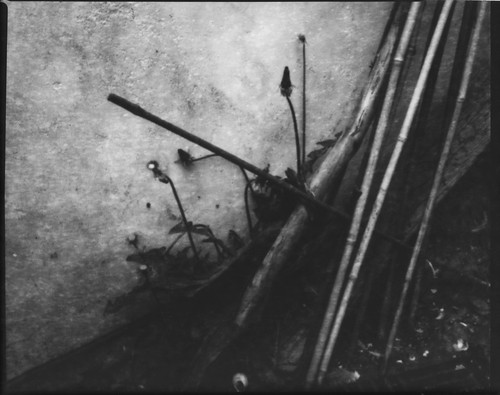
A couple of weeks prior to yesterday's Worldwide Pinhole Photography Day, I was given a Flights of Fancy pinhole photography kit, as well as an already constructed camera, which must have come from a second kit. The box itself contains everything necessary to build the camera and shoot and develop paper negatives: six sides of fibreboard that slot together to make the camera, a cover for the pinhole, a cardboard insert that the user pierces for the pinhole and which also holds the photographic paper, included, against the back of the camera for exposure. The kit contains three plastic trays, tongs, developer, fix, red gel to make a safelight and a booklet with a potted history of photography and full instructions. Although it's possible to use the camera simply held together with rubber bands, the constructed one had been glued. For the photographs, I used an already opened packet of 3x3-inch variable contrast paper which must have come with the kit of the already-constructed camera.

Flights of Fancy pinhole photography kit
I hadn't made any tests before using the camera yesterday; I also did not measure the pinhole to ascertain its f-stop, and simply made exposures based on the guidelines in the instruction booklet; the weather was mostly overcast and the recommendations given were for 60 seconds 'overcast', or two minutes for 'dull daylight'. Rather than use the trays and chemicals provided (the developer bottle rattled when shaken, indicating that some of the chemical constituents had crystallised), I stand developed the paper in Ilfotec LC29 diluted 1+100, for one hour. The instructions with the kit suggest making contact prints on the paper provided; I scanned the paper negatives instead, and these scans were inverted with Photoshop to create positives.

Flights of Fancy pinhole camera with variable contrast paper
For a beginner, within its limitations, the Flights of Fancy pinhole kit might be a worthwhile introduction to pinhole photography. Although the exposures I'd estimated were not all that accurate,  I've posted the images here as I was following the guidelines provided with the kit, rather than relying on experience, partly to test the instructions. I can also envision a few ways in which the kit could also be modified - a metal pinhole rather than black card, better seals to prevent light leaks, and a tripod fitting, for example (I rested the camera on any flat surface available during exposure, and the rubber band, around the whole body to keep the top secure meant that it did not sit entirely flat, leading to the camera shake seen in the second to last image above).

MPP Micro-Technical camera with Ilford HP5 Plus
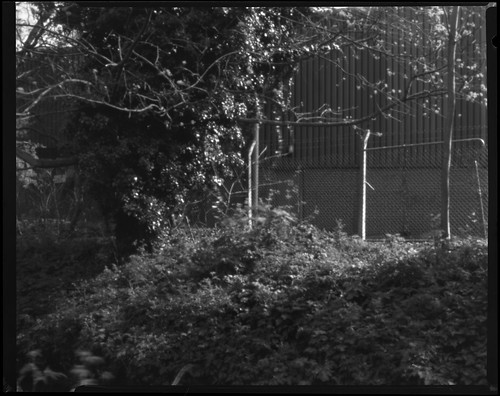
However, needing to unload and reload the Flights of Fancy box camera in a changing bag for each shot meant that I only exposed four sheets of paper with it over the course of the day; I also used a pinhole lensboard on my MPP Micro-Technical Mark VIII to shoot some paper negatives and a roll of medium format Ilford HP5 Plus. With HP5 Plus, the exposures were metered and measured out in seconds rather than minutes, the paper needed considerably longer. The weather was mostly overcast, with some very brief sunshine, at the tail end of a storm that had passed over the UK; for some shots I was concerned about wind shaking the tripod, although the softness of the pinhole images probably disguises this more than adequately.

MPP Micro-Technical camera with grade 2 Ilfospeed paper
For the paper negatives with the MPP, I used a home-made 9x12cm-to-4x5 inch adaptor; I had originally made this to use the Rada rollfilm back on the MPP with a 6x6 mask, but 9x12cm plate would also fit. Shooting long exposures outside showed that this was not especially light-tight when the darkslides of the holders were removed, and some of the paper negatives were spoiled with light leaks, present on the two images shown here to a greater or lesser degree. The paper I used for these was from an old box of grade 2 Ilfospeed resin coated paper which has a label dating to 1977; I also flashed the paper in the darkroom. As with the Flights of Fancy camera, the 9x12cm paper negatives were stand developed in Ilfotec LC29 diluted 1+100, for one hour, as a means to reduce contrast further.

MPP Micro-Technical camera with grade 2 Ilfospeed paper
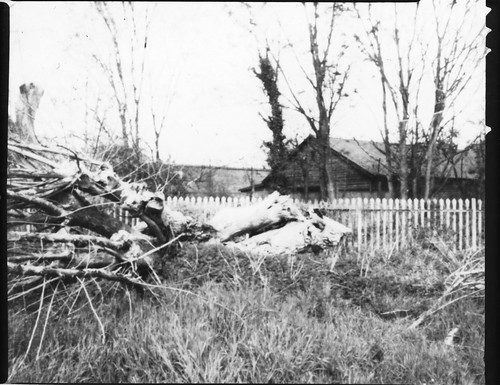
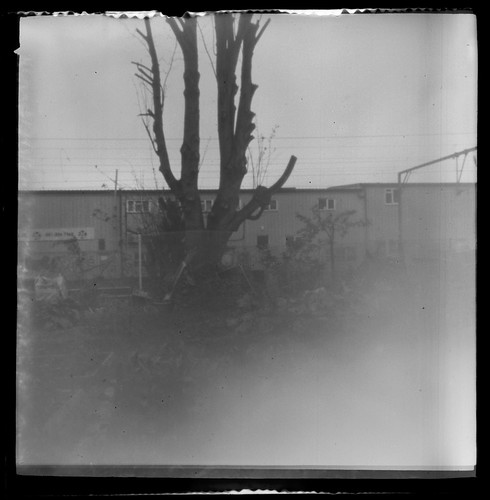
In the past when using a pinhole with the MPP Micro-Technical camera, I have tended to position the lensboard at a 'normal' focal length (150mm-180mm); when shooting yesterday, I used 50mm-75mm, partly to facilitate shorter exposure times. Although both the 9x12cm paper negatives and the rollfilm represented some cropping on the 4x5-inch format, the 6x9cm frames of the latter considerably so, at these focal lengths, all the shots could firmly be defined as wide angle. I very rarely use wide angle lenses in any format, and I did find it hard to compose the shots with this in mind; however, with the relatively short exposures provided by using HP5 Plus - in comparison to the paper negatives - that the skies have relatively good definition (which in retrospect could have been improved using a yellow filter with little effect on exposure times) almost certainly adds structurally to what the compositions are lacking in the subject matter, the one exception from these considerations being the shot, immediately below, of a tree, where the wide angle emphasises the splaying of both roots and branches.

MPP Micro-Technical camera with Ilford HP5 Plus

Monday, 28 August 2017

The Hand Inside the Frame


Earlier this year when invited to participate in the exhibition Pinhole and the Art of Invention, I instinctively wanted to turn the premise on its head (“Pinhole and The Art of Invention celebrates the art of invention and the inventiveness of artists by including photographers who build homemade cameras and mechanisms to serve a specific purpose. These innovative apparatuses will take centre stage…”), and, instead of the camera being the inventive mechanism, I wanted to use that invention as a means of showing a sequence of animated pinhole images. For the exhibition, with the pinhole as a constraint, I wanted to use the most minimal means to create a moving image, which meant using pre-cinematic optical devices that produced a form of animated image, specifically the zoetrope, flip book, and phénakisticope. Although commonly thought of as optical toys, these began as instruments to demonstrate theories around the idea of the persistence of vision. Probably the least well-known, the phénakisticope was invented first, and simultaneously, by Joseph Plateau and Simon von Stampfer in 1832 (called the stroboscope by Stampfer), based on work by Peter Mark Roget and Michael Faraday; the zoetrope (in its definitive form), designed by William Ensign Lincoln, and the flip book, by John Barnes Linnett (under the name kineograph), were both invented in the 1860s.

It struck me as a remarkable coincidence that during the same decade that photography was being invented, a number of scientists were independently investigating visual phenomena that could produce the appearance of motion from a sequence of rapidly changing still images. A primitive form of photographic animation would have been theoretically possible from its very birth - although, with the long exposure times then necessary, this would have had to have been constructed through stop motion. The use of the pinhole rather than a lens was simply a consideration in order to fit the remit of the show, but this necessity, and the long exposures that resulted from the pinhole, did provoke the idea that, given the fact that these optical devices were as old as (and separate to) photography, the ‘instantaneous’ photograph (which would become the individual frames of cinema) was not necessary for animation, that the long exposure times of the mid—nineteenth century, replicated in part by the long exposures of the pinhole, could still have created moving images. Yet the desire to do so appears to have only developed after motion had been analytically broken down by the instantaneous photograph, and the subsequent realisation that it could be recombined into movement.

The subject for the animations needed to be simple and repetitive, easy to comprehend and limited to a very few frames. As a model for animated sequences shot with a pinhole camera, I turned to the very beginnings of the moving image, and, specifically, the work of Eadweard Muybridge. Of course, Muybridge didn’t use a pinhole for any of his work, but to animate his photographs, he made a modified version of the phénakisticope, combined with a magic lantern, to project moving images with what he called the zoöpraxiscope of 1879 (these were generally painted versions, rather than photographic, stretched in order to combat the distortion of the figures caused by the rotation of the disc against the counter-rotation of the viewing slits). I had previously used photographs from Muybridge’s Animal Locomotion when at college, re-animating some sequences, in my ignorance thinking that in this I was doing something unique, ignorant of those who had done same thing before me; I had also made some flip books using photocopies taken from illustrations in Aaron Scharf’s book, Art and Photography (where I also encountered the chronophotography of Marey, although Marey is best known for using multiple exposures on a single plate, and so most of his work does not have the ease of Muybridge’s for appropriation, at least for animation). My interest in Muybridge’s work had been rekindled by the Tate Britain exhibition in 2010, which put the Animal Locomotion in the wider context of his entire career as a photographer.

Drawings after Muybridge, 1996
For the exhibition, I shot sequences based on two plates from Animal Locomotion, ‘Movement of the hand; drawing a circle’, and ‘Movement of the hand; lifting a ball’, both of which were simple, repetitive motions; the first plate was one that I had used in one of the simple animations I had made while at art college twenty-one years ago. In the original plates, Muybridge constructed his sequences from twelve images, shot from in front of the figure, and a second set from the side; to replicate or emulate these twelve shots on a continuous strip of film, with the 6x6 negative size, a roll of medium format film would provide twelve square shots. I shot the images with an MPP large format camera with a 9x12cm rollfilm back, with a mask for 6x6 negatives. I made a 4x5 to 9x12cm plate back adaptor to use this back, which changed the camera’s film plane, but using a pinhole lensboard, focus was not a consideration. The photographs were shot at a focal length of around 50mm, a wide angle at 6x6, useful as it was difficult to calculate exactly what would be in the frame. For the exhibition itself, I displayed the work in the three forms previously mentioned: my initial idea was to make zoetropes to show the sequences, which were made contact prints from the uncut strip of negatives on Kodak High Resolution Aerial Duplicating film; to these I added phénakistocopes, printed from scans, and also flip books made from contact prints on paper. The latter were the most successful for showing the sequences moving; the luminance of the image does have some bearing on how well the effect of animation was perceived, and the pinhole images I had made were not bright or clear enough for both the zoetropes and phénakistocopes. However, the best representation of these image sequences is as animated GIF files - the perfect form for short, repetitive sequences of images: at one point almost a footnote, an anachronous remnant of the early internet, now social media has made the animated GIF the perfect visual form for the easily digestible meme of the social media age.


That my own hand appears in the frame is a coincidental echo of the Moebius film made earlier this year, while the theme of emulation or re-enactment also ties it to the photograph of my hand holding a photograph in Gelsenkirchen as part of my project around Wim Wenders' locations used in his road movies trilogy in the 1970s. With all of these pieces, projecting oneself into the work, as these were all made on film, taking the photographs entirely myself, there was a difficulty of knowing exactly how much of the image was in view or in focus; someone else could have operated the camera, but it was never practical in these cases. The hand inside the frame stands in for the hand of the viewer; in these two other pieces, the camera placed to suggest a subjective viewpoint, while the pinhole animations attempted the ostensible detachment of Muybridge’s work. The invisible surface of the photograph and its ability to render texture in a close-up image provokes a desire for a tactile confirmation - the viewer wanting to touch - and the hand in the frame provides an imaginative access into this depicted realm. This may be a sublimated response, and only really relates to a certain type of photograph, but perhaps the close-up of any near object has this potential, whether the subject is animate or inanimate, one can imagine the feel of the bark of a tree, the worn surface of steps, the side of a face, a wisp of hair, or in the animations, the textures and responsive pressures of the resistance of a graphite pencil against a sheet of paper. Once made, I had the odd realisation that they (my hands) looked like the hand (or more specifically the forearm) of my father, but reminiscent of the experiences of childhood intimacy, bound up with demonstrations of dexterity - the hands of my father as he demonstrated how to do things: drawing, painting, cutting lino or wood, coupled with the idea that my hands are older now than his were when this would have been the case.


Although Muybridge himself does appear in a number of the Animal Locomotion plates, the hands in these sequences are not his. They belong to J. Liberty Tadd, the director of the Industrial School of Art in Philadelphia. One wonders if he introduced the idea of the subject of the hand to Muybridge; certainly, the plate of the hand drawing a circle has overt art historical references, most clearly to the anecdote of Giotto drawing a perfect circle freehand, a feat that Albrecht Dürer repeated two centuries later to demonstrate his parity with the artists of the Italian Renaissance. Its circularity is also ideal for the limitations of the twelve-image sequences that Muybridge was working with. Once animated and looped, the circle is infinitely drawn and erased. In my own re-enactment, I marked out twelve positions around a lightly traced circle where my hand would rest for each minute-long exposure, and in doing so made explicit an analogy to the clock, both in the motion and duration of the twelve images. The 'Movement of the hand; lifting a ball' has less immediate associations, although perhaps the clock of the previous plate has now become a globe; these exposures were two minutes long each, and with my hand unsupported for most of the shots, this time duration is more evident in the final pinhole photographs.


The two plates that I drew on for the exhibition were part of a larger sequence of five of Tadd; these five plates all appear at the very end of Part Five of Animal Locomotion, being ‘Males and Females (Draped)’. All five plates are titled 'Movement of the hand', with the explanatory suffixes: plate 532 is 'Movement of the hand; drawing a circle', 533, 'clasping hands', 534, 'lifting a ball', 535, 'beating time', and 536, 'hands changing pencil' (Part Six which follows is 'Abnormal Movements’). Having re-enacted the first two plates, it seemed logically necessary to tackle the other three plates, to complete the project outside of the exhibition; two of these, clasping hands and hands changing pencil, lack the visual clarity of the other three, in that the representation of a simple gesture or movement does not naturally form a circular unit; one plate in particular, 'Movement of the Hand; beating time', had a richness to it that merited further consideration. Intriguingly, the plate of 'hands changing pencil', although in itself perhaps the least interesting (it appears almost as if it is a preparation for the drawing of the circle - although it is in fact a different tool), in  J. Liberty Tadd’s obituary from the American Art News, in its short paragraph, among other achievements, it mentions a demonstration of ‘ambidextral drawing’ to the Royal Arts Society of London in 1891, so this plate might acknowledge Tadd’s ambidextrousness. All five plates of the hand demonstrates dextrousness of course: the fine motor skills and opposable thumbs of the human hand. That Muybridge’s Animal Locomotion is in some senses a comparative anatomy, one could infer that evolution might be an implied, unconscious subject.


Plate 535, the 'hand beating time' plate clearly suggests music - and therefore sound. A few of the Animal Locomotion sequences explicitly do suggest the idea of music in mind of the viewer, namely those of figures dancing; less than a decade after Animal Locomotion, under the aegis of Thomas Edison, William Kennedy Laurie Dickson’s ‘Experimental Sound Film’ of late 1894 or early 1895 achieved the feat of recording sound and moving images simultaneously, showing Dickson himself playing the fiddle into a phonograph while two men dance. Sound was present from the very birth of cinema, and all through the silent era (the 'silent era' was of course never silent) there were numerous attempts to record sound simultaneously with the images; although the problems with synchronising playback were not conquered until the development of sound-on-film (the earliest successes with ‘talking pictures’ did in fact use sound-on-disc), amplification was as much an issue as synchronicity. I emulated the positions of Tadd’s hand through this sequence rather than beat time itself, given the long exposures. Was Tadd beating time to a tune in his head - or to music provided by one of Muybridge’s assistants? (It would be too fanciful to suggest that he was beating time to music being played on an Edison phonograph; a few short decades later, silent films would use music on set to create an emotional atmosphere for actors - ‘silent’ film sets were themselves notoriously noisy, and in larger, open studios several different scenes might all be being filmed at the same time). Although there is no possibility of reconstructing a tune, Tadd’s hand appears to be beating in triple-time - not itself surprising given the date of the sequence, but I was struck how strongly the visual rhythm suggests this.


Muybridge and Edison met in 1888. Muybridge’s account of the meeting suggests that they discussed using Edison’s phonograph to accompany his zoopraxiscope, although, with the very short duration of Muybridge’s sequences, logically, the phonograph would have needed to simply produce a short loop of sound if these were to be synchronised; the phonograph’s two minutes of recording time must have seemed vastly expansive to Muybridge. The form of the phonograph - a cylinder with a linear, spiral track - informed Edison and Dickson’s initial approach to moving pictures: a glass cylinder with microscopic frames arranged in a spiral. However, after Muybridge, Edison met Marey in 1889, by which time Marey was working with rolls of film rather than fixed plates. Thus Muybridge’s closed, circular motion in the zoopraxiscope led to an open, cylindrical motion, to the linear motion of a continuous strip of film of (theoretically) unlimited length. This was also a transition from the inflexible glass plate to flexible celluloid film (via some experiments with paper) and a host of other inventors (Janssen, Anschütz, Le Prince, Friese-Greene, Donisthorpe, to name a few), as detailed in Rudolf Arnheim’s ‘The Thoughts that Made the Picture Move’.

Muybridge's photographs were cropped significantly for publication in Animal Locomotion: the frame was imposed retrospectively, and what we see in the neat modernist grids of the published plates is not the whole photograph. The cyanotype contact prints of the photographs that make up the 'Movement of the hand' series show Tadd as a half-length figure, with a hat shading his face against the sun. As with almost all early cinema (and proto-cinema), Muybridge depended on natural light for his sequence images; although the dark, gridded background appears airless, the grid itself was an open screen of twine: in some of the oblique views it's possible to perceive this background as a shallow space beyond the grid that it is possible to enter, not merely the limit of the picture in depth. That the 'Movement of the hand' plates have a unique position in the Animal Locomotion as a whole is emphasised by the fact that these five plates (as “Class 9. Movements of a man's hand”) were available as one of the separate sections when Muybridge reissued Animal Locomotion at the time of the 1893 World's Columbian Exposition in Chicago, which had a ‘Zoopraxigraphical Hall’ where he lectured; there is some dispute over whether Edison demonstrated his Kinetoscope at the fair or not. The 'Movement of the hand' plates do not appear to have been translated into zoopraxiscope discs for projection, but one particular aspect of the sequences does foreshadow cinema: they are the only plates which could be said to constitute a close-up in the whole project. David Campany describes the close-up, along with montage, as part of the distinguishing grammar of cinema, and, that, “…as Beaumont Newhall noted in 1937, ‘photographs of portions of objects (close-ups) were most uncommon before the moving picture.’” This uncommoness is represented in Muybridge's distinct five plates of the 'Movement of the hand':
The close-up can show us a quality in a gesture of the hand we never noticed before when we saw that hand stroke or strike something, a quality which is often more expressive than any play of the features. The close-up shows your shadow on the wall with which you have lived all your life and which you scarcely knew; it shows the speechless face and fate of the dumb objects that live with you in your room and whose fate is bound up with your own.
Béla Balázs, Theory of the Film

Bibliography

Hans-Christian Adam, Eadweard Muybridge: the Human and Animal Locomotion photographs, Taschen, Köln 2014
Rudolf Arnheim, ‘The Thoughts that Made the Picture Move’, in Film as Art, Faber, London 1958
Béla Balázs, Theory of the film: character and growth of a new art, translated from the Hungarian by Edith Bone, Dover Publications, New York 1970
Philip Brockman, Eadweard Muybridge, Tate, London 2010
David Campany, Photography and Cinema, Reaktion Books, London 2008
Kevin MacDonnell, Eadweard Muybridge: The man who invented the moving picture, Weidenfeld and Nicolson, London 1972
E. J. Marey, Movement, translated by Eric Pritchard, D. Appleton and Co, New York 1895
Eadweard Muybridge, Descriptive Zoopraxography, Lakeside Press, Chicago 1893
Aaron Scharf, Art and Photography, Allen Lane, London 1968
Rebecca Solnit, River of Shadows: Eadweard Muybridge and the Technological Wild West, Bloomsbury, London 2003
Spencer Sundell, The Pre-History of Sound Cinema, Part 1: Thomas Edison and W.K.L. Dickson
J. Liberty Tadd obituary, American Art News

Monday, 17 April 2017

Pinhole and The Art of Invention

To coincide with this year's Worldwide Pinhole Photography Day (on Sunday April 30th), I will be exhibiting in Pinhole and The Art of Invention. Curated by Anthony Carr, and is part of the London Pinhole Festival, an annual photography festival dedicated to pinhole photography. The main London Pinhole Festival exhibition will be held at the Four Corners Gallery. For more info on the festival visit the LPF Facebook event page.

Timelapse Pinhole Camera Mechanism Mark V by Anthony Carr
Pinhole and The Art of Invention celebrates the art of invention and the inventiveness of artists by including photographers who build homemade cameras and mechanisms to serve a specific purpose. These innovative apparatuses will take centre stage and be given the limelight their ingeniousness deserves. Just for a change this exhibition champions the cameras behind the images.

Exhibitors 
Daniel Berrange
Anthony Carr
Andrew Chisholm
Nicholas Middleton
Howard Moiser
Emma Simpson

The exhibition opens to the public on Friday 28th April (6.30-8.30pm). The show continues until Saturday 20th May.
Monty's Gallery is at 45 Exmouth Market London EC1R 4QL (located in the basement of Barber Streisand).
Open 11am-8pm Monday-Friday, 11am-6pm Saturday and 11am-5pm Sunday.


Saturday, 31 December 2016

Photographic Objects

"A forward-thinking young man"
For my last post of the year, I wanted to reflect on some work that I exhibited during 2016; I have only very rarely exhibited photography (other than online) but this year I made a number of 'photographic objects' for exhibitions to which I was invited to contribute. As these were all created with chemical photography, the work falls under the remit of this blog.

Invited to contribute to the exhibition Art:Science:Life by Dr Lucy Lyons at the Ipswich Art School Gallery, the brief was to respond to an object in the adjacent Ipswich Museum's collection, and make a piece of work which could take the original object's place in the museum, while the object itself would be displayed in the art gallery next door, along with the information about the artwork, under the banner of 'Curated Responses', alongside a number of other invited artists.

Curated Responses
I chose the two aircraft recognition sheets from the Ipswich at War gallery in the museum. These were printed on some form of translucent material, which provided the initial inspiration to form my response. A number of years ago, I had read H.G. Wells' novel The War In The Air and was struck by its prescient qualities. My first thoughts were to use this, the book itself, as an object to make a painting, but on reflection, a much more apposite approach was to echo the material qualities of the objects I had chosen. To this end, I used Kodak High-Resolution Aerial Duplicating film to make contact prints of the cover and colophon of my paperback of the novel: not only did the film have a similar look to the aircraft recognition sheets, it was also manufactured to duplicate aerial reconnaissance photographs. Asked to write a statement for the 'Curated Responses' room, I provided the following:
H.G. Wells' novel The War In The Air was first serialised in 1908. Written before Louis Bleriot's successful cross-channel flight, it imagines a war in the near future in which flying machines are decisive; the use of aircraft in the two World Wars, renders aspects of Wells' speculative future prophetic. Taking the cover and the title page (with the reverse showing the original publication date) from a paperback edition of Wells’ book, I made contact prints on Kodak High Resolution Aerial Duplicating film. This high contrast film is designed to make positive and negative duplicates from high resolution aerial photographic negatives; its transparent qualities mimic the aircraft recognition sheets from the Second World War that Wells would live to see.

"A forward-thinking young man"
I called the piece "A forward-thinking young man" from a quote in the book about the protagonist that could equally be applied to Wells himself.

At the Doomed Gallery in Dalston, for the London Pinhole Festival in April to coincide with Worldwide Pinhole Photography Day 2016, I showed a small set of pinhole images, shot two years earlier, presented as positives on glass, appropriate as the original negatives were made with glass plates.

“Talking about pinhole photography with security guards in the park”

I titled the piece, “Talking about pinhole photography with security guards in the park” to relate it directly to my experiences of taking the photographs, rather than what they might show. The work was accompanied by a statement which read:

Related to an ongoing series of photographs using previously unexposed vintage photographic glass plates, for 'Worldwide Pinhole Photography Day' in 2014, I shot a number of photographs using homemade pinhole cameras around the London 2012 Olympic Park. The photographic plates used in the pinhole cameras were Ilford Special Lantern plates, designed to make glass slides for projection, coated in 1965. These were developed as negatives and then contact printed on Ilford N.50 Thin Film Half Tone plates (from 1957) to create positive transparencies on glass for display. The title is a reference to the photographer’s aberrant behaviour and its being outside the sphere of reference of those in authority.

For the positives, created simply by contact printing the original pinhole glass negatives, I used orthochromatic plates so I could work under red lights and develop by inspection. As the physical qualities of the plates themselves seemed important, especially their fragility, I wanted to display these in such a way as to allow the viewer to inspect the plates closely. I could have shown the positives on a light box, but I felt like this would have diminished some of those qualities that I wished to emphasise, so I constructed a shelf which would hold the glass plates upright, projected a short distance from the gallery wall. The lighting was not entirely sympathetic, but this did have the effect of making the viewer look at the plates all the more attentively in order to comprehend the images.
Prototype for a Photographic Object
I returned to using the Kodak High Resolution Aerial Duplicating film for an exhibition called Machine Flight at the Pictorem Gallery in November. Close to the gallery in Walthamstow, there was the ideal source material in locations on Walthamstow Marshes. I took an initial set of photographs on 'Expired Film Day' of the railway arches where A. V. Roe built and then flew the first British aeroplane on the marshes in 1909; I shot the photographs on 4x5 film with a lens that could have been used at the time, a Rapid Rectilinear. I returned to take a second set of photographs of an adjacent feature on the marshes, known as 'bomb crater pond', less than a couple of hundred metres from the railway arches. This pond was created by the impact of a V2 towards the end of the Second World War. It seemed too appropriate a coincidence that within a generation from the first heavier-than-air powered flight, the space age was born, and that this would come together on an otherwise unremarkable patch of north London.

I shot the photographs on FP4 and Plus-X from the 1970s, and contact printed these negatives on a continuous strip of the High Resolution Aerial film, eighteen images, the whole length of positive film being around 2.5 metres long in total. Given how this aerial film would have been originally used, I made a device a little reminiscent of a microfilm reader, allowing the viewer to scroll through the images sequentially, forwards and backwards; I titled this a prototype, as its Heath Robinson construction would ideally have been improved.

Saturday, 30 April 2016

Worldwide Pinhole Photography Day 2016

Harman Direct Positive Paper
Last weekend, for Worldwide Pinhole Photography Day, I shot exclusively large format film and paper. Using a pinhole lensboard with my MPP Micro-Technical camera provided more flexibility than the cardboard cameras I'd made two years ago to shoot glass plates, four cameras constructed in two different sizes. In order to shoot more than just four pinhole photographs, I had taken boxes of plates and a changing bag with me to reload the cameras; the limit to using large format was how many 4x5 film holders I had. I made a pinhole using a piece of metal from a drinks can and rotating a needle to pierce it, fitting it behind a home-made lensboard. Measuring the hole by scanning it at maximum resolution gave a measurement of 0.2mm, although as I could only measure this down to one decimal place, it provided a margin of error to all other calculations. At a focal length of 150mm, this provides an aperture of f750. I shot some test photographs with this pinhole to find the resulting images less sharp than anticipated, realising afterwards this was due to the diffraction effect provided by small apertures.

MPP Micro-Technical Mk VI with pinhole lensboard
The website Mr Pinhole has a useful table to help calculate an optimum pinhole size for a given focal length. At 150mm this was given as 0.5mm. Carefully enlarging the pinhole and measuring it a few steps at a time, produced a pinhole of 0.6mm. At 150mm, this would be f250; extending the bellows to 180mm would mean f300, both convenient round numbers. The lensboard could be placed anywhere on the triple extension of the MPP, but short focal lengths would mean a loss of detail due to too wide an f-stop (as well as showing the folding bed in the frame), and long focal lengths a loss of resolution due to diffraction again, as well as increasingly long exposure times. Ideally, one could make a number of pinholes with optimum sizes for a number of focal lengths, but I used one, mostly at a focal length of 150mm, with only a couple of shots at 180mm; it was easier to conceptualise each picture at a 'standard' angle of view as the ground glass couldn't be used.
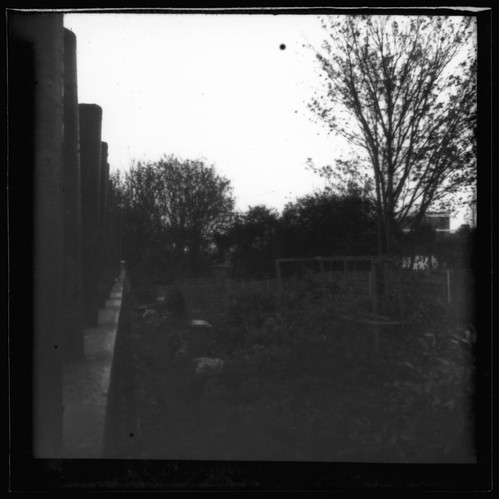
Ilford FP4 with handwritten date '11/4/78', shot with 180mm focal length
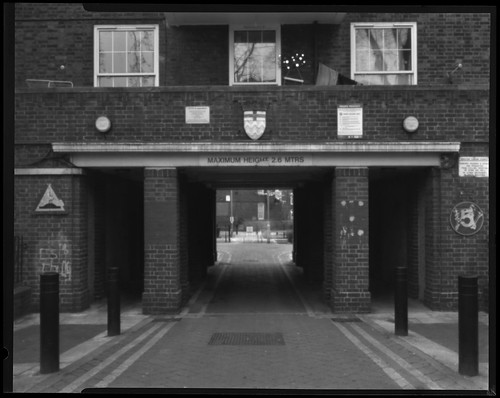
Initially, I had considered only using Harman Direct Positive Paper, but after testing the paper the day before with rather mixed results, I decided to shoot film as well, using the FP4 and Plus-X from the 1970s that I'd shot on the recent Expired Film Day (I did also shoot a handful of glass plates but found these harder than the Direct Positive Paper to get a decent image with the pinhole I had made). The Direct Positive Paper I shot was over five years old, and the developer I used, PQ Universal, was probably as old, if not older, an unopened bottle having been given to me some years ago. I developed the paper in a tank like film rather than in trays, so I wasn't able to inspect the process, but even with developing times around ten minutes, the darkest tones never quite got dark enough. In addition, getting the exposure right with Direct Positive Paper is difficult enough given its high contrast, compounded by rapidly changing lighting conditions in the morning, with broken clouds moving quickly across the sky, as seen in this shot on FP4 with an eight second exposure.

Harman Direct Positive Paper
With relatively long exposures at an aperture around f250 and shooting the paper with an exposure index of 3, a number of shots were complicated by the light changing during the exposure itself: with exposure times in full sun calculated at around 90 seconds, I had a more than one shot when part-way through an exposure, the sun would disappear behind a cloud, and I had to try to re-calculate how much to extend the exposure with the light levels dropping three or four stops, as in the image above, and mostly erred on overexposure, with which the paper very quickly loses all highlight detail.

Harman Direct Positive Paper
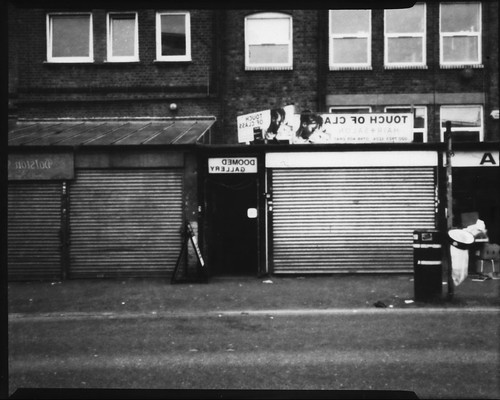
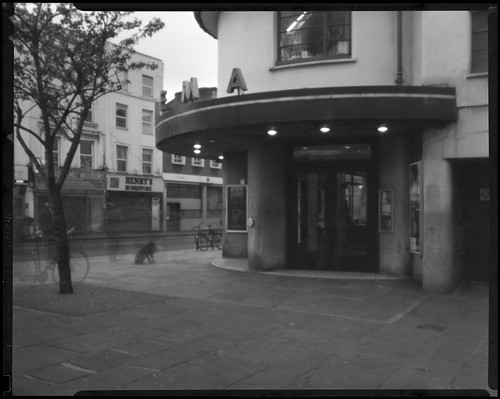
Later in the day, conditions became overcast, which made using the Direct Positive Paper easier, not only with more consistent lighting, but also being inherently lower contrast. The images above, and at the top of this post, were taken in such lighting. The Direct Positive Paper does give a reversed image, which might mean avoiding shots with lettering being prominent; I shot the exterior of Doomed Gallery as I had an exhibit in the London Alternative Photography Collective exhibition over the weekend as part of the London Pinhole Festival - glass plate positives of the negatives shot on Worldwide Pinhole Photography Day two years ago. I also made another exposure on FP4 film as a comparison. As well as exposures in seconds rather than minutes, using film, even out of date film rated 64 and 25 for the FP4 and Plus-X respectively, both film's latitude and reciprocity failure helped achieve more consistent results.

Ilford FP4 with handwritten date on the box '11/4/78'
Kodak Plus-X, develop date before July 1972
See the whole set of pinhole photographs here.

Thursday, 28 May 2015

Worldwide Pinhole Photography Day 2015

Ilford Special Lantern Plate
Having made four pinhole cameras for last year's Worldwide Pinhole Photography Day, it was simple enough to use these again for this year's event on 26th April. I had made the cameras to use glass lantern plates in two different sizes, 8.2x8.2cm and two-inch square plates. Unlike last year, where I had an encounter with security staff in the Queen Elizabeth Olympic Park, this year I just shot the plates at home and while working on my allotment.

For the small cameras, I used Ilford Special Lantern plates, the fastest lantern plates that Ilford manufactured, and the plates that I used were of 'soft' contrast grade; I've used these plates fairly often before, and not just with pinhole photography. The box that the plates I used for this year's Worldwide Pinhole Photography Day had a leaflet inside the box dated to 1966, and in common with other boxes of Special Lantern plates, the emulsion has lasted well. However, I did have problems  with fogging, possibly a light leak as this shows up in the bottom right corner in most of these plates.

Ilford Special Lantern Plate
One feature of the emulsion used for lantern plates is that it is 'ordinary' or blue sensitive. In the still life photograph above, the yellow of the lemons is rendered as dark, if not darker, to their green leaves (this plate was also underexposed). For most of the pinhole photographs taken with the lantern plates, this has little directly observable difference from panchromatic emulsions, but with a high-key local colour, such as with the lemons, it is striking in comparison.

Ilford Special Lantern Plate
For the larger cameras, I used Kodak L5 Warm Tone plates, having used all my Ilford plates in the 8.2cm size. I'd shot a test plate from the box last year, so I anticipated the results. The Kodak emulsion has suffered more from age in comparison to the Ilford plates, and appears higher in contrast. The plates were all tray developed by inspection under a red safelight in RO9 One Shot, diluted 1:120.

Kodak L5 Warm Tone Lantern Plate
See the whole set of photographs here.
Worldwide Pinhole Photography Day website.

Thursday, 17 March 2011

Anthony Carr, A Month of Nights, Format Festival Derby


The above image shows one of artist Anthony Carr's pinhole cameras, disguised as, or protected from the elements in, a bird box. Over a number of recent projects and exhibitions Carr has developed pinhole cameras with a shutter driven by a clockwork mechanism which controls the exposure of the film inside. For the Format Festival Carr is exhibiting a number of prints from these cameras placed around Derby which recorded images on film at night, over the course of a month, as well as having installed cameras to expose film for the duration of the photography festival itself.


At Pickford's House until 17th April 2011


Format Festival Derby


Anthony Carr on Axis


Images ©Anthony Carr