Sunday, 21 October 2018

Ilford XP2 Super - Part Two

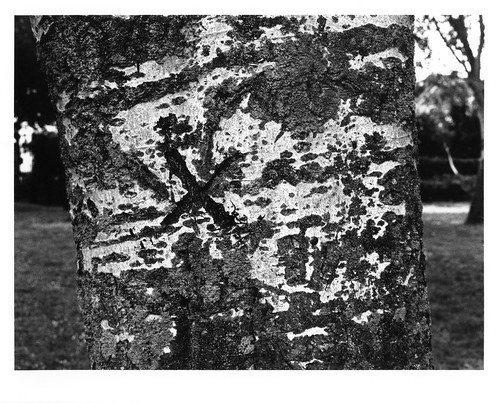
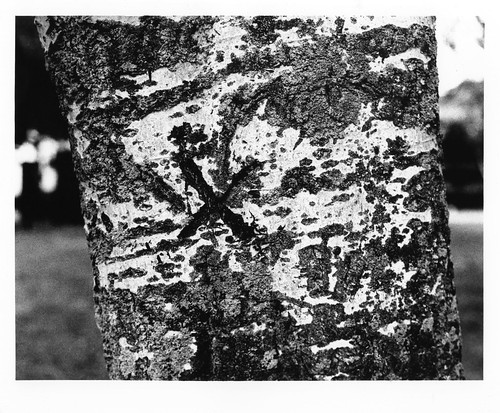
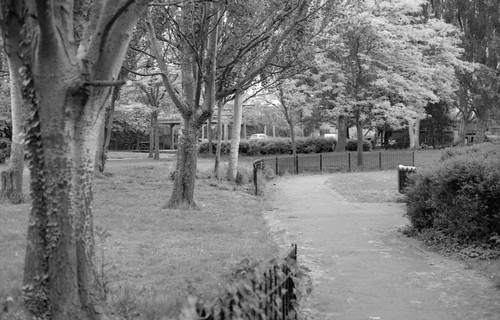
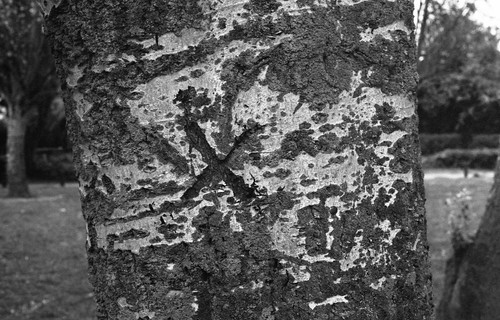
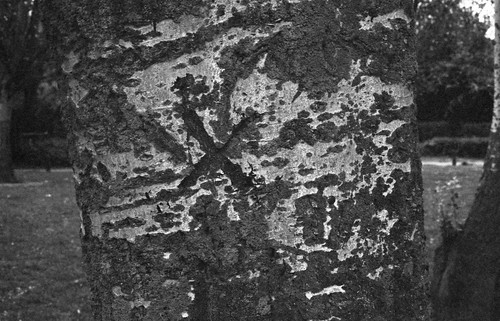
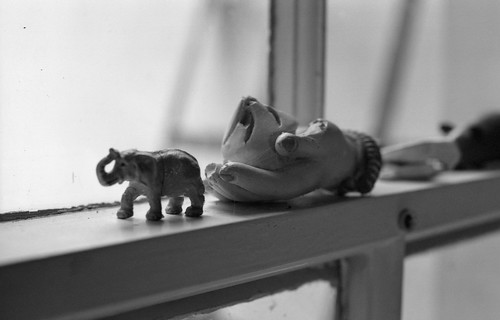
First roll of Ilford XP2, shot with Praktica BCA, July 1994
In my previous post, part one of Ilford XP2 Super, I revisited a film that I had used more than any other for a few years when I didn't have access to a darkroom, and had my interest rekindled by buying a cheap batch of just-out-of-date film. The current version of Ilford's chromogenic film, Ilford XP2 Super, is twenty years old this year; I had first used the previous named iteration of the film, XP2, in 1994 (it was 'updated' in 1996 with no name change to indicate this); in the course of my research for writing about the film, I scanned some of the negatives and prints from the first photographs I'd taken with Ilford XP2, but decided that some of that material would be better as a  separate post, with a more personal reflection on using the film; at the same time, in the interval, I also had the chance to make some prints in the darkroom from some of the tests I had shot for the first post.

In part one, I made two sets of latitude tests, and compared Ilford XP2 Super processed as C41 to that using a traditional black and white film developer. Those comparisons were made from assessing the contact sheets and scans from negatives, but I did feel that I should also make a comparison with printing from the negatives. This confirmed my first results, but perhaps the differences were even more marked. All the prints I made used Kentmere VC Select paper without using Multigrade contrast filters, thereby rendering the paper at a grade 2 contrast: this appeared to be ideal for neither set of negatives - too low in contrast for the C41 negatives, too high for the black and white developed ones.
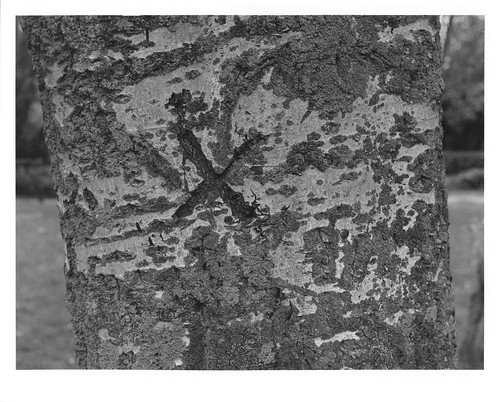
Ilford XP2 Super, rated EI 400, C41 process
Ilford XP2 Super, rated EI 400, developed in Fomadon R09
The comparisons when rating the film as low as 50 varied even more. As Ilford suggest with XP2 Super, it can be rated at EI 50 for 'finest grain'; this also reduces the contrast further. Developed in R09, essentially the opposite effect is achieved: the appearance of grain is more prominent and the highlights start losing detail, adding to contrast.
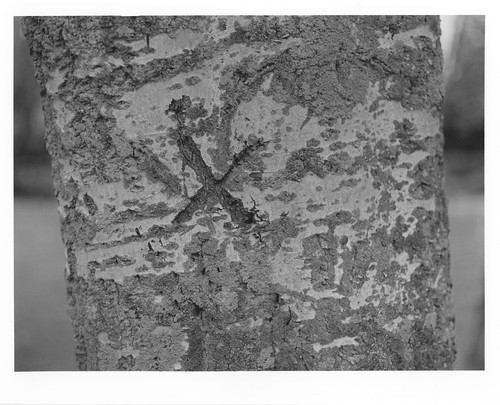
Ilford XP2 Super, rated EI 50, C41 process 
Ilford XP2 Super, rated EI 50, developed in Fomadon R09
As the scans from the negatives seemed to indicate, from making prints in the darkroom, the practice of rating the film at EI 50 for 'finest grain' does also appear to reduce sharpness; there is nothing to be gained in rating the film at EI 50 if developing it in black and white chemicals - the best results I achieved were at exposure indexes of 200-400. The grain with black and white chemicals was fairly consistent, perhaps even a little more apparent grain than one might expect with a 400 ISO film, but this might be more prominent due to the relatively high contrast of the images, which in itself exaggerates grain.

As I wrote in the previous post, one of the chief advantages of using XP2 is that, as it is designed for the C41 process, it can be developed at any lab that processes colour negative film, and so it would be possible to produce proof prints for a whole roll of film in an hour. However, in my experience from using XP2 over many years, relying on the standard C41 lab prints, the results would often vary widely. When I first used XP2, I would take it to Boots for developing; generally, they used to provide very warm sepia prints, at least in the 1990s. Later, using Kodak processing via a big supermarket chain, I would often receive prints with much cooler colours in a blue-tinted monochrome. Sometimes though, the prints from a lab would come back with a colour cast varying from orange to green to magenta across a single print as in the example below; sometimes shop prints might have as good as no detail in the highlight areas, or, more commonly in my experience, the midtones and shadows might be compressed.
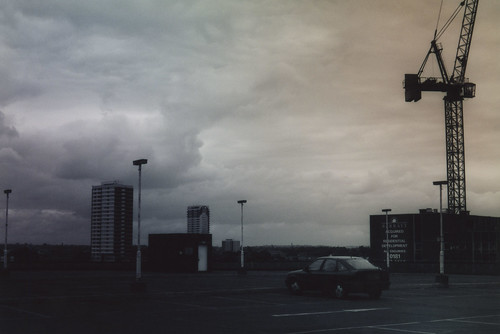
Ilford XP2 Super - scan from lab print
Ilford XP2 Super - scan from negative
At the time that I was using Ilford XP2 regularly, I often used the resulting lab prints as reference material to make paintings from. To begin with, these were often from enlarged photocopies, then from scans of the prints, which at times became quite elaborate, sometimes numerous photographs joined together in a seamless fashion digitally as a basis for the more complicated paintings that I was doing. As can be appreciated from the comparison above, the variations in the prints do make a large difference - the print has very little shadow detail, and the colour cast also affects tonal relationships - and as such, this could be a problem when working from lab prints. Scanning from the negative above has pulled out all the available shadow detail, while retaining the modelling in the sky, producing a much more usable image.
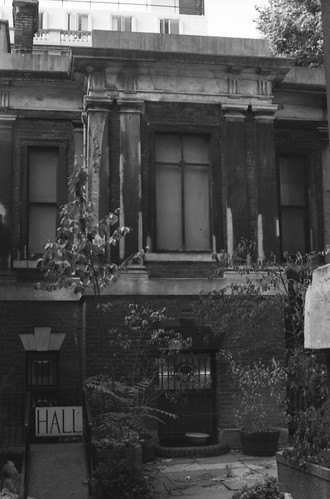
First roll of Ilford XP2, shot with Praktica BCA, July 1994
In the summer of 1994, I bought a secondhand Praktica camera body - a BCA for £26, my second 35mm SLR camera, which would be my main camera until I replaced it with a Canon A-1 in 2001 (it was my only SLR, which was later supplemented by a Zeiss Ikoflex Ic, an Olympus Pen EE3 and a Kodak No.2 Brownie). The reason for buying a Praktica BCA was, as well as being cheap, that I already had a lens from my previous 35mm SLR, a Praktica BC1, as written about in the post Twenty Years Since. That summer, with my new-to-me Praktica BCA, between college courses and without access to a darkroom, I could get XP2 developed for the same price as colour film and with the same turnover time, in comparison to normal black and white film, which I'd just started to use over the previous few months. Ilford XP2's other distinct characteristics - its fine grain for a fast film, its latitude - were not considerations at the time: cost and convenience were the main reasons for choosing it. There were two photographs on XP2 from that summer which I still have as both the original lab prints, and as prints I'd made myself in the darkroom a year later; from the negatives, I made scans of  these as a point of comparison to the two very different prints.
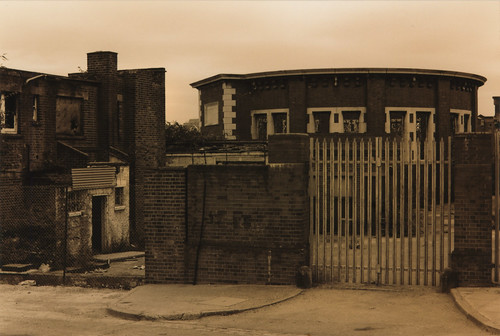
Praktica BCA with Ilford XP2, scan from lab print
Scan from print on Jessops VC paper
Scan from negative
In the original lab prints, the low contrast of the XP2 negatives appears to be a little problematic: detail in the highlights is retained, while compromising the relationship of the mid-tones to the shadow areas. However, I do remember that I liked the sepia effect of the monochrome prints on colour paper, and this was something I used in a number of collages I made at the time, incorporating these prints. These were from the first rolls of XP2 that I shot, and I didn't experience the variability that was possible in lab prints of the film until some years later.

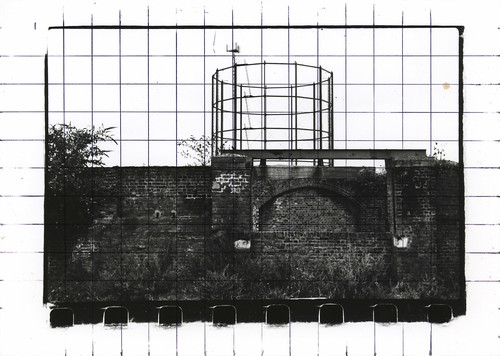
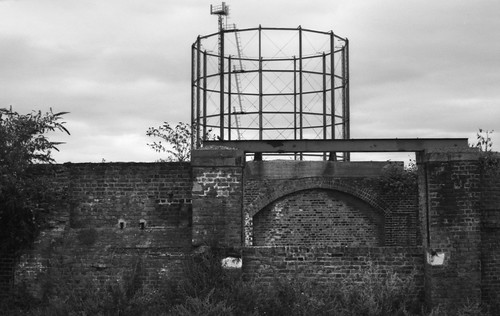
I had used significantly more contrast in the darkroom prints made in 1995, and, although I was probably happy with the results then, I am less keen on the blank skies now, and would probably try to retain detail through burning or split grade printing, or a combination of both. I had also made my own negative carrier in order to show the edges of the negative and a part of the perforations at the bottom edge of the image, something I now think of as an affectation - no doubt I had seen this effect in a book and had wanted to emulate it. The darkroom print from the photograph below is squared up with a grid to use the image as reference for a painting - and subsequently used for a second painting, too. Coincidentally, this location with the gasholder was photographed for the cover of the Tyrrel Corporation's single 'You're Not Here' with the two band members sitting on the low wall in front of the arch. The single was released in 1994 and I remember flyposters advertising it on hoardings in Ilford town centre around the time I took my photograph below: also, coincidentally, the cover of the single and the images on the posters happened to be in sepia.
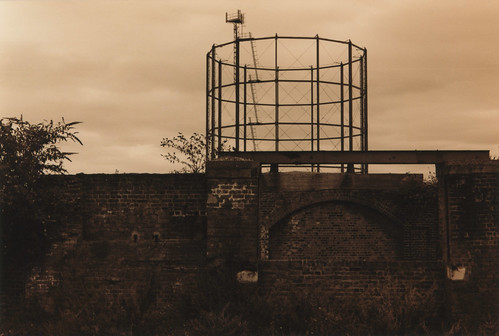
Praktica BCA with Ilford XP2, scan from lab print
Scan from print on Jessops VC paper
Scan from negative
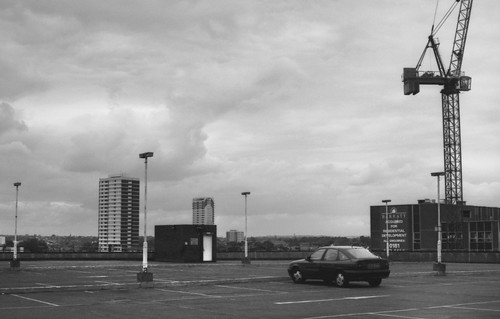
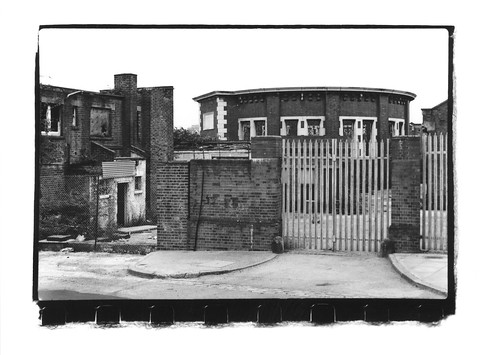
After scanning the original negatives of these two photographs alongside the two different prints, I had the idea to revisit these two locations this summer, to photograph them again on Ilford XP2 Super, twenty-four years to the day. I had thought that these images had come from my first roll of Ilford XP2, but, on closer inspection of the dates and diary entries, these turned out to be from my second roll of the film. The first had been shot over the preceding two weeks, including the shot at the top of this post, but I did get both rolls processed at the same time - at Boots in Ilford, of all places - I had handed in the first roll beforehand, to Jessops I believe, but they returned the film undeveloped, telling me that they couldn't process it (perhaps they had been thinking of XP1, which had its own developer), at which point I took the two rolls to Boots: Ilford XP2 provided them without any difficulties, and I had Boots process a few more rolls of film after that.

As I no longer have my Praktica BCA, I used a Zenit 11 in order to shoot with a screw-mount 50mm f1.8 Prakticar lens - the same lens as used on the BCA (which would have been a Praktica bayonet mount of course, but the lens design would be the same; at the time I only had the standard 50mm lens; later I would get a 28mm and a 70-210mm zoom). The weather twenty-four years ago had been overcast (my darkroom prints made a year later simply omitted the cloud detail in the negative through using high contrast filters); shooting the same subjects this summer, at the tail end of the longest heatwave for forty-two years in England, the weather was unfailingly sunny.
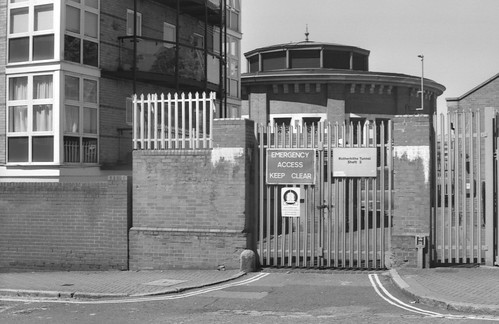
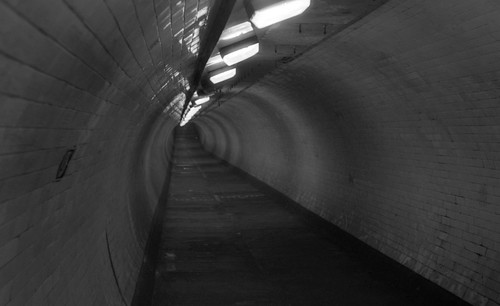
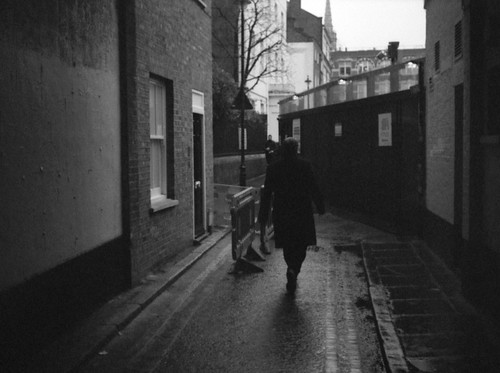
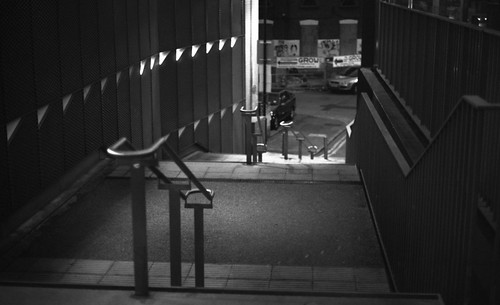
Rotherhithe, August 2018; Zenit 11 with Ilford XP2 Super
Rotherhithe, August 2018; Zenit 11 with Ilford XP2 Super
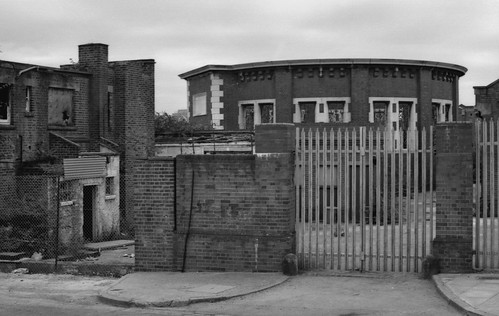
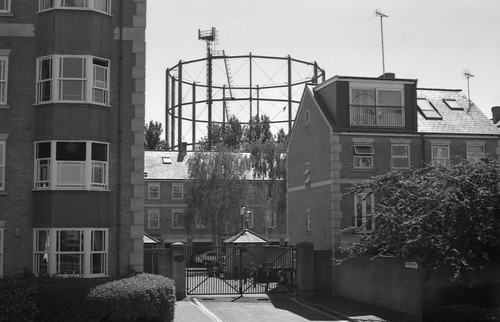
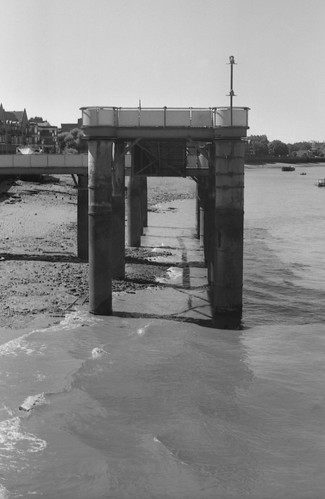
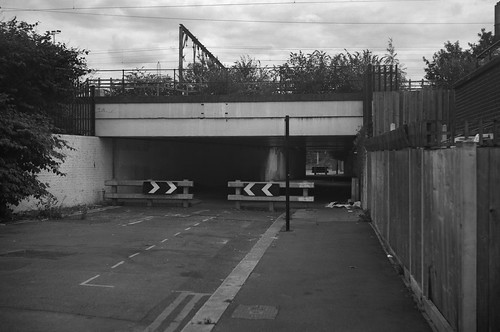
The subjects of the two photographs from 1994 which appear in the lab and darkroom prints are only a few metres apart, on the south of the river Thames in Rotherhithe; the first shows the southern ventilation shaft to the Rotherhithe Tunnel. The shaft building itself remains, although this now has a roof; the gate and gateposts are the same, but the outbuildings have been replaced by a newer residential block since, a process that has changed the view of the gasholder in the second photograph even more radically. By 1994 most of the operations of the London docks had moved miles further east to Tilbury, and this area alongside the Thames was in between cycles of speculative building: the boom of 'Docklands', largely on the Isle of Dogs on the other side of the river, had slowed in the wake of the recession of the early 1990s. Redevelopment of the area was restarted towards the end of the decade and into the 2000s, with the impetus of the Millennium Dome and improved transport links, as well as the general economic climate of the time.
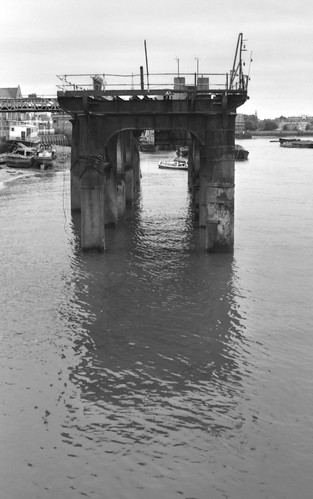
Rotherhithe, August 1994; Praktica BCA with Ilford XP2
Rotherhithe, August 2018; Zenit 11 with Ilford XP2 Super
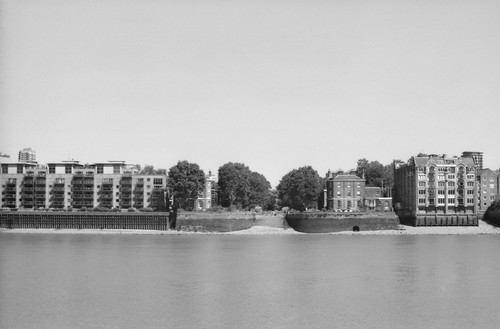
Discovering photography and exploring London went hand in hand, and I would return to these areas a number of times in subsequent years, shooting in medium format when I bought my Ikoflex Ic a couple of years later. This was an area relatively close to where I had been attending college in east London earlier in 1994, a couple of stops down on the old East London line on the Underground from Whitechapel. Its proximity was one attraction; the other was the sense of abandonment - that there were still second world war bomb sites in London that hadn't been built on, fifty years after the end of the war - and the mild illicit thrill of climbing through holes in fences or over walls to take some of these photographs. One particular location that I photographed on Ilford XP2 in 1994, on the other side of the river from Rotherhithe, in Wapping, was that of Watson's Wharf on Hermitage Wall. This had been derelict since the war; it had been the site of a large air raid shelter which had also been the base of the 'Dead End Kids', local teenagers organised into a group of unofficial air raid wardens and firefighters, some of whom had been killed while on duty. Local residents had wanted to turn the whole site into a memorial garden to commemorate Londoners who had died in the Blitz; around the time I had photographed it, the site had then been recently sold to the London Docklands Development Corporation and there were notices from a group called Civilians Remembered along the railings and fences around the site. The building seen side on in the photograph from 1994 below marks what would have been the boundary of the proposed memorial garden. In the photograph from this year, it can been seen face on, behind the tree, just to the left of centre: the foreground of the first photograph is now built over with the large block of apartments that takes up the whole left hand side of the second photograph.

Watson's Wharf, Wapping, August 1994; Praktica BCA with Ilford XP2
View of Wapping, August 2018; Zenit 11 with Ilford XP2 Super

Thursday, 27 September 2018

Ilford XP2 Super - Part One

Ilford XP2 Super, shot on XP2 Super, 35mm and medium format 
WHY XP2 SUPER IS DIFFERENT 
XP2 SUPER is a chromogenic film. This means that the dyes which make up the image are formed during development rather than being present in the film or added later. The extremely wide exposure latitude of XP2 SUPER is the result of the unique relationship between exposure and grain in chromogenic films. The best balance of sharpness and grain is obtained when XP2 SUPER is exposed at EI 400/27. However, down-rated or overexposed XP2 SUPER negatives have finer grain, the opposite of that expected and obtained with conventional films. Up-rated or underexposed XP2 SUPER negatives have only a slight loss in quality. Furthermore, standard C41 processing is recommended for the whole of the exposure range.
Ilford XP2 Super data sheet
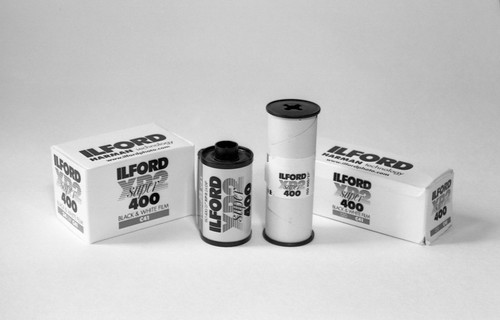
At some point over the last four decades, all the big four film manufacturers marketed chromogenic black and white films: Agfapan Vario XL was the first such film, followed by Ilford with XP1; Kodak produced BW400CN and Fuji had Neopan 400CN (although this film itself is made in Europe with  Ilford being involved in its manufacture). The reasons that chromogenic black and white films were developed surround the simple logistics of standardised C41 negative processing: once this infrastructure was established - the typical high street one hour photo - the rationale for a black and white film which could be processed in this way was clear. Chromogenic films had an appeal to two distinct types of customers: for the amateur, wanting to use black and white but unwilling to either pay the premium for black and white processing or endure the wait while the film to sent to a specialist lab; for professionals, the film could be developed alongside colour negative film and lab prints from chromogenic film could be treated as proofs for later bespoke printing by hand in a darkroom. In some respects, XP2 Super's distinct features - C41 processing and wide latitude - make it an ideal choice for someone wanting to shoot black and white film for the first time. Ilford XP1 400 was announced at Photokina in 1980, a year after Agfapan Vario XL, and a year after Ilford's centenary. The first version had its own chemistry as well as being able to be processed in standard C41 chemicals. XP2 succeeded XP1 in 1991; the film was "updated" with no name change in 1996; and it reached the current iteration of Ilford XP2 Super twenty years ago this year in 1998. The Super suffix for XP2 would appear to be the equivalent of the 'Plus' versions of HP5 and FP4.

Although of any particular film stock HP5 Plus is almost certainly the film I've used more than any other, Ilford XP2 Super may be the one film I used most intensely, for a number of years when I didn't have access to a darkroom and did not develop at home: I used it as my standard black and white film, mostly through the early 2000s. Since returning to developing negatives myself, I've not used XP2 very much, but, at the end of last year, I bought a brick of 10 24-exposure rolls of 35mm XP2 Super at a clearance price due to being out-dated. The films were dated September 2016 - and as it was then only a year out of date, I've made no adjustments in exposure to compensate for age - and these films were priced at £1.50 per roll, and even though this was closer to £2 each with postage, this was still very economical, and I had no doubt that the age of the film would be as close as negligible in terms of its results.

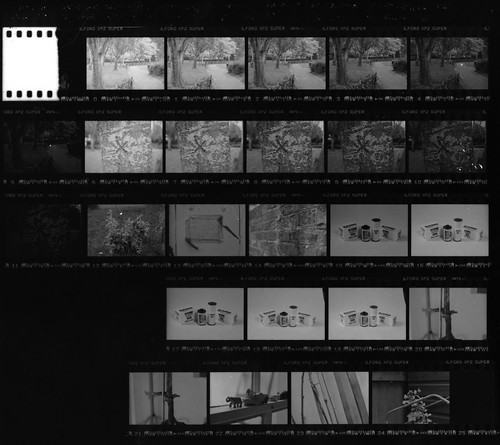
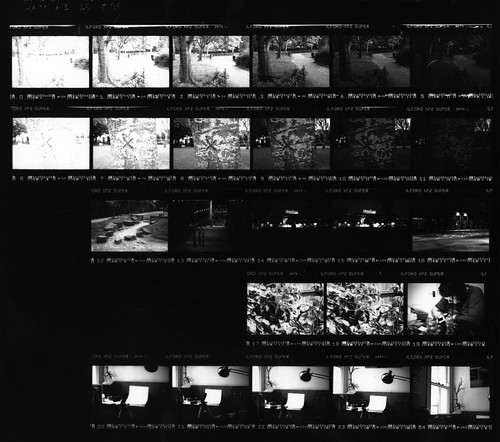
Ilford XP2 Super latitude test contact sheet (C41 process)
One of Ilford's claims for XP2 Super is that it has exceptional latitude and can be exposed at a range of exposure indexes with no adjustment in processing times:
XP2 SUPER film has a speed rating of ISO 400/27° (400ASA, 27DIN, EI 400/27) to daylight. [...] Although rated at ISO 400/27°, XP2 SUPER can be exposed over the range EI 50/18–800/30. When higher speed is needed, XP2 SUPER can be rated at up to EI 800/30. For finer grain, when speed is less important, rate the film at EI 200/24, although for finest grain it can be rated as low as EI 50/18 if required.
Although I had used XP2 Super a great deal in the past, I hadn't made any kind of systematic tests at the time. Like other films written about on this blog, for this post, I wanted to make some tests as to the film's capabilities, and I began with a latitude test. I shot a roll of XP2 Super with two sequences of six frames rated at exposure indexes rated 50/100/200/400/800/1600. The rest of the roll was rated at 200 and this was processed professionally with C41 development. The results of the tests on this post were scanned; a more comprehensive set of tests would include darkroom printing, but the scanned negatives should provide some relatively comparable results.

Ilford XP2 Super rated EI 50
The suggestion from Ilford's data sheet with regards to the relationship of density to fineness of grain does appear to hold true: I've never had a reason to rate XP2 as low as EI 50 before, but the frames so rated have a smoothness to them that might seem surprising for a 400 ISO film. This is apparently due to the way that the dye clouds which replace the silver in processing overlap. In practice, however XP2 Super is rated, this does have the effect that the grain is finer in overexposed areas, while the grain is more pronounced in the shadow areas, the opposite effect to the case with traditional black and white negative film, where denser areas provide more visible grain. One aspect of this unique peculiarity makes XP2 Super particularly good at rendering skies in landscapes with much smoother tones than one might achieve with a similar speed conventional black and white film, for example. However, when rated at an exposure index of 50 or 100 it appears there is some compression of the tonal range; the date sheet has a curve with a very shallow shoulder. In addition, it would appear that rating the film for 'finest grain' is at the expense of sharpness; this may seem counter-intuitive, but, on consideration, a denser negative would logically be less sharp than a thinner one, though how great a difference one might perceive in a print or scan is not something I've tested for here.

Ilford XP2 Super rated EI 800
At the other end of the exposure scale, grain appears to become apparent in the mid-tones through to the shadows when rated at EI 800, but squeezing an extra stop from the film in low light conditions without any change to processing - and on the same roll as frames exposed at different ratings - is potentially very useful. Ilford do not recommend push processing with Ilford XP2 Super, and I have not test the feasibility of this with C41 processing. However the frames rated EI 1600 displayed quite a pronounced grain, which my tests, looks quite visually unappealing - unlike some traditional black and white films, where the visual texture of the film grain adds something to the image, rather than detracts.

Ilford XP2 Super rated EI 1600
The remainder of this test roll I shot at EI 200, and this became my standard practice when available light allowed while shooting a number of rolls of XP2 Super subsequent to making the latitude test.

Ilford XP2 Super, rated EI 200
One aspect of the film that I was keen to test for this post was the difference between processing XP2 Super as intended by C41, and compare this to XP2 Super developed using traditional black and white chemicals. For this second latitude test, I used the same camera (a Canon A-1) and the same ratings of 50/100/200/400/800/1600 for two successive series of six shots. Again, the remainder of the roll was shot at a rating of EI 200. Ilford does not recommend using black and white chemicals to process XP2, but, like any film, it's based on a silver negative: as with a colour negative film, the developed silver is then bleached and replaced by dyes; unlike a colour negative, of course, there's only one layer. Therefore, there's no reason that it cannot be developed as a black and white negative, but it is not intended for this and so it may not necessarily give the best results - which was something I wanted to test (and unless otherwise stated all the images on this post were from C41 processed negatives). I have previously used stand development with Rodinal with XP2, a good all-round method for developing almost any film, but there are listings on the Massive Dev Chart for a standard small tank development routine with intermittent agitation. The listing for Rodinal is given as 18 minutes at 20ºC at a dilution of 1+25.

Ilford XP2 Super latitude test contact sheet (developed in R09)
In the event, for the test roll in black and white chemicals, I developed the film for two minutes longer at a degree cooler in temperature. With the two latitude tests, I printed contact sheets on variable contrast paper without a contrast filter, with the result that these would be the equivalent of using grade 2 paper. The difference between the use of black and white chemicals and C41 processing was immediately clear: with black and white chemicals the film's contrast is notably greater, and its latitude appears less. In both tests, the frames rated 1600, two stops underexposed, shadow detail appears to dramatically drop off, but this was even more marked with the film developed in R09. One final note on the differences, interestingly, is that there appears to be less base fog with black and white chemicals, which may increase the overall contrast. Further, I did not try push-processing in black and white chemicals (as with C41 development) due in part to the already long development times.

Ilford XP2 Super, rated EI 50, developed with R09
Scanning the negatives developed in RO9, one issue I had was that the density in the highlight areas resulted in noise, which, while distinct from the grain itself, made it difficult to assess the appearance of grain when developed in traditional black and white chemicals. It was immediately obvious that the particular characteristics of XP2 Super are as a direct result of being developed by the C41 process: in black and white chemicals the results are fairly unremarkable. However, some of the images that were rated at EI 200 rather than box speed still had a relatively smooth, fine-grained appearance, and possibly, if not developing XP2 Super as colour negative, this procedure might give the best results.

Ilford XP2 Super, rated EI 200, developed with R09
Other black and white developers will also work with XP2 Super: the Massive Dev Chart has a limited list. One developer that I use frequently not on the list is Ilfotec LC29; I've only used this for one roll of Ilford XP2 (not Super, it had a 'develop before' date of Nov 1996) and made a calculated guess of a dilution of 1+29 with a time of 14 minutes at 18ºC. This worked well enough but I would want to make more tests with Ilfotec LC29 before recommending it with these times and dilutions.

Voigtländer Avus with Ilford XP2 (6x9 medium format) developed in Ilfotec LC29
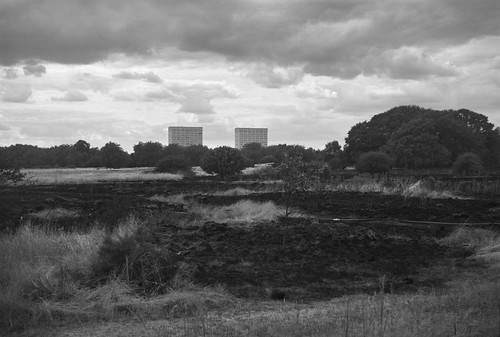
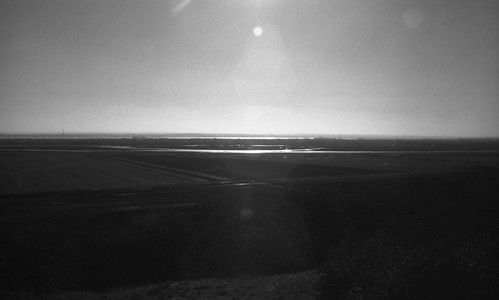
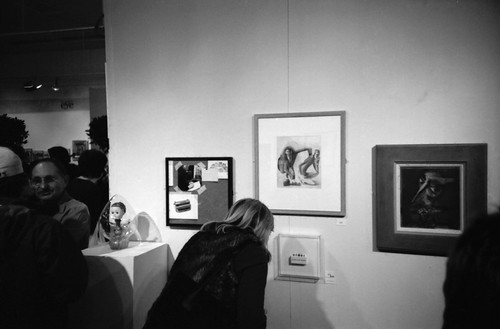
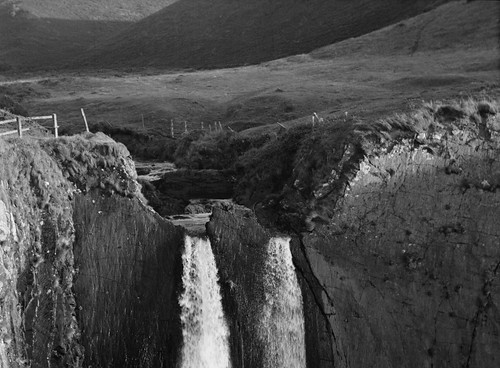
In terms of XP2 Super's specific characteristics with C41 processing, its latitude can sometimes produce images which appear 'flat' with a fairly straight print or scan, that is without increasing the contrast - or other manipulation such as dodging and burning. The contact sheet of the C41-processed  latitude test film above shows this, especially when compared to the black and white processed film. This latitude is a benefit when shooting scenes with a wide range subject brightness range: it's especially good for maintaining detail in skies for example. The image below has fairly good modelling in the clouds, which, although obscuring the sun, were brightly lit against the overcast landscape of burnt grass, and, with a small amount of digital burning in (only useful if the detail is there to begin with), has the sort of effect one might perhaps achieve with a light yellow filter. In low-light scenes like night time urban settings, which often have isolated highlights and deep shadow areas, XP2 Super does seem to be quite good at managing these wide variations in illumination (it does suffer reciprocity law failure, but the night shots on this post were taken handheld, without long exposures; also, I haven't made accurate comparisons between C41 and R09 processing for such subjects).

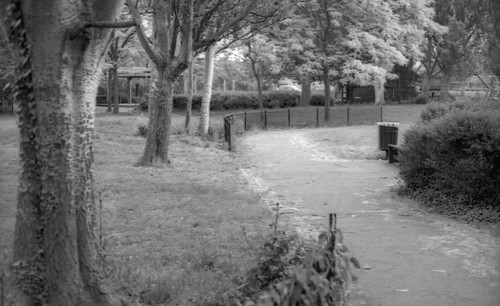
Voigtländer Bessa RF (6x9 medium format) with Ilford XP2 Super
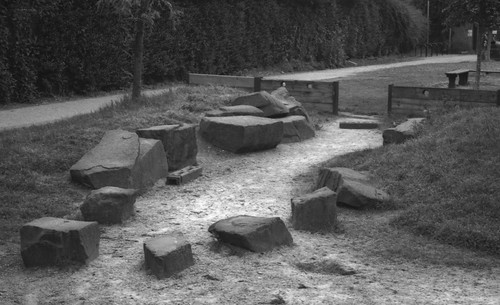
Zenit 11 with Ilford XP2 Super
When Kodak announced that BW400CN was to be discontinued in 2014, Ilford took the opportunity to produce a comparison sheet. One of the obvious advantages of Ilford's chromogenic film over Kodak's always was that it was available in medium format as well as 35mm (it is also now available in single use cameras; XP2 was once available in sheet film but this was one format I have neither seen or used). The other notable points of comparison are XP2 Super's wide exposure range: the sheet gives BW400CN as "400 – Not specified in technical data". In addition, BW400CN was coated onto a standard colour negative orange base, which one might imagine to be less than ideal for printing on black and white variable contrast paper, as well as for scanning. Ilford's film has a pink base, which varies in intensity depending on wash times - some of my negatives look almost clear or at least a light grey without much discernible colour, while others are quite pink. Ilford XP2 Super has a fairly distinct place in the film market now, a niche which it shares with Fuji Neopan 400CN (which, although not confirmed by Ilford, is, according to some, the same emulsion). One would hope that its distinct characteristics should mean that XP2 Super has a place in Ilford's range of films for the foreseeable future.

Belomo Agat 18K with Ilford XP2 Super
Praktica nova I with Ilford XP2 Super developed in R09 One Shot
Lomo LCA with Ilford XP2 Super
Zenit 11 with Ilford XP2 Super
Kiev-4 with Ilford XP2 Super
Kiev-4 with Ilford XP2 Super developed in Fomadon R09
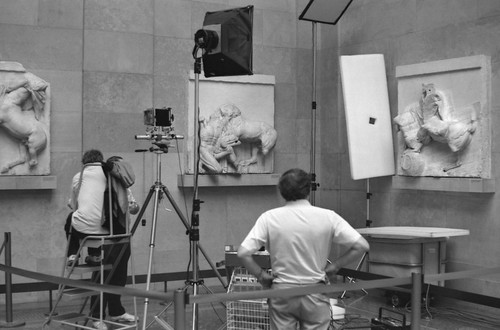
Canon A-1 with Ilford XP2 Super (scan from lab print)
Canon A-1 with Ilford XP2 Super
Canon A-1 with Ilford XP2 Super developed in Fomadon R09
Wallace Heaton Zodel camera (rollfilm back with 6x4.5 mask), Ilford XP2 Super
Voigtländer Bessa RF (6x9 medium format) with Ilford XP2 Super
Ilford XP2 Super - part two

Sources/further reading
Ilford XP2 Super data sheet
XP2 Super/BW400CN comparison sheet
In Praise of XP2 Super - Richard Pickup
Ilford XP2 - an under-appreciated film - The Web Darkroom
How to shoot Ilford XP2 Super - The Online Photographer
Ilford XP2 Super in Black & White Chemistry - Christopher Moss

Wednesday, 18 July 2018

127 Day Summer 2018

Kodak Brownie 127 with Ilford FP4 Plus
Of all the camera-themed days on the contemporary film photography calendar, 127 Day is the one I observe most often, and not just due to it appearing three times a year in its different iterations. I used the Kodak Brownie 127 for last week's version. The camera came with three rolls of film, two unexposed (the third, which had been exposed, I had previously developed and posted under Found Film 4). I had intended to use the two unexposed films on the day, both probably around forty years old. One was wrapped in its original inner packaging, which had the Kodak logotype and gave me hope that it might just be Verichrome Pan, but it was simply another roll of Kodacolor II once unwrapped; the other roll had its sealing band intact which was in German and English and had the letters 'CN S' and the film speed given as 20 DIN/80 ASA, but no other indication of what film this was.


I shot this film first, which was a misjudgment on my part. After shooting all eight frames, on reaching the end of the roll, advancing the film became very stiff - and in attempting to force the advance knob on the camera to turn, this broke. The knob is plastic, but sits on a square-section metal spindle, and the plastic was brittle enough for two sides of its square cap to break off entirely. The cause of the resistance I felt when advancing the film was the fact that the backing paper had rusted to the original metal spool. The rust suggested that, as the film was unwrapped, at the very least humidity had got to the roll, not promising much for the photographs I'd just shot.

Agfacolor Special backing paper
Information on the 'exposed' sealing band identified the roll as Agfacolor Special (the 'CN S' standing for 'Colour Negative Special'; Agfa introduced this film in 1968 and it was replaced by CNS II in 1975 according to the Agfa Colour page on Photomemorabilia). Due to its age, I stand developed the film black and white chemicals. As the Kodak Brownie 127 has no means of adjusting exposure, there was little I could do to compensate for the age of the film; only one image registered on the film sufficiently to scan it: I had pointed the camera directly at the sun mitigated by haze and a passing lower cloud. This image showed up as a faint positive on the film, not a negative as I had expected; this may just be the fact that with the film having a very dark base that did not clear on fixing, the negative density was sufficient to show up against this, very much as the principle behind the tintype.

Kodak Brownie 127 with Agfacolor Special
Having unloaded the Agfacolor film, avoiding the Kodacolor roll, I loaded the camera with cut-down Ilford FP4 Plus; there was just enough purchase with the broken advance knob to wind the film through the camera, though this became increasingly difficult as the film ran through the camera, and I had to put more force on the knob: each time this slipped, rather than turn the metal spindle, the plastic was abraded against the metal. As it was late afternoon into the early evening when I shot the roll of FP4 Plus, in development, I pushed the film one stop to compensate, which mostly worked well, even providing some shadow detail in one interior shot I made.

Kodak Brownie 127 with Ilford FP4 Plus
I risked one final roll, some cut-down Ilford HP5 Plus. Shooting this inside, in moderately low-lighting conditions, I pushed the film three stops on development; this gave rather underexposed images, as I had thought might be the case, but these had just enough information to scan them. The problems with advancing the film with the broken knob had become bad enough that I only shot four frames before I was unable to advance the film any further.

Kodak Brownie 127 with Ilford HP5 Plus
In hindsight, both the old colour negative 127 films would have been better saved for a camera in which I could adjust aperture and shutter speed to increase exposure, compensating for the loss of sensitivity with the age of the films; I might not then have broken the film advance on the Kodak Brownie 127, and, perhaps, I might have found myself with a better set of photographs from the day.

Kodak Brownie 127 with Ilford FP4 Plus
Kodak Brownie 127 with Ilford HP5 Plus

Thursday, 12 July 2018

Kodak Brownie 127

Kodak Brownie 127
The first Brownie camera was introduced by Eastman Kodak in 1900 and continued to be used by the company for inexpensive snapshot cameras right through most of the twentieth century, into the 1980s, almost as successful a brand name as Kodak itself, the name of George Eastman's first box camera model. The initial Brownie cameras were simple box-type constructions, and the No.2 Brownie introduced 120 medium format rollfilm still in use today; 127 format rollfilm accompanied the Vest Pocket Kodak just over a decade later, and a Brownie No.0 for 127 film followed a couple of years later. Several 127 format Brownies were produced during the following decades as cardboard gave way to metal and then plastic for the bodies of snapshot cameras, and although the use of plastics allowed for the shape of cameras to change, in essence the topography of the snapshot camera remained that of the simple box with a lens and just the two moving parts, the shutter and the film transport. The Kodak 'Brownie' 127 is one of these cameras, first made in 1952. It was made in the UK by Kodak Ltd and produced in millions of units (and as such is very easy to find today). My version here is the second model, first made in 1959, and produced for about four years (it is also the camera which came with a roll of exposed Kodacolor II film that I developed and posted under 'Found Film 4'). This second model is distinguished from the first version by having narrow vertical ribs on the body, whereas the first has broad and shallow horizontal steps; the second version also gives the lens the 'Dakon' name - in design terms, this appears to be a simple plastic meniscus lens. The second model was also produced in white in limited numbers for the Channel Islands, although this apparently discoloured easily; examples of the standard black model's shutter button and advance knob are often seen as a yellow-cream colour, which may be discolouring with age and, presumably, exposure to light, but on my example these are still a light grey. Two years after the second version was discontinued, a third camera with the same name was produced by Kodak Ltd, but the image format was changed to take twelve 4x4cm negatives on a 127 roll, rather than the eight 6x4cm frames of the previous two models. This last model was being made at the same time that Kodak's 126 cartridge was supplanting the 127 rollfilm for snapshot cameras; perhaps the change to the square format was not unrelated in the last Kodak Brownie 127.

Kodak Brownie 127
According to information available online, the Dakon lens has a focal length of 65mm and an aperture of f11 (provided by a stop behind the lens); the shutter speed given by the manual is "around" 1/50th (some sights give this as 1/40th). In comparison to the first model, the second has a slightly faster lens (f11 compared to f14), which may possibly be indicative of the growing popularity of colour film as the 1950s gave way to the 1960s. The lens is fixed focus and slightly wide angle for the 6x4cm format, designed to provide in-focus images from five feet to infinity, a "three-quarter length portrait" as described in the manual.

Kodak Brownie 127 opening for loading
The camera loads by removing the top section, to which the chassis that holds the film is attached, with a metal lock on the bottom; looking at the way the camera is constructed, the body is made from three pieces of Bakelite, possibly four, with the underside of the viewfinder being a separate piece inserted underneath the film carrier section. There is closely-spaced ribbing inside the As with many a camera using a cheap meniscus lens, the film path is curved (as can be seen in the image above) to compensate for its limitations, although these are still clearly evident towards the corners of photographs taken with the camera. The shutter, as seen in the detail below, is very similar to the shutter on the original Brownie camera of nearly sixty years earlier, as seen on my post for the No.2. The round shutter button on the camera top depresses the semi-circular tab as seen below, which first tensions, then releases the shutter; the arm which connects both springs then caps the shutter as it returns once pressure is removed from the button.

Kodak Brownie 127 shutter
As standard for a 127 camera of the time, the camera has a red window on the back for the frame numbers on the back of the film, without a cover as became more common with rollfilm cameras post-war. The viewfinder is placed centrally over the lens, meaning that parallax should only be present in one axis; with subjects being in focus from five feet or more such issues should be relatively negligible, within the parameters one might expect from a snapshot camera. It is oddly deep however, running the depth of the camera from front to back, which means that the viewfinder image, although clear, looks far away when put to the eye.

The Kodak Brownie 127 was supplemented with a handful of accessories. The body has strap lugs, and it came with a cord as a matter of course. There was a soft case for it with a shoulder strap; being squared-off in comparison to the camera body, there's plenty of room in the corners of the case for rolls of film. There were also push-fit filters and a lens hood. There was a 'portrait' close-up filter and yellow 'cloud' filter. The filter size is 28.5mm.

The choice of Bakelite as a material for camera bodies was motivated by the fact that the plastic can be easily moulded - giving rise to the Art Deco-influenced bodies of the first generation plastic cameras - and the fact that it can be sawn, drilled, machined in a number of ways. One of its drawbacks however is its relative brittleness: the top part of my camera has two chips either side of the squared-off front section, and as the raised rim the functions as a light trap is farly short, in use I've taped over the gaps as a precaution against light leaks.

Wanting to use the Kodak Brownie 127 for July's 127 Day, I tested the camera with a few short rolls of cut-down film, using the film slitter that I'd made for the purpose. There's a certain amount of distortion which is most obvious in subjects with horizontals and verticals, as below, but the illumination across the picture plane is surprisingly good, although definition falls off towards the corners and the edges

Kodak Brownie 127 with Ilford HP5 Plus
The lens is no doubt set at a hyperfocal distance, and although claims for focus and depth of field with snapshot cameras are often exaggerated, a focus distance of five feet appears to hold true, as in the shot below. Unlike the photograph above, framing the subject with the lines at diagonals hides most of the distortion.

Kodak Brownie 127 with Ilford HP5 Plus
One often reads online in comments on box cameras that one should use slower films with them as these are the kind of emulsions that were around at the time, and were what the cameras were designed for. As I've written about before, this reasoning is simplistic at best. Using faster, modern emulsions expands the range of conditions that a simple snapshot camera such as the Kodak Brownie 127, but I was gratified to read the advice in the manual which states that the camera should be used with Verichrome Pan in the summer - and Tri-X for "dull winter days" - however, it warns to use colour film in "bright sunshine only", as would have been appropriate for the slow colour films at the time. In my tests, I used Ilford HP5 Plus in sunlight, without pull-processing, and the latitude of the film provided perfectly usable results. I also shot some FP4 Plus, and some 35mm Ilford Mark V, which I've been rating between 25-50; this film was too slow for shadow detail as in the first image below, but gave reasonable results in full sunlight. In researching the Kodak Brownie 127 for this post, I came across a webpage documenting an exhibition titled 'Only the Sunny Hours' from just last month curated by Cally Trench in which Kodak Brownie 127 cameras were given to a number of contemporary artists to get their responses. The test describes the camera being "so familiar to us, having been so ubiquitous" having been used by "a younger self or an older relative". This isn't my own personal experience (this would be the Kodak Instamatic, which followed on from the discontinuation of the second model Kodak Brownie 127); however, the first paragraph of the text below could well be applied to the found photographs that I developed from the camera - the "relatives lined up in the garden" and an apposite sentiment on which to close this post:
"The Kodak Brownie 127 camera, like a sundial, works best in bright sunlight. Sundials usually have mottoes; a typical one is ‘I tell only the sunny hours’, and this would be a good motto for a Brownie 127 too. According to my family photograph album, my childhood was a series of sunny days by the seaside or in the garden. We spent no time indoors, and there was no winter and no night. Many of these photographs show relatives lined up in the garden [...]. Everyone looks directly at the camera, warned and fully aware that they are to be photographed, their expressions composed, eyes fixed open, waiting for the button to click.
[...]
Does it matter that the photographs in this project were taken on a Brownie 127? Photography, more than any art form, often seems to need a context, a title, an explication. We want to know who, when and where. We are unwilling to accept a photograph as universal. It matters if the location is Glyndebourne or Strood, whether the sitter is Napoleon’s younger brother in 1856 (the photograph with which Barthes opens Camera Lucida), or myself as a child in 1962. So, yes, it is significant that these photographs were taken with simple vintage cameras using film, because these things affect not just the photographs that are made but also how they are received by viewers."
Cally Trench, Only the Sunny Hours 
Kodak Brownie 127 with 35mm Ilford Mark V
Kodak Brownie 127 with Ilford FP4 Plus
Kodak Brownie 127 with Ilford HP5 Plus

Sources/further reading:
Kodak_Brownie_127 on Camera Wiki
Brownie-Camera page on the Kodak Brownie 127 model II
Onetwosevenorg on the Kodak Brownie 127
Kodak Brownie 127 (model II) manual (PDF)
Fantastic plastic: Moments from a Kodak Brownie 127 Raymond Parker Photo
Kodak Brownie 127 on CameraShiz
Cally Trench, Only the Sunny Hours