Thursday, 7 April 2011

Ilford Delta 3200

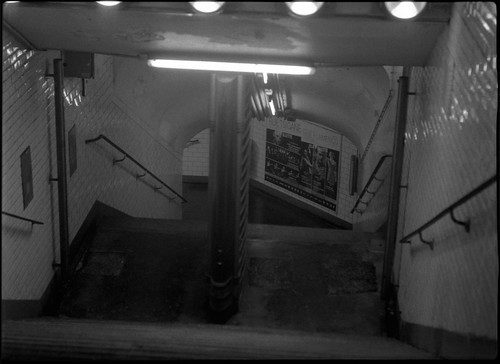
Metro Entrance, Ilford Delta 3200, handheld at 1/50th, f4.5

Along with Kodak T-Max P3200, Ilford Delta 3200 is the fastest black & white film currently on the market. Despite the prominent '3200' in the name, its true emulsion speed is 1000 ISO: essentially this means the film is recommended by Ilford to be exposed at a range of speeds, including 3200 ISO, and developed accordingly (incidentally, T-Max P3200 has similar characteristics: Kodak state it to be 1000 ISO in their proprietory T-Max developers, or 800 ISO otherwise). Delta 3200's main advantage over T-Max P3200 is that it is available in medium format as well as 35mm. When in Paris recently I shot a roll at night, as an experiment, to use the film in medium format; I had previously shot Delta 3200 in 35mm but found the results unsatisfactory. This may have been partly due to using Rodinal as a developer. Being a high-acutance developer, Rodinal tends to be recommended for slower films with more traditional emulsions, as the acutance effect can emphasise film grain considerably; with larger negatives in medium format, this is less noticeable.
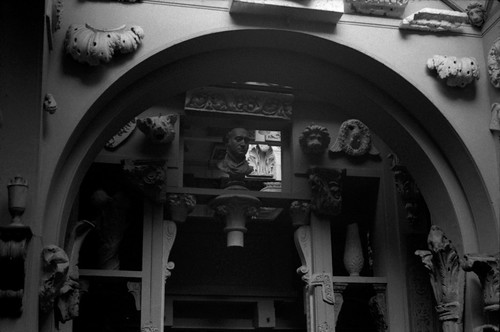
Kodak T-Max P3200, developed in ID11 stock solution, 12 minutes at 20 degrees C.
When I first began to take and develop photographs as a student, I frequently found myself wanting to shoot hand-held pictures in low-light situations, often in museums, or on the Underground. I carefully annotated my contact sheets with the ISO ratings and the developing times and dilutions I used at the time, so now, looking back, they provide a useful reference for comparison. I did use T-Max P3200 a couple of times, which was the fastest film on the market (Delta 3200 was introduced in 1998), although more often I pushed Ilford HP5+, frequently to 800 ISO, and occasionally to 1600 and to 3200, with variable results. I can't recall the prices, but I imagine T-Max P3200 was more expensive than HP5. I suspect the reason that I did not use T-Max P3200 more was that the I perceived the difference in quality insufficient for the price. Another factor was using ID11 to develop the film,  which is reputedly better than Rodinal for push-processing.
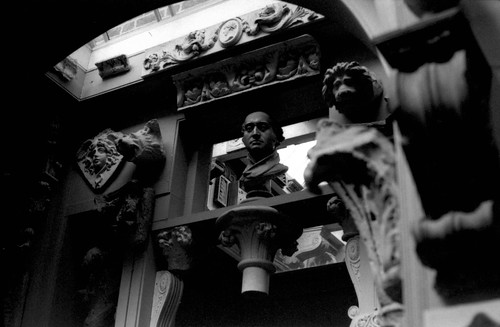
Ilford HP5, rated at 3200 ISO, developed in ID11, 18 minutes at 20 degrees C. A comparison to the previous shot of Sir John Soane's museum does show a lack of shadow detail, though not a considerable difference.

One consideration against push-processing film for night and low-light photography is that an effect of pushing a film is an increase in contrast. Often night scenes are themselves inherently high contrast: bright light sources and reflections, and dense shadow areas, therefore pushing a film can result in a negative with blocked highlights and very little- if any- detail in shadow areas. In this regard it would be more appropriate to pull-process the film, and so reduce contrast, which however negates the use of a higher ISO rating, a real consideration for hand-held photography.

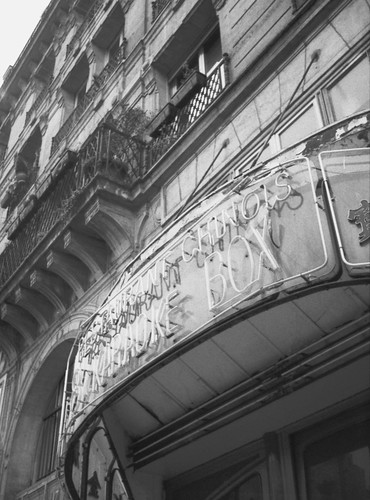
Rue Lacepede, Ilford Delta 3200, handheld at 1/50th, f4.5
The current photographs were shot using a Baldalux medium format folding camera, with a 6x4.5 mask, a compromise between larger negatives, and getting more shots from a roll of film. One drawback with the camera is the lack of a built in light meter; for daylight shots I use a Weston light meter, but being a selenium cell meter, there isn't enough light for it to work at night, so the photographs I took in Paris are not metered. The hand-held shots were all taken wide open, at the maximum aperture of f4.5, at a 50th of a second; for the Jardin De Plantes photograph I held the camera flat against a hole in the iron gate. I developed the film in Rodinal 1:25 at 19 degrees C, 15m 45s (3 and a half minutes longer than Ilford's recommended time), with the last four minutes 'stand', meaning without agitation, preferring to potentially over-develop the film as an insurance against under-exposure.
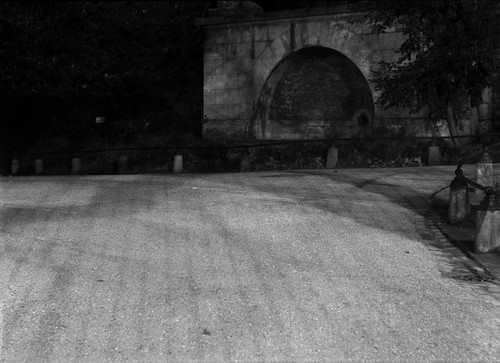
Jardin des Plantes, Delta 3200, roughly 60 seconds at f11.

Friday, 25 March 2011

Photographs developed from a found roll of film 2


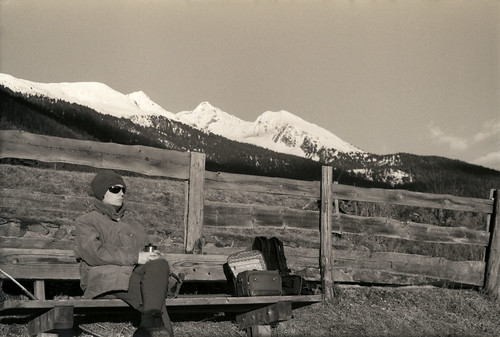
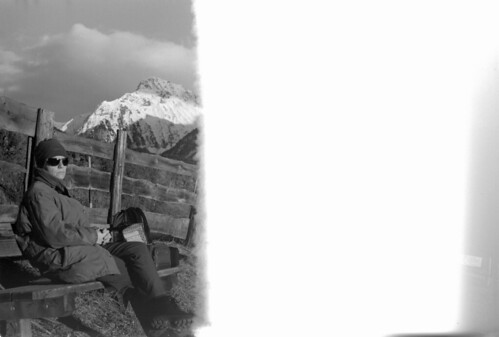
I bought a Rada rollfilm back to use with a Zodel 6x9 plate camera. When I pulled out the darkslide, I found that it had a roll of film inside. This partly exposed the second frame (below). Having spoiled a couple of frames, I shot the remainder of the film. As with the previous post, I stand developed the film in Rodinal 1:100 for one hour. The film is marked 'Kodak GB-4' in the rebate.

The two shots look possibly Alpine, but I don't know if the mountain range is distinct enough to be easily identified. Unlike the film in the previous post, the photographs do look relatively recent, judging by the clothing and the camera bag and rucksack.

The subsequent photographs I took on the roll were all affected by light leaks, possibly due to the roll not being tightly wound.

Thursday, 17 March 2011

Anthony Carr, A Month of Nights, Format Festival Derby


The above image shows one of artist Anthony Carr's pinhole cameras, disguised as, or protected from the elements in, a bird box. Over a number of recent projects and exhibitions Carr has developed pinhole cameras with a shutter driven by a clockwork mechanism which controls the exposure of the film inside. For the Format Festival Carr is exhibiting a number of prints from these cameras placed around Derby which recorded images on film at night, over the course of a month, as well as having installed cameras to expose film for the duration of the photography festival itself.


At Pickford's House until 17th April 2011


Format Festival Derby


Anthony Carr on Axis


Images ©Anthony Carr

Thursday, 3 March 2011

New Silverprint Catalogue

For the first time in four years they say, Silverprint have produced a print catalogue. Made like a tabloid newspaper, it's so much more than a list of all the products they sell- there's lots of historical background to different techniques, processes, suppliers, all representing a bit of a resurgence in analogue photography (they're even selling reconditioned Olympus Trips):-

www.silverprint.co.uk

Monday, 28 February 2011

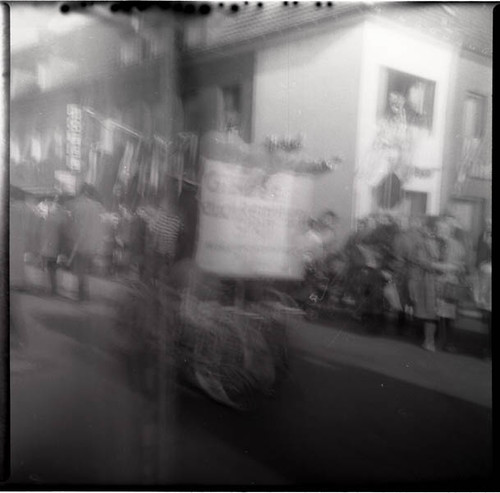
Photographs developed from a found roll of film

From an undeveloped roll of Kodak colour film found inside a Brownie-type of camera. Using Rodinal diluted 1:100, presoaking the film, and then stand developing it for an hour produced usable monochrome negatives from the film. Colour films can be developed with black and white chemicals, as all films contain silver halides which are the light-sensitve element: in colour films these are replaced by dyes in the developing process. As I had no way of knowing how old the film was, and how viable it was for developing in colour chemicals, it made more sense to me to use black & white chemicals to attempt to process the film.
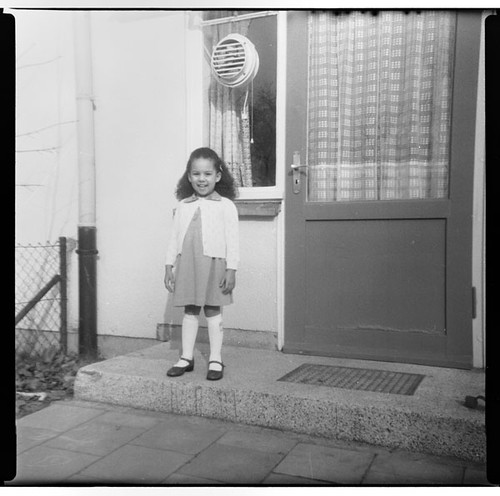
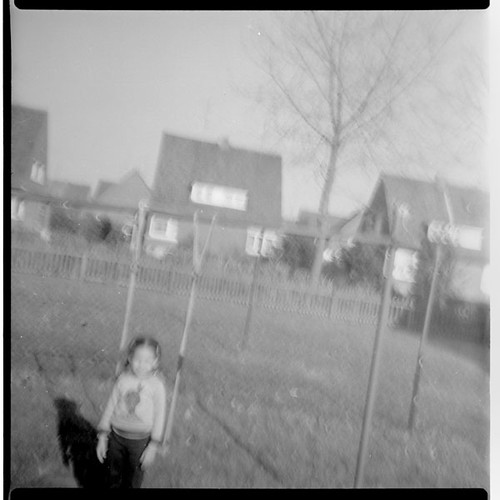
I didn't note down exactly which camera this came from at the time. On the film there are a couple of shots of a girl on a doorstep; the rest of the photographs all suffer from camera shake- there is one shot of the same girl in a back garden, and a two pictures that look like a parade of some sort.


There's something romantic about releasing images that have remained latent on a roll of film for many years. The girl's dress and the domestic architecture date this to any time between the 1960s and early 1980s perhaps.

Sunday, 27 February 2011

Paris Flea Market Finds


From the Porte de Vanves flea market:

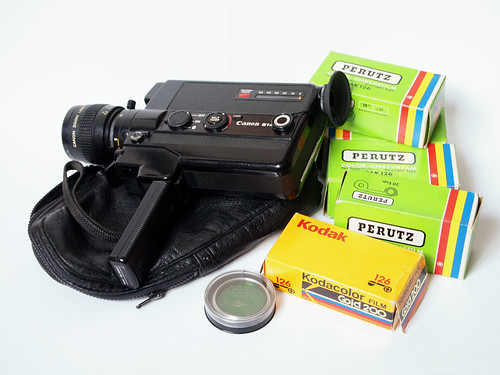
Canon 514XL Super-8 cine camera: €20
Kinax green filter: €1
Five expired 126 film cartridges: €1 each

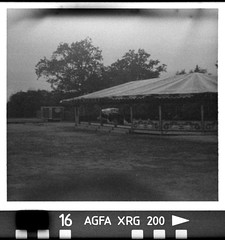
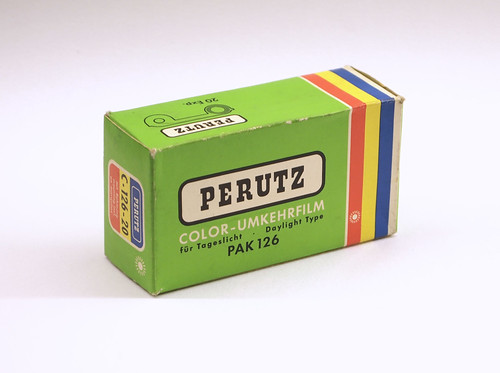
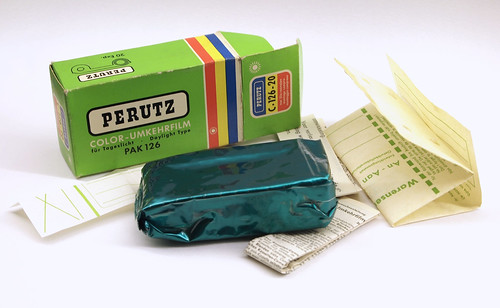
The 126 films are all still sealed; the Kodacolor film has a 'develop before' date of March 1991, the Perutz films have a date of May 1974. Quite possibly a waste of €5, but with 126 film no longer manufactured, I was intrigued to see whether the films might produce images from a Kodak Instamatic camera I have. While event-crewing last summer, I didn't want to take a 'proper' camera on jobs with me, but finding the Instamatic 50 in a drawer with a film in it, I took this. The film was Agfa XRG 200, and trying the fail-safe method of stand developing in Rodinal, a black & white film developer, produced some images.


The Perutz film is more interesting than the Kodacolor: it's a transparency film, although it doesn't use the E6 system of development, the only colour transparency system still available. It was originally process-paid, so inside the box is an envelope for the film and a number of different addresses around the world for Perutz labs which would develop the film, and return the mounted slides.


Perutz 126 Color Transparency film 64 ASA/19 DIN- expiration date May 1974.

What you get in the box:-

Foil wrapped cartridge of 64 ISO colour transparency film, 20 exposures
Process-paid return envelope in 7 different languages
Address label
Instruction leaflet in 7 languages
Leaflet listing Perutz Color Service processors in nine countries

Tuesday, 22 February 2011

In Praise of the Olympus Pen


 The original Olympus Pen was a series of half-frame cameras produced by Olympus between 1959-1983 (the name has recently been revived for its Micro Four-Thirds digital system cameras). The Pen EE3 model came out in 1973 and was produced for a decade. It has a fixed-focus 28mm f1:3.5 Zuiko lens, which equates to 40mm in full-frame 35mm format. Exposure is controlled by a selenium cell meter surrounding the lens that matches aperture to one of two shutter speeds, either 1/40th or 1/200th. ASA (ISO) settings run from 25 to 400, and the camera has a hot shoe and PC socket for use with an external flash. If there is insufficient light, a red indicator appears in the viewfinder, and the shutter won't fire. There isn't much scope for manually overriding the automatic exposure, except by turning the film speed ring away from the ASA settings: there are distance markings from 1 to 4 metres for the dedicated GN14 flash, or aperture numbers for a generic flash. Without a film speed selected, the shutter defaults to 1/40th of a second for flash sync.

When I was at college in the 1990s, with the internet in its infancy, information about different cameras was harder to come by. Much of this simply came from talking to people with more knowledge and experience. A photography tutor at college, Mick Williamson, had been keeping a half-frame photo-diary, and I was inspired by this a few years later when a half-frame camera appeared in the window of the local camera shop. Before Ebay, a decent camera shop would have at most a few dozen secondhand cameras in stock at any one time. It could have been any model of half-frame camera; it happened to be the Olympus Pen EE3. I bought the camera just as I was about to leave college, and it came in useful for documenting the build-up to my end of year show. Using the Pen EE3 then was rather like the way most people use digital cameras today, film felt a lot less precious when one could shoot 72 frames before needing to change the roll. Compact for a film camera, it's small enough to carry around, works without batteries thanks to the selenium meter, and is easy to use: not needing to set exposure controls or focus the lens makes operating the camera simply about framing.


Olympus Pen EE3 sample

Of course, having an image area half that of a conventional 35mm frame does mean that the resultant photographs will have larger grain relative to their size. Set against the smaller frame size however, the Zuiko lens is pretty sharp, and the results are good especially when used with slower, finer grained films. The above image was shot on FP4 film, rated at 200 ISO (I personally like the slightly increased contrast of pushing the film 2/3s of a stop, as well as the extra speed), developed in Rodinal at a dilution of 1:50.