Showing posts with label discontinued film. Show all posts

Wednesday, 8 May 2019

Agfapan APX 100

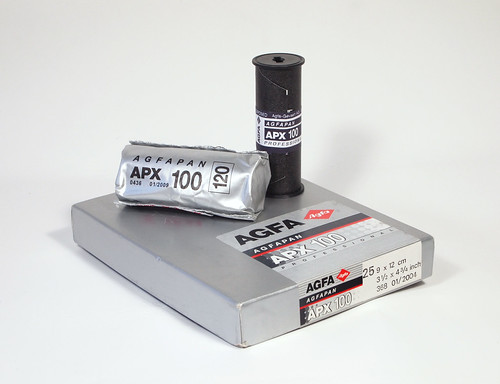
Agfa Agfapan APX 100 in sheet film (9x12cm) and medium format
Among the currently available range of black and white films, there are two films named AgfaPhoto APX, in 100 and 400 speeds. This film is sold by Lupus Imaging, and, it seems, is most likely made by Harman, similar to the Rollei RPX films, and (but perhaps not quite the same as) Harman's Kentmere films. These films from Lupus trade on the name of Agfa's discontinued Agfapan APX 100; this post is about the original Agfapan APX 100 and it is not a comparison to the new APX 100; the new APX 100 films are not the same emulsion or a new version of Agfa's original: apparently Adox Silvermax is close to the original APX 100 recipe.

I first used Agfapan APX 100 in 35mm when it was sold under the name of Rollei Retro 100. The last master rolls of Agfapan APX 100 produced in 2005-06 were bought up by Maco when Agfa ceased production and repackaged under the name Rollei Retro 100, with generic-looking labels, rather like the first RPX films, sold in non-DX coded cassettes; possibly the film's renaming was due to Lupus having already acquired the rights to the AgfaPhoto and APX names (to add some confusion to the matter, it appears that Lupus also sold the old APX 100 film prior to the new APX 100 in 2013; Maco sold two other, different 'Rollei Retro' films: Rollei Retro 100 S and Rollei Retro 100 Tonal, not to be confused with the Rollei Retro 100 that was the old Agfapan APX 100).

Almost unintentionally, Agfapan APX 100 has become one expired film stock that I've used frequently over the past couple of years, some time after first encountering it as Rollei Retro 100. According to the Wikipedia page on discontinued film stocks, Agfapan APX 100 was produced between 1989 to 2005, which would mean that the Rollei Retro 100 that I bought in 2011 would have been a few years old at that point. The reason for buying the Rollei Retro 100 film then was that it was very economical: I can't recall exactly how much I paid for a batch of ten rolls, but Maco were selling ten rolls of 35mm Rollei Retro for less than €20 around the time (prices do seem to have varied somewhat, but Wayback Machine gives an idea of what I might have paid then).

I shot most of the Rollei Retro 100 in the the Spring and Summer of 2011, almost exclusively with the Kodak Retina IIa (one roll was shot with the Agfa Optima Sensor), developed in Agfa Rodinal, which seemed a good fit for bright sunny days, providing relatively tight grain and smooth tonal qualities; as a film, it also seemed to work well with Rodinal, the first developer that I used when coming back to processing film, and I also happened to be using the last of the stocks of the old Agfa Rodinal that the darkroom had, before switching to other generic R09 developers.

Kodak Retina IIa with Agfapan APX 100 (as Rollei Retro 100)
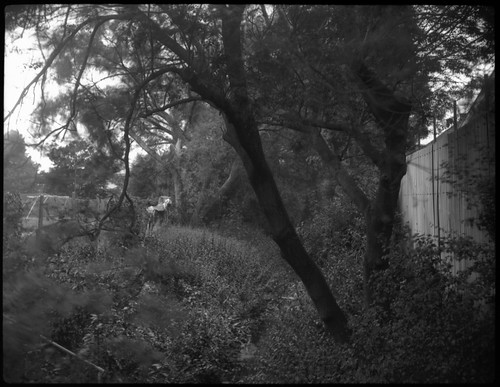
After I'd used up the ten rolls of Rollei Retro 100, fairly quickly, there was a gap of few years before I found a box of 9x12cm APX 100 sheet film, dated 01/2004. I hadn't been looking out for Agfapan APX 100 specifically, rather it was a case of finding cheap sheet film in the 9x12cm size; when buying this, it was a decade past its develop before date but I imagined that, being relatively slow, this would be less affected by age (without knowing how it was stored before I bought it of course), and I shot some of this, handheld in bright conditions, with the Kodak Recomar 33, rating it at box speed, or just below at an exposure index of 80, and subsequently also using it with other 9x12cm format cameras. The box also included a leaflet with developing times for both APX 100 and AP 400 - it's worth noting that the 400-speed film here is not called APX 400, but the instructions inside the 35mm boxes I later used did have APX 400; the reasons for the difference in naming are not clear, the developing times are the same for both.

Agfapan APX 100 - AP 400 leaflet
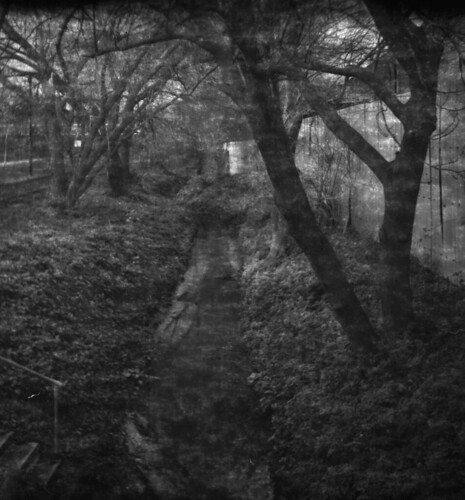
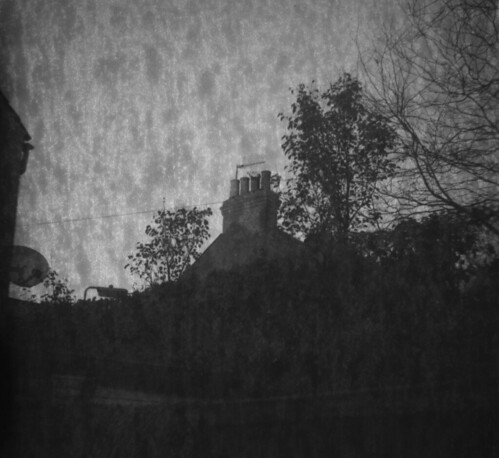
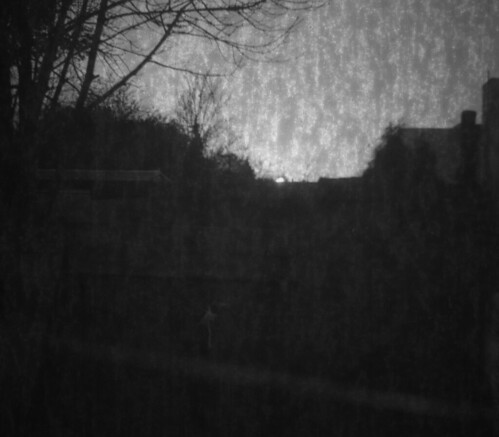
Then, I bought a batch of medium format APX 100, eight unboxed rolls with a develop before date January 2009. Some of this I cut down to 127 to use for January 2017's 127 Day with the Baby Ikonta, and also used when testing the Baby Box Tengor, as well as using it with 116 backing paper in the Agfa Standard. However, these films, all with the same process before date, were not consistent - some rolls gave good results, but on some the emulsion appeared to have reacted to the backing paper, as in the image below, where the numbering from the backing paper is just visible across the sky; in the second image this isn't present.

Agfa Record III with Agfapan APX 100 (6x9 medium format)
Zodel Baldalux with Agfapan APX 100 (6x9 medium format)
Some of these rolls of film went through X-rays more than one before and after exposure when travelling, although as a medium speed film, this should not affect the emulsion, nor is it clear whether this would increase any reactions to the backing paper, but this was perhaps not unexpected with out-of-date film, with unknown storage conditions - this is, after all, sometimes seen with new film. However, that it did not occur with all rolls, though apparently from the same batch, was frustrating, as it couldn't be anticipated.
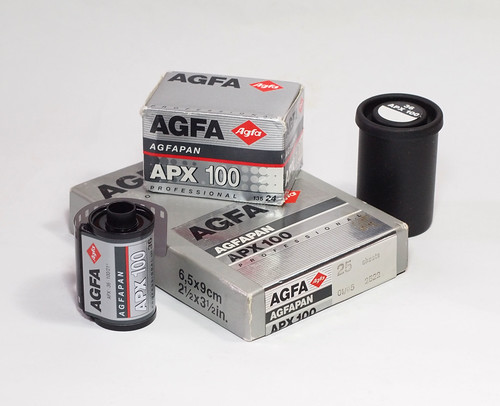
Agfa Agfapan APX 100 in sheet film (6.5x9cm) and 35mm
With the notion that I might write a blog post about Agfapan APX 100, I sought out a couple of rolls of APX 100 in 35mm to make some tests with - ordinarily, I wouldn't do this for discontinued films, although I might test for sensitivity; a latitude test, and tests for pull/push processing I would usually make for my own future reference, less of a necessity with a discontinued film that one might not have the opportunity to use in future (I also found some 6.5x9cm sheet film around the same time, with a process before date of January 95, using this with my Glunz plate camera, making such a sensitivity test with one sheet from this box). For a latitude test with the 35mm film, I shot half a roll of Agfapan APX 100 with a date of January 2002, rather older than the Rollei Retro 100 I'd used a few years previously.

35mm Agfa Agfapan APX 100 latitude test
On the contact sheet above the first two rows were rated EI 400/200/100/50/25/12 from left to right; the third and last row was shot at box speed of 100 ISO. This was developed in Ilfotec LC29 diluted 1+19 for 7m30s at 20ºC. Times were taken from the Massive Dev Chart, where Agfapan APX 100 is  listed under 'Discontinued/Unlisted' rather than referring to the data inside the box, which I could have used if I'd developed the film in R09. The results from this test showed that perhaps the film could have benefitted from a little more exposure than box speed, although perhaps not as much as one whole stop; I shot the rest of the first of these two films with the Kiev-4 rated 80. It is also worth mentioning that Ilfoted LC29 may not have been the best developer for this test, but I didn't have any Rodinal at the time of processing; this may have been better historically, even just in relation to the APX 100 I shot as Rollei Retro 100 a few years ago.

Agfapan APX 100 (develop before Jan 2002) at box speed
Agfapan APX 100 (develop before Jan 2002) rated EI 50
When I first used Agfapan APX 100 in its incarnation as Rollei Retro 100, I didn't have much occasion to push the film, shooting just one roll at anything other than box speed: this I rated at an exposure index of 200 as, if I remember rightly, I didn't have any faster films at the time for shooting on an overnight bicycle journey - although I didn't take many pictures during the night itself, more in the early grey dawn hours.

Agfa Optima Sensor with Rollei Retro 100, rated 200
Last year, with the second roll of APX 100 with the develop before date of January 2002, I found myself in a similar situation: taking photographs in a dark interior; with the film already loaded into the Kiev-4, this was not ideal, and I wouldn't normally push expired film this old, especially two stops, but this was a compromise which produced generally acceptable results, with the caveat that there was also some patches of bright sunlight in the otherwise dim building to complicate the exposures, and the density of these highlights rendered noise in the scanning of the negatives.
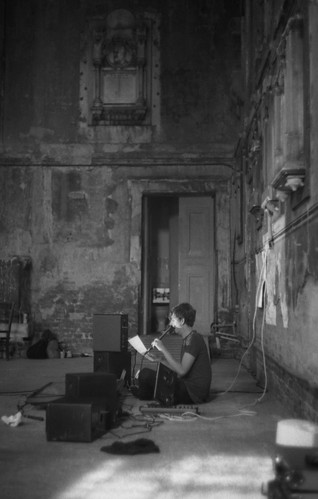
Kiev-4 with Agfapan APX 100, rated 400
As I stated in the introduction to this post, this is not a comparison of AgfaPhoto APX 100 with the original Agfapan APX 100: despite the name, these are different films. From what I've read, Adox Silvermax is close to the original APX 100 emulsion, so a comparison between these two films might have been instructive, and the qualities that I like in Silvermax do seem to be present in APX 100. However, that may not be an entirely equal contest, given that Silvermax is a new film, still very much in production at the time of writing, whereas the most recent stocks of APX 100 would now be coming up to a decade and a half old, and, although, backing paper issues aside, most of the old Agfapan APX 100 I've used has lasted well so far, using existing old stocks of the film such as may still be around must be approached with a little caution - as with any films a fair number of years past their 'develop before' date.

Kiev-4 rangefinder with Agfapan APX 100 (develop before Jan 2002) rated 80
Canon A-1 with Agfapan APX 100 (develop before Jan 2002) rated 100
Kodak Retina IIa with Agfapan APX 100 (as Rollei Retro 100)
Agfa Optima Sensor with Agfapan APX 100 (as Rollei Retro 100) rated EI 200
Kiev-4 rangefinder with Agfapan APX 100 (develop before Jan 2002) rated EI 400
Baby Ikonta with cut down Agfapan APX 100 (127 format)
Zodel Baldalux with Agfapan APX 100 (6x9 medium format)
Glunz Mod 0 with Agfapan APX 100 (6.5x9cm sheet film)
Kodak Recomar 33 with 9x12cm Agfapan APX 100
Rietzschel Heli-Clack with 9x12cm Agfapan APX 100
Voigtländer Avus with 9x12cm Agfapan APX 100

Monday, 8 December 2014

127 Day - Winter 2014

Studio window, Baby Ikonta with Ilford Selochrome
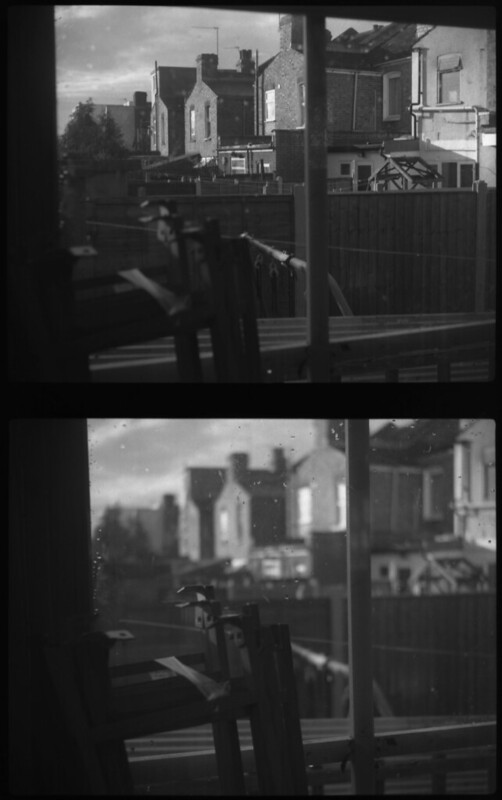
One aspect of taking photographs on certain annual recurring days, such as the '127 Days', is that repetition can become an archive when photographing the same scenes as time (and the seasons) passes, such as the shot of Dagenham Brook below, which I had shot in July; in December last year, I took a walk along the same route I'd taken the year before. For yesterday's 127 Day I had one roll of Ilford Selochrome with a develop before date of January 1970 which I hadn't shot on this year's 127 Day in July. I also shot two rolls of Kodak Verichrome Pan in 828 format with a develop before date of August 1974 which I'd rolled with 127 backing paper, and similarly, a roll of 35mm Rollei ATO 2.1 Supergraphic. All films were shot with my Zeiss Ikon Ikonta 520/18 - otherwise known as the 'Baby Ikonta'. I shot half the roll of Selochrome around the house, which allowed me to make a couple of diptychs shooting through windows, and, although the skies briefly cleared, by the time I went out to take some more photographs, it was a typically grey December afternoon (the weather being one reason I tend not to shoot on 27th January, the other 1/27 in the calendar when written in the form used commonly in the US).

Dagenham Brook, Kodak Verichrome Pan
Both rolls of Verichrome Pan exhibited very pronounced texturing from the backing paper. The Ilford Selochrome also showed a trace of this effect, but having retained more sensitivity, with a denser negative this was much less apparent and only really showed up in shots which were underexposed. The lighting conditions weren't sympathetic to shooting the Verichrome Pan film with a slower rating than 50 EI which may have helped. The film also had a very strong curl which caused problems with film flatness: it seems this was enough to force back the camera's pressure plate in a number of shots.

Kodak Verichrome Pan, showing a lack of film flatness
The poor lighting conditions were less than ideal for using Rollei ATO 2.1, which has a nominal rating of 25 ISO, but performs better at lower exposure indexes, and, unlike July this year, I did not have a tripod with me for longer exposures (most of the shots illustrating this post were at fairly wide apertures and at shutter speeds of either 1/50th or 1/25th). The image below was the best shot from the roll of ATO; I attempted some shots at 1/10th, but the Baby Ikonta's shutter was beginning to stick at that speed.

Leyton Sign, Rollei ATO 2.1
All films were stand developed in Ilfotec LC29 for one hour, at 1:100, except for the ATO 2.1, for which I used a dilution of 1:200. As I was developing the first couple of rolls of film, the clouds began to break up again in time for the sun to set and I shot the second roll of Verichrome Pan.

Winter Afternoon, Kodak Verichrome Pan
Sunset, Kodak Verichrome Pan

Friday, 18 July 2014

127 Day - Summer 2014

Dagenham Brook, Baby Ikonta, Kodak High Resolution Aerial Duplicating Film
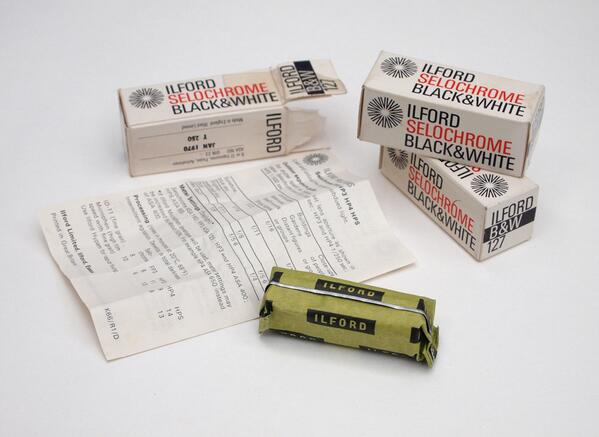
On last Saturday's 127 Day, I shot two rolls of Ilford Selochrome and Kodak High Resolution Aerial Duplicating Film apiece with my Baby Ikonta. The Selochrome films had a develop before date of January 1970, but I've had fairly good results with out of date Ilford 127 format films before, notably FP4 on last December's 127 Day. These Selochrome films were originally rated 160 ISO, but I shot the rolls at 40 EI to compensate for the loss of sensitivity with age. Selochrome was a brand name that Ilford used for a number of emulsions - the Selochrome roll film I used was panchromatic, whereas I have used older versions of Selochrome which were orthochromatic. To develop the Selochrome films, I extrapolated a time from the leaflet inside the box, which has data for ID-11 and Microphen. I used Ilfotec LC29; to determine a developing time, I compared the Selochrome times in ID-11 with FP3, which are the same, then used the FP4 Plus developing times with Ilfotec LC29,  but added another minute and thirty seconds as an additional margin of error.

Ilford Selochrome 127 format
I developed the first of the Selochrome films only to find that I didn't have any fixer. This oversight can be explained by the fact that I wasn't using my normal darkroom due to refurbishment, instead developing at home using a dark bag and a single reel tank. I had acquired a number of bottles of various chemicals and was under the impression one of these was fixer. Instead, I had three different types of developer, and one bottle of stop. As it was a Sunday afternoon, I wasn't able to buy some fixer there and then. Rather than leave the film in the rinse unfixed overnight, I looked online for suggestions of household chemicals that could be substituted for fixer, and came across several discussions (mainly with the same participants, such as here and here) about the use of common salt. From others' experiments, the use of a salt solution requires the film to be soaked for considerable time in a highly saturated solution. Apparently, the time can be reduced by being heated, but I didn't want to so with such an old film, fearing that the emulsion might simply separate from the base, quite apart from the chance of reticulation. Recommendations for the salt solution suggested a mix of 300g salt to 1 litre of water, which I heated to disolve the salt, cooled the solution, and then left the film soaking overnight. I also soaked an undeveloped film end to use as a control. The next morning, after around 18 hours, the film end was nearly clear, but not so transparent that I would be confident of its archival stability. I bought some Ilford Rapid Fixer to fix the Selochrome film, which was also fairly clear after being soaked overnight. Although I did take the precaution of re-fixing the film, this experiment seemed to demonstrate that it would be possible to use such a technique in an emergency, but not in a hurry.

Brick Wall & Shadows, Baby Ikonta, Ilford Selochrome
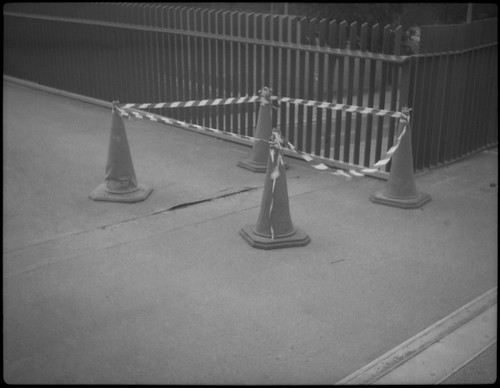
Cones, Baby Ikonta, Ilford Selochrome
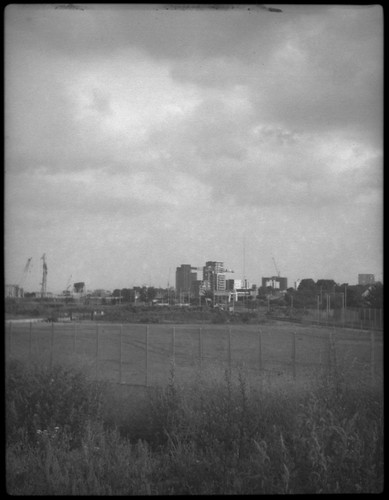
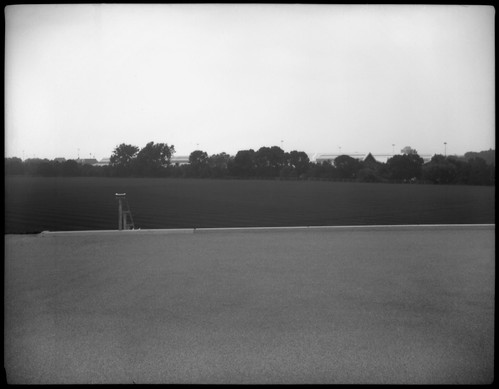
127 Day, Baby Ikonta, Ilford Selochrome

The Selochrome negatives looked a little overexposed, with some fog as to be expected with films over forty years old, and there was a texture imparted on the emulsion from the backing paper, but this mainly showed up in larger areas of more even tone, such as the sky in the last photograph above.

I also shot two rolls of Kodak High Resolution Aerial Duplicating film cut to 127 size. One film I pre-exposed in the darkroom to raise shadow values, the other was shot without, although the results show no real difference. Having recently tried stand development with Ilfotec LC29, rather than Rodinal/R09 One Shot, I also used it here. The first of these High Resolution Aerial Duplicating films was stand developed in Ilfotec LC29 at a dilution of 1+200, but, looking a little thin, I used a dilution of 1+150 for the second film. I was also using a small tank, which only held a maximum of 400ml, so the actual amounts of developer used was very small, 2ml and 3ml respectively. The best shot from the High Resolution Aerial Duplicating film is at the top of this post, all the other photographs had featureless skies, which I did expect from this high contrast blue-sensitive film, which also exaggerates the vignetting of my Ikonta's Novar lens, even stopped down.

Lea Interchange, Baby Ikonta, High Resolution Aerial Duplicating film
East Marsh, Baby Ikonta, High Resolution Aerial Duplicating film
Leyton Sign, Baby Ikonta, High Resolution Aerial Duplicating film

Sunday, 28 April 2013

Ilford Mk V Motion Picture Film

The 35mm film format was originally developed for motion picture cameras, but the convenience of the format's small size soon led to its adoption for still photography (35mm was known as 'miniature' film, by comparison to the 'medium' format of rollfilms, and large format sheet films and plates). The famous Leica wasn't the first still picture camera to use 35mm film, but it did help to popularise the format; subsequently the Kodak Retina was designed around the 35mm daylight loading cartridge, and by the second half of the 20th century, 35mm film became the dominant film format. Meanwhile, it continued (and continues) to be used for motion pictures and was only challenged by the quality of digital very recently. There were (and still are) some film emulsions produced explicitly for motion picture use which have never been generally available in short lengths for still camera use. However, there are photographers that use motion picture stocks for still photography, with online communities catering for this niche such as Project Double-X, and the Double-X and Orwo Flickr groups.

Ilford Mark V Motion Picture Film
Looking for unusual film stock online, I found, and bought, a lot of 4 cans of Ilford Mark V motion picture film from a well-known auction site. Each can contains 50 ft of film; given roughly 5ft per 36 exposure roll of film, each can would hold about 10 rolls' worth of film. On a generic label, 'Ilford Photographic Materials', the particulars of the film are printed underneath and "Date of test 21.5.73". Shooting 35mm film at 24 frames per second uses 90 feet of film per minute: 35mm motion picture film is usually sold in 400ft to 1000ft lengths. A 50ft roll of film would last just over 30 seconds. Returning to the label, it's a question as to what the 'test' actually refers to: was the film in these cans produced for quality control purposes, to test the Mark V emulsion, or film base, or coating machinery? Or are these short reels produced for film makers to make tests with (although the syntax suggests otherwise)?

Top: Ilford Mark V perforations. Bottom: HP5 Plus
As a motion picture film, it has different perforations from still camera film, but should run through  35mm cameras without any problems: problems occur when using 35mm still camera film in cine cameras, not the other way around. The general practice of edge marking on 35mm film is to print it to be read from the same side as the negative frames, but the lettering on the Mark V film is reversed. It's marked simply "IlFORD SAFETY FILM", obviously without frame numbering, but there are numbers at intervals on the edge of the film.

For a first test, I shot a roll of Mk V with successive exposures at 400, 200, 100, 50, and 25 EI, and then stand developed the film in Rodinal diluted 1:100 for an hour, to give me a rough guide to exposure to make further tests with.

Contact sheet of Ilford Mk V test roll
After developing the first roll of film, I was struck by how grey the film looked. I assumed this to simply be fog due to age, although I later discovered the film also has a grey base. Exposures at 25 and 50 EI yielded usable results (it looks as though the highlights are beginning to block at 25); I had hoped that the film might be faster than that. At this point I didn't know what the film was originally rated at, but I had read online that it was 500 ISO; the results of scanning the negatives show them to be as grainy as a fast film, and in my experience of out of date film, as a broad general rule, faster emulsions are more affected by loss of sensitivity with age. There were also no indications of how these cans of film were stored over the past 40 years.

Ilford Mk V, shot at 25 EI
Ilford Mk V, shot at 50 EI
As a consequence of my research into Ilford Limited's operations in Ilford, I was also able to find out more about Mk V film. Silver By The Ton has an appendix of the company's products. Mark V film is listed under 'Cine and Aerial Films' with an introduction date of 1965. However, this list, unlike the lists for plates, sheet films and rollfilms, does not have ASA/ISO values attached. There is also no mention of any Mark I - IV iterations of the film: I have read some speculation that Mark V may have used a version of the HP emulsion, which was HP4 at the time (HP5 appeared in 1976). For the next couple of test rolls I tried developing Mk V as if it was HP5 Plus, using exposure to compensate for the film's loss of sensitivity, but using the same development times as HP5+. For a second test roll, I exposed the film at 25 and 32 EI, using my Agfa Optima Sensor. Cutting the roll of film in to two lengths, I developed half the roll in Rodinal 1:25 for 6m30s at 19ºC and the other half for 8m45s at 19ºC (I also shot and developed a roll using the Ilford Sportsman at the same time). I had hoped that a shorter development time might reduce the fog without the need to add anti-fog agents, but the effect seemed negligible. Comparing these results to the first roll of film which had been stand developed, I felt like the grain might be a little more pronounced, but, without shooting exactly the same subject matter, making an accurate comparison is difficult.

Mk V film, 32 EI, developed 6m30s in Rodinal 1:25
Mk V film, 25 EI, developed 8m45s in Rodinal 1:25
Further to my research on Ilford at Redbridge Central Library, I subsequently found the Ilford Technical Information Book. Rather than a book exactly, these are four ring bound manuals containing information sheets on Ilford's various products, and could be updated with new sheets when required. Dates on the information sheets of the Technical Information Book that Redbridge Library holds range from the early 1960s to the mid-1970s; Volume 1 contained the sheet for Mark V Negative Motion Picture Film, dated L68, i.e. December 1968. Although this was after I'd exposed and developed a few rolls of film, and had found workable parameters for using it, the sheet provided a wealth of information about the film:
This film has fine grain and wide exposure latitude. These characteristics, together with its high speed, make the film suitable for the production of pictures of very high quality under a wide variety of lighting conditions. Newsreel photography in poor light, filming at night and television work generally are situations in which this film is particularly useful. In the studio the high speed of the film makes great depth of field possible without the need for exceptionally powerful lighting units.
The information sheet provides the original speed ratings, two of which are given: a 'daylight average' of 250 ASA and a 'minimum' of 500 (ratings for tungsten lighting are given as 200 and 400 respectively). Under 'Special Development Techniques' it also mentions Microphen for push processing for speeds up to 1300, although it gives no development times.
Two speed ratings are quoted. The minimum exposure rating is recommended when it is necessary to achieve the maximum film speed and image quality, but this is only possible when the processing conditions are strictly related to the exposure conditions. The average exposure ensures image quality of a very high order in a wide range of exposure and processing conditions.
Sensitometric curves when developed in ID11 at 20ºC (continuous agitation).
From Technical Information Sheet A50.7
The film couldn't really be described as having 'fine grain' now, but the wide latitude does appear to still be present even with the loss of sensitivity with age: having initially thought the film might now be as slow as 25, I shot another roll at 50 EI, and bracketed either side of this with usable results (the first test had been shot on a grey winter's day, not the best lighting conditions for this). For this roll I returned to stand development, developing half in Rodinal 1:100 for one hour, and half in Rodinal 1:150 for 3 hours (I had tried this time and dilution with HP5 recently, with good results).

I wouldn't want to be prescriptive about appropriate uses of different types of film: the grain of Mark V is more pronounced than that of modern 400 speed films, and so the choice of subject matter is a consideration when using this film. The grain can appear disruptively prominent in the skies of landscape shots, but from the results of the rolls I've developed so far the subjects that work best with Mark V film, in the examples below, are those such as the dim station interior or the photograph of Dagenham Brook in fading light.

Mk V film, 50 EI, stand developed in Rodinal 1:100 for 1 hour
Mk V film, rated 50 EI, stand developed in Rodinal 1:150 for 3 hours
Ilford Mk V, 50 EI, stand developed in Rodinal 1:150 for 3 hours
Ilford Mk V, 32 EI, developed in Rodinal 1:25 for 8m45s

Sources/Further reading
Silver by the Ton - A History of Ilford Limited 1879-1979, RJ Hercock and GA Jones
Ilford Technical Information Book Volume 1

Labeauratoire (with which I am in no way affiliated) is currently selling Mark V with an expiry date of 1979. Their recommendation is 400 or 200 ISO, which suggests their film was kept better than my stock.

Friday, 11 January 2013

Ilford G.30 Plates

Ilford G.30 Chromatic backed plates
Following the first vintage glass plates I shot last year, I've been keen to use more, although I have only found time to do so recently. I bought a couple of previously unopened boxes of Ilford G.30 Chromatic glass plates in 4x5 size; one of the film holders for my MPP large format camera takes glass plates (it does also have film sheaths, which can be inserted to shoot film). As the label states 'Open in red light only', the word 'Chromatic' appears to mean orthochromatic; where the label continues onto the underside of the box it also states, "Meter settings for minimum exposure ASA 10 DIN 11". The design of the packaging suggests the plates are from the 1960s; the leaflet inside the box has a code number L.64/D, which might refer to the year of printing, 1964.

For the first test I metered for 10 ISO, and took three successive exposures on the same plate, progressively withdrawing the darkslide between each shot (although not very evenly). Viewed from left to right, this effectively achieved exposures indexes of 10, 5, and 2.5. The plate was stand-developed in R09 One Shot (Rodinal), at a dilution of 1:100 for one hour, with a couple of inversions at the half hour mark.

Ilford G.30 Plate test - three successive exposures at 10 EI
There is some blurring due to a small amount of movement between the multiple exposures, but in terms of a test to determine a working exposure, it's clear enough. The first exposure at 10 EI appears to be workable, and initially I did think that this might have meant that the plates hadn't lost any sensitivity over the 50 years since manufacture, but Flickr member richard314159 reminded me of the doubling of film speed by the ASA in 1960. This change in standards simply reduced the margin of error against under-exposure. Although I can't be sure that the plates are from before the revised ASA settings, if so the plates would have originally been 20 rather than 10 by modern standards, and so may have lost one stop in sensitivity. There's also not much background fog on this plate, probably not much more than I've got with some contemporary films; from my limited experience, slower emulsions do appear to age better.

I subsequently shot two plates at night with long exposures. On first inspection, these seemed like they might have been over-exposed, but, particularly with the second plate below, this was important to register the foreground detail, although at the expense of the clarity of the lit-up lettering. The haloes around the lights are somewhat unusual, this may be due to the fact it's shot on glass. It is also noticeable that there's a line of thicker emulsion at two of the adjacent edges where, as it was poured onto the plate, the emulsion collected as the excess was poured off.

Ilford G.30 Plate - 1 minute exposure at f5.6
Ilford G.30 Plate - 2mins exposure at f5.6

Edit: 29/04/13

As a result of my research into Ilford, I discovered the Ilford Technical Information Book, which contains a sheet on the G.30 Chromatic plates, dated to 1965. This provides additional information for the plates from the leaflet in the box. It describes the G.30 Plate as
widely used for the photo-micrography of metal specimens. It is particularly useful for green-corrected microscope lenses since it allows comparatively short exposures to be given when using a Tricolour Green filter.
Ilford G.30 Chromatic Plates are used in the graphic arts, copying and scientific fields. For graphic arts work the main use is in the preparation of continuous tone negatives.
It gives the ASA setting for tungsten lighting as 5, against the daylight setting of 10. The date of the technical information sheet disproves the idea above after my first test that the meter settings were from before the change in speed ratings for black & white emulsions, and so the plates have lost very little sensitivity since they were made nearly 50 years ago. The table of development times gives further dilutions and times for both continuous and intermittent agitation.

Ilford G.30 Chromatic Plate development times
Ilford G.30 Chromatic Plate sensitometric curves
I subsequently shot some more plates with my MPP Micro-Technical camera, the best of which is below, a difficult subject given the brightness of the fluorescent strip lights under the awning compared to the building above.

Ilford G.30 Plate, 12 seconds exposure at f4.5