|
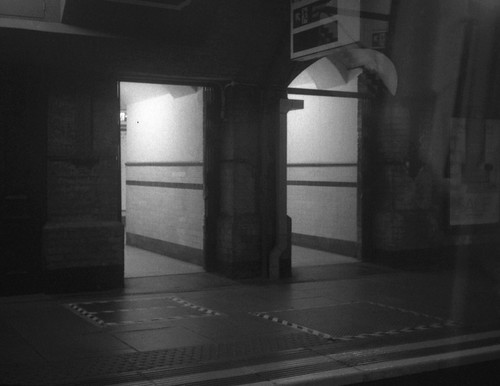
| Metro Entrance, Ilford Delta 3200, handheld at 1/50th, f4.5 |
Along with Kodak T-Max P3200, Ilford Delta 3200 is the fastest black & white film currently on the market. Despite the prominent '3200' in the name, its true emulsion speed is
1000 ISO: essentially this means the film is recommended by Ilford to be exposed at a range of speeds, including 3200 ISO, and developed accordingly (incidentally, T-Max P3200 has similar characteristics:
Kodak state it to be 1000 ISO in their proprietory T-Max developers, or 800 ISO otherwise). Delta 3200's main advantage over T-Max P3200 is that it is available in medium format as well as 35mm. When in Paris recently I shot a roll at night, as an experiment, to use the film in medium format; I had previously shot Delta 3200 in 35mm but found the results unsatisfactory. This may have been partly due to using Rodinal as a developer. Being a high-acutance developer, Rodinal tends to be recommended for slower films with more traditional emulsions, as the acutance effect can emphasise film grain considerably; with larger negatives in medium format, this is less noticeable.
 |
| Kodak T-Max P3200, developed in ID11 stock solution, 12 minutes at 20 degrees C. |
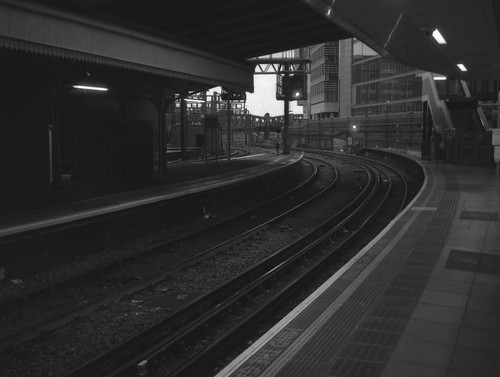
When I first began to take and develop photographs as a student, I frequently found myself wanting to shoot hand-held pictures in low-light situations, often in museums, or on the Underground. I carefully annotated my contact sheets with the ISO ratings and the developing times and dilutions I used at the time, so now, looking back, they provide a useful reference for comparison. I did use T-Max P3200 a couple of times, which was the fastest film on the market (Delta 3200 was introduced in 1998), although more often I pushed Ilford HP5+, frequently to 800 ISO, and occasionally to 1600 and to 3200, with variable results. I can't recall the prices, but I imagine T-Max P3200 was more expensive than HP5. I suspect the reason that I did not use T-Max P3200 more was that the I perceived the difference in quality insufficient for the price. Another factor was using ID11 to develop the film, which is reputedly better than Rodinal for push-processing.
 |
| Ilford HP5, rated at 3200 ISO, developed in ID11, 18 minutes at 20 degrees C. A comparison to the previous shot of Sir John Soane's museum does show a lack of shadow detail, though not a considerable difference. |
|
One consideration against push-processing film for night and low-light photography is that an effect of pushing a film is an increase in contrast. Often night scenes are themselves inherently high contrast: bright light sources and reflections, and dense shadow areas, therefore pushing a film can result in a negative with blocked highlights and very little- if any- detail in shadow areas. In this regard it would be more appropriate to
pull-process the film, and so reduce contrast, which however negates the use of a higher ISO rating, a real consideration for hand-held photography.
 |
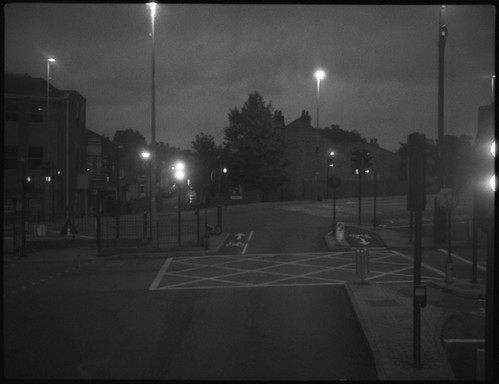
| Rue Lacepede, Ilford Delta 3200, handheld at 1/50th, f4.5 |
The current photographs were shot using a
Baldalux medium format folding camera, with a 6x4.5 mask, a compromise between larger negatives, and getting more shots from a roll of film. One drawback with the camera is the lack of a built in light meter; for daylight shots I use a Weston light meter, but being a selenium cell meter, there isn't enough light for it to work at night, so the photographs I took in Paris are not metered. The hand-held shots were all taken wide open, at the maximum aperture of f4.5, at a 50th of a second; for the Jardin De Plantes photograph I held the camera flat against a hole in the iron gate. I developed the film in Rodinal 1:25 at 19 degrees C, 15m 45s (3 and a half minutes longer than Ilford's recommended time), with the last four minutes 'stand', meaning without agitation, preferring to potentially over-develop the film as an insurance against under-exposure.
 |
| Jardin des Plantes, Delta 3200, roughly 60 seconds at f11. |