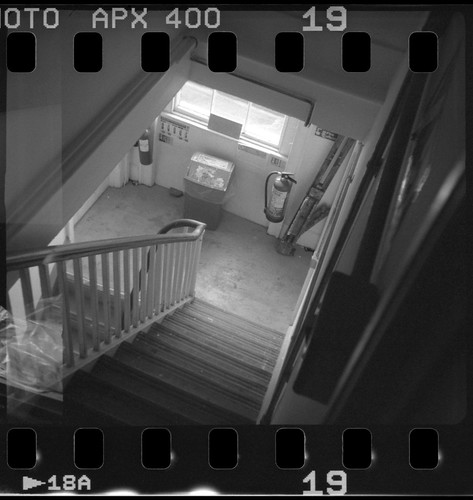
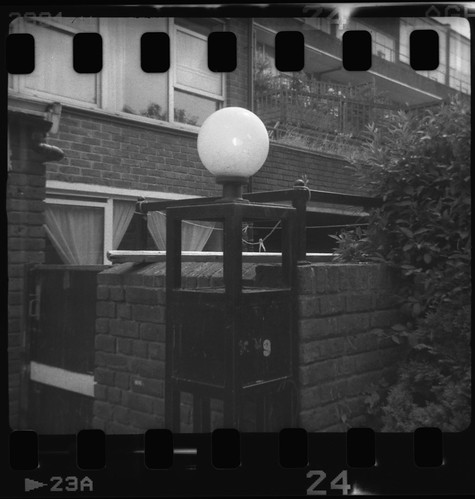
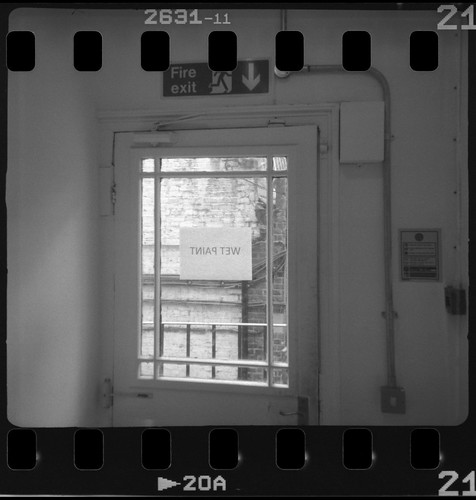
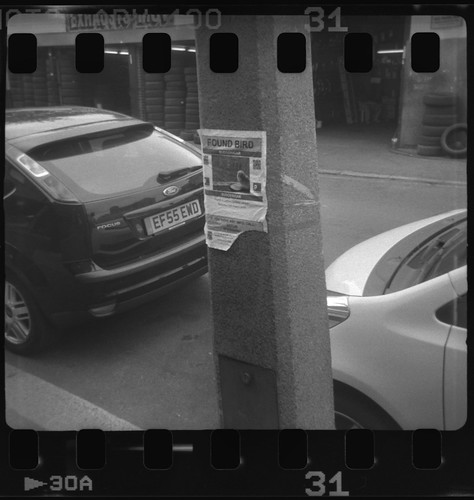
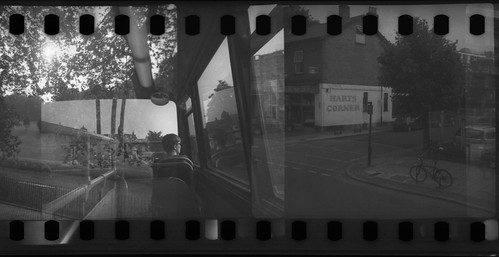
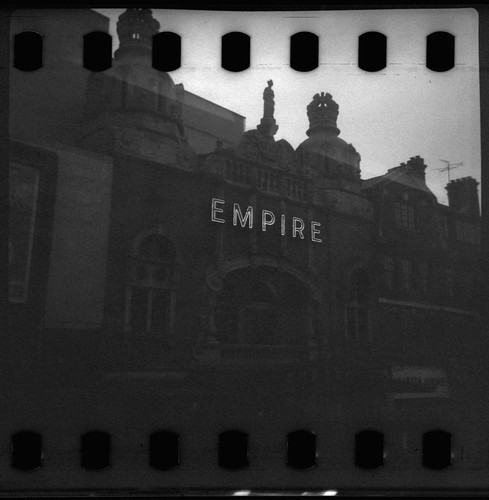
The 35mm film format was originally developed for motion picture cameras, but the convenience of the format's small size soon led to its adoption for still photography (35mm was known as 'miniature' film, by comparison to the 'medium' format of rollfilms, and large format sheet films and plates). The famous
Leica wasn't the first still picture camera to use 35mm film, but it did help to popularise the format; subsequently the
Kodak Retina was designed around the 35mm daylight loading cartridge, and by the second half of the 20th century, 35mm film became the dominant film format. Meanwhile, it continued (and continues) to be used for motion pictures and was only challenged by the quality of digital very recently. There were (and still are) some film emulsions produced explicitly for motion picture use which have never been generally available in short lengths for still camera use. However, there are photographers that use motion picture stocks for still photography, with online communities catering for this niche such as
Project Double-X, and the
Double-X and
Orwo Flickr groups.
 |
| Ilford Mark V Motion Picture Film |
Looking for unusual film stock online, I found, and bought, a lot of 4 cans of
Ilford Mark V motion picture film from a well-known auction site. Each can contains 50 ft of film; given roughly 5ft per 36 exposure roll of film, each can would hold about 10 rolls' worth of film. On a generic label, 'Ilford Photographic Materials', the particulars of the film are printed underneath and "Date of test 21.5.73". Shooting 35mm film at 24 frames per second uses 90 feet of film per minute: 35mm motion picture film is usually sold in 400ft to
1000ft lengths. A 50ft roll of film would last just over 30 seconds. Returning to the label, it's a question as to what the 'test' actually refers to: was the film in these cans produced for quality control purposes, to test the Mark V emulsion, or film base, or coating machinery? Or are these short reels produced for film makers to make tests with (although the syntax suggests otherwise)?
 |
| Top: Ilford Mark V perforations. Bottom: HP5 Plus |
As a motion picture film, it has different
perforations from still
camera film, but should run through 35mm cameras without any problems: problems occur when using 35mm still camera film in cine cameras, not the other way around. The general practice of edge marking on 35mm film is to print it to be read from the same side as the negative frames, but the lettering on the Mark V film is reversed. It's marked simply "IlFORD SAFETY FILM", obviously without frame numbering, but there are numbers at intervals on the edge of the film.
For a first test, I shot a roll of Mk V with successive exposures at 400, 200, 100, 50, and 25 EI, and then stand developed the film in Rodinal diluted 1:100 for an hour, to give me a rough guide to exposure to make further tests with.
 |
| Contact sheet of Ilford Mk V test roll |
After developing the first roll of film, I was struck by how grey the film looked. I assumed this to simply be fog due to age, although I later discovered the film also has a grey base. Exposures at 25 and 50 EI yielded usable results (it looks as though the highlights are beginning to block at 25); I had hoped that the film might be faster than that. At this point I didn't know what the film was originally rated at, but I had read online that it was 500 ISO; the results of scanning the negatives show them to be as grainy as a fast film, and in my experience of out of date film, as a broad general rule, faster emulsions are more affected by loss of sensitivity with age. There were also no indications of how these cans of film were stored over the past 40 years.
 |
| Ilford Mk V, shot at 25 EI |
 |
| Ilford Mk V, shot at 50 EI |
As a consequence of my research into
Ilford Limited's operations in Ilford, I was also able to find out more about Mk V film.
Silver By The Ton has an appendix of the company's products. Mark V film is listed under 'Cine and Aerial Films' with an introduction date of 1965. However, this list,
unlike the lists for plates, sheet films and rollfilms, does not have ASA/ISO
values attached. There is also no mention of any Mark I - IV iterations of the
film: I have read some speculation that Mark V may have used a version
of the HP emulsion, which was HP4 at the time (HP5 appeared in 1976). For the next couple of test rolls I tried developing Mk V as if it was
HP5 Plus, using exposure to compensate for the film's loss of sensitivity, but using the same development times as HP5+. For a second test roll, I exposed the film at 25 and 32 EI, using my
Agfa Optima Sensor. Cutting the roll of film in to two lengths, I developed half the roll in Rodinal 1:25 for 6m30s at 19ºC and the other half for 8m45s at 19ºC (I also shot and developed a roll using the
Ilford Sportsman at the same time). I had hoped that a shorter development time might reduce the fog without the need to add anti-fog agents, but the effect seemed negligible. Comparing these results to the first roll of film which had been stand developed, I felt like the grain might be a little more pronounced, but, without shooting exactly the same subject matter, making an accurate comparison is difficult.
 |
| Mk V film, 32 EI, developed 6m30s in Rodinal 1:25 |
 |
| Mk V film, 25 EI, developed 8m45s in Rodinal 1:25 |
Further to my research on Ilford at Redbridge Central Library, I subsequently found the
Ilford Technical Information Book. Rather than a book exactly, these are four ring bound manuals containing information sheets on Ilford's various products, and could be updated with new sheets when required. Dates on the information sheets of the
Technical Information Book that Redbridge Library holds range from the early 1960s to the mid-1970s; Volume 1 contained the sheet for Mark V Negative Motion Picture Film, dated L68, i.e. December 1968. Although this was after I'd exposed and developed a few rolls of film, and had found workable parameters for using it, the sheet provided a wealth of information about the film:
This film has fine grain and wide exposure latitude. These characteristics, together with its high speed, make the film suitable for the production of pictures of very high quality under a wide variety of lighting conditions. Newsreel photography in poor light, filming at night and television work generally are situations in which this film is particularly useful. In the studio the high speed of the film makes great depth of field possible without the need for exceptionally powerful lighting units.
The information sheet provides the original speed ratings, two of which are given: a 'daylight average' of 250 ASA and a 'minimum' of 500 (ratings for tungsten lighting are given as 200 and 400 respectively). Under 'Special Development Techniques' it also mentions Microphen for push processing for speeds up to 1300, although it gives no development times.
Two speed ratings are quoted. The minimum exposure rating is recommended when it is necessary to achieve the maximum film speed and image quality, but this is only possible when the processing conditions are strictly related to the exposure conditions. The average exposure ensures image quality of a very high order in a wide range of exposure and processing conditions.
 |
Sensitometric curves when developed in ID11 at 20ºC (continuous agitation).
From Technical Information Sheet A50.7 |
The film couldn't really be described as having 'fine grain' now, but the wide latitude does appear to still be present even with the loss of sensitivity with age: having initially thought the film might now be as slow as 25, I shot another roll at 50 EI, and bracketed either side of this with usable results (the first test had been shot on a grey winter's day, not the best lighting conditions for this). For this roll I returned to stand development, developing half in Rodinal 1:100 for one hour, and half in Rodinal 1:150 for 3 hours (I had tried
this time and dilution with HP5 recently, with good results).
I wouldn't want to be prescriptive about appropriate uses of different types of film: the grain of Mark V is more pronounced than that of modern 400 speed films, and so the choice of subject matter is a consideration when using this film. The grain can appear disruptively prominent in the skies of landscape shots, but from the results of the rolls I've developed so far the subjects that work best with Mark V film, in the examples below, are those such as the dim station interior or the photograph of Dagenham Brook in fading light.
 |
| Mk V film, 50 EI, stand developed in Rodinal 1:100 for 1 hour |
 |
| Mk V film, rated 50 EI, stand developed in Rodinal 1:150 for 3 hours |
 |
| Ilford Mk V, 50 EI, stand developed in Rodinal 1:150 for 3 hours |
 |
| Ilford Mk V, 32 EI, developed in Rodinal 1:25 for 8m45s |
Sources/Further reading
Silver by the Ton - A History of Ilford Limited 1879-1979, RJ Hercock and GA Jones
Ilford Technical Information Book Volume 1
Labeauratoire
(with which I am in no way affiliated) is currently selling Mark V with an expiry date of 1979. Their
recommendation is 400 or 200 ISO, which suggests their film was kept
better than my stock.