|
| Front left:Agfa Isolette III; right: Vito CL; behind: Instamatic 300 |
In Stockholm recently, I visited two of the local flea markets there during my stay: the Sunday market at Hötorget, and the all-week around covered market, Loppmarknaden at Vårberg. The overall quality of the stalls at Hötorget was better, while Loppmarknaden, which is an underground hall in the shopping complex attached to Vårberg Tunnelbana station, some of the stalls appeared to be little more than just piles of household rubbish. This market charges an entry fee at weekends, but I went on a weekday. There were many digital cameras from about a decade ago, a number of older SLRs, but the only camera that caught my eye was an Agfa Isolette III. This looked in good condition, although a bit dusty, and everything worked except for the uncoupled rangefinder, which was stuck on the 10m mark. This may be easy to repair, but as it is uncoupled, this does not affect the camera's operation, simply meaning that guess-focussing has to be used. What piqued my interest sufficiently to buy the Isolette was the half-used roll of film inside. The seller wanted (and got) 200 SEK, just over £15. I finished the roll of film in the Isolette at Vårberg, in the market and at the station adjoining it. Stand developing the film, Kodacolor II, in RO9 One Shot for an hour at 1:100 resulted in a few faint images, no negatives came out from before the few that I shot with it, and the best, if rather fogged, image was of the ramp to the platforms of the station.
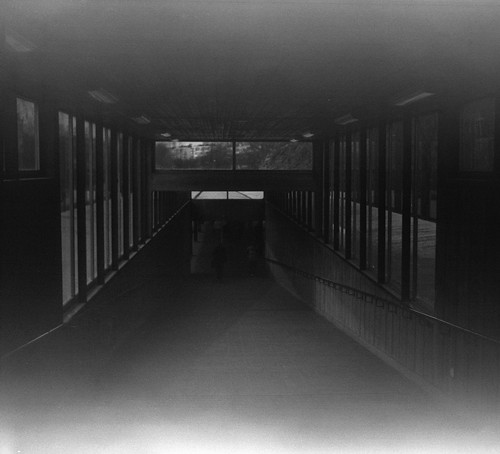 |
| Agfa Isolette III with Kodacolor II film |
I returned to the Hötorget market a week on from my first visit, which had been on Easter Sunday. It was busier, with more stalls, some of which were the same as the previous week, I found a
Voigtländer Vito CL, which, although dirty, looked in relatively good condition, and its shutter fired and the lightmeter was responding. I asked how much and was told 100 SEK; the same stall had a Kodak Instamatic 300 which had a part-used film cartridge inside. As with the Isolette, the part-used film was intriguing, and the seller gave me
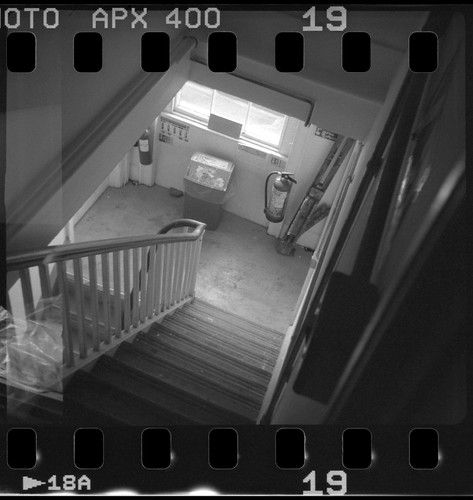
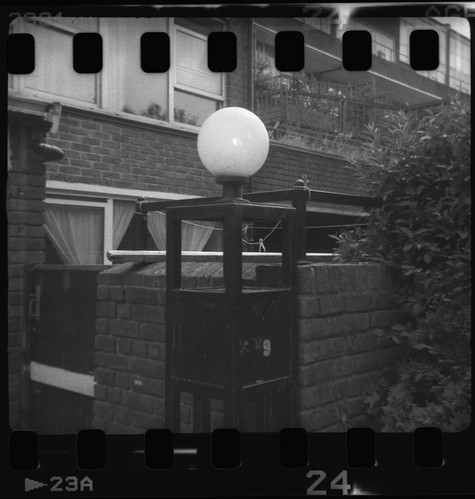
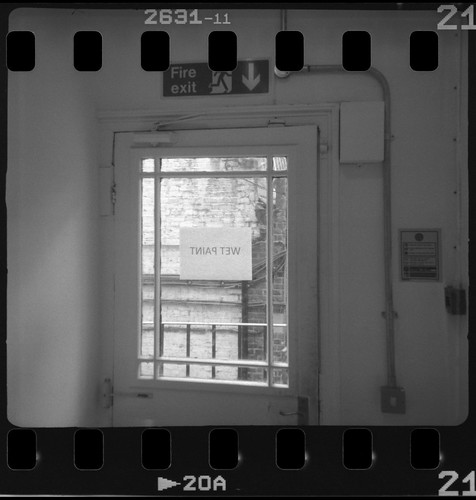
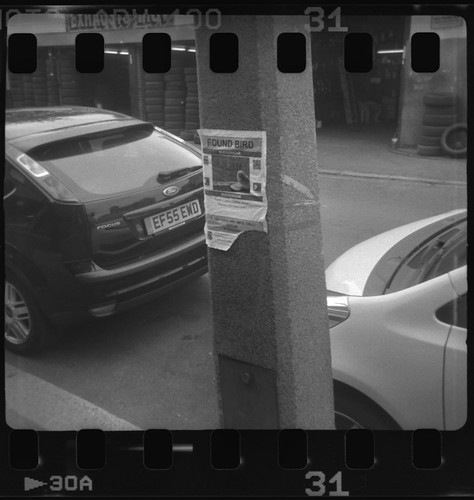
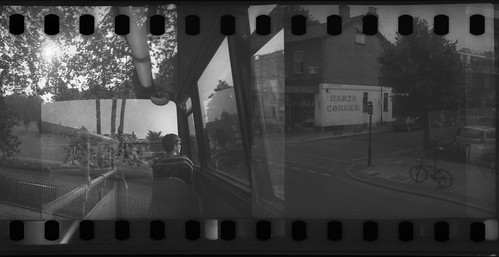
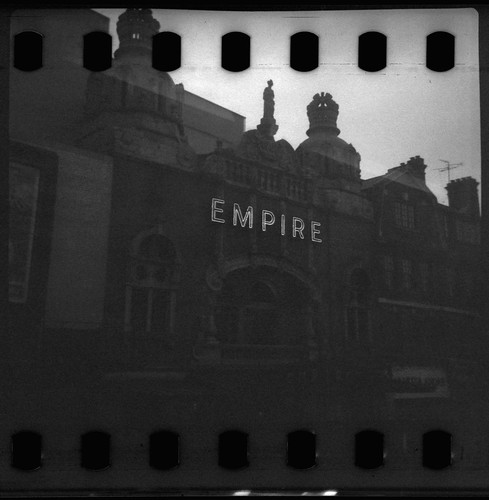
both cameras for 100 SEK and put them into a hessian bag. I shot the rest of the film at the flea market while there, then later I cut open the 126 cartridge, removed the 126 film for safekeeping until development, and loaded the cartridge with a length of Agfaphoto APX 400 taped to the backing paper. I shot this film a couple of days later. Using 35mm film in the camera provided problems that I have experienced before with the film's perforations not always coinciding with the holes in the backing paper, leading to gaps and overlaps in the exposures, and tears in the film where the advance had to be forced. The original colour film from the cartridge was stand developed in RO9 One Shot 1:100 for one hour, and the APX 400 developed as normal. The Kodak Instamatic 300 does have a selenium meter to control exposure, and, although the shutter fired, it was hard to tell whether this or the aperture changed with the light conditions. The 400 ISO film was mostly shot with a deep yellow filter taped over the lens and the negatives do not appear overexposed; the Kodacolor VR film from the cartridge (dating from 1982-86) was too dense to scan once developed, although images are visible.
 |
| Kodak Instamatic 300 with Agfaphoto APX 400 |
 |
| Kodak Instamatic 300 with Agfaphoto APX 400 |
 |
| Kodak Instamatic 300 with Agfaphoto APX 400 |