"One of the internet's most intriguing capabilities, for a topographical film-maker, was that it offered contemporaneous views of distant landscapes. During 1996, I had heard that there were websites where one could access the cameras that observe traffic on UK motorways, and immediately conceived a strong desire to explore, and perhaps to sample, what I imagined would be a large and increasing number of real-time moving images of landscapes throughout the world. I wondered, perhaps, one day, I might be able to make a film without leaving the house."Patrick Keiller, 'The Robinson Institute'
"And then, again, a sudden light, and recurring darkness.”O. Winter, ‘The Cinematograph’, May 1896
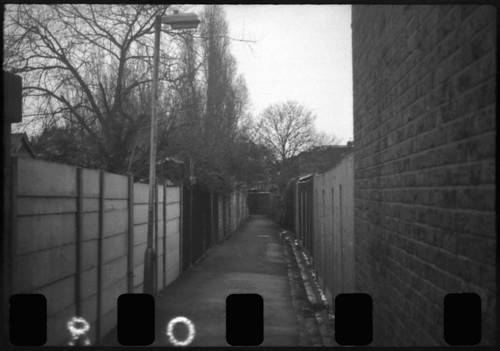
Just short of a year ago, I filmed two views in Ilford, with an 8mm camera facing the locations which had once been entrances to Britannia Works, a large factory site that was the main manufacturing base for the photographic company that became Ilford, Limited, and wrote about this as 'Workers Not Leaving The Factory'. Due to a sense of dissatisfaction with the results, I had a desire to revisit the location and film the site again. In the latter part of last year, I realised that the opportunity might coincide with either one of two significant anniversaries: in December, it would 125 years since August and Louis Lumière demonstrated projected moving photographic images to a paying audience, which, despite other prior claimants, is seen to mark 'the birth of cinema'. The other anniversary was 21st February, when the Lumières' films were first shown before a paying audience in London in 1896.
 |
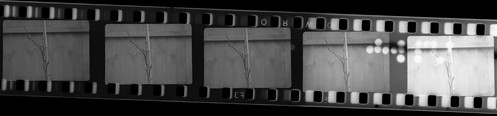
| Original 2x8mm negative, digitally inverted |
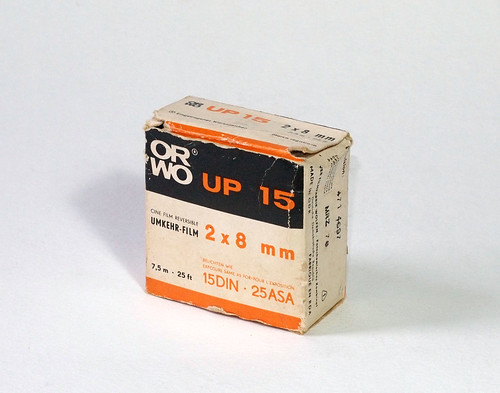
Last year, I shot the film on Ilford FP4 Plus, using a length of 16mm-wide film cut down from medium format. As a result, this did not have perforations, but I found that, imperfectly, this would be driven through a Bolex B8 camera by the friction of the pull-down claws alone. Using this film involved many compromises, particularly in duration, so I had been looking out for Ilford ciné film on a certain well-known auction site, and, eventually, a couple of rolls of 16mm Ilford Fast Pan film turned up, and were purchased. The labels on both read "date of test 6.1.69", meaning that the film would have been made at the Britannia Works site in Ilford before production there stopped in the mid-1970s. In addition, I also acquired a couple of Kodak 16mm movie cameras, one of which was made in England, so I was set to film a new version of 'Workers Not Leaving The Factory' at the site of the now-demolished factory, with vintage Ilford film made there, and possibly with an English-made 16mm camera. The ideas that I had touched upon in writing about the filming last year were still appropriate of course, but I hoped the material aspect of this action now had more resonance.
 |
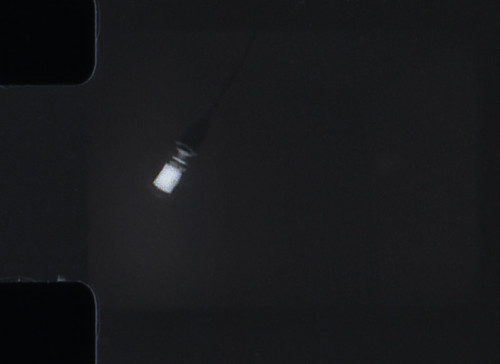
| Ilford Fast Pan 16mm Film |
The current coronavirus pandemic, and its particular severity in the UK, upset my plans. I had filmed last year on the 3rd of March. Less than two weeks later, my workplace moved to remote working, preceding the government's general 'stay at home' injunction by a little over a week itself. In December 2020, I was still recovering from Covid-19, having contracted the virus in mid-November, which precluded filming on the 28th, the date of the Lumières' first public showing at the Salon Indien du Grand Café, Paris, in 1895. With daily new infection rates in the tens of thousands, and infections in London running at an estimated rate of around 1 in 30 of the population by the beginning of January, new restrictions were put in force across the UK. Having largely recovered from the virus myself by the second anniversary date of 21st February when the Lumières' films were first shown in London, I could have returned to Ilford to shoot these two locations again. However, the 'stay at home' injunction still applied. Reasons to leave home included travelling to a workplace if that work could not reasonably be carried out at home; arguably, this filming could have come under this definition of 'work', but I felt it was hardly within the spirit of the rules. Another reason for leaving home would be for daily exercise, once a day, and I have used my daily exercise to take photographs while walking a route around my local area; in this rule, the 'local' is stressed: although Ilford is less than 5 miles from where I currently live, again, this feels outside the spirit of the rules, particularly so when one uses a tripod, which makes the act of taking photographs (or filming) seem less like an incidental aspect of daily exercise and something more intentional.
Given the 'stay at home' order, nevertheless I still wanted to mark this anniversary. The act of projection itself, appropriately, would take the place of location in importance. Last year's film physically existed as two negatives, 16mm-wide, without perforations, the frames running in both directions along their lengths. Having been given a dual-format 8mm/Super-8 projector for Christmas, if I could make a positive print from these negatives, I could project my film. With perforations it would have been possible to make a contact print by sandwiching the negative film on top of a roll of unexposed film and, running both through a camera, this would expose the fresh film through the negative, and, once developed, this would result in a positive print. However, in using cut down Ilford FP4 Plus film, my original negative didn't have perforations. Although the film had gone through the camera without perforations at the time I shot it, trying to run this back through the camera with perforated film underneath might have worked, but my Bolex B8 had developed a fault with its motor, and wasn't running properly (I also think that there would be a high likelihood of the unperforated negatives slipping against the fresh film; if the negative had perforations this would keep the two layers of film aligned while running through the camera).
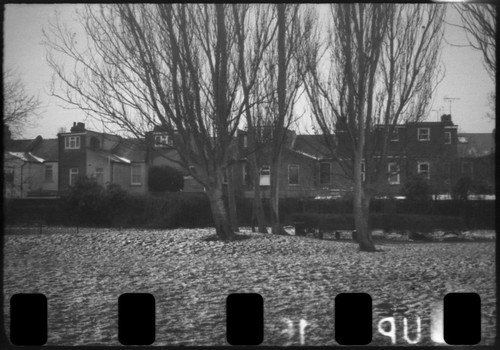
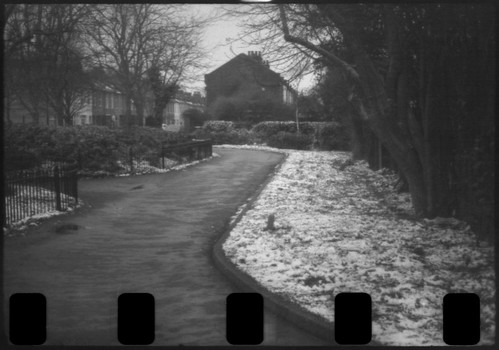
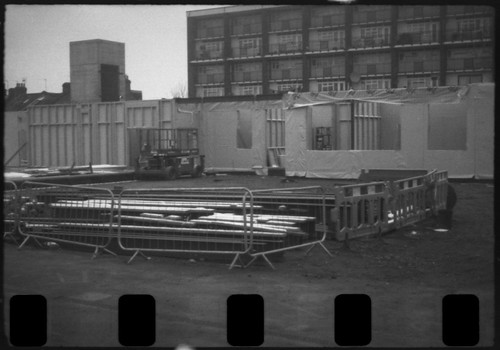
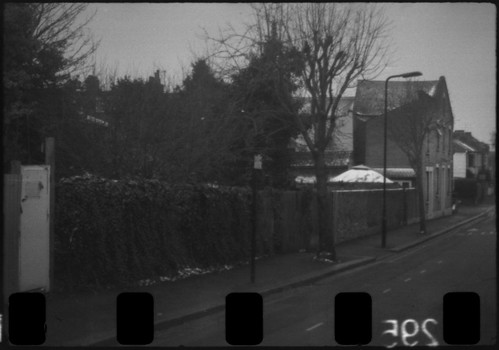
The only practical solution within easy reach was to expose the two separate negative lengths as a contact print with fresh film underneath. As the original negative had erratic frame spacing, there was no way of ensuring that the frames would be correctly aligned with the perforations in the positive print, so, as a fait accompli, there was simply no point in worrying about accurate registration. The hardest part of the exercise was lining up the long strips of 16mm-wide film in complete darkness before exposing these, only partly successful, and this became another contingent fact in the print, whereby the successive frames wander in both horizontal and vertical directions as a result. Not having a single sheet of glass large enough to cover the whole film, I used two sheets in an attempt to keep the film as flat as possible during exposure, with some of the film not held flat at either end and the edges of the glass showing in the prints.
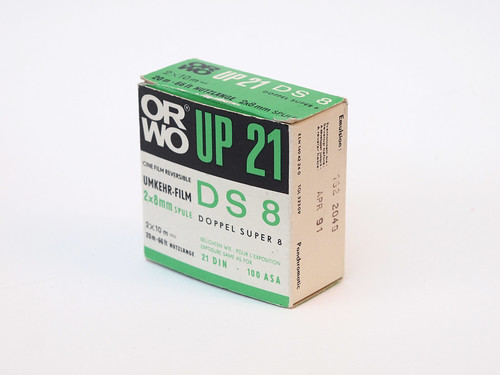 |
| Orwo UP21 DS8 Film |
I made one test with the UP21 DS8 film to get a rough idea of exposure, then contact printed the negatives onto the film, developing it in Ilfotec LC29 diluted 1+19 for 9 minutes at 20ºC. I cut these prints to 8mm width by hand, somewhat imperfectly (I had ordered a 2x8mm splitter the day before, realising this would be useful, but I went ahead with cutting the prints by hand, not thinking that the splitter would arrive a couple of hours later).
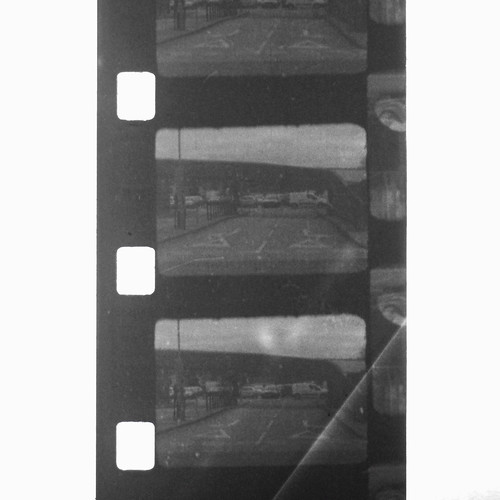 |
| Contact print on Orwo UP21 DS8 film; the diagonal white line lower right is the edge of one sheet of glass |
Unable to film in Ilford on the 21st, I wanted to connect–visually–the projection of my film from last year to the site with some form of simultaneousness to Ilford on the 21st of February. I conceived that the manner of achieving this could be through streaming a live projection of a webcam from the town and recording both projections at the same time. I found just one such instance online with any kind of proximity to the site of Britannia Works: a traffic camera on the A118 Romford Road looking in the direction of Ilford Hill, across the river Roding underneath the A406 flyover. Britannia Works would have been off to the right of the field of view of this camera, but at some point Ilford Limited had expanded their operations to include properties between Roden Street and Ilford Hill, including the use of a skating rink, which would have been somewhere in the location of the building with the white double-height ground floor seen on the camera. Close by, there is another camera on Mill Lane, offline at the time of writing: in my research I found no connection between the paper mill which gives the road its name and the raw materials supplied to Ilford for the manufacture of photographic paper. There is also a webcam focused on a depth gauge in the Roding, although this only provided a still image; this could be 'animated' through refreshing a web browser window to update the image, but this had less of the 'liveness' of the traffic camera, although there was an association there to be had with the anecdote in Silver by the Ton of drying the glass used for photographic plates by the banks of the river while the area was still semi-rural at the end of the nineteenth century, as well as the risk of flooding on Riverdene Road that caused the houses that once backed onto Britannia Works there to be built with a slightly raised lower storey.
 |
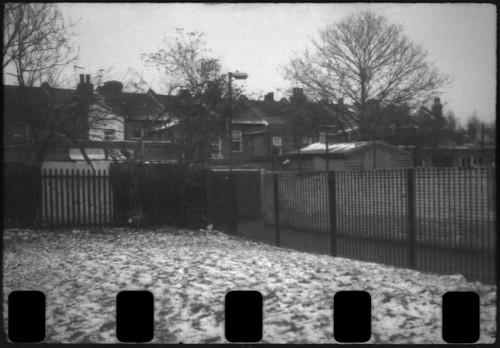
| Contact print on Orwo UP21 DS8 film; the second location on Riverdene Road |
The passage from Patrick Keiller's 'The Robinson Institute' that continues from the quote at the top of this post quickly punctures its utopian idea: Keiller goes on to write about how this promise of electronic flânerie was more imagined than realised at the time, in the late 1990s, there being relatively few websites providing actual live streams rather than, like the flood gauge in the Roding, still images that needed constant refreshment. At the time of writing twenty-five years later, the idea of scouring the internet for websites showing live images from anywhere around the world–for some experiential form of spatially-dislocated dérive–seems to me something of a relic of the idealistic promise of those early years. Other forms have supplanted the simple live webcam view: the experience of Google Street View, for example, while affording the opportunity to travel virtually through many towns and cities around the world does not allow the user to experience the simultaneousness of the live stream; this simultaneousness is now part of the everyday with various videoconferencing platforms, but using these has a tendency to subsume any kind of pleasure in the experience of dislocation into pragmatic and productive concerns.
The traffic camera I found looking in the direction of Ilford Hill only provides a short loop of a few seconds: this loop is updated every few minutes online. However, this suited my purposes as the short lengths of film that I projected are only seconds long (I didn't have the right equipment to splice the film together into one continuous length), and each section would have to be separately threaded into the projector; in the interim I could refresh the page to update the loop from the traffic camera to its most recent version. This webcam stream also had a date and timestamp, functioning as evidence to the specificity of the day I projected and recorded it as 'live', returning to the location remotely. There was a provisional quality to the composition of these two projections, utilising an otherwise neglected corner of a room, furnishing it with some of the ephemera that I'd collected in my research into the history of the Britannia Works site in Ilford, sufficient to give a texture to the white walls. I had envisaged the possibility of recording this set up with multiple camera angles, close ups of the various elements within the frame: the business of just projecting the film and documenting this action took precedence over anything more complex than a single angle, static camera.
I had problems in the actual projection of the film I had made. The short lengths had no leader: I had made the contract prints longer than the negative strips, with this extra length acting as a leader, but leader material tends, I think, to be a little thicker than the film itself. The projector I used has automatic threading, which frequently refused the prints I'd made; sometimes these would go through smoothly, but did not always come out the other end of the film path of the projector (also an issue to do with the material's thickness), which then had a tendency to fold itself up inside the projector, and, once creased, was even less likely to cleanly run through the projector, jamming in the gate, which sometimes could be shepherded through by toggling the frame. In addition, thanks to being hand cut, some parts of the film were a millimetre or so too wide, which was relatively easily solved by trimming a sliver from the edge; some parts of the film were not wide enough, and this caused it to jam, possibly by having too much side-to-side play when engaging the projector's pull down mechanism. Despite these issues I was able to film the four separate parts of the footage (each location's filming having been broken over the two lengths of the original cut-down negative); I also kept a section where one length of film jammed in the projector's gate, partly as this print shows a good deal of the lettering in the film rebate, notably 'ILFORD' itself. The duration is shorter than the original film: this was shot at 12 frames per second; although the projector does have adjustable frame rates, it seems to only run at 16fps. I tried slowing the playback to 75%, but found the distortion of the slower audio (even at its original pitch) more distracting than anything gained by seeing the film at the rate intended. With all these contingent factors, the film itself as projected has become fragmentary and somewhat abstract, the image sliding across the frame, hard to fix. Perhaps, in terms of "photographs in motion" (a phrase from David Campany in Photography and Cinema, on the Lumières' first film) the least obstructive section is the very brief few frames in which a pedestrian crosses the screen, but the focus here is off, partly due to the contact print, compounded by the projection itself, in which, thanks to the hand-made quality of the material, needed constant readjustment.
 |
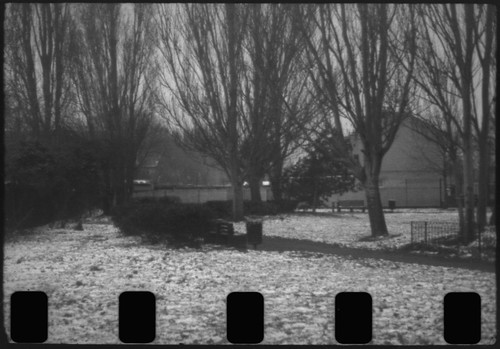
| Contact print on Orwo UP21 DS8 film showing both irregular vertical and horizontal framing |
Writing about the beginnings of Ilford, Limited under Alfred Harman last year, I described it as "literally a cottage industry" in that, having outgrown his basement on Cranbrook Road, Harman rented a cottage on the Clyde Estate as his first expansion into the location which would become Britannia Works, rapidly incorporating many more cottage buildings, some of which remained on the site until demolition nearly a century later. This use of domestic space as a site of production was something I wrote about at the end of 'Workers Not Leaving The Factory', or rather, more specifically, the de-localising or re-localising of production outside of a strict spatial definition of 'the workplace'. The global pandemic has accelerated some of these trends, while delineating what kind of work could be moved online easily (although not always pursued) against work impossible to carry out remotely. Surrounding the filming in Ilford a year ago, the consumption the supermarket that has replaced Britannia Works allows relies on the productive work, necessarily tied to a number of spatially-located specificities, non-virtual, culminating in the supermarket itself; the construction work just off-frame is also solidly tied to the real, real bricks, real concrete, and the physical labour required to configure these materials into living spaces, such spaces now co-opted into being the site of production for many, unforeseen a year ago.
The title used here comes from a reproduction of the original programme of the Lumière films shown in London in 1896: their first film, of workers leaving the Lumière factory, is not among the titles listed, but the possibility that it may have been shown is tantalisingly suggested by the promise that the programme "will be selected from the following subjects, and will be liable to frequent changes, as well as ADDITIONAL POURTRAYALS [sic]".
Patrick Keiller, 'The Robinson Institute', The View From the Train, Verso 2013
O. Winter, ‘The Cinematograph’, The New Review, May 1896 (https://picturegoing.com/?p=4166 retrieved 21/3/20)