Showing posts with label fleamarket. Show all posts

Tuesday, 7 June 2016

Paris flea market finds (2)

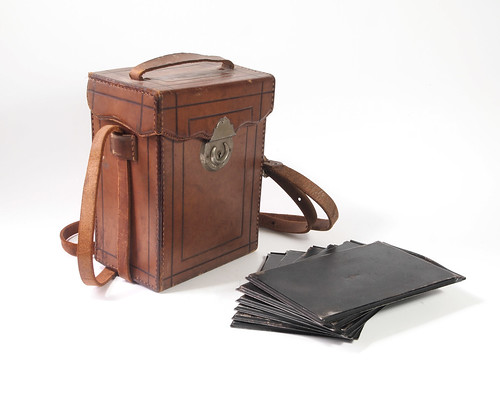
Plate camera box and plateholders
One of my first posts on this blog was describing what I'd found in the Porte de Vanves flea market in Paris five years ago; the weekend before last I revisited this flea market on my way through Paris to the south. There were a few cameras of interest to me, but none without one problem or another. However, I did find a stall which had a couple of plate camera boxes containing plate holders. These were 9x12cm-size plate holders, which, having a few cameras in the size, such as the Ica Trona and the Kodak Recomar, it's always useful to have more. The stallholder wanted €25 for six holders; I did try to barter down to €20, but he wouldn't move on the price. I then asked for the box too, and was told the price was €10 for the box alone, but he gave me the box and plate holders for €30. If my French had been better, I'd have asked him how often he sells glass plate holders, as I don't imagine these items sell which any frequency in the flea market. The plate holders are all stamped AP Paris, some with a craquelure finish on the darkslide; none had film sheathes inside, but one did contain a glass plate negative, shown below.
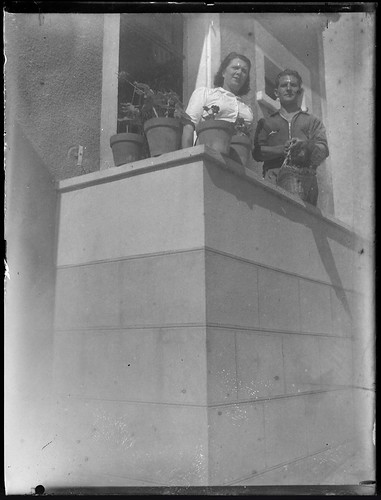
Found glass plate
A few days later, in Toulouse, a window display of a shop on the Rue Pargaminières drew my attention, with, amongst other secondhand cameras, a Contax IIIa. The shop was Photos Signe Des Temps - the website is limited, but the shop itself had a good stock of film, and film cameras, including a whole cabinet of classic SLRs, and a glass case of all kinds of old cameras. One camera which caught my eye was a folding plate camera with a 165mm lens.
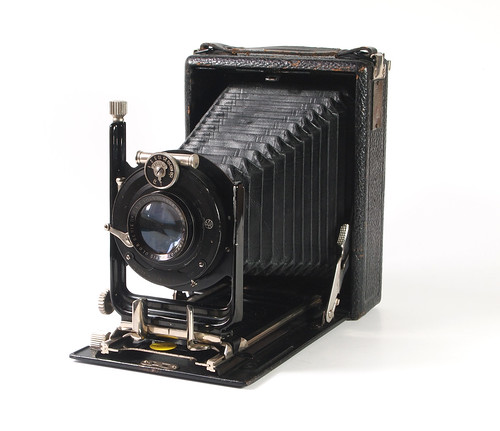
Photo-Plait branded 9x12cm plate camera
Typically, for a camera of this age, the 165mm focal length would denote a 10x15cm plate size, and at a glance, it looked as though it was larger than a typical 9x12cm camera - which it turned out to be - due to the wooden body. The lens itself was a Berthiot Olor Series IIa, reputedly a Tessar clone, with a maximum aperture of f5.7 in an Ibso shutter - the eight-speed version with 1/150th, rather than the more common seven-speed shutter, up to 1/100th. The shutter gave some indication of the camera's date: according to Camera-Wiki, the Ibso was made by Gauthier between 1908-1926. However, I suspect that the lens and shutter unit may not be original to the body, and not simply due to it being an unusual focal length for the negative format. Some of the features are clearly missing, such as the focus scale, and, at infinity, the 165mm lens is drawn out so much that the metal indicator at the base of the lens standard is beyond where the focus scale would need to be in order to read this. It is also missing a wire frame finder, and a brilliant finder: the latter appears as though it may have been carefully sawn away, with the metal cut into a continuation of the curve around the lens standard. As a typical mid-range folding plate camera, it has rise and cross movements, and rack and pinion focus with double extension bellows - a necessity given the focal length. The bellows were in good condition, and the ground glass intact. The lens was dirty but appeared otherwise good, and, by ear, the shutter fired at all speeds fairly close to each setting.
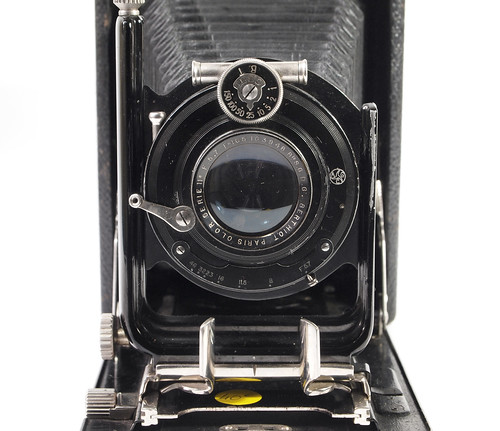
Berthiot Olor Series IIa lens in Ibso shutter
The camera was priced at €40, and although it did have some missing features, the serendipity of having found the plate holders and camera box in the flea market earlier in the week prompted me to buy it. Needless to say, the plate holders did fit, and the camera itself fitted into the box with the six plate holders too. Even if the lens and shutter were original, there was little on the body to identify the camera, except for a metal plaque with 'Photo-Plait Paris'. This Paris-based dealer would have affixed this small plaque to the cameras that they sold (including, in this discussion thread, a Leica), but it appears that some cameras were manufactured for Photo-Plait and sold under their own name. The distinctive thumb-grips on the two locking levers for the base board were some help in getting close to an identification: French cameras are something of a lacuna for me, but after a detailed trawl through www.collection-appareils.fr, with a different lens, and some removed features, it looks closest to the Photo-Plait Splendor model.

Thursday, 30 April 2015

Flea Markets in Stockholm

Front left:Agfa Isolette III; right: Vito CL; behind: Instamatic 300
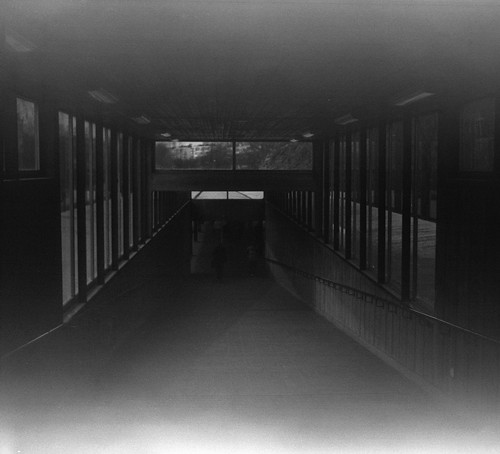
In Stockholm recently, I visited two of the local flea markets there during my stay: the Sunday market at Hötorget, and the all-week around covered market, Loppmarknaden at Vårberg. The overall quality of the stalls at Hötorget was better, while Loppmarknaden, which is an underground hall in the shopping complex attached to Vårberg Tunnelbana station, some of the stalls appeared to be little more than just piles of household rubbish. This market charges an entry fee at weekends, but I went on a weekday. There were many digital cameras from about a decade ago, a number of older SLRs, but the only camera that caught my eye was an Agfa Isolette III. This looked in good condition, although a bit dusty, and everything worked except for the uncoupled rangefinder, which was stuck on the 10m mark. This may be easy to repair, but as it is uncoupled, this does not affect the camera's operation, simply meaning that guess-focussing has to be used. What piqued my interest sufficiently to buy the Isolette was the half-used roll of film inside. The seller wanted (and got) 200 SEK, just over £15. I finished the roll of film in the Isolette at Vårberg, in the market and at the station adjoining it. Stand developing the film, Kodacolor II, in RO9 One Shot for an hour at 1:100 resulted in a few faint images, no negatives came out from before the few that I shot with it, and the best, if rather fogged, image was of the ramp to the platforms of the station.

Agfa Isolette III with Kodacolor II film
I returned to the Hötorget market a week on from my first visit, which had been on Easter Sunday. It was busier, with more stalls, some of which were the same as the previous week, I found a Voigtländer Vito CL, which, although dirty, looked in relatively good condition, and its shutter fired and the lightmeter was responding. I asked how much and was told 100 SEK; the same stall had a Kodak Instamatic 300 which had a part-used film cartridge inside. As with the Isolette, the part-used film was intriguing, and the seller gave me both cameras for 100 SEK and put them into a hessian bag. I shot the rest of the film at the flea market while there, then later I cut open the 126 cartridge, removed the 126 film for safekeeping until development, and loaded the cartridge with a length of Agfaphoto APX 400 taped to the backing paper. I shot this film a couple of days later. Using 35mm film in the camera provided problems that I have experienced before with the film's perforations not always coinciding with the holes in the backing paper, leading to gaps and overlaps in the exposures, and tears in the film where the advance had to be forced. The original colour film from the cartridge was stand developed in RO9 One Shot 1:100 for one hour, and the APX 400 developed as normal. The Kodak Instamatic 300 does have a selenium meter to control exposure, and, although the shutter fired, it was hard to tell whether this or the aperture changed with the light conditions. The 400 ISO film was mostly shot with a deep yellow filter taped over the lens and the negatives do not appear overexposed; the Kodacolor VR film from the cartridge (dating from 1982-86) was too dense to scan once developed, although images are visible.

Kodak Instamatic 300 with Agfaphoto APX 400

Tuesday, 1 November 2011

Werra 1

Werra with 50mm Novonar f3.5 lens
The Werra is a unique 35mm compact camera produced by Carl Zeiss Jena. The version I bought at the Mauerpark flea market is the original olive green model with a 50mm Novonar f3.5 lens. This model is generally referred to as the Werra 1 to distinguish it from the subsequent versions, but at the time was simply called 'Werra'. Not knowing much about the Werra when I bought it, I had assumed that it dated from the 1960s, due to its streamlined design. However production began in 1954, and the serial number on my camera's lens dates it to 1955. Compare the look of the Werra with, for example, the Kodak Signet or the Baldessa, both 35mm viewfinder cameras contemporary to the Werra and it's easy to see how advanced its design was for the mid-1950s. One might speculate for the reason for this is that the Werra was made by Carl Zeiss Jena, principally a lens manufacturer, which made very few cameras. Perhaps it's a camera built around a lens, without being derived from any precedents. In keeping with the minimalist design, the camera is marked with just the name 'WERRA' embossed on the lens cap and rear of the body, 'Novonar' on the lens and the manufacturer's name is entirely absent.

Werra with lens cap/shade removed
The two most distinctive aspects of the Werra's design are its unusual film advance, which works by turning the aluminium bezel around the lens, and the combined lens cap and shade. The lens cap can be unscrewed from the shade, the shade removed, reversed and attached. The camera's controls are located around the lens, and, with the frame counter on the underside of the camera, which leaves just the shutter release for the top plate. The original Werra is a completely manual camera, without a meter. However there are figures around the lens picked out in red for optimum exposure and focus: 1/50th of a second on the shutter, f8 for the aperture, and 6m on the focus ring, which at f8 gives a depth of field from just beyond 3m to nearly infinity.

Detail of figures picked out in red around the lens
Obviously this depends on film speed and lighting conditions, but one can assume that these settings were designed to be used in fair daylight conditions with a film of medium speed. I used these settings to finish the film that was in the camera when I bought it. Raul M, in his blog post about the Werra, suggests that the shade can be left on covering the controls, effectively turning the Werra into a point and shoot camera. The entire back and bottom plate slides off to load the film, which travels from right to left, opposite to the direction 35mm film normally travels in a camera (although this is also true of the Agfa Optima Sensor), meaning that the frames on the developed film appear to be upside down, and also read in sequence right to left.

Sample image from the Werra, FP4 stand developed in Rodinal 1:100

ORWO NP 20: Mauerpark Flea Market & Found Images

ORWO NP 20 35mm film
Inside the Werra camera I bought at the Mauerpark flea market in Berlin there was a partly used roll of film, which I inadvertently exposed when opening the camera to check the shutter. On buying the camera, it felt appropriate to use the rest of the film taking photographs in the flea market itself. Being a manual camera, and not knowing what the film's speed was, I used the settings marked out in red on the Werra to shoot the film.

Flohmarkt am Mauerpark, ORWO NP 20 film
Slot Machine, Flohmarkt am Mauerpark, ORWO NP 20 film
Flohmarkt am Mauerpark, ORWO NP 20 film
Once I'd finished the film, and could safely open the camera again, I discovered that the film was a roll of ORWO NP 20, an East German black and white film, presumably dating back to before reunification. It was also in a reusable plastic film canister, with the minimal label stuck across the join with the canister's screw top. To develop the film, I used Rodinal, diluted 1:100 for 1 hour stand development, with a couple of inversions at the 30 minute mark. I've previously used stand development with unknown or old films (including colour) with some success as it seems to simply reveal what's actually on the film. The frames I shot on the film came out well enough, apart from the inevitable light leaks. More excitingly, the film that had already been exposed in the camera yielded a number of frames, which I had feared would have mostly been lost due to being exposed to light when I opened the camera, yet a dozen frames came out almost unaffected. After an oblique shot of a fence and a greenhouse, the unaffected frames show some sort of parade or procession (oddly enough, as do some of the photographs on the first roll of old film I developed), while some of the frames largely obliterated by light leaks appear to show sheep shearing on a farm.

Found image on a roll of ORWO NP 20
The images already on the film appear to show a couple of aspects of life in rural Germany. Judging from the haircuts and clothes of some of the younger people watching the parade, the pictures were no doubt taken some time in the 1980s.

Tuesday, 30 August 2011

Berlin Flea Market Finds


From the Mauerpark flea market: Werra 35mm camera with ever-ready case containing part used Orwo NP20 film, €30.
From stalls opposite the Bode Museum: unbranded 9x12cm metal plate holder with film sheath, €5.
The Mauerpark Flohmarkt had a great number of German and specifically old East German cameras. The Werra has a f3.5 Novonar lens. The same stall also had a Werra with a f2.8 Tessar lens, but in much worse condition; the Werra with the Novonar lens appeared to be barely used and I haggled down from €40.
I also found a couple of 9x12 plate holders on a stall opposite the Bode Museum, one was in far better condition than the other, with a film sheath inside; for €5 it was worth adding to my stock of plate holders.