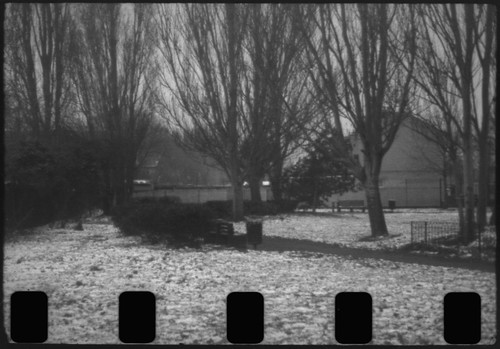
Tuesday, 29 May 2018

Found Film 4


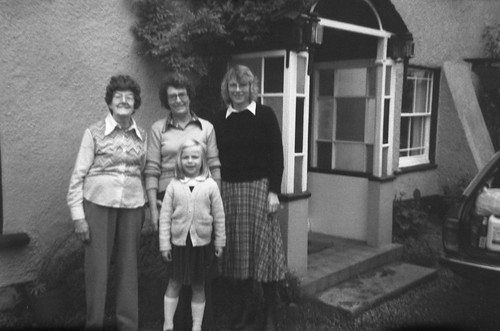
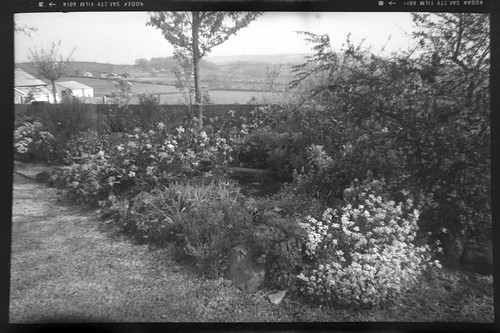
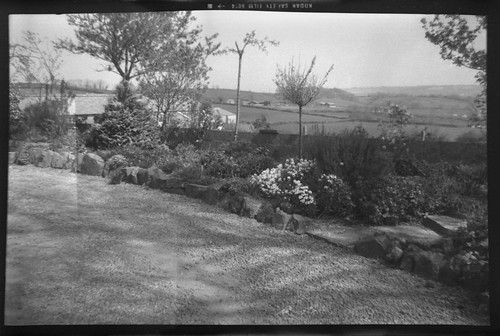
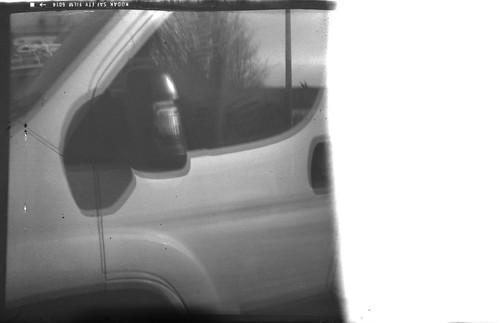
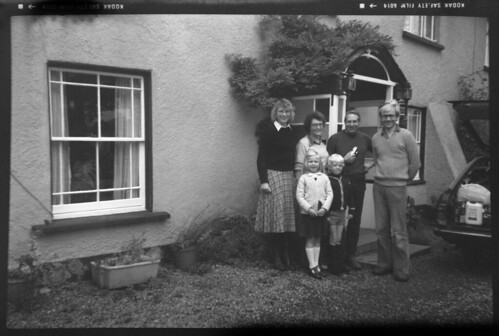
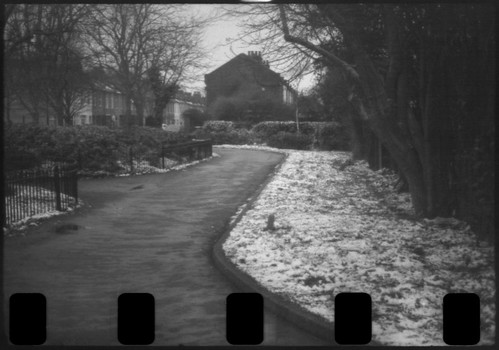
In looking for some 127 film in early anticipation of this Summer's 127 Day in a couple of months, I found a roll of exposed Kodacolor II film that came with a Kodak Brownie 127 and some unexposed rolls. Although Kodacolor II is a C41 colour negative film, not knowing how old the film was and not wanting to pay to develop the film commercially especially if there were no images on it (the roll was not secured with the self-adhesive tab), I stand developed it in RO9 One Shot, diluted to 1+100 for one hour. The negatives that resulted were thin, but relatively easy to get images from them in scanning. The negative frame sizes were eight 4x6cm frames on the 127 film - as one might have predicted, although the film was not in the camera itself, it's the right frame size and the images look exactly like these were shot with the Kodak Brownie 127, down to the evidence of a lack of film flatness in the somewhat wavy edges to the negative frames. One frame was completely over-exposed, including the rebates at top and bottom, with the two frames either side partially exposed - the two images at the top and bottom of this post - which looked exactly like the camera had been opened with the film still inside, partially used.


Two images show two portrait groups; the clothes look as though they date to the 1970s. Kodacolor II was introduced in different formats in 1973 after first appearing the year before in 110 format only. It was discontinued in 1982, which gives a possible cut-off date; it seems unlikely that these family photographs would have been taken after this date. Later on the roll is a vertical image of the doorway behind the figures. The top photograph, with an off-centre composition has been taken with a steadier hand than the second; the first photograph was presumably taken by the older woman in the left in the second who does not appear in the first. This second photograph with a little camera shake may have been taken by one of the two men in the first, although the older man has what looks like a 35mm compact camera in his hand, so this shot may have been taken by the younger man - or perhaps the small boy. The open back of a packed car just visible on the right hand side of the photograph suggests a family having just arrived for a holiday.


There are also three shots from similar angles of the edge of a garden with gentle hills behind. Separated by the shot of the front door, in sequence, the image at the top of this post appears to show a gap of time, with the first two images looking as though shot in spring, the third photograph of the garden has fuller foliage on the trees and the flowers appear different. The climber around the porch has also flowered in the image of it without the people. This sequence of images is redolent of the uses of photography in the domestic sphere, where a roll of film might be left in a camera for some time after being started, and the camera only coming out for special occasions, suggesting a family visit to the same place in Easter, and then a return in the Summer.

The final shot on the film is a van door, double-exposed, after the blank, over-exposed section. This van looks to be a relatively contemporary model, suggesting the first six frames were shot relatively close in time to each other, possibly on two separate occasions, then the film was left in the camera, later opened, with the realisation there was a film inside, and then the last photograph taken after this, twice, without advancing the frame.


Wednesday, 23 May 2018

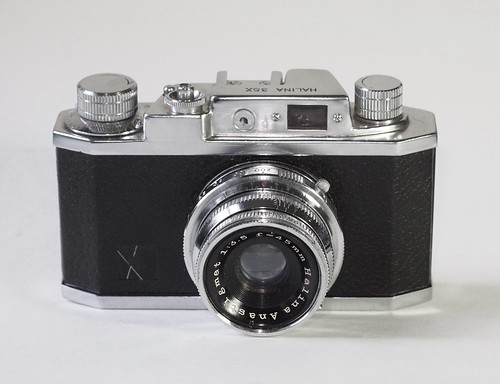
Halina 35X

Halina 35X
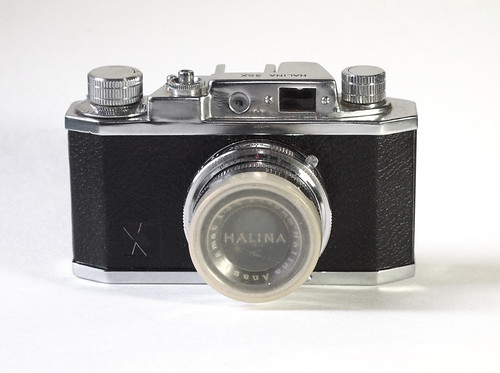
According to the chronology on Collections Appareils, the Halina 35X was Haking's first camera, while other sources place their medium format pseudo-TLR cameras earlier, it may well be that the 35X was simply the first 35mm camera that Haking produced. The Halina brand name was used for Haking's first cameras in the late 1950s, and later became synonymous with ubiquitous, cheap, mass-produced plastic cameras in the 1980s and 90s. Haking still exists, and their website (although apparently not recently updated) lists both 35mm and digital cameras. My first new camera as a teenager was a red Halina (a 260 I think), after being given a secondhand Kodak Instamatic 25.

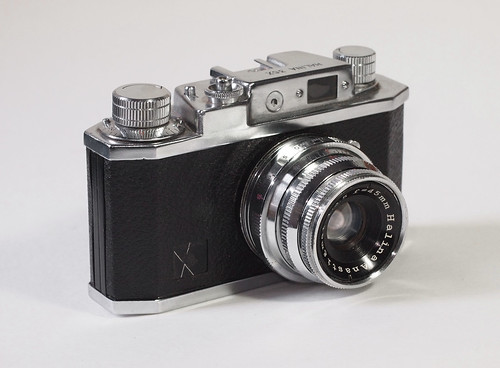
The Halina 35X camera that illustrates this post was acquired in the job lot which included the Praktica nova I, the No.2A Brownie, and the Vest Pocket Autographic Kodak. The Halina 35X was the least interesting of the lot, but I decided to put a roll of film through it in order to check that the camera worked. My camera was missing its badges - the red, round badge above the lens might suggest a rather well-known expensive camera maker, which the camera's general design mimics (the styling makes the camera look more sophisticated than it is) - but the name and model designation are firmly inscribed on the camera's top plate. Haking was established in Hong Kong during the post-war period, while it was still a UK colony: my camera has the non-specific phrase "Empire Made" on the bottom. Presumably this meant that it was not subject to import restrictions to the UK at the time, enacted with the object of protecting the home market against the resurgent German manufacturers immediately after the war.

Halina 35X
The Halina 35X is a manual 35mm viewfinder camera. It has a fixed 45mm f3.5 Halina Anastigmat lens in a four-speed leaf shutter with speeds 1/25th, 1/50th, 1/100th, 1/200th, as well as 'B'. The shutter needs cocking on the lens barrel (about which more below); the shutter release is on the top plate of the camera. Focus is manual, down to 3 feet. Aperture selection is on the outermost ring of the lens; it is marked down to f16, but it does turn further, possibly to f22. The aperture ring also rotates as the camera is focussed. The viewfinder has neither framelines and, naturally, no parallax correction. Frame advance is by knob, at time when the design of many other 35mm cameras had progressed to an easier-to-use lever.

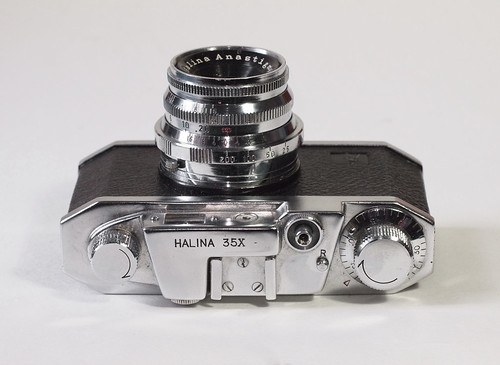
Halina 35X top view
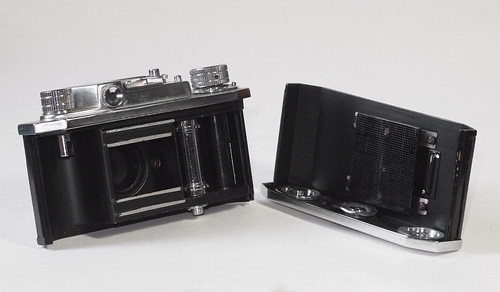
The frame counter around the advance knob needs to be manually set. To rewind the film, there's a small button on the top near the shutter release marked 'R', and the rewind knob on the user's left is a little smaller than the advance knob. The camera does feature a PC socket for flash, and an accessory shoe. The back of the camera removes entirely for loading.

Halina 35X opened for loading
My camera came with its original case and push-on lens cap - this, oddly, is transparent. The case has a plastic dome and top to protect the lens, but there's no plastic in the camera itself. What is remarkable about the Halina 35X is, for its small size, it is surprisingly heavy. The main body is cast from a fairly substantial block of metal with very, very shiny chroming to the top and bottom plate. Rather than being reassuring, this weight (and shininess) suggests a lack of care over its design.

Halina 35X with original lens cap
As with some other vintage cameras, the Halina 35X seems to have been lubricated with grease that becomes very stiff with age: the focus ring was difficult to rotate, needing a firm grip on the body and lens in each hand to turn (there are some suggestions that this was always a problem with the camera). However, the most frustrating aspect of using the camera is its counter-intuitive double exposure prevention. After the shutter release has been pressed, the advance knob need to be turned to wind on the film before another shot can be taken whether or not the shutter has been cocked. This means that if one presses the button without remembering to depress the cocking lever - or by accident (there is no shutter lock), a blank frame is the result. Even with being familiar with non-self cocking shutters, it is still easy to waste film with the 35X. This post on Filmwasters states that if one continues to hold down the shutter release after pressing it without cocking the shutter, before winding on, it is possible to then cock and fire the shutter.

Halina 35X with Ilford Pan 100
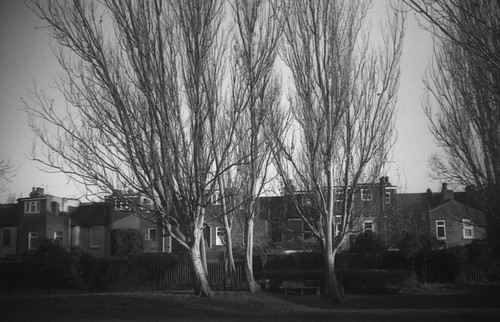
I shot half a roll of Ilford Pan 100 to test the camera. The lens provides fairly heavy vignetting, and, based on just the few photographs I took with the camera, uneven illumination across the frame too. For some subjects of course, such as the image below, the vignetting from the lens may add something in terms of atmosphere or character, but it's not necessarily something one might want on all frames.

Halina 35X with Ilford Pan 100
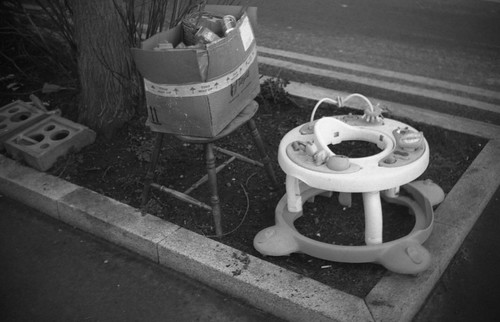
Combined with the vignetting, there is also a falling off of definition away from the centre of the image - and, although the lens is described as an Anastigmat, the out-of-focus areas away from the centre of the image do seem to show some astigmatism. On the small sample of photographs that I shot with the camera, although a triplet, the lens behaves more like a meniscus or doublet - some of which can still perform well at small apertures. Oddly, just two of the three lens elements are coated.

Halina 35X with Ilford Pan 100
In a blog post on the Halina 35 X, Kosmophoto asks "Is this the worst 35mm camera ever made?" No doubt it isn't, but the Halina 35X is badly designed, and frustrating to use. There's not much to recommend the camera - and there are many other entirely mechanical compact viewfinder cameras that one could chose for a better experience of shooting, and to provide better results. The post on Filmwasters already referenced states that the Halina 35X is "loose" and "un-camera-like": "it gives the feeling that it must be a facsimile of a camera, rather than an actual camera. This sounds weird, but when you have one in your hands you'll understand. It is both familiar and alien at the same time." It almost suggests that the designers of the camera had seen detailed drawings, photographs, and descriptions of contemporary 35mm cameras - without ever have actually used one. To sum up, on a page which is more a passing comment than a review, Rick Oleson describes the Halina 35X as a 35mm Hit camera.

Halina 35X with Ilford Pan 100
Sources/further reading:
Halina_35X on Camera-Wiki
Collection-Appareils (French)
Kosmofoto's page on the Halina 35X
Halina-35X on John's Old Cameras
Filmwasters review of the Halina 35X

Tuesday, 15 May 2018

Ilford Pan 100

Ilford Pan 100 35mm film
Ilford Pan 100 is a traditional cubic-type emulsion medium-speed black and white panchromatic film from Harman under the Ilford brand, which is complemented with a fast Ilford Pan 400 film. Ilford FP4 Plus and HP5 Plus are Ilford's well-known traditional emulsion films in the same (or similar; see comments below) speed ratings; however, the Ilford Pan films have not been generally available in the UK. The data sheet states:

The ILFORD range of PAN 100 and PAN 400 black and white camera films are not generally distributed and sold worldwide, they are only made available in selected markets.

The name, 'Pan', simply standing for panchromatic, is indicative of the basic nature of these films (panchromatic is, of course, the 'P' in FP4 and HP5). Recently a number of UK retailers have been stocking the films, which may represent a change of policy by Ilford in terms of market strategy for their particular products. I bought a number of rolls of Ilford Pan 100 at Process Supplies Ltd - now my 'drop-in' shop in central London (on the closure of film photography shops, see my post Seven Years On), where I noticed a display under the glass counter of the Pan films - despite these not being listed on their website.

There are some suggestions online that the Pan 100 and 400 films currently available are the old formulas of FP4 and HP5; there's an unattributed 'Ilford employee' quoted on a thread on the Amateur Photographer forum given as stating: "They are based on FP4+ and HP5+ technology, but are produced to lower specifications and tolorances [sic]. While the quality is acceptable, these films are lower in quality than other ILFORD films." Having used the older version of FP4, before the 'Plus' iteration, I was able to compare times from the leaflet inside the box of FP4 with times given for Ilford Pan 100, and the times are different in all developers, some are close, but not the same. However, in some developers the times are the same for the current version of FP4 Plus and Ilford Pan 100 (notably for the developers I used for this post, R09/Rodinal and Ilfotec LC29), with the important caveat that FP4 Plus is of course rated 125 ISO at box speed, one-third of a stop faster than the box speed of Pan 100 - not a great difference in sensitivity, but worth noting. It's also worth remarking that the Kentmere films, made by Ilford's parent company Harman, have been their low-price traditional films available in recent years, but these have different times from the Pan films. The data sheet referenced earlier states that the Pan 100 and 400 are available in 35mm and 120, but the sheet itself is dated March 2002; there are a few posts online suggesting that the Pan films were discontinued some years ago; it may be that the production ceased for a period, and was then restarted for 35mm film only.

When researching Ilford Pan 100, I did not find any in-depth, serious reviews of the film online - there are, however, plenty of forum posts along the line of 'what is this film?' Incidentally, Pan 400 appears to be a bit more popular, or at least seems to come up more often than Pan 100, and in searches, there's a lot of results for Ilford Pan F - which is quite a different film altogether. Developing times for Pan 100 (and Pan 400) are not listed on Ilford's standard development chart listing their other Ilford-branded films (except Ortho Copy Plus); for this post I used the times printed inside the box, which are the same as those on the Massive Dev Chart.

Ilford Pan 100 latitude test contact sheet
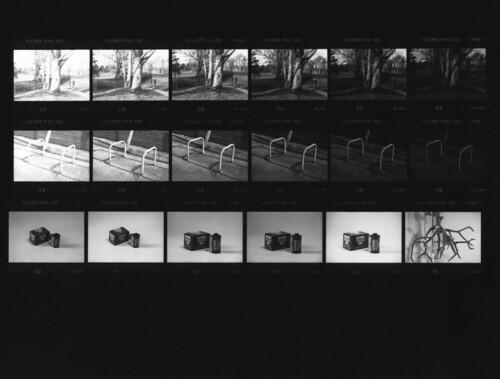
For a latitude test, I shot a half roll of Ilford Pan 100 with the Canon A-1. The first two rows on the contact sheet above were rated at exposure indexes of 25/50/100/200/400/800; the last row was shot at box speed, but with some bracketing. I developed the film in R09 One Shot, diluted 1+25 for 9 minutes at 20ºC. The contact sheet appears to show a swift falling off with underexposure; with scanning, it was possible to pull detail from the shadows (likewise with the highlights with overexposure) for a stop under without any difficulty, but with three stops there was very little detail there.

Ilford Pan 100 one stop underexposed
Ilford Pan 100 three stops underexposed
With overexposure, the compression of the tonal range is problematic: the detail is all present, but the flattened tones are perhaps unattractive, and makes scanning more difficult.

Ilford Pan 100 two stops overexposed
Departing from box speed, I shot some Ilford Pan 100 at 50, a one-stop pull. Developed in Ilfotec LC29, diluted 1+19 for 6m30s at 20ºC, the results may show a slightly reduced contrast, although for most conditions, pull-processing is a compromise relied on less often, and so as a general rule, less critical than push-processing - I very rarely pull-process. However, in high-contrast situations, it may well be a useful corrective.

Kiev-4 with Ilford Pan 100 at 50
Ilford's developing chart in the box also has times for a one-stop push to an exposure index of 200. I shot a roll with the Kiev-4; however on the day I shot the film, I was not really shooting in 'normal' lighting conditions - the snow made for relatively high-contrast subjects, but the lighting was heavily overcast and grey. In addition, this one-stop test was mostly shot at end of afternoon as the light itself was fading. I developed this roll in Ilfotec LC29 diluted 1+19 for 9 minutes at 20ºC.

Kiev-4 with Ilford Pan 100, rated 200
The results from the latitude test were not as good as other films I've tested (my benchmark for a film that demonstrates especially good latitude is Adox Silvermax 100), but I did want to try a two-stop push with Ilford Pan 100; rating it at 400 is not recommended by Ilford themselves. On the Massive Dev Chart there are a couple of results for rating it at 400 (as well as 800 and 1600), but none in developers I habitually use. For a first test, I used Ilfotec LC29 diluted 1+19, and made an estimate at 14 minutes (in retrospect, this probably should have been more like 18 minutes, using a rule of thumb of a two-stop push needing 2.25x normal development). The results were mixed; with good, diffused light, as in the image below, this developing regime worked well enough.

Ilford Pan 100 at 400, developed in Ilfotec LC29, 1+19 for 14m at 20ºC
However, with high contrast subjects, the lack of shadow detail was clear. In the first of the two images below, this matters less, but the landscape image underneath suffers: the bright but low angle of the sunlight casts deep shadows that are nearly featureless. Highlight detail (as in the clouds) is also difficult to retrieve (I also shot some of this roll at night, further adding to the contrast).

Ilford Pan 100 at 400, developed in Ilfotec LC29, 1+19 for 14m at 20ºC
In either case, I doubt that extending the development time to a full 18 minutes would have helped. Rather than assume that pushing Pan 100 to 400 to be a compromise hardly worth attempting, I tried a different tack: stand development. Using R09 One Shot diluted to 1+150, I stand developed another roll of Pan 100 rated 400 for 3 hours (agitating on each hour interval). It's a method I have used with Ilford HP5 Plus previously and I've liked the results. The theory behind using such a high dilution of R09 is to reduce the contrast that accompanies push-processing; no doubt most of the development has occurred by the one-hour stage, but I wanted to give the shadow areas as much opportunity to develop as possible. The grain in the photographs developed in this way appears smoother than the push-processing in Ilfotec LC29, although of course the subject matter is not entirely comparable. Incidentally, both rolls shot at an exposure index of 400 were taken with the Canon A-1, which should eliminate the vagaries of metering, although lighting conditions were quite varied; further tests might be taken to refine this approach, but, in a pinch, a two-stop push with Pan 100 can produce acceptable results.

Ilford Pan 100 rated 400, stand developed in RO9 diluted 1+150 for 3 hours
Ilford Pan 100 is certainly not a good substitute for FP4 Plus - but it may be for Kentmere 100, if one is looking for a budget black and white film. The grain of Pan 100 does not appear as smooth as FP4 Plus, and, to my eye, it also has a different look: something about it reminds me somewhat of the Fomapan films, the pattern of the grain being more random and less evenly dispersed. The price, of course, is what is attractive about the Ilford Pan films: I bought my 36-exposure rolls of Pan 100 at £3.99 apiece, which is admittedly a little more expensive than Kentmere 100 (perhaps the extra twenty-something pence is for the Ilford name) - and it may of course be possible to find the film even cheaper elsewhere online.

Ilford Pan 100 shot with Agat 18K (half frame)
Ilford Pan 100 shot with Halina 35X
Ilford Pan 100 shot with Praktica nova I
Ilford Pan 100 shot with Voigtländer Vito IIa
Ilford Pan 100 shot with Canon A-1
Ilford Pan 100 shot with Kiev-4, rated 200
Ilford Pan 100, rated 400, shot with Canon A-1
Ilford Pan 100 and Pan 400 data sheet (PDF)

Wednesday, 18 April 2018

Expired Film Day 2018 (2)

Rollei 16 with Orwo UP15
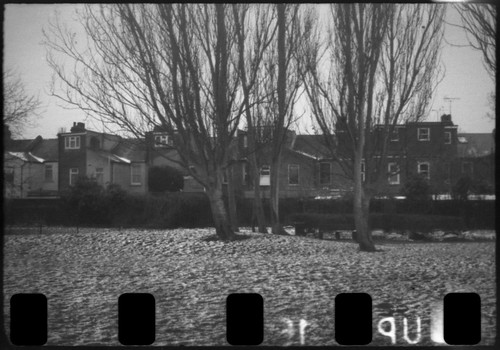
On this year's Expired Film Day, as well as making a short film on expired film, I also had the  intention of documenting the process in photographs shot on expired film. Given how intensive the whole process was - shooting the film (of which I shot two takes of the film), processing, scanning and so on - the idea of shooting stills of the making of the film remained just that, an idea. However, I did shoot one length of the same Orwo UP15 film from March 1978 in the Rollei 16 while the film was drying, outside, as it was getting dark between the snow showers on that day. As I was rating the film at an exposure index of 12, the lowest ASA setting on the Rollei 16, this was hardly ideal for the lighting conditions, and green light of the camera's meter hovered between on and off, meaning that most of the shots were taken at 1/30th at f2.8, so are not as sharp as they might have been with a faster film.

Orwo UP15 double-8 film with edge markings
As the film is perforated for double-8 cine cameras, it does work in the Rollei 16 - which needs perforations to advance the film - and the double-8 perforations are the same size as 16mm, with twice as many standard 16mm perforations, but of course, with perforations on both sides of the film, these show up along the bottom edge of the frame.  I didn't get a single frame with the word 'ORWO' written neatly between these perforations, but there was one with the UP15 - backwards too, as seems standard for edge markings on motion picture film, unlike film intended for still photographs.


Monday, 9 April 2018

Paper Cinema


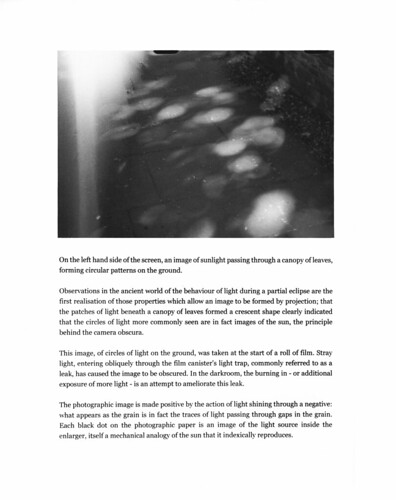
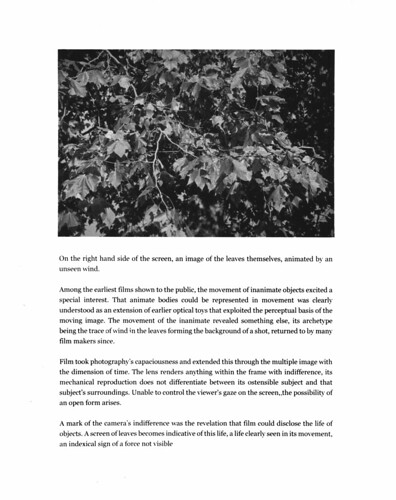
Paper Cinema; silver gelatin prints, 9.5x12 inches each

The text in the two photographs reads:

On the left hand side of the screen, an image of sunlight passing through a canopy of leaves, forming circular patterns on the ground.

Observations in the ancient world of the behaviour of light during a partial eclipse are the first realisation of those properties which allow an image to be formed by projection; that the patches of light beneath a canopy of leaves formed a crescent shape clearly indicated that the circles of light more commonly seen are in fact images of the sun, the principle behind the camera obscura.

This image, of circles of light on the ground, was taken at the start of a roll of film. Stray light, entering obliquely through the film canister's light trap, commonly referred to as a leak, has caused the image to be obscured. In the darkroom, the burning in - or additional exposure of more light - is an attempt to ameliorate this leak.

The photographic image is made positive by the action of light shining through a negative: what appears as the grain is in fact the traces of light passing through gaps in the grain. Each black dot on the photographic paper is an image of the light source inside the enlarger, itself a mechanical analogy of the sun that it indexically reproduces.

***

On the right hand side of the screen, an image of the leaves themselves, animated by an unseen wind.

Among the earliest films shown to the public, the movement of inanimate objects excited a special interest. That animate bodies could be represented in movement was clearly understood as an extension of earlier optical toys that exploited the perceptual basis of the moving image. The movement of the inanimate revealed something else, its archetype being the trace of wind in the leaves forming the background of a shot, returned to by many film makers since.

Film took photography’s capaciousness and extended this through the multiple image with the dimension of time. The lens renders anything within the frame with indifference, its mechanical reproduction does not differentiate between its ostensible subject and that subject's surroundings. Unable to control the viewer's gaze on the screen, the possibility of an open form arises.

A mark of the camera’s indifference was the revelation that film could disclose the life of objects. A screen of leaves becomes indicative of this life, a life clearly seen in its movement, an indexical sign of a force not visible.

***

Notes

One

On the left hand side of the screen: In the photographic print itself, the screen referred to is not explicit in the image: the reader of these two photographs is being asked to imagine a screen, the description that follows makes it clear that the image on the print above the text is that to which the text refers. The left and right descriptions are orientations understandable in relation to one each other in the exhibition display.

an image of sunlight passing through a canopy of leaves, forming circular patterns on the ground: In the Northern Hemisphere this effect is most notable during the summer months; the sun needs to be sufficiently high in the sky to project circles of light on the ground, at lower elevations, these circles become oblique. The distance between the canopy and the ground also affect the appearance of the circular patterns: as with a pinhole, there is an optimum focal length for the formation of an image.

Observations in the ancient world of the behaviour of light during a partial eclipse: In the fourth century BCE, Aristotle observed this behaviour:
"The image of the sun at the time of the eclipse, unless it is total, demonstrates that when its light passes through a narrow, round hole and is cast on a plane opposite to the hole it takes on the form of a moon-sickle. The image of the sun shows this peculiarity only when the hole is very small. When the hole is enlarged, the picture changes..."
Aristotle, 'On The Form Of The Eclipse'
are the first realisation of those properties which allow an image to be formed by projection: At its simplest, this is the property that light waves travel in a straight line. If rays of light are permitted to project onto a surface through a sufficiently small aperture, an inverted image is drawn on that surface.

that the patches of light beneath a canopy of leaves formed a crescent shape clearly indicated that the circles of light more commonly seen are in fact images of the sun: During the total eclipse of 2017, visible across North America on Monday 21st August (a week and a day after the photograph of the patches of light was shot), images of the crescent shape of projected light through the leaves of trees either side of totality was seen across social media with a sense of astonishment remarkable for such a natural phenomenon, particularly in the context of a total solar eclipse itself.

the principle behind the camera obscura: The application of the Latin word camera in English - and many other languages - to describe a device which takes photographs retains this link to the dark or obscured room or chamber. Many cameras obscura utilise a lens to form a sharper, brighter image, but the principle remains the same.

This image, of circles of light on the ground, was taken at the start of a roll of film: The partial visibility of perforations at the top of this image are evidence of its physical substrate. The flexible roll film was designed for the ease of shooting a succession of still images without the need to reload a camera; after early experiments with both paper and glass cylinders, flexible celluloid film was adapted for the first moving image cameras, and perforations were introduced for the intermittent motion required to reproduce a succession of correctly registered still images that could then recreate motion when played back. Perforated 35mm motion picture film stock was reused for still photography, popularised by small format cameras. Less common, other still cameras used other perforated motion picture film stocks.

Stray light, entering obliquely through the film canister's light trap, commonly referred to as a leak: Light is seen as pernicious, wanting to gain ingress, yet it is a substance that can be trapped. In photography, analogies between light and water abound: a light source itself; light 'pours in' through leaks; understanding the relationship between aperture and shutters speed in exposure is likened to turning on a tap, or water passing through a sieve; liquid photographic emulsion is also known as liquid light. There are others.

has caused the image to be obscured: Obscured here in the sense of obliterating the detail in the image, the additional exposure of unwanted light from a source other than the lens, passing over the surface of the film, reduces the detail of the image forming on the surface itself.

In the darkroom: In a mirroring of the process of image formation inside the dark chamber of the camera, after development of the exposed film into a negative, returning to another dark chamber is required to create the final, positive image.

the burning in - or additional exposure of more light - is an attempt to ameliorate this leak: 'Burning in' is another analogy or metaphor; light here, part of the spectrum of electromagnetic radiation, is connected to heat, and this metaphorical heat in connected to the darkness of the image. The darkroom techniques of dodging and burning remain familiar through their emulation as digital tools in image-manipulation software.

The photographic image is made positive by the action of light shining through a negative: As silver halide salts darken with exposure to light, an image formed is inverted in its tonal range. Inverting this a second time provides the required positive image. Demonstrating linguistic logic, here two negatives do make a positive. All photographic processes which produce an image rely on this phenomenon. Although the Daguerreotype is sometimes described as a positive process, the images are not strictly positive, rather the angle of reflection from the polished silvered surface determines whether the image appears positive or negative.

what appears as the grain is in fact the traces of light passing through gaps in the grain: Grain is another metaphor; photographic grains are clumps of silver halide crystals reduced to metallic silver by the process of development. The quality of grain only became prominent when negatives began to be printed by enlargement, dependent on many factors, but chiefly the enlargement ratio and the film's sensitivity to light; the word printing itself is suggestive of the direct contact between the negative and positive surfaces: with enlargement, the photographic print really becomes something else. In the photographic print itself, the grain of the light sensitive paper remains below the threshold of perception as it is not enlarged.

Each black dot on the photographic paper is an image of the light source inside the enlarger: In the 19th century, most photographs made using the negative-positive process were contact printed by daylight; with larger negatives, prints by contact persisted well into the 20th century. Although enlargers did exist, exposure times with the low sensitivity emulsions then available would result in prohibitively long exposure times. Printing by enlargement needed faster emulsions, faster emulsions made the possibility of smaller format cameras viable; early roll-film formats provided relatively large negatives for contact printing. The use of 35mm motion picture film for still images broke this link, making enlargement of the negatives necessary.

a mechanical analogy of the sun: In 1826, Nicéphore Niépce devised the term héliographie - sun-drawing - to describe his experiments with creating images using light-sensitive materials, making explicit photography’s relationship to the sun. Eadweard Muybridge used the name 'Helios' when he began his career as a photographer, and called his business, 'Helios Flying Studio'.

that it indexically reproduces: In the semiotic system of Charles Pierce, signs can be categorised in three different ways according to their relationship to the sign's referent - the reality to which the sign points. The photograph is an index in having a direct relationship to the optical phenomenon it reproduces: light, reflecting from the subject, strikes the photographic emulsion, and causes an image to be formed. In Peirce's terms, photography also fulfils the condition of the icon: the icon is a sign which resembles its referent: photographs tend to resemble their referent in visual terms due to their indexical construction.

***

Two

On the right hand side of the screen, an image of the leaves themselves, animated by an unseen wind: The first image, of circular patterns of light caused by the sun penetrating a canopy of leaves, is joined by a second image, reading from left to right, a spatial juxtaposition in an analogy of the principle of cinematic montage. The wind which animates the leaves - this animation merely inferred by the still image - in unseen in the sense that the actual movement of air is not visible, but its indexical effects on the leaves can been seen.

Among the earliest films shown to the public: Films had been exhibited by projection by the Lathams' Lambda company in New York in May 1895; by the Skladanowsky brothers in Berlin in November; and by the Lumière Brothers in Paris in December (all had previous private or press showings earlier that year). Photographic moving images had previously been shown in Thomas Edison's kinetoscope, the peep-show box seen by a single viewer at at time; cinema as a collective experience - as the institution that it would become - required projection, to which Edison was initially resistant. The collective experience would prove to be transformative.

The Lumières' first public programme exhibited ten films, all 'actualités'. The Lumières' cinématographe, camera, printer, and projector in one, was small, portable, and hand-cranked, thus able to go anywhere, out into the world - and able to encounter the movement of inanimate objects. Such effects were not available to Edison: unsurprisingly, his camera was powered by electricity, and therefore not portable in practical terms at the time. Instead, Edison built the Black Maria, the first film studio, which dictated the content of his kinetoscope reels; other early film-makers conceived of film's possibilities in similar terms to Edison: shooting in a controlled environment, the Lathams' first projected films were of boxing matches, itself a form of theatre, while the Skladanowsky's films are records of circus or variety acts, as were many of Edison's films. With the appearance of new imaging technologies, their application is often confined by the uses of earlier forms. The technical superiority of the Lumières' system endowed the name of their technology to posterity and the institution of the cinema, but there is also a sense that the Lumières intuited the capacity of film for the contingencies of life from the outset. This may reflect the Lumières' backgrounds in photography itself, in contrast to Edison, the Lathams, and the Skladanowsky brothers.

the movement of inanimate objects excited a special interest: Of the many earliest written accounts of experiencing the first projected films by the Lumière brothers, most do not fail to mention the movement of the trees in the background of these films:
"The photographs I hear were taken at the rate of eighty to the minute, and, whilst the principle is not new, the representation of life-sized figures close to you, acting as human nature does act, the trivial and the significant all mixed up together, is totally new, and it is startling to see these congealed moments, as I may call them, suddenly become irrified at the turning of some Pygmalionic handle, the trees and bushes moving in the wind, the workpeople rushing out for dinner, mixed up with bicycles, carriages, dogs, and horses, you only miss the prattle and the argot."
‘Our London Letter’, The Star, St. Peter Port, Guernsey, 19 March 1896.

"But suddenly a strange flicker passes through the screen and the picture stirs to life. Carriages coming from somewhere in the perspective of the picture are moving straight at you, into the darkness in which you sit; somewhere from afar people appear and loom larger as they come closer to you; in the foreground children are playing with a dog, bicyclists tear along, and pedestrians cross the street picking their way among the carriages. All this moves, teems with life and, upon approaching the edge of the screen, vanishes somewhere beyond it.
And all this in strange silence where no rumble of the wheels is heard, no sound of footsteps or of speech. Nothing. Not a single note of the intricate symphony that always accompanies the movements of people. Noiselessly, the ashen-grey foliage of the trees sways in the wind..."
'Last night I was in the Kingdom of Shadows', ‘I.M. Pacatus’ (Maxim Gorky), Nizhegorodski listok, 4 July 1896.

"The Lumière Cinématographe will begin its fifteenth consecutive week at the Wonderland [Theatre] next week, continuing what was long ago the longest run ever made by any one attraction in this city. People go to see it again and again, for even the familiar views reveal some new feature with each successive exhibition. Take, for example, BABY’S BREAKFAST, shown last week and this. It represents Papa and Mamma fondly feeding the junior member of the household. So intent is the spectator usually in watching the proceedings of the happy trio at table that he fails to notice the pretty background of trees and shrubbery, whose waving branches indicate that a stiff breeze is blowing. So it is in each of the pictures shown; they are full of interesting little details that come out one by one when the same views are seen several times..."
The Post-Express, Rochester New York, 6 February 1897.
That animate bodies could be represented in movement was clearly understood as an extension of earlier optical toys: These 'optical toys', most famously the zoetrope, as well as the phénakisticope, praxinoscope, thaumatrope, and others, were not invented purely for amusement or entertainment: they were devices to demonstrate scientific principles. Their ultimate expression was, perhaps, in Émile Reynaud's Théâtre Optique, which projected a succession of hand-drawn images on flexible film in 1892; these all paved the way for the technological means to conceive and reproduce a photographic moving image, but, importantly, also prepared its audience for the emergence of film as a medium, something early commentators explicitly noted:
“Our readers may probably remember the old “Wheel of Life,” [the zoetrope] and they are more likely still to be familiar with Edison’s kinetoscope. An instrument which is a further development of the principle of both these inventions is now on show in London, which is as far ahead of the kinetoscope as the kinetoscope was of the wheel of life. This is the cinematograph, which may be seen any day from 2 p.m. onwards at the Marlborough Rooms, in Regent Street.”
‘The Cinematograph’, The Sheffield & Rotherham Independent, 27 February 1896.
that exploited the perceptual basis of the moving image: The first descriptions of this perceptual basis are attributed to a paper presented to the Royal Society of London in 1824 by Peter Mark Roget, followed by the work of Joseph Plateau, the inventor of the phénakisticope, and that of Michael Faraday. Despite being superseded by the explanation of the phi phenomenon for the perceptual basis of how a rapid succession of still images creates the impression of motion in the viewer, the colloquial concept of the 'persistence of vision' stubbornly remains.

The movement of the inanimate revealed something else, its archetype being the trace of wind in the leaves forming the background of a shot, returned to by many film makers since: In the Lumières' first public showing, as well as the animate, human subjects, the public would have also seen the movement of: water, under pressure, from a hose (Le Jardinier or l'Arroseur Arrosé); waves caused by wind (La Mer or Baignade en Mer); steam and smoke (Les Forgerons); and the movement of leaves (most notably in Repas de bébé, but also in La Pêche aux poissons rouges, and Le Jardinier to an extent). The famous train arriving at La Ciotat station featured in a later screening.

Film took photography’s capaciousness and extended this through the multiple image with the dimension of time: "Like photography, film tends to cover all material phenomena virtually within reach of the camera," Siegfried Kracauer, Theory of Film. Kracauer's 'Inherent Affinities' in Theory of Film are: the unstaged, the fortuitous, endlessness, the indeterminate, and the 'flow of life' ("peculiar to film alone," in which photography is extended by motion), all redolent of this capaciousness.

The lens renders anything within the frame with indifference:
"Here, then, is life; life it must be because a machine knows not how to invent; but it is life which you may only contemplate through a mechanical medium, life which eludes you in your daily pilgrimage. It is wondrous, even terrific; the smallest whiff of smoke goes upward in the picture; and a house falls to the ground without an echo. It is all true, and it is all false. [...] The newest toy attains this false reality without a struggle. Both the Cinematograph and the Pre-Raphaelite suffer from the same vice. The one and the other are incapable of selection; they grasp at every straw that comes in their way; they see the trivial and important, the near and the distant, with the same fecklessly impartial eye."
O. Winter, ‘The Cinematograph’, The New Review, May 1896.
its mechanical reproduction does not differentiate between its ostensible subject and that subject's surroundings: In comparison with the theatre, on stage, the background remains the background, the actors are in the same contiguous space as the audience, and, like the audience, separate from the set. In film, according to Béla Balázs, “...man and background are of the same stuff, both are mere pictures and hence no difference in the reality of man and object.” (Béla Balázs, Theory of the film: character and growth of a new art).

Unable to control the viewer's gaze on the screen, the possibility of an open form arises: In practice, most films are constructed in such a way as to constrain the viewer's experience and attention, but the possibility remains that this gaze may be distracted by or come to rest on something other that the ostensible subject of the film, or, indeed the film-maker may explicitly design the disposition of the screen to provide a multiplication of points of interest, such as in Jacques Tati's Playtime. The open form may also be achieved through narrative irresolution.

A mark of the camera’s indifference was the revelation that film could disclose the life of objects: Perhaps most notable amongst many other examples, is the way silent comedy found a substitute for verbal wit in the wit of things: Chaplin’s boots, Harold Lloyd’s clock, Keaton struggling to stand upright in the wind, or trying to evade the boulders on a hillside chasing him. In these, the human figure is but one actor in the ‘flow of life’. One may also think of the last minutes of Antonioni's L'Eclisse.

A screen of leaves becomes indicative of this life, a life clearly seen in its movement, an indexical sign of a force not visible: The imaginative screen of the first sentence has become the screen of leaves, filling the visual field, a screen which simultaneously shows and conceals, discloses and encloses:
"The drifting of clouds, the waves of the wind over a wheat field, the onrush of a waterfall, the swing of a pendulum, the up and down of pistons have lent more impact to many a film scene than all the gestures of the actors. This is not surprising for the actions of the inorganic world have a grandiose simplicity, which is not easily matched by the complex instrument of the human mind."
Rudolf Arnheim, 'Motion' in Film as Art.
***

Paper Cinema was shown in the Documents exhibition at Lumen Studios in January this year.

The title, 'Paper Cinema', is borrowed from a chapter title in David Campany’s book, Photography and the Cinema relating to printed work derived from, or aspiring to, cinema; the two prints and the attendant texts began as an idea for a short film with the text as a spoken narration heard while moving versions of the two still photographs appeared as successive split-screen images, the left image first, which would then be joined by the image on the right.

Both images were shot on 16mm black and white motion picture negative film stock. The text, which is, of course, also an image, made photographically, was shot on 35mm black and white document film. The photographic prints were made by exposing the paper to the negatives of the images and the text separately and successively in the darkroom before development.

***

Bibliography

Joseph and Barbara Anderson, 'Motion Perception in Motion Pictures', in The Cinematic Apparatus, edited by Teresa de Laurentis and Stephen Heath, MacMillan, London, 1980
Rudolf Arnheim, 'Motion' and ‘The Thoughts that Made the Picture Move’, in Film as Art, Faber, London 1958Bela Balázs, Theory of the film: character and growth of a new art, translated from the Hungarian by Edith Bone. New York, Dover Publications, 1970. Originally published 1952 by Dennis Dobson.
Stephen Barber, ‘The Skladanowsky Brothers: The Devil Knows’, Senses of Cinema, Issue 56, October 2010 http://sensesofcinema.com/2010/feature-articles/the-skladanowsky-brothers-the-devil-knows/ Retrieved 25/1/18.
Geoffrey Batchen, Burning with Desire: The Conception of Photography, MIT Press 1999
Phlip Brookman, Eadweard Muybridge, Tate Publishing, London 2010
Paul Burns, The History of the Discovery of Cinetmatography, http://www.precinemahistory.net/900.htm Retrieved 9/4/18.
David Campany, Photography and Cinema, Reaktion Books, London 2008
Alan Horder (editor), The Manual of Photography, Focal Press, London, sixth edition 1976 reprint.
Siegfried Kracauer, Nature of Film: The Redemption of Physical Reality, Dobson Books, London, 1960

Written accounts of experiences of the first projected films are from the excellent Picturegoing blog. Italics added for emphasis in these accounts.
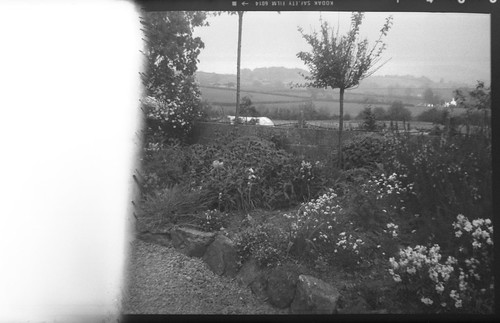
Thursday, 29 March 2018

Praktica nova I

Praktica nova I with 50mm f2.8 Domiplan lens
On Camera-Wiki and elsewhere, the camera that's the subject of this post is often referred to as the Praktica PL Nova I. This is what's embossed on the camera's nameplate, reading from the top down and left to right; however, the name the manufacturer, Pentacon, uses, rather than that in more common usage, is simply Praktica nova I. The nova part, as well as on the nameplate, is also written in the manual in lower case. The prominent PL on the camera's nameplate stands for 'Pentacon load' or 'loading', one of a number of 'easy load' systems for 35mm cameras, such as Canon's Quick Load (QL) from around the same time, seen on the Canon FTb-N, for example. These easy-load systems for 35mm cameras might be seen as a response, in part, to the introduction of Kodak's 126 cartridge in the early 1960s. There was an earlier Praktica nova which differs most notably in its shutter speed dial, with the fast and slow speeds with separate selection on the same dial; the first Praktica nova was a complete redesign for the Praktica SLR, 'nova' intended to suggest this newness. The Praktica nova cameras were produced after KW, the Praktica's original manufacturer, was merged with the East German arm of Zeiss Ikon (and others) to form VEB Pentacon. In the design of the Praktica nova I it's possible to see this merger in in the evolution of the Praktica nova body style: as well as deriving from previous Praktica cameras, it borrows elements - notably the shutter release design - from the Zeiss Ikon Contax S (which itself derives from the Contax rangefinder before the war).
There are many references to the Praktica nova I online, which suggests that a large volume of cameras were produced - and that many are still being used today. On the Praktica-Collector website, the production for the nova I is listed as 136,400 units, over five years from 1967. My model came in a job lot with a number of other cameras - including the Vest Pocket Kodak and the Kodak No.2A Brownie which I have previously written about. My first impressions of the Praktica nova I were of an unremarkable SLR camera - and the partly obscured focus screen (see below) did not enthuse me to pick up the camera to use it at the time I acquired it.

Praktica nova I with Domiplan lens
As a student buying used cameras in the 1990s, Praktica were generally lowest in price, compared to those of Japanese manufacture (I don't recall seeing Zenit cameras very often at the time); Praktica cameras do seem to have had a not inconsiderable share of the UK market at the time, and as such are a familiar brand. My first SLR cameras were of the Praktica B-series of the 1980s, secondhand and a decade old when I first used them, something I touched on in my post Twenty Years Since.

The Praktica nova I is much earlier than the B-series cameras I was using then. The camera is an entirely manual 35mm single lens reflex with a cloth focal plane shutter. There was a model B version of the camera, which has a selenium light meter incorporated into the name plate. The shutter release is on the front of the body, and angled, not on the top, and is threaded for a cable release; this rotates to a lock position, with a small red dot to indicate this. The shutter speeds run from 1 second through to 1/500th, plus 'B'. It also has a distinct setting for flash and the longer shutter speed numerals are picked out in red. For flash, there are two PC sockets, marked F for flashbulbs and X for electronic flash. The manual states that the 1/30th shutter speed setting should be used with F, while X requires selecting the flash symbol setting: the manual states this to be 1/40th. There is no hot shoe (or accessory shoe) for flash, so using a flash requires an accessory mounting. On the advance lever, there's a film reminder with symbols for black and white and then four different types of colour film: daylight or tungsten in both transparency and negative. Around the rewind crank, where the exposure calculator on the nova I B model is located, is a reminder of the film speed, in ASA or DIN, to be matched up with the length of the film, 12, 20, or 36 exposures.

Praktica nova I top view
The camera back opens by a sliding latch on the side, rather than by pulling up the rewind crank. The PL system features two bars that clamp down on the end of the film as the advance spool rotates with the advance lever. This seems to work very well (on my limited use of the camera) in securing the end of the film when loading. To rewind a film, rather than the more common button on the underneath of the camera, there's a small knob by the advance lever which pushes in to release the film for rewinding.

Praktica nova I opened for loading
There's a red 'flag' in the top left corner of the viewfinder to indicate that the film needs to be advanced. On my camera the focus screen had a white deposit over its surface in a number of places - appearing black against the light when seen through the viewfinder. It looked as though something had attacked the glass, etching it, possibly something in oil that had leaked out over the screen, but the patterns of this deposit appear inconsistent - some appearing to flow, some marks like cracks or stresses. This did not clean off with water; the focus screen could no doubt be changed, but it was still usable.

Praktica nova I focus screen with deposits
The Praktica nova I has an M42 screw lens mount. This allows for a very wide range of compatible lenses, being a popular mount throughout the 1960s; the camera utilises the M42 automatic stopping-down pin; open at the widest aperture for composing and focussing, partially depressing the shutter release stops down the lens to the selected aperture. In the manual it also describes disengaging the automatic diaphragm, with a small lever inside the camera lens mount for "older interchangeable lenses" - i.e., for lenses without an automatic stopping-down pin. The Praktica nova I came with a Meyer-Optik Gorlitz 50mm f2.8 Domiplan lens; this was the lower-priced standard lens for the camera on purchase.

Praktica nova I with 50mm f1.8 Pentacon lens
For a comparison with the Domiplan lens which came with the camera, I also used a Pentacon f1.8 50mm lens on the Praktica nova I. As well as having a wider maximum aperture (giving a brighter image in the viewfinder), the Pentacon lens also has a much closer near-focus: it can focus down to 0.33m, whereas the Domiplan lens will focus to 0.75m, which does not feel especially close for a 'standard' 50mm lens on a 35mm SLR camera. The two images below show the difference with both lenses at their respective close-focus distance.

Praktica nova I with Domiplan f2.8 50mm lens
Praktica nova I with Pentacon f1.8 50mm lens
As well as the difference in close-focus distance, the Domiplan lens is clearly softer, with some flare evident, emphasised by the high contrast of the subject. The design of the Domiplan lens, with the aperture ring on its outside, rather than nearest to the body (an arrangement which seems more common), makes it easier to accidentally shift this ring while focussing.

Praktica nova I with Derek Gardner f2.8 28mm lens
I took a few shots with a Derek Gardner 28mm lens (a rebranded Chinon lens); the lens' aperture blades closed very slowly on pressing the shutter button - slower than than one would normally take over taking a shot - and without realising, a number of shots with the Derek Gardner lens were over-exposed as a result. I also had a M42 2x Teleconverter picked up at a charity shop for £5, named Helios Auto, no doubt to link it to the KMZ M42 Helios lenses, although the converter itself wasn't made by KMZ, for its origin, its marked simply 'Japan'. This worked well enough with the Pentacon lens stopped down.

The Praktica nova I is a basic, manual, mechanical 35mm SLR camera, and the lack of a lightmeter  wouldn't necessarily make it a perfect choice for a camera in its class - there are many better 'entry-level' mechanical SLR cameras, such as the Pentax K1000 for example. However, despite everything that could be placed against the Praktica nova I, in using the camera for a few rolls of film (and mostly using the 'sunny-16' rule for metering), I found the experience of it more positive than my first impressions. In use, the angled shutter release makes sense in terms of the position of one's fingers around the height of the camera's body, with the body design feeling quite ergonomically considered with its angled sides, and the stopping down on partially depressing the release fits naturally in the sequence of shooting; oddly, in using my camera, what feels unergonimic is that the metal advance lever is thin and as a result feels a little flimsy. This would have originally had a plastic tip covering the end of the lever, as one might imagine it should - looking at a number of images online of the Praktica nova cameras, it seems that this loss is not uncommon.

Praktica nova I with Pentacon 50mm lens and Ilford Mark V film
Praktica nova I with Pentacon 50mm lens and Ilford Pan 100
Praktica nova I with Pentacon 50mm lens and Ilford HP5 Plus
Praktica nova I with Pentacon 50mm lens (2x teleconverter) and Ilford HP5 Plus
Praktica nova I with Pentacon 50mm lens and Ilford XP2 Super

Sources/further reading
Praktica nova I page on Camera-Wiki
Praktica nova I on praktica-collector.de
Praktica nova I (with pricing information) on Marriotworld
Evolution of the Praktica SLR on Dresdener-Kamera (German)
Filmphotography.eu - Praktica nova I (German)
Collection-Appareils Sylvain Halgand page on the Praktica nova I (French)
From the Focal Plane to Infinity - Praktica nova I (Spanish)