Showing posts with label Bakelite. Show all posts

Saturday, 27 January 2024

Kodak Baby Brownie

Kodak Baby Brownie

The emergence of plastic in the manufacture of cameras from the late 1920s into the 1930s allowed for the typical shape of the snapshot camera to radically change. The Kodak Baby Brownie with its Bakelite body, updates the simple, entry-level box camera. One imagines that it looked very modern when first produced, in comparison to Kodak's typical box camera, which only recently would have been made with a cardboard body. The Kodak Baby Brownie owes its distinctive styling to Walter Dorwin Teague who designed many cameras for Kodak: the vertical ribbed designs that run around the camera with the central roundel of the lens makes it a little reminiscent of an Art Deco radio set, while the curves and scalloped edges evoke light wooden furniture, a bureau or a cabinet perhaps. It was not Kodak's first plastic camera–according to Art Deco Cameras, Kodak Ltd in the UK had that honour with the No. 2 Hawkette–the Hawkette however was made for promotional purposes, not for general retail; according to numerous sources, 4 million Kodak Baby Brownies were produced over the two phases of its production either side of the Second World War.

It appears that the rationale behind the design of the Kodak Baby Brownie was Kodak's desire to return to the $1 price point of the original Brownie camera of 1900 (it's worth mentioning that this does not of course account for the effect of inflation over the thirty-odd years–a single dollar must have bought a lot more in 1900 compared to 1934, when the Baby Brownie appeared; the low price of the camera presumably reflects the economies of scale possible with Kodak's manufacturing in the mid-thirties). The Kodak Baby Brownie is simpler than the original Brownie too, partly due to the plastic construction. The meniscus lens is fixed-focus, with a fixed-aperture, and the rotary shutter has a single speed. Most sites profiling the camera do not usually provide lens and shutter specifications: Art Deco Cameras lists the lens' focal length as being 60mm, its aperture as f16 and the shutter speed at 1/50th; the manual states that "everything about five feet and beyond will be photographed sharply". It takes 127 format rollfilm, smaller and cheaper than 120, appropriately for a cheap camera appearing during the Depression, although it does use the 'full-frame' of the 127 format, nominally 4x6cm, giving eight exposures on a roll of 127 film–other cameras had already created the 'half-frame' 3x4cm negative size, which provides sixteen frames on a roll.

The Kodak Baby Brownie had two distinct periods of production. Kodak manufactured the Baby Brownie in the US until 1941; subsequently, Kodak Ltd in the UK made the camera between 1948-52. Given that there appears to be no observable differences between the US and UK made Baby Brownies, one wonders whether the dies and moulds were shipped out to the UK after the Second World War to boost the Kodak Ltd's postwar production, with the Baby Brownie, coming of the Depression, now a fitting camera for Austerity Britain, still in rationing. There was a slight variant model Kodak Baby Brownie for export, distinguished by a metal stud or pin above the lens. This is a 'time' setting: pull the stud out, and the shutter stays open when the shutter lever is pressed. The Brownie Camera Page states that this export version was made in the UK during the camera's second production run; my camera has the time setting, although the lettering on the bottom of the camera clearly reads "MADE IN USA". If exactly the same moulds were used for the UK-made camera (the time setting requiring a single small hole to be drilled through the front), this might explain this discrepancy, although I would have thought that any camera made in the UK would have to be marked as such. As well as the 'export variant' there was also a commemorative version made for the 1939 New York's World Fair, which has a rectangular name plate around the lens with this lettering: the camera itself has 'BABY BROWNIE' embossed around the lens.

Kodak Baby Brownie with viewfinder raised

I bought my Kodak Baby Brownie at the Place du Jeu de Balle flea market in Brussels in late spring last year for €10, haggled down from €15 (there were many other cameras there, but I was on a tight budget after a week abroad, and knowing that there's usually very little that can go wrong with a simple box camera, the Brownie seemed a safe investment). I used it last year on the 127 Day in July, but did not scan the negatives at the time, a couple of which illustrate this post below. When I bought the camera I wasn't aware of the export variant, but was pleased that was what I had, a small difference which does increase the conditions in which the camera can be used–although with some caveats, mentioned below. The modest size of the camera, with its curved and ribbed shape, as well as the Bakelite itself, does feel good in the hand, perhaps rather like an over-sized netsuke.

To open the camera for loading and unloading film, on the camera's base is a metal lever which pivots between OPEN/CLOSE (and sweeps over lettering stating the camera was made in the USA). The top slides out from the body with the film carrier attached. Opening the camera shows how simply it is constructed despite its Art Deco stylings: the camera is made from three pieces of Bakelite, the body, top plate, and film carrier, with a few metal fixings.

Kodak Baby Brownie - opened for loading

The the camera has a curved film plane, a common strategy to compensate for the limitations of a simple meniscus lens. The inside moulding is ribbed behind the lens inside counter reflections on the smooth Bakelite surface. One can also see that there's a metal stop behind the lens to reduce its aperture and increase definition, another frequent compensation for the limitations of a simple lens. The film spools are held either side of the lens opening on the film carrier by a sprung metal clip, with an additional piece of sprung curved metal on the supple-side to prevent the film from unspooling. Manual frame advance uses the red window in the middle of the camera back.

Kodak Baby Brownie - opened for loading

The rotary shutter on my camera has some rust as can be seen in the image below. To trip the shutter, the lever has to be pulled to the left from the user's position; it springs back into position with a self-capping function. The time setting works by simply blocking the shutter from completing its swing when the pin or stud is pulled out. The shutter lever needs constant pressure for the shutter to remain open: it will close when the shutter lever is released, or if the time pin is pushed back in. Framing is achieved by a fold-up open frame finder on the top of the camera body.
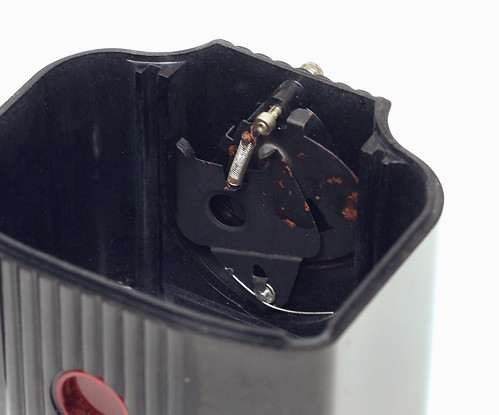
Kodak Baby Brownie - detail of shutter mechanism

My camera had some damage to two opposite corners, showing the fragility of the Bakelite: the chip on the inside rear corner I thought might possibly cause a light leak, which can be seen in the image above. To counter this, I added a small strip of black tape on the inside of the body. Using the camera for July 2023's 127 Day, the few frames from the Kodak Baby Brownie show that the lens has fairly good definition in the centre of the image, but this does fall off considerably towards the edges. When the camera was produced, most photographs for the typical user would probably have been made as contact prints and the limitations of the lens less apparent.

Kodak Baby Brownie with Fomapan 200

I used Fomapan 200 for the images on this post. Despite the photographs being taken in July, the weather was heavily overcast on the day, and a 400 speed film (or pushing a stop in development) would have been a better choice. The manual states for best results "outdoor exposures should be made with the subjects in bright sunlight", the usual conditions for a typical box camera when these were made; using a faster emulsion allows for a broader range of subject conditions for these cameras than would have been the case when first in use.
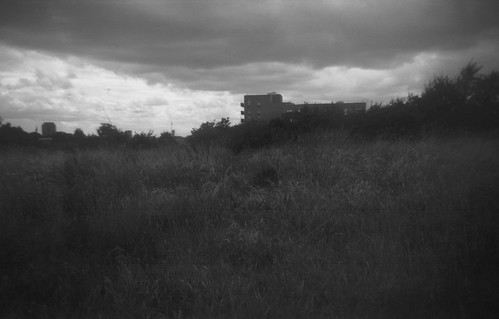
Kodak Baby Brownie with Fomapan 200

The one aspect of the Kodak Baby Brownie in use that feels to me not sufficiently thought-through is the position of the shutter lever: placed directly below the lens, this keeps the camera's design symmetrical, with the exception of the winding knob. Here, it feels as though it should naturally be used by the left hand (an illustration in the manual confirms this), and the action of tripping the shutter is to pull it away from the camera's centre of gravity (which must increase the chance of some camera shake). There was a successor to the Kodak Baby Brownie, also designed by Walter Dorwin Teague, though rather less beautiful, in the Kodak Baby Brownie Special. It is notable that the shutter button of the Special is on the user's right, and it pushes in to trip the shutter. The position of the shutter lever on the Kodak Baby Brownie being directly under the lens is also inconvenient when using the time function: the camera does not have a tripod fixing, but the camera's based is fairly flush, allowing for it to be placed on a level surface for long exposures–which makes reaching for the shutter lever less easy–almost any other placement on the camera would be better for this. However, this additional function of the export variant of the Baby Brownie, must make it a little more desirable over the standard model.

Sources/further reading
The Kodak Baby Brownie on Camera-wiki
Baby Brownie on The Brownie Camera Page
On Art Deco Cameras with manual (PDF)
Kodak Baby Brownie on Retro Film Camera
Kodak Baby Brownie on Down the Road
A Camera Worth a Thousand Words Cooper Hewitt

Tuesday, 1 December 2020

Coronet 6-6

Coronet 6-6 camera
The start of the new #shittycamerachallenge's 'holiday apocalypse' last month, running from November to January, almost neatly coincided with the new coronavirus lockdown restrictions coming into force in England on November 2nd. As with the previous period of 'lockdown' from March this year, the restrictions have not been as stringent as in many continental European countries: working in education, moving from the only then recently introduced tiered system to the lockdown had essentially no difference to my daily life, as I was still physically going to work, face-to-face, in the same way I had been since the start of September, while watching the rolling seven-day figures of cases, hospital admissions, and deaths, rise with what felt like inevitability, once schools and colleges opened at the start of term, and stayed open throughout. I was taking my photographs for the #shittycamerachallenge on my way to work, at lunchbreaks, and, on a couple of occasions, during exercise, alone, which was permitted. Despite taking all the precautions that were practical at work, again, with what felt like inevitability, I became ill halfway through the month, and a test confirmed that this was Covid-19. As a result, I finished my last roll of film while isolating at home.

The camera I had picked for the #shittycamerachallenge was the Coronet 6-6. I felt it fitted the spirit of the exercise due to being largely made from plastic, and with the most minimal user controls - and also that the camera had mould inside the body when I first opened it. The camera's name is sometimes written as the Coronet 66; above the lens, the two numerals are separated by the coronet logo, and, taking nominally 6x6cm images, no doubt the name would be said as "six-six" (it's also worth remarking that Coronet made a 127 format camera called the Coronet 4-4 from its negative size, and this is written on the camera as '4-4'). The Coronet 6-6 is a simple point-and-shoot Bakelite-bodied camera from the 1950s, using 120 medium format roll film, taking twelve 6x6cm images. This camera belongs to a class of mid-twentieth century cheap point-and-shoot models which can essentially be considered derivations of the box camera, and, as with the Coronet 6-6, not necessarily as well featured as many of those box cameras. These cameras also tend to reflect the availability of new materials: Kodak's Brownies began with cardboard bodies, before being replaced by metal; by the mid-twentieth century, many of these cameras were made from early plastics. The Coronet 6-6's body is made from Bakelite, one the most popular plastics of the era.

Coronet 6-6 camera
The Coronet 6-6 was manufactured by Coronet, a Birmingham-based company specialising in a broad range of cheap cameras, many of which share very similar features across different models. The Coronet 6-6 is clearly based on the body moulding of the Coronet Cadet and the Coronet Flashmaster, but with a different lens and shutter unit: the wider-angle lens of the Coronet 6-6 allows for a more compact camera. The Coronet 6-6 was also the basis for the Coronet Rapier, which uses an internal mask (and a different position of red window) to achieve sixteen 4x4 exposures on 120 film. (There is also a name variant of the Coronet 6-6 which has 'Flashmaster' on the name plate under the lens, but this is otherwise exactly the same model; there's also a variant of the Coronet Cadet which looks the same as the 6-6).

The Coronet 6-6 has fixed-focus meniscus lens, which looks and feels to be made from plastic. The focal length is reputedly 65mm, which gives a wide-angle image on the 6x6 format frame. Behind the lens and shutter is a metal plate with a smaller aperture punched into it, possibly around f11 or slightly smaller, such as a non-standard setting like f14. The shutter has a single speed, possibly around 1/30th to 1/50th, and is not provided with a bulb or time setting: it does have a flash sync for a proprietary flash, connecting to two metal ports on the side of the lens unit, as seen in the image above (an image of the flash here shows it to be almost as big as the camera). The viewfinder, placed directly above the lens, is of the reverse Galilean type. Frame advance is manual, by turning the large plastic knob to the side of the viewfinder, and using the red window on the back of the camera to follow the frame numbers on the film's backing paper.

Coronet 6-6 opened for loading
The back of the Coronet 6-6 is made from a piece of stamped metal with riveted spool holders and pressure springs. To load the camera, two catches either side of the camera, to which the carrying strap is attached, slide downwards, and the whole back slides off. Inside the camera, the Bakelite behind the lens is painted with a matte black, presumably to cut down on internal reflections from the smooth surface of the Bakelite. Loading film is simple: the take up spool is placed under the advance knob on the sprung spool holder, the new roll of film positioned in the other holder, and the backing paper stretched across to the take up spool. There is a serial number on the inside of the camera back, printed in very blotchy paint, a little hard to read.

I shot one roll of Ilford HP5 Plus with the Coronet 6-6, and two rolls of Fomapan 400. Although both are 400 ISO films, even on sunny days, due no doubt to the late time of year, these were not overexposed. I often read opinions online that, in box cameras (and the Coronet 6-6 can be considered a box camera here) one should use a slow film, as this is what these cameras were designed for. Indeed, the cameras were designed for films which might have been the equivalent of 25 ISO, but they were also intended to only be shot handheld, outside, in sunny weather in the summer months. Using a 400-speed film means being able to use the kind of simple camera that the Coronet 6-6 is in more conditions than those originally intended by the manufacturers, November in the northern hemisphere, with short days, sometimes sunny, sometimes very grey, embodying such conditions. The image below for example, looks like it was shot at dusk (helped, of course, in that interpretation by the lit streetlamp); it was actually taken around noon, but on a very overcast day; with a 100 ISO film it would have been quite underexposed. With a single shutter speed and aperture setting, when using the Coronet 6-6, to get acceptable results in a variety of the lighting conditions relies heavily on the latitude of whichever film is used; far better to use a faster film and potentially overexpose it for some shots, than a slower film and not take a shot because the sun isn't shining.

Coronet 6-6 with Fomapan 400
In use, I found the wideness of the lens occasionally surprised me: I'd see what I thought might make a fitting subject, raised the camera to my eye, then realised I had to get closer for a composition anything like what I had thought I'd get. I also hadn't anticipated how slow the shutter was - after developing the first roll from the Coronet, a number of exposures had camera shake. This is also partly due to the shutter button, a big plastic lever offset from the lens. There is a small amount of travel which evidently tensions the shutter, but then it gets quite stiff just before the shutter actually releases. It is also quite flimsy, and bends backwards, and on occasion got caught on a small protrusion on the moulding behind it, none of which made for a smooth release. I was more conscious of this as I shot more with the camera.

Coronet 6-6 with Ilford HP5 Plus
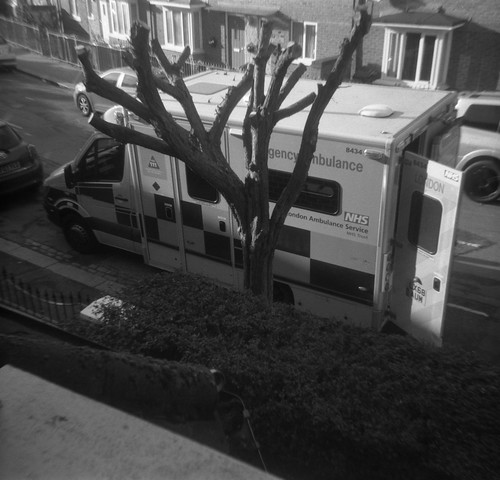
The lens displays all the classic aberrations one would expect from a plastic meniscus: the above image, from my first roll through the camera, does have some camera shake, but also clearly evident is pincushion distortion, seen in the verticals. Without camera shake, the lens is moderately sharp in the centre, but this falls off quickly towards the sides and corners. I haven't used colour film with the camera, but no doubt some chromatic aberration would be seen. Also discernible is astigmatism and coma, flare, and in a few shots what looks like internal reflections, despite the matte paint. Given the limitations of the lens, it's quite understandable that there would be a version of the camera which only used the central portion of the image in the guise of the Coronet Rapier. The fact that the Coronet 6-6 uses medium format film is somewhat negated by the qualities of the lens: unlike a Kodak Brownie (and there are simple box cameras with much better lenses), for example, here the larger negative format is lost on the poor definition of much of the image.

Coronet 6-6 with Fomapan 400
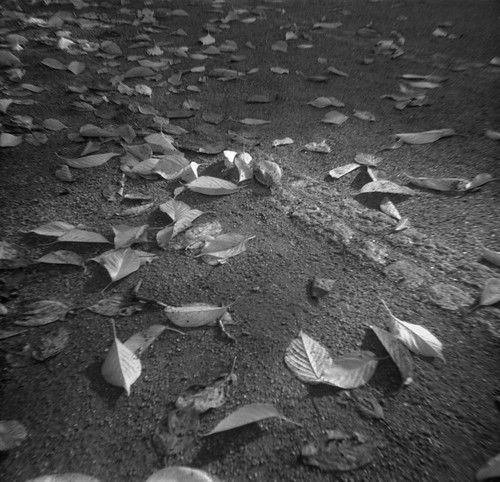
Being aware of the limitations of the Coronet 6-6 meant I sought out subjects and compositions where these limitations either didn't matter, were less obvious, or even added something to the image. With the photograph above, some vignetting, and falling off of definition helps with the sense of depth recession, enhancing the concentration on the lit leaves in the middle of the frame. I also tended to avoid any compositions with clearly rectilinear subjects, choosing more oblique angles where appropriate.

Coronet 6-6 with Fomapan 400
Sometimes none of these approaches really worked, and the photographs that resulted were just unsatisfactory, despite whatever impulses made me press the shutter at the time; frequently, the wide angle of the lens, the lack of definition towards the edges and other aspects just produced images which had a distracting 'busyness' to them. However, the pleasure in using a simple point-and-shoot camera like the Coronet 6-6 largely resides in the fact that the operation of the camera is entirely about the subject and composition with no other concerns in the taking of the photograph.

Coronet 6-6 with Ilford HP5 Plus
Coronet 6-6 with Fomapan 400
Sources/further reading:
Coronet 6-6 on Camera-Wiki

Friday, 13 May 2016

Soho Cadet Model B

Soho Cadet Model B
The materials that cameras have been made from has evolved to suit the technology of image production as it has developed historically. The first cameras were hand built largely from wood, with relatively small volumes of production. With increasing popularity and ease of use, other materials were needed: cardboard for cameras like the cheap Kodak Brownies, metal for smaller, more precise formats which could be cast and machined and produced in greater numbers. Plastic first appeared as a material for camera production in the 1920s (although celluloid was already in use as a base for photographic emulsion itself in the earliest flexible films); notably with the Rajar No. 6, a Bakelite strut-folder made in 1929. Of the early plastics, Bakelite was well suited to camera construction, being easy to mould but hard and rigid once set, and can be drilled and cut. The Rajar No. 6 produced a number of imitators in the 1930s, and, as a material, Bakelite seems to embody Art Deco modernity. However, as other plastics were developed better suited to the task, Bakelite quickly fell out of use for camera bodies, as well as for many other purposes.

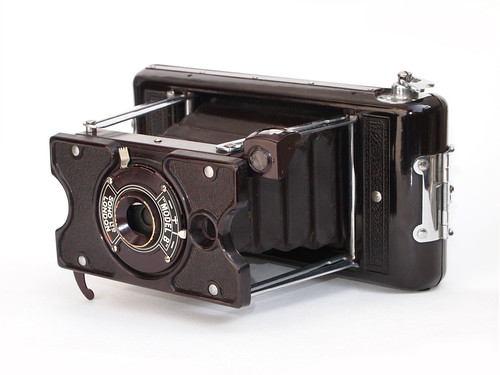
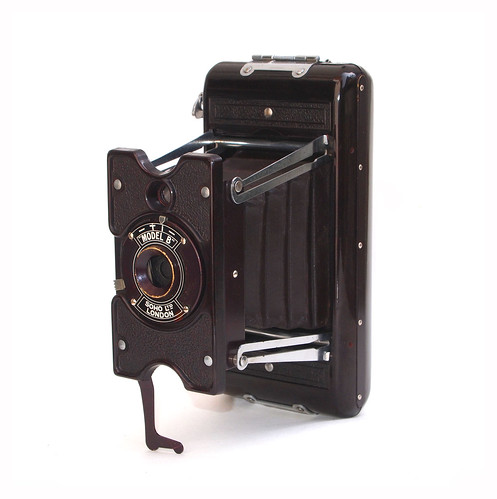
The Rajar camera was made by APM which had been formed by the merger of a number of companies largely concerned with the manufacture of film, plates and paper; APM was later split into APEM to continue this line, while cameras were made by Soho. The Soho Cadet Model B clearly owes much of its design to the Rajar No. 6, although it was ultimately derived from the Soho Cadet, a more traditional medium format folding-bed camera from 1930. The Early Photography website dates the Model B to 1931 (other sites give a date of c.1935); the camera itself does not use the name Cadet anywhere, marked simply "Model B" above the lens, but the front and back body sections (as well as some of the metal fixings) appear to be almost the same as those used in the original Cadet: a small amount of alteration may have been made to the Cadet mouldings for the Model B. Instead of the folding bed, the Model B is a strut-folding version with a lens panel not dissimilar to the Rajar No. 6. The back section of the body removes entirely for loading; inside the back is the statement: "Takes any standard film 2 1/4 x 3 1/4 inches or 6x9cms" with the same patent number as that inside the original Cadet (however, Red Bellows describes the Model B as having a different patent number inside). Incidentally, the Rajar camera uses medium format film, but with Rajar's own propriety spool, possibly making the description 'standard film' more apposite than it might at first seem. Frame advance is by red window and there is no pressure plate, which may affect film flatness. Some of the metal parts, such as the two pivoting stands for horizontal and vertical orientation are painted deep maroon to match the Bakelite body and front, the bellows also being maroon too; the remaining metal components are very brightly chromed.

Soho Cadet Model B opened for loading
The Model B has a fixed-focus lens unlike the original Cadet, which could be focussed by the position of the lens panel on the rails of the folding bed. The Cadet was also provided with a (limited) range of shutter and lens options; like the basic Cadet, the Model B has a meniscus lens in an everset shutter with 'I' for Instant and 'B' for Bulb: in bulb mode the shutter fires with the shutter lever tripped in both directions. Although not measured, I estimate that the shutter fires at about 1/40th - and it can sometimes be a little sluggish when the shutter lever is pressed in the down direction: it seems that gravity works against it when held in certain ways. From my rough measurements, the camera has a focal length of around 100mm, making the aperture about f14.

Soho Cadet Model B with vertical stand
My example of the Model B came in a job lot of cameras, and may have been the least interesting of them, but I did want to try it with film. I shot a couple of rolls of Fomapan 200, possibly a stop or two too fast for conditions with bright sunlight, the latitude of the film coped with this well enough. The camera uses a brilliant finder, but one of the smallest I've used, making it difficult to compose a shot. Held vertically, the finder is located directly above the lens behind the lens board, but pivots out through 90 degrees for horizontal shots. The results show all the shortcomings one might expect from a simple meniscus lens: vignetting, astigmatism, barrel distortion, and coma - as well as what appears to be some internal reflection.

Soho Cadet Model B with Fomapan 200
Interestingly, the lens' curvature of field aberration means that at the very edges of the frame near objects are more in focus: in the image above, the oblique fence recedes away from the lens into focus at the right - but at far left is also in focus. This effect can also seen in the image below in the bottom right. The Soho Cadet Model B is essentially a snapshot camera, no more sophisticated than contemporary box cameras and indeed with less user controls than many. The shortcomings of the lens are a little compensated for by the large image size: this was probably perfectly adequate for contact prints made from the negatives in the 1930s. Today, the camera is probably of more interest of collectors of Bakelite than the film photographer.

Soho Cadet Model B with Fomapan 200
Sources/further reading
Soho Cadet on Early Photography
Soho Cadet on Red Bellows
Soho on Camera Wiki
Marriotworld's The Bakelite Story